1
Reinforced Concrete
Structures 1 - Eurocodes
RCS 1
Professor Marwan SADEK
https://www.researchgate.net/profile/Marwan_Sadek
https://fr.slideshare.net/marwansadek00
Email : marwansadek00@gmail.com
If you detect any mistakes, please let me know at : marwansadek00@gmail.com
2
RCS1
M. SADEK
Ch 1 : Generalities – Reinforced concrete in practice
Ch 2 : Evolution of the standards – Limit states
Ch 3 : Mechanical Characteristics of materials – Constitutive
relations
Ch 4 : Durability and Cover
Ch 5 : Beam under simple bending – Ultimate limit state ULS
Ch 6 : Beam under simple bending – serviceability limit state SLS
Ch 7 : Section subjected to pure tension
3
Selected References
French BAEL Code (91, 99)
 Règles BAEL 91 modifiées 99, Règles techniques de conception et de calcul des
ouvrages et constructions en béton armé, Eyrolles, 2000.
 J. Perchat (2000), Maîtrise du BAEL 91 et des DTU associés, Eyrolles, 2000.
 J.P. Mougin (2000), BAEL 91 modifié 99 et DTU associés, Eyrolles, 2000.
 ….
EUROCODES
 H. Thonier (2013), Le projet de béton armé, 7ème édition, SEBTP, 2013.
 Jean-Armand Calgaro, Paolo Formichi ( 2013) Calcul des actions sur les
bâtiments selon l'Eurocode 1 , Le moniteur, 2013.
 J. M. Paillé (2009), Calcul des structures en béton, Eyrolles- AFNOR, 2009.
 Jean Perchat (2013), Traité de béton armé Selon l'Eurocode 2, Le moniteur,
2013 (2ème édition)
 Manual for the design of concrete building structures to Eurocode 2, The
Institution of Structural Engineers, BCA, 2006.
 A. J. Bond (2006), How to Design Concrete Structures using Eurocode 2, The
concrete centre, BCA, 2006.
https://usingeurocodes.com/
M. SADEK
4
In addition to Eurocodes, the references that are mainly
used to prepare this course material are :
 Thonier 2013
 Perchat 2013
 Paillé 2009
Some figures and formulas are taken from
 Cours de S. Multon - BETON ARME Eurocode 2 (available on internet)
 Cours béton armé de Christian Albouy
M. SADEK
5
Chapter V
Beam under simple bending – Ultimate limit
state ULS
1. Introduction
2. Design Assumptions
3. Rectangular Section without compression Steel
4. Rectangular Section with compression Steel
5. T Section
6. Particular rules
6
M. SADEK
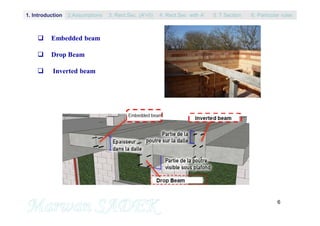
 Embedded beam
 Drop Beam
 Inverted beam
1. Introduction 3. Rect.Sec. (A’=0) 5. T Section2.Assumptions 4. Rect.Sec with A’ 6. Particular rules
7
M. SADEK
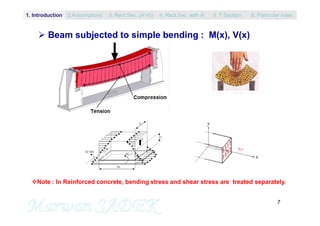
 Beam subjected to simple bending : M(x), V(x)
Note : In Reinforced concrete, bending stress and shear stress are treated separately.
1. Introduction 3. Rect.Sec. (A’=0) 5. T Section2.Assumptions 4. Rect.Sec with A’ 6. Particular rules
8
M. SADEK
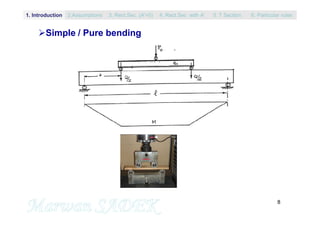
Simple / Pure bending
1. Introduction 3. Rect.Sec. (A’=0) 5. T Section2.Assumptions 4. Rect.Sec with A’ 6. Particular rules
9
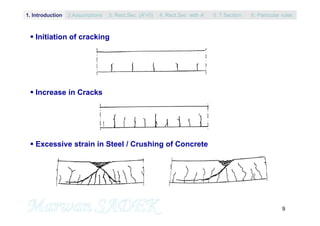
 Initiation of cracking
 Increase in Cracks
 Excessive strain in Steel / Crushing of Concrete
1. Introduction 3. Rect.Sec. (A’=0) 5. T Section2.Assumptions 4. Rect.Sec with A’ 6. Particular rules
10
M. SADEK
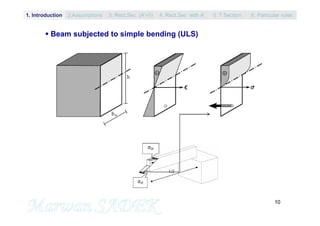
 Beam subjected to simple bending (ULS)
1. Introduction 3. Rect.Sec. (A’=0) 5. T Section2.Assumptions 4. Rect.Sec with A’ 6. Particular rules
11
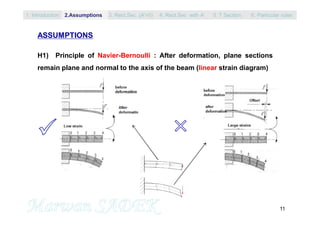
ASSUMPTIONS
H1) Principle of Navier-Bernoulli : After deformation, plane sections
remain plane and normal to the axis of the beam (linear strain diagram)
1. Introduction 3. Rect.Sec. (A’=0) 5. T Section2.Assumptions 4. Rect.Sec with A’ 6. Particular rules
12
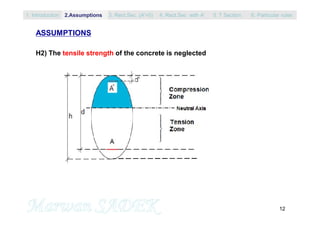
ASSUMPTIONS
H2) The tensile strength of the concrete is neglected
1. Introduction 3. Rect.Sec. (A’=0) 5. T Section2.Assumptions 4. Rect.Sec with A’ 6. Particular rules
13
ASSUMPTIONS
H3) bundled bars are treated as a single bar of a diameter derived
from the equivalent total area and placed at the COG of the group
H4) Total bond between concrete and steel (no relative slip)
at the contact : s=c
H5) The design stress-strain diagram for the concrete and the steel
are :
1. Introduction 3. Rect.Sec. (A’=0) 5. T Section2.Assumptions 4. Rect.Sec with A’ 6. Particular rules
14
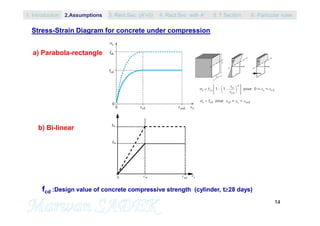
Stress-Strain Diagram for concrete under compression
a) Parabola-rectangle
b) Bi-linear
fcd :Design value of concrete compressive strength (cylinder, t28 days)
1. Introduction 3. Rect.Sec. (A’=0) 5. T Section2.Assumptions 4. Rect.Sec with A’ 6. Particular rules
15
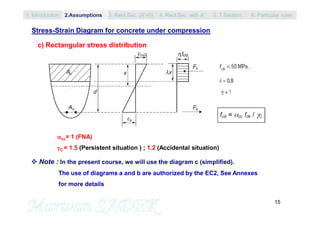
c) Rectangular stress distribution
 Note : In the present course, we will use the diagram c (simplified).
The use of diagrams a and b are authorized by the EC2, See Annexes
for more details
cc= 1 (FNA)
C = 1.5 (Persistent situation ) ; 1.2 (Accidental situation)
Stress-Strain Diagram for concrete under compression
1. Introduction 3. Rect.Sec. (A’=0) 5. T Section2.Assumptions 4. Rect.Sec with A’ 6. Particular rules
16
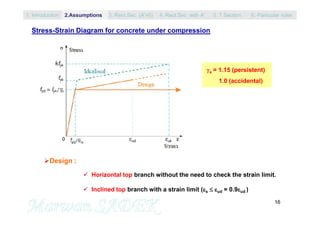
Design :
 Horizontal top branch without the need to check the strain limit.
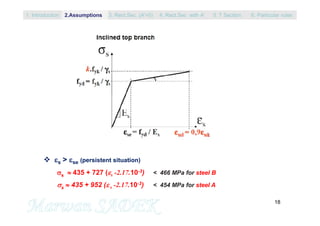
 Inclined top branch with a strain limit (s  ud = 0.9ud )
s = 1.15 (persistent)
1.0 (accidental)
Stress-Strain Diagram for concrete under compression
1. Introduction 3. Rect.Sec. (A’=0) 5. T Section2.Assumptions 4. Rect.Sec with A’ 6. Particular rules
17
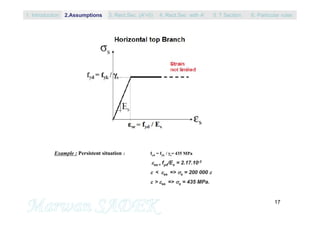
Example : Persistent situation : fyd = fyk / s= 435 MPa
se = fyd/Es = 2.17.10-3
 < se => s = 200 000 
 > se => s = 435 MPa.
1. Introduction 3. Rect.Sec. (A’=0) 5. T Section2.Assumptions 4. Rect.Sec with A’ 6. Particular rules
18
 s > se (persistent situation)
s  435 + 727 (s -2.17.10-3) < 466 MPa for steel B
s  435 + 952 ( s -2.17.10-3) < 454 MPa for steel A
1. Introduction 3. Rect.Sec. (A’=0) 5. T Section2.Assumptions 4. Rect.Sec with A’ 6. Particular rules
19
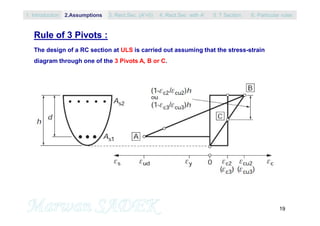
Rule of 3 Pivots :
The design of a RC section at ULS is carried out assuming that the stress-strain
diagram through one of the 3 Pivots A, B or C.
1. Introduction 3. Rect.Sec. (A’=0) 5. T Section2.Assumptions 4. Rect.Sec with A’ 6. Particular rules
20
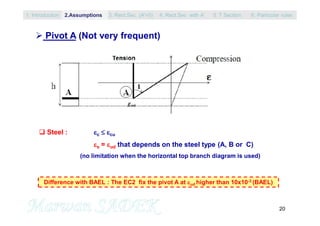
 Pivot A (Not very frequent)
 Steel : c  cu
s = ud that depends on the steel type (A, B or C)
(no limitation when the horizontal top branch diagram is used)
Difference with BAEL : The EC2 fix the pivot A at ud higher than 10x10-3 (BAEL)
1. Introduction 3. Rect.Sec. (A’=0) 5. T Section2.Assumptions 4. Rect.Sec with A’ 6. Particular rules
21
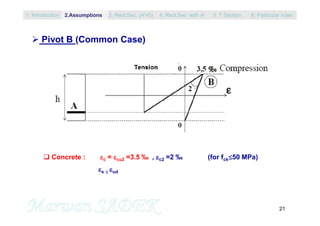
 Pivot B (Common Case)
 Concrete : c = cu2 =3.5 ‰ , c2 =2 ‰ (for fck50 MPa)
s  ud
1. Introduction 3. Rect.Sec. (A’=0) 5. T Section2.Assumptions 4. Rect.Sec with A’ 6. Particular rules
22
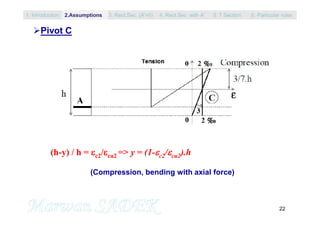
Pivot C
(h-y) / h = c2/cu2 => y = (1-c2/cu2).h
(Compression, bending with axial force)
1. Introduction 3. Rect.Sec. (A’=0) 5. T Section2.Assumptions 4. Rect.Sec with A’ 6. Particular rules
23
Simple Bending, ULS
1. Introduction 3. Rect.Sec. (A’=0) 5. T Section2.Assumptions 4. Rect.Sec with A’ 6. Particular rules
24
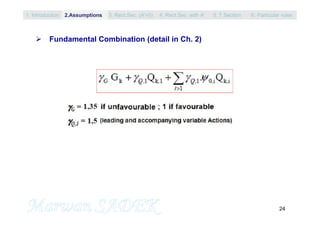
 Fundamental Combination (detail in Ch. 2)
1. Introduction 3. Rect.Sec. (A’=0) 5. T Section2.Assumptions 4. Rect.Sec with A’ 6. Particular rules
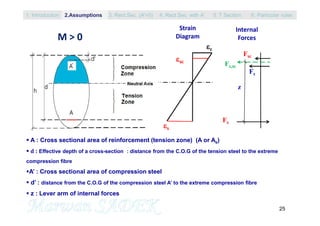
25
c
s
sc
Strain
Diagram
Internal
Forces
Fc,sc
Fsc
Fc
Fs
z
 A : Cross sectional area of reinforcement (tension zone) (A or As)
 d : Effective depth of a cross-section : distance from the C.O.G of the tension steel to the extreme
compression fibre
A’ : Cross sectional area of compression steel
 d’ : distance from the C.O.G of the compression steel A’ to the extreme compression fibre
 z : Lever arm of internal forces
M > 0
1. Introduction 3. Rect.Sec. (A’=0) 5. T Section2.Assumptions 4. Rect.Sec with A’ 6. Particular rules
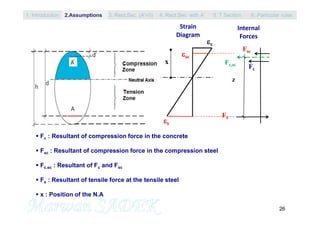
26
 Fc : Resultant of compression force in the concrete
 Fsc : Resultant of compression force in the compression steel
 Fc,sc : Resultant of Fc and Fsc
 Fs : Resultant of tensile force at the tensile steel
 x : Position of the N.A
c
s
sc
Strain
Diagram
Internal
Forces
x Fc,sc
Fsc
Fc
Fs
z
1. Introduction 3. Rect.Sec. (A’=0) 5. T Section2.Assumptions 4. Rect.Sec with A’ 6. Particular rules
27
c
s
sc
x Fc,sc
Fsc
Fc
Fs
z
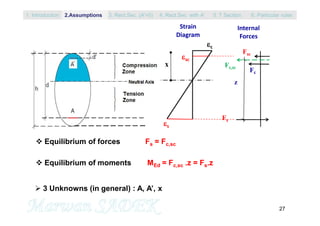
 Equilibrium of forces Fs = Fc,sc
 Equilibrium of moments MEd = Fc,sc .z = Fs.z
 3 Unknowns (in general) : A, A’, x
Strain
Diagram
Internal
Forces
1. Introduction 3. Rect.Sec. (A’=0) 5. T Section2.Assumptions 4. Rect.Sec with A’ 6. Particular rules
28
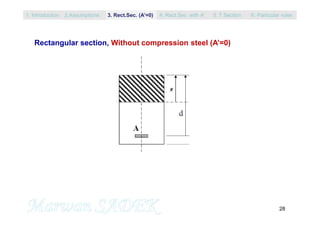
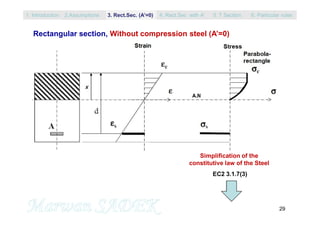
Rectangular section, Without compression steel (A’=0)
1. Introduction 3. Rect.Sec. (A’=0) 5. T Section2.Assumptions 4. Rect.Sec with A’ 6. Particular rules
29
Simplification of the
constitutive law of the Steel
EC2 3.1.7(3)
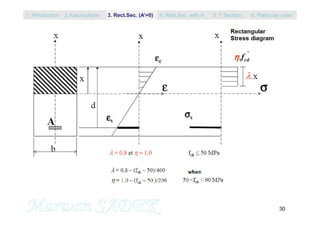
Rectangular section, Without compression steel (A’=0)
1. Introduction 3. Rect.Sec. (A’=0) 5. T Section2.Assumptions 4. Rect.Sec with A’ 6. Particular rules
30
1. Introduction 3. Rect.Sec. (A’=0) 5. T Section2.Assumptions 4. Rect.Sec with A’ 6. Particular rules
31
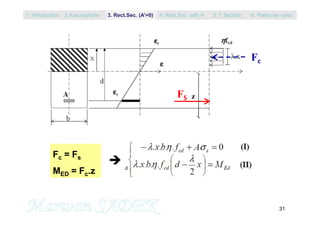
Fc
FS
Fc = Fs
MED = Fc.z
z
1. Introduction 3. Rect.Sec. (A’=0) 5. T Section2.Assumptions 4. Rect.Sec with A’ 6. Particular rules
32
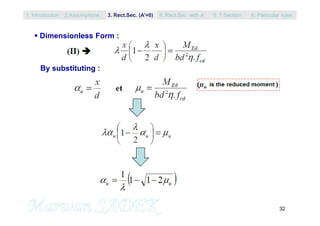
 Dimensionless Form :
By substituting :
1. Introduction 3. Rect.Sec. (A’=0) 5. T Section2.Assumptions 4. Rect.Sec with A’ 6. Particular rules
33
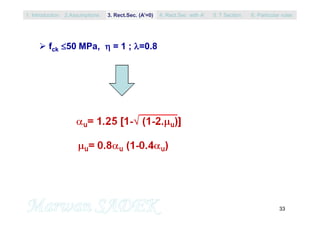
 fck 50 MPa,  = 1 ; =0.8
1. Introduction 3. Rect.Sec. (A’=0) 5. T Section2.Assumptions 4. Rect.Sec with A’ 6. Particular rules
34
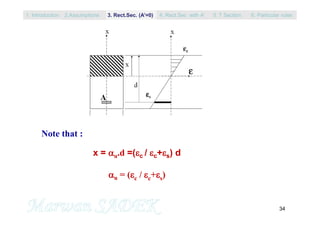
Note that :
x = u.d =(c / c+s) d
u = (c / c+s)
1. Introduction 3. Rect.Sec. (A’=0) 5. T Section2.Assumptions 4. Rect.Sec with A’ 6. Particular rules
35
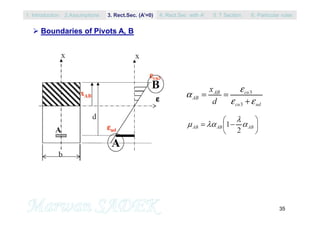
 Boundaries of Pivots A, B
1. Introduction 3. Rect.Sec. (A’=0) 5. T Section2.Assumptions 4. Rect.Sec with A’ 6. Particular rules
36
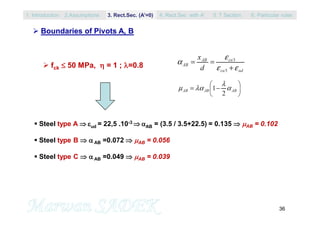
 Steel type A  ud = 22,5 .10-3  AB = (3.5 / 3.5+22.5) = 0.135  AB = 0.102
 Steel type B   AB =0.072  AB = 0.056
 Steel type C   AB =0.049  AB = 0.039
 fck  50 MPa,  = 1 ; =0.8
 Boundaries of Pivots A, B
1. Introduction 3. Rect.Sec. (A’=0) 5. T Section2.Assumptions 4. Rect.Sec with A’ 6. Particular rules
37
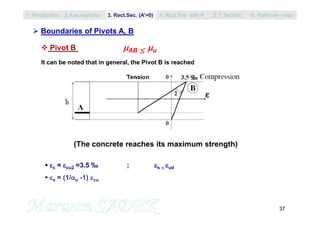
 Pivot B AB  u
It can be noted that in general, the Pivot B is reached
 c = cu2 =3.5 ‰ ; s  ud
 s = (1/u -1) cu
(The concrete reaches its maximum strength)
 Boundaries of Pivots A, B
1. Introduction 3. Rect.Sec. (A’=0) 5. T Section2.Assumptions 4. Rect.Sec with A’ 6. Particular rules
38
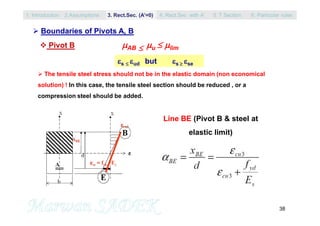
 Pivot B AB  u  lim
 The tensile steel stress should not be in the elastic domain (non economical
solution) ! In this case, the tensile steel section should be reduced , or a
compression steel should be added.
s  ud but s  se
Line BE (Pivot B & steel at
elastic limit)
 Boundaries of Pivots A, B
1. Introduction 3. Rect.Sec. (A’=0) 5. T Section2.Assumptions 4. Rect.Sec with A’ 6. Particular rules
39
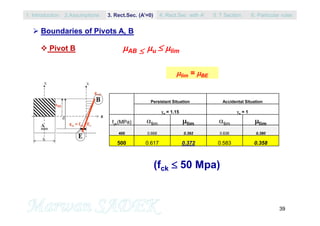
(fck  50 Mpa)
Persistant Situation Accidental Situation
s = 1.15 s = 1
fyk(MPa) lim lim lim lim
400 0.668 0.392 0.636 0.380
500 0.617 0.372 0.583 0.358
lim = BE
 Pivot B AB  u  lim
 Boundaries of Pivots A, B
1. Introduction 3. Rect.Sec. (A’=0) 5. T Section2.Assumptions 4. Rect.Sec with A’ 6. Particular rules
40
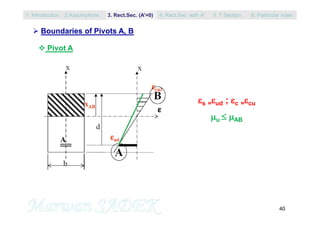
 Pivot A
s =ud ; c =cu
u  AB
 Boundaries of Pivots A, B
1. Introduction 3. Rect.Sec. (A’=0) 5. T Section2.Assumptions 4. Rect.Sec with A’ 6. Particular rules
41
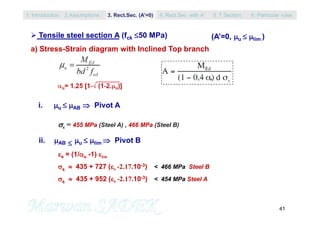
 Tensile steel section A (fck 50 MPa)
a) Stress-Strain diagram with Inclined Top branch
i. u  AB  Pivot A
s = 455 MPa (Steel A) , 466 MPa (Steel B)
ii. AB  u  lim  Pivot B
s = (1/u -1) cu
s  435 + 727 (s -2.17.10-3) < 466 MPa Steel B
s  435 + 952 (s -2.17.10-3) < 454 MPa Steel A
(A’=0, u  lim )
1. Introduction 3. Rect.Sec. (A’=0) 5. T Section2.Assumptions 4. Rect.Sec with A’ 6. Particular rules
42
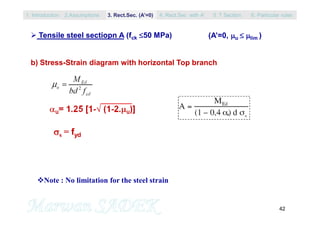
 Tensile steel sectiopn A (fck 50 MPa)
b) Stress-Strain diagram with horizontal Top branch
(A’=0, u  lim )
s = fyd
Note : No limitation for the steel strain
1. Introduction 3. Rect.Sec. (A’=0) 5. T Section2.Assumptions 4. Rect.Sec with A’ 6. Particular rules
43
Note 1
 Effective depth d – Initial value dini
 The exact value of d could not be determined before the choice of the steel
reinforcement.
 Take d  0.9 h for common beams (this formula is not safe for embedded beam
and for slab with low thickness  20 cm)
Take d = h – cnom – 1 cm (Slab with a thickness  20 cm )
After the determination of the reinforcement, it becomes possible to calculate the
exact value of d=dreal. If dreal < dini , the steel reinforcement section As should be
recalculated.
1. Introduction 3. Rect.Sec. (A’=0) 5. T Section2.Assumptions 4. Rect.Sec with A’ 6. Particular rules
44
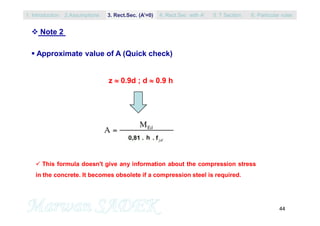
 Note 2
 Approximate value of A (Quick check)
z  0.9d ; d  0.9 h
 This formula doesn't give any information about the compression stress
in the concrete. It becomes obsolete if a compression steel is required.
1. Introduction 3. Rect.Sec. (A’=0) 5. T Section2.Assumptions 4. Rect.Sec with A’ 6. Particular rules
45
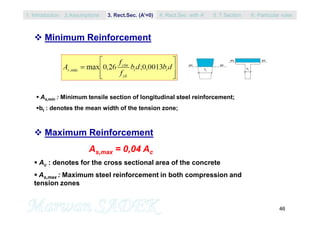
 Minimum Reinforcement (to prevent brittle failure)
 For rectangular section bh, the ultimate resistant bending moment of Non-
reinforced concrete :
MRc = (I/v)  fctm = (b.h²/6)  fctm
 The minimum As,min section should resist the following moment
MRs = As,min  fyk  z
 By considering MRc = MRs , and substituting z  0.9 d ; h d / 0.9
As,min = b.d.[fctm/(0.9  0.81  6)fyk]  0.23 b d fctm / fyk
 L’EC2 replace the value of 0.23 by 0.26 and fix a lower limit of the quantity 0.26 fctm/fyk
with the value 0.0013
1. Introduction 3. Rect.Sec. (A’=0) 5. T Section2.Assumptions 4. Rect.Sec with A’ 6. Particular rules
46
 Minimum Reinforcement
 Maximum Reinforcement
As,max = 0,04 Ac
 Ac : denotes for the cross sectional area of the concrete
 As,max : Maximum steel reinforcement in both compression and
tension zones
 As,min : Minimum tensile section of longitudinal steel reinforcement;
bt : denotes the mean width of the tension zone;
1. Introduction 3. Rect.Sec. (A’=0) 5. T Section2.Assumptions 4. Rect.Sec with A’ 6. Particular rules
47
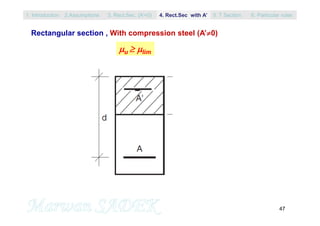
Rectangular section , With compression steel (A’0)
u  lim
1. Introduction 3. Rect.Sec. (A’=0) 5. T Section2.Assumptions 4. Rect.Sec with A’ 6. Particular rules
48
 3 unknowns (A, A’, x) / 2 equations ???
 Infinite number of solutions
 Possibility n°1 : Minimum of “A+ A’ " (long run)
 Possibility n°2 : Concept of limit Moment (adopted in general)
- Resolution by the decomposition method - 2 imaginary sections
u  lim
Rectangular section , With compression steel (A’0)
1. Introduction 3. Rect.Sec. (A’=0) 5. T Section2.Assumptions 4. Rect.Sec with A’ 6. Particular rules
49
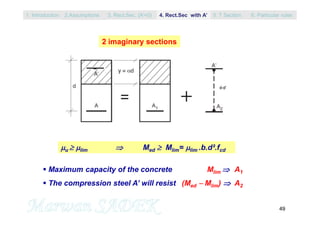
2 imaginary sections
 Maximum capacity of the concrete Mlim  A1
 The compression steel A’ will resist (Med  Mlim)  A2
u  lim  Med  Mlim= lim .b.d².fcd
1. Introduction 3. Rect.Sec. (A’=0) 5. T Section2.Assumptions 4. Rect.Sec with A’ 6. Particular rules
50
cu
s
sc
x=lim.d
d’
d
A1 = Mlim / (1 – 0.4.lim).d.fyd
A’ = (Med – Mlim) / [sc . (d-d’)]
sc = 3,5.10-3. (1-d’/xlim)
 The value of sc is close to 3 °/°° (>se), in other terms sc=fyd when using the diagram
with horizontal top branch, and a value slightly great than fyd when using the diagram
with inclined top branch.
 In general, we take a value sc=fyd .
A2 = A’. sc / s = A’. fyd / s
1. Introduction 3. Rect.Sec. (A’=0) 5. T Section2.Assumptions 4. Rect.Sec with A’ 6. Particular rules
51
A1 = Mlim / [(1 – 0.4.lim).d.fyd]
A2 = A’. sc / s
A’ = (Med – Mlim) / [fyd . (d-d’)]
 When using same types and grade for A and A’  sc = s = fyd
 A2 = A’
A = A1 + A2
1. Introduction 3. Rect.Sec. (A’=0) 5. T Section2.Assumptions 4. Rect.Sec with A’ 6. Particular rules
52
 Note 1 : The EC2 don’t restrict the moment that could be supported by
the compression steel like the previous BAEL standard (40% Med).
However A’ is limited by the maximum requirement
A+A’  As,max = 0,04 Ac
 Note 2 : Any compression longitudinal reinforcement (diameter )
which is included in the resistance calculation should be held by
transverse reinforcement with spacing not greater than 15 .
1. Introduction 3. Rect.Sec. (A’=0) 5. T Section2.Assumptions 4. Rect.Sec with A’ 6. Particular rules
53
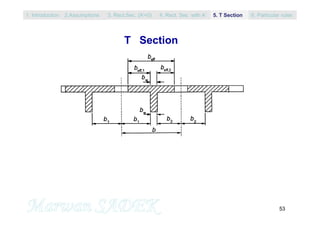
T Section
1. Introduction 3. Rect.Sec. (A’=0) 5. T Section2.Assumptions 4. Rect. Sec with A’ 6. Particular rules
54
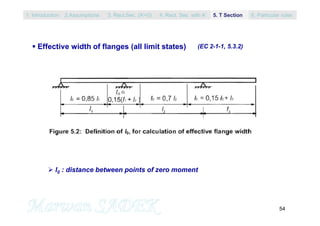
 Effective width of flanges (all limit states)
 l0 : distance between points of zero moment
(EC 2-1-1, 5.3.2)
1. Introduction 3. Rect.Sec. (A’=0) 5. T Section2.Assumptions 4. Rect. Sec with A’ 6. Particular rules
55
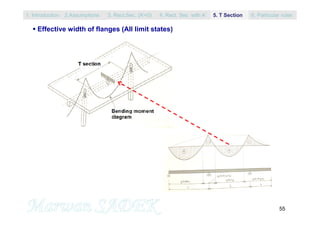
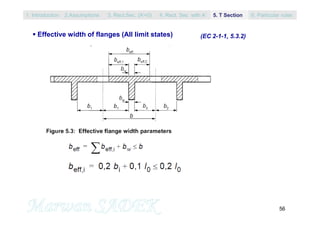
 Effective width of flanges (All limit states)
1. Introduction 3. Rect.Sec. (A’=0) 5. T Section2.Assumptions 4. Rect. Sec with A’ 6. Particular rules
56
(EC 2-1-1, 5.3.2) Effective width of flanges (All limit states)
1. Introduction 3. Rect.Sec. (A’=0) 5. T Section2.Assumptions 4. Rect. Sec with A’ 6. Particular rules
57
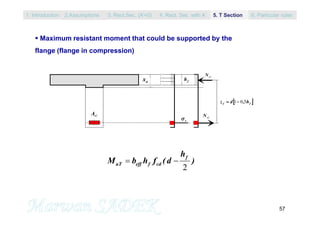
 Maximum resistant moment that could be supported by the
flange (flange in compression)
2
f
uT eff f cd
h
M b h f (d ) 
1sA
ux fh
s 1sN
1cN
 ff h,dz 501
1. Introduction 3. Rect.Sec. (A’=0) 5. T Section2.Assumptions 4. Rect. Sec with A’ 6. Particular rules
58
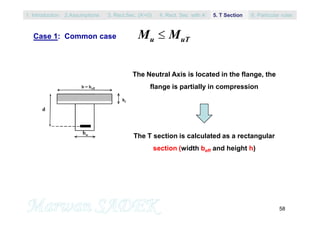
Case 1: Common case M Mu uT
bw
b = beff
d
hf
The Neutral Axis is located in the flange, the
flange is partially in compression
The T section is calculated as a rectangular
section (width beff and height h)
1. Introduction 3. Rect.Sec. (A’=0) 5. T Section2.Assumptions 4. Rect. Sec with A’ 6. Particular rules
59
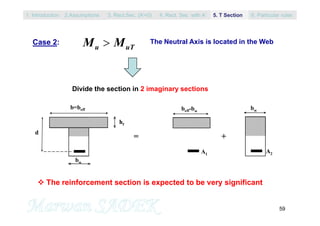
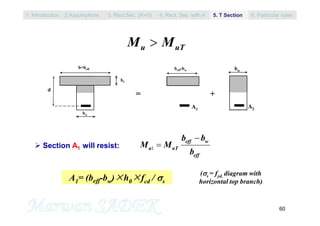
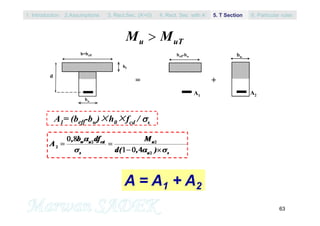
Case 2: The Neutral Axis is located in the WebM Mu uT
Divide the section in 2 imaginary sections
 The reinforcement section is expected to be very significant
bw
b=beff
d
hf
=
beff-bw
A1
A2
bw
+
1. Introduction 3. Rect.Sec. (A’=0) 5. T Section2.Assumptions 4. Rect. Sec with A’ 6. Particular rules
60
M Mu uT
1
eff w
u uT
eff
b b
M M
b

 Section A1 will resist:
bw
b=beff
d
hf
=
beff-bw
A1
A2
bw
+
A1= (beff-bw)×h0×fcd / s
(s = fyd, diagram with
horizontal top branch)
1. Introduction 3. Rect.Sec. (A’=0) 5. T Section2.Assumptions 4. Rect. Sec with A’ 6. Particular rules
61
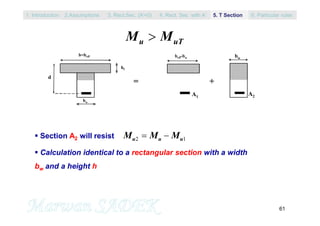
M Mu uT
 Section A2 will resist
 Calculation identical to a rectangular section with a width
bw and a height h
bw
b=beff
d
hf
=
beff-bw
A1
A2
bw
+
M M Mu u u2 1 
1. Introduction 3. Rect.Sec. (A’=0) 5. T Section2.Assumptions 4. Rect. Sec with A’ 6. Particular rules
62
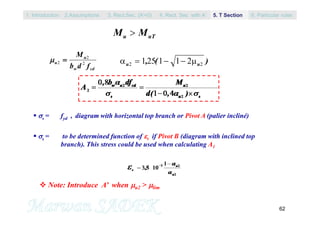
M Mu uT
 s = fyd , diagram with horizontal top branch or Pivot A (palier incliné)
 s = to be determined function of s if Pivot B (diagram with inclined top
branch). This stress could be used when calculating A1
cdw
u
u
fdb
M
2
2
2   u u2 2125 1 1 2  , ( )
 Note: Introduce A’ whenu2 > lim
1. Introduction 3. Rect.Sec. (A’=0) 5. T Section2.Assumptions 4. Rect. Sec with A’ 6. Particular rules
63
M Mu uT
bw
b=beff
d
hf
=
beff-bw
A1
A2
bw
+
A = A1 + A2
A1= (beff-bw)×h0×fcd / s
1. Introduction 3. Rect.Sec. (A’=0) 5. T Section2.Assumptions 4. Rect. Sec with A’ 6. Particular rules
64
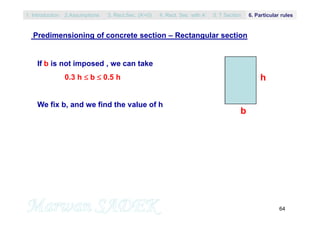
Predimensioning of concrete section – Rectangular section
b
h
If b is not imposed , we can take
0.3 h  b  0.5 h
We fix b, and we find the value of h
1. Introduction 3. Rect.Sec. (A’=0) 5. T Section2.Assumptions 4. Rect. Sec with A’ 6. Particular rules
65
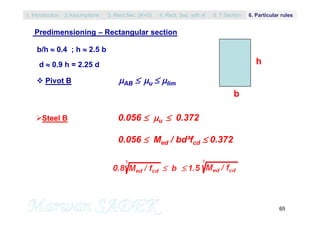
b
h
b/h  0.4 ; h  2.5 b
d  0.9 h = 2.25 d
 Pivot B AB  u  lim
Steel B 0.056  u  0.372
0.056  Med / bd²fcd  0.372
Predimensioning – Rectangular section
1. Introduction 3. Rect.Sec. (A’=0) 5. T Section2.Assumptions 4. Rect. Sec with A’ 6. Particular rules
66
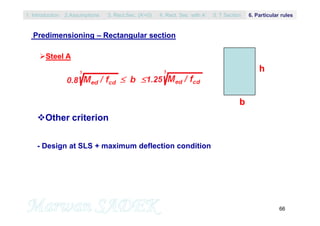
b
h
Other criterion
- Design at SLS + maximum deflection condition
Steel A
Predimensioning – Rectangular section
1. Introduction 3. Rect.Sec. (A’=0) 5. T Section2.Assumptions 4. Rect. Sec with A’ 6. Particular rules
67
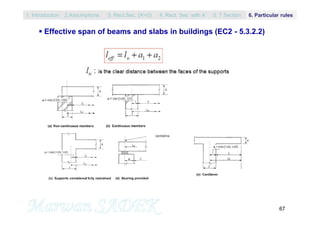
 Effective span of beams and slabs in buildings (EC2 - 5.3.2.2)
1. Introduction 3. Rect.Sec. (A’=0) 5. T Section2.Assumptions 4. Rect. Sec with A’ 6. Particular rules
68
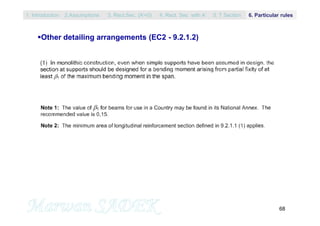
Other detailing arrangements (EC2 - 9.2.1.2)
1. Introduction 3. Rect.Sec. (A’=0) 5. T Section2.Assumptions 4. Rect. Sec with A’ 6. Particular rules
69
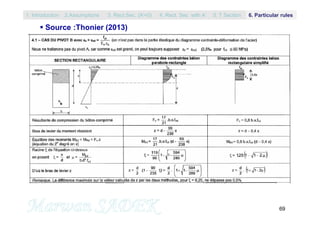
 Source :Thonier (2013)
1. Introduction 3. Rect.Sec. (A’=0) 5. T Section2.Assumptions 4. Rect. Sec with A’ 6. Particular rules
70
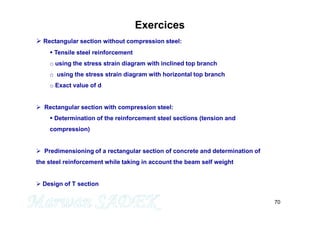
Exercices
 Rectangular section without compression steel:
 Tensile steel reinforcement
o using the stress strain diagram with inclined top branch
o using the stress strain diagram with horizontal top branch
o Exact value of d
 Rectangular section with compression steel:
 Determination of the reinforcement steel sections (tension and
compression)
 Predimensioning of a rectangular section of concrete and determination of
the steel reinforcement while taking in account the beam self weight
 Design of T section

Rcs1-Chapter5-ULS

  • 1.
    1 Reinforced Concrete Structures 1- Eurocodes RCS 1 Professor Marwan SADEK https://www.researchgate.net/profile/Marwan_Sadek https://fr.slideshare.net/marwansadek00 Email : marwansadek00@gmail.com If you detect any mistakes, please let me know at : marwansadek00@gmail.com
  • 2.
    2 RCS1 M. SADEK Ch 1: Generalities – Reinforced concrete in practice Ch 2 : Evolution of the standards – Limit states Ch 3 : Mechanical Characteristics of materials – Constitutive relations Ch 4 : Durability and Cover Ch 5 : Beam under simple bending – Ultimate limit state ULS Ch 6 : Beam under simple bending – serviceability limit state SLS Ch 7 : Section subjected to pure tension
  • 3.
    3 Selected References French BAELCode (91, 99)  Règles BAEL 91 modifiées 99, Règles techniques de conception et de calcul des ouvrages et constructions en béton armé, Eyrolles, 2000.  J. Perchat (2000), Maîtrise du BAEL 91 et des DTU associés, Eyrolles, 2000.  J.P. Mougin (2000), BAEL 91 modifié 99 et DTU associés, Eyrolles, 2000.  …. EUROCODES  H. Thonier (2013), Le projet de béton armé, 7ème édition, SEBTP, 2013.  Jean-Armand Calgaro, Paolo Formichi ( 2013) Calcul des actions sur les bâtiments selon l'Eurocode 1 , Le moniteur, 2013.  J. M. Paillé (2009), Calcul des structures en béton, Eyrolles- AFNOR, 2009.  Jean Perchat (2013), Traité de béton armé Selon l'Eurocode 2, Le moniteur, 2013 (2ème édition)  Manual for the design of concrete building structures to Eurocode 2, The Institution of Structural Engineers, BCA, 2006.  A. J. Bond (2006), How to Design Concrete Structures using Eurocode 2, The concrete centre, BCA, 2006. https://usingeurocodes.com/ M. SADEK
  • 4.
    4 In addition toEurocodes, the references that are mainly used to prepare this course material are :  Thonier 2013  Perchat 2013  Paillé 2009 Some figures and formulas are taken from  Cours de S. Multon - BETON ARME Eurocode 2 (available on internet)  Cours béton armé de Christian Albouy M. SADEK
  • 5.
    5 Chapter V Beam undersimple bending – Ultimate limit state ULS 1. Introduction 2. Design Assumptions 3. Rectangular Section without compression Steel 4. Rectangular Section with compression Steel 5. T Section 6. Particular rules
  • 6.
    6 M. SADEK  Embeddedbeam  Drop Beam  Inverted beam 1. Introduction 3. Rect.Sec. (A’=0) 5. T Section2.Assumptions 4. Rect.Sec with A’ 6. Particular rules
  • 7.
    7 M. SADEK  Beamsubjected to simple bending : M(x), V(x) Note : In Reinforced concrete, bending stress and shear stress are treated separately. 1. Introduction 3. Rect.Sec. (A’=0) 5. T Section2.Assumptions 4. Rect.Sec with A’ 6. Particular rules
  • 8.
    8 M. SADEK Simple /Pure bending 1. Introduction 3. Rect.Sec. (A’=0) 5. T Section2.Assumptions 4. Rect.Sec with A’ 6. Particular rules
  • 9.
    9  Initiation ofcracking  Increase in Cracks  Excessive strain in Steel / Crushing of Concrete 1. Introduction 3. Rect.Sec. (A’=0) 5. T Section2.Assumptions 4. Rect.Sec with A’ 6. Particular rules
  • 10.
    10 M. SADEK  Beamsubjected to simple bending (ULS) 1. Introduction 3. Rect.Sec. (A’=0) 5. T Section2.Assumptions 4. Rect.Sec with A’ 6. Particular rules
  • 11.
    11 ASSUMPTIONS H1) Principle ofNavier-Bernoulli : After deformation, plane sections remain plane and normal to the axis of the beam (linear strain diagram) 1. Introduction 3. Rect.Sec. (A’=0) 5. T Section2.Assumptions 4. Rect.Sec with A’ 6. Particular rules
  • 12.
    12 ASSUMPTIONS H2) The tensilestrength of the concrete is neglected 1. Introduction 3. Rect.Sec. (A’=0) 5. T Section2.Assumptions 4. Rect.Sec with A’ 6. Particular rules
  • 13.
    13 ASSUMPTIONS H3) bundled barsare treated as a single bar of a diameter derived from the equivalent total area and placed at the COG of the group H4) Total bond between concrete and steel (no relative slip) at the contact : s=c H5) The design stress-strain diagram for the concrete and the steel are : 1. Introduction 3. Rect.Sec. (A’=0) 5. T Section2.Assumptions 4. Rect.Sec with A’ 6. Particular rules
  • 14.
    14 Stress-Strain Diagram forconcrete under compression a) Parabola-rectangle b) Bi-linear fcd :Design value of concrete compressive strength (cylinder, t28 days) 1. Introduction 3. Rect.Sec. (A’=0) 5. T Section2.Assumptions 4. Rect.Sec with A’ 6. Particular rules
  • 15.
    15 c) Rectangular stressdistribution  Note : In the present course, we will use the diagram c (simplified). The use of diagrams a and b are authorized by the EC2, See Annexes for more details cc= 1 (FNA) C = 1.5 (Persistent situation ) ; 1.2 (Accidental situation) Stress-Strain Diagram for concrete under compression 1. Introduction 3. Rect.Sec. (A’=0) 5. T Section2.Assumptions 4. Rect.Sec with A’ 6. Particular rules
  • 16.
    16 Design :  Horizontaltop branch without the need to check the strain limit.  Inclined top branch with a strain limit (s  ud = 0.9ud ) s = 1.15 (persistent) 1.0 (accidental) Stress-Strain Diagram for concrete under compression 1. Introduction 3. Rect.Sec. (A’=0) 5. T Section2.Assumptions 4. Rect.Sec with A’ 6. Particular rules
  • 17.
    17 Example : Persistentsituation : fyd = fyk / s= 435 MPa se = fyd/Es = 2.17.10-3  < se => s = 200 000   > se => s = 435 MPa. 1. Introduction 3. Rect.Sec. (A’=0) 5. T Section2.Assumptions 4. Rect.Sec with A’ 6. Particular rules
  • 18.
    18  s >se (persistent situation) s  435 + 727 (s -2.17.10-3) < 466 MPa for steel B s  435 + 952 ( s -2.17.10-3) < 454 MPa for steel A 1. Introduction 3. Rect.Sec. (A’=0) 5. T Section2.Assumptions 4. Rect.Sec with A’ 6. Particular rules
  • 19.
    19 Rule of 3Pivots : The design of a RC section at ULS is carried out assuming that the stress-strain diagram through one of the 3 Pivots A, B or C. 1. Introduction 3. Rect.Sec. (A’=0) 5. T Section2.Assumptions 4. Rect.Sec with A’ 6. Particular rules
  • 20.
    20  Pivot A(Not very frequent)  Steel : c  cu s = ud that depends on the steel type (A, B or C) (no limitation when the horizontal top branch diagram is used) Difference with BAEL : The EC2 fix the pivot A at ud higher than 10x10-3 (BAEL) 1. Introduction 3. Rect.Sec. (A’=0) 5. T Section2.Assumptions 4. Rect.Sec with A’ 6. Particular rules
  • 21.
    21  Pivot B(Common Case)  Concrete : c = cu2 =3.5 ‰ , c2 =2 ‰ (for fck50 MPa) s  ud 1. Introduction 3. Rect.Sec. (A’=0) 5. T Section2.Assumptions 4. Rect.Sec with A’ 6. Particular rules
  • 22.
    22 Pivot C (h-y) /h = c2/cu2 => y = (1-c2/cu2).h (Compression, bending with axial force) 1. Introduction 3. Rect.Sec. (A’=0) 5. T Section2.Assumptions 4. Rect.Sec with A’ 6. Particular rules
  • 23.
    23 Simple Bending, ULS 1.Introduction 3. Rect.Sec. (A’=0) 5. T Section2.Assumptions 4. Rect.Sec with A’ 6. Particular rules
  • 24.
    24  Fundamental Combination(detail in Ch. 2) 1. Introduction 3. Rect.Sec. (A’=0) 5. T Section2.Assumptions 4. Rect.Sec with A’ 6. Particular rules
  • 25.
    25 c s sc Strain Diagram Internal Forces Fc,sc Fsc Fc Fs z  A :Cross sectional area of reinforcement (tension zone) (A or As)  d : Effective depth of a cross-section : distance from the C.O.G of the tension steel to the extreme compression fibre A’ : Cross sectional area of compression steel  d’ : distance from the C.O.G of the compression steel A’ to the extreme compression fibre  z : Lever arm of internal forces M > 0 1. Introduction 3. Rect.Sec. (A’=0) 5. T Section2.Assumptions 4. Rect.Sec with A’ 6. Particular rules
  • 26.
    26  Fc :Resultant of compression force in the concrete  Fsc : Resultant of compression force in the compression steel  Fc,sc : Resultant of Fc and Fsc  Fs : Resultant of tensile force at the tensile steel  x : Position of the N.A c s sc Strain Diagram Internal Forces x Fc,sc Fsc Fc Fs z 1. Introduction 3. Rect.Sec. (A’=0) 5. T Section2.Assumptions 4. Rect.Sec with A’ 6. Particular rules
  • 27.
    27 c s sc x Fc,sc Fsc Fc Fs z  Equilibriumof forces Fs = Fc,sc  Equilibrium of moments MEd = Fc,sc .z = Fs.z  3 Unknowns (in general) : A, A’, x Strain Diagram Internal Forces 1. Introduction 3. Rect.Sec. (A’=0) 5. T Section2.Assumptions 4. Rect.Sec with A’ 6. Particular rules
  • 28.
    28 Rectangular section, Withoutcompression steel (A’=0) 1. Introduction 3. Rect.Sec. (A’=0) 5. T Section2.Assumptions 4. Rect.Sec with A’ 6. Particular rules
  • 29.
    29 Simplification of the constitutivelaw of the Steel EC2 3.1.7(3) Rectangular section, Without compression steel (A’=0) 1. Introduction 3. Rect.Sec. (A’=0) 5. T Section2.Assumptions 4. Rect.Sec with A’ 6. Particular rules
  • 30.
    30 1. Introduction 3.Rect.Sec. (A’=0) 5. T Section2.Assumptions 4. Rect.Sec with A’ 6. Particular rules
  • 31.
    31 Fc FS Fc = Fs MED= Fc.z z 1. Introduction 3. Rect.Sec. (A’=0) 5. T Section2.Assumptions 4. Rect.Sec with A’ 6. Particular rules
  • 32.
    32  Dimensionless Form: By substituting : 1. Introduction 3. Rect.Sec. (A’=0) 5. T Section2.Assumptions 4. Rect.Sec with A’ 6. Particular rules
  • 33.
    33  fck 50MPa,  = 1 ; =0.8 1. Introduction 3. Rect.Sec. (A’=0) 5. T Section2.Assumptions 4. Rect.Sec with A’ 6. Particular rules
  • 34.
    34 Note that : x= u.d =(c / c+s) d u = (c / c+s) 1. Introduction 3. Rect.Sec. (A’=0) 5. T Section2.Assumptions 4. Rect.Sec with A’ 6. Particular rules
  • 35.
    35  Boundaries ofPivots A, B 1. Introduction 3. Rect.Sec. (A’=0) 5. T Section2.Assumptions 4. Rect.Sec with A’ 6. Particular rules
  • 36.
    36  Steel typeA  ud = 22,5 .10-3  AB = (3.5 / 3.5+22.5) = 0.135  AB = 0.102  Steel type B   AB =0.072  AB = 0.056  Steel type C   AB =0.049  AB = 0.039  fck  50 MPa,  = 1 ; =0.8  Boundaries of Pivots A, B 1. Introduction 3. Rect.Sec. (A’=0) 5. T Section2.Assumptions 4. Rect.Sec with A’ 6. Particular rules
  • 37.
    37  Pivot BAB  u It can be noted that in general, the Pivot B is reached  c = cu2 =3.5 ‰ ; s  ud  s = (1/u -1) cu (The concrete reaches its maximum strength)  Boundaries of Pivots A, B 1. Introduction 3. Rect.Sec. (A’=0) 5. T Section2.Assumptions 4. Rect.Sec with A’ 6. Particular rules
  • 38.
    38  Pivot BAB  u  lim  The tensile steel stress should not be in the elastic domain (non economical solution) ! In this case, the tensile steel section should be reduced , or a compression steel should be added. s  ud but s  se Line BE (Pivot B & steel at elastic limit)  Boundaries of Pivots A, B 1. Introduction 3. Rect.Sec. (A’=0) 5. T Section2.Assumptions 4. Rect.Sec with A’ 6. Particular rules
  • 39.
    39 (fck  50Mpa) Persistant Situation Accidental Situation s = 1.15 s = 1 fyk(MPa) lim lim lim lim 400 0.668 0.392 0.636 0.380 500 0.617 0.372 0.583 0.358 lim = BE  Pivot B AB  u  lim  Boundaries of Pivots A, B 1. Introduction 3. Rect.Sec. (A’=0) 5. T Section2.Assumptions 4. Rect.Sec with A’ 6. Particular rules
  • 40.
    40  Pivot A s=ud ; c =cu u  AB  Boundaries of Pivots A, B 1. Introduction 3. Rect.Sec. (A’=0) 5. T Section2.Assumptions 4. Rect.Sec with A’ 6. Particular rules
  • 41.
    41  Tensile steelsection A (fck 50 MPa) a) Stress-Strain diagram with Inclined Top branch i. u  AB  Pivot A s = 455 MPa (Steel A) , 466 MPa (Steel B) ii. AB  u  lim  Pivot B s = (1/u -1) cu s  435 + 727 (s -2.17.10-3) < 466 MPa Steel B s  435 + 952 (s -2.17.10-3) < 454 MPa Steel A (A’=0, u  lim ) 1. Introduction 3. Rect.Sec. (A’=0) 5. T Section2.Assumptions 4. Rect.Sec with A’ 6. Particular rules
  • 42.
    42  Tensile steelsectiopn A (fck 50 MPa) b) Stress-Strain diagram with horizontal Top branch (A’=0, u  lim ) s = fyd Note : No limitation for the steel strain 1. Introduction 3. Rect.Sec. (A’=0) 5. T Section2.Assumptions 4. Rect.Sec with A’ 6. Particular rules
  • 43.
    43 Note 1  Effectivedepth d – Initial value dini  The exact value of d could not be determined before the choice of the steel reinforcement.  Take d  0.9 h for common beams (this formula is not safe for embedded beam and for slab with low thickness  20 cm) Take d = h – cnom – 1 cm (Slab with a thickness  20 cm ) After the determination of the reinforcement, it becomes possible to calculate the exact value of d=dreal. If dreal < dini , the steel reinforcement section As should be recalculated. 1. Introduction 3. Rect.Sec. (A’=0) 5. T Section2.Assumptions 4. Rect.Sec with A’ 6. Particular rules
  • 44.
    44  Note 2 Approximate value of A (Quick check) z  0.9d ; d  0.9 h  This formula doesn't give any information about the compression stress in the concrete. It becomes obsolete if a compression steel is required. 1. Introduction 3. Rect.Sec. (A’=0) 5. T Section2.Assumptions 4. Rect.Sec with A’ 6. Particular rules
  • 45.
    45  Minimum Reinforcement(to prevent brittle failure)  For rectangular section bh, the ultimate resistant bending moment of Non- reinforced concrete : MRc = (I/v)  fctm = (b.h²/6)  fctm  The minimum As,min section should resist the following moment MRs = As,min  fyk  z  By considering MRc = MRs , and substituting z  0.9 d ; h d / 0.9 As,min = b.d.[fctm/(0.9  0.81  6)fyk]  0.23 b d fctm / fyk  L’EC2 replace the value of 0.23 by 0.26 and fix a lower limit of the quantity 0.26 fctm/fyk with the value 0.0013 1. Introduction 3. Rect.Sec. (A’=0) 5. T Section2.Assumptions 4. Rect.Sec with A’ 6. Particular rules
  • 46.
    46  Minimum Reinforcement Maximum Reinforcement As,max = 0,04 Ac  Ac : denotes for the cross sectional area of the concrete  As,max : Maximum steel reinforcement in both compression and tension zones  As,min : Minimum tensile section of longitudinal steel reinforcement; bt : denotes the mean width of the tension zone; 1. Introduction 3. Rect.Sec. (A’=0) 5. T Section2.Assumptions 4. Rect.Sec with A’ 6. Particular rules
  • 47.
    47 Rectangular section ,With compression steel (A’0) u  lim 1. Introduction 3. Rect.Sec. (A’=0) 5. T Section2.Assumptions 4. Rect.Sec with A’ 6. Particular rules
  • 48.
    48  3 unknowns(A, A’, x) / 2 equations ???  Infinite number of solutions  Possibility n°1 : Minimum of “A+ A’ " (long run)  Possibility n°2 : Concept of limit Moment (adopted in general) - Resolution by the decomposition method - 2 imaginary sections u  lim Rectangular section , With compression steel (A’0) 1. Introduction 3. Rect.Sec. (A’=0) 5. T Section2.Assumptions 4. Rect.Sec with A’ 6. Particular rules
  • 49.
    49 2 imaginary sections Maximum capacity of the concrete Mlim  A1  The compression steel A’ will resist (Med  Mlim)  A2 u  lim  Med  Mlim= lim .b.d².fcd 1. Introduction 3. Rect.Sec. (A’=0) 5. T Section2.Assumptions 4. Rect.Sec with A’ 6. Particular rules
  • 50.
    50 cu s sc x=lim.d d’ d A1 = Mlim/ (1 – 0.4.lim).d.fyd A’ = (Med – Mlim) / [sc . (d-d’)] sc = 3,5.10-3. (1-d’/xlim)  The value of sc is close to 3 °/°° (>se), in other terms sc=fyd when using the diagram with horizontal top branch, and a value slightly great than fyd when using the diagram with inclined top branch.  In general, we take a value sc=fyd . A2 = A’. sc / s = A’. fyd / s 1. Introduction 3. Rect.Sec. (A’=0) 5. T Section2.Assumptions 4. Rect.Sec with A’ 6. Particular rules
  • 51.
    51 A1 = Mlim/ [(1 – 0.4.lim).d.fyd] A2 = A’. sc / s A’ = (Med – Mlim) / [fyd . (d-d’)]  When using same types and grade for A and A’  sc = s = fyd  A2 = A’ A = A1 + A2 1. Introduction 3. Rect.Sec. (A’=0) 5. T Section2.Assumptions 4. Rect.Sec with A’ 6. Particular rules
  • 52.
    52  Note 1: The EC2 don’t restrict the moment that could be supported by the compression steel like the previous BAEL standard (40% Med). However A’ is limited by the maximum requirement A+A’  As,max = 0,04 Ac  Note 2 : Any compression longitudinal reinforcement (diameter ) which is included in the resistance calculation should be held by transverse reinforcement with spacing not greater than 15 . 1. Introduction 3. Rect.Sec. (A’=0) 5. T Section2.Assumptions 4. Rect.Sec with A’ 6. Particular rules
  • 53.
    53 T Section 1. Introduction3. Rect.Sec. (A’=0) 5. T Section2.Assumptions 4. Rect. Sec with A’ 6. Particular rules
  • 54.
    54  Effective widthof flanges (all limit states)  l0 : distance between points of zero moment (EC 2-1-1, 5.3.2) 1. Introduction 3. Rect.Sec. (A’=0) 5. T Section2.Assumptions 4. Rect. Sec with A’ 6. Particular rules
  • 55.
    55  Effective widthof flanges (All limit states) 1. Introduction 3. Rect.Sec. (A’=0) 5. T Section2.Assumptions 4. Rect. Sec with A’ 6. Particular rules
  • 56.
    56 (EC 2-1-1, 5.3.2)Effective width of flanges (All limit states) 1. Introduction 3. Rect.Sec. (A’=0) 5. T Section2.Assumptions 4. Rect. Sec with A’ 6. Particular rules
  • 57.
    57  Maximum resistantmoment that could be supported by the flange (flange in compression) 2 f uT eff f cd h M b h f (d )  1sA ux fh s 1sN 1cN  ff h,dz 501 1. Introduction 3. Rect.Sec. (A’=0) 5. T Section2.Assumptions 4. Rect. Sec with A’ 6. Particular rules
  • 58.
    58 Case 1: Commoncase M Mu uT bw b = beff d hf The Neutral Axis is located in the flange, the flange is partially in compression The T section is calculated as a rectangular section (width beff and height h) 1. Introduction 3. Rect.Sec. (A’=0) 5. T Section2.Assumptions 4. Rect. Sec with A’ 6. Particular rules
  • 59.
    59 Case 2: TheNeutral Axis is located in the WebM Mu uT Divide the section in 2 imaginary sections  The reinforcement section is expected to be very significant bw b=beff d hf = beff-bw A1 A2 bw + 1. Introduction 3. Rect.Sec. (A’=0) 5. T Section2.Assumptions 4. Rect. Sec with A’ 6. Particular rules
  • 60.
    60 M Mu uT 1 effw u uT eff b b M M b   Section A1 will resist: bw b=beff d hf = beff-bw A1 A2 bw + A1= (beff-bw)×h0×fcd / s (s = fyd, diagram with horizontal top branch) 1. Introduction 3. Rect.Sec. (A’=0) 5. T Section2.Assumptions 4. Rect. Sec with A’ 6. Particular rules
  • 61.
    61 M Mu uT Section A2 will resist  Calculation identical to a rectangular section with a width bw and a height h bw b=beff d hf = beff-bw A1 A2 bw + M M Mu u u2 1  1. Introduction 3. Rect.Sec. (A’=0) 5. T Section2.Assumptions 4. Rect. Sec with A’ 6. Particular rules
  • 62.
    62 M Mu uT s = fyd , diagram with horizontal top branch or Pivot A (palier incliné)  s = to be determined function of s if Pivot B (diagram with inclined top branch). This stress could be used when calculating A1 cdw u u fdb M 2 2 2   u u2 2125 1 1 2  , ( )  Note: Introduce A’ whenu2 > lim 1. Introduction 3. Rect.Sec. (A’=0) 5. T Section2.Assumptions 4. Rect. Sec with A’ 6. Particular rules
  • 63.
    63 M Mu uT bw b=beff d hf = beff-bw A1 A2 bw + A= A1 + A2 A1= (beff-bw)×h0×fcd / s 1. Introduction 3. Rect.Sec. (A’=0) 5. T Section2.Assumptions 4. Rect. Sec with A’ 6. Particular rules
  • 64.
    64 Predimensioning of concretesection – Rectangular section b h If b is not imposed , we can take 0.3 h  b  0.5 h We fix b, and we find the value of h 1. Introduction 3. Rect.Sec. (A’=0) 5. T Section2.Assumptions 4. Rect. Sec with A’ 6. Particular rules
  • 65.
    65 b h b/h  0.4; h  2.5 b d  0.9 h = 2.25 d  Pivot B AB  u  lim Steel B 0.056  u  0.372 0.056  Med / bd²fcd  0.372 Predimensioning – Rectangular section 1. Introduction 3. Rect.Sec. (A’=0) 5. T Section2.Assumptions 4. Rect. Sec with A’ 6. Particular rules
  • 66.
    66 b h Other criterion - Designat SLS + maximum deflection condition Steel A Predimensioning – Rectangular section 1. Introduction 3. Rect.Sec. (A’=0) 5. T Section2.Assumptions 4. Rect. Sec with A’ 6. Particular rules
  • 67.
    67  Effective spanof beams and slabs in buildings (EC2 - 5.3.2.2) 1. Introduction 3. Rect.Sec. (A’=0) 5. T Section2.Assumptions 4. Rect. Sec with A’ 6. Particular rules
  • 68.
    68 Other detailing arrangements(EC2 - 9.2.1.2) 1. Introduction 3. Rect.Sec. (A’=0) 5. T Section2.Assumptions 4. Rect. Sec with A’ 6. Particular rules
  • 69.
    69  Source :Thonier(2013) 1. Introduction 3. Rect.Sec. (A’=0) 5. T Section2.Assumptions 4. Rect. Sec with A’ 6. Particular rules
  • 70.
    70 Exercices  Rectangular sectionwithout compression steel:  Tensile steel reinforcement o using the stress strain diagram with inclined top branch o using the stress strain diagram with horizontal top branch o Exact value of d  Rectangular section with compression steel:  Determination of the reinforcement steel sections (tension and compression)  Predimensioning of a rectangular section of concrete and determination of the steel reinforcement while taking in account the beam self weight  Design of T section