Analysis & Design of
Reinforced Concrete Structures (1) Lecture.2 Materials
13
Dr. Muthanna Adil Najm
Concrete:
In the design of concrete mixes, three principal requirements for concrete are of
importance:
 Quality of concrete is measured by its strength and durability. The principal
factors affecting the strength of concrete , assuming a sound aggregates,
W/C ratio, and the extent to which hydration has progressed. Durability of
concrete is the ability of the concrete to resist disintegration due to freezing
and thawing and chemical attack.
 Workability of concrete may be defined as a composite characteristic
indicative of the ease with which the mass of plastic material may deposited
in its final place without segregation during placement, and its ability to
conform to fine forming detail.
 Economical takes into account effective use of materials, effective
operation, and ease of handling. The cost of producing good quality
concrete is an important consideration in the overall cost of the construction
project.
Concrete Mixing and Proportioning:
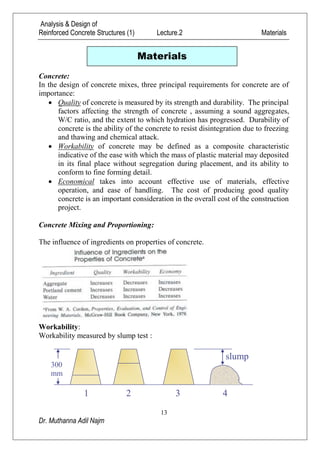
The influence of ingredients on properties of concrete.
Workability:
Workability measured by slump test :
1 2 3 4
300
mm
slump
300
mm
Materials
Analysis & Design of
Reinforced Concrete Structures (1) Lecture.2 Materials
14
Dr. Muthanna Adil Najm
1. Layer 1: Fill 1/3 full. 25 stokes
2. Layer 2: Fill 2/3 full. 25 stokes
3. Layer 3: Fill full. 25 stokes
4. Lift cone and measure slump (typically 5-15 cm.)
Slump test - The measurement of the consistency of the mix is done with the
slump-cone test. The recommend consistency for various classes of concrete
structures .
Admixtures:
 Applications:
 Improve workability
 Accelerate or retard setting and hardening
 Aid in curing
 Improve durability
Air-Entrainment: Add air voids with bubbles
 Help with freeze/thaw cycles, workability, etc.
 Decreases density: reduces strength, but also decreases W/C
Superplasticizers: increase workability by chemically releasing water from
fine aggregates.
Types of Cement:
 Type I: General Purpose
 Type II: Lower heat of hydration than Type I
 Type III: High Early Strength
Higher heat of hydration quicker strength (7 days vs. 28 days for Type I)
 Type IV: Low Heat of Hydration
Gradually heats up, less distortion (massive structures).
 Type V: Sulfate Resisting
For footings, basements, sewers, etc. exposed to soils with sulfates.
Failure Mechanism of Concrete:
Analysis & Design of
Reinforced Concrete Structures (1) Lecture.2 Materials
15
Dr. Muthanna Adil Najm
1- Shrinkage Microcracks: are the initial shrinkage cracks due to carbonation
shrinkage, hydration shrinkage, and drying shrinkage.
2- Bond Microcracks: are extensions of shrinkage microcracks, as the compression
stress field increases, the shrinkage microcracks widen but do not propagates into
the matrix. Occur at 15-20 % ultimate strength of concrete.
3- Matrix Microcracks: are microcracks that occur in the matrix. The propagate
from 20% fc. Occur up to 30-45 % ultimate strength of concrete. Matrix
microcracks start bridge one another at 75%. Aggregate microcracks occur just
before failure (90%).
Concrete Properties:
1- Uniaxial Stress versus Strain Behavior in Compression:
Analysis & Design of
Reinforced Concrete Structures (1) Lecture.2 Materials
16
Dr. Muthanna Adil Najm
The standard strength test generally uses a cylindrical sample. It is tested after 28
days to test for strength, fc. The concrete will continue to harden with time and for
a normal Portland cement will increase with time as follows:
1- Compressive Strength, f'c: Normally use 28-day strength for design strength
2- Poisson’s Ratio, n: n ≈ 0.15 to 0.20 Usually use n = 0.17
3- Modulus of Elasticity, Ec: Corresponds to secant modulus at 0.45 f’c
The ACI 318-05 (Sec. 8.5.1): use this equation for concrete modulus of elasticity
for unit concrete weight of 1440 kg/m3
< wc < 2480 kg/m3
ccc fwE  5.1
043.0 in MPa
For normal weight concrete Ec shall be permitted to be taken as:
cc fE  4700 in MPa
4- Concrete strain at max. compressive stress, εo
 For typical ε curves in compression
 εo varies between 0.0015-0.003
 For normal strength concrete, εo ≈ 0.002
5- Maximum useable strain, εu
 ACI Code: εu = 0.003
 Used for flexural and axial compression
Typical Concrete Stress-Strain Curves in Compression
cε
cE
oε uε
c0.45f’
cf
cf’ 12”
6”
Analysis & Design of
Reinforced Concrete Structures (1) Lecture.2 Materials
17
Dr. Muthanna Adil Najm
Types of compression failure:
There are three modes of failure.
1. Under axial compression concrete fails in shear.
2. The separation of the specimen into columnar pieces by what is known as
splitting or columnar fracture.
3. Combination of shear and splitting failure.
2- Tensile Strength:
 Tensile strength ≈ 8 % to 15 % of f'c
 Modulus of Rupture, fr
For deflection calculations, use:
cr ff  62.0 ACI Eq. 9-10 (ACI 318-05 sec. 9.5.2.3)
Analysis & Design of
Reinforced Concrete Structures (1) Lecture.2 Materials
18
Dr. Muthanna Adil Najm
Test:
 Splitting Tensile Strength, fct
 Split Cylinder Test (Not given in ACI Code)
3. Shrinkage and Creep:
Shrinkage: Due to water loss to atmosphere (volume loss).
 Plastic shrinkage: occurs while concrete is still “wet” (hot day, flat work, etc.)
 Drying shrinkage: occurs after concrete has set
 Most shrinkage occurs in first few months (~80% within one year).
 Cycles of shrinking and swelling may occur as environment changes.
 Reinforcement restrains the development of shrinkage.
Shrinkage is a function of :
 W/C ratio (high water content reduces amount of aggregate which restrains
shrinkage)
 Aggregate type & content (modulus of Elasticity)
 Volume/Surface Ratio
 Type of cement (finely ground…)
 Admixtures
 Relative humidity (largest for relative humidity of 40% or less).
 Typical magnitude of strain: (200 to 600) * 10-6 or (200 to 600 microstrain)
Creep:
 Deformations (strains) under sustained loads.
P
Concrete Cylinder
Poisson’s
Effect
ld
P
fct

2

P
rf
= P/2*amaxM
unreinforced
concrete beam
2
6
bh
M
I
Mc
fr 
Analysis & Design of
Reinforced Concrete Structures (1) Lecture.2 Materials
19
Dr. Muthanna Adil Najm
 Like shrinkage, creep is not completely reversible.
 Magnitude of creep strain is a function of all the above that affect shrinkage,
plus
 magnitude of stress
 age at loading
 Creep strain develops over time…
 Absorbed water layers tend to become thinner between gel particles that are
transmitting compressive stresses
 Bonds form between gel particles in their deformed position.
Steel Reinforcement:
1. General:
 Standard Reinforcing Bar Markings
 Most common types for non-prestressed members:
Analysis & Design of
Reinforced Concrete Structures (1) Lecture.2 Materials
20
Dr. Muthanna Adil Najm
 hot-rolled deformed bars
 welded wire fabric
 Areas, Weights, Dimensions
Standard inch-pound
bars × in





8
1 Soft metric bars
mm
# 3
# 4
# 5
# 10
# 12
# 16
# 6
# 7
# 8
# 19
# 22
# 25
Analysis & Design of
Reinforced Concrete Structures (1) Lecture.2 Materials
21
Dr. Muthanna Adil Najm
# 9
# 10
# 11
# 29
# 32
# 36
# 14
# 18
# 43
# 57
2. Types:
ASTM A615 - Standard Specification for Deformed and Plain-Billet Steel Bars
 Grade 60: fy = 60 ksi = 420 MPa, #3 to #18: Most common in buildings and
bridges
 Grade 40: fy = 40 ksi = 280 MPa, #3 to #6: Most ductile
 Grade 75: fy = 75 ksi = 520 MPa, #6 to #18 : Less used in building.
3. Stress versus Strain
Stress-Strain curve for various types of steel reinforcement bar.
Es = Initial tangent modulus = 29,000 ksi = 200 MPa(all grades)
Note: GR40 has a longer yield plateau

Lec.2 materials

  • 1.
    Analysis & Designof Reinforced Concrete Structures (1) Lecture.2 Materials 13 Dr. Muthanna Adil Najm Concrete: In the design of concrete mixes, three principal requirements for concrete are of importance:  Quality of concrete is measured by its strength and durability. The principal factors affecting the strength of concrete , assuming a sound aggregates, W/C ratio, and the extent to which hydration has progressed. Durability of concrete is the ability of the concrete to resist disintegration due to freezing and thawing and chemical attack.  Workability of concrete may be defined as a composite characteristic indicative of the ease with which the mass of plastic material may deposited in its final place without segregation during placement, and its ability to conform to fine forming detail.  Economical takes into account effective use of materials, effective operation, and ease of handling. The cost of producing good quality concrete is an important consideration in the overall cost of the construction project. Concrete Mixing and Proportioning: The influence of ingredients on properties of concrete. Workability: Workability measured by slump test : 1 2 3 4 300 mm slump 300 mm Materials
  • 2.
    Analysis & Designof Reinforced Concrete Structures (1) Lecture.2 Materials 14 Dr. Muthanna Adil Najm 1. Layer 1: Fill 1/3 full. 25 stokes 2. Layer 2: Fill 2/3 full. 25 stokes 3. Layer 3: Fill full. 25 stokes 4. Lift cone and measure slump (typically 5-15 cm.) Slump test - The measurement of the consistency of the mix is done with the slump-cone test. The recommend consistency for various classes of concrete structures . Admixtures:  Applications:  Improve workability  Accelerate or retard setting and hardening  Aid in curing  Improve durability Air-Entrainment: Add air voids with bubbles  Help with freeze/thaw cycles, workability, etc.  Decreases density: reduces strength, but also decreases W/C Superplasticizers: increase workability by chemically releasing water from fine aggregates. Types of Cement:  Type I: General Purpose  Type II: Lower heat of hydration than Type I  Type III: High Early Strength Higher heat of hydration quicker strength (7 days vs. 28 days for Type I)  Type IV: Low Heat of Hydration Gradually heats up, less distortion (massive structures).  Type V: Sulfate Resisting For footings, basements, sewers, etc. exposed to soils with sulfates. Failure Mechanism of Concrete:
  • 3.
    Analysis & Designof Reinforced Concrete Structures (1) Lecture.2 Materials 15 Dr. Muthanna Adil Najm 1- Shrinkage Microcracks: are the initial shrinkage cracks due to carbonation shrinkage, hydration shrinkage, and drying shrinkage. 2- Bond Microcracks: are extensions of shrinkage microcracks, as the compression stress field increases, the shrinkage microcracks widen but do not propagates into the matrix. Occur at 15-20 % ultimate strength of concrete. 3- Matrix Microcracks: are microcracks that occur in the matrix. The propagate from 20% fc. Occur up to 30-45 % ultimate strength of concrete. Matrix microcracks start bridge one another at 75%. Aggregate microcracks occur just before failure (90%). Concrete Properties: 1- Uniaxial Stress versus Strain Behavior in Compression:
  • 4.
    Analysis & Designof Reinforced Concrete Structures (1) Lecture.2 Materials 16 Dr. Muthanna Adil Najm The standard strength test generally uses a cylindrical sample. It is tested after 28 days to test for strength, fc. The concrete will continue to harden with time and for a normal Portland cement will increase with time as follows: 1- Compressive Strength, f'c: Normally use 28-day strength for design strength 2- Poisson’s Ratio, n: n ≈ 0.15 to 0.20 Usually use n = 0.17 3- Modulus of Elasticity, Ec: Corresponds to secant modulus at 0.45 f’c The ACI 318-05 (Sec. 8.5.1): use this equation for concrete modulus of elasticity for unit concrete weight of 1440 kg/m3 < wc < 2480 kg/m3 ccc fwE  5.1 043.0 in MPa For normal weight concrete Ec shall be permitted to be taken as: cc fE  4700 in MPa 4- Concrete strain at max. compressive stress, εo  For typical ε curves in compression  εo varies between 0.0015-0.003  For normal strength concrete, εo ≈ 0.002 5- Maximum useable strain, εu  ACI Code: εu = 0.003  Used for flexural and axial compression Typical Concrete Stress-Strain Curves in Compression cε cE oε uε c0.45f’ cf cf’ 12” 6”
  • 5.
    Analysis & Designof Reinforced Concrete Structures (1) Lecture.2 Materials 17 Dr. Muthanna Adil Najm Types of compression failure: There are three modes of failure. 1. Under axial compression concrete fails in shear. 2. The separation of the specimen into columnar pieces by what is known as splitting or columnar fracture. 3. Combination of shear and splitting failure. 2- Tensile Strength:  Tensile strength ≈ 8 % to 15 % of f'c  Modulus of Rupture, fr For deflection calculations, use: cr ff  62.0 ACI Eq. 9-10 (ACI 318-05 sec. 9.5.2.3)
  • 6.
    Analysis & Designof Reinforced Concrete Structures (1) Lecture.2 Materials 18 Dr. Muthanna Adil Najm Test:  Splitting Tensile Strength, fct  Split Cylinder Test (Not given in ACI Code) 3. Shrinkage and Creep: Shrinkage: Due to water loss to atmosphere (volume loss).  Plastic shrinkage: occurs while concrete is still “wet” (hot day, flat work, etc.)  Drying shrinkage: occurs after concrete has set  Most shrinkage occurs in first few months (~80% within one year).  Cycles of shrinking and swelling may occur as environment changes.  Reinforcement restrains the development of shrinkage. Shrinkage is a function of :  W/C ratio (high water content reduces amount of aggregate which restrains shrinkage)  Aggregate type & content (modulus of Elasticity)  Volume/Surface Ratio  Type of cement (finely ground…)  Admixtures  Relative humidity (largest for relative humidity of 40% or less).  Typical magnitude of strain: (200 to 600) * 10-6 or (200 to 600 microstrain) Creep:  Deformations (strains) under sustained loads. P Concrete Cylinder Poisson’s Effect ld P fct  2  P rf = P/2*amaxM unreinforced concrete beam 2 6 bh M I Mc fr 
  • 7.
    Analysis & Designof Reinforced Concrete Structures (1) Lecture.2 Materials 19 Dr. Muthanna Adil Najm  Like shrinkage, creep is not completely reversible.  Magnitude of creep strain is a function of all the above that affect shrinkage, plus  magnitude of stress  age at loading  Creep strain develops over time…  Absorbed water layers tend to become thinner between gel particles that are transmitting compressive stresses  Bonds form between gel particles in their deformed position. Steel Reinforcement: 1. General:  Standard Reinforcing Bar Markings  Most common types for non-prestressed members:
  • 8.
    Analysis & Designof Reinforced Concrete Structures (1) Lecture.2 Materials 20 Dr. Muthanna Adil Najm  hot-rolled deformed bars  welded wire fabric  Areas, Weights, Dimensions Standard inch-pound bars × in      8 1 Soft metric bars mm # 3 # 4 # 5 # 10 # 12 # 16 # 6 # 7 # 8 # 19 # 22 # 25
  • 9.
    Analysis & Designof Reinforced Concrete Structures (1) Lecture.2 Materials 21 Dr. Muthanna Adil Najm # 9 # 10 # 11 # 29 # 32 # 36 # 14 # 18 # 43 # 57 2. Types: ASTM A615 - Standard Specification for Deformed and Plain-Billet Steel Bars  Grade 60: fy = 60 ksi = 420 MPa, #3 to #18: Most common in buildings and bridges  Grade 40: fy = 40 ksi = 280 MPa, #3 to #6: Most ductile  Grade 75: fy = 75 ksi = 520 MPa, #6 to #18 : Less used in building. 3. Stress versus Strain Stress-Strain curve for various types of steel reinforcement bar. Es = Initial tangent modulus = 29,000 ksi = 200 MPa(all grades) Note: GR40 has a longer yield plateau