Lecture 7 - Flexure
June 16, 2003
CVEN 444
Lecture GoalsLecture Goals
Doubly Reinforced beams
T Beams and L Beams
Pan Joist
Analysis of FlangedAnalysis of Flanged
SectionSection
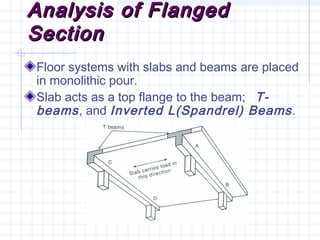
Floor systems with slabs and beams are placed
in monolithic pour.
Slab acts as a top flange to the beam; T-
beams, and Inverted L(Spandrel) Beams.
Analysis of FlangedAnalysis of Flanged
SectionsSections
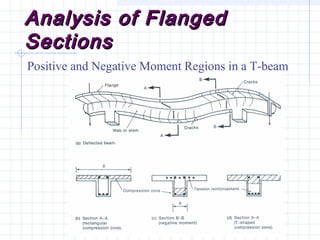
Positive and Negative Moment Regions in a T-beam
Analysis of FlangedAnalysis of Flanged
SectionsSections
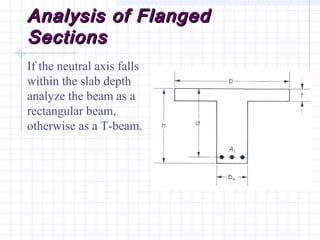
If the neutral axis falls
within the slab depth
analyze the beam as a
rectangular beam,
otherwise as a T-beam.
Analysis of FlangedAnalysis of Flanged
SectionsSections
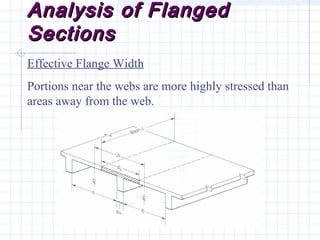
Effective Flange Width
Portions near the webs are more highly stressed than
areas away from the web.
Analysis of FlangedAnalysis of Flanged
SectionsSections
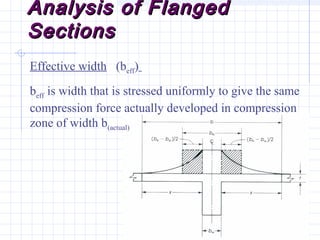
Effective width (beff)
beff is width that is stressed uniformly to give the same
compression force actually developed in compression
zone of width b(actual)
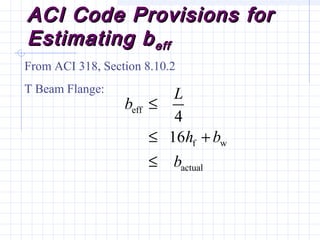
ACI Code Provisions forACI Code Provisions for
Estimating bEstimating beffeff
From ACI 318, Section 8.10.2
T Beam Flange:
eff
f w
actual
4
16
L
b
h b
b
≤
≤ +
≤
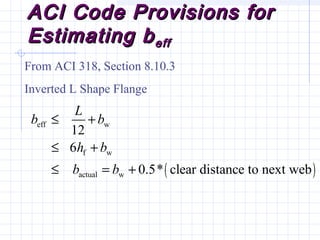
ACI Code Provisions forACI Code Provisions for
Estimating bEstimating beffeff
From ACI 318, Section 8.10.3
Inverted L Shape Flange
( )
eff w
f w
actual w
12
6
0.5* clear distance to next web
L
b b
h b
b b
≤ +
≤ +
≤ = +
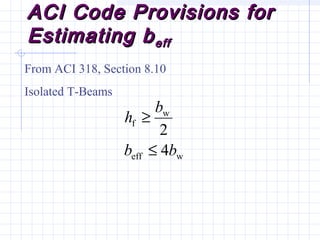
ACI Code Provisions forACI Code Provisions for
Estimating bEstimating beffeff
From ACI 318, Section 8.10
Isolated T-Beams
weff
w
f
4
2
bb
b
h
≤
≥
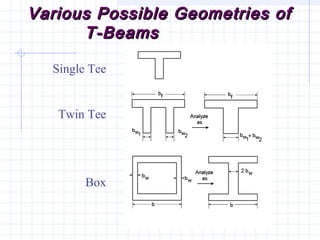
Various Possible Geometries ofVarious Possible Geometries of
T-BeamsT-Beams
Single Tee
Twin Tee
Box
Analysis of T-BeamAnalysis of T-Beam
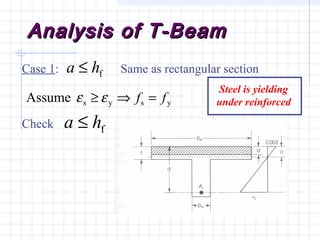
Case 1: Same as rectangular section
Steel is yielding
under reinforced
Check fha ≤
fha ≤
ysysAssume ff =⇒≥ εε
Analysis of T-BeamAnalysis of T-Beam
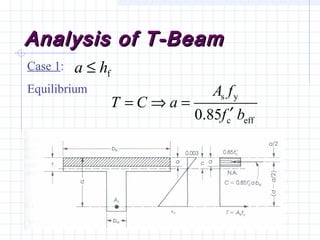
Case 1:
Equilibrium
fha ≤
s y
c eff0.85
A f
T C a
f b
= ⇒ =
′
Analysis of T-BeamAnalysis of T-Beam
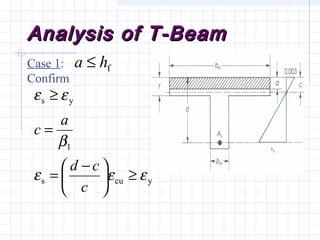
Case 1:
Confirm
fha ≤
ycus
1
ys
εεε
β
εε
≥




 −
=
=
≥
c
cd
a
c
Analysis of T-BeamAnalysis of T-Beam
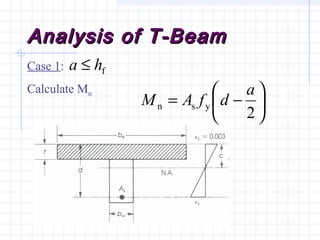
Case 1:
Calculate Mn
fha ≤






−=
2
ysn
a
dfAM
Analysis of T-BeamAnalysis of T-Beam
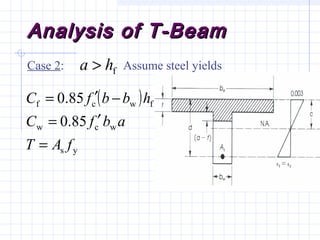
Case 2: Assume steel yieldsfha >
( )
ys
wcw
fwcf
85.0
85.0
fAT
abfC
hbbfC
=
′=
−′=
Analysis of T-BeamAnalysis of T-Beam
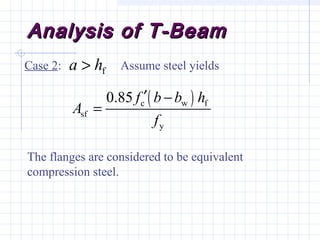
Case 2: Assume steel yieldsfha >
( )c w f
sf
y
0.85 f b b h
A
f
′ −
=
The flanges are considered to be equivalent
compression steel.
Analysis of T-BeamAnalysis of T-Beam
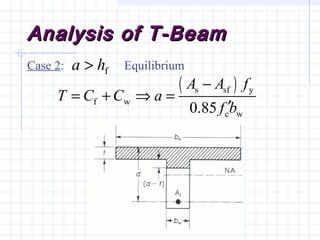
Case 2: Equilibriumfha >
( )s sf y
f w
c w0.85
A A f
T C C a
f b
−
= + ⇒ =
′
Analysis of T-BeamAnalysis of T-Beam
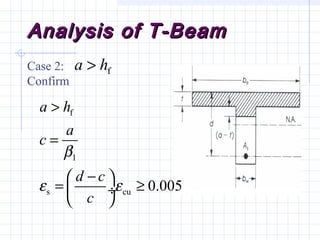
Case 2:
Confirm
fha >
f
1
s cu 0.005
a h
a
c
d c
c
β
ε ε
>
=
− 
= ≥ ÷
 
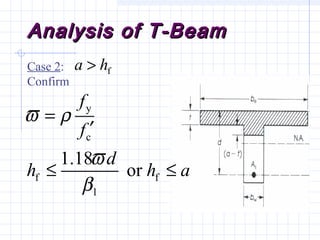
Analysis of T-BeamAnalysis of T-Beam
Case 2:
Confirm
fha >
y
c
f f
1
1.18
or
f
f
d
h h a
ϖ ρ
ϖ
β
=
′
≤ ≤
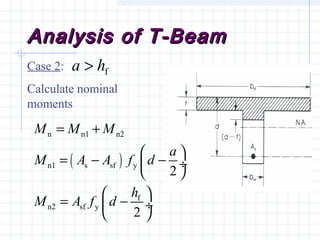
Analysis of T-BeamAnalysis of T-Beam
Case 2:
Calculate nominal
moments
fha >
( )
n n1 n2
n1 s sf y
f
n2 sf y
2
2
M M M
a
M A A f d
h
M A f d
= +
 
= − − ÷
 
 
= − ÷
 
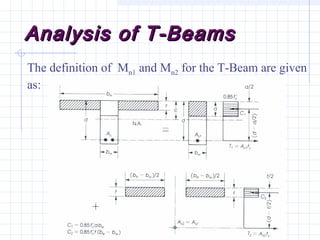
Analysis of T-BeamsAnalysis of T-Beams
The definition of Mn1 and Mn2 for the T-Beam are given
as:
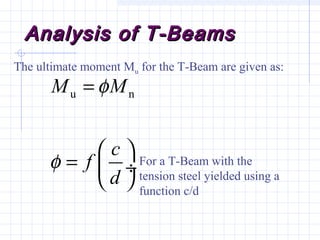
Analysis of T-BeamsAnalysis of T-Beams
The ultimate moment Mu for the T-Beam are given as:
u nM M
c
f
d
φ
φ
=
 
=  ÷
 
For a T-Beam with the
tension steel yielded using a
function c/d
Limitations on ReinforcementLimitations on Reinforcement
for Flange Beamsfor Flange Beams
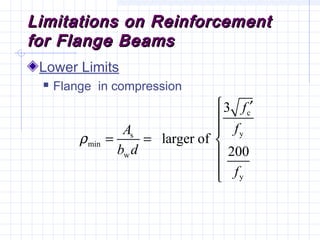
Lower Limits
 Flange in compression
c
ys
min
w
y
3
larger of
200
f
fA
b d
f
ρ
 ′


= = 



Limitations on ReinforcementLimitations on Reinforcement
for Flange Beamsfor Flange Beams
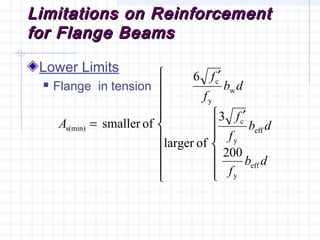
Lower Limits
 Flange in tension
















 ′
′
=
db
f
db
f
f
db
f
f
A
eff
y
eff
y
c
w
y
c
s(min)
200
3
oflarger
6
ofsmaller
Limitations on ReinforcementLimitations on Reinforcement
for Flange Beamsfor Flange Beams
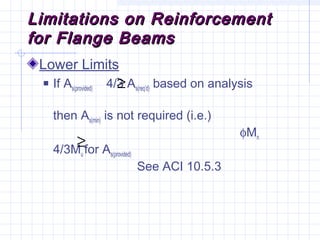
Lower Limits
 If As(provided) 4/3 As(req’d) based on analysis
then As(min) is not required (i.e.)
φMn
4/3Mu for As(provided)
See ACI 10.5.3
≥
≥
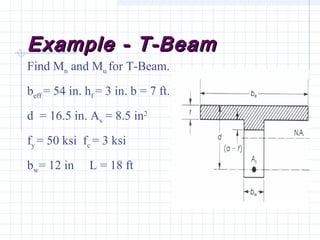
Example - T-BeamExample - T-Beam
Find Mn and Mu for T-Beam.
beff = 54 in. hf = 3 in. b = 7 ft.
d = 16.5 in. As = 8.5 in2
fy = 50 ksi fc = 3 ksi
bw= 12 in L = 18 ft
Example of L-BeamExample of L-Beam
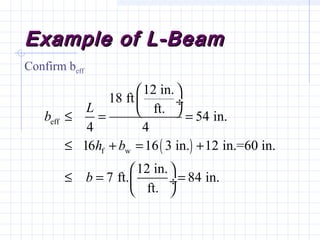
Confirm beff
( )
eff
f w
12 in.
18 ft
ft.
54 in.
4 4
16 16 3 in. 12 in.=60 in.
12 in.
7 ft. 84 in.
ft.
L
b
h b
b
 
 ÷
 ≤ = =
≤ + = +
 
≤ = = ÷
 
Example - T-BeamExample - T-Beam
( )( )
( ) ( )
2
s y
c eff
1
s
8.5 in 50 ksi
3.09 in.
0.85 0.85 3 ksi 54 in.
3.09 in
3.63 in.
0.85
16.5 in.
1 0.003 1 0.003 0.0106 0.005
3.63 in.
A f
a
f b
a
c
d
c
β
ε
= = =
′
= = =
   
= − = − = >   
   
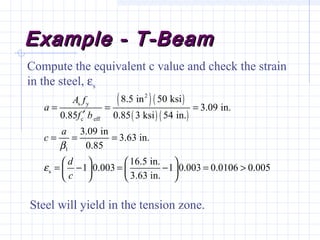
Compute the equivalent c value and check the strain
in the steel, εs
Steel will yield in the tension zone.
Example - T-BeamExample - T-Beam
( )
( ) ( )
2
s
w
y
min min
c
y
8.5 in
0.0429
12 in. 16.5 in.
200 200
0.004
50000
0.004
3 3 3000
0.00329
50000
0.0429 0.004
A
b d
f
f
f
ρ
ρ ρ
= = =

= =

= ⇒ =
 = =


>
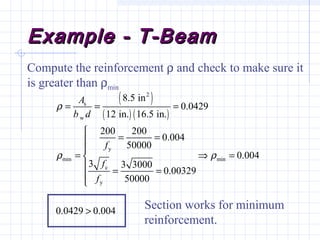
Compute the reinforcement ρ and check to make sure it
is greater than ρmin
Section works for minimum
reinforcement.
Example - T-BeamExample - T-Beam
( ) ( )
y
c
f
1
f
50 ksi
0.0429 0.7155
3 ksi
1.18 0.7155 16.5 in.1.18
3 in. 16.388
0.85
3 in. 3.09 in.
f
f
d
h
h a
ϖ ρ
ϖ
β
 
= = = ÷′  
≤ ⇒ ≤ =
≤ ⇒ ≤
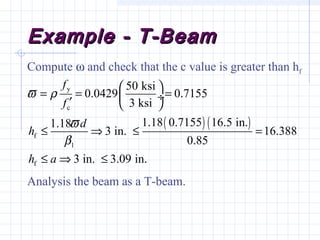
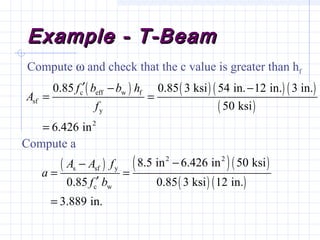
Compute ω and check that the c value is greater than hf
Analysis the beam as a T-beam.
Example - T-BeamExample - T-Beam
Compute ω and check that the c value is greater than hf
Compute a
( ) ( ) ( ) ( )
( )
c eff w f
sf
y
2
0.85 0.85 3 ksi 54 in. 12 in. 3 in.
50 ksi
6.426 in
f b b h
A
f
′ − −
= =
=
( ) ( )( )
( ) ( )
2 2
s sf y
c w
8.5 in 6.426 in 50 ksi
0.85 0.85 3 ksi 12 in.
3.889 in.
A A f
a
f b
−−
= =
′
=
Example - T-BeamExample - T-Beam
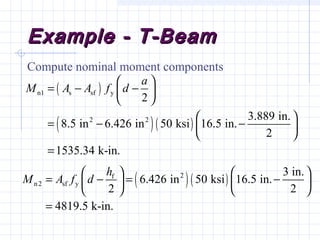
Compute nominal moment components
( )( )2f
n2 sf y
3 in.
6.426 in 50 ksi 16.5 in.
2 2
4819.5 k-in.
h
M A f d
   
= − = −   
   
=
( )
( )( )
n1 s sf y
2 2
2
3.889 in.
8.5 in 6.426 in 50 ksi 16.5 in.
2
1535.34 k-in.
a
M A A f d
 
= − − 
 
 
= − − 
 
=
Example - T-BeamExample - T-Beam
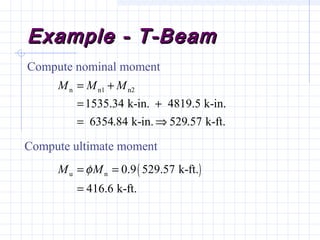
Compute nominal moment
( )u n 0.9 529.57 k-ft.
416.6 k-ft.
M Mφ= =
=
n n1 n2
1535.34 k-in. 4819.5 k-in.
6354.84 k-in. 529.57 k-ft.
M M M= +
= +
= ⇒
Compute ultimate moment
Example of L-BeamExample of L-Beam
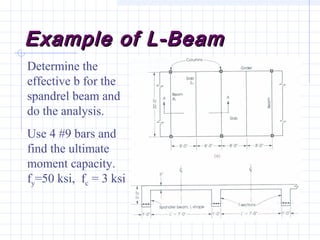
Determine the
effective b for the
spandrel beam and
do the analysis.
Use 4 #9 bars and
find the ultimate
moment capacity.
fy=50 ksi, fc = 3 ksi
Example of L-BeamExample of L-Beam
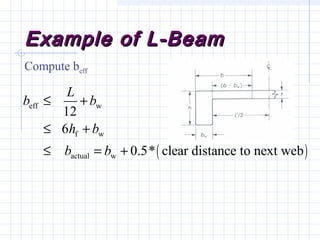
Compute beff
( )
eff w
f w
actual w
12
6
0.5* clear distance to next web
L
b b
h b
b b
≤ +
≤ +
≤ = +
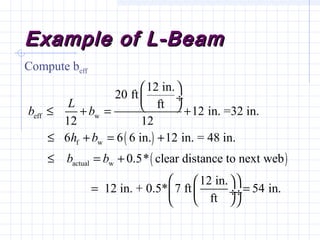
Example of L-BeamExample of L-Beam
Compute beff
( )
( )
eff w
f w
actual w
12 in.
20 ft
ft
12 in. =32 in.
12 12
6 6 6 in. 12 in. = 48 in.
0.5* clear distance to next web
12 in.
12 in. + 0.5* 7 ft 54 i
ft
L
b b
h b
b b
 
 ÷
 ≤ + = +
≤ + = +
≤ = +
  
= = ÷ ÷
  
n.
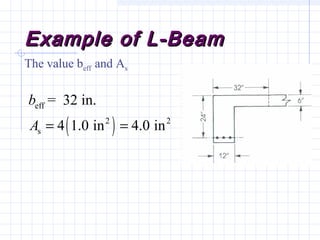
Example of L-BeamExample of L-Beam
The value beff and As
( )
eff
2 2
s
= 32 in.
4 1.0 in 4.0 in
b
A = =
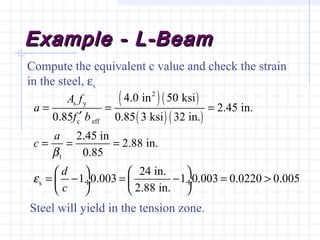
Example - L-BeamExample - L-Beam
( )( )
( ) ( )
2
s y
c eff
1
s
4.0 in 50 ksi
2.45 in.
0.85 0.85 3 ksi 32 in.
2.45 in
2.88 in.
0.85
24 in.
1 0.003 1 0.003 0.0220 0.005
2.88 in.
A f
a
f b
a
c
d
c
β
ε
= = =
′
= = =
   
= − = − = > ÷  ÷
   
Compute the equivalent c value and check the strain
in the steel, εs
Steel will yield in the tension zone.
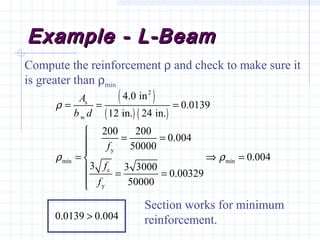
Example - L-BeamExample - L-Beam
( )
( ) ( )
2
s
w
y
min min
c
y
4.0 in
0.0139
12 in. 24 in.
200 200
0.004
50000
0.004
3 3 3000
0.00329
50000
0.0139 0.004
A
b d
f
f
f
ρ
ρ ρ
= = =

= =

= ⇒ =
 = =


>
Compute the reinforcement ρ and check to make sure it
is greater than ρmin
Section works for minimum
reinforcement.
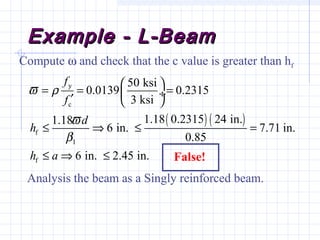
Example - L-BeamExample - L-Beam
( ) ( )
y
c
f
1
f
50 ksi
0.0139 0.2315
3 ksi
1.18 0.2315 24 in.1.18
6 in. 7.71 in.
0.85
6 in. 2.45 in.
f
f
d
h
h a
ϖ ρ
ϖ
β
 
= = = ÷′  
≤ ⇒ ≤ =
≤ ⇒ ≤
Compute ω and check that the c value is greater than hf
Analysis the beam as a Singly reinforced beam.
False!
Example - L-BeamExample - L-Beam
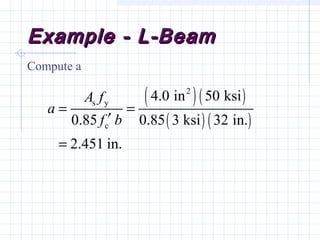
Compute a
( )( )
( ) ( )
2
s y
c
4.0 in 50 ksi
0.85 0.85 3 ksi 32 in.
2.451 in.
A f
a
f b
= =
′
=
Example - L-BeamExample - L-Beam
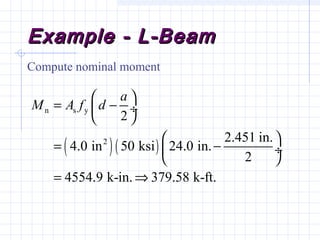
Compute nominal moment
( )( )
n s y
2
2
2.451 in.
4.0 in 50 ksi 24.0 in.
2
4554.9 k-in. 379.58 k-ft.
a
M A f d
 
= − ÷
 
 
= − ÷
 
= ⇒
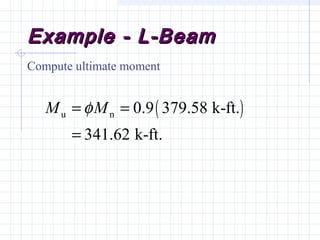
Example - L-BeamExample - L-Beam
( )u n 0.9 379.58 k-ft.
341.62 k-ft.
M Mφ= =
=
Compute ultimate moment
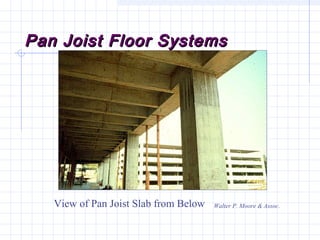
Pan Joist Floor SystemsPan Joist Floor Systems
View of Pan Joist Slab from Below Walter P. Moore & Assoc.
Pan Joist Floor SystemsPan Joist Floor Systems
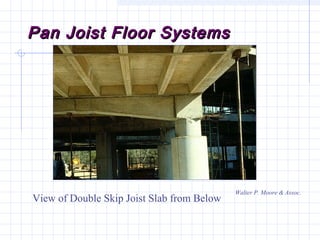
View of Double Skip Joist Slab from Below
Walter P. Moore & Assoc.
Pan Joist FloorPan Joist Floor
SystemsSystems
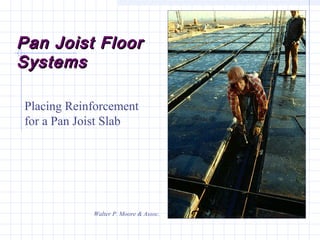
Placing Reinforcement
for a Pan Joist Slab
Walter P. Moore & Assoc.
Pan Joist Floor SystemsPan Joist Floor Systems
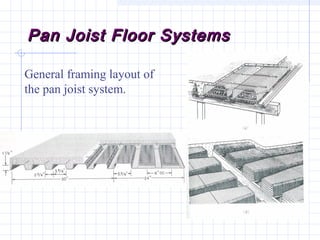
General framing layout of
the pan joist system.
Pan Joist FloorPan Joist Floor
SystemsSystems
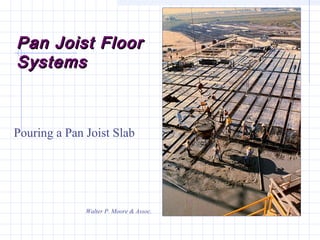
Pouring a Pan Joist Slab
Walter P. Moore & Assoc.
Pan Joist Floor SystemsPan Joist Floor Systems
Definition: The type of slab is also called a
ribbed slab. It consists of a floor slab, usually
2-4 in. thick, supported by reinforced concrete
ribs. The ribs are usually tapered and
uniformly spaced at distances that do not
exceed 30 in. The ribs are supported on
girders that rest on columns. In some ribbed
slabs, the space between ribs may be filled
with permanent fillers to provide a horizontal
slab soffit.
One-Way JoistOne-Way Joist
ConstructionConstruction
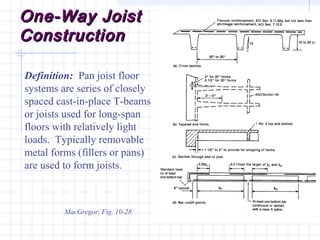
MacGregor, Fig. 10-28
Definition: Pan joist floor
systems are series of closely
spaced cast-in-place T-beams
or joists used for long-span
floors with relatively light
loads. Typically removable
metal forms (fillers or pans)
are used to form joists.
One-Way Joist ConstructionOne-Way Joist Construction
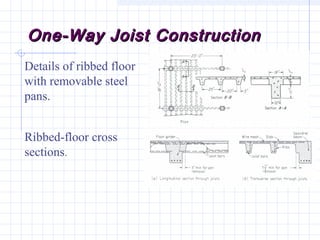
Details of ribbed floor
with removable steel
pans.
Ribbed-floor cross
sections.
One-Way JoistOne-Way Joist
ConstructionConstruction
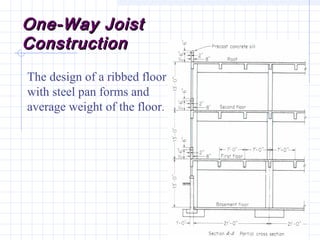
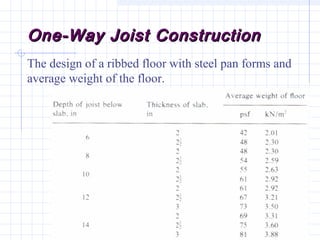
The design of a ribbed floor
with steel pan forms and
average weight of the floor.
One-Way Joist ConstructionOne-Way Joist Construction
The design of a ribbed floor with steel pan forms and
average weight of the floor.
One-Way Joist ConstructionOne-Way Joist Construction
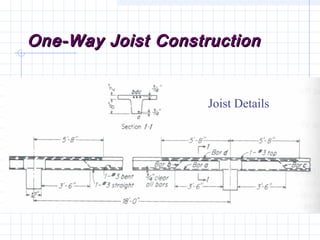
Joist Details
Pan Joist Floor SystemsPan Joist Floor Systems
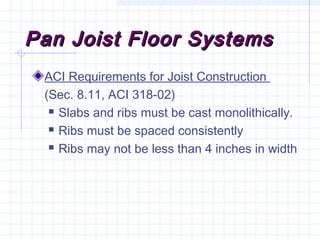
ACI Requirements for Joist Construction
(Sec. 8.11, ACI 318-02)
 Slabs and ribs must be cast monolithically.
 Ribs must be spaced consistently
 Ribs may not be less than 4 inches in width
Pan Joist Floor SystemsPan Joist Floor Systems
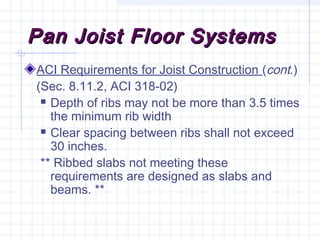
ACI Requirements for Joist Construction (cont.)
(Sec. 8.11.2, ACI 318-02)
 Depth of ribs may not be more than 3.5 times
the minimum rib width
 Clear spacing between ribs shall not exceed
30 inches.
** Ribbed slabs not meeting these
requirements are designed as slabs and
beams. **
Pan Joist Floor SystemsPan Joist Floor Systems
Slab Thickness
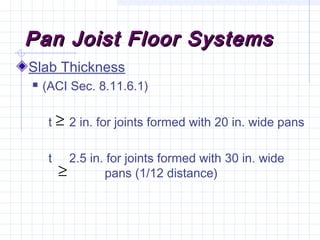
 (ACI Sec. 8.11.6.1)
t 2 in. for joints formed with 20 in. wide pans
t 2.5 in. for joints formed with 30 in. wide
pans (1/12 distance)≥
≥
Pan Joist Floor SystemsPan Joist Floor Systems
Slab Thickness (cont.)
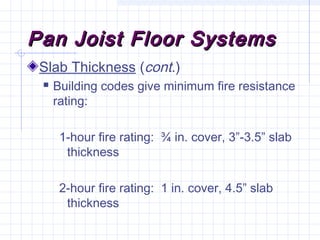
 Building codes give minimum fire resistance
rating:
1-hour fire rating: ¾ in. cover, 3”-3.5” slab
thickness
2-hour fire rating: 1 in. cover, 4.5” slab
thickness
FloorFloor
SystemsSystems
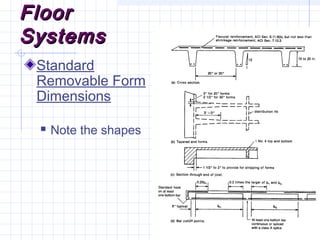
Standard
Removable Form
Dimensions
 Note the shapes
Pan Joist Floor SystemsPan Joist Floor Systems
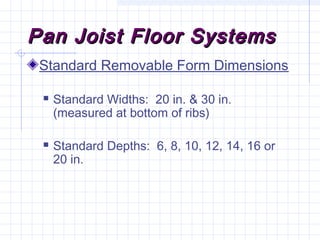
Standard Removable Form Dimensions
 Standard Widths: 20 in. & 30 in.
(measured at bottom of ribs)
 Standard Depths: 6, 8, 10, 12, 14, 16 or
20 in.
Pan Joist Floor SystemsPan Joist Floor Systems
Standard Removable Form Dimensions
(cont.)
 End Forms: one end is closed (built-in) to
form the supporting beam
 Tapered End Forms: provide additional
shear capacity at ends of joists by tapering
ends to increase rib width.
Pan Joist
Slabs
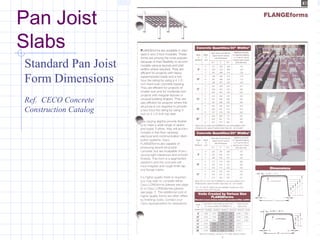
Standard Pan Joist
Form Dimensions
Ref. CECO Concrete
Construction Catalog
Pan Joist
Slabs
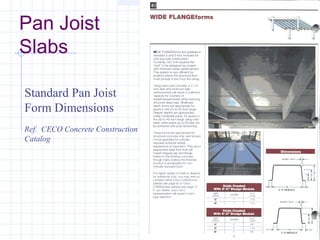
Standard Pan Joist
Form Dimensions
Ref. CECO Concrete Construction
Catalog
Pan Joist Floor SystemsPan Joist Floor Systems
Laying Out Pan Joist Floors
 Rib/slab thickness
Governed by strength, fire rating,
available space
 Overall depth and rib thickness
Governed by deflections and shear
Pan Joist Floor SystemsPan Joist Floor Systems
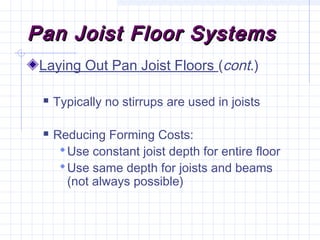
Laying Out Pan Joist Floors (cont.)
 Typically no stirrups are used in joists
 Reducing Forming Costs:
Use constant joist depth for entire floor
Use same depth for joists and beams
(not always possible)
Pan Joist Floor SystemsPan Joist Floor Systems
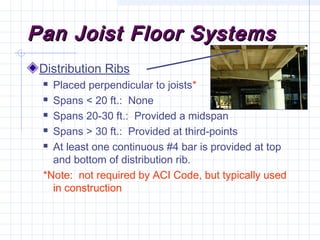
Distribution Ribs
 Placed perpendicular to joists*
 Spans < 20 ft.: None
 Spans 20-30 ft.: Provided a midspan
 Spans > 30 ft.: Provided at third-points
 At least one continuous #4 bar is provided at top
and bottom of distribution rib.
*Note: not required by ACI Code, but typically used
in construction
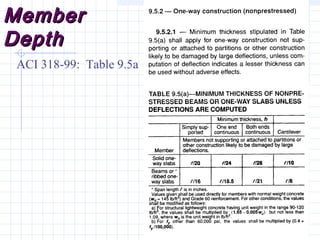
Member DepthMember Depth
ACI provides minimum member depth and
slab thickness requirements that can be used
without a deflection calculation (Sec. 9.5 ACI
318)
 Useful for selecting preliminary member
sizes
Member DepthMember Depth
ACI 318 - Table 9.5a:
 Min. thickness, h (for beams or ribbed one-way
slab)
For beams with one end continuous: L/18.5
For beams with both ends continuous: L/21
L is span length in inches
 Table 9.5a usually gives a depth too shallow for
design, but should be checked as a minimum.
MemberMember
DepthDepth
ACI 318-99: Table 9.5a
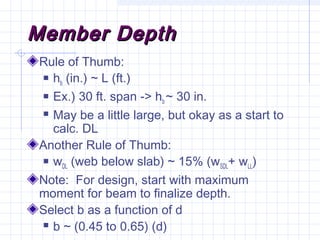
Member DepthMember Depth
Rule of Thumb:
 hb (in.) ~ L (ft.)
 Ex.) 30 ft. span -> hb ~ 30 in.
 May be a little large, but okay as a start to
calc. DL
Another Rule of Thumb:
 wDL (web below slab) ~ 15% (wSDL+ wLL)
Note: For design, start with maximum
moment for beam to finalize depth.
Select b as a function of d
 b ~ (0.45 to 0.65) (d)

Analysis of T-Beam

  • 1.
    Lecture 7 -Flexure June 16, 2003 CVEN 444
  • 2.
    Lecture GoalsLecture Goals DoublyReinforced beams T Beams and L Beams Pan Joist
  • 3.
    Analysis of FlangedAnalysisof Flanged SectionSection Floor systems with slabs and beams are placed in monolithic pour. Slab acts as a top flange to the beam; T- beams, and Inverted L(Spandrel) Beams.
  • 4.
    Analysis of FlangedAnalysisof Flanged SectionsSections Positive and Negative Moment Regions in a T-beam
  • 5.
    Analysis of FlangedAnalysisof Flanged SectionsSections If the neutral axis falls within the slab depth analyze the beam as a rectangular beam, otherwise as a T-beam.
  • 6.
    Analysis of FlangedAnalysisof Flanged SectionsSections Effective Flange Width Portions near the webs are more highly stressed than areas away from the web.
  • 7.
    Analysis of FlangedAnalysisof Flanged SectionsSections Effective width (beff) beff is width that is stressed uniformly to give the same compression force actually developed in compression zone of width b(actual)
  • 8.
    ACI Code ProvisionsforACI Code Provisions for Estimating bEstimating beffeff From ACI 318, Section 8.10.2 T Beam Flange: eff f w actual 4 16 L b h b b ≤ ≤ + ≤
  • 9.
    ACI Code ProvisionsforACI Code Provisions for Estimating bEstimating beffeff From ACI 318, Section 8.10.3 Inverted L Shape Flange ( ) eff w f w actual w 12 6 0.5* clear distance to next web L b b h b b b ≤ + ≤ + ≤ = +
  • 10.
    ACI Code ProvisionsforACI Code Provisions for Estimating bEstimating beffeff From ACI 318, Section 8.10 Isolated T-Beams weff w f 4 2 bb b h ≤ ≥
  • 11.
    Various Possible GeometriesofVarious Possible Geometries of T-BeamsT-Beams Single Tee Twin Tee Box
  • 12.
    Analysis of T-BeamAnalysisof T-Beam Case 1: Same as rectangular section Steel is yielding under reinforced Check fha ≤ fha ≤ ysysAssume ff =⇒≥ εε
  • 13.
    Analysis of T-BeamAnalysisof T-Beam Case 1: Equilibrium fha ≤ s y c eff0.85 A f T C a f b = ⇒ = ′
  • 14.
    Analysis of T-BeamAnalysisof T-Beam Case 1: Confirm fha ≤ ycus 1 ys εεε β εε ≥      − = = ≥ c cd a c
  • 15.
    Analysis of T-BeamAnalysisof T-Beam Case 1: Calculate Mn fha ≤       −= 2 ysn a dfAM
  • 16.
    Analysis of T-BeamAnalysisof T-Beam Case 2: Assume steel yieldsfha > ( ) ys wcw fwcf 85.0 85.0 fAT abfC hbbfC = ′= −′=
  • 17.
    Analysis of T-BeamAnalysisof T-Beam Case 2: Assume steel yieldsfha > ( )c w f sf y 0.85 f b b h A f ′ − = The flanges are considered to be equivalent compression steel.
  • 18.
    Analysis of T-BeamAnalysisof T-Beam Case 2: Equilibriumfha > ( )s sf y f w c w0.85 A A f T C C a f b − = + ⇒ = ′
  • 19.
    Analysis of T-BeamAnalysisof T-Beam Case 2: Confirm fha > f 1 s cu 0.005 a h a c d c c β ε ε > = −  = ≥ ÷  
  • 20.
    Analysis of T-BeamAnalysisof T-Beam Case 2: Confirm fha > y c f f 1 1.18 or f f d h h a ϖ ρ ϖ β = ′ ≤ ≤
  • 21.
    Analysis of T-BeamAnalysisof T-Beam Case 2: Calculate nominal moments fha > ( ) n n1 n2 n1 s sf y f n2 sf y 2 2 M M M a M A A f d h M A f d = +   = − − ÷     = − ÷  
  • 22.
    Analysis of T-BeamsAnalysisof T-Beams The definition of Mn1 and Mn2 for the T-Beam are given as:
  • 23.
    Analysis of T-BeamsAnalysisof T-Beams The ultimate moment Mu for the T-Beam are given as: u nM M c f d φ φ =   =  ÷   For a T-Beam with the tension steel yielded using a function c/d
  • 24.
    Limitations on ReinforcementLimitationson Reinforcement for Flange Beamsfor Flange Beams Lower Limits  Flange in compression c ys min w y 3 larger of 200 f fA b d f ρ  ′   = =    
  • 25.
    Limitations on ReinforcementLimitationson Reinforcement for Flange Beamsfor Flange Beams Lower Limits  Flange in tension                  ′ ′ = db f db f f db f f A eff y eff y c w y c s(min) 200 3 oflarger 6 ofsmaller
  • 26.
    Limitations on ReinforcementLimitationson Reinforcement for Flange Beamsfor Flange Beams Lower Limits  If As(provided) 4/3 As(req’d) based on analysis then As(min) is not required (i.e.) φMn 4/3Mu for As(provided) See ACI 10.5.3 ≥ ≥
  • 27.
    Example - T-BeamExample- T-Beam Find Mn and Mu for T-Beam. beff = 54 in. hf = 3 in. b = 7 ft. d = 16.5 in. As = 8.5 in2 fy = 50 ksi fc = 3 ksi bw= 12 in L = 18 ft
  • 28.
    Example of L-BeamExampleof L-Beam Confirm beff ( ) eff f w 12 in. 18 ft ft. 54 in. 4 4 16 16 3 in. 12 in.=60 in. 12 in. 7 ft. 84 in. ft. L b h b b    ÷  ≤ = = ≤ + = +   ≤ = = ÷  
  • 29.
    Example - T-BeamExample- T-Beam ( )( ) ( ) ( ) 2 s y c eff 1 s 8.5 in 50 ksi 3.09 in. 0.85 0.85 3 ksi 54 in. 3.09 in 3.63 in. 0.85 16.5 in. 1 0.003 1 0.003 0.0106 0.005 3.63 in. A f a f b a c d c β ε = = = ′ = = =     = − = − = >        Compute the equivalent c value and check the strain in the steel, εs Steel will yield in the tension zone.
  • 30.
    Example - T-BeamExample- T-Beam ( ) ( ) ( ) 2 s w y min min c y 8.5 in 0.0429 12 in. 16.5 in. 200 200 0.004 50000 0.004 3 3 3000 0.00329 50000 0.0429 0.004 A b d f f f ρ ρ ρ = = =  = =  = ⇒ =  = =   > Compute the reinforcement ρ and check to make sure it is greater than ρmin Section works for minimum reinforcement.
  • 31.
    Example - T-BeamExample- T-Beam ( ) ( ) y c f 1 f 50 ksi 0.0429 0.7155 3 ksi 1.18 0.7155 16.5 in.1.18 3 in. 16.388 0.85 3 in. 3.09 in. f f d h h a ϖ ρ ϖ β   = = = ÷′   ≤ ⇒ ≤ = ≤ ⇒ ≤ Compute ω and check that the c value is greater than hf Analysis the beam as a T-beam.
  • 32.
    Example - T-BeamExample- T-Beam Compute ω and check that the c value is greater than hf Compute a ( ) ( ) ( ) ( ) ( ) c eff w f sf y 2 0.85 0.85 3 ksi 54 in. 12 in. 3 in. 50 ksi 6.426 in f b b h A f ′ − − = = = ( ) ( )( ) ( ) ( ) 2 2 s sf y c w 8.5 in 6.426 in 50 ksi 0.85 0.85 3 ksi 12 in. 3.889 in. A A f a f b −− = = ′ =
  • 33.
    Example - T-BeamExample- T-Beam Compute nominal moment components ( )( )2f n2 sf y 3 in. 6.426 in 50 ksi 16.5 in. 2 2 4819.5 k-in. h M A f d     = − = −        = ( ) ( )( ) n1 s sf y 2 2 2 3.889 in. 8.5 in 6.426 in 50 ksi 16.5 in. 2 1535.34 k-in. a M A A f d   = − −      = − −    =
  • 34.
    Example - T-BeamExample- T-Beam Compute nominal moment ( )u n 0.9 529.57 k-ft. 416.6 k-ft. M Mφ= = = n n1 n2 1535.34 k-in. 4819.5 k-in. 6354.84 k-in. 529.57 k-ft. M M M= + = + = ⇒ Compute ultimate moment
  • 35.
    Example of L-BeamExampleof L-Beam Determine the effective b for the spandrel beam and do the analysis. Use 4 #9 bars and find the ultimate moment capacity. fy=50 ksi, fc = 3 ksi
  • 36.
    Example of L-BeamExampleof L-Beam Compute beff ( ) eff w f w actual w 12 6 0.5* clear distance to next web L b b h b b b ≤ + ≤ + ≤ = +
  • 37.
    Example of L-BeamExampleof L-Beam Compute beff ( ) ( ) eff w f w actual w 12 in. 20 ft ft 12 in. =32 in. 12 12 6 6 6 in. 12 in. = 48 in. 0.5* clear distance to next web 12 in. 12 in. + 0.5* 7 ft 54 i ft L b b h b b b    ÷  ≤ + = + ≤ + = + ≤ = +    = = ÷ ÷    n.
  • 38.
    Example of L-BeamExampleof L-Beam The value beff and As ( ) eff 2 2 s = 32 in. 4 1.0 in 4.0 in b A = =
  • 39.
    Example - L-BeamExample- L-Beam ( )( ) ( ) ( ) 2 s y c eff 1 s 4.0 in 50 ksi 2.45 in. 0.85 0.85 3 ksi 32 in. 2.45 in 2.88 in. 0.85 24 in. 1 0.003 1 0.003 0.0220 0.005 2.88 in. A f a f b a c d c β ε = = = ′ = = =     = − = − = > ÷  ÷     Compute the equivalent c value and check the strain in the steel, εs Steel will yield in the tension zone.
  • 40.
    Example - L-BeamExample- L-Beam ( ) ( ) ( ) 2 s w y min min c y 4.0 in 0.0139 12 in. 24 in. 200 200 0.004 50000 0.004 3 3 3000 0.00329 50000 0.0139 0.004 A b d f f f ρ ρ ρ = = =  = =  = ⇒ =  = =   > Compute the reinforcement ρ and check to make sure it is greater than ρmin Section works for minimum reinforcement.
  • 41.
    Example - L-BeamExample- L-Beam ( ) ( ) y c f 1 f 50 ksi 0.0139 0.2315 3 ksi 1.18 0.2315 24 in.1.18 6 in. 7.71 in. 0.85 6 in. 2.45 in. f f d h h a ϖ ρ ϖ β   = = = ÷′   ≤ ⇒ ≤ = ≤ ⇒ ≤ Compute ω and check that the c value is greater than hf Analysis the beam as a Singly reinforced beam. False!
  • 42.
    Example - L-BeamExample- L-Beam Compute a ( )( ) ( ) ( ) 2 s y c 4.0 in 50 ksi 0.85 0.85 3 ksi 32 in. 2.451 in. A f a f b = = ′ =
  • 43.
    Example - L-BeamExample- L-Beam Compute nominal moment ( )( ) n s y 2 2 2.451 in. 4.0 in 50 ksi 24.0 in. 2 4554.9 k-in. 379.58 k-ft. a M A f d   = − ÷     = − ÷   = ⇒
  • 44.
    Example - L-BeamExample- L-Beam ( )u n 0.9 379.58 k-ft. 341.62 k-ft. M Mφ= = = Compute ultimate moment
  • 45.
    Pan Joist FloorSystemsPan Joist Floor Systems View of Pan Joist Slab from Below Walter P. Moore & Assoc.
  • 46.
    Pan Joist FloorSystemsPan Joist Floor Systems View of Double Skip Joist Slab from Below Walter P. Moore & Assoc.
  • 47.
    Pan Joist FloorPanJoist Floor SystemsSystems Placing Reinforcement for a Pan Joist Slab Walter P. Moore & Assoc.
  • 48.
    Pan Joist FloorSystemsPan Joist Floor Systems General framing layout of the pan joist system.
  • 49.
    Pan Joist FloorPanJoist Floor SystemsSystems Pouring a Pan Joist Slab Walter P. Moore & Assoc.
  • 50.
    Pan Joist FloorSystemsPan Joist Floor Systems Definition: The type of slab is also called a ribbed slab. It consists of a floor slab, usually 2-4 in. thick, supported by reinforced concrete ribs. The ribs are usually tapered and uniformly spaced at distances that do not exceed 30 in. The ribs are supported on girders that rest on columns. In some ribbed slabs, the space between ribs may be filled with permanent fillers to provide a horizontal slab soffit.
  • 51.
    One-Way JoistOne-Way Joist ConstructionConstruction MacGregor,Fig. 10-28 Definition: Pan joist floor systems are series of closely spaced cast-in-place T-beams or joists used for long-span floors with relatively light loads. Typically removable metal forms (fillers or pans) are used to form joists.
  • 52.
    One-Way Joist ConstructionOne-WayJoist Construction Details of ribbed floor with removable steel pans. Ribbed-floor cross sections.
  • 53.
    One-Way JoistOne-Way Joist ConstructionConstruction Thedesign of a ribbed floor with steel pan forms and average weight of the floor.
  • 54.
    One-Way Joist ConstructionOne-WayJoist Construction The design of a ribbed floor with steel pan forms and average weight of the floor.
  • 55.
    One-Way Joist ConstructionOne-WayJoist Construction Joist Details
  • 56.
    Pan Joist FloorSystemsPan Joist Floor Systems ACI Requirements for Joist Construction (Sec. 8.11, ACI 318-02)  Slabs and ribs must be cast monolithically.  Ribs must be spaced consistently  Ribs may not be less than 4 inches in width
  • 57.
    Pan Joist FloorSystemsPan Joist Floor Systems ACI Requirements for Joist Construction (cont.) (Sec. 8.11.2, ACI 318-02)  Depth of ribs may not be more than 3.5 times the minimum rib width  Clear spacing between ribs shall not exceed 30 inches. ** Ribbed slabs not meeting these requirements are designed as slabs and beams. **
  • 58.
    Pan Joist FloorSystemsPan Joist Floor Systems Slab Thickness  (ACI Sec. 8.11.6.1) t 2 in. for joints formed with 20 in. wide pans t 2.5 in. for joints formed with 30 in. wide pans (1/12 distance)≥ ≥
  • 59.
    Pan Joist FloorSystemsPan Joist Floor Systems Slab Thickness (cont.)  Building codes give minimum fire resistance rating: 1-hour fire rating: ¾ in. cover, 3”-3.5” slab thickness 2-hour fire rating: 1 in. cover, 4.5” slab thickness
  • 60.
  • 61.
    Pan Joist FloorSystemsPan Joist Floor Systems Standard Removable Form Dimensions  Standard Widths: 20 in. & 30 in. (measured at bottom of ribs)  Standard Depths: 6, 8, 10, 12, 14, 16 or 20 in.
  • 62.
    Pan Joist FloorSystemsPan Joist Floor Systems Standard Removable Form Dimensions (cont.)  End Forms: one end is closed (built-in) to form the supporting beam  Tapered End Forms: provide additional shear capacity at ends of joists by tapering ends to increase rib width.
  • 63.
    Pan Joist Slabs Standard PanJoist Form Dimensions Ref. CECO Concrete Construction Catalog
  • 64.
    Pan Joist Slabs Standard PanJoist Form Dimensions Ref. CECO Concrete Construction Catalog
  • 65.
    Pan Joist FloorSystemsPan Joist Floor Systems Laying Out Pan Joist Floors  Rib/slab thickness Governed by strength, fire rating, available space  Overall depth and rib thickness Governed by deflections and shear
  • 66.
    Pan Joist FloorSystemsPan Joist Floor Systems Laying Out Pan Joist Floors (cont.)  Typically no stirrups are used in joists  Reducing Forming Costs: Use constant joist depth for entire floor Use same depth for joists and beams (not always possible)
  • 67.
    Pan Joist FloorSystemsPan Joist Floor Systems Distribution Ribs  Placed perpendicular to joists*  Spans < 20 ft.: None  Spans 20-30 ft.: Provided a midspan  Spans > 30 ft.: Provided at third-points  At least one continuous #4 bar is provided at top and bottom of distribution rib. *Note: not required by ACI Code, but typically used in construction
  • 68.
    Member DepthMember Depth ACIprovides minimum member depth and slab thickness requirements that can be used without a deflection calculation (Sec. 9.5 ACI 318)  Useful for selecting preliminary member sizes
  • 69.
    Member DepthMember Depth ACI318 - Table 9.5a:  Min. thickness, h (for beams or ribbed one-way slab) For beams with one end continuous: L/18.5 For beams with both ends continuous: L/21 L is span length in inches  Table 9.5a usually gives a depth too shallow for design, but should be checked as a minimum.
  • 70.
  • 71.
    Member DepthMember Depth Ruleof Thumb:  hb (in.) ~ L (ft.)  Ex.) 30 ft. span -> hb ~ 30 in.  May be a little large, but okay as a start to calc. DL Another Rule of Thumb:  wDL (web below slab) ~ 15% (wSDL+ wLL) Note: For design, start with maximum moment for beam to finalize depth. Select b as a function of d  b ~ (0.45 to 0.65) (d)