Introduction to
CMOS VLSI
Design
Case Study: Intel Processors
CMOS VLSI Design
Case Study: Intel Processors Slide 2
Outline
 Evolution of Intel Microprocessors
– Scaling from 4004 to Pentium 4
– Courtesy of Intel Museum
CMOS VLSI Design
Case Study: Intel Processors Slide 3
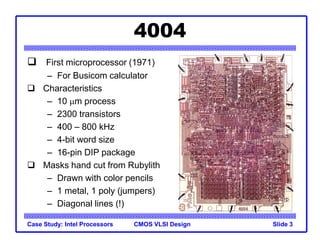
4004
 First microprocessor (1971)
– For Busicom calculator
 Characteristics
– 10 mm process
– 2300 transistors
– 400 – 800 kHz
– 4-bit word size
– 16-pin DIP package
 Masks hand cut from Rubylith
– Drawn with color pencils
– 1 metal, 1 poly (jumpers)
– Diagonal lines (!)
CMOS VLSI Design
Case Study: Intel Processors Slide 4
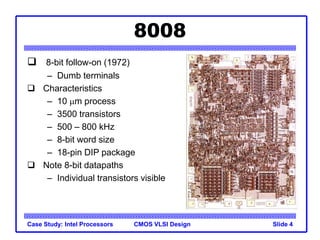
8008
 8-bit follow-on (1972)
– Dumb terminals
 Characteristics
– 10 mm process
– 3500 transistors
– 500 – 800 kHz
– 8-bit word size
– 18-pin DIP package
 Note 8-bit datapaths
– Individual transistors visible
CMOS VLSI Design
Case Study: Intel Processors Slide 5
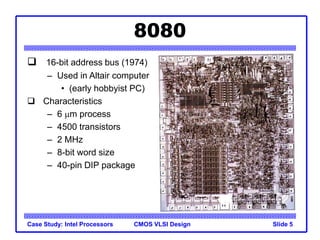
8080
 16-bit address bus (1974)
– Used in Altair computer
• (early hobbyist PC)
 Characteristics
– 6 mm process
– 4500 transistors
– 2 MHz
– 8-bit word size
– 40-pin DIP package
CMOS VLSI Design
Case Study: Intel Processors Slide 6
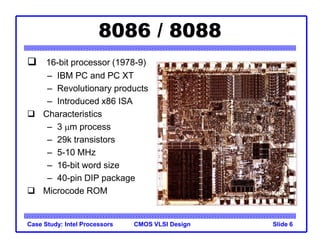
8086 / 8088
 16-bit processor (1978-9)
– IBM PC and PC XT
– Revolutionary products
– Introduced x86 ISA
 Characteristics
– 3 mm process
– 29k transistors
– 5-10 MHz
– 16-bit word size
– 40-pin DIP package
 Microcode ROM
CMOS VLSI Design
Case Study: Intel Processors Slide 7
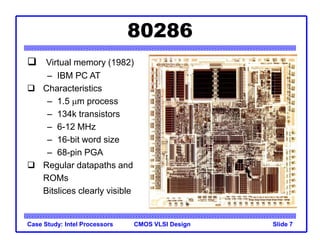
80286
 Virtual memory (1982)
– IBM PC AT
 Characteristics
– 1.5 mm process
– 134k transistors
– 6-12 MHz
– 16-bit word size
– 68-pin PGA
 Regular datapaths and
ROMs
Bitslices clearly visible
CMOS VLSI Design
Case Study: Intel Processors Slide 8
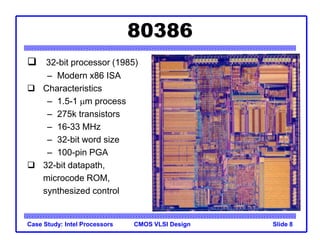
80386
 32-bit processor (1985)
– Modern x86 ISA
 Characteristics
– 1.5-1 mm process
– 275k transistors
– 16-33 MHz
– 32-bit word size
– 100-pin PGA
 32-bit datapath,
microcode ROM,
synthesized control
CMOS VLSI Design
Case Study: Intel Processors Slide 9
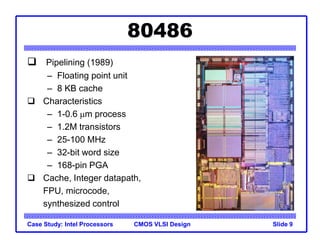
80486
 Pipelining (1989)
– Floating point unit
– 8 KB cache
 Characteristics
– 1-0.6 mm process
– 1.2M transistors
– 25-100 MHz
– 32-bit word size
– 168-pin PGA
 Cache, Integer datapath,
FPU, microcode,
synthesized control
CMOS VLSI Design
Case Study: Intel Processors Slide 10
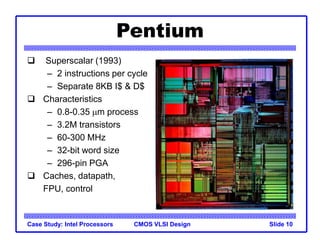
Pentium
 Superscalar (1993)
– 2 instructions per cycle
– Separate 8KB I$ & D$
 Characteristics
– 0.8-0.35 mm process
– 3.2M transistors
– 60-300 MHz
– 32-bit word size
– 296-pin PGA
 Caches, datapath,
FPU, control
CMOS VLSI Design
Case Study: Intel Processors Slide 11
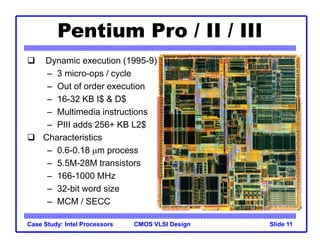
Pentium Pro / II / III
 Dynamic execution (1995-9)
– 3 micro-ops / cycle
– Out of order execution
– 16-32 KB I$ & D$
– Multimedia instructions
– PIII adds 256+ KB L2$
 Characteristics
– 0.6-0.18 mm process
– 5.5M-28M transistors
– 166-1000 MHz
– 32-bit word size
– MCM / SECC
CMOS VLSI Design
Case Study: Intel Processors Slide 12
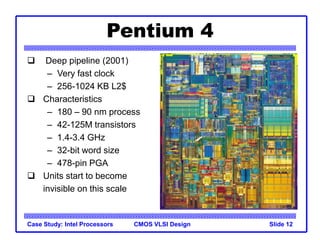
Pentium 4
 Deep pipeline (2001)
– Very fast clock
– 256-1024 KB L2$
 Characteristics
– 180 – 90 nm process
– 42-125M transistors
– 1.4-3.4 GHz
– 32-bit word size
– 478-pin PGA
 Units start to become
invisible on this scale
CMOS VLSI Design
Case Study: Intel Processors Slide 13
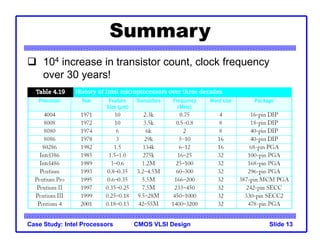
Summary
 104 increase in transistor count, clock frequency
over 30 years!

Lec22 intel

  • 1.
  • 2.
    CMOS VLSI Design CaseStudy: Intel Processors Slide 2 Outline  Evolution of Intel Microprocessors – Scaling from 4004 to Pentium 4 – Courtesy of Intel Museum
  • 3.
    CMOS VLSI Design CaseStudy: Intel Processors Slide 3 4004  First microprocessor (1971) – For Busicom calculator  Characteristics – 10 mm process – 2300 transistors – 400 – 800 kHz – 4-bit word size – 16-pin DIP package  Masks hand cut from Rubylith – Drawn with color pencils – 1 metal, 1 poly (jumpers) – Diagonal lines (!)
  • 4.
    CMOS VLSI Design CaseStudy: Intel Processors Slide 4 8008  8-bit follow-on (1972) – Dumb terminals  Characteristics – 10 mm process – 3500 transistors – 500 – 800 kHz – 8-bit word size – 18-pin DIP package  Note 8-bit datapaths – Individual transistors visible
  • 5.
    CMOS VLSI Design CaseStudy: Intel Processors Slide 5 8080  16-bit address bus (1974) – Used in Altair computer • (early hobbyist PC)  Characteristics – 6 mm process – 4500 transistors – 2 MHz – 8-bit word size – 40-pin DIP package
  • 6.
    CMOS VLSI Design CaseStudy: Intel Processors Slide 6 8086 / 8088  16-bit processor (1978-9) – IBM PC and PC XT – Revolutionary products – Introduced x86 ISA  Characteristics – 3 mm process – 29k transistors – 5-10 MHz – 16-bit word size – 40-pin DIP package  Microcode ROM
  • 7.
    CMOS VLSI Design CaseStudy: Intel Processors Slide 7 80286  Virtual memory (1982) – IBM PC AT  Characteristics – 1.5 mm process – 134k transistors – 6-12 MHz – 16-bit word size – 68-pin PGA  Regular datapaths and ROMs Bitslices clearly visible
  • 8.
    CMOS VLSI Design CaseStudy: Intel Processors Slide 8 80386  32-bit processor (1985) – Modern x86 ISA  Characteristics – 1.5-1 mm process – 275k transistors – 16-33 MHz – 32-bit word size – 100-pin PGA  32-bit datapath, microcode ROM, synthesized control
  • 9.
    CMOS VLSI Design CaseStudy: Intel Processors Slide 9 80486  Pipelining (1989) – Floating point unit – 8 KB cache  Characteristics – 1-0.6 mm process – 1.2M transistors – 25-100 MHz – 32-bit word size – 168-pin PGA  Cache, Integer datapath, FPU, microcode, synthesized control
  • 10.
    CMOS VLSI Design CaseStudy: Intel Processors Slide 10 Pentium  Superscalar (1993) – 2 instructions per cycle – Separate 8KB I$ & D$  Characteristics – 0.8-0.35 mm process – 3.2M transistors – 60-300 MHz – 32-bit word size – 296-pin PGA  Caches, datapath, FPU, control
  • 11.
    CMOS VLSI Design CaseStudy: Intel Processors Slide 11 Pentium Pro / II / III  Dynamic execution (1995-9) – 3 micro-ops / cycle – Out of order execution – 16-32 KB I$ & D$ – Multimedia instructions – PIII adds 256+ KB L2$  Characteristics – 0.6-0.18 mm process – 5.5M-28M transistors – 166-1000 MHz – 32-bit word size – MCM / SECC
  • 12.
    CMOS VLSI Design CaseStudy: Intel Processors Slide 12 Pentium 4  Deep pipeline (2001) – Very fast clock – 256-1024 KB L2$  Characteristics – 180 – 90 nm process – 42-125M transistors – 1.4-3.4 GHz – 32-bit word size – 478-pin PGA  Units start to become invisible on this scale
  • 13.
    CMOS VLSI Design CaseStudy: Intel Processors Slide 13 Summary  104 increase in transistor count, clock frequency over 30 years!