EC8711 EMBEDDED LABORATORY
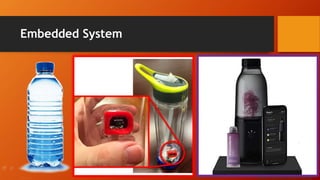
Embedded System
Why ARM ?
• One of the most licensed and thus widespread processor cores in
the world
• Used in PDA, cell phones, multimedia players, handheld game console,
digital TV and cameras
• ARM7: GBA, iPod
• ARM9: NDS, PSP, Sony Ericsson, BenQ
• ARM11: Apple iPhone, Nokia N93, N800
• 75% of 32-bit embedded processors
• Used especially in portable devices due to its low power
consumption and reasonable performance
History of ARM
• ARM (Acorn RISC Machine) started as a new, powerful, CPU design
for the replacement of the 8-bit 6502 in Acorn Computers
(Cambridge, UK, 1985)
• 1990 : ARM renamed Advanced RISC Machines
• New cores with added features
• Harvard architecture (ARM9, ARM11, Cortex)
• Floating point arithmetic
• Vector computing (VFP, NEON)
• Java language (Jazelle)
Design and license ARM core design but not fabricate
ARM Facts
32-bit CPU
3-operand instructions (typical): ADD Rd,Rn,Operand2
RISC design…
• Few, simple, instructions
• Load/store architecture (instructions operate on registers, not memory)
• Large register set
• Pipelined execution
… Although with some CISC touches…
• Multiplication and Load/Store Multiple are complex instructions (many cycles longer than
regular, RISC, instructions)
… And some very specific details
• No stack. Link register instead
• PC as a regular register
• Conditional execution of all instructions
• Flags altered or not by data processing instructions (selectable)
• Concurrent shifts/rotations (at the same time of other processing)
30
5
10
15
25
20
TIME’S UP! TIME LIMIT:
30 seconds
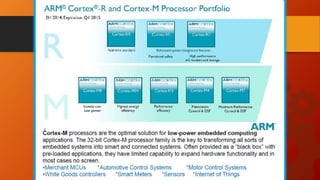
ARM Family Comparison
year 1995 1997 1999 2003
Equipment Adopting ARM Cores
30
5
10
15
25
20
TIME’S UP!
CUBLI CUBE
TIME LIMIT:
30 seconds
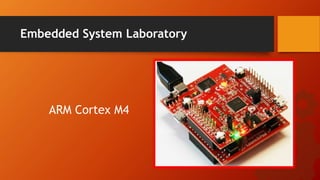
Embedded System Laboratory
ARM Cortex M4
Embedded System Laboratory
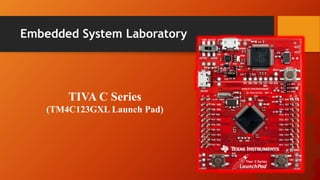
TIVA C Series
(TM4C123GXL Launch Pad)
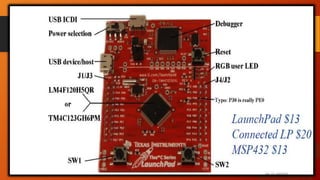
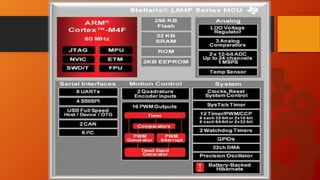
• 32-bit ARM® Cortex™-M4 core
• Thumb2 16/32-bit code: 26% less memory & 25 % faster than pure 32-bit
• System clock frequency up to 80 MHz
• 100 DMIPS @ 80MHz
• Flexible clocking system
– Internal precision oscillator
– External main oscillator with PLL support
– Internal low frequency oscillator
– Real-time-clock through Hibernation module
• Harvard architecture characterized by separate buses for instruction and data
Atomic bit manipulation. Read-Modify-Write using bit-banding
• Single Cycle multiply and hardware divider
• Unaligned data access for more efficient memory usage
• IEEE754 compliant single-precision floating-point unit
• Serial Wire Debug debugger access
30
5
10
15
25
20
30 seconds
Challenge
TIME’S UP!
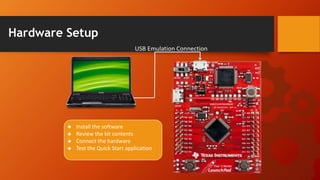
 Install the software
 Review the kit contents
 Connect the hardware
 Test the Quick Start application
USB Emulation Connection
Hardware Setup
Software Development Tools
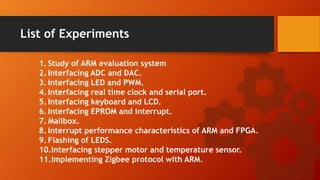
List of Experiments
1. Study of ARM evaluation system
2. Interfacing ADC and DAC.
3. Interfacing LED and PWM.
4. Interfacing real time clock and serial port.
5. Interfacing keyboard and LCD.
6. Interfacing EPROM and interrupt.
7. Mailbox.
8. Interrupt performance characteristics of ARM and FPGA.
9. Flashing of LEDS.
10.Interfacing stepper motor and temperature sensor.
11.Implementing Zigbee protocol with ARM.
30
5
10
15
25
20
TIME LIMIT:
30 seconds
TIME’S UP!

Introduction to Embedded Laboratory EC 8711

  • 2.
  • 3.
  • 8.
    Why ARM ? •One of the most licensed and thus widespread processor cores in the world • Used in PDA, cell phones, multimedia players, handheld game console, digital TV and cameras • ARM7: GBA, iPod • ARM9: NDS, PSP, Sony Ericsson, BenQ • ARM11: Apple iPhone, Nokia N93, N800 • 75% of 32-bit embedded processors • Used especially in portable devices due to its low power consumption and reasonable performance
  • 9.
    History of ARM •ARM (Acorn RISC Machine) started as a new, powerful, CPU design for the replacement of the 8-bit 6502 in Acorn Computers (Cambridge, UK, 1985) • 1990 : ARM renamed Advanced RISC Machines • New cores with added features • Harvard architecture (ARM9, ARM11, Cortex) • Floating point arithmetic • Vector computing (VFP, NEON) • Java language (Jazelle)
  • 11.
    Design and licenseARM core design but not fabricate
  • 12.
    ARM Facts 32-bit CPU 3-operandinstructions (typical): ADD Rd,Rn,Operand2 RISC design… • Few, simple, instructions • Load/store architecture (instructions operate on registers, not memory) • Large register set • Pipelined execution … Although with some CISC touches… • Multiplication and Load/Store Multiple are complex instructions (many cycles longer than regular, RISC, instructions) … And some very specific details • No stack. Link register instead • PC as a regular register • Conditional execution of all instructions • Flags altered or not by data processing instructions (selectable) • Concurrent shifts/rotations (at the same time of other processing)
  • 13.
  • 14.
    ARM Family Comparison year1995 1997 1999 2003
  • 17.
  • 18.
  • 19.
  • 20.
    Embedded System Laboratory TIVAC Series (TM4C123GXL Launch Pad)
  • 22.
    • 32-bit ARM®Cortex™-M4 core • Thumb2 16/32-bit code: 26% less memory & 25 % faster than pure 32-bit • System clock frequency up to 80 MHz • 100 DMIPS @ 80MHz • Flexible clocking system – Internal precision oscillator – External main oscillator with PLL support – Internal low frequency oscillator – Real-time-clock through Hibernation module • Harvard architecture characterized by separate buses for instruction and data Atomic bit manipulation. Read-Modify-Write using bit-banding • Single Cycle multiply and hardware divider • Unaligned data access for more efficient memory usage • IEEE754 compliant single-precision floating-point unit • Serial Wire Debug debugger access
  • 24.
  • 25.
     Install thesoftware  Review the kit contents  Connect the hardware  Test the Quick Start application USB Emulation Connection Hardware Setup
  • 26.
  • 27.
    List of Experiments 1.Study of ARM evaluation system 2. Interfacing ADC and DAC. 3. Interfacing LED and PWM. 4. Interfacing real time clock and serial port. 5. Interfacing keyboard and LCD. 6. Interfacing EPROM and interrupt. 7. Mailbox. 8. Interrupt performance characteristics of ARM and FPGA. 9. Flashing of LEDS. 10.Interfacing stepper motor and temperature sensor. 11.Implementing Zigbee protocol with ARM.
  • 28.