Prepared By
SANA ULLAH
M.cs
Roll No - 35854
Student
Contact No - +923219316714
Hazara university Mansehra IT
department
Moore’s Law
Given by Gordon Moore in 1965, co-founder and
former chairman of Intel Corporation.
It states : The number of transistors that can be
placed inexpensively on an integrated circuit
doubles approximately every two years.
This trend has continued for more than half a
century and is expected to continue until 2015 or
2020 or later.
Microprocessor
• The microprocessor is the core of computer
systems.
- Nowadays many communication, digital
entertainment, portable devices, are
controlled by them.
- The word comes from the combination micro
and processor.
Processor
- Processor means a device that processes
whatever. In this context processor means a
device that processes numbers, specifically
binary numbers, 0’s and 1’s.
- In the late 1960’s, processors were built using
discrete elements. These devices performed
the required operation, but were too large
and too slow.
Micro
- In the early 1970’s the microchip was
invented. All of the components that made up
the processor were now placed on a single
piece of silicon. The size became several
thousand times smaller and the speed
became several hundred times faster. The
“Micro” Processor was born.
Definition of a Microprocessor
• The microprocessor is a programmable device
that takes in numbers, performs on them
arithmetic or logical operations according to
the program stored in memory and then
produces other numbers as a result.
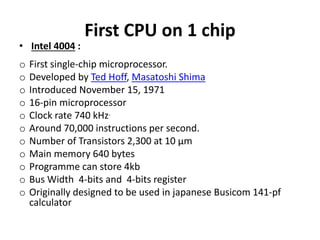
First CPU on 1 chip
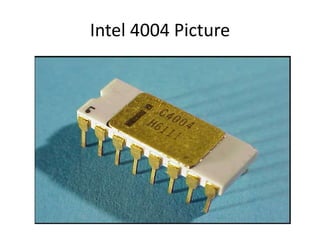
• Intel 4004 :
o First single-chip microprocessor.
o Developed by Ted Hoff, Masatoshi Shima
o Introduced November 15, 1971
o 16-pin microprocessor
o Clock rate 740 kHz.
o Around 70,000 instructions per second.
o Number of Transistors 2,300 at 10 µm
o Main memory 640 bytes
o Programme can store 4kb
o Bus Width 4-bits and 4-bits register
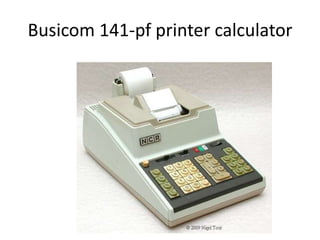
o Originally designed to be used in japanese Busicom 141-pf
calculator
Busicom 141-pf printer calculator
Intel 4004 Picture
Clock rate
It refers to the frequency .The speed at which
microprocessor execute instructions per second.
It can be measured in hz,khz,mhz,ghz…old unit was
cp/s mean cycle per second.
Transistor
a transistor is an electronic component used in a
circuit to control a large amount of current
or voltage with a small amount of voltage or current.
Register
In a computer, a register is one of a small set of data
holding places that are part of a computer processor.
A register may hold a computer instruction, a storage address,
or any kind of data (such as a bit sequence or individual
characters). Some instructions specify registers as part of the
instruction. For example, an instruction may specify that the
contents of two defined registers be added together and then
placed in a specified register. A register must be large enough
to hold an instruction - for example, in a 32-bit instruction
computer, a register must be 32 bits in length. In some
computer designs, there are smaller registers - for example,
half-registers - for shorter instructions. Depending on the
processor design and language rules, registers may be
numbered or have arbitrary names.
System bus
Provides for communication among processors, main
memory, and I/O modules.
Data bus
Bus is defined to transfer data b/w hardware component of
Computer. It is the process within CPU to send data to
processor or send data from processor. Internal buses carry
information within processor while external buses carry
information or data b/w processor and Memory.
The width of data bus refers to number of bits commonly this
width include 4,8,16,32 and 64.A 64-line data bus can transfer
64 bits of data at one time.
The data bus lines are bi-directional. It means that:
1)CPU can read data from memory using these lines
2)CPU can write data to memory locations using these line
Address bus
It has bits address where data should reach from actual
Position. Many components are connected to one another
through buses. Each component is assigned a unique ID. This
ID is called the address of that component. It a component
wants to communicate with another component, it uses
address bus to specify the address of that component. The
address bus is a unidirectional bus. It can carry information
only in one direction. It carries address of memory location
from microprocessor to the main memory.
The width of the address bus determines the amount of
memory that can be addressed. A 32-bit bus can address
4,294,967,296 (2 ^ 32) bytes of memory.
Control Bus
Control bus is used to transmit different commands or control signals
from one component to another component. Suppose CPU wants to
read data from main memory. It will use control is also used to transmit
control signals like ASKS (Acknowledgement signals). A control signal
contains the following:
1 Timing information: It specifies the time for which a device can use
data and address bus.
2 Command Signal: It specifies the type of operation to be performed.
Suppose that CPU gives a command to the main memory to write data.
The memory sends acknowledgement signal to CPU after writing the
data successfully. CPU receives the signal and then moves to perform
some other action.
Main memory
Main memory is where programs and data are kept when
the processor is actively using them. When programs and
data become active, they are copied from secondary
memory into main memory where the processor can interact
with them. A copy remains in secondary memory.
Secondary memory
Secondary memory is where programs and data are kept on
a long-term basis. Common secondary storage devices are
the hard disk and . The hard disk has enormous storage
capacity compared to main memory.
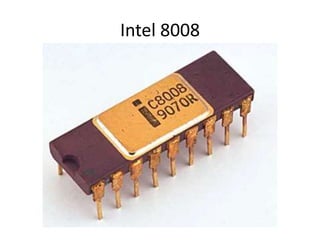
Intel 8008
Introduced in April 1972.
It was first 8-bit µP.
16-pin microprocessor
Its clock rate 500 KHz-800khz.
Could execute 36,000-80,000 instructions per second.
Number of Transistors 2,300 at 10 µm
Programme memory space 16kb
Bus width 8 bits and 8 bits of register
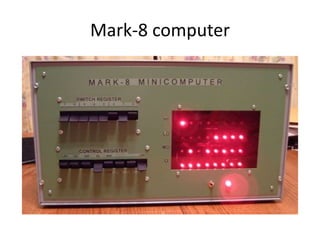
used in Mark-8 computer which was 1st Pc
Mark-8 computer
Intel 8008
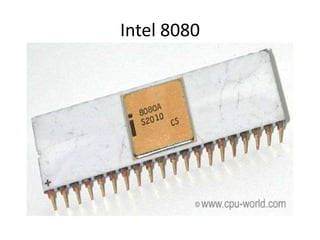
Intel 8080
Introduced in April 1974.
designed by Federico Faggin and Masatoshi Shima
It was also 8-bit µP.
40-pin microprocessor
its clock speed was 2 MHz.
It had 6,000 transistors at 6 µm.
Was 10 times faster than 8008.
Could execute 5,00,000 instructions per second
Programme memory space 64kb
16-bit address bus and an 8-bit data bus and register
Intel 8080
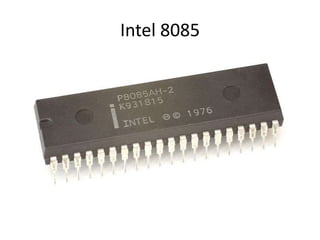
Intel 8085
Introduced in 1976.
40-pin microprocessor
It was also 8-bit µP.
Its clock speed was 3 ,5,and 6MHz.
its data bus is 8-bit and address bus is 16-bit.
It had 6,500 transistors at 3 micrometer
Could execute 7,69,230 instructions per second.
It could access 64 KB of memory.
Intel 8085
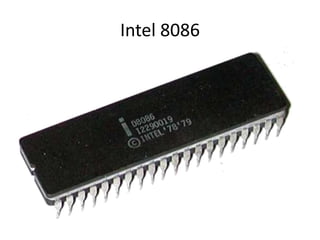
Intel 8086
Introduced in 8 june 1978.
It was first 16-bit µP.
40-pin microprocessor
Its clock speed is 4.77 MHz, 8 MHz and 10 MHz, depending on the version.
Its data bus and register is 16-bit and address bus is 20-bit.
It had 29,000 transistors at 3µm.
Could execute 2.5 million instructions per second.
It could access 1 MB of memory.
It had multiply and divide instructions.
Used in portable computing.
Intel 8086
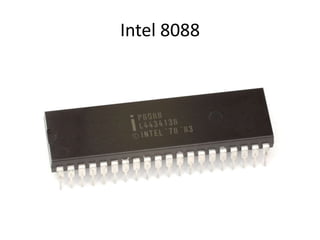
Intel 8088
Introduced in 1 june 1979.
Its clock rate 5mhz-10mhz
40-pin processor
It had 45,000 transistors at 6µm
It was also 16-bit µP. 16-bit register and data bus and 20 bits of address bus
It was created as a cheaper version of Intel’s 8086.
Could execute 2.5 million instructions per second.
This chip became the most popular in the computer industry when IBM used
it for its first PC.
Intel 8088
Intel 80386
Introduced October 17, 1985.
Clock rates : 16 – 33 MHz.
32-bit data & address bus
Space memory 4GB
Virtual Memory 64 TB
No. of transistors : 275,000 at1 µm
Used in Desktop Computing
80188 and 80186
Introduced in 1982.
They were 16-bit µPs.
Clock speed was 6 MHz.
80188 was a cheaper version of 80186 with an
8-bit external data bus.
No of transistors 55000 at 3 µm
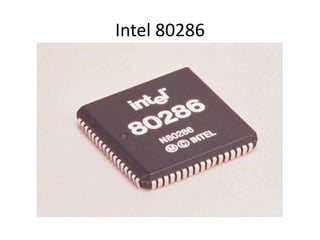
Intel 80286
1982
Clock speed: 12 MHz
Number of transistor:
• 134000 at 1.5 µm
• 16-bit register and data bus
• It could execute 4 million instructions per
second.
Intel 80286
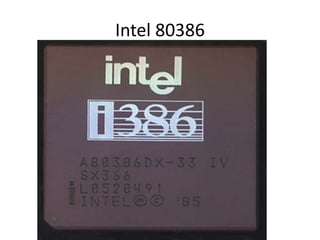
Intel 80386
 Introduced in 17 october 1985.
 It was first 32-bit µP.
 Its data bus is 32-bit and address bus is 32-bit.
 It could address 4 GB of memory.
 It had 2,75,000 transistors at 1.5 µm
 Its clock speed varied from 16 MHz to 33 MHz depending upon the
various versions.
 Different versions:
 80386 DX
 80386 SX
 80386 SL
 Intel 80386 became the best selling microprocessor in history
 Used in Desktop Computing
Intel 80386
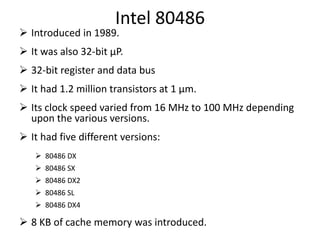
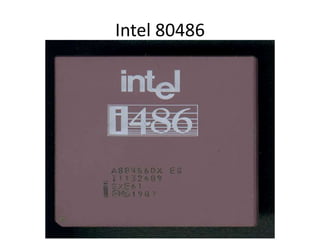
Intel 80486
 Introduced in 1989.
 It was also 32-bit µP.
 32-bit register and data bus
 It had 1.2 million transistors at 1 µm.
 Its clock speed varied from 16 MHz to 100 MHz depending
upon the various versions.
 It had five different versions:
 80486 DX
 80486 SX
 80486 DX2
 80486 SL
 80486 DX4
 8 KB of cache memory was introduced.
Intel 80486
cache memory
cache memory is a high speed memory kept in
between processor and RAM to increase the data
execution speed. It is kept near to the processor. This is
also know as high speed buffer.
L1-cache
L1-cache is the fastest cache and it usually comes within the
processor chip itself.
The L1 cache typically ranges in size from 8KB to 64KB and
uses the high-speed SRAM (static RAM) instead of the slower
and cheaper DRAM (dynamic RAM) used for main memory.
L2-cache
This is not on the processor.L2 cache comes between L1
and RAM(processor-L1-L2-RAM) and is bigger than the
primary cache (typically 64KB to 4MB).
L3-cache
L3 caches are found on the motherboard rather than the
processor. It is kept between RAM and L2 cache.
So if your system has L1,L2 and L3 cache data fetching will
be L1->L2->L3->RAM
ie. If data is not there in L1 it will check L2 then L3 then
RAM...
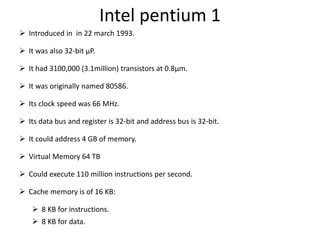
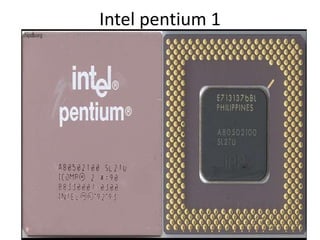
Intel pentium 1
 Introduced in in 22 march 1993.
 It was also 32-bit µP.
 It had 3100,000 (3.1million) transistors at 0.8µm.
 It was originally named 80586.
 Its clock speed was 66 MHz.
 Its data bus and register is 32-bit and address bus is 32-bit.
 It could address 4 GB of memory.
 Virtual Memory 64 TB
 Could execute 110 million instructions per second.
 Cache memory is of 16 KB:
 8 KB for instructions.
 8 KB for data.
Intel pentium 1
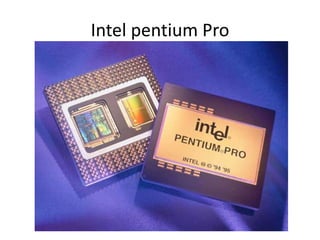
Intel pentium Pro
 Introduced in 1995.
 It was also 32-bit µP.
 It had 5500,000 (5.5million) transistors at 0.5µm.
 It had L2 cache of 256 KB.
 It had 21 million transistors.
 *32-bit register and data bus
 It was primarily used in server systems.
 Cache memory:
 8 KB for instructions.
 8 KB for data.
 It had L2 cache of 256 KB.
Intel pentium Pro
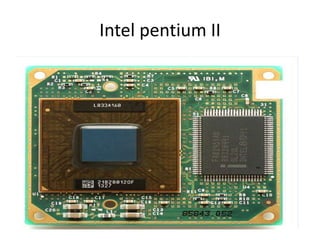
Intel pentium II
Introduced in 8 january 1997.
It was also 32-bit µP.
32-bit register and data bus.
No. of transistors : 7500,000 at 0.35 µm
Its clock speed was 233 MHz to 500 MHz.
Could execute 333 million instructions per
second.
32 KB L1 cache
MMX technology was supported.
Intel pentium II
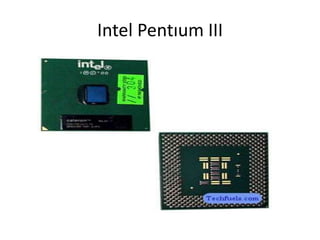
Intel Pentıum III
Introduced in 1999.
It was also 32-bit µP.
Introduction of L2 cache (512 KB)
Its clock speed varied from 500 MHz to 1.4 GHz.
32-bit register and data bus
It had 9.5 million transistors at 0.25µm.
Intel Pentıum III
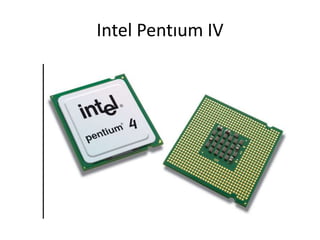
Intel Pentıum IV
 Introduced in 2000.
 64-bit register and data bus.
 Its clock speed was from 1.3 GHz to 3.8 GHz.
 L2 cache increased upto 512 KB
 All internal connections were made from aluminium to copper.
 Used greatly in the desktop & laptop computers.
 No. of transistors : 42 million at 0.18 µm
Intel Pentıum IV
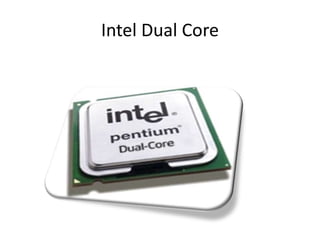
Intel Dual Core
 Introduced in 2006.
 It is 32-bit or 64-bit µP.
 Its clock speed was from 1.3 GHz to 2.6 GHz
 No of transistors 1,700,000,000 at 90 nm.
 It has two cores.
 Both the cores have there own internal bus and L1 cache, but share the
external bus and L2 cache .
 It supported SMT technology.
 SMT: Simultaneously Multi-Threading
 E.g.: Adobe Photoshop supported SMT
Intel Dual Core
Intel Core 2
 Introduced in 2006.
 It is a 64-bit µP.
 Its clock speed is from 1.2 GHz to 3 GHz.
 It has 291 million transistors.
 It has 64 KB of L1 cache per core and 4 MB of L2 cache.
 It is launched in three different versions:
Intel Core 2 Duo
Intel Core 2 Quad
Intel Core 2 Extreme

History of processor

  • 1.
    Prepared By SANA ULLAH M.cs RollNo - 35854 Student Contact No - +923219316714 Hazara university Mansehra IT department
  • 2.
    Moore’s Law Given byGordon Moore in 1965, co-founder and former chairman of Intel Corporation. It states : The number of transistors that can be placed inexpensively on an integrated circuit doubles approximately every two years. This trend has continued for more than half a century and is expected to continue until 2015 or 2020 or later.
  • 3.
    Microprocessor • The microprocessoris the core of computer systems. - Nowadays many communication, digital entertainment, portable devices, are controlled by them. - The word comes from the combination micro and processor.
  • 4.
    Processor - Processor meansa device that processes whatever. In this context processor means a device that processes numbers, specifically binary numbers, 0’s and 1’s. - In the late 1960’s, processors were built using discrete elements. These devices performed the required operation, but were too large and too slow.
  • 5.
    Micro - In theearly 1970’s the microchip was invented. All of the components that made up the processor were now placed on a single piece of silicon. The size became several thousand times smaller and the speed became several hundred times faster. The “Micro” Processor was born.
  • 6.
    Definition of aMicroprocessor • The microprocessor is a programmable device that takes in numbers, performs on them arithmetic or logical operations according to the program stored in memory and then produces other numbers as a result.
  • 7.
    First CPU on1 chip • Intel 4004 : o First single-chip microprocessor. o Developed by Ted Hoff, Masatoshi Shima o Introduced November 15, 1971 o 16-pin microprocessor o Clock rate 740 kHz. o Around 70,000 instructions per second. o Number of Transistors 2,300 at 10 µm o Main memory 640 bytes o Programme can store 4kb o Bus Width 4-bits and 4-bits register o Originally designed to be used in japanese Busicom 141-pf calculator
  • 8.
  • 9.
  • 10.
    Clock rate It refersto the frequency .The speed at which microprocessor execute instructions per second. It can be measured in hz,khz,mhz,ghz…old unit was cp/s mean cycle per second. Transistor a transistor is an electronic component used in a circuit to control a large amount of current or voltage with a small amount of voltage or current. Register In a computer, a register is one of a small set of data holding places that are part of a computer processor.
  • 11.
    A register mayhold a computer instruction, a storage address, or any kind of data (such as a bit sequence or individual characters). Some instructions specify registers as part of the instruction. For example, an instruction may specify that the contents of two defined registers be added together and then placed in a specified register. A register must be large enough to hold an instruction - for example, in a 32-bit instruction computer, a register must be 32 bits in length. In some computer designs, there are smaller registers - for example, half-registers - for shorter instructions. Depending on the processor design and language rules, registers may be numbered or have arbitrary names.
  • 12.
    System bus Provides forcommunication among processors, main memory, and I/O modules. Data bus Bus is defined to transfer data b/w hardware component of Computer. It is the process within CPU to send data to processor or send data from processor. Internal buses carry information within processor while external buses carry information or data b/w processor and Memory. The width of data bus refers to number of bits commonly this width include 4,8,16,32 and 64.A 64-line data bus can transfer 64 bits of data at one time. The data bus lines are bi-directional. It means that: 1)CPU can read data from memory using these lines 2)CPU can write data to memory locations using these line
  • 13.
    Address bus It hasbits address where data should reach from actual Position. Many components are connected to one another through buses. Each component is assigned a unique ID. This ID is called the address of that component. It a component wants to communicate with another component, it uses address bus to specify the address of that component. The address bus is a unidirectional bus. It can carry information only in one direction. It carries address of memory location from microprocessor to the main memory. The width of the address bus determines the amount of memory that can be addressed. A 32-bit bus can address 4,294,967,296 (2 ^ 32) bytes of memory.
  • 14.
    Control Bus Control busis used to transmit different commands or control signals from one component to another component. Suppose CPU wants to read data from main memory. It will use control is also used to transmit control signals like ASKS (Acknowledgement signals). A control signal contains the following: 1 Timing information: It specifies the time for which a device can use data and address bus. 2 Command Signal: It specifies the type of operation to be performed. Suppose that CPU gives a command to the main memory to write data. The memory sends acknowledgement signal to CPU after writing the data successfully. CPU receives the signal and then moves to perform some other action.
  • 15.
    Main memory Main memoryis where programs and data are kept when the processor is actively using them. When programs and data become active, they are copied from secondary memory into main memory where the processor can interact with them. A copy remains in secondary memory. Secondary memory Secondary memory is where programs and data are kept on a long-term basis. Common secondary storage devices are the hard disk and . The hard disk has enormous storage capacity compared to main memory.
  • 16.
    Intel 8008 Introduced inApril 1972. It was first 8-bit µP. 16-pin microprocessor Its clock rate 500 KHz-800khz. Could execute 36,000-80,000 instructions per second. Number of Transistors 2,300 at 10 µm Programme memory space 16kb Bus width 8 bits and 8 bits of register used in Mark-8 computer which was 1st Pc
  • 17.
  • 18.
  • 19.
    Intel 8080 Introduced inApril 1974. designed by Federico Faggin and Masatoshi Shima It was also 8-bit µP. 40-pin microprocessor its clock speed was 2 MHz. It had 6,000 transistors at 6 µm. Was 10 times faster than 8008. Could execute 5,00,000 instructions per second Programme memory space 64kb 16-bit address bus and an 8-bit data bus and register
  • 20.
  • 21.
    Intel 8085 Introduced in1976. 40-pin microprocessor It was also 8-bit µP. Its clock speed was 3 ,5,and 6MHz. its data bus is 8-bit and address bus is 16-bit. It had 6,500 transistors at 3 micrometer Could execute 7,69,230 instructions per second. It could access 64 KB of memory.
  • 22.
  • 23.
    Intel 8086 Introduced in8 june 1978. It was first 16-bit µP. 40-pin microprocessor Its clock speed is 4.77 MHz, 8 MHz and 10 MHz, depending on the version. Its data bus and register is 16-bit and address bus is 20-bit. It had 29,000 transistors at 3µm. Could execute 2.5 million instructions per second. It could access 1 MB of memory. It had multiply and divide instructions. Used in portable computing.
  • 24.
  • 25.
    Intel 8088 Introduced in1 june 1979. Its clock rate 5mhz-10mhz 40-pin processor It had 45,000 transistors at 6µm It was also 16-bit µP. 16-bit register and data bus and 20 bits of address bus It was created as a cheaper version of Intel’s 8086. Could execute 2.5 million instructions per second. This chip became the most popular in the computer industry when IBM used it for its first PC.
  • 26.
  • 27.
    Intel 80386 Introduced October17, 1985. Clock rates : 16 – 33 MHz. 32-bit data & address bus Space memory 4GB Virtual Memory 64 TB No. of transistors : 275,000 at1 µm Used in Desktop Computing
  • 28.
    80188 and 80186 Introducedin 1982. They were 16-bit µPs. Clock speed was 6 MHz. 80188 was a cheaper version of 80186 with an 8-bit external data bus. No of transistors 55000 at 3 µm
  • 29.
    Intel 80286 1982 Clock speed:12 MHz Number of transistor: • 134000 at 1.5 µm • 16-bit register and data bus • It could execute 4 million instructions per second.
  • 30.
  • 31.
    Intel 80386  Introducedin 17 october 1985.  It was first 32-bit µP.  Its data bus is 32-bit and address bus is 32-bit.  It could address 4 GB of memory.  It had 2,75,000 transistors at 1.5 µm  Its clock speed varied from 16 MHz to 33 MHz depending upon the various versions.  Different versions:  80386 DX  80386 SX  80386 SL  Intel 80386 became the best selling microprocessor in history  Used in Desktop Computing
  • 32.
  • 33.
    Intel 80486  Introducedin 1989.  It was also 32-bit µP.  32-bit register and data bus  It had 1.2 million transistors at 1 µm.  Its clock speed varied from 16 MHz to 100 MHz depending upon the various versions.  It had five different versions:  80486 DX  80486 SX  80486 DX2  80486 SL  80486 DX4  8 KB of cache memory was introduced.
  • 34.
  • 35.
    cache memory cache memoryis a high speed memory kept in between processor and RAM to increase the data execution speed. It is kept near to the processor. This is also know as high speed buffer. L1-cache L1-cache is the fastest cache and it usually comes within the processor chip itself. The L1 cache typically ranges in size from 8KB to 64KB and uses the high-speed SRAM (static RAM) instead of the slower and cheaper DRAM (dynamic RAM) used for main memory.
  • 36.
    L2-cache This is noton the processor.L2 cache comes between L1 and RAM(processor-L1-L2-RAM) and is bigger than the primary cache (typically 64KB to 4MB). L3-cache L3 caches are found on the motherboard rather than the processor. It is kept between RAM and L2 cache. So if your system has L1,L2 and L3 cache data fetching will be L1->L2->L3->RAM ie. If data is not there in L1 it will check L2 then L3 then RAM...
  • 37.
    Intel pentium 1 Introduced in in 22 march 1993.  It was also 32-bit µP.  It had 3100,000 (3.1million) transistors at 0.8µm.  It was originally named 80586.  Its clock speed was 66 MHz.  Its data bus and register is 32-bit and address bus is 32-bit.  It could address 4 GB of memory.  Virtual Memory 64 TB  Could execute 110 million instructions per second.  Cache memory is of 16 KB:  8 KB for instructions.  8 KB for data.
  • 38.
  • 39.
    Intel pentium Pro Introduced in 1995.  It was also 32-bit µP.  It had 5500,000 (5.5million) transistors at 0.5µm.  It had L2 cache of 256 KB.  It had 21 million transistors.  *32-bit register and data bus  It was primarily used in server systems.  Cache memory:  8 KB for instructions.  8 KB for data.  It had L2 cache of 256 KB.
  • 40.
  • 41.
    Intel pentium II Introducedin 8 january 1997. It was also 32-bit µP. 32-bit register and data bus. No. of transistors : 7500,000 at 0.35 µm Its clock speed was 233 MHz to 500 MHz. Could execute 333 million instructions per second. 32 KB L1 cache MMX technology was supported.
  • 42.
  • 43.
    Intel Pentıum III Introducedin 1999. It was also 32-bit µP. Introduction of L2 cache (512 KB) Its clock speed varied from 500 MHz to 1.4 GHz. 32-bit register and data bus It had 9.5 million transistors at 0.25µm.
  • 44.
  • 45.
    Intel Pentıum IV Introduced in 2000.  64-bit register and data bus.  Its clock speed was from 1.3 GHz to 3.8 GHz.  L2 cache increased upto 512 KB  All internal connections were made from aluminium to copper.  Used greatly in the desktop & laptop computers.  No. of transistors : 42 million at 0.18 µm
  • 46.
  • 47.
    Intel Dual Core Introduced in 2006.  It is 32-bit or 64-bit µP.  Its clock speed was from 1.3 GHz to 2.6 GHz  No of transistors 1,700,000,000 at 90 nm.  It has two cores.  Both the cores have there own internal bus and L1 cache, but share the external bus and L2 cache .  It supported SMT technology.  SMT: Simultaneously Multi-Threading  E.g.: Adobe Photoshop supported SMT
  • 48.
  • 49.
    Intel Core 2 Introduced in 2006.  It is a 64-bit µP.  Its clock speed is from 1.2 GHz to 3 GHz.  It has 291 million transistors.  It has 64 KB of L1 cache per core and 4 MB of L2 cache.  It is launched in three different versions: Intel Core 2 Duo Intel Core 2 Quad Intel Core 2 Extreme