History Of INTEL
Microprocessor
1
4 Bit Microprocessors
2
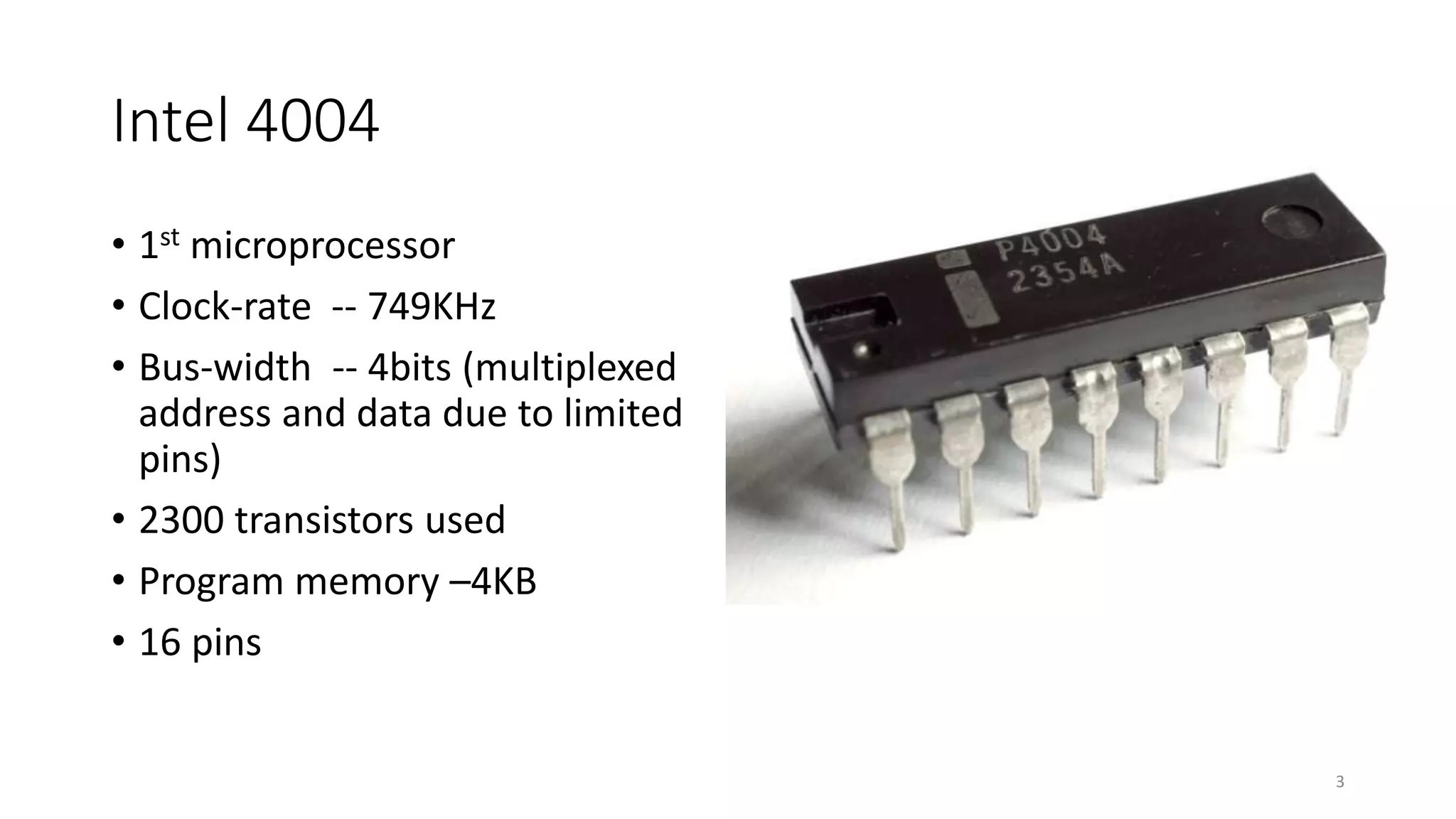
Intel 4004
• 1st microprocessor
• Clock-rate -- 749KHz
• Bus-width -- 4bits (multiplexed
address and data due to limited
pins)
• 2300 transistors used
• Program memory –4KB
• 16 pins
3
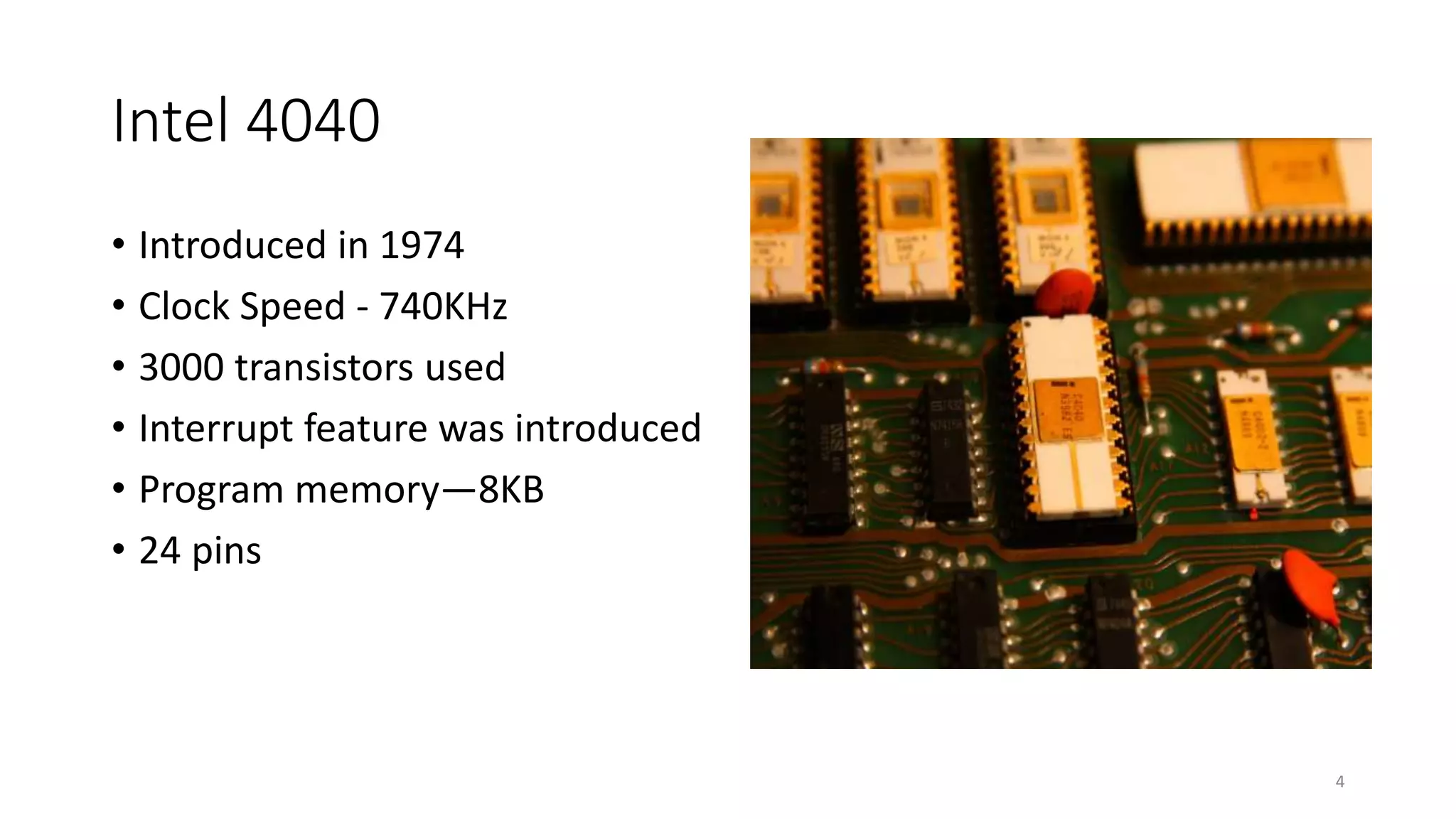
Intel 4040
• Introduced in 1974
• Clock Speed - 740KHz
• 3000 transistors used
• Interrupt feature was introduced
• Program memory—8KB
• 24 pins
4
8 bits processors
5
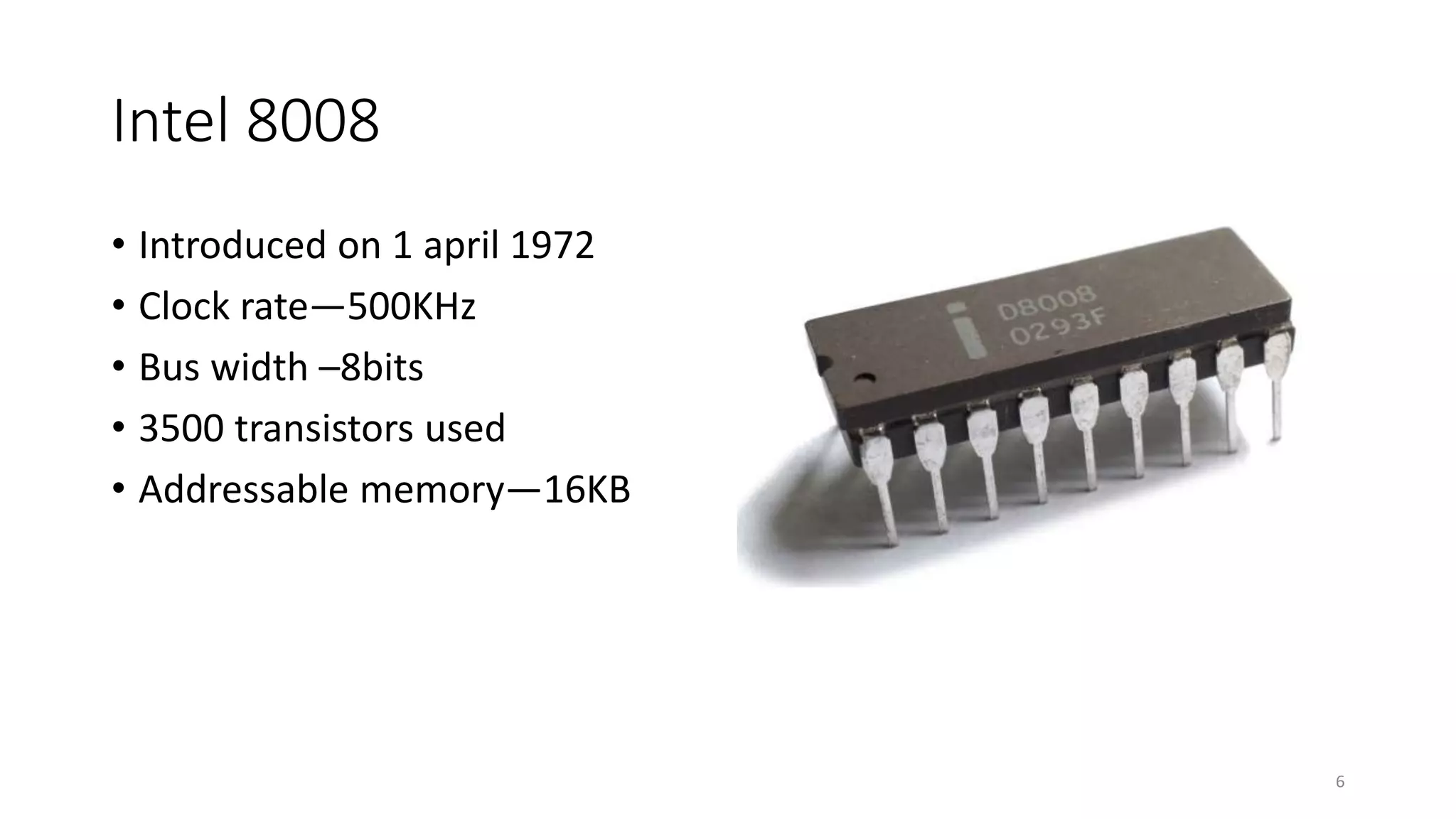
Intel 8008
• Introduced on 1 april 1972
• Clock rate—500KHz
• Bus width –8bits
• 3500 transistors used
• Addressable memory—16KB
6
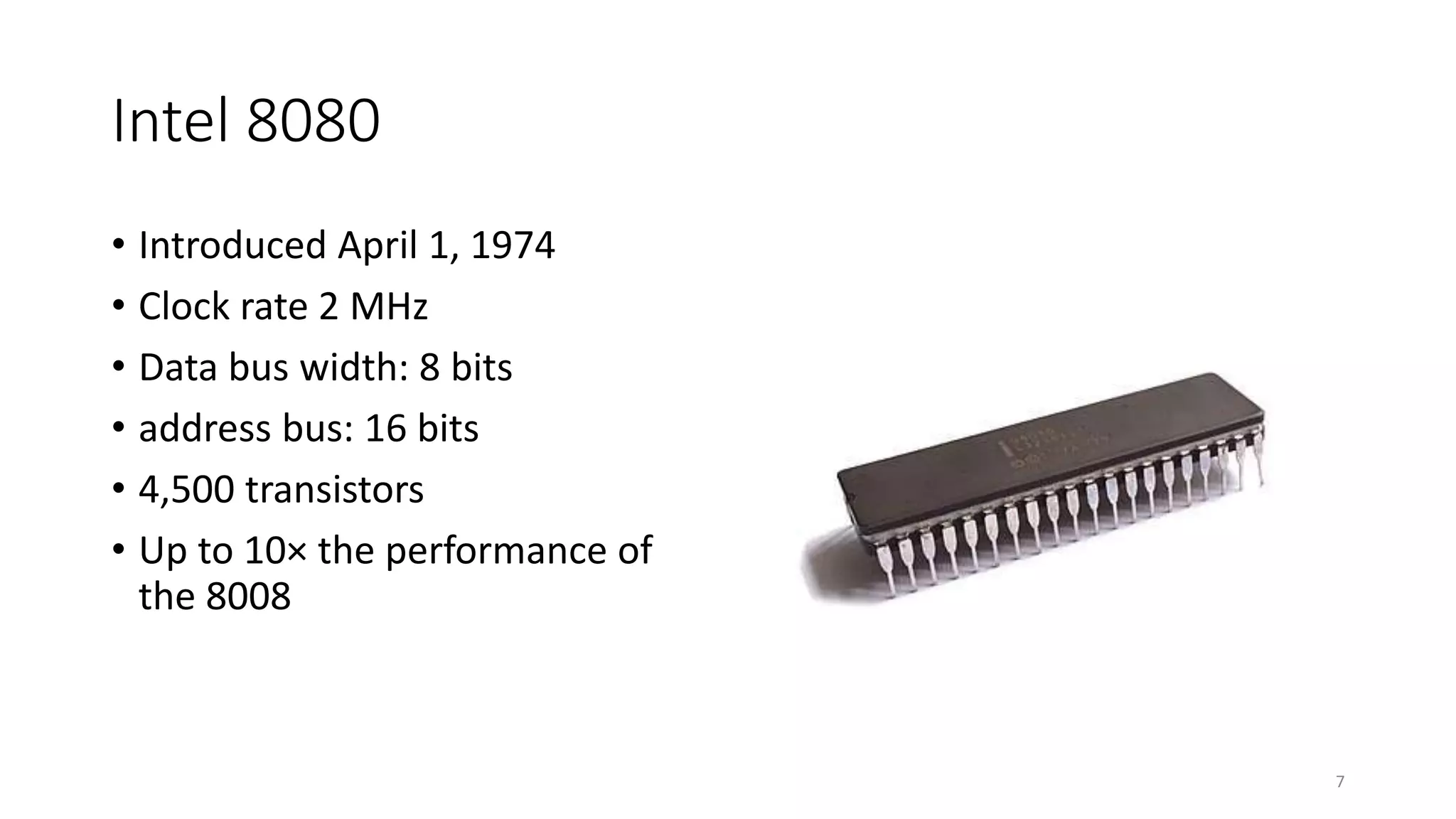
Intel 8080
• Introduced April 1, 1974
• Clock rate 2 MHz
• Data bus width: 8 bits
• address bus: 16 bits
• 4,500 transistors
• Up to 10× the performance of
the 8008
7
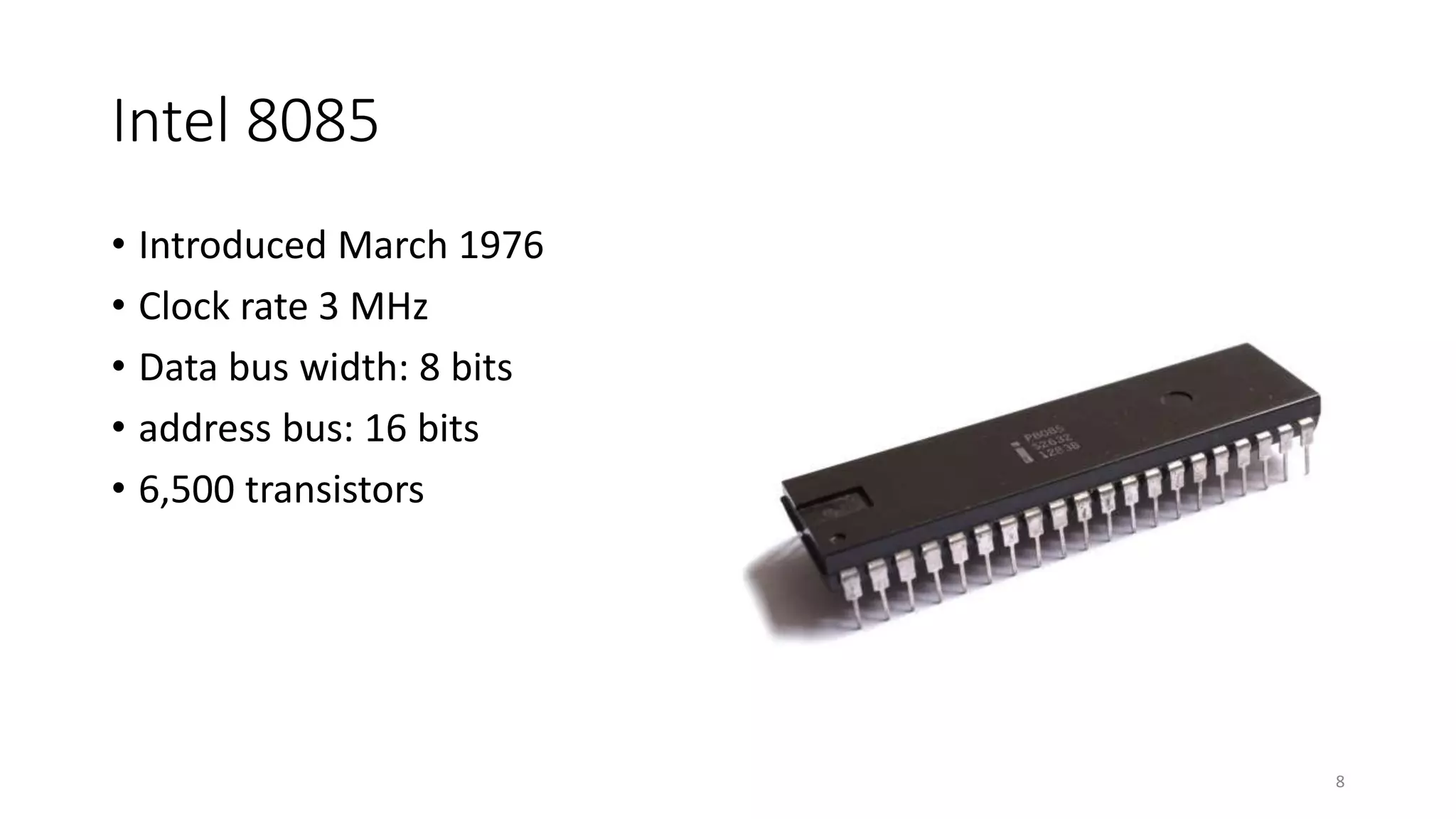
Intel 8085
• Introduced March 1976
• Clock rate 3 MHz
• Data bus width: 8 bits
• address bus: 16 bits
• 6,500 transistors
8
16 Bits Processors
9
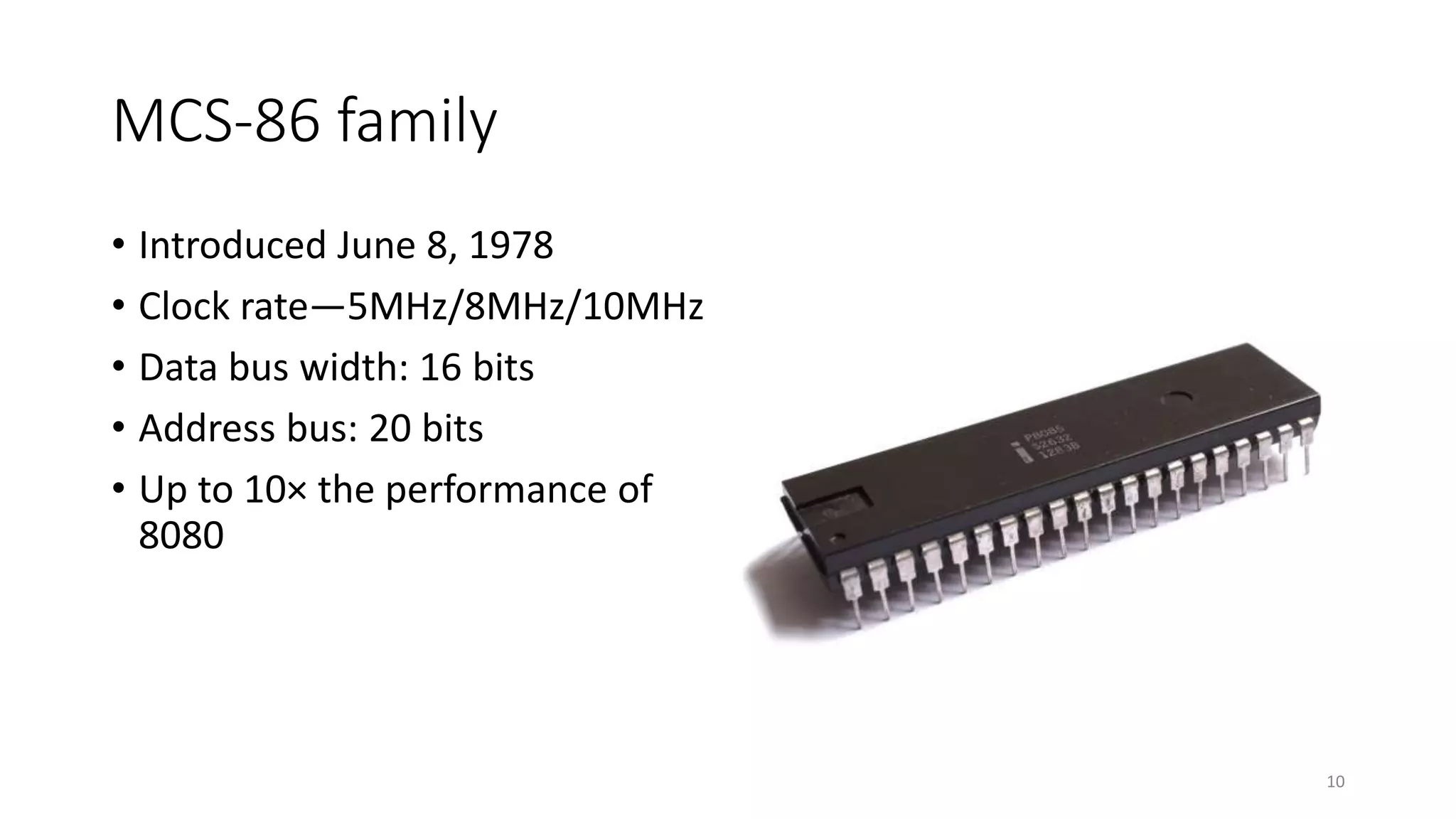
MCS-86 family
• Introduced June 8, 1978
• Clock rate—5MHz/8MHz/10MHz
• Data bus width: 16 bits
• Address bus: 20 bits
• Up to 10× the performance of
8080
10
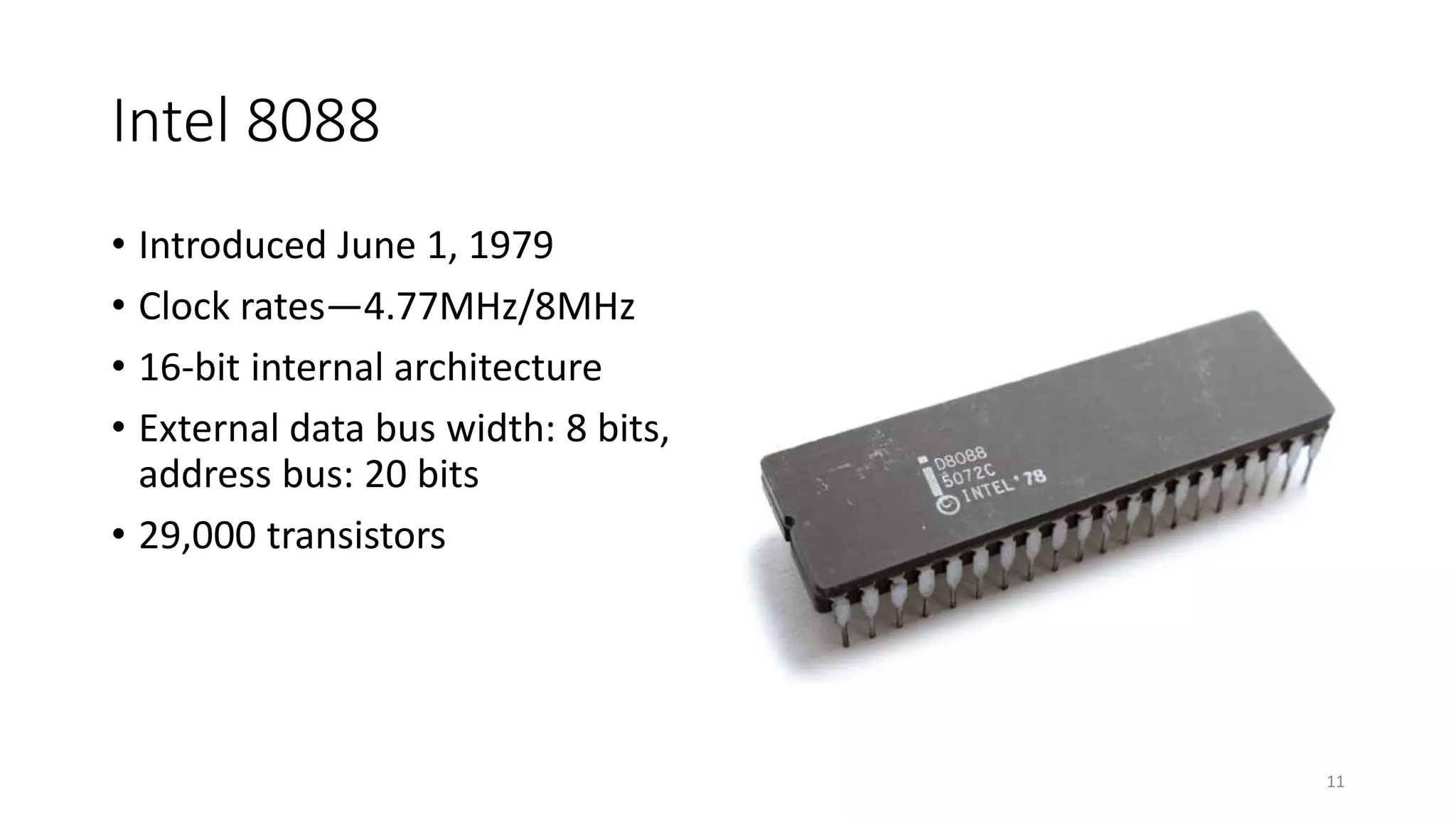
Intel 8088
• Introduced June 1, 1979
• Clock rates—4.77MHz/8MHz
• 16-bit internal architecture
• External data bus width: 8 bits,
address bus: 20 bits
• 29,000 transistors
11
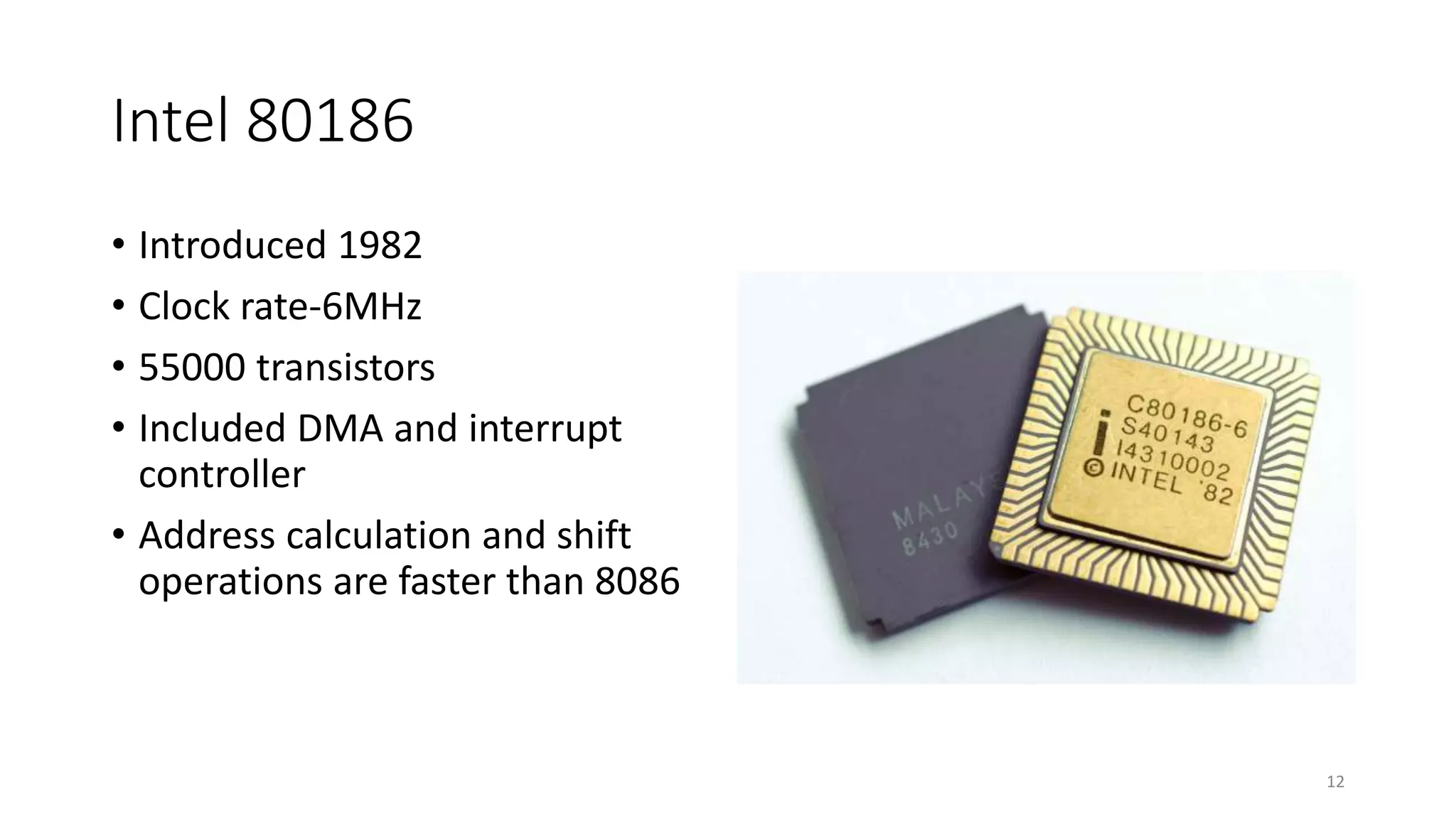
Intel 80186
• Introduced 1982
• Clock rate-6MHz
• 55000 transistors
• Included DMA and interrupt
controller
• Address calculation and shift
operations are faster than 8086
12
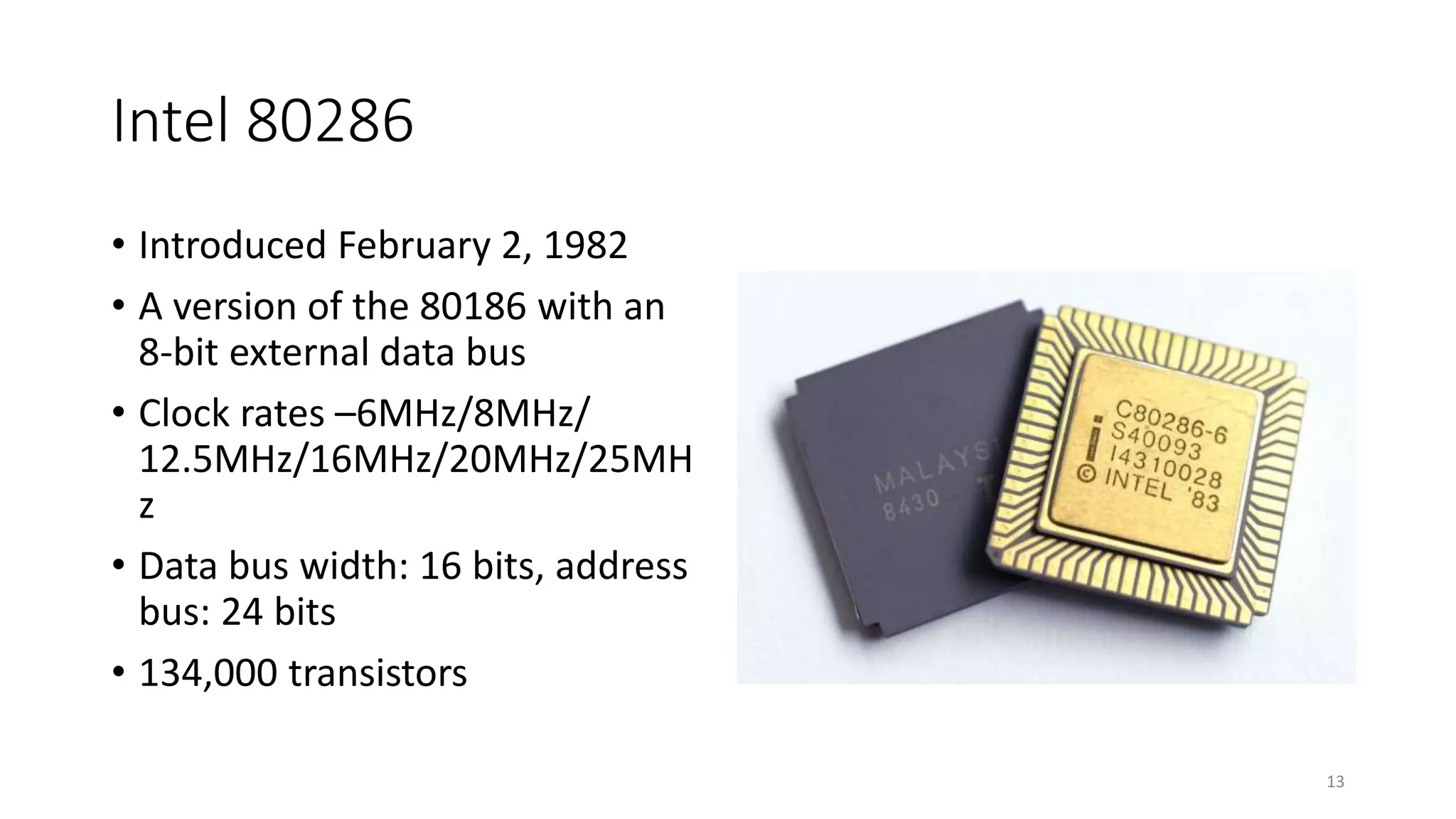
Intel 80286
• Introduced February 2, 1982
• A version of the 80186 with an
8-bit external data bus
• Clock rates –6MHz/8MHz/
12.5MHz/16MHz/20MHz/25MH
z
• Data bus width: 16 bits, address
bus: 24 bits
• 134,000 transistors
13
32 bits microprocessors
14
Intel iAPX 432
• Introduced January 1, 1981
• Multi-chip CPU
• Clock rates:5 MHz/7 MHz/8 MHz
15
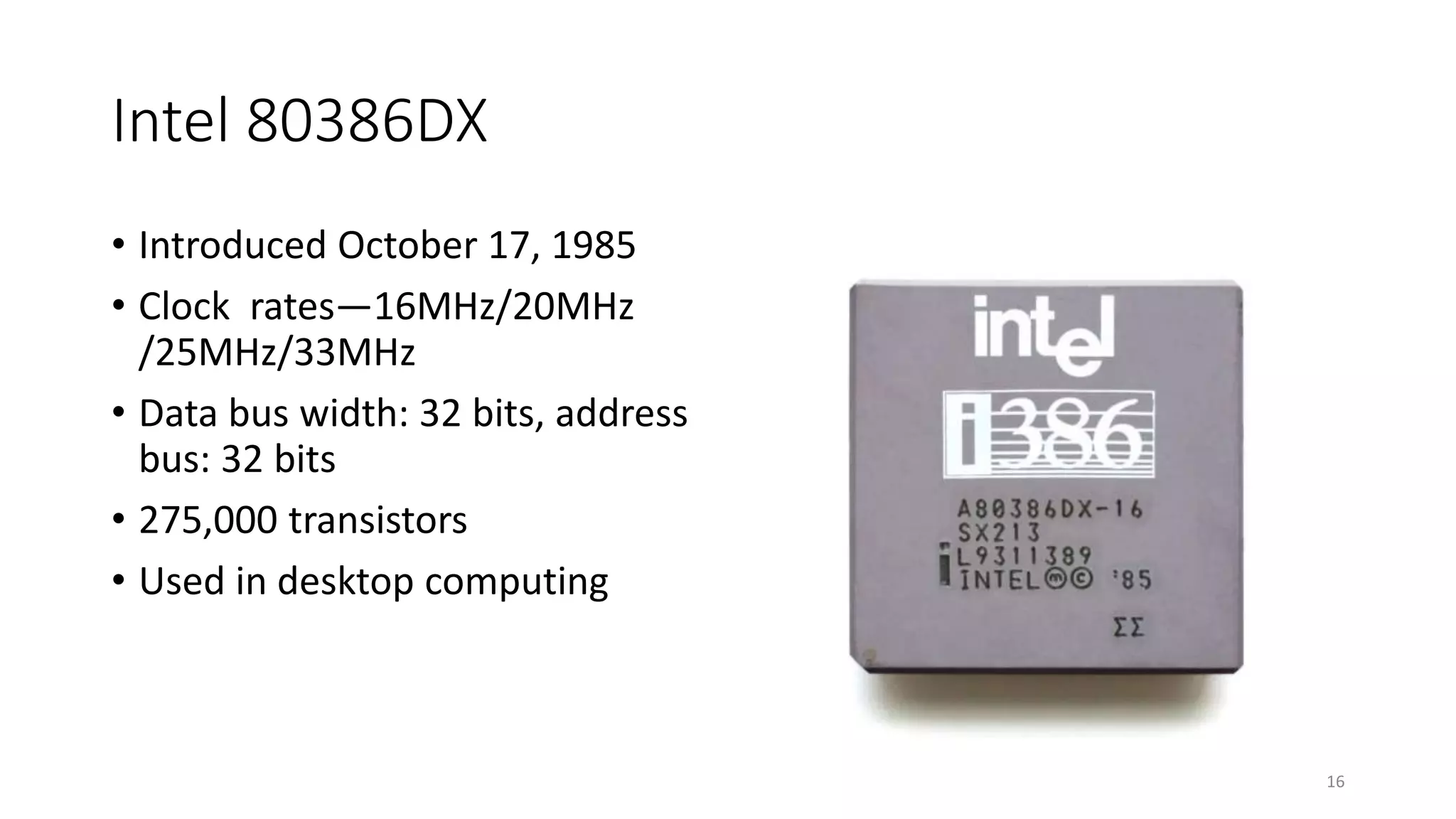
Intel 80386DX
• Introduced October 17, 1985
• Clock rates—16MHz/20MHz
/25MHz/33MHz
• Data bus width: 32 bits, address
bus: 32 bits
• 275,000 transistors
• Used in desktop computing
16
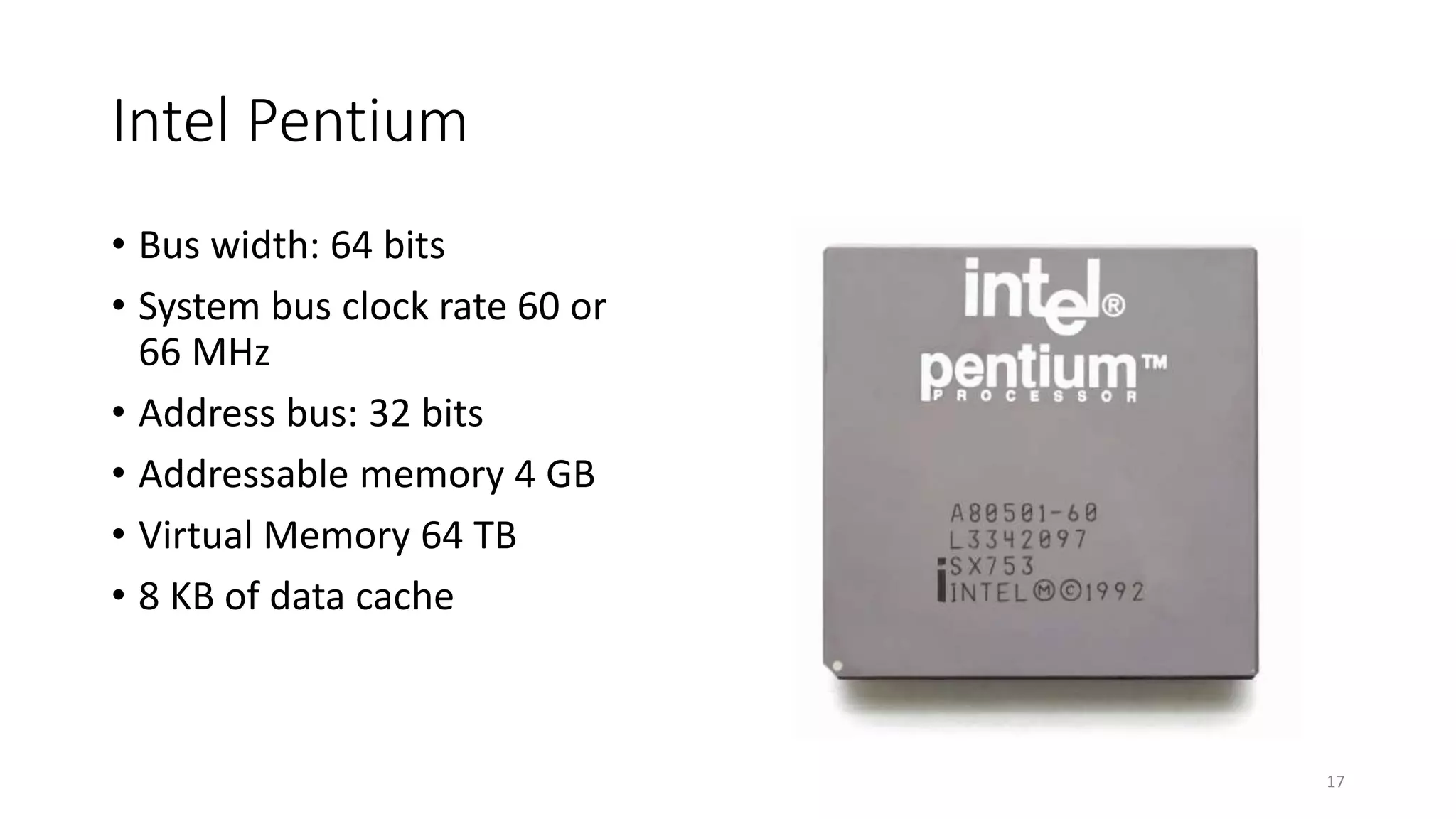
Intel Pentium
• Bus width: 64 bits
• System bus clock rate 60 or
66 MHz
• Address bus: 32 bits
• Addressable memory 4 GB
• Virtual Memory 64 TB
• 8 KB of data cache
17
Intel Pentium with MMX technology
• Introduced January 8, 1997
• 16 KB L1 instruction cache
• 16 KB data cache
• 4.5 million transistors
• System bus clock rate 66 MHz
18
Intel 64 bits microprocessor
19
Intel Core i3(1st Generation)
• 2 physical cores/4 threads
• 32+32 KB L1 cache
• 256 KB L2 cache
• 4 MB L3 cache
• Introduced on January 7, 2010
• Socket 1156 LGA
• 2-channel DDR3
• Integrated HD GPU
20
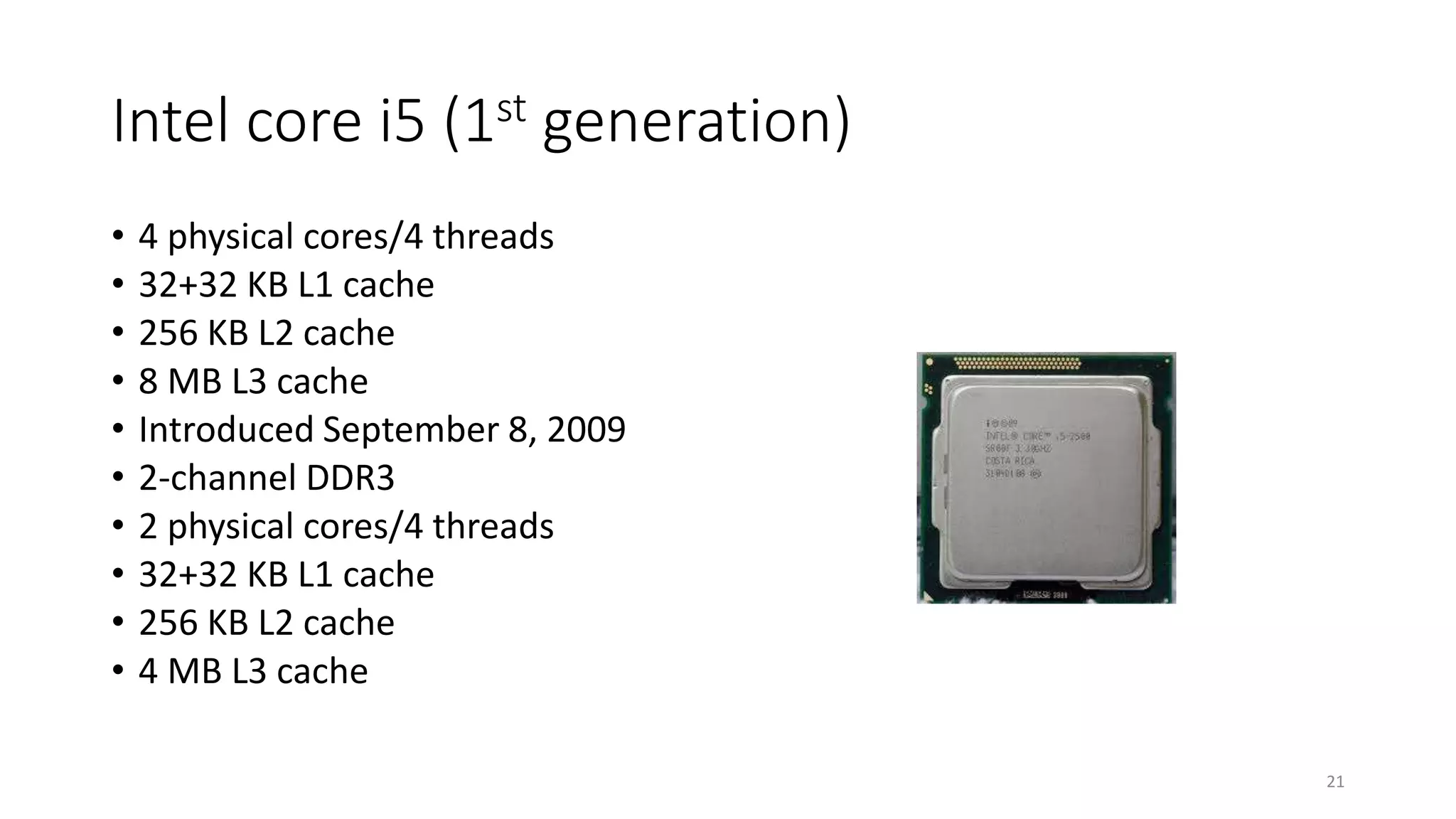
Intel core i5 (1st generation)
• 4 physical cores/4 threads
• 32+32 KB L1 cache
• 256 KB L2 cache
• 8 MB L3 cache
• Introduced September 8, 2009
• 2-channel DDR3
• 2 physical cores/4 threads
• 32+32 KB L1 cache
• 256 KB L2 cache
• 4 MB L3 cache
21
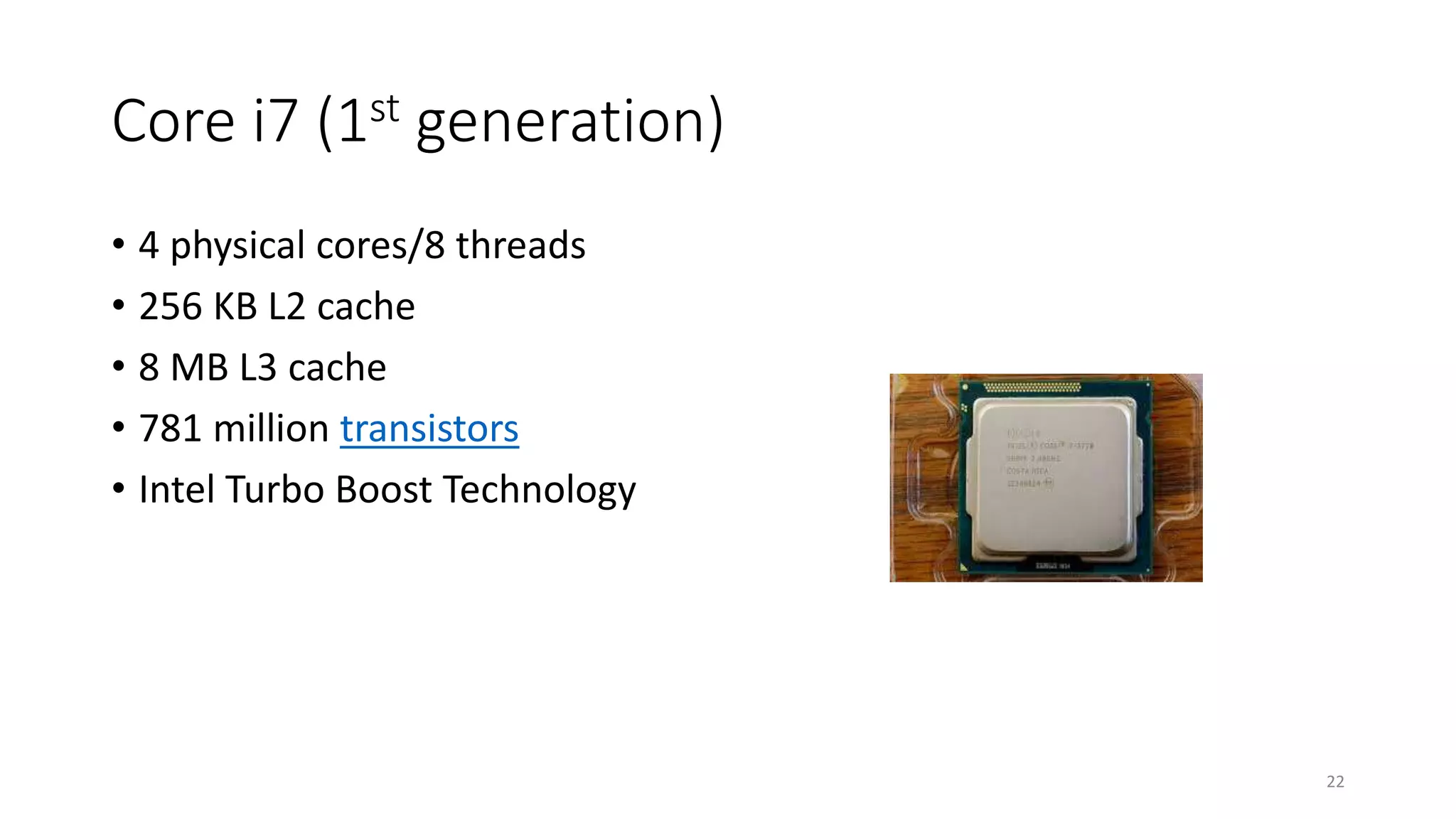
Core i7 (1st generation)
• 4 physical cores/8 threads
• 256 KB L2 cache
• 8 MB L3 cache
• 781 million transistors
• Intel Turbo Boost Technology
22
Thank You
References-
https://en.wikipedia.org/wiki/List_of_Intel_processors#The_4-
bit_processors
23

History of intel microprocessors

  • 1.
  • 2.
  • 3.
    Intel 4004 • 1stmicroprocessor • Clock-rate -- 749KHz • Bus-width -- 4bits (multiplexed address and data due to limited pins) • 2300 transistors used • Program memory –4KB • 16 pins 3
  • 4.
    Intel 4040 • Introducedin 1974 • Clock Speed - 740KHz • 3000 transistors used • Interrupt feature was introduced • Program memory—8KB • 24 pins 4
  • 5.
  • 6.
    Intel 8008 • Introducedon 1 april 1972 • Clock rate—500KHz • Bus width –8bits • 3500 transistors used • Addressable memory—16KB 6
  • 7.
    Intel 8080 • IntroducedApril 1, 1974 • Clock rate 2 MHz • Data bus width: 8 bits • address bus: 16 bits • 4,500 transistors • Up to 10× the performance of the 8008 7
  • 8.
    Intel 8085 • IntroducedMarch 1976 • Clock rate 3 MHz • Data bus width: 8 bits • address bus: 16 bits • 6,500 transistors 8
  • 9.
  • 10.
    MCS-86 family • IntroducedJune 8, 1978 • Clock rate—5MHz/8MHz/10MHz • Data bus width: 16 bits • Address bus: 20 bits • Up to 10× the performance of 8080 10
  • 11.
    Intel 8088 • IntroducedJune 1, 1979 • Clock rates—4.77MHz/8MHz • 16-bit internal architecture • External data bus width: 8 bits, address bus: 20 bits • 29,000 transistors 11
  • 12.
    Intel 80186 • Introduced1982 • Clock rate-6MHz • 55000 transistors • Included DMA and interrupt controller • Address calculation and shift operations are faster than 8086 12
  • 13.
    Intel 80286 • IntroducedFebruary 2, 1982 • A version of the 80186 with an 8-bit external data bus • Clock rates –6MHz/8MHz/ 12.5MHz/16MHz/20MHz/25MH z • Data bus width: 16 bits, address bus: 24 bits • 134,000 transistors 13
  • 14.
  • 15.
    Intel iAPX 432 •Introduced January 1, 1981 • Multi-chip CPU • Clock rates:5 MHz/7 MHz/8 MHz 15
  • 16.
    Intel 80386DX • IntroducedOctober 17, 1985 • Clock rates—16MHz/20MHz /25MHz/33MHz • Data bus width: 32 bits, address bus: 32 bits • 275,000 transistors • Used in desktop computing 16
  • 17.
    Intel Pentium • Buswidth: 64 bits • System bus clock rate 60 or 66 MHz • Address bus: 32 bits • Addressable memory 4 GB • Virtual Memory 64 TB • 8 KB of data cache 17
  • 18.
    Intel Pentium withMMX technology • Introduced January 8, 1997 • 16 KB L1 instruction cache • 16 KB data cache • 4.5 million transistors • System bus clock rate 66 MHz 18
  • 19.
    Intel 64 bitsmicroprocessor 19
  • 20.
    Intel Core i3(1stGeneration) • 2 physical cores/4 threads • 32+32 KB L1 cache • 256 KB L2 cache • 4 MB L3 cache • Introduced on January 7, 2010 • Socket 1156 LGA • 2-channel DDR3 • Integrated HD GPU 20
  • 21.
    Intel core i5(1st generation) • 4 physical cores/4 threads • 32+32 KB L1 cache • 256 KB L2 cache • 8 MB L3 cache • Introduced September 8, 2009 • 2-channel DDR3 • 2 physical cores/4 threads • 32+32 KB L1 cache • 256 KB L2 cache • 4 MB L3 cache 21
  • 22.
    Core i7 (1stgeneration) • 4 physical cores/8 threads • 256 KB L2 cache • 8 MB L3 cache • 781 million transistors • Intel Turbo Boost Technology 22
  • 23.