2
CONTENTS
Introduction
Explanationof Basic Terms
Microprocessors and Microcontrollers
Microprocessor-based System
Evolution of Microprocessor
Classification of Microprocessor
3.
3
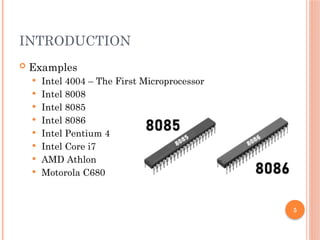
INTRODUCTION
The microprocessoris an electronic chip that
functions as the central processing unit (CPU) of
a computer.
In other words, the microprocessor is the heart of
any computer system.
Is silicon chip which includes
ALU,
Register circuits and
Control circuits
4.
4
INTRODUCTION
is thelogic circuitry that responds to and
processes the basic instructions that drives a
computer
is a programmable device that takes in
numbers, performs on them arithmetic or
logical operations according to the program stored
in memory and then produces other numbers as a
result
7
TERMS
Bus
Abus is a set of conductors intended to transmit data,
address or control information to different elements in a
microprocessor.
Usually a microprocessor will have 3 types of buses
Data Bus, Control Bus and Address Bus.
8.
8
TERMS
Instruction Set
Instruction set is the group of commands that a
microprocessor can understand.
Is an interface between hardware and software
An instruction commands the processor to switch
relevant transistors for doing some processing in data.
e.g. ADD A, B ; is used to add two numbers stored in
; the register A and B.
9.
9
TERMS
Word Length
is the number of bits in the internal data bus of
a processor
is the number of bits a processor can process at a
time.
e.g.
An 8-bit processor will have an 8-bit data bus, 8-bit
registers and will do 8-bit processing at a time.
Higher bits (32-bit, 16-bit) operations, it will split that into
a series of 8-bit operations.
10.
10
TERMS
Cache memory
is a random access memory that is integrated into the
processor.
So the processor can access data in the cache memory
more quickly than from a regular RAM.
It is also known as CPU Memory.
Cache memory is used to store data or instructions that
are frequently referenced by the software or program
during the operation. So it will increase the overall
speed of the operation.
11.
11
TERMS
Clock Speed
Microprocessors uses a clock signal to control the
rate at which instructions are executed,
synchronize other internal components and to control
the data transfer between them.
Clock speed refers to the speed at which a
microprocessor executes instructions.
It is usually measured in Hertz and are expressed in
megahertz (MHz), gigahertz (GHz) etc.
12.
12
MICROPROCESSOR VS
MICROCONTROLLER
Microprocessorconsists
of only a CPU,
Microprocessor is used
in Personal Computers
Microprocessor uses an
external bus to
interface to RAM, ROM,
and other peripherals,
Microcontroller contains
a CPU, Memory, I/O all
integrated into one chip.
Microcontroller is used
in an embedded system.
Microcontroller uses an
internal controlling
bus
13.
13
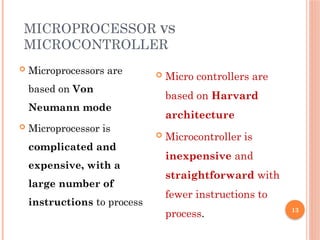
MICROPROCESSOR VS
MICROCONTROLLER
Microprocessorsare
based on Von
Neumann mode
Microprocessor is
complicated and
expensive, with a
large number of
instructions to process
Micro controllers are
based on Harvard
architecture
Microcontroller is
inexpensive and
straightforward with
fewer instructions to
process.
16
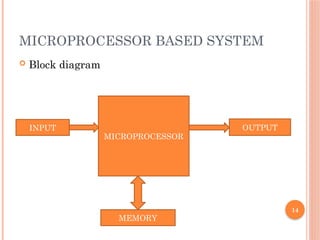
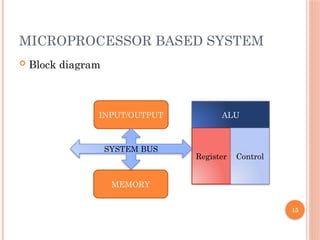
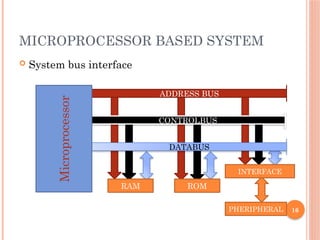
MICROPROCESSOR BASED SYSTEM
System bus interface
PHERIPHERAL
CONTROLBUS
ADDRESS BUS
RAM ROM
INTERFACE
DATABUS
Microprocessor
17.
17
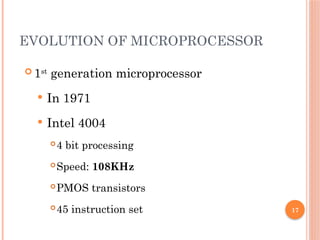
EVOLUTION OF MICROPROCESSOR
1st
generation microprocessor
In 1971
Intel 4004
4 bit processing
Speed: 108KHz
PMOS transistors
45 instruction set
18.
18
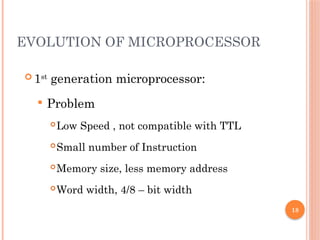
EVOLUTION OF MICROPROCESSOR
1st
generation microprocessor:
Problem
Low Speed , not compatible with TTL
Small number of Instruction
Memory size, less memory address
Word width, 4/8 – bit width
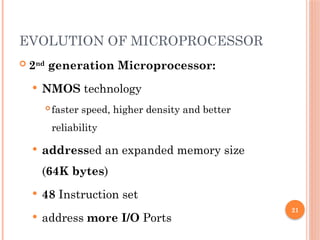
24
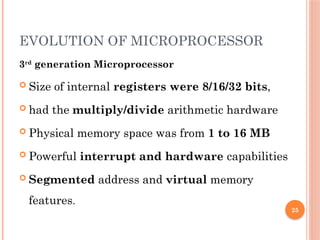
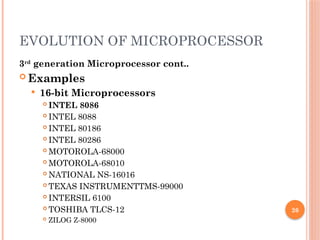
EVOLUTION OF MICROPROCESSOR
3rd
generationMicroprocessor
Introduced in 1978.
16-bit microprocessors
HMOS (High Density MOS) technology.
better speed and higher packing density
than NMOS.
25.
25
EVOLUTION OF MICROPROCESSOR
3rd
generationMicroprocessor
Size of internal registers were 8/16/32 bits,
had the multiply/divide arithmetic hardware
Physical memory space was from 1 to 16 MB
Powerful interrupt and hardware capabilities
Segmented address and virtual memory
features.
28
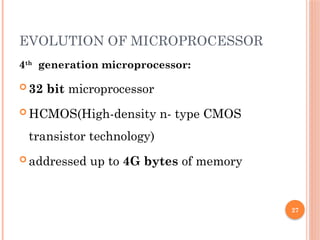
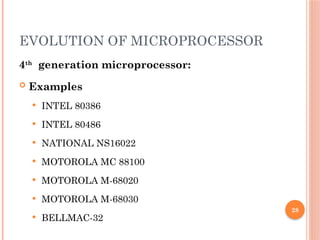
EVOLUTION OF MICROPROCESSOR
4th
generationmicroprocessor:
Examples
INTEL 80386
INTEL 80486
NATIONAL NS16022
MOTOROLA MC 88100
MOTOROLA M-68020
MOTOROLA M-68030
BELLMAC-32
29.
29
EVOLUTION OF MICROPROCESSOR
5th
generation microprocessor:
Introduced by INTEL Corporation in 1993
PENTIUM with 64 data bus.
Clock frequency of 60 MHz and 66 MHz
Speed of 110 MIPS
32
CLASSIFICATION OF
MICROPROCESSOR
Basedon application
I. General-purpose processors
used in general computer system
integration and can be used by the
programmer for any application.
Common processors : Intel 8085 to Pentium
33.
33
CLASSIFICATION OF
MICROPROCESSOR
Basedon application
II. Microcontrollers
chips with built-in hardware for the memory
and ports
can be programmed by the user for any generic
control application
34.
34
CLASSIFICATION OF
MICROPROCESSOR
Basedon application
III. Special-purpose processors
to handle special functions required for an
application
Digital signal processors
Application Specific Integrated Circuit (ASIC)
35.
35
CLASSIFICATION OF
MICROPROCESSOR
Basedon Architecture and Hardware
I. RISC
supports limited machine language
instructions
II. CISC
Large number of instruction
Easier to program
Slower and expensive
36.
36
CLASSIFICATION OF
MICROPROCESSOR
Basedon Architecture and Hardware
III. VLIW(Very large Instruction Word)
instruction-level parallelism
Large number of registers
IV. Superscalar processor
Use complex hardware to achieve parallelism.
overlapping of instruction execution