1
SINGLE-SOURCE SHORTEST PATHS
2
Introduction
Generalization of BFS to handle weighted graphs
• Direct Graph G = ( V, E ), edge weight fn ; w : E → R
• In BFS w(e)=1 for all e  E
Weight of path p = v1  v2  …  vk is
1
1
1
( ) ( , )
k
i i
i
w p w v v



 
3
Shortest Path
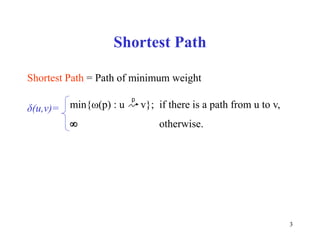
Shortest Path = Path of minimum weight
δ(u,v)= min{ω(p) : u v}; if there is a path from u to v,
 otherwise.
p
4
Shortest-Path Variants
• Shortest-Path problems
– Single-source shortest-paths problem: Find the shortest path from s
to each vertex v. (e.g. BFS)
– Single-destination shortest-paths problem: Find a shortest path to a
given destination vertex t from each vertex v.
– Single-pair shortest-path problem: Find a shortest path from u to v
for given vertices u and v.
– All-pairs shortest-paths problem: Find a shortest path from u to v
for every pair of vertices u and v.
5
Optimal Substructure Property
Theorem: Subpaths of shortest paths are also shortest paths
• Let P1k = <v1, ... ,vk > be a shortest path from v1 to vk
• Let Pij = <vi, ... ,vj > be subpath of P1k from vi to vj
for any i, j
• Then Pij is a shortest path from vi to vj
6
Proof: By cut and paste
• If some subpath were not a shortest path
• We could substitute a shorter subpath to create a shorter
total path
• Hence, the original path would not be shortest path
v2
v3 v4
v5 v6 v7
Optimal Substructure Property
v1
v0
7
Definition:
• δ(u,v) = weight of the shortest path(s) from u to v
Well Definedness:
• negative-weight cycle in graph: Some shortest paths may not
be defined
• argument:can always get a shorter path by going around the
cycle again
s v
cycle
< 0
Optimal Substructure Property
8
Negative-weight edges
• No problem, as long as no negative-weight cycles are
reachable from the source
• Otherwise, we can just keep going around it, and
get w(s, v) = −∞ for all v on the cycle.
9
Triangle Inequality
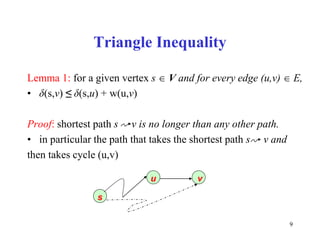
Lemma 1: for a given vertex s  V and for every edge (u,v)  E,
• δ(s,v) ≤ δ(s,u) + w(u,v)
Proof: shortest path s v is no longer than any other path.
• in particular the path that takes the shortest path s v and
then takes cycle (u,v)
s
u v
10
Relaxation
• Maintain d[v] for each v  V
• d[v] is called shortest-path weight estimate
and it is upper bound on δ(s,v)
INIT(G, s)
for each v  V do
d[v] ← ∞
π[v] ← NIL
d[s] ← 0
11
Relaxation
RELAX(u, v)
if d[v] > d[u]+w(u,v) then
d[v] ← d[u]+w(u,v)
π[v] ← u
5
u v
v
u
2
2
9
5 7
Relax(u,v)
5
u v
v
u
2
2
6
5 6
12
Properties of Relaxation
Algorithms differ in
 how many times they relax each edge, and
 the order in which they relax edges
Question: How many times each edge is relaxed in BFS?
Answer: Only once!
13
Properties of Relaxation
Given:
• An edge weighted directed graph G = ( V, E ) with edge
weight function (w:E → R) and a source vertex s  V
• G is initialized by INIT( G , s )
Lemma 2: Immediately after relaxing edge (u,v),
d[v] ≤ d[u] +w(u,v)
Lemma 3: For any sequence of relaxation steps over E,
(a) the invariant d[v] ≥ δ(s,v) is maintained
(b) once d[v] achieves its lower bound, it never changes.
14
Properties of Relaxation
Proof of (a): certainly true after
INIT(G,s) : d[s] = 0 = δ(s,s):d[v] = ∞ ≥ δ(s,v)  v V-{s}
• Proof by contradiction:Let v be the first vertex for which
RELAX(u, v) causes d[v] < δ(s, v)
• After RELAX(u , v) we have
• d[u] + w(u,v) = d[v] < δ(s, v)
≤ δ(s, u) + w(u,v) by L1
• d[u]+w(u,v) < δ(s, u) + w(u, v) => d[u] < δ(s, u)
contradicting the assumption
15
Properties of Relaxation
Proof of (b):
• d[v] cannot decrease after achieving its lower bound;
because d[v] ≥ δ(s,v)
• d[v] cannot increase since relaxations don’t increase d
values.
16
Properties of Relaxation
C1 : For any vertex v which is not reachable from s, we have
invariant d[v] = δ(s,v) that is maintained over any sequence of
relaxations
Proof: By L3(b), we always have ∞ = δ(s,v) ≤ d[v]
=> d[v] = ∞ = δ(s,v)
17
Properties of Relaxation
Lemma 4: Let s u →v be a shortest path from s to v for
some u,v  V
• Suppose that a sequence of relaxations including
RELAX(u,v) were performed on E
• If d[u] = δ(s, u) at any time prior to RELAX(u, v)
• then d[v] = δ(s, v) at all times after RELAX(u, v)
18
Properties of Relaxation
Proof: If d[u] = δ(s, v) prior to RELAX(u, v)
d[u] = δ(s, v) hold thereafter by L3(b)
• After RELAX(u,v), we have d[v] ≤ d[u] + w(u, v) by L2
= δ(s, u) + w(u, v) hypothesis
= δ(s, u) by optimal subst.property
• Thus d[v] ≤ δ(s, v)
• But d[v] ≥ δ(s, v) by L3(a) => d[v] = δ(s, v)
Q.E.D.
19
Single-Source Shortest Paths in DAGs
• Shortest paths are always well-defined in dags
 no cycles => no negative-weight cycles even if
there are negative-weight edges
• Idea: If we were lucky
 To process vertices on each shortest path from left
to right, we would be done in 1 pass due to L4
20
Single-Source Shortest Paths in DAGs
In a dag:
• Every path is a subsequence of the topologically sorted
vertex order
• If we do topological sort and process vertices in that order
• We will process each path in forward order
 Never relax edges out of a vertex until have processed
all edges into the vertex
• Thus, just 1 pass is sufficient
21
Single-Source Shortest Paths in DAGs
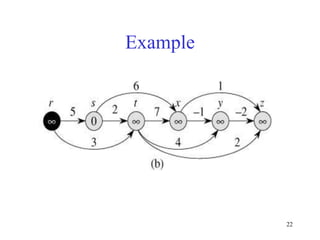
DAG-SHORTEST PATHS(G, s)
TOPOLOGICALLY-SORT the vertices of G
INIT(G, s)
for each vertex u taken in topologically sorted order do
for each v  Adj[u] do
RELAX(u, v)
22
Example
23
Example
24
Example
25
Example
26
Example
27
Example
Single-Source Shortest Paths in DAGs
Runs in linear time: Θ(V+E)
 topological sort: Θ(V+E)
 initialization: Θ(V+E)
 for-loop: Θ(V+E)
each vertex processed exactly once
=> each edge processed exactly once: Θ(V+E)
29
Single-Source Shortest Paths in DAGs
Thm: (Correctness of DAG-SHORTEST-PATHS):
At termination of DAG-SHORTEST-PATHS procedure
d[v] = δ(s, v) for all v V
30
Single-Source Shortest Paths in DAGs
Proof: If v  Rs , then d[v] = δ(s, v)
• If v  Rs , so a shortest path
p = <v0=s, v1, v2, …,vk=v>
• Because we process vertices in topologically sorted order
 Edges on p are relaxed in the order
(u0, u1),(u1, u2),...,(uk-1, uk)
• A simple induction on k using L4 shows that
 d[vi] = δ(s, v) at termination for i = 0,1,2,...,k
v  V
31
• Non-negative edge weight
• Like BFS: If all edge weights are equal, then use BFS,
otherwise use this algorithm
• Use Q = priority queue keyed on d[v] values
(note: BFS uses FIFO)
Dijkstra’s Algorithm For Shortest Paths
32
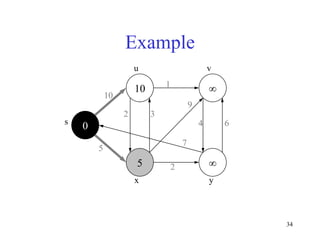
DIJKSTRA(G, s)
INIT(G, s)
S←Ø > set of discovered nodes
Q←V[G]
while Q ≠Ø do
u←EXTRACT-MIN(Q)
S←S U {u}
for each v  Adj[u] do
RELAX(u, v) > May cause
> DECREASE-KEY(Q, v, d[v])
Dijkstra’s Algorithm For Shortest Paths
33
Example
3
 
 
0
s
u v
y
x
10
5
1
2 9
4 6
7
2
34
Example
2
10 
5 
0
s
u v
y
x
10
5
1
3
9
4 6
7
2
35
Example
2
8 14
5 7
0
s
y
x
10
5
1
3 9
4 6
7
2
u v
36
Example
10
8 13
5 7
0
s
u v
y
x
5
1
2 3 9
4 6
7
2
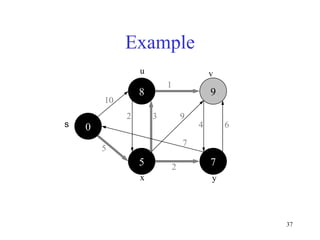
37
Example
8
u v
9
5 7
0
y
x
10
5
1
2 3 9
4 6
7
2
s
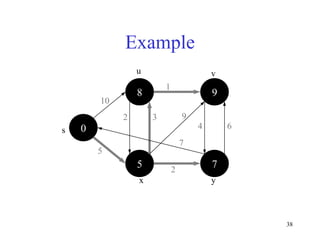
38
Example
u
5
8 9
5 7
0
v
y
x
10
1
2 3 9
4 6
7
2
s
39
Observe :
• Each vertex is extracted from Q and inserted into S
exactly once
• Each edge is relaxed exactly once
• S = set of vertices whose final shortest paths have already
been determined
 i.e. , S = {v  V: d[v] = δ(s, v) ≠ ∞ }
Dijkstra’s Algorithm For Shortest Paths
40
• Similar to BFS algorithm: S corresponds to the set of
black vertices in BFS which have their correct breadth-
first distances already computed
• Greedy strategy: Always chooses the closest(lightest)
vertex in Q = V-S to insert into S
• Relaxation may reset d[v] values thus updating
Q = DECREASE-KEY operation.
Dijkstra’s Algorithm For Shortest Paths
41
• Similar to Prim’s MST algorithm: Both algorithms
use a priority queue to find the lightest vertex outside a
given set S
• Insert this vertex into the set
• Adjust weights of remaining adjacent vertices outside the
set accordingly
Dijkstra’s Algorithm For Shortest Paths
42
Example: Run algorithm on a sample graph
4
3
2
10
5 1
s
0
∞ 5
∞ 10 9 8
∞ 6
Dijkstra’s Algorithm For Shortest Paths
43
Thm: At termination of Dijkstra’s algorithm
d[u] = δ(s, u)  u  V
Proof: Trivial for u  Rs since d[u] = ∞ = δ(s, u)
Proof: By contradiction for u  Rs
• Let u be the first vertex for which d[u] ≠ δ(s, u) when it is
inserted to S
• d[u] > δ(s, u) since d[v] ≥ δ(s, v)  v  V by L3(a)
• Consider an actual shortest path p from s  S to
u  Q = V-S
Correctness of Dijkstra’s Algorithm
44
• Let y be first vertex along p such that y  V-S
• Let x  V be y’s predecessor along p
• Thus p can be decomposed as s x→y u
Claim: d[y] = δ(s, y) when u was selected from Q for
insertion into S
• Observe that x  S by assumption on y
• d[x] = δ(s, x) by assumption on u being first
vertex in S for which d[u] ≠ δ(s, u)
Correctness of Dijkstra’s Algorithm
p1 p2
45
Correctness of Dijkstra’s Algorithm
• x  S => x is already processed => edge (x, y) is already
relaxed => d[y] = δ(s, y) by L4 & optimal subst. property
s
x y
u
P2
P1
46
• d[u] > δ(s, u)
= δ(s, y) + w(p2) by optimal substructure Thm
= d[y] + w(p2) by the above claim
≥ d[y] due to non-negative edge-weight assumption
• d[u] > d[y] => algorithm would have chosen y to
process next, not u.Contradiction
Correctness of Dijkstra’s Algorithm
s
x y
u
P2
P1
47
Figure about the proof:
Correctness of Dijkstra’s Algorithm
s
x y
u
P2
P1
S
 vertices x&y are distinct, but may have s=x and/or y=u
 path P2 may or may not reenter set S
48
• Look at different Q implementation, as did for Prim’s
algorithm
• Initialization (INIT) : Θ(V) time
• While-loop:
• EXTRACT-MIN executed |V| times
• DECREASE-KEY executed |E| times
• Time T = |V| x TE-MIN +|E| x TD-KEY
Running Time Analysis of
Dijkstra’s Algorithm
49
Look at different Q implementation, as did for Prim’s
algorithm
Q TE-MIN TD-KEY TOTAL
• Linear
Unsorted O(V) O(1) O(V²+E)
Array:
• Binary Heap: O(lgV) O(logV) O(VlgV+ElgV) = O(ElgV)
• Fibonacci heap: O(lgV) O(1) O(VlgV+E)
(Amortized) (Amortized) (Worst Case)
Running Time Analysis of
Dijkstra’s Algorithm
50
Q = unsorted-linear array:
• Scan the whole array for EXTRACT-MIN
• Joint index for DECREASE-KEY
Q = Fibonacci heap: note advantage of amortized analysis
• Can use amortized Fibonacci heap bounds per operation
in the analysis as if they were worst-case bound
• Still get (real) worst-case bounds on aggregate running
time
Running Time Analysis of
Dijkstra’s Algorithm
51
Bellman-Ford Algorithm for Single
Source Shortest Paths
• More general than Dijkstra’s algorithm:
 Edge-weights can be negative
• Detects the existence of negative-weight cycle(s)
reachable from s.
52
BELMAN-FORD( G, s )
INIT( G, s )
for i ←1 to |V|-1 do
for each edge (u, v)  E do
RELAX( u, v )
for each edge ( u, v )  E do
if d[v] > d[u]+w(u,v) then
return FALSE > neg-weight cycle
return TRUE
Bellman-Ford Algorithm for Single
Source Shortest Paths
53
Observe:
• First nested for-loop performs |V|-1 relaxation passes;
relax every edge at each pass
• Last for-loop checks the existence of a negative-weight
cycle reachable from s
Bellman-Ford Algorithm for Single
Source Shortest Paths
54
• Running time = O(VxE)
Constants are good; it’s simple, short code(very
practical)
• Example: Run algorithm on a sample graph with
no negative weight cycles.
Bellman-Ford Algorithm for Single
Source Shortest Paths
55
Bellman-Ford Algorithm
Example
5
 
 
0
s
z
y
6
7
8
-3
7
2
9
-2
x
t
-4
56
Bellman-Ford Algorithm
Example
6 
7 
0
s
z
y
6
7
8
-3
7
2
9
-2
x
t
-4
5
57
Bellman-Ford Algorithm
Example
6 4
7 2
0
s
z
y
6
7
8
-3
7
2
9
-2
x
t
-4
5
58
Bellman-Ford Algorithm
Example
2 4
7 2
0
s
z
y
6
7
8
-3
7
2
9
-2
x
t
-4
5
59
Bellman-Ford Algorithm
Example
2 4
7 2
0
s
z
y
6
7
8
-3
7
2
9
-2
x
t
-4
5
60
• Converges in just 2 relaxation passes
• Values you get on each pass & how early converges
depend on edge process order
• d value of a vertex may be updated more than once in a
pass
Bellman-Ford Algorithm for Single
Source Shortest Paths
61
Correctness of Bellman-Ford Algorithm
L5: Assume that G contains no negative-weight cycles
reachable from s
• Thm, at termination of BELLMAN-FORD, we have
d[v] = δ(s, v)  v Rs
• Proof: Let v  Rs , consider a shortest path
p = <v0=s,v1,v2,...,vk=v> from s to v
62
• No neg-weight cycle => path p is simple => k ≤|V|-1
o i.e., longest simple path has |V|-1 edge
prove by induction that for i = 0,1,...,k
o we have d[v1] = δ(s,vi) after i-th pass and this
equality maintained thereafter
basis: d[v0=s] = 0 = δ(s, s) after INIT( G, s ) and doesn’t
change by L3(b)
hypothesis: assume that d[vi-1] = δ(s,vi-1) after the (i-1)th
pass
Correctness of Bellman-Ford Algorithm
63
• Edge (vi-1, vi) is relaxed in the ith pass
o so by L4 , d[vi] = δ(s,vi) after i-th pass, and doesn’t
change thereafter
Thm:Bellman-Ford algorithm
(a) returns TRUE together with correct d values, if G
contains no neg-weight cycle  Rs
(b) returns FALSE, otherwise
Correctness of Bellman-Ford Algorithm
64
Proof of (a):
• if v  Rs , then L5 proves this claim
• if v  Rs , the claim follows from L1
• Now, prove the claim that BELLMAN-FORD returns
TRUE
Correctness of Bellman-Ford Algorithm
65
• At termination, we have for all edges (u, v)  E
d[v] = δ(s,v)
≤ δ(s, u) + w(u, v) by triangle inequality
= d[u] + w(u,v) by first claim proven
• d[v] ≤ d[u] +w(u, v) => none of the if tests in the 2nd for
loop passes therefore, it returns TRUE.
Correctness of Bellman-Ford Algorithm
66
k
i = 1
Correctness of Bellman-Ford Algorithm
k
i = 1
k
i = 1
k
i = 1
67
But, each vertex in c appears exactly once in both
Σ d[vi] & Σ d[vi-1]
• Therefore, Σ d[vi] = Σ d[vi-1]
• Moreover, d[vi] is finite  vi  C , since c  Rs
• Thus, 0 ≤ Σ w(vi-1, vi)
0 ≤ Σ w(vi-1, vi) = w(c), contradicting w(c) < 0
Q.E.D.
Correctness of Bellman-Ford Algorithm
k
i = 1
k
i = 1
k
i = 1
k
i = 1
k
i = 1
k
i = 1
68
LINEAR PROGRAMMING(LP)
• given: an mxn constraint matrix A & an mx1 bound vector b
& an nx1 cost vector c
• problem : find an n-vector x that maximizes cTx subject
•
A ≤ maximizing
A x b C
x n
T
m
n
n
Linear Programming and
Bellman-Ford Algorithm
m
n
69
• Linear feasibility:
• satisfy m linear constraints : Σ aij ≤ bi
for i = 1,2,...,m
• Linear optimization:
• maximize the linear cost(objective) function: Σ ljxj
• General algorithms:
• simplex: practical, but worst-case is exponential
• ellipsoid: theoretical, polynomial time
• Karmarkar: polynomial time, practical
n
i = 1
Linear Programming and
Bellman-Ford Algorithm
n
i = 1
70
Linear Feasibility Problem
• special case of LP
• no optimization criteria
• find x  R such that Ax ≤ b
Systems of Difference Constraints
• special case of linear feasibility problem
• each row of A contains exactly one 1 and one –1, and the
rest 0
• thus, constraints have the form xj-xi ≤ bk ,
1 ≤ i, j ≤ n & 1 ≤ k ≤ m
n
Linear Programming and
Bellman-Ford Algorithm
71
x1
x2
x3
x4
≤
0
-1
1
5
4
-1
-3
-3
x1-x2 ≤ 0 = b1
x1-x5 ≤ -1 = b2
x2-x5 ≤ 1 = b3
x3-x1 ≤ 5 = b4
x4-x1 ≤ 4 = b5
x4-x3 ≤ -1 = b6
x5-x3 ≤ -3 = b7
x5-x4 ≤ -3 = b8
Linear Programming and
Bellman-Ford Algorithm
x5
example:
1 -1 0 0 0
1 0 0 0 -1
0 1 0 0 -1
-1 0 1 0 0
-1 0 0 1 0
0 0 -1 1 0
0 0 -1 0 1
0 0 0 -1 1
1 2 3 4 5
1
2
3
4
5
6
7
8
72
• Two solutions : x = ( -5, -3, 0,-1, -4 ) & x = < 0, 2, 5, 4, 1 >
note : x = x*+5
• L1: let x = ( x1, x2, ... , xn ) be a solution to a system Ax ≤ b
of difference constraints
=> x+d = (x1+d, x2+d, ..., xn+d) is also a solution for any
constant d
1 2 3 4 5 1 2 3 4 5
Linear Programming and
Bellman-Ford Algorithm
73
• proof: for each xi&xj: (xj+d)-(xi+d) = xj-xi
• application: job(task scheduling)
• given: n tasks t1,t2,...,tn
• problem: determine starting time xi for job ti
for i = 1,2,...,n
• constraints:
o xi ≥ xj +dj = duration of tj, i.e., do job ti after
finishing tj
o xi ≤ xj+gij;gj = max permissible time gap between
starting jobs
Q.E.D.
Linear Programming and
Bellman-Ford Algorithm
74
• graph theoritical representation of difference constraints
• a system Ax ≤ b of difference constraints with an mxn
constraint matrix A
=> incidence matrix of an edge-weighted directed graph
with n vertices and m edges
• one vertex per variable: V = {v1,v2,...,vn} such that
Vi ↔ Xi for i = 1,2,...,n
Linear Programming and
Bellman-Ford Algorithm
75
• one edge per constraint:
k-th constraint xj-xi ≤ bk
• xj-xi ≤ bk edge lij incident to vj(+1)
from vi(-1)
• more than one constraint on xj-xi for a single i,j pair
o :can avoid multiple edges by removing
weaker constraints
vi vj
vi vj
Linear Programming and
Bellman-Ford Algorithm
76
• constraint graph for the sample system of difference
constraints
Linear Programming and
Bellman-Ford Algorithm
v5
v4 v3
v2
b3 = 1
5 = b4
-3 = b7
4 = b5
b6 = -1
b7 = -3
v1
• constraint graph for the sample system of difference
constraints
1 -1 0 0 0
1 0 0 0 -1
0 1 0 0 -1
-1 0 1 0 0
-1 0 0 1 0
0 0 -1 1 0
0 0 -1 0 1
0 0 0 -1 1
1 2 3 4 5
1
2
3
4
5
6
7
8
0
-1
1
5
4
-1
-3
-3
b
77
• adding vertex s to enable Bellman-Ford algorithm solve the
feasibility problem.
δ(s,vi)
x = (-5, -3, 0, -1, -4)
feasible soln.
1 2 3 4 5
vi
0
0
-1
-3
0
-1 0
-3
s
v5
v1
v2
v3
5
-3
4
-1
1
0
-4
-5
0
0
Linear Programming and
Bellman-Ford Algorithm
78
Difference Constraints and
Bellman-Ford Algorithm
• Thm: let G = (V,E) be the constraint graph of the system
Ax ≤ b of difference constraints.
(a) if G has a neg-wgt cycle then Ax ≤ b has no feasible soln
(b) if G has no neg-wgt cycle then Ax ≤ b has a feasible
solution
• proof(a): let neg-wgt cycle be c = <v1,v2,...,vk=vl>
cycle c contains the following k constraints (inequalities)
79
• x2-x1 ≤ w12
x3-x2 ≤ w23
.
.
.
xk-1-xk-2 ≤ wk-2, k-1
+ xk = x1-xk-1 ≤ wk-1, 1
x1 – x1 ≤ w(i) < 0 => x1-x1 < 0 => no solution
Difference Constraints and
Bellman-Ford Algorithm
80
• Consider any feasible soln. x for Ax ≤ b
o x must satisfy each of these k inequalities
o x must also satisfy the inequality that results when we
sum them together
Difference Constraints and
Bellman-Ford Algorithm
81
• proof(b): add vertex s  V with 0-weight edge to each vertex
vi  V
• i.e., G0 = (V0, E0) V0 = V U {S} &
E0 = E U {(s, vi): }&  v V w(s,vi) = 0
• no neg-wgt cycle introduced , because no path to
vertex s
• use Bellman-Ford to find shortest-path weights from
common source s to every Vi V
Difference Constraints and
Bellman-Ford Algorithm
82
• Claim : X = (xi) with xi = δ(s,vi) is a feasible soln. to Ax ≤ b
o consider kth constraint xj-xi ≤ bk => (vi, vj)  E
with wij = bk
triangle ineaquality: δ(s,vi) ≤ δ(s,vi)+wij
xj ≤ xi + bk
xj - xi ≤ bk
s
vi vj
Difference Constraints and
Bellman-Ford Algorithm
83
• δ(s,vj) ≤ δ(s,vi) + bk => δ(s,vj) - δ(s,vi) ≤ bk => xj-xi ≤ bk
• so, Bellman-Ford solves a special case of LP
Bellman-Ford also minimizes Max{xi}-Min{xi}
1 ≤i ≤n 1 ≤i ≤n
Difference Constraints and
Bellman-Ford Algorithm

Bellman ford algorithm

  • 1.
  • 2.
    2 Introduction Generalization of BFSto handle weighted graphs • Direct Graph G = ( V, E ), edge weight fn ; w : E → R • In BFS w(e)=1 for all e  E Weight of path p = v1  v2  …  vk is 1 1 1 ( ) ( , ) k i i i w p w v v     
  • 3.
    3 Shortest Path Shortest Path= Path of minimum weight δ(u,v)= min{ω(p) : u v}; if there is a path from u to v,  otherwise. p
  • 4.
    4 Shortest-Path Variants • Shortest-Pathproblems – Single-source shortest-paths problem: Find the shortest path from s to each vertex v. (e.g. BFS) – Single-destination shortest-paths problem: Find a shortest path to a given destination vertex t from each vertex v. – Single-pair shortest-path problem: Find a shortest path from u to v for given vertices u and v. – All-pairs shortest-paths problem: Find a shortest path from u to v for every pair of vertices u and v.
  • 5.
    5 Optimal Substructure Property Theorem:Subpaths of shortest paths are also shortest paths • Let P1k = <v1, ... ,vk > be a shortest path from v1 to vk • Let Pij = <vi, ... ,vj > be subpath of P1k from vi to vj for any i, j • Then Pij is a shortest path from vi to vj
  • 6.
    6 Proof: By cutand paste • If some subpath were not a shortest path • We could substitute a shorter subpath to create a shorter total path • Hence, the original path would not be shortest path v2 v3 v4 v5 v6 v7 Optimal Substructure Property v1 v0
  • 7.
    7 Definition: • δ(u,v) =weight of the shortest path(s) from u to v Well Definedness: • negative-weight cycle in graph: Some shortest paths may not be defined • argument:can always get a shorter path by going around the cycle again s v cycle < 0 Optimal Substructure Property
  • 8.
    8 Negative-weight edges • Noproblem, as long as no negative-weight cycles are reachable from the source • Otherwise, we can just keep going around it, and get w(s, v) = −∞ for all v on the cycle.
  • 9.
    9 Triangle Inequality Lemma 1:for a given vertex s  V and for every edge (u,v)  E, • δ(s,v) ≤ δ(s,u) + w(u,v) Proof: shortest path s v is no longer than any other path. • in particular the path that takes the shortest path s v and then takes cycle (u,v) s u v
  • 10.
    10 Relaxation • Maintain d[v]for each v  V • d[v] is called shortest-path weight estimate and it is upper bound on δ(s,v) INIT(G, s) for each v  V do d[v] ← ∞ π[v] ← NIL d[s] ← 0
  • 11.
    11 Relaxation RELAX(u, v) if d[v]> d[u]+w(u,v) then d[v] ← d[u]+w(u,v) π[v] ← u 5 u v v u 2 2 9 5 7 Relax(u,v) 5 u v v u 2 2 6 5 6
  • 12.
    12 Properties of Relaxation Algorithmsdiffer in  how many times they relax each edge, and  the order in which they relax edges Question: How many times each edge is relaxed in BFS? Answer: Only once!
  • 13.
    13 Properties of Relaxation Given: •An edge weighted directed graph G = ( V, E ) with edge weight function (w:E → R) and a source vertex s  V • G is initialized by INIT( G , s ) Lemma 2: Immediately after relaxing edge (u,v), d[v] ≤ d[u] +w(u,v) Lemma 3: For any sequence of relaxation steps over E, (a) the invariant d[v] ≥ δ(s,v) is maintained (b) once d[v] achieves its lower bound, it never changes.
  • 14.
    14 Properties of Relaxation Proofof (a): certainly true after INIT(G,s) : d[s] = 0 = δ(s,s):d[v] = ∞ ≥ δ(s,v)  v V-{s} • Proof by contradiction:Let v be the first vertex for which RELAX(u, v) causes d[v] < δ(s, v) • After RELAX(u , v) we have • d[u] + w(u,v) = d[v] < δ(s, v) ≤ δ(s, u) + w(u,v) by L1 • d[u]+w(u,v) < δ(s, u) + w(u, v) => d[u] < δ(s, u) contradicting the assumption
  • 15.
    15 Properties of Relaxation Proofof (b): • d[v] cannot decrease after achieving its lower bound; because d[v] ≥ δ(s,v) • d[v] cannot increase since relaxations don’t increase d values.
  • 16.
    16 Properties of Relaxation C1: For any vertex v which is not reachable from s, we have invariant d[v] = δ(s,v) that is maintained over any sequence of relaxations Proof: By L3(b), we always have ∞ = δ(s,v) ≤ d[v] => d[v] = ∞ = δ(s,v)
  • 17.
    17 Properties of Relaxation Lemma4: Let s u →v be a shortest path from s to v for some u,v  V • Suppose that a sequence of relaxations including RELAX(u,v) were performed on E • If d[u] = δ(s, u) at any time prior to RELAX(u, v) • then d[v] = δ(s, v) at all times after RELAX(u, v)
  • 18.
    18 Properties of Relaxation Proof:If d[u] = δ(s, v) prior to RELAX(u, v) d[u] = δ(s, v) hold thereafter by L3(b) • After RELAX(u,v), we have d[v] ≤ d[u] + w(u, v) by L2 = δ(s, u) + w(u, v) hypothesis = δ(s, u) by optimal subst.property • Thus d[v] ≤ δ(s, v) • But d[v] ≥ δ(s, v) by L3(a) => d[v] = δ(s, v) Q.E.D.
  • 19.
    19 Single-Source Shortest Pathsin DAGs • Shortest paths are always well-defined in dags  no cycles => no negative-weight cycles even if there are negative-weight edges • Idea: If we were lucky  To process vertices on each shortest path from left to right, we would be done in 1 pass due to L4
  • 20.
    20 Single-Source Shortest Pathsin DAGs In a dag: • Every path is a subsequence of the topologically sorted vertex order • If we do topological sort and process vertices in that order • We will process each path in forward order  Never relax edges out of a vertex until have processed all edges into the vertex • Thus, just 1 pass is sufficient
  • 21.
    21 Single-Source Shortest Pathsin DAGs DAG-SHORTEST PATHS(G, s) TOPOLOGICALLY-SORT the vertices of G INIT(G, s) for each vertex u taken in topologically sorted order do for each v  Adj[u] do RELAX(u, v)
  • 22.
  • 23.
  • 24.
  • 25.
  • 26.
  • 27.
  • 28.
    Single-Source Shortest Pathsin DAGs Runs in linear time: Θ(V+E)  topological sort: Θ(V+E)  initialization: Θ(V+E)  for-loop: Θ(V+E) each vertex processed exactly once => each edge processed exactly once: Θ(V+E)
  • 29.
    29 Single-Source Shortest Pathsin DAGs Thm: (Correctness of DAG-SHORTEST-PATHS): At termination of DAG-SHORTEST-PATHS procedure d[v] = δ(s, v) for all v V
  • 30.
    30 Single-Source Shortest Pathsin DAGs Proof: If v  Rs , then d[v] = δ(s, v) • If v  Rs , so a shortest path p = <v0=s, v1, v2, …,vk=v> • Because we process vertices in topologically sorted order  Edges on p are relaxed in the order (u0, u1),(u1, u2),...,(uk-1, uk) • A simple induction on k using L4 shows that  d[vi] = δ(s, v) at termination for i = 0,1,2,...,k v  V
  • 31.
    31 • Non-negative edgeweight • Like BFS: If all edge weights are equal, then use BFS, otherwise use this algorithm • Use Q = priority queue keyed on d[v] values (note: BFS uses FIFO) Dijkstra’s Algorithm For Shortest Paths
  • 32.
    32 DIJKSTRA(G, s) INIT(G, s) S←Ø> set of discovered nodes Q←V[G] while Q ≠Ø do u←EXTRACT-MIN(Q) S←S U {u} for each v  Adj[u] do RELAX(u, v) > May cause > DECREASE-KEY(Q, v, d[v]) Dijkstra’s Algorithm For Shortest Paths
  • 33.
    33 Example 3     0 s uv y x 10 5 1 2 9 4 6 7 2
  • 34.
    34 Example 2 10  5  0 s uv y x 10 5 1 3 9 4 6 7 2
  • 35.
  • 36.
    36 Example 10 8 13 5 7 0 s uv y x 5 1 2 3 9 4 6 7 2
  • 37.
  • 38.
  • 39.
    39 Observe : • Eachvertex is extracted from Q and inserted into S exactly once • Each edge is relaxed exactly once • S = set of vertices whose final shortest paths have already been determined  i.e. , S = {v  V: d[v] = δ(s, v) ≠ ∞ } Dijkstra’s Algorithm For Shortest Paths
  • 40.
    40 • Similar toBFS algorithm: S corresponds to the set of black vertices in BFS which have their correct breadth- first distances already computed • Greedy strategy: Always chooses the closest(lightest) vertex in Q = V-S to insert into S • Relaxation may reset d[v] values thus updating Q = DECREASE-KEY operation. Dijkstra’s Algorithm For Shortest Paths
  • 41.
    41 • Similar toPrim’s MST algorithm: Both algorithms use a priority queue to find the lightest vertex outside a given set S • Insert this vertex into the set • Adjust weights of remaining adjacent vertices outside the set accordingly Dijkstra’s Algorithm For Shortest Paths
  • 42.
    42 Example: Run algorithmon a sample graph 4 3 2 10 5 1 s 0 ∞ 5 ∞ 10 9 8 ∞ 6 Dijkstra’s Algorithm For Shortest Paths
  • 43.
    43 Thm: At terminationof Dijkstra’s algorithm d[u] = δ(s, u)  u  V Proof: Trivial for u  Rs since d[u] = ∞ = δ(s, u) Proof: By contradiction for u  Rs • Let u be the first vertex for which d[u] ≠ δ(s, u) when it is inserted to S • d[u] > δ(s, u) since d[v] ≥ δ(s, v)  v  V by L3(a) • Consider an actual shortest path p from s  S to u  Q = V-S Correctness of Dijkstra’s Algorithm
  • 44.
    44 • Let ybe first vertex along p such that y  V-S • Let x  V be y’s predecessor along p • Thus p can be decomposed as s x→y u Claim: d[y] = δ(s, y) when u was selected from Q for insertion into S • Observe that x  S by assumption on y • d[x] = δ(s, x) by assumption on u being first vertex in S for which d[u] ≠ δ(s, u) Correctness of Dijkstra’s Algorithm p1 p2
  • 45.
    45 Correctness of Dijkstra’sAlgorithm • x  S => x is already processed => edge (x, y) is already relaxed => d[y] = δ(s, y) by L4 & optimal subst. property s x y u P2 P1
  • 46.
    46 • d[u] >δ(s, u) = δ(s, y) + w(p2) by optimal substructure Thm = d[y] + w(p2) by the above claim ≥ d[y] due to non-negative edge-weight assumption • d[u] > d[y] => algorithm would have chosen y to process next, not u.Contradiction Correctness of Dijkstra’s Algorithm s x y u P2 P1
  • 47.
    47 Figure about theproof: Correctness of Dijkstra’s Algorithm s x y u P2 P1 S  vertices x&y are distinct, but may have s=x and/or y=u  path P2 may or may not reenter set S
  • 48.
    48 • Look atdifferent Q implementation, as did for Prim’s algorithm • Initialization (INIT) : Θ(V) time • While-loop: • EXTRACT-MIN executed |V| times • DECREASE-KEY executed |E| times • Time T = |V| x TE-MIN +|E| x TD-KEY Running Time Analysis of Dijkstra’s Algorithm
  • 49.
    49 Look at differentQ implementation, as did for Prim’s algorithm Q TE-MIN TD-KEY TOTAL • Linear Unsorted O(V) O(1) O(V²+E) Array: • Binary Heap: O(lgV) O(logV) O(VlgV+ElgV) = O(ElgV) • Fibonacci heap: O(lgV) O(1) O(VlgV+E) (Amortized) (Amortized) (Worst Case) Running Time Analysis of Dijkstra’s Algorithm
  • 50.
    50 Q = unsorted-lineararray: • Scan the whole array for EXTRACT-MIN • Joint index for DECREASE-KEY Q = Fibonacci heap: note advantage of amortized analysis • Can use amortized Fibonacci heap bounds per operation in the analysis as if they were worst-case bound • Still get (real) worst-case bounds on aggregate running time Running Time Analysis of Dijkstra’s Algorithm
  • 51.
    51 Bellman-Ford Algorithm forSingle Source Shortest Paths • More general than Dijkstra’s algorithm:  Edge-weights can be negative • Detects the existence of negative-weight cycle(s) reachable from s.
  • 52.
    52 BELMAN-FORD( G, s) INIT( G, s ) for i ←1 to |V|-1 do for each edge (u, v)  E do RELAX( u, v ) for each edge ( u, v )  E do if d[v] > d[u]+w(u,v) then return FALSE > neg-weight cycle return TRUE Bellman-Ford Algorithm for Single Source Shortest Paths
  • 53.
    53 Observe: • First nestedfor-loop performs |V|-1 relaxation passes; relax every edge at each pass • Last for-loop checks the existence of a negative-weight cycle reachable from s Bellman-Ford Algorithm for Single Source Shortest Paths
  • 54.
    54 • Running time= O(VxE) Constants are good; it’s simple, short code(very practical) • Example: Run algorithm on a sample graph with no negative weight cycles. Bellman-Ford Algorithm for Single Source Shortest Paths
  • 55.
    55 Bellman-Ford Algorithm Example 5    0 s z y 6 7 8 -3 7 2 9 -2 x t -4
  • 56.
    56 Bellman-Ford Algorithm Example 6  7 0 s z y 6 7 8 -3 7 2 9 -2 x t -4 5
  • 57.
    57 Bellman-Ford Algorithm Example 6 4 72 0 s z y 6 7 8 -3 7 2 9 -2 x t -4 5
  • 58.
    58 Bellman-Ford Algorithm Example 2 4 72 0 s z y 6 7 8 -3 7 2 9 -2 x t -4 5
  • 59.
    59 Bellman-Ford Algorithm Example 2 4 72 0 s z y 6 7 8 -3 7 2 9 -2 x t -4 5
  • 60.
    60 • Converges injust 2 relaxation passes • Values you get on each pass & how early converges depend on edge process order • d value of a vertex may be updated more than once in a pass Bellman-Ford Algorithm for Single Source Shortest Paths
  • 61.
    61 Correctness of Bellman-FordAlgorithm L5: Assume that G contains no negative-weight cycles reachable from s • Thm, at termination of BELLMAN-FORD, we have d[v] = δ(s, v)  v Rs • Proof: Let v  Rs , consider a shortest path p = <v0=s,v1,v2,...,vk=v> from s to v
  • 62.
    62 • No neg-weightcycle => path p is simple => k ≤|V|-1 o i.e., longest simple path has |V|-1 edge prove by induction that for i = 0,1,...,k o we have d[v1] = δ(s,vi) after i-th pass and this equality maintained thereafter basis: d[v0=s] = 0 = δ(s, s) after INIT( G, s ) and doesn’t change by L3(b) hypothesis: assume that d[vi-1] = δ(s,vi-1) after the (i-1)th pass Correctness of Bellman-Ford Algorithm
  • 63.
    63 • Edge (vi-1,vi) is relaxed in the ith pass o so by L4 , d[vi] = δ(s,vi) after i-th pass, and doesn’t change thereafter Thm:Bellman-Ford algorithm (a) returns TRUE together with correct d values, if G contains no neg-weight cycle  Rs (b) returns FALSE, otherwise Correctness of Bellman-Ford Algorithm
  • 64.
    64 Proof of (a): •if v  Rs , then L5 proves this claim • if v  Rs , the claim follows from L1 • Now, prove the claim that BELLMAN-FORD returns TRUE Correctness of Bellman-Ford Algorithm
  • 65.
    65 • At termination,we have for all edges (u, v)  E d[v] = δ(s,v) ≤ δ(s, u) + w(u, v) by triangle inequality = d[u] + w(u,v) by first claim proven • d[v] ≤ d[u] +w(u, v) => none of the if tests in the 2nd for loop passes therefore, it returns TRUE. Correctness of Bellman-Ford Algorithm
  • 66.
    66 k i = 1 Correctnessof Bellman-Ford Algorithm k i = 1 k i = 1 k i = 1
  • 67.
    67 But, each vertexin c appears exactly once in both Σ d[vi] & Σ d[vi-1] • Therefore, Σ d[vi] = Σ d[vi-1] • Moreover, d[vi] is finite  vi  C , since c  Rs • Thus, 0 ≤ Σ w(vi-1, vi) 0 ≤ Σ w(vi-1, vi) = w(c), contradicting w(c) < 0 Q.E.D. Correctness of Bellman-Ford Algorithm k i = 1 k i = 1 k i = 1 k i = 1 k i = 1 k i = 1
  • 68.
    68 LINEAR PROGRAMMING(LP) • given:an mxn constraint matrix A & an mx1 bound vector b & an nx1 cost vector c • problem : find an n-vector x that maximizes cTx subject • A ≤ maximizing A x b C x n T m n n Linear Programming and Bellman-Ford Algorithm m n
  • 69.
    69 • Linear feasibility: •satisfy m linear constraints : Σ aij ≤ bi for i = 1,2,...,m • Linear optimization: • maximize the linear cost(objective) function: Σ ljxj • General algorithms: • simplex: practical, but worst-case is exponential • ellipsoid: theoretical, polynomial time • Karmarkar: polynomial time, practical n i = 1 Linear Programming and Bellman-Ford Algorithm n i = 1
  • 70.
    70 Linear Feasibility Problem •special case of LP • no optimization criteria • find x  R such that Ax ≤ b Systems of Difference Constraints • special case of linear feasibility problem • each row of A contains exactly one 1 and one –1, and the rest 0 • thus, constraints have the form xj-xi ≤ bk , 1 ≤ i, j ≤ n & 1 ≤ k ≤ m n Linear Programming and Bellman-Ford Algorithm
  • 71.
    71 x1 x2 x3 x4 ≤ 0 -1 1 5 4 -1 -3 -3 x1-x2 ≤ 0= b1 x1-x5 ≤ -1 = b2 x2-x5 ≤ 1 = b3 x3-x1 ≤ 5 = b4 x4-x1 ≤ 4 = b5 x4-x3 ≤ -1 = b6 x5-x3 ≤ -3 = b7 x5-x4 ≤ -3 = b8 Linear Programming and Bellman-Ford Algorithm x5 example: 1 -1 0 0 0 1 0 0 0 -1 0 1 0 0 -1 -1 0 1 0 0 -1 0 0 1 0 0 0 -1 1 0 0 0 -1 0 1 0 0 0 -1 1 1 2 3 4 5 1 2 3 4 5 6 7 8
  • 72.
    72 • Two solutions: x = ( -5, -3, 0,-1, -4 ) & x = < 0, 2, 5, 4, 1 > note : x = x*+5 • L1: let x = ( x1, x2, ... , xn ) be a solution to a system Ax ≤ b of difference constraints => x+d = (x1+d, x2+d, ..., xn+d) is also a solution for any constant d 1 2 3 4 5 1 2 3 4 5 Linear Programming and Bellman-Ford Algorithm
  • 73.
    73 • proof: foreach xi&xj: (xj+d)-(xi+d) = xj-xi • application: job(task scheduling) • given: n tasks t1,t2,...,tn • problem: determine starting time xi for job ti for i = 1,2,...,n • constraints: o xi ≥ xj +dj = duration of tj, i.e., do job ti after finishing tj o xi ≤ xj+gij;gj = max permissible time gap between starting jobs Q.E.D. Linear Programming and Bellman-Ford Algorithm
  • 74.
    74 • graph theoriticalrepresentation of difference constraints • a system Ax ≤ b of difference constraints with an mxn constraint matrix A => incidence matrix of an edge-weighted directed graph with n vertices and m edges • one vertex per variable: V = {v1,v2,...,vn} such that Vi ↔ Xi for i = 1,2,...,n Linear Programming and Bellman-Ford Algorithm
  • 75.
    75 • one edgeper constraint: k-th constraint xj-xi ≤ bk • xj-xi ≤ bk edge lij incident to vj(+1) from vi(-1) • more than one constraint on xj-xi for a single i,j pair o :can avoid multiple edges by removing weaker constraints vi vj vi vj Linear Programming and Bellman-Ford Algorithm
  • 76.
    76 • constraint graphfor the sample system of difference constraints Linear Programming and Bellman-Ford Algorithm v5 v4 v3 v2 b3 = 1 5 = b4 -3 = b7 4 = b5 b6 = -1 b7 = -3 v1 • constraint graph for the sample system of difference constraints 1 -1 0 0 0 1 0 0 0 -1 0 1 0 0 -1 -1 0 1 0 0 -1 0 0 1 0 0 0 -1 1 0 0 0 -1 0 1 0 0 0 -1 1 1 2 3 4 5 1 2 3 4 5 6 7 8 0 -1 1 5 4 -1 -3 -3 b
  • 77.
    77 • adding vertexs to enable Bellman-Ford algorithm solve the feasibility problem. δ(s,vi) x = (-5, -3, 0, -1, -4) feasible soln. 1 2 3 4 5 vi 0 0 -1 -3 0 -1 0 -3 s v5 v1 v2 v3 5 -3 4 -1 1 0 -4 -5 0 0 Linear Programming and Bellman-Ford Algorithm
  • 78.
    78 Difference Constraints and Bellman-FordAlgorithm • Thm: let G = (V,E) be the constraint graph of the system Ax ≤ b of difference constraints. (a) if G has a neg-wgt cycle then Ax ≤ b has no feasible soln (b) if G has no neg-wgt cycle then Ax ≤ b has a feasible solution • proof(a): let neg-wgt cycle be c = <v1,v2,...,vk=vl> cycle c contains the following k constraints (inequalities)
  • 79.
    79 • x2-x1 ≤w12 x3-x2 ≤ w23 . . . xk-1-xk-2 ≤ wk-2, k-1 + xk = x1-xk-1 ≤ wk-1, 1 x1 – x1 ≤ w(i) < 0 => x1-x1 < 0 => no solution Difference Constraints and Bellman-Ford Algorithm
  • 80.
    80 • Consider anyfeasible soln. x for Ax ≤ b o x must satisfy each of these k inequalities o x must also satisfy the inequality that results when we sum them together Difference Constraints and Bellman-Ford Algorithm
  • 81.
    81 • proof(b): addvertex s  V with 0-weight edge to each vertex vi  V • i.e., G0 = (V0, E0) V0 = V U {S} & E0 = E U {(s, vi): }&  v V w(s,vi) = 0 • no neg-wgt cycle introduced , because no path to vertex s • use Bellman-Ford to find shortest-path weights from common source s to every Vi V Difference Constraints and Bellman-Ford Algorithm
  • 82.
    82 • Claim :X = (xi) with xi = δ(s,vi) is a feasible soln. to Ax ≤ b o consider kth constraint xj-xi ≤ bk => (vi, vj)  E with wij = bk triangle ineaquality: δ(s,vi) ≤ δ(s,vi)+wij xj ≤ xi + bk xj - xi ≤ bk s vi vj Difference Constraints and Bellman-Ford Algorithm
  • 83.
    83 • δ(s,vj) ≤δ(s,vi) + bk => δ(s,vj) - δ(s,vi) ≤ bk => xj-xi ≤ bk • so, Bellman-Ford solves a special case of LP Bellman-Ford also minimizes Max{xi}-Min{xi} 1 ≤i ≤n 1 ≤i ≤n Difference Constraints and Bellman-Ford Algorithm