Menchie M. Garachico
Freddie C. Santos Jr.
INTELLECTUAL
DISABILITY
*―An intellectual disability, formerly
referred to as ―mental retardation‖ is
characterized by a combination of deficits
in both cognitive functioning and adaptive
behavior.
*The severity of the intellectual disability is
determined by the discrepancy between
the individual's capabilities in learning and
in and the expectations of the social
environment.
(Project IDEAL, 2008)
The Nature of Intellectual Disability
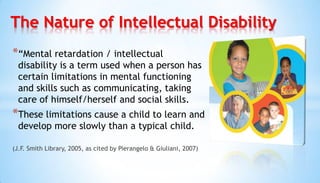
*―Mental retardation / intellectual
disability is a term used when a person has
certain limitations in mental functioning
and skills such as communicating, taking
care of himself/herself and social skills.
*These limitations cause a child to learn and
develop more slowly than a typical child.
(J.F. Smith Library, 2005, as cited by Pierangelo & Giuliani, 2007)
The Nature of Intellectual Disability
Mental Retardation/ Intellectual Disability in
DSM – IV – TR is an Axis II Disorder criteria that
includes:
* Intelligence Test Scores
* Adaptive Functioning
* Age of Onset
(DSM-IV-TR, 2000)
The Nature of Intellectual Disability
“Significantly sub-average general
intellectual functioning, existing
concurrently with deficits in adaptive
behavior and manifested during the
developmental period, that adversely
affects a child’s educational performance.‖
IDEA (Individuals with Disabilities Education Act)
Definitions for Intellectual Disability
―Characterized by significant limitations
both in intellectual functioning and
adaptive behavior, which covers many
everyday social and practical skills. The
disability originates before the age of 18.‖
AAIDD (American Association of Intellectual and Developmental Disabilities)
Definitions for Intellectual Disability
*Conceptual skills—language and literacy; money,
time, and number concepts; and self-direction.
*Social skills—interpersonal skills, social
responsibility, self-esteem, gullibility, naïveté (i.e.,
wariness), social problem solving, and the ability to
follow rules/obey laws and to avoid being
victimized.
*Practical skills—activities of daily living (personal
care), occupational skills, healthcare,
travel/transportation, schedules/routines, safety,
use of money, use of the telephone.
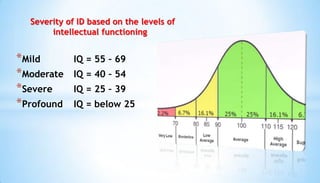
*Mild IQ = 55 – 69
*Moderate IQ = 40 – 54
*Severe IQ = 25 – 39
*Profound IQ = below 25
Severity of ID based on the levels of
intellectual functioning
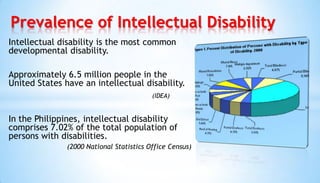
Intellectual disability is the most common
developmental disability.
Approximately 6.5 million people in the
United States have an intellectual disability.
(IDEA)
In the Philippines, intellectual disability
comprises 7.02% of the total population of
persons with disabilities.
(2000 National Statistics Office Census)
Prevalence of Intellectual Disability
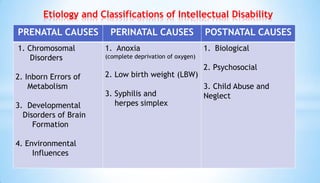
PRENATAL CAUSES PERINATAL CAUSES POSTNATAL CAUSES
1. Chromosomal
Disorders
2. Inborn Errors of
Metabolism
3. Developmental
Disorders of Brain
Formation
4. Environmental
Influences
1. Anoxia
(complete deprivation of oxygen)
2. Low birth weight (LBW)
3. Syphilis and
herpes simplex
1. Biological
2. Psychosocial
3. Child Abuse and
Neglect
Etiology and Classifications of Intellectual Disability
PRENATAL CAUSES
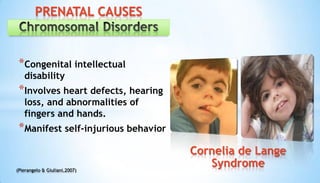
*Congenital intellectual
disability
*Involves heart defects, hearing
loss, and abnormalities of
fingers and hands.
*Manifest self-injurious behavior
(Pierangelo & Giuliani,2007)
PRENATAL CAUSES
Cornelia de Lange
Syndrome
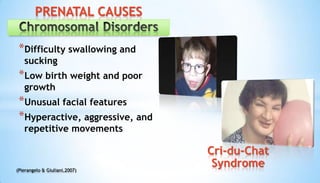
*Difficulty swallowing and
sucking
*Low birth weight and poor
growth
*Unusual facial features
*Hyperactive, aggressive, and
repetitive movements
(Pierangelo & Giuliani,2007)
PRENATAL CAUSES
Cri-du-Chat
Syndrome
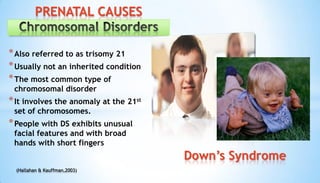
*Also referred to as trisomy 21
*Usually not an inherited condition
*The most common type of
chromosomal disorder
*It involves the anomaly at the 21st
set of chromosomes.
*People with DS exhibits unusual
facial features and with broad
hands with short fingers
(Hallahan & Kauffman,2003)
PRENATAL CAUSES
Down’s Syndrome
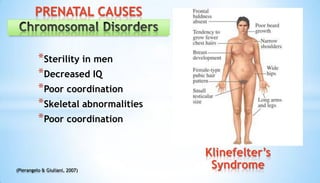
*Sterility in men
*Decreased IQ
*Poor coordination
*Skeletal abnormalities
*Poor coordination
(Pierangelo & Giuliani, 2007)
PRENATAL CAUSES
Klinefelter’s
Syndrome
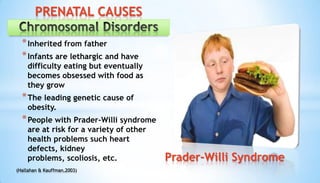
*Inherited from father
*Infants are lethargic and have
difficulty eating but eventually
becomes obsessed with food as

they grow
*The leading genetic cause of
obesity.
*People with Prader-Willi syndrome
are at risk for a variety of other
health problems such heart
defects, kidney
problems, scoliosis, etc. Prader-Willi Syndrome
PRENATAL CAUSES
(Hallahan & Kauffman,2003)
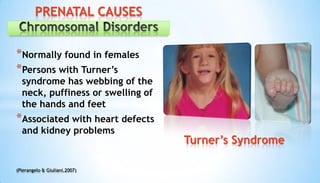
*Normally found in females
*Persons with Turner’s
syndrome has webbing of the
neck, puffiness or swelling of
the hands and feet
*Associated with heart defects
and kidney problems
Turner’s Syndrome
PRENATAL CAUSES
(Pierangelo & Giuliani,2007)
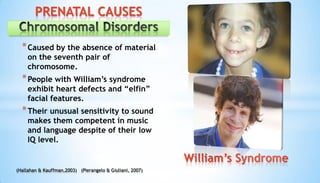
*Caused by the absence of material
on the seventh pair of
chromosome.
*People with William’s syndrome
exhibit heart defects and “elfin”
facial features.
*Their unusual sensitivity to sound
makes them competent in music
and language despite of their low
IQ level.
William’s Syndrome
PRENATAL CAUSES
(Hallahan & Kauffman,2003) (Pierangelo & Giuliani, 2007)
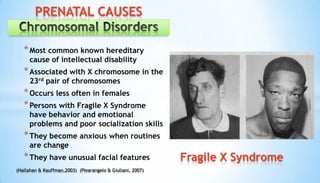
*Most common known hereditary
cause of intellectual disability
*Associated with X chromosome in the
23rd pair of chromosomes
*Occurs less often in females
*Persons with Fragile X Syndrome
have behavior and emotional
problems and poor socialization skills
*They become anxious when routines
are change
*They have unusual facial features Fragile X Syndrome
PRENATAL CAUSES
(Hallahan & Kauffman,2003) (Piearangelo & Giuliani, 2007)
PRENATAL CAUSES
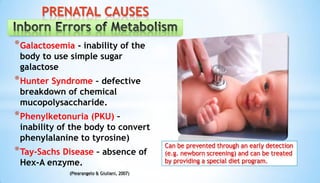
*Galactosemia - inability of the
body to use simple sugar
galactose
*Hunter Syndrome – defective
breakdown of chemical
mucopolysaccharide.
*Phenylketonuria (PKU) –
inability of the body to convert
phenylalanine to tyrosine)
*Tay-Sachs Disease – absence of
Hex-A enzyme.
PRENATAL CAUSES
(Piearangelo & Giuliani, 2007)
Can be prevented through an early detection
(e.g. newborn screening) and can be treated
by providing a special diet program.
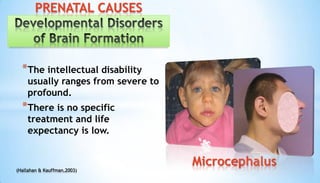
PRENATAL CAUSES
*The intellectual disability
usually ranges from severe to
profound.
*There is no specific
treatment and life
expectancy is low.
Microcephalus
PRENATAL CAUSES
(Hallahan & Kauffman,2003)
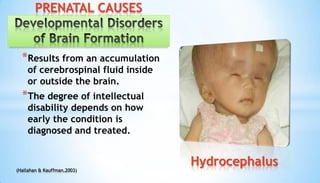
*Results from an accumulation
of cerebrospinal fluid inside
or outside the brain.
*The degree of intellectual
disability depends on how
early the condition is
diagnosed and treated.
Hydrocephalus
PRENATAL CAUSES
(Hallahan & Kauffman,2003)
PRENATAL CAUSES
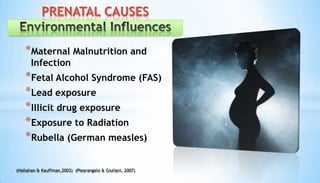
*Maternal Malnutrition and
Infection
*Fetal Alcohol Syndrome (FAS)
*Lead exposure
*Illicit drug exposure
*Exposure to Radiation
*Rubella (German measles)
PRENATAL CAUSES
(Hallahan & Kauffman,2003) (Piearangelo & Giuliani, 2007)
PERINATAL CAUSES
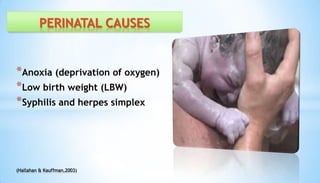
*Anoxia (deprivation of oxygen)
*Low birth weight (LBW)
*Syphilis and herpes simplex
PERINATAL CAUSES
(Hallahan & Kauffman,2003)
POSTNATAL CAUSES
Environmental and
Psychosocial Problems
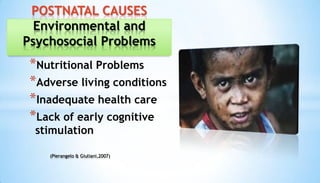
*Nutritional Problems
*Adverse living conditions
*Inadequate health care
*Lack of early cognitive
stimulation
POSTNATAL CAUSES
Environmental and
Psychosocial Problems
(Pierangelo & Giuliani,2007)
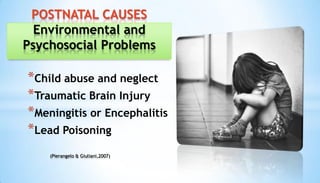
*Child abuse and neglect
*Traumatic Brain Injury
*Meningitis or Encephalitis
*Lead Poisoning
POSTNATAL CAUSES
Environmental and
Psychosocial Problems
(Pierangelo & Giuliani,2007)
PLACEMENT
PROGRAMS
for Persons with
Intellectual Disabilities
*For children with mild intellectual disability, readiness and functional academic
skills are present and thus can be placed into Inclusion Programs.
*Educational placement programs for children with moderate to severe intellectual
disability can be more tedious. Curriculum and materials for these children should
be age-appropriate, which should help develop independent behavior within the
child.
*Individualized Education Program (IEP) is designed to cater the special
educational needs of special children. This is a useful and common vehicle to
develop skills and educate children with intelletual disabilities who are in more
severe cases.
*Behavior Therapy Programs may also be employed, as they are very useful in
altering behavior by lessening distruptive or inappropriate actions of a particular
child.
*Alternative Programs can also be incorporated in a child’s special education
process. Such programs would include vocational training, physical education,
theatre, music, etc.
*Unlike preschool programs for
children at risk, in which the
goal is to prevent intellectual
disability from
occurring, programs for infants
and preschoolers who are
already identified with
intellectual disability are
designed to help them achieve as
high a cognitive level as possible
(Hallahan & Kauffman, 2003).
PLACEMENT PROGRAMS
Early Childhood
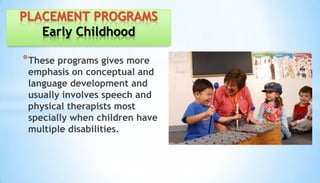
*These programs gives more
emphasis on conceptual and
language development and
usually involves speech and
physical therapists most
specially when children have
multiple disabilities.
PLACEMENT PROGRAMS
Early Childhood
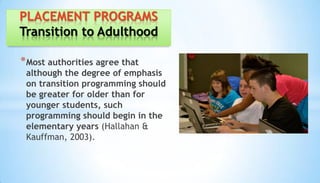
*Most authorities agree that
although the degree of emphasis
on transition programming should
be greater for older than for
younger students, such
programming should begin in the
elementary years (Hallahan &
Kauffman, 2003).
PLACEMENT PROGRAMS
Transition to Adulthood
*Transition programming for
individuals involves two related
areas; first, community
adjustment to acquire a number
of self-help skills and
second, employment to lead to a
meaningful job.
PLACEMENT PROGRAMS
Transition to Adulthood
Current Researches
about
Intellectual Disability
Cerrero, M. E. (2009) Academic engagement of learners with moderate mental retardation through
pictorial self-management and video self-modeling , Unpublished Master’s Thesis, University
of the Philippines – Diliman
Clark, L.L. and Griffiths, P. (2008) Learning Disability and other Intellectual
Impairments, John Wiley & Sons, Ltd.
Davidson, P.W., Janicki, M.P. and Prasher, V.P. (2003) Mental Health,
Intellectual Disabilities and Aging Process, Blackwell Publishing
Definition of Intellectual Disability, AAIDD (2006) retrieved from:
http://www.aaidd.org/content_100.cfm
Drew, C.J. and Hardman, M.L. (2007) Intellectual Disabilities Across the Life
Span, 9th edition, Pearson Education, Inc.
Friend, M. (2011) Special Education: Contemporary Perspectives for School
Professionals, 3rd edition, Pearson Education, Inc.
Hallahan, D.P. and Kauffman, J. M. (2003) Exceptional Learners:
Introduction to Special Education, 9th edition, Pearson Education, Inc.
REFERENCES
Heward, L.W. (2006) Exceptional Children: An Introduction to Special
Education, 8th edition, Pearson Education, Inc.
Intellectual Disability, Project IDEAL (2008) retrieved from:
http://www.projectidealonline.org/intellectualDisabilities.php
Koa, K.S. (2009) Young Adults with Mental Retardations:Their Response
to Death, Grief and Bereavement, Unpublished Master’s Thesis, University
of the Philippines – Diliman
Oliver-Africano, P., Murphy, D., & Tyrer, P. (2009). Aggressive behaviour in
adults with intellectual disability. CNS Drugs,23(11), 903-13.
doi:http://dx.doi.org/10.2165/11310930-000000000-00000
Pierangelo, R. & Giuliani G. (2007) The Educator’s Diagnostic Manual of
Disabilities and Disorders, John Wiley & Sons, Inc.
Pownall, J. D., Jahoda, A., & Hastings, R. P. (2012). Sexuality and sex
education of adolescents with intellectual disability: Mothers' attitudes,
experiences, and support needs. Intellectual and Developmental
Disabilities, 50(2), 140-54. Retrieved from:
http://search.proquest.com/docview/1022483830?accountid=141440
Salvador-Curalla, L., & Bertelli, M. (2007). 'Mental retardation' or
'intellectual disability': Time for a conceptual
change.Psychopathology, 41(1), 10-6. Retrieved from:
http://search.proquest.com/docview/233349678?accountid=141440

Intellectual disability

  • 1.
    Menchie M. Garachico FreddieC. Santos Jr. INTELLECTUAL DISABILITY
  • 2.
    *―An intellectual disability,formerly referred to as ―mental retardation‖ is characterized by a combination of deficits in both cognitive functioning and adaptive behavior. *The severity of the intellectual disability is determined by the discrepancy between the individual's capabilities in learning and in and the expectations of the social environment. (Project IDEAL, 2008) The Nature of Intellectual Disability
  • 3.
    *―Mental retardation /intellectual disability is a term used when a person has certain limitations in mental functioning and skills such as communicating, taking care of himself/herself and social skills. *These limitations cause a child to learn and develop more slowly than a typical child. (J.F. Smith Library, 2005, as cited by Pierangelo & Giuliani, 2007) The Nature of Intellectual Disability
  • 4.
    Mental Retardation/ IntellectualDisability in DSM – IV – TR is an Axis II Disorder criteria that includes: * Intelligence Test Scores * Adaptive Functioning * Age of Onset (DSM-IV-TR, 2000) The Nature of Intellectual Disability
  • 5.
    “Significantly sub-average general intellectualfunctioning, existing concurrently with deficits in adaptive behavior and manifested during the developmental period, that adversely affects a child’s educational performance.‖ IDEA (Individuals with Disabilities Education Act) Definitions for Intellectual Disability
  • 6.
    ―Characterized by significantlimitations both in intellectual functioning and adaptive behavior, which covers many everyday social and practical skills. The disability originates before the age of 18.‖ AAIDD (American Association of Intellectual and Developmental Disabilities) Definitions for Intellectual Disability
  • 7.
    *Conceptual skills—language andliteracy; money, time, and number concepts; and self-direction. *Social skills—interpersonal skills, social responsibility, self-esteem, gullibility, naïveté (i.e., wariness), social problem solving, and the ability to follow rules/obey laws and to avoid being victimized. *Practical skills—activities of daily living (personal care), occupational skills, healthcare, travel/transportation, schedules/routines, safety, use of money, use of the telephone.
  • 8.
    *Mild IQ =55 – 69 *Moderate IQ = 40 – 54 *Severe IQ = 25 – 39 *Profound IQ = below 25 Severity of ID based on the levels of intellectual functioning
  • 9.
    Intellectual disability isthe most common developmental disability. Approximately 6.5 million people in the United States have an intellectual disability. (IDEA) In the Philippines, intellectual disability comprises 7.02% of the total population of persons with disabilities. (2000 National Statistics Office Census) Prevalence of Intellectual Disability
  • 10.
    PRENATAL CAUSES PERINATALCAUSES POSTNATAL CAUSES 1. Chromosomal Disorders 2. Inborn Errors of Metabolism 3. Developmental Disorders of Brain Formation 4. Environmental Influences 1. Anoxia (complete deprivation of oxygen) 2. Low birth weight (LBW) 3. Syphilis and herpes simplex 1. Biological 2. Psychosocial 3. Child Abuse and Neglect Etiology and Classifications of Intellectual Disability
  • 11.
  • 12.
    *Congenital intellectual disability *Involves heartdefects, hearing loss, and abnormalities of fingers and hands. *Manifest self-injurious behavior (Pierangelo & Giuliani,2007) PRENATAL CAUSES Cornelia de Lange Syndrome
  • 13.
    *Difficulty swallowing and sucking *Lowbirth weight and poor growth *Unusual facial features *Hyperactive, aggressive, and repetitive movements (Pierangelo & Giuliani,2007) PRENATAL CAUSES Cri-du-Chat Syndrome
  • 14.
    *Also referred toas trisomy 21 *Usually not an inherited condition *The most common type of chromosomal disorder *It involves the anomaly at the 21st set of chromosomes. *People with DS exhibits unusual facial features and with broad hands with short fingers (Hallahan & Kauffman,2003) PRENATAL CAUSES Down’s Syndrome
  • 15.
    *Sterility in men *DecreasedIQ *Poor coordination *Skeletal abnormalities *Poor coordination (Pierangelo & Giuliani, 2007) PRENATAL CAUSES Klinefelter’s Syndrome
  • 16.
    *Inherited from father *Infantsare lethargic and have difficulty eating but eventually becomes obsessed with food as they grow *The leading genetic cause of obesity. *People with Prader-Willi syndrome are at risk for a variety of other health problems such heart defects, kidney problems, scoliosis, etc. Prader-Willi Syndrome PRENATAL CAUSES (Hallahan & Kauffman,2003)
  • 17.
    *Normally found infemales *Persons with Turner’s syndrome has webbing of the neck, puffiness or swelling of the hands and feet *Associated with heart defects and kidney problems Turner’s Syndrome PRENATAL CAUSES (Pierangelo & Giuliani,2007)
  • 18.
    *Caused by theabsence of material on the seventh pair of chromosome. *People with William’s syndrome exhibit heart defects and “elfin” facial features. *Their unusual sensitivity to sound makes them competent in music and language despite of their low IQ level. William’s Syndrome PRENATAL CAUSES (Hallahan & Kauffman,2003) (Pierangelo & Giuliani, 2007)
  • 19.
    *Most common knownhereditary cause of intellectual disability *Associated with X chromosome in the 23rd pair of chromosomes *Occurs less often in females *Persons with Fragile X Syndrome have behavior and emotional problems and poor socialization skills *They become anxious when routines are change *They have unusual facial features Fragile X Syndrome PRENATAL CAUSES (Hallahan & Kauffman,2003) (Piearangelo & Giuliani, 2007)
  • 20.
  • 21.
    *Galactosemia - inabilityof the body to use simple sugar galactose *Hunter Syndrome – defective breakdown of chemical mucopolysaccharide. *Phenylketonuria (PKU) – inability of the body to convert phenylalanine to tyrosine) *Tay-Sachs Disease – absence of Hex-A enzyme. PRENATAL CAUSES (Piearangelo & Giuliani, 2007) Can be prevented through an early detection (e.g. newborn screening) and can be treated by providing a special diet program.
  • 22.
  • 23.
    *The intellectual disability usuallyranges from severe to profound. *There is no specific treatment and life expectancy is low. Microcephalus PRENATAL CAUSES (Hallahan & Kauffman,2003)
  • 24.
    *Results from anaccumulation of cerebrospinal fluid inside or outside the brain. *The degree of intellectual disability depends on how early the condition is diagnosed and treated. Hydrocephalus PRENATAL CAUSES (Hallahan & Kauffman,2003)
  • 25.
  • 26.
    *Maternal Malnutrition and Infection *FetalAlcohol Syndrome (FAS) *Lead exposure *Illicit drug exposure *Exposure to Radiation *Rubella (German measles) PRENATAL CAUSES (Hallahan & Kauffman,2003) (Piearangelo & Giuliani, 2007)
  • 27.
  • 28.
    *Anoxia (deprivation ofoxygen) *Low birth weight (LBW) *Syphilis and herpes simplex PERINATAL CAUSES (Hallahan & Kauffman,2003)
  • 29.
  • 30.
    *Nutritional Problems *Adverse livingconditions *Inadequate health care *Lack of early cognitive stimulation POSTNATAL CAUSES Environmental and Psychosocial Problems (Pierangelo & Giuliani,2007)
  • 31.
    *Child abuse andneglect *Traumatic Brain Injury *Meningitis or Encephalitis *Lead Poisoning POSTNATAL CAUSES Environmental and Psychosocial Problems (Pierangelo & Giuliani,2007)
  • 32.
  • 33.
    *For children withmild intellectual disability, readiness and functional academic skills are present and thus can be placed into Inclusion Programs. *Educational placement programs for children with moderate to severe intellectual disability can be more tedious. Curriculum and materials for these children should be age-appropriate, which should help develop independent behavior within the child. *Individualized Education Program (IEP) is designed to cater the special educational needs of special children. This is a useful and common vehicle to develop skills and educate children with intelletual disabilities who are in more severe cases. *Behavior Therapy Programs may also be employed, as they are very useful in altering behavior by lessening distruptive or inappropriate actions of a particular child. *Alternative Programs can also be incorporated in a child’s special education process. Such programs would include vocational training, physical education, theatre, music, etc.
  • 34.
    *Unlike preschool programsfor children at risk, in which the goal is to prevent intellectual disability from occurring, programs for infants and preschoolers who are already identified with intellectual disability are designed to help them achieve as high a cognitive level as possible (Hallahan & Kauffman, 2003). PLACEMENT PROGRAMS Early Childhood
  • 35.
    *These programs givesmore emphasis on conceptual and language development and usually involves speech and physical therapists most specially when children have multiple disabilities. PLACEMENT PROGRAMS Early Childhood
  • 36.
    *Most authorities agreethat although the degree of emphasis on transition programming should be greater for older than for younger students, such programming should begin in the elementary years (Hallahan & Kauffman, 2003). PLACEMENT PROGRAMS Transition to Adulthood
  • 37.
    *Transition programming for individualsinvolves two related areas; first, community adjustment to acquire a number of self-help skills and second, employment to lead to a meaningful job. PLACEMENT PROGRAMS Transition to Adulthood
  • 38.
  • 41.
    Cerrero, M. E.(2009) Academic engagement of learners with moderate mental retardation through pictorial self-management and video self-modeling , Unpublished Master’s Thesis, University of the Philippines – Diliman Clark, L.L. and Griffiths, P. (2008) Learning Disability and other Intellectual Impairments, John Wiley & Sons, Ltd. Davidson, P.W., Janicki, M.P. and Prasher, V.P. (2003) Mental Health, Intellectual Disabilities and Aging Process, Blackwell Publishing Definition of Intellectual Disability, AAIDD (2006) retrieved from: http://www.aaidd.org/content_100.cfm Drew, C.J. and Hardman, M.L. (2007) Intellectual Disabilities Across the Life Span, 9th edition, Pearson Education, Inc. Friend, M. (2011) Special Education: Contemporary Perspectives for School Professionals, 3rd edition, Pearson Education, Inc. Hallahan, D.P. and Kauffman, J. M. (2003) Exceptional Learners: Introduction to Special Education, 9th edition, Pearson Education, Inc. REFERENCES
  • 42.
    Heward, L.W. (2006)Exceptional Children: An Introduction to Special Education, 8th edition, Pearson Education, Inc. Intellectual Disability, Project IDEAL (2008) retrieved from: http://www.projectidealonline.org/intellectualDisabilities.php Koa, K.S. (2009) Young Adults with Mental Retardations:Their Response to Death, Grief and Bereavement, Unpublished Master’s Thesis, University of the Philippines – Diliman Oliver-Africano, P., Murphy, D., & Tyrer, P. (2009). Aggressive behaviour in adults with intellectual disability. CNS Drugs,23(11), 903-13. doi:http://dx.doi.org/10.2165/11310930-000000000-00000 Pierangelo, R. & Giuliani G. (2007) The Educator’s Diagnostic Manual of Disabilities and Disorders, John Wiley & Sons, Inc. Pownall, J. D., Jahoda, A., & Hastings, R. P. (2012). Sexuality and sex education of adolescents with intellectual disability: Mothers' attitudes, experiences, and support needs. Intellectual and Developmental Disabilities, 50(2), 140-54. Retrieved from: http://search.proquest.com/docview/1022483830?accountid=141440 Salvador-Curalla, L., & Bertelli, M. (2007). 'Mental retardation' or 'intellectual disability': Time for a conceptual change.Psychopathology, 41(1), 10-6. Retrieved from: http://search.proquest.com/docview/233349678?accountid=141440