Dr.Kaushalya M K
House surgeon
Dept. of paeds
MMC & RI
Definition: LDs are a
heterogeneous group of disorders
where the individual unexpectedly
fails to competently
acquire, retrieve and use
information.
 Definition: LDs are a heterogeneous group of disorders
where the individual unexpectedly fails to competently
acquire, retrieve and use information.
• LD has been defined as a
neurodevelopmental disorder of biological origin
manifesting in learning difficulties and problems in
acquiring academic skills, which are markedly below age
• LD manifests during early school years and it is not
attributed to intellectual disabilities, or neurological or
motor disorders. The difficulties should last for at least six
months, to warrant a diagnosis
…SLD may occur in combination with
other disabling conditions, but they are
not due primarily to other conditions,
such as intellectual disability,
behavioral disturbance, lack of
opportunities to learn, or primary
sensory deficits."
 Prevalence: Approximately 5% of all students in
public
schools in the United States are identified as having
LD
[4]; while another study in US reported that 7% of
children 3-17 years of age had LD [6]. The reported
prevalence in India ranges from 1.6%-15%, varying
based
on age-range, survey method, tool used, and region
of the
country [7-10]. A cross-sectional study conducted in
Chandigarh (n = 3600, grade 3 and 4 students)
reported
3.08% of children with a diagnosis of LD [8]. Another
study using informal assessment, conducted in five
schools in Jaipur (n=1156, children 6-13 years of
age)
reported 12.8% with LD (21.6%, 15.5% and 22.3% of
children with dyslexia, dyscalculia and dysgraphia,
respectively)].
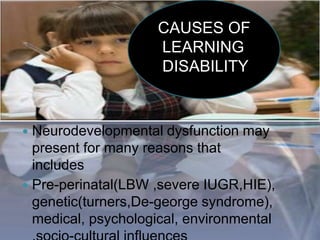
CAUSES OF
LEARNING
DISABILITY
 Neurodevelopmental dysfunction may
present for many reasons that
includes
 Pre-perinatal(LBW ,severe IUGR,HIE),
genetic(turners,De-george syndrome),
medical, psychological, environmental
ICD categorises thesespecific developmental
disorder of scholastic skills that includes
 Dyslexia
A language and reading disability
 Dyscalculia
Problems with arithmetic and math concepts
 Dysgraphia
A writing disorder resulting in illegibility
TYPES OF
DISABILITY
DYSGRAPHI
A
DISCALCULI
A
DYSLEXIA
Dyslexia
 Dyslexia or reading disability is a specific type of reading
disorder caused by deficits in phonologic processing. .
Also called specific reading disability, dyslexia is the
most common learning disability in children.
 . Most people with dyslexia are of average or above-
average intelligence, but read at levels significantly
lower than expected.
 Individuals with dyslexia commonly have problems
 Processing and understanding what they hear.
 They may have difficulty comprehending rapid
instructions,
 following more than one command at a time or
 Remembering the sequence of things.
 Reversals of letters (b for d) and a
 Reversal of words (saw for was) are typical among
individuals who have dyslexia.
 Individuals with dyslexia may also try to read from
right to left,
 May fail to see (and occasionally to hear) similarities
and differences in letters and words,
 may not recognize the spacing that organizes letters
into separate words,
 and may be unable to sound out the pronunciation of
an unfamiliar word.
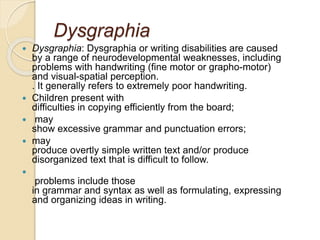
Dysgraphia
Dysgraphia
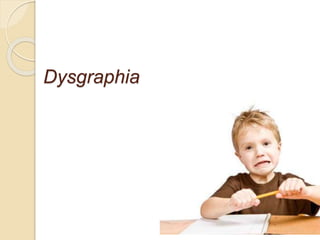
 Dysgraphia: Dysgraphia or writing disabilities are caused
by a range of neurodevelopmental weaknesses, including
problems with handwriting (fine motor or grapho-motor)
and visual-spatial perception.
. It generally refers to extremely poor handwriting.
 Children present with
difficulties in copying efficiently from the board;
 may
show excessive grammar and punctuation errors;
 may
produce overtly simple written text and/or produce
disorganized text that is difficult to follow.

problems include those
in grammar and syntax as well as formulating, expressing
and organizing ideas in writing.
 Problems in these areas can result in phoeno
typically poor ,yet visually comparable
approximations to the actual word(faght for
fight)
 ,spelling that is phoenotypically correct but
visualy incorrect ( plad for played)

Other signs of this condition may include:
A strong dislike of writing and/or drawing
Trouble writing down ideas
A quick loss of energy and interest while writing
Trouble writing down thoughts in a logical sequence
Saying words out loud while writing
Leaving words unfinished or omitting them when
writing sentences
DISCALCULIA
It is a disability in learning
mathematics. It involves
difficulty in memorization
and organization of
numbers and operations.
A child with dyscalculia
may also have trouble
with counting principles or
have difficulty in telling
time
Dyscalculia
•Dyscalculia: Dyscalculia or mathematical disabilities may
include problems with number sense, problems retrieving
math facts (arithmetic combinations or calculations)
• difficulty with the language of math (correctly reading
and understanding numbers and symbols)
• , word problems in math (correctly reading and understanding
the text of word problems) and the visual-spatial and
organizational demands of math.
• Students may reverse
numbers or make errors while reading them aloud. These
problems are usually seen in conjunction with disabilities
in reading or written expression.
• Math functions depend
upon the ability of the student to understand words
associated with arithmetic operations and word problems.
Dyslexia can aggravate difficulties in acquiring math
skills.
Nonacademic Problems
 Neurodevelopmental dysfunctions commonly have effects that extend
far beyond academic performance. These effects may be related to
the dysfunctions themselves or to secondary sequelae (e.g.,
persistent failure and frustration).. Children with
neurodevelopmental dysfunctions can experience excessive
performance anxiety or clinical depression, and sadness, self-
deprecatory comments, declining self-esteem, chronic fatigue, loss of
interests, and even suicidal ideation can ensue. Some children lose
motivation. They tend to give up and exhibit learned helplessness, a
sense that they have no control over their destiny. Therefore, they
feel no need to exert effort and develop future goals. These children
may be easily led toward dysfunctional interpersonal relationships,
detrimental behaviors (e.g.,delinquency), and the development of
mental health and personality disorders, such as mood
disorders or antisocial personality disorder.
 differential diagnoses (e.g. normal variations in academic
achievement, ADHD, Intellectual disability, Learning disorders due to
sensory or neurological impairments) have been provided in the.
These conditions can be differentiated by history, examination,
laboratory tests (e.g. blood lead level), hearing and vision
Assessment
 primarily by history: An appropriate
assessment for LD includes information from student’s
educational history, a description of classroom
observations and standardized psychometric measures.
 screening questionnaires such as Specific Learning
Disability-Screening Questionnaire (SLD-SQ) [8] or
designed screening tools for class teachers to identify
LD ‘at-risk’ children.
 The pointers include:
unexplainable absence from school, below average
academic performance, poor writing ability, problems in
reading ability, poor mathematical competence and
problems in recall. Concerns in two or more of these
areas, should warrant a referral [10]

 NIMHANS index to assess children with LD [5]. The
index comprises of the following tests: (a) attention test
(number cancellation); (b) visual-motor skills (BenderGestalt
test and developmental test of visual-motor
integration); (c) auditory and visual processing
(discrimination and memory); (d) reading, writing, spelling
and comprehension tests; (e) speech and language
assessments including auditory behaviour (receptive
language) and verbal expression; and (f) arithmetic tests
(addition, subtraction, multiplication and division).
 The Rehabilitation Council of India (RCI) recommends
informal assessment (i.e., parental interviewing after
consent; gathering information from teacher/school;
reviewing student’s workbooks; and interviewing the
child) and formal testing (i.e., criterion and
normreferenced tests). Tests for LD have two
components: (a)
testing for potential performance discrepancy – where a
two-year discrepancy between potential and
performance
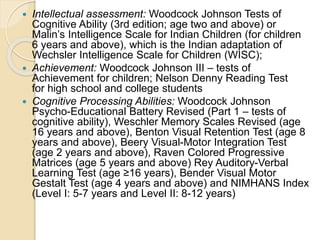
 Intellectual assessment: Woodcock Johnson Tests of
Cognitive Ability (3rd edition; age two and above) or
Malin’s Intelligence Scale for Indian Children (for children
6 years and above), which is the Indian adaptation of
Wechsler Intelligence Scale for Children (WISC);
 Achievement: Woodcock Johnson III – tests of
Achievement for children; Nelson Denny Reading Test
for high school and college students
 Cognitive Processing Abilities: Woodcock Johnson
Psycho-Educational Battery Revised (Part 1 – tests of
cognitive ability), Weschler Memory Scales Revised (age
16 years and above), Benton Visual Retention Test (age 8
years and above), Beery Visual-Motor Integration Test
(age 2 years and above), Raven Colored Progressive
Matrices (age 5 years and above) Rey Auditory-Verbal
Learning Test (age ≥16 years), Bender Visual Motor
Gestalt Test (age 4 years and above) and NIMHANS Index
(Level I: 5-7 years and Level II: 8-12 years)
 • Intervention approach should focus on
interpretation of evaluation reports, description
of specific skills that may
be delayed and identification of co-morbidities.
• It is essential to have an inter-disciplinary
approach involving different specialities; regular
and concise
documentation facilitates the process.
• The intervention should be inter-disciplinary
and individualized to each child.
• Remedial education includes assessment of
the child’s academic strengths and weaknesses
and development
of an individual education program (IEP) having
short-term and long-term goals and monitoring
of the child’s
progress.
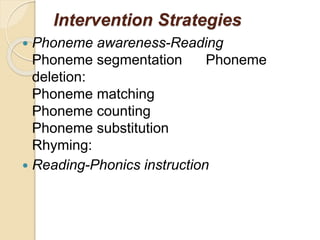
Intervention Strategies
 Phoneme awareness-Reading
Phoneme segmentation Phoneme
deletion:
Phoneme matching
Phoneme counting
Phoneme substitution
Rhyming:
 Reading-Phonics instruction
Basic principles – writing skill
Basic principles – Mathematics:In Mathematical disorder, primary
deficits occur in
number sense and math facts (arithmetic combinations or
calculations) effective remediation for reading and
writing disability has to be primarily worked upon.
Finally, visual-spatial and organizational problems can
interfere with success in mathematics, which requires
occupational therapy intervention
 Number sense: (a) practicing identification or
estimation of quantity(i.e., less and more);
 (b) 1:1 correspondence (e.g.,
correlating the number of coins being dropped into a
box
with the sound made by each of the coins, as it
drops);
 (c)serial ordering (numbers are always counted in
the sameorder);
 (d) “counting on” (i.e., identifying changes in
quantity by adding up from a smaller quantity to
create a
larger quantity);
 (e) showing the link between addition
and subtraction while using objects
 ; (f) using more than
one type of visual representation for numbers (e.g.
both
horizontal and vertical number lines); and
 Provisions and Advocacy
Advocacy of the rights of children with LD to achieveoptimal potential via
provisions is a necessity.
 The cornerstone of treatment of LD is thoroughcomprehensive evaluation and
outcome-based, documented multidisciplinary intervention. Screening ofall
children at the age of 7 years for LD in the pediatric clinic will be highly
beneficial (2-3 years after school exposure).
 students with LD can be poor in academic intelligence but may be better in
other domains
 Concessions
 In terms of inclusion, the following policy-level changes are conducive for
children with LD:
 (a)Government of India launched the Sarva Shiksha Abhiyan in 2001
(‘Education for All’) that aims to provide useful and relevant education to all
children, including children with disabilities in the mainstream (‘inclusive
education’)
[26];
 (b) Right of Children to Free and Compulsory Education 2009 (RTE Act)
stresses on free and compulsory education for children 6 to 14 years of age,
including children with special needs, and research has also looked at the
challenges in its execution
 (c)Rashtriya Bal Swasthya Karyakram (RBSK) focuses on early detection and
intervention of disease, disabilities, deficiencies and developmental problem
Thank you

Learning disabilities

  • 1.
    Dr.Kaushalya M K Housesurgeon Dept. of paeds MMC & RI
  • 2.
    Definition: LDs area heterogeneous group of disorders where the individual unexpectedly fails to competently acquire, retrieve and use information.
  • 3.
     Definition: LDsare a heterogeneous group of disorders where the individual unexpectedly fails to competently acquire, retrieve and use information. • LD has been defined as a neurodevelopmental disorder of biological origin manifesting in learning difficulties and problems in acquiring academic skills, which are markedly below age • LD manifests during early school years and it is not attributed to intellectual disabilities, or neurological or motor disorders. The difficulties should last for at least six months, to warrant a diagnosis
  • 4.
    …SLD may occurin combination with other disabling conditions, but they are not due primarily to other conditions, such as intellectual disability, behavioral disturbance, lack of opportunities to learn, or primary sensory deficits."
  • 5.
     Prevalence: Approximately5% of all students in public schools in the United States are identified as having LD [4]; while another study in US reported that 7% of children 3-17 years of age had LD [6]. The reported prevalence in India ranges from 1.6%-15%, varying based on age-range, survey method, tool used, and region of the country [7-10]. A cross-sectional study conducted in Chandigarh (n = 3600, grade 3 and 4 students) reported 3.08% of children with a diagnosis of LD [8]. Another study using informal assessment, conducted in five schools in Jaipur (n=1156, children 6-13 years of age) reported 12.8% with LD (21.6%, 15.5% and 22.3% of children with dyslexia, dyscalculia and dysgraphia, respectively)].
  • 6.
    CAUSES OF LEARNING DISABILITY  Neurodevelopmentaldysfunction may present for many reasons that includes  Pre-perinatal(LBW ,severe IUGR,HIE), genetic(turners,De-george syndrome), medical, psychological, environmental
  • 7.
    ICD categorises thesespecificdevelopmental disorder of scholastic skills that includes  Dyslexia A language and reading disability  Dyscalculia Problems with arithmetic and math concepts  Dysgraphia A writing disorder resulting in illegibility
  • 8.
  • 10.
    Dyslexia  Dyslexia orreading disability is a specific type of reading disorder caused by deficits in phonologic processing. . Also called specific reading disability, dyslexia is the most common learning disability in children.  . Most people with dyslexia are of average or above- average intelligence, but read at levels significantly lower than expected.
  • 11.
     Individuals withdyslexia commonly have problems  Processing and understanding what they hear.  They may have difficulty comprehending rapid instructions,  following more than one command at a time or  Remembering the sequence of things.  Reversals of letters (b for d) and a  Reversal of words (saw for was) are typical among individuals who have dyslexia.  Individuals with dyslexia may also try to read from right to left,  May fail to see (and occasionally to hear) similarities and differences in letters and words,  may not recognize the spacing that organizes letters into separate words,  and may be unable to sound out the pronunciation of an unfamiliar word.
  • 12.
  • 13.
    Dysgraphia  Dysgraphia: Dysgraphiaor writing disabilities are caused by a range of neurodevelopmental weaknesses, including problems with handwriting (fine motor or grapho-motor) and visual-spatial perception. . It generally refers to extremely poor handwriting.  Children present with difficulties in copying efficiently from the board;  may show excessive grammar and punctuation errors;  may produce overtly simple written text and/or produce disorganized text that is difficult to follow.  problems include those in grammar and syntax as well as formulating, expressing and organizing ideas in writing.
  • 14.
     Problems inthese areas can result in phoeno typically poor ,yet visually comparable approximations to the actual word(faght for fight)  ,spelling that is phoenotypically correct but visualy incorrect ( plad for played)  Other signs of this condition may include: A strong dislike of writing and/or drawing Trouble writing down ideas A quick loss of energy and interest while writing Trouble writing down thoughts in a logical sequence Saying words out loud while writing Leaving words unfinished or omitting them when writing sentences
  • 15.
    DISCALCULIA It is adisability in learning mathematics. It involves difficulty in memorization and organization of numbers and operations. A child with dyscalculia may also have trouble with counting principles or have difficulty in telling time
  • 16.
    Dyscalculia •Dyscalculia: Dyscalculia ormathematical disabilities may include problems with number sense, problems retrieving math facts (arithmetic combinations or calculations) • difficulty with the language of math (correctly reading and understanding numbers and symbols) • , word problems in math (correctly reading and understanding the text of word problems) and the visual-spatial and organizational demands of math. • Students may reverse numbers or make errors while reading them aloud. These problems are usually seen in conjunction with disabilities in reading or written expression. • Math functions depend upon the ability of the student to understand words associated with arithmetic operations and word problems. Dyslexia can aggravate difficulties in acquiring math skills.
  • 17.
    Nonacademic Problems  Neurodevelopmentaldysfunctions commonly have effects that extend far beyond academic performance. These effects may be related to the dysfunctions themselves or to secondary sequelae (e.g., persistent failure and frustration).. Children with neurodevelopmental dysfunctions can experience excessive performance anxiety or clinical depression, and sadness, self- deprecatory comments, declining self-esteem, chronic fatigue, loss of interests, and even suicidal ideation can ensue. Some children lose motivation. They tend to give up and exhibit learned helplessness, a sense that they have no control over their destiny. Therefore, they feel no need to exert effort and develop future goals. These children may be easily led toward dysfunctional interpersonal relationships, detrimental behaviors (e.g.,delinquency), and the development of mental health and personality disorders, such as mood disorders or antisocial personality disorder.  differential diagnoses (e.g. normal variations in academic achievement, ADHD, Intellectual disability, Learning disorders due to sensory or neurological impairments) have been provided in the. These conditions can be differentiated by history, examination, laboratory tests (e.g. blood lead level), hearing and vision
  • 18.
    Assessment  primarily byhistory: An appropriate assessment for LD includes information from student’s educational history, a description of classroom observations and standardized psychometric measures.  screening questionnaires such as Specific Learning Disability-Screening Questionnaire (SLD-SQ) [8] or designed screening tools for class teachers to identify LD ‘at-risk’ children.  The pointers include: unexplainable absence from school, below average academic performance, poor writing ability, problems in reading ability, poor mathematical competence and problems in recall. Concerns in two or more of these areas, should warrant a referral [10] 
  • 19.
     NIMHANS indexto assess children with LD [5]. The index comprises of the following tests: (a) attention test (number cancellation); (b) visual-motor skills (BenderGestalt test and developmental test of visual-motor integration); (c) auditory and visual processing (discrimination and memory); (d) reading, writing, spelling and comprehension tests; (e) speech and language assessments including auditory behaviour (receptive language) and verbal expression; and (f) arithmetic tests (addition, subtraction, multiplication and division).  The Rehabilitation Council of India (RCI) recommends informal assessment (i.e., parental interviewing after consent; gathering information from teacher/school; reviewing student’s workbooks; and interviewing the child) and formal testing (i.e., criterion and normreferenced tests). Tests for LD have two components: (a) testing for potential performance discrepancy – where a two-year discrepancy between potential and performance
  • 20.
     Intellectual assessment:Woodcock Johnson Tests of Cognitive Ability (3rd edition; age two and above) or Malin’s Intelligence Scale for Indian Children (for children 6 years and above), which is the Indian adaptation of Wechsler Intelligence Scale for Children (WISC);  Achievement: Woodcock Johnson III – tests of Achievement for children; Nelson Denny Reading Test for high school and college students  Cognitive Processing Abilities: Woodcock Johnson Psycho-Educational Battery Revised (Part 1 – tests of cognitive ability), Weschler Memory Scales Revised (age 16 years and above), Benton Visual Retention Test (age 8 years and above), Beery Visual-Motor Integration Test (age 2 years and above), Raven Colored Progressive Matrices (age 5 years and above) Rey Auditory-Verbal Learning Test (age ≥16 years), Bender Visual Motor Gestalt Test (age 4 years and above) and NIMHANS Index (Level I: 5-7 years and Level II: 8-12 years)
  • 21.
     • Interventionapproach should focus on interpretation of evaluation reports, description of specific skills that may be delayed and identification of co-morbidities. • It is essential to have an inter-disciplinary approach involving different specialities; regular and concise documentation facilitates the process. • The intervention should be inter-disciplinary and individualized to each child. • Remedial education includes assessment of the child’s academic strengths and weaknesses and development of an individual education program (IEP) having short-term and long-term goals and monitoring of the child’s progress.
  • 22.
    Intervention Strategies  Phonemeawareness-Reading Phoneme segmentation Phoneme deletion: Phoneme matching Phoneme counting Phoneme substitution Rhyming:  Reading-Phonics instruction
  • 23.
    Basic principles –writing skill Basic principles – Mathematics:In Mathematical disorder, primary deficits occur in number sense and math facts (arithmetic combinations or calculations) effective remediation for reading and writing disability has to be primarily worked upon. Finally, visual-spatial and organizational problems can interfere with success in mathematics, which requires occupational therapy intervention
  • 24.
     Number sense:(a) practicing identification or estimation of quantity(i.e., less and more);  (b) 1:1 correspondence (e.g., correlating the number of coins being dropped into a box with the sound made by each of the coins, as it drops);  (c)serial ordering (numbers are always counted in the sameorder);  (d) “counting on” (i.e., identifying changes in quantity by adding up from a smaller quantity to create a larger quantity);  (e) showing the link between addition and subtraction while using objects  ; (f) using more than one type of visual representation for numbers (e.g. both horizontal and vertical number lines); and
  • 25.
     Provisions andAdvocacy Advocacy of the rights of children with LD to achieveoptimal potential via provisions is a necessity.  The cornerstone of treatment of LD is thoroughcomprehensive evaluation and outcome-based, documented multidisciplinary intervention. Screening ofall children at the age of 7 years for LD in the pediatric clinic will be highly beneficial (2-3 years after school exposure).  students with LD can be poor in academic intelligence but may be better in other domains  Concessions  In terms of inclusion, the following policy-level changes are conducive for children with LD:  (a)Government of India launched the Sarva Shiksha Abhiyan in 2001 (‘Education for All’) that aims to provide useful and relevant education to all children, including children with disabilities in the mainstream (‘inclusive education’) [26];  (b) Right of Children to Free and Compulsory Education 2009 (RTE Act) stresses on free and compulsory education for children 6 to 14 years of age, including children with special needs, and research has also looked at the challenges in its execution  (c)Rashtriya Bal Swasthya Karyakram (RBSK) focuses on early detection and intervention of disease, disabilities, deficiencies and developmental problem
  • 26.