DyscalculiaPresented by:
Baniqued, Eryzhell
Banados, Isabel
Cruz, Martin
Deriada, Desi
Hernandez, Chamae
Valencia, Trisia
Yang, Alyssa Marie
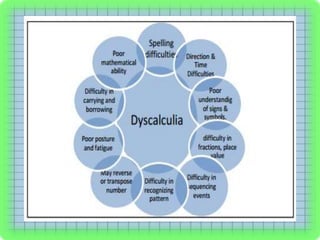
What is Dyscalculia?
• Formerly known as Mathematics Disorder
(DSM-IV TR)
• Under Specific Learning Disorders (DSM-5)
• Problems with numbers
• Inability to acquire arithmetic skills
• Severe difficulty in learning math concepts
and computations
Types of Dyscalculia (Kosc)
• Verbal- difficulty using math orally
• Practognostic- difficulty manipulating concrete
materials
• Lexical- difficulty reading mathematics symbols
• Graphical- difficulty writing mathematics symbols
• Ideognostic- difficulty understanding
mathematical relationships
• Operational- difficulty in performing specified
math operations
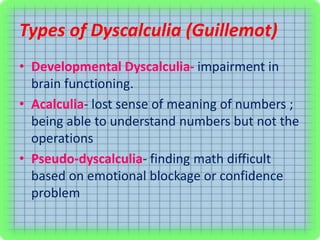
Types of Dyscalculia (Guillemot)
• Developmental Dyscalculia- impairment in
brain functioning.
• Acalculia- lost sense of meaning of numbers ;
being able to understand numbers but not the
operations
• Pseudo-dyscalculia- finding math difficult
based on emotional blockage or confidence
problem
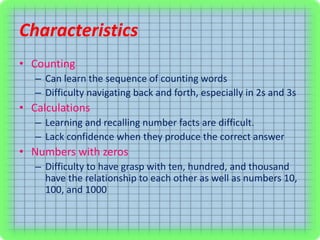
Characteristics
• Counting
– Can learn the sequence of counting words
– Difficulty navigating back and forth, especially in 2s and 3s
• Calculations
– Learning and recalling number facts are difficult.
– Lack confidence when they produce the correct answer
• Numbers with zeros
– Difficulty to have grasp with ten, hundred, and thousand
have the relationship to each other as well as numbers 10,
100, and 1000
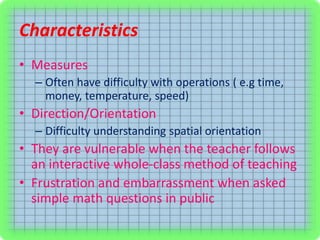
Characteristics
• Measures
– Often have difficulty with operations ( e.g time,
money, temperature, speed)
• Direction/Orientation
– Difficulty understanding spatial orientation
• They are vulnerable when the teacher follows
an interactive whole-class method of teaching
• Frustration and embarrassment when asked
simple math questions in public
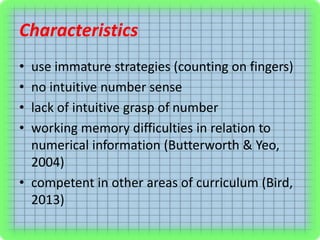
Characteristics
• use immature strategies (counting on fingers)
• no intuitive number sense
• lack of intuitive grasp of number
• working memory difficulties in relation to
numerical information (Butterworth & Yeo,
2004)
• competent in other areas of curriculum (Bird,
2013)
Causes
• Genes and heredity: a child with dyscalculia often
has a parent or sibling with similar math issues.
• Brain development: difference in the surface
area, thickness and volume parts of the brain that
are linked to learning and memory.
• Environment: exposure to alcohol in the womb,
prematurity and low birth weight.
• Brain injury: injury to certain parts of the brain
results to acquired dyscalculia.
Skills Affected by Dyscalculia
• Social skills: failing repeatedly can result to low self
esteem that can affects your child’s willingness to make
new friends.
• Sense of direction: distinguishing left from right,
children with dyscalculia have trouble picturing things
in their minds.
• Physical condition: difficulty in judging distances
between objects
• Money management: difficulty in budgeting, counting
change and estimates costs.
• Time management: difficulty in estimating time,
keeping track of time.
Conditions Related to Dyscalculia
• ADHD
• Math anxiety
• Genetic disorders
Treatment
• A child diagnosed with dyscalculia should receive
special education and there are way that parents
can help their child at home:
• Using visual aids when solving a problem
• Using concrete examples that connect math to
real life
• Using graphing papers
• Playing math related games
• Draw pictures of word problems
• Use diagrams and draw math concepts
References
• www.aboutdyscalculia.org/causes.html
• Butterworth, B. (2003). Dyscalculia Screener (1st ed.). London:
nferNelson. Retrieved from
http://sebastien.brunekreef.com/dyscalculie/Dyscalculia_Screener_
Manual.pdf
• Cornwall Dyslexia Association (2011). Dyscalculia, Dyslexia, and
Maths. Retrieved from cornwalldyslexia.org.uk
• Guillemot, T. (n.a). Dyscalculia- An Overview of Research on
Learning Disability
• Gupta, N. (2011) Dyscalculic Co-morbidity in Secondary School
Going Children-A Comprehensive Study of Predicting Parameters
and Remedies
• Kelly, K., Phillips, S., & Symes, L.. (2013). Assessment of Learners
with Dyslexic-Type Difficulties. London: SAGE.

Dyscalculia

  • 1.
    DyscalculiaPresented by: Baniqued, Eryzhell Banados,Isabel Cruz, Martin Deriada, Desi Hernandez, Chamae Valencia, Trisia Yang, Alyssa Marie
  • 2.
    What is Dyscalculia? •Formerly known as Mathematics Disorder (DSM-IV TR) • Under Specific Learning Disorders (DSM-5) • Problems with numbers • Inability to acquire arithmetic skills • Severe difficulty in learning math concepts and computations
  • 3.
    Types of Dyscalculia(Kosc) • Verbal- difficulty using math orally • Practognostic- difficulty manipulating concrete materials • Lexical- difficulty reading mathematics symbols • Graphical- difficulty writing mathematics symbols • Ideognostic- difficulty understanding mathematical relationships • Operational- difficulty in performing specified math operations
  • 4.
    Types of Dyscalculia(Guillemot) • Developmental Dyscalculia- impairment in brain functioning. • Acalculia- lost sense of meaning of numbers ; being able to understand numbers but not the operations • Pseudo-dyscalculia- finding math difficult based on emotional blockage or confidence problem
  • 5.
    Characteristics • Counting – Canlearn the sequence of counting words – Difficulty navigating back and forth, especially in 2s and 3s • Calculations – Learning and recalling number facts are difficult. – Lack confidence when they produce the correct answer • Numbers with zeros – Difficulty to have grasp with ten, hundred, and thousand have the relationship to each other as well as numbers 10, 100, and 1000
  • 6.
    Characteristics • Measures – Oftenhave difficulty with operations ( e.g time, money, temperature, speed) • Direction/Orientation – Difficulty understanding spatial orientation • They are vulnerable when the teacher follows an interactive whole-class method of teaching • Frustration and embarrassment when asked simple math questions in public
  • 7.
    Characteristics • use immaturestrategies (counting on fingers) • no intuitive number sense • lack of intuitive grasp of number • working memory difficulties in relation to numerical information (Butterworth & Yeo, 2004) • competent in other areas of curriculum (Bird, 2013)
  • 9.
    Causes • Genes andheredity: a child with dyscalculia often has a parent or sibling with similar math issues. • Brain development: difference in the surface area, thickness and volume parts of the brain that are linked to learning and memory. • Environment: exposure to alcohol in the womb, prematurity and low birth weight. • Brain injury: injury to certain parts of the brain results to acquired dyscalculia.
  • 10.
    Skills Affected byDyscalculia • Social skills: failing repeatedly can result to low self esteem that can affects your child’s willingness to make new friends. • Sense of direction: distinguishing left from right, children with dyscalculia have trouble picturing things in their minds. • Physical condition: difficulty in judging distances between objects • Money management: difficulty in budgeting, counting change and estimates costs. • Time management: difficulty in estimating time, keeping track of time.
  • 11.
    Conditions Related toDyscalculia • ADHD • Math anxiety • Genetic disorders
  • 12.
    Treatment • A childdiagnosed with dyscalculia should receive special education and there are way that parents can help their child at home: • Using visual aids when solving a problem • Using concrete examples that connect math to real life • Using graphing papers • Playing math related games • Draw pictures of word problems • Use diagrams and draw math concepts
  • 13.
    References • www.aboutdyscalculia.org/causes.html • Butterworth,B. (2003). Dyscalculia Screener (1st ed.). London: nferNelson. Retrieved from http://sebastien.brunekreef.com/dyscalculie/Dyscalculia_Screener_ Manual.pdf • Cornwall Dyslexia Association (2011). Dyscalculia, Dyslexia, and Maths. Retrieved from cornwalldyslexia.org.uk • Guillemot, T. (n.a). Dyscalculia- An Overview of Research on Learning Disability • Gupta, N. (2011) Dyscalculic Co-morbidity in Secondary School Going Children-A Comprehensive Study of Predicting Parameters and Remedies • Kelly, K., Phillips, S., & Symes, L.. (2013). Assessment of Learners with Dyslexic-Type Difficulties. London: SAGE.