Scenarios
• Manpreet (4 years old) has trouble settling
  in at nursery because he gets very upset
  and angry when the other children don’t
  understand him

• Tariq (8 years old) is having real difficulty
  with reading but he seems very bright. His
  teacher has just found out that he had
  difficulty learning to talk.
• Manisha (6 years old) got into trouble at
  school today with a new teacher because
  she didn’t do what the teacher wanted but
  Manisha didn’t understand what the
  teacher meant.

• Harish (12) doesn’t want to go to school,
  he doesn’t seem to have any friends and
  his parents think he is being bullied
  because of his speech
ADDRESSING NEEDS OF
CHILDREN WITH LANGUAGE
      DIFFICULTIES

             PRESENTED BY:
           Ms. GURKIRAT KAUR
               ASST. PROF.
          CHITKARA UNIVERSITY
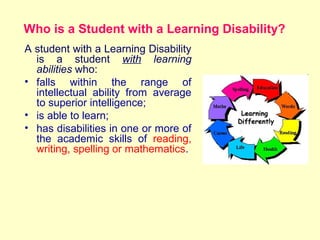
Who is a Student with a Learning Disability?
    A student with a Learning Disability
      is a student with learning
      abilities who:
    • falls within the range of
      intellectual ability from average
      to superior intelligence;
    • is able to learn;
    • has disabilities in one or more of
      the academic skills of reading,
      writing, spelling or mathematics.
Definition of Learning Disability

    LD Association of Ontario -
    Learning disabilities refers to a variety of disorders
      that affect the acquisition, retention, understanding,
      organization or use of verbal and/or non-verbal
 
      information.
    The impairments are generally life-long.
    Some impairments may be noted during the pre-school
      years by low academic achievement, while others
      may not become evident until much later.
Definition of Learning Disability cont .

    Learning disabilities range in severity and invariably
      interfere with the acquisition and use of one or more
      of the following important skills:
    • oral     language     (listening,    speaking     and
      understanding)
    • reading (decoding and comprehension)
 
    • written language (spelling and written expression)
    • mathematics (computation and problem solving)
    Learning disabilities may also cause difficulties with
      organizational skills, and social interaction.
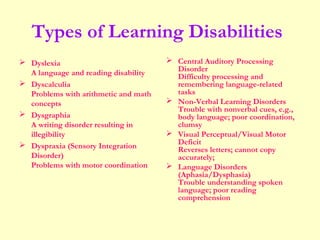
Types of Learning Disabilities
 Dyslexia                             Central Auditory Processing
  A language and reading disability     Disorder
                                        Difficulty processing and
 Dyscalculia                           remembering language-related
  Problems with arithmetic and math     tasks
  concepts                             Non-Verbal Learning Disorders
                                        Trouble with nonverbal cues, e.g.,
 Dysgraphia                            body language; poor coordination,
  A writing disorder resulting in       clumsy
  illegibility                         Visual Perceptual/Visual Motor
 Dyspraxia (Sensory Integration        Deficit
                                        Reverses letters; cannot copy
  Disorder)                             accurately;
  Problems with motor coordination     Language Disorders
                                        (Aphasia/Dysphasia)
                                        Trouble understanding spoken
                                        language; poor reading
                                        comprehension
Celebrities with dyslexia
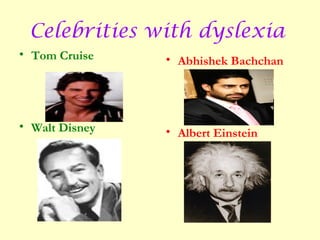
• Tom Cruise    • Abhishek Bachchan


• Walt Disney   • Albert Einstein
• Dyslexia involves difficulty with
             LANGUAGE

  • Intelligence is not the problem

• There is an expected GAP between
  their potential for learning and their
          school achievement
• Individuals with dyslexia have a wide
     range of talents e.g. art, drama,
        entrepreneurial work etc.
• They often have difficulty organizing
               themselves

    • Each dyslexic individual has
  different strengths and weaknesses
 • Often other members of the family
  have dyslexia or similar difficulties
Identifying symptoms
           delay in talking

  difficulty with rhymes and rhythm

    difficulty with remembering rote
  information, e.g. telephone no., names

difficulty in remembering and following
                 directions
Identifying symptoms
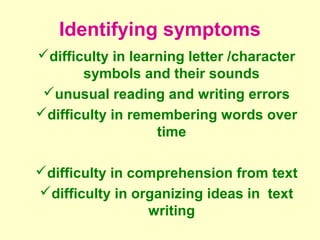
difficulty in learning letter /character
       symbols and their sounds
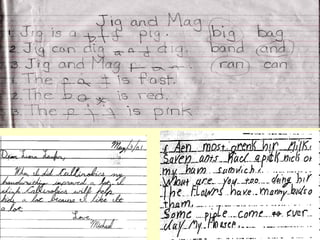
 unusual reading and writing errors
difficulty in remembering words over
                   time

difficulty in comprehension from text
difficulty in organizing ideas in text
                 writing
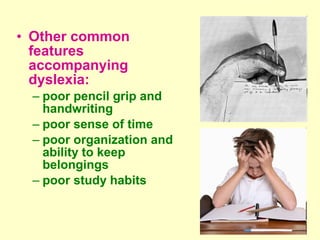
• Other common
  features
  accompanying
  dyslexia:
 – poor pencil grip and
   handwriting
 – poor sense of time
 – poor organization and
   ability to keep
   belongings
 – poor study habits
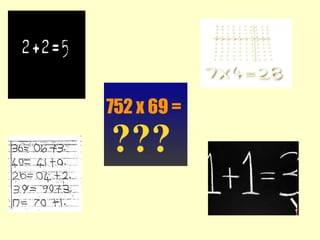
What is Dyscalculia?
• Developmental Dyscalculia was first
   recognised by Dept for education and Skills
   2001 and defined as
  ‘a condition that affects the ability to
   acquire arithmetical skills. Dyscalculic
   learners may have difficulty understanding
   simple number concepts, lack an intuitive
   grasp of numbers and have problems
   learning number facts and procedures.
   Even if they produce a correct answer or
   use a correct method they may do so
   mechanically and without confidence.’
How do I recognise a child who has
                Dyscalculia?

•   the child will be performing below teacher’s
    expectations with no obvious reason such as illness
•   This underachievement may manifest itself in
    specifics such as knowing the value of numbers,
    realising 9 is 1 less that 10
•   They may have no understanding of why or what the
    result means in a sum
•   Do not be surprised that those who have
    difficulties in decoding and understanding written
    words and learning patterns involving symbols also
    experience in learning facts, symbols which are
    used in Mathematics
Dyscalculic pupils may:
• Have sound technical reading skills but fail
  to understand the mathematical language
• Difficulty linking mathematical words to
  numerals
• Fails to remember the sequence of
  calculations in multi-step word problem
• Forget the formula
• Unable to read the time
• Difficulty with mathematical language of
  money
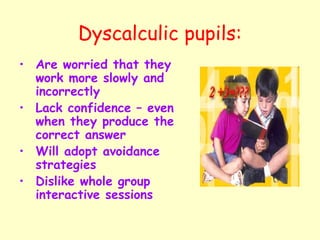
Dyscalculic pupils:
• Are worried that they
  work more slowly and
  incorrectly
• Lack confidence – even
  when they produce the
  correct answer
• Will adopt avoidance
  strategies
• Dislike whole group
  interactive sessions
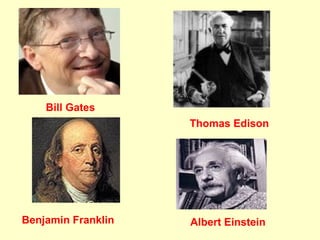
Bill Gates
                    Thomas Edison


Benjamin Franklin   Albert Einstein
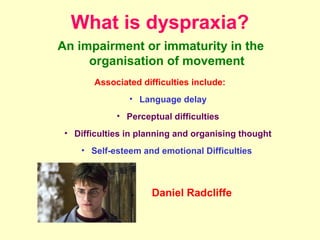
What is dyspraxia?
An impairment or immaturity in the
     organisation of movement
        Associated difficulties include:
                • Language delay
             • Perceptual difficulties
 • Difficulties in planning and organising thought
     • Self-esteem and emotional Difficulties


                      Daniel Radcliffe
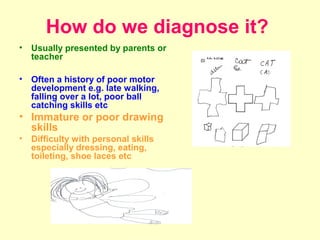
How do we diagnose it?
•   Usually presented by parents or
    teacher

•   Often a history of poor motor
    development e.g. late walking,
    falling over a lot, poor ball
    catching skills etc
• Immature or poor drawing
  skills
•   Difficulty with personal skills
    especially dressing, eating,
    toileting, shoe laces etc
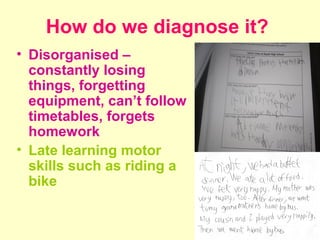
How do we diagnose it?
• Disorganised –
  constantly losing
  things, forgetting
  equipment, can’t follow
  timetables, forgets
  homework
• Late learning motor
  skills such as riding a
  bike
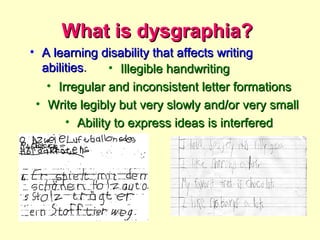
What is dysgraphia?
• A learning disability that affects writing
  abilities.    • Illegible handwriting
   • Irregular and inconsistent letter formations
 • Write legibly but very slowly and/or very small
       • Ability to express ideas is interfered
Diagnosis of dysgraphia
• Dysgraphia cannot be diagnosed solely by
  looking at handwriting samples.
• Not only the finished product is assessed, but
  also the process (The International Dyslexia
  Association, 1996-2007).
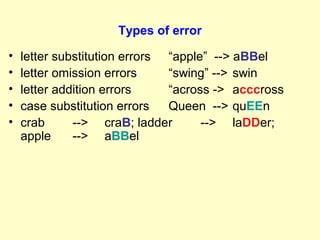
Types of error

•   letter substitution errors “apple” --> aBBel
•   letter omission errors     “swing” --> swin
•   letter addition errors     “across -> acccross
•   case substitution errors   Queen --> quEEn
•   crab      --> craB; ladder       --> laDDer;
    apple     --> aBBel
What a TEACHER can
        do?
Accommodations for Dyslexia
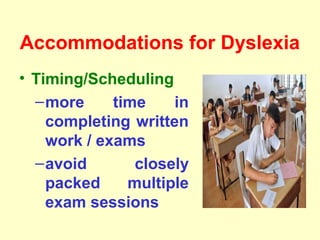
• Timing/Scheduling
  – more     time    in
    completing written
    work / exams
  – avoid       closely
    packed     multiple
    exam sessions
• Presentation Format
  – Larger print with less crowding
  – Questions and answers on same
    page
  – Directions in simple wording, child’s
    understanding checked
  – Test items read to student
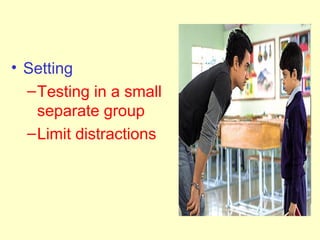
• Setting
  – Testing in a small
    separate group
  – Limit distractions
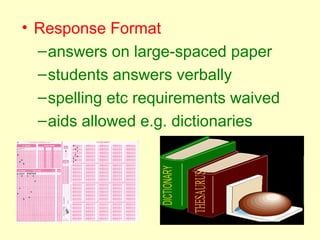
• Response Format
  – answers on large-spaced paper
  – students answers verbally
  – spelling etc requirements waived
  – aids allowed e.g. dictionaries
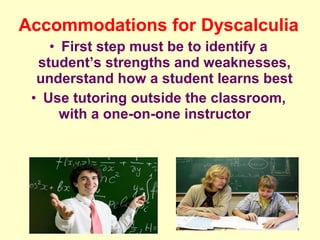
Accommodations for Dyscalculia
    • First step must be to identify a
  student’s strengths and weaknesses,
  understand how a student learns best
 • Use tutoring outside the classroom,
      with a one-on-one instructor
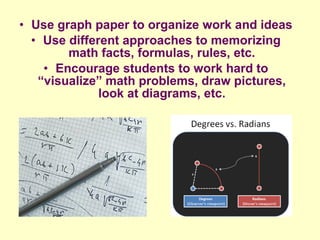
• Use graph paper to organize work and ideas
  • Use different approaches to memorizing
        math facts, formulas, rules, etc.
    • Encourage students to work hard to
   “visualize” math problems, draw pictures,
              look at diagrams, etc.
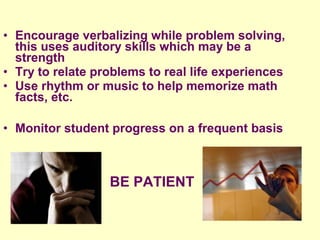
• Encourage verbalizing while problem solving,
  this uses auditory skills which may be a
  strength
• Try to relate problems to real life experiences
• Use rhythm or music to help memorize math
  facts, etc.

• Monitor student progress on a frequent basis


                  BE PATIENT
Accommodations for
            Dyspraxia
• Multi-disciplinary approach to tackle learning, motor
  skills and self esteem

    Interventions to make life easier and learn
    skills which are difficult eg:
       – List of equipment on inside of school
                    bag or pencil case
         – Practising ball skills, using cutlery,
           drawing, PC instead of handwriting
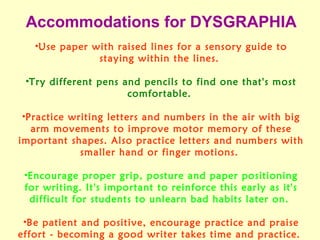
Accommodations for DYSGRAPHIA
   •Use paper with raised lines for a sensory guide to
               staying within the lines.

 •Try different pens and pencils to find one that's most
                      comfortable.

 •Practice writing letters and numbers in the air with big
   arm movements to improve motor memory of these
important shapes. Also practice letters and numbers with
             smaller hand or finger motions.
 •Encourage proper grip, posture and paper positioning
 for writing. It's important to reinforce this early as it's
  difficult for students to unlearn bad habits later on.

 •Be patient and positive, encourage practice and praise
effort - becoming a good writer takes time and practice.
A Student with a LANGUAGE DISABILITY


               is a Student with SPEACIAL ABILITIES


    who can SUCCEED at ACADEMIC STUDY

CHILDREN WITH LANGUAGE DIFFICULTIES

  • 1.
    Scenarios • Manpreet (4years old) has trouble settling in at nursery because he gets very upset and angry when the other children don’t understand him • Tariq (8 years old) is having real difficulty with reading but he seems very bright. His teacher has just found out that he had difficulty learning to talk.
  • 2.
    • Manisha (6years old) got into trouble at school today with a new teacher because she didn’t do what the teacher wanted but Manisha didn’t understand what the teacher meant. • Harish (12) doesn’t want to go to school, he doesn’t seem to have any friends and his parents think he is being bullied because of his speech
  • 3.
    ADDRESSING NEEDS OF CHILDRENWITH LANGUAGE DIFFICULTIES PRESENTED BY: Ms. GURKIRAT KAUR ASST. PROF. CHITKARA UNIVERSITY
  • 4.
    Who is aStudent with a Learning Disability? A student with a Learning Disability is a student with learning abilities who: • falls within the range of intellectual ability from average to superior intelligence; • is able to learn;   • has disabilities in one or more of the academic skills of reading, writing, spelling or mathematics.
  • 5.
    Definition of LearningDisability LD Association of Ontario - Learning disabilities refers to a variety of disorders that affect the acquisition, retention, understanding, organization or use of verbal and/or non-verbal   information. The impairments are generally life-long. Some impairments may be noted during the pre-school years by low academic achievement, while others may not become evident until much later.
  • 6.
    Definition of LearningDisability cont . Learning disabilities range in severity and invariably interfere with the acquisition and use of one or more of the following important skills: • oral language (listening, speaking and understanding) • reading (decoding and comprehension)   • written language (spelling and written expression) • mathematics (computation and problem solving) Learning disabilities may also cause difficulties with organizational skills, and social interaction.
  • 7.
    Types of LearningDisabilities  Dyslexia  Central Auditory Processing A language and reading disability Disorder Difficulty processing and  Dyscalculia remembering language-related Problems with arithmetic and math tasks concepts  Non-Verbal Learning Disorders Trouble with nonverbal cues, e.g.,  Dysgraphia body language; poor coordination, A writing disorder resulting in clumsy illegibility  Visual Perceptual/Visual Motor  Dyspraxia (Sensory Integration Deficit Reverses letters; cannot copy Disorder) accurately; Problems with motor coordination  Language Disorders (Aphasia/Dysphasia) Trouble understanding spoken language; poor reading comprehension
  • 8.
    Celebrities with dyslexia •Tom Cruise • Abhishek Bachchan • Walt Disney • Albert Einstein
  • 9.
    • Dyslexia involvesdifficulty with LANGUAGE • Intelligence is not the problem • There is an expected GAP between their potential for learning and their school achievement
  • 10.
    • Individuals withdyslexia have a wide range of talents e.g. art, drama, entrepreneurial work etc. • They often have difficulty organizing themselves • Each dyslexic individual has different strengths and weaknesses • Often other members of the family have dyslexia or similar difficulties
  • 11.
    Identifying symptoms delay in talking difficulty with rhymes and rhythm difficulty with remembering rote information, e.g. telephone no., names difficulty in remembering and following directions
  • 12.
    Identifying symptoms difficulty inlearning letter /character symbols and their sounds unusual reading and writing errors difficulty in remembering words over time difficulty in comprehension from text difficulty in organizing ideas in text writing
  • 14.
    • Other common features accompanying dyslexia: – poor pencil grip and handwriting – poor sense of time – poor organization and ability to keep belongings – poor study habits
  • 16.
    What is Dyscalculia? •Developmental Dyscalculia was first recognised by Dept for education and Skills 2001 and defined as ‘a condition that affects the ability to acquire arithmetical skills. Dyscalculic learners may have difficulty understanding simple number concepts, lack an intuitive grasp of numbers and have problems learning number facts and procedures. Even if they produce a correct answer or use a correct method they may do so mechanically and without confidence.’
  • 17.
    How do Irecognise a child who has Dyscalculia? • the child will be performing below teacher’s expectations with no obvious reason such as illness • This underachievement may manifest itself in specifics such as knowing the value of numbers, realising 9 is 1 less that 10 • They may have no understanding of why or what the result means in a sum • Do not be surprised that those who have difficulties in decoding and understanding written words and learning patterns involving symbols also experience in learning facts, symbols which are used in Mathematics
  • 18.
    Dyscalculic pupils may: •Have sound technical reading skills but fail to understand the mathematical language • Difficulty linking mathematical words to numerals • Fails to remember the sequence of calculations in multi-step word problem • Forget the formula • Unable to read the time • Difficulty with mathematical language of money
  • 19.
    Dyscalculic pupils: • Areworried that they work more slowly and incorrectly • Lack confidence – even when they produce the correct answer • Will adopt avoidance strategies • Dislike whole group interactive sessions
  • 20.
    Bill Gates Thomas Edison Benjamin Franklin Albert Einstein
  • 21.
    What is dyspraxia? Animpairment or immaturity in the organisation of movement Associated difficulties include: • Language delay • Perceptual difficulties • Difficulties in planning and organising thought • Self-esteem and emotional Difficulties Daniel Radcliffe
  • 22.
    How do wediagnose it? • Usually presented by parents or teacher • Often a history of poor motor development e.g. late walking, falling over a lot, poor ball catching skills etc • Immature or poor drawing skills • Difficulty with personal skills especially dressing, eating, toileting, shoe laces etc
  • 23.
    How do wediagnose it? • Disorganised – constantly losing things, forgetting equipment, can’t follow timetables, forgets homework • Late learning motor skills such as riding a bike
  • 24.
    What is dysgraphia? •A learning disability that affects writing abilities. • Illegible handwriting • Irregular and inconsistent letter formations • Write legibly but very slowly and/or very small • Ability to express ideas is interfered
  • 25.
    Diagnosis of dysgraphia •Dysgraphia cannot be diagnosed solely by looking at handwriting samples. • Not only the finished product is assessed, but also the process (The International Dyslexia Association, 1996-2007).
  • 26.
    Types of error • letter substitution errors “apple” --> aBBel • letter omission errors “swing” --> swin • letter addition errors “across -> acccross • case substitution errors Queen --> quEEn • crab --> craB; ladder --> laDDer; apple --> aBBel
  • 27.
  • 28.
    Accommodations for Dyslexia •Timing/Scheduling – more time in completing written work / exams – avoid closely packed multiple exam sessions
  • 29.
    • Presentation Format – Larger print with less crowding – Questions and answers on same page – Directions in simple wording, child’s understanding checked – Test items read to student
  • 30.
    • Setting – Testing in a small separate group – Limit distractions
  • 31.
    • Response Format – answers on large-spaced paper – students answers verbally – spelling etc requirements waived – aids allowed e.g. dictionaries
  • 32.
    Accommodations for Dyscalculia • First step must be to identify a student’s strengths and weaknesses, understand how a student learns best • Use tutoring outside the classroom, with a one-on-one instructor
  • 33.
    • Use graphpaper to organize work and ideas • Use different approaches to memorizing math facts, formulas, rules, etc. • Encourage students to work hard to “visualize” math problems, draw pictures, look at diagrams, etc.
  • 34.
    • Encourage verbalizingwhile problem solving, this uses auditory skills which may be a strength • Try to relate problems to real life experiences • Use rhythm or music to help memorize math facts, etc. • Monitor student progress on a frequent basis BE PATIENT
  • 35.
    Accommodations for Dyspraxia • Multi-disciplinary approach to tackle learning, motor skills and self esteem Interventions to make life easier and learn skills which are difficult eg: – List of equipment on inside of school bag or pencil case – Practising ball skills, using cutlery, drawing, PC instead of handwriting
  • 36.
    Accommodations for DYSGRAPHIA •Use paper with raised lines for a sensory guide to staying within the lines. •Try different pens and pencils to find one that's most comfortable. •Practice writing letters and numbers in the air with big arm movements to improve motor memory of these important shapes. Also practice letters and numbers with smaller hand or finger motions. •Encourage proper grip, posture and paper positioning for writing. It's important to reinforce this early as it's difficult for students to unlearn bad habits later on. •Be patient and positive, encourage practice and praise effort - becoming a good writer takes time and practice.
  • 37.
    A Student witha LANGUAGE DISABILITY   is a Student with SPEACIAL ABILITIES   who can SUCCEED at ACADEMIC STUDY

Editor's Notes

  • #5 The particular learning difficulty or the combination of learning difficulties experienced by a student with a Learning Disability affects the student’s ability to study and to learn. This is not because the student is unable to study or learn, but because so much of the teaching and learning that takes place in educational institutions is dependent upon the academic skills of reading and writing of printed materials.    With flexible presentation of teaching and learning materials and alternative assessment of tasks, the student with a Learning Disability is not only able to learn, but is able to demonstrate their understanding and competence in the content of the subject being offered.
  • #6 The Australian Learning Disability Association recognises this definition as the most accurate available and it is included in the OAO II resource.
  • #38 People with learning disabilities are able to contribute positively to our global society in all walks of life. People who have contributed in the past include: Albert Einstien Agatha Christie Winston Churchill Thomas Edison People who are contributing now include: Richard Branson Robin Williams Whoopi Goldberg Tom Cruise