

WELCOME FRIENDS
Ms.Meril Manuel
MSc.Nursing 2nd Year
YENEPOYA NURSING COLLEGE
It is defined by the presence of abnormal
and or impaired development that is
manifest before the age of 3 years,
characterized by abnormalities of social
development, communication and a
restriction of behavior and interest.
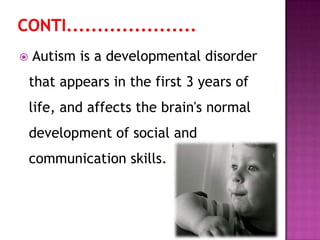
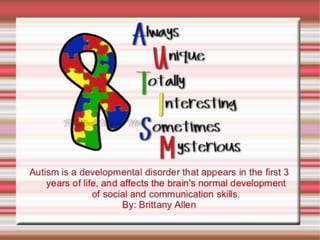
 Autism is a developmental disorder
that appears in the first 3 years of
life, and affects the brain's normal
development of social and
communication skills.
Today, autism is a severe form of a
broader group of disorders
These are referred to as pervasive
developmental disorders (later)
Typically appears during the first 3
years of life
HISTORICAL
OVERVIEW
First described by Leo Kanner
in 1943 as early infantile
autism
“Auto” – children are “locked
within themselves.”
For next 30 years, considered
to be an emotional
disturbance
 Lauretta Bender first used the
term “childhood schizophrenia”
for chilhood autism
Prevalence is 2-6/1000 individuals
(1/2 to 1 ½ million affected)
4 times more prevalent in boys
No known racial, ethnic, or social
boundaries
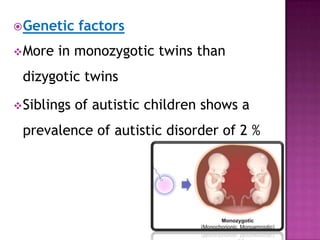
Genetic factors
More in monozygotic twins than
dizygotic twins
Siblings of autistic children shows a
prevalence of autistic disorder of 2 %
Biochemical factors
1/3 of clients with autistic disorder
have elevated plasma serotonin
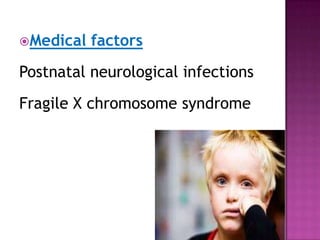
Medical factors
Postnatal neurological infections
Fragile X chromosome syndrome
Perinatal factors
Maternal bleeding after 1st
trimester and maconium in
amniotic fluid
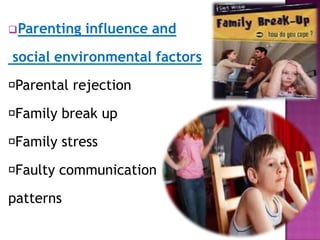
Parenting influence and
social environmental factors
Parental rejection
Family break up
Family stress
Faulty communication
patterns
Refrigerator parents, Kenner 1973
Fixation in presymbiotic phase,
according to Mahler 1975. child
creates a barrier between self and
others.
Theory of mind in autism
“Mind blind”, lack the
Ability to put themselves in
the place of another person
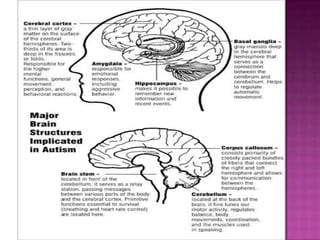
Neuroanatomical studies
Enlargement of lateral ventricles and
cerebellar degeneration
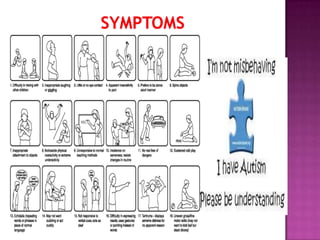
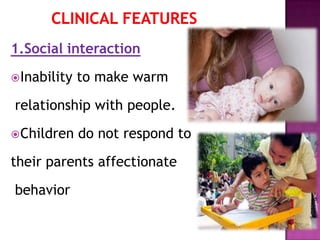
1.Social interaction
Inability to make warm
relationship with people.
Children do not respond to
their parents affectionate
behavior
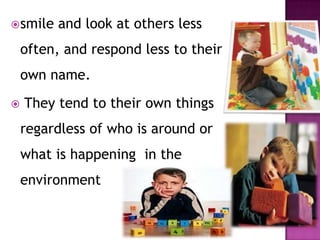
smile and look at others less
often, and respond less to their
own name.
 They tend to their own things
regardless of who is around or
what is happening in the
environment
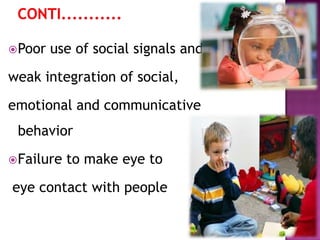
Poor use of social signals and
weak integration of social,
emotional and communicative
behavior
Failure to make eye to
eye contact with people
2. Impairments in
communication
failure to develop normal
speech, failure to communicate by
gestures, body movements or
facial expressions
lack of social usage of whatever
language skills are present
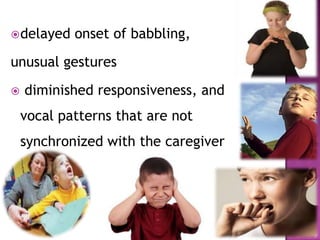
delayed onset of babbling,
unusual gestures
 diminished responsiveness, and
vocal patterns that are not
synchronized with the caregiver
their gestures are less often
integrated with words.
deficits in joint attention
less likely to make requests or share
experiences
o impairment in social
Imitative play
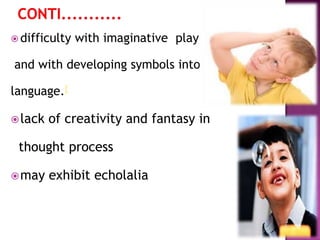
 difficulty with imaginative play
and with developing symbols into
language.[
lack of creativity and fantasy in
thought process
may exhibit echolalia
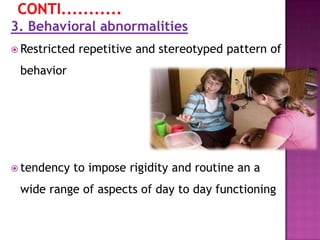
3. Behavioral abnormalities
 Restricted repetitive and stereotyped pattern of
behavior
 tendency to impose rigidity and routine an a
wide range of aspects of day to day functioning
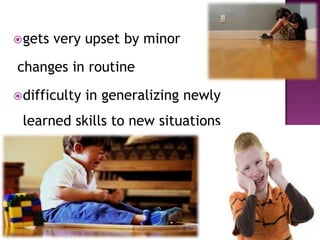
gets very upset by minor
changes in routine
difficulty in generalizing newly
learned skills to new situations
stereotyped and repetitive play
ritualistic behavior like checking and
touching rituals and dressing up in
particular way. When the rituals are
interrupted, children may become
anxious or angry
rocking, twirling, head banging and similar
repetitive behavior are often seen
especially in autistic children
Over activity, disruptive behavior and
temper tantrums which may occur for little
or no reason
Phobias, eating and sleeping disturbances
4. Cognitive abnormalities
poor at symbolization, understanding
abstract ideas and grasping theoretical
concepts
memory may be excellent
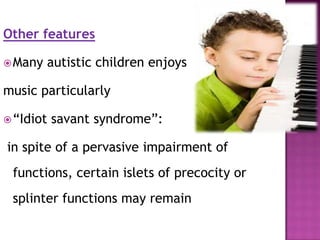
Other features
Many autistic children enjoys
music particularly
“Idiot savant syndrome”:
in spite of a pervasive impairment of
functions, certain islets of precocity or
splinter functions may remain
TYPES OF PERVASIVE
DEVELOPMENTAL
DISORDERS
Impairments in social interaction,
communication, and imaginative
play.
Apparent before age 3.
Also includes stereotyped behaviors,
interests, and activities
Impairments in social interactions, and
presence of restricted interests and
activities
No clinically significant general delay
in language
Average to above average intelligence
Often referred to as atypical autism
Used when a child does not meet
the criteria for a specific diagnosis,
but there is severe and pervasive
impairment in specified behaviors
Progressive disorder which, to date, has
only occurred in girls.
Period of normal development and then
the loss of previously acquired skills
Also loss of purposeful use of hands,
which is replaced by repetitive hand
movements
Beginning at age of 1-4 years
Normal development for at least the
first 2 years
Then significant loss of previously
acquired skills
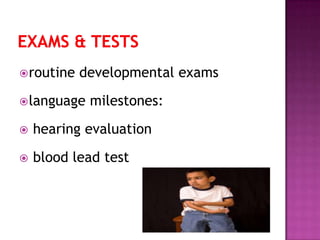
routine developmental exams
language milestones:
 hearing evaluation
 blood lead test
screening test for autism (such as the
Checklist for Autism in Toddlers [CHAT]
or the Autism Screening Questionnaire).
 genetic testing
 complete physical
examination
 nervous system (neurologic)
examination.
Autism Diagnostic Interview - Revised (ADI-R)
Autism Diagnostic Observation Schedule
(ADOS)
Childhood Autism rating Scale (CARS)
Gilliam Autism Rating Scale
Pervasive Developmental Disorders Screening
Test - Stage 3
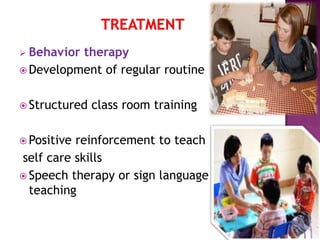
 Behavior therapy
 Development of regular routine
 Structured class room training
 Positive reinforcement to teach
self care skills
 Speech therapy or sign language
teaching
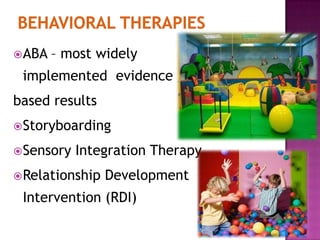
ABA – most widely
implemented evidence
based results
Storyboarding
Sensory Integration Therapy
Relationship Development
Intervention (RDI)
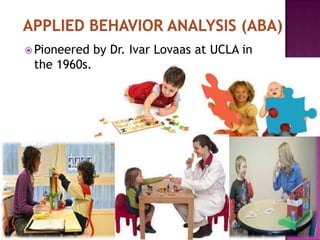
 Pioneered by Dr. Ivar Lovaas at UCLA in
the 1960s.
Several variations today, but general agreement that:
 Usually beneficial, sometimes very beneficial
 Most beneficial with young children, but older
children can benefit
 20-40 hours/week is ideal
 Prompting, as necessary, to achieve high level of
success, with gradual fading of prompts
 Therapists need proper training and supervision
 Regular team meetings needed to maintain
consistency
 Speech Therapy
 Occupational Therapy/Physical
Therapy
 Physical Therapy
 Sensory Integration
 Auditory Integration Therapy (AIT)
 Vocational Therapy
Psychotherapy
not effective in infantile autism
Parental counseling and supportive
therapy are useful in allaying
parental anxiety and guilt
 Pharmacotherapy
Fenfluramine helps in decreasing
behavioral symptoms, and helpful in
increasing IQ
Haloperidol decreases hyperactivity
and abnormal behavioral symptoms
Other drugs like chlorpromazine,
imipramine etc
Antiepileptic medication
 a gluten-free(wheat,barley)
 or casein-free diet(milk,cheese)
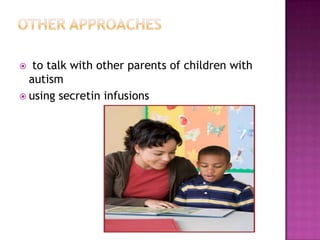
 to talk with other parents of children with
autism
 using secretin infusions
 Fragile X syndrome
 Mental retardation
 Tuberous sclerosis
Autism is a very challenging disability
to solve because of many unknown
factors.
Since there is no cure for autism,
proper procedures such as therapy
must be taken to help these individuals
handle their problems.
With proper therapy sessions, individuals
with autism can improve their modes of
communication and socialization to live
very productive independent lifestyles in
society.
Autistic children with IQ scores of 70 and
above, normally can live and work more
productive independent lifestyles within
society
 Autism symptoms vary from mild to severe.
The prognosis for these individuals depends
on the severity of their disability and the
level of therapy they receive.
 Individuals with autism usually
demonstrate some aspect of impairment of
their senses throughout life.
 Individuals with autism are often labeled
incorrectly as “loners” because of their
inability to socially interact.
 Approximately 33% of children with autism
will eventually develop epilepsy. The
highest risk is with children that have
severe cognitive impairments and motor
deficits
 Individuals with autism can live very active
lifestyles. They are very capable of
performing most physical activities. This will
depend on the severity of the disability.
 Also, an active lifestyle is more likely to help
these individuals with weight control,
muscular endurance, muscular strength,
cardiovascular endurance,self-esteem, and
self-confidence.
May need 1:1 supervision for child
Provide an initial screening process
to determine student’s physical
strengths and weaknesses. This will
help in writing IEP objectives and
goals.
Establish routines and smooth
transitions throughout the lesson
Modify equipment-Provide balls that
will provide sensory output during
activities. (ie: Knobby balls)
Videotapes can be useful for autistic
children who can follow visual cues.
Any activity that requires vigorous
activity and will improve their overall
fitness levels. (flexibility,cardiovascular
endurance, strength, muscular
endurance)
Walking/Hiking
Bike riding (Type of bike will depend on
ability/balance levels)
 Swimming: An excellent low impact activity
that can benefit student in a variety of health-
related ways
 Activities that require the use of their senses.
Autistic children like deep pressure that helps
them relax. Weighted backpacks/vest can help
provide this deep pressure.
 Find out the students physical activity
interests.
Having class in a loud and/or bright
environment; providing too much
stimuli within the environment.
Activities that require a lot of contact.
Spending too much time on a single
activity and not providing enough
choices
Use teaching stations
Change activities regularly
Eliminate different distractions
Keep directions short and age-
appropriate.
.
Use sensory stimulation to increase
attention span
Use smooth transitions
Instruct in an environment were noise,
smells, lights will not interfere with
learning. Teach in less stimulating
environment.
Provide students with ear plugs/cotton
balls in noisier environment.
Keep motivational music at low level.
Establish predictable routines within
lessons
Create high structured environment
which is organized and predictable
Warm-up, Activity, Closure
Use visual aids during activities
Use vigorous aerobic exercises to keep
student on task
Use a consistent behavior modification
program
Provide lots of practice
time/repetitions.
Show enthusiasm when teaching.
Use a reward system like sticker
chart
Teach students basic loco-motor and
object control skills.
Provide reward system that allows
studentsthe opportunity to participate
in enjoyable activity.
Teach students lead-up activities for
team, individual, and cooperative
activities.
Have child perform task and draw parts
of a picture (face) every time task is
completed
Use a peer tutor to assist child in
learning.
Allow choices when setting up the
curriculum so they can choose an
activity that is of interest to them.
Set realistic goals and expectations
Increase amount of activity time, while
decreasing instructional and transition
periods
Check for basic understanding to make
sure students know expectations
Provide a structured environment with
appropriate routines
Challenge the students to keep them
motivated
Provide a reward system for good
attitudes and behavior
Provide non-verbal feedback and
encouragement with high 5’s and
cheering
Be consistent and fair with your rules
and consequences
Use proximity control if a problem is
arising
 Get to know the students and show interest
toward them outside of the physical
education environment.
 Create a positive and enthusiastic
environment for everyone
 Provide vigorous activities to help students
remain on task.
AUTISM  ppt
AUTISM  ppt
AUTISM  ppt

AUTISM ppt

  • 1.
    WELCOME FRIENDS Ms.Meril Manuel MSc.Nursing2nd Year YENEPOYA NURSING COLLEGE
  • 4.
    It is definedby the presence of abnormal and or impaired development that is manifest before the age of 3 years, characterized by abnormalities of social development, communication and a restriction of behavior and interest.
  • 5.
     Autism isa developmental disorder that appears in the first 3 years of life, and affects the brain's normal development of social and communication skills.
  • 6.
    Today, autism isa severe form of a broader group of disorders These are referred to as pervasive developmental disorders (later) Typically appears during the first 3 years of life
  • 8.
  • 9.
    First described byLeo Kanner in 1943 as early infantile autism “Auto” – children are “locked within themselves.” For next 30 years, considered to be an emotional disturbance
  • 10.
     Lauretta Benderfirst used the term “childhood schizophrenia” for chilhood autism
  • 11.
    Prevalence is 2-6/1000individuals (1/2 to 1 ½ million affected) 4 times more prevalent in boys No known racial, ethnic, or social boundaries
  • 13.
    Genetic factors More inmonozygotic twins than dizygotic twins Siblings of autistic children shows a prevalence of autistic disorder of 2 %
  • 14.
    Biochemical factors 1/3 ofclients with autistic disorder have elevated plasma serotonin
  • 15.
    Medical factors Postnatal neurologicalinfections Fragile X chromosome syndrome
  • 16.
    Perinatal factors Maternal bleedingafter 1st trimester and maconium in amniotic fluid
  • 17.
    Parenting influence and socialenvironmental factors Parental rejection Family break up Family stress Faulty communication patterns
  • 18.
    Refrigerator parents, Kenner1973 Fixation in presymbiotic phase, according to Mahler 1975. child creates a barrier between self and others.
  • 19.
    Theory of mindin autism “Mind blind”, lack the Ability to put themselves in the place of another person Neuroanatomical studies Enlargement of lateral ventricles and cerebellar degeneration
  • 22.
    1.Social interaction Inability tomake warm relationship with people. Children do not respond to their parents affectionate behavior
  • 23.
    smile and lookat others less often, and respond less to their own name.  They tend to their own things regardless of who is around or what is happening in the environment
  • 24.
    Poor use ofsocial signals and weak integration of social, emotional and communicative behavior Failure to make eye to eye contact with people
  • 25.
    2. Impairments in communication failureto develop normal speech, failure to communicate by gestures, body movements or facial expressions lack of social usage of whatever language skills are present
  • 26.
    delayed onset ofbabbling, unusual gestures  diminished responsiveness, and vocal patterns that are not synchronized with the caregiver
  • 27.
    their gestures areless often integrated with words. deficits in joint attention less likely to make requests or share experiences o impairment in social Imitative play
  • 28.
     difficulty withimaginative play and with developing symbols into language.[ lack of creativity and fantasy in thought process may exhibit echolalia
  • 29.
    3. Behavioral abnormalities Restricted repetitive and stereotyped pattern of behavior  tendency to impose rigidity and routine an a wide range of aspects of day to day functioning
  • 30.
    gets very upsetby minor changes in routine difficulty in generalizing newly learned skills to new situations
  • 31.
    stereotyped and repetitiveplay ritualistic behavior like checking and touching rituals and dressing up in particular way. When the rituals are interrupted, children may become anxious or angry
  • 32.
    rocking, twirling, headbanging and similar repetitive behavior are often seen especially in autistic children Over activity, disruptive behavior and temper tantrums which may occur for little or no reason Phobias, eating and sleeping disturbances
  • 33.
    4. Cognitive abnormalities poorat symbolization, understanding abstract ideas and grasping theoretical concepts memory may be excellent
  • 34.
    Other features Many autisticchildren enjoys music particularly “Idiot savant syndrome”: in spite of a pervasive impairment of functions, certain islets of precocity or splinter functions may remain
  • 35.
  • 36.
    Impairments in socialinteraction, communication, and imaginative play. Apparent before age 3. Also includes stereotyped behaviors, interests, and activities
  • 37.
    Impairments in socialinteractions, and presence of restricted interests and activities No clinically significant general delay in language Average to above average intelligence
  • 38.
    Often referred toas atypical autism Used when a child does not meet the criteria for a specific diagnosis, but there is severe and pervasive impairment in specified behaviors
  • 39.
    Progressive disorder which,to date, has only occurred in girls. Period of normal development and then the loss of previously acquired skills Also loss of purposeful use of hands, which is replaced by repetitive hand movements Beginning at age of 1-4 years
  • 40.
    Normal development forat least the first 2 years Then significant loss of previously acquired skills
  • 42.
    routine developmental exams languagemilestones:  hearing evaluation  blood lead test
  • 43.
    screening test forautism (such as the Checklist for Autism in Toddlers [CHAT] or the Autism Screening Questionnaire).  genetic testing  complete physical examination  nervous system (neurologic) examination.
  • 44.
    Autism Diagnostic Interview- Revised (ADI-R) Autism Diagnostic Observation Schedule (ADOS) Childhood Autism rating Scale (CARS) Gilliam Autism Rating Scale Pervasive Developmental Disorders Screening Test - Stage 3
  • 45.
     Behavior therapy Development of regular routine  Structured class room training  Positive reinforcement to teach self care skills  Speech therapy or sign language teaching
  • 46.
    ABA – mostwidely implemented evidence based results Storyboarding Sensory Integration Therapy Relationship Development Intervention (RDI)
  • 47.
     Pioneered byDr. Ivar Lovaas at UCLA in the 1960s.
  • 48.
    Several variations today,but general agreement that:  Usually beneficial, sometimes very beneficial  Most beneficial with young children, but older children can benefit  20-40 hours/week is ideal  Prompting, as necessary, to achieve high level of success, with gradual fading of prompts  Therapists need proper training and supervision  Regular team meetings needed to maintain consistency
  • 49.
     Speech Therapy Occupational Therapy/Physical Therapy  Physical Therapy  Sensory Integration  Auditory Integration Therapy (AIT)  Vocational Therapy
  • 50.
    Psychotherapy not effective ininfantile autism Parental counseling and supportive therapy are useful in allaying parental anxiety and guilt
  • 51.
     Pharmacotherapy Fenfluramine helpsin decreasing behavioral symptoms, and helpful in increasing IQ Haloperidol decreases hyperactivity and abnormal behavioral symptoms Other drugs like chlorpromazine, imipramine etc Antiepileptic medication
  • 52.
     a gluten-free(wheat,barley) or casein-free diet(milk,cheese)
  • 53.
     to talkwith other parents of children with autism  using secretin infusions
  • 55.
     Fragile Xsyndrome  Mental retardation  Tuberous sclerosis
  • 56.
    Autism is avery challenging disability to solve because of many unknown factors. Since there is no cure for autism, proper procedures such as therapy must be taken to help these individuals handle their problems.
  • 57.
    With proper therapysessions, individuals with autism can improve their modes of communication and socialization to live very productive independent lifestyles in society. Autistic children with IQ scores of 70 and above, normally can live and work more productive independent lifestyles within society
  • 58.
     Autism symptomsvary from mild to severe. The prognosis for these individuals depends on the severity of their disability and the level of therapy they receive.  Individuals with autism usually demonstrate some aspect of impairment of their senses throughout life.
  • 59.
     Individuals withautism are often labeled incorrectly as “loners” because of their inability to socially interact.  Approximately 33% of children with autism will eventually develop epilepsy. The highest risk is with children that have severe cognitive impairments and motor deficits
  • 60.
     Individuals withautism can live very active lifestyles. They are very capable of performing most physical activities. This will depend on the severity of the disability.  Also, an active lifestyle is more likely to help these individuals with weight control, muscular endurance, muscular strength, cardiovascular endurance,self-esteem, and self-confidence.
  • 61.
    May need 1:1supervision for child Provide an initial screening process to determine student’s physical strengths and weaknesses. This will help in writing IEP objectives and goals.
  • 62.
    Establish routines andsmooth transitions throughout the lesson Modify equipment-Provide balls that will provide sensory output during activities. (ie: Knobby balls) Videotapes can be useful for autistic children who can follow visual cues.
  • 63.
    Any activity thatrequires vigorous activity and will improve their overall fitness levels. (flexibility,cardiovascular endurance, strength, muscular endurance) Walking/Hiking Bike riding (Type of bike will depend on ability/balance levels)
  • 64.
     Swimming: Anexcellent low impact activity that can benefit student in a variety of health- related ways  Activities that require the use of their senses. Autistic children like deep pressure that helps them relax. Weighted backpacks/vest can help provide this deep pressure.  Find out the students physical activity interests.
  • 65.
    Having class ina loud and/or bright environment; providing too much stimuli within the environment. Activities that require a lot of contact. Spending too much time on a single activity and not providing enough choices
  • 66.
    Use teaching stations Changeactivities regularly Eliminate different distractions Keep directions short and age- appropriate. .
  • 67.
    Use sensory stimulationto increase attention span Use smooth transitions Instruct in an environment were noise, smells, lights will not interfere with learning. Teach in less stimulating environment.
  • 68.
    Provide students withear plugs/cotton balls in noisier environment. Keep motivational music at low level. Establish predictable routines within lessons Create high structured environment which is organized and predictable Warm-up, Activity, Closure
  • 69.
    Use visual aidsduring activities Use vigorous aerobic exercises to keep student on task Use a consistent behavior modification program Provide lots of practice time/repetitions. Show enthusiasm when teaching.
  • 70.
    Use a rewardsystem like sticker chart Teach students basic loco-motor and object control skills.
  • 71.
    Provide reward systemthat allows studentsthe opportunity to participate in enjoyable activity. Teach students lead-up activities for team, individual, and cooperative activities.
  • 72.
    Have child performtask and draw parts of a picture (face) every time task is completed Use a peer tutor to assist child in learning. Allow choices when setting up the curriculum so they can choose an activity that is of interest to them.
  • 73.
    Set realistic goalsand expectations Increase amount of activity time, while decreasing instructional and transition periods Check for basic understanding to make sure students know expectations
  • 74.
    Provide a structuredenvironment with appropriate routines Challenge the students to keep them motivated Provide a reward system for good attitudes and behavior Provide non-verbal feedback and encouragement with high 5’s and cheering
  • 75.
    Be consistent andfair with your rules and consequences Use proximity control if a problem is arising
  • 76.
     Get toknow the students and show interest toward them outside of the physical education environment.  Create a positive and enthusiastic environment for everyone  Provide vigorous activities to help students remain on task.