Dr. Lamiaa Gamal
Assistant lecturer of child health, Kindergarten Faculty
•a group of disorders
that have in common
deficits of adaptive
and intellectual
function and an age
of onset before
maturity is reached.
Country and/or language Term
United States Intellectual disability
Australia Intellectual disability
Canada (English, French) Mental deficiency, intellectual handicap
England
Learning disability*, intellectual disability,
developmental disability•
France Mental deficiency, mental apraxia
Germany Mental handicap, mental retardation
Italy Mental delay, mentally deficient
Estonia Mental retardation
Puerto Rico Mentally slowed down
Spain Mental delay
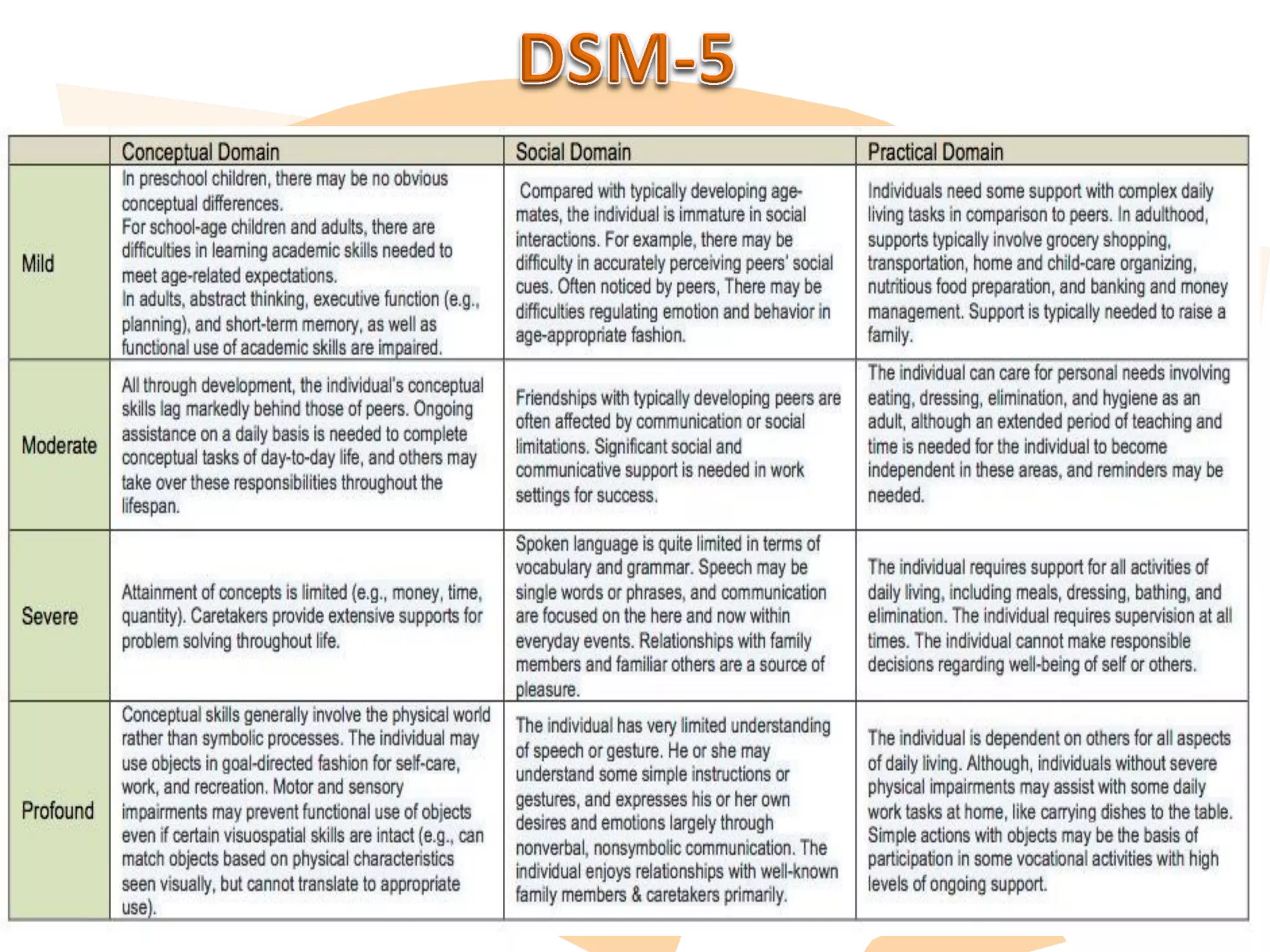
DSM-5
Global Developmental Delay
• Diagnosed reserved for individuals under 5
when clinical severity level cannot be reliably
assessed.
• Diagnosed when an individual fails to meet
expected developmental milestones in several
areas of intellectual functioning, and applies to
individuals who are unable to undergo
systematic assessments of intellectual
functioning, including children who are too
young to participate in standardized testing.
• Requires reassessment after a period of time.
Unspecified Intellectual Disability
• Diagnosed in individuals over 5 when assessment of
the degree of intellectual disability by means of
locally available procedures is difficult or impossible
because of:
- associated sensory or physical impairments, as in
blindness or prelingual deafness; locomotor disability;
or
- presence of severe problem behaviors or co-occurring
mental disorder.
- Should only be used in exceptional circumstances
and requires reassessment after a period of time.
ICD 11
• ICD-11 uses the term intellectual developmental
disorders to indicate that these are disorders that
involve impaired brain functioning early in life.
These disorders are described in ICD-11 as a meta
syndrome occurring in the developmental period
analogous to dementia or neurocognitive
disorder in later life.
• There are four subtypes in ICD-11: mild,
moderate, severe, and profound.
Intellectual disability has an overall
general population prevalence of
approximately 1%, and prevalence
rates vary by age
Prevalence for severe intellectual
disability is approximately 6 per 1,000
males are more likely than females to
be diagnosed with both mild MR
(average male: female ratio 1.6:1) and
severe MR (average male: female ratio
1.2:1)
Country (Reference)
Source of study
population
Definition used
Total study
population
Prevalence per 1000
population
Australia
(Beange & Taplin
1996)
Administrative data on 20-50
year olds
AAMR classification of
1983
104584
3.3
Male = 3.4
Female = 3.2
Australia
(Leonard et al. 2003)
Administrative data on children
6-15 years
DSM-IV TR 240358 14.3
Canada
(Bradley et al. 2002)
Administrative data and
population based study on 14-
20 year old adolescents
ICD 10 35485 7.2
China
(Zuo et al. 1986)
Survey of 0-14 year old childrenAAMR definition 7150
7.8
Male = 7.8
Female = 7.9
China
(Xie et al. 2008)
Household survey of children
aged 0-6 years
Specific disability criteria 60124
9.3
Male = 10.1
Female = 8.3
Ethiopia
(Fitaw et al. 2006)
Population based study on
adults
ICF 24453 3.9
Finland
(Rantakallio et al.
1986)
Administrative data on specific
birth cohort of children
ICD 9 12058
5.6 (Mild mental
retardation)
6.3 (Moderate-severe
mental retardation)
Ireland
(including Northern
Ireland, UK)
(McConkey et al.
2006)
Administrative data of adults ICD 10 3961701 6.3
Norway
(Stromme et al. 1998)
Administrative data on specific
birth cohort of children
DSM-IV 30037
6.2
Male = 8.4
Female = 5.7
USA Administrative data on 10 year
DSM-III 89534
12
Male = 13.8
Prenatal
Genetic
syndromes
Environmental
influences
maternal
disease
Inborn errors of
metabolism
Perinatal
delivery-related
events
Postnatal
infections
traumatic brain
injury
Severe and
chronic social
deprivation
Toxic metabolic
syndromes and
intoxications
 Mild MR
– 55-70 IQ
– Adaptive limitations in 2 or more domains
 Moderate MR
– 35-54 IQ
– Adaptive limitations in 2 or more domains
 Severe MR
– 20-34 IQ
– Adaptive limitations in all domains
 Profound MR
– Below 20 IQ
– Adaptive limitations in all domains
Conceptual Skills:
communication, functional academics, self-
direction, money concepts
Social Skills:
interpersonal skills, self-esteem,
naiveté/gullibility, self-governance (obeys rules)
Practical Skills:
self-care, domestic skills, work, health & safety
Severity mental
age as
adult
Adult adaptation
Mild 9-11 yr Reads at 4th-5th grade level; simple multiplication and division; writes
simple letter, lists; completes job application; basic independent job skills
(arrive on time, stay at task, interact with coworkers); uses public
transportation, might qualify for driver's license; keeps house, cooks using
recipes
Moderate 6-8 yr Sight-word reading; copies information, e.g., address from card to job
application; matches written number to number of items; recognizes time
on clock; communicates; some independence in self-care; housekeeping
with supervision or cue cards; meal preparation, can follow picture recipe
cards; job skills learned with much repetition; uses public transportation
with some supervision
Sever 3-5 yr Needs continuous support and supervision; might communicate wants
and needs, sometimes with augmentative communication techniques
Profound <3 yr Limitations of self-care, continence, communication, and mobility; might
need complete custodial or nursing care
International Statistical Classification of Diseases and Related Health Problems, 10th edition (World
Health Organization).
Co-occurring mental, neurodevelopmental,
medical, and physical conditions are
frequent in intellectual disability, with rates
of some conditions (e.g., mental disorders,
cerebral palsy, and epilepsy) three to four
times higher than in the general
population.
The most common co-occurring mental and
neurodevelopmental disorders are:
- attention-deficit/hyperactivity disorder
- depressive and bipolar disorders
- anxiety disorders
- autism spectrum disorder
- stereotypic movement disorder (with or
without self-injurious behavior)
- impulse-control disorders
- major neurocognitive disorder
• Different studies in the review showed that
among children with mental retardation, autism is
present in about 25%, ADHD in about 10%, and
cerebral palsy in 7-30%, depending on the
severity of mental retardation.
• Among adults with Down's Syndrome, dementia
is the most common cause of mortality and
morbidity, and research from The Netherlands has
found that often it has an earlier age of onset
(8.9% in 45-49 year old age-group) compared to
the general population
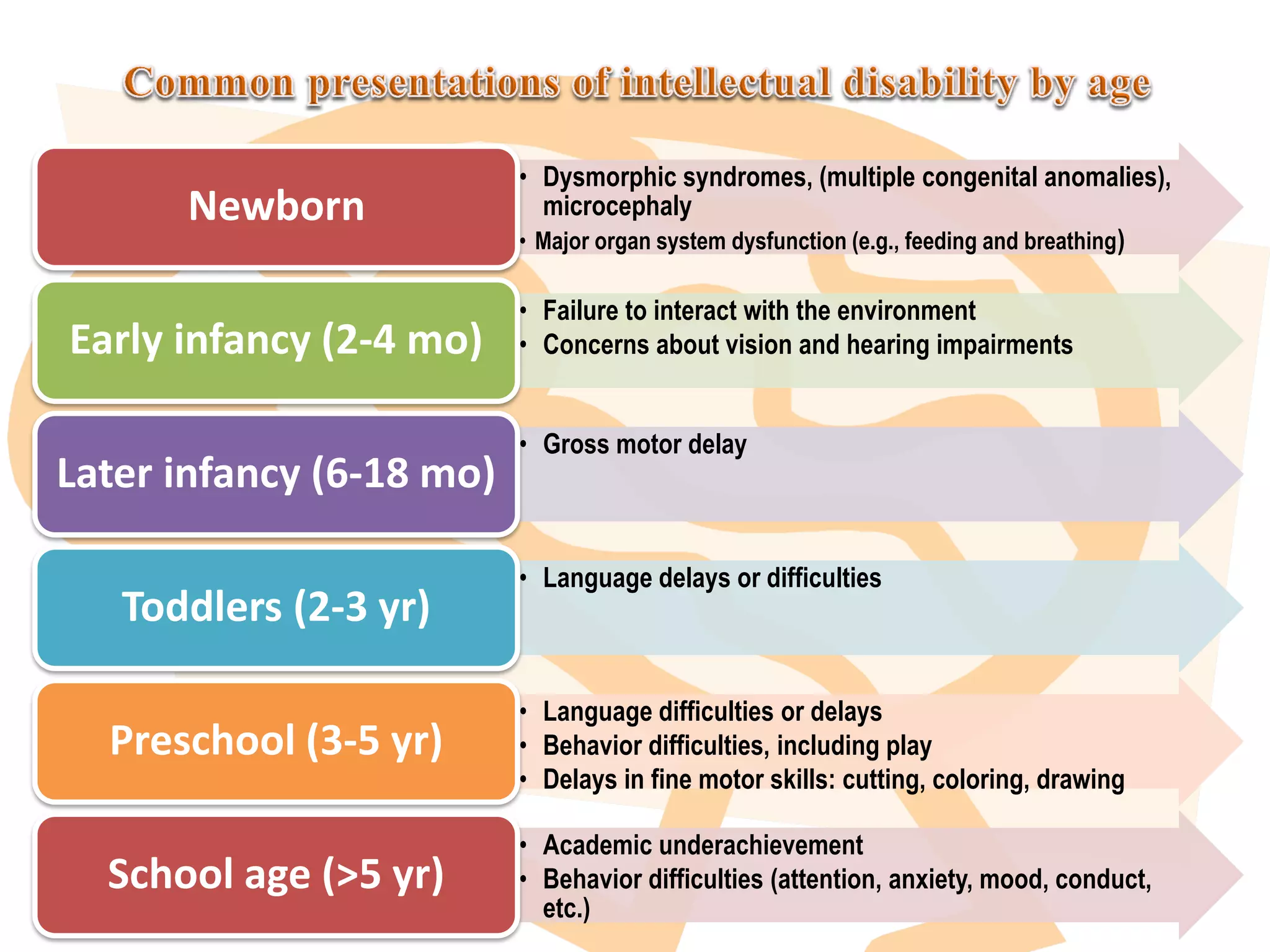
• Dysmorphic syndromes, (multiple congenital anomalies),
microcephaly
• Major organ system dysfunction (e.g., feeding and breathing)
Newborn
• Failure to interact with the environment
• Concerns about vision and hearing impairmentsEarly infancy (2-4 mo)
• Gross motor delay
Later infancy (6-18 mo)
• Language delays or difficulties
Toddlers (2-3 yr)
• Language difficulties or delays
• Behavior difficulties, including play
• Delays in fine motor skills: cutting, coloring, drawing
Preschool (3-5 yr)
• Academic underachievement
• Behavior difficulties (attention, anxiety, mood, conduct,
etc.)
School age (>5 yr)
Associated Features Supporting Diagnosis:
• Difficulties with social judgment; assessment of risk; self-
management of behavior, emotions, or interpersonal
relationships; or motivation in school or work
environments.
• Lack of communication skills ….. disruptive and
aggressive behaviors.
• Gullibility and lack of awareness of risk may result in
exploitation by others and possible victimization, fraud,
unintentional criminal involvement, false confessions, and
risk for physical and sexual abuse.
• Individuals with a diagnosis of intellectual disability with
co-occurring mental disorders are at risk for suicide. Thus,
screening for suicidal thoughts is essential in the
assessment process.
• Because of a lack of awareness of risk and danger,
accidental injury rates may be increased.
• A comprehensive evaluation includes
- An assessment of intellectual capacity and
adaptive functioning.
- Identification of genetic and non-genetic
etiologies.
- Evaluation for associated medical conditions
(e.g., cerebral palsy, seizure disorder).
- Evaluation for co-occurring mental, emotional,
and behavioral disorders.
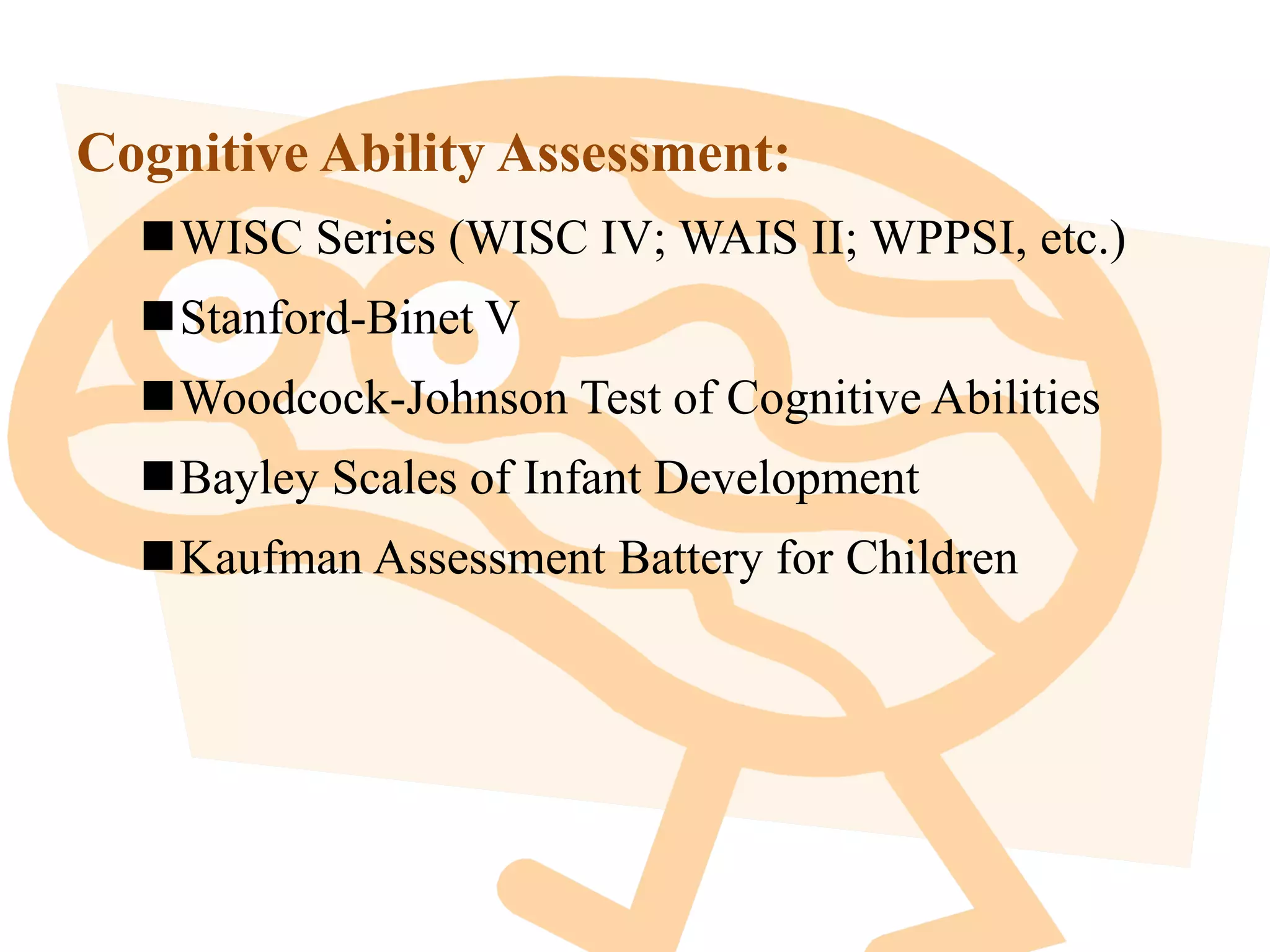
Cognitive Ability Assessment:
WISC Series (WISC IV; WAIS II; WPPSI, etc.)
Stanford-Binet V
Woodcock-Johnson Test of Cognitive Abilities
Bayley Scales of Infant Development
Kaufman Assessment Battery for Children
Adaptive Behavior Assessment
 Vineland II Adaptive Behavior Scales (Sparrow,
Cicchetti, & Balla, 2005)
 Scales of Independent Behavior– Revised (SIB-R)
(Brunininks, Woodcock, Weatherman, & Hill, 1996)
 Adaptive Behavior Assessment System 2nd Edition
(ABAS – II) (Harrison & Oakland, 2003)
 Basic pre- and perinatal medical history
 Three-generational family pedigree
 Physical examination
 Genetic evaluation (e.g., karyotype or
chromosomal microarray analysis and
testing for specific genetic syndromes)
 Metabolic screening
 Neuroimaging assessment
 In many countries of the MENA region
disabled children are facing:
health, educational, social and psychological
problems. For example, disabled children are
facing low enrolment ratios, limited health care
and low health awareness among families of
disabled children.
 Some disabled children in MENA region face
problems of stigmatization, social exclusion
and isolation, thus they become deprived of
active participation in social, economic and
community life.
The 2000 Demographic and Health Survey in Egypt
has estimated the total number of children in need of
special education at 600,000.
However, according to Ministry of Education, only
15% of them receive education in regular schools.
Girls are even more disadvantaged than boys.
The low level of enrolment is partially due to the
unavailability of appropriate education and partially to
the fact that some parents do not send their disable
children to schools.
Some families believe that disabled children are not
capable of receiving education.
- Many countries in the MENA region have
insufficient health facilities and poor
training for medical personnel working with
disabled children.
- The lack of community education programs
leave many undetected child disabilities.
- Many communities, especially in rural areas,
lack rehabilitative services for disabled
children
Because of the stigma associated with intellectual
disability, they may use euphemisms to avoid being
thought of as “stupid” or “retarded” and refer to
themselves as learning disabled, dyslexic, language
disordered, or slow learners.
Some people with intellectual disability emulate their
social milieu to be accepted. They may be social
chameleons and assume the morals of the group to
which they are attached. Some would rather be thought
“bad” than “incompetent.”
Some disabled children in countries of MENA
region are also vulnerable to:
maltreatment and humiliation particularly
those living in rehabilitative care institutions
where emotional, physical and sometimes
even sexual abuses are not uncommon
Challenging behaviors (aggression, self-injury,
oppositional defiant behavior) and mental illness
(mood and anxiety disorders) occur with greater
frequency in this population than among children
with typical intelligence. These behavioral and
emotional disorders are the primary cause for
out-of-home placements, reduced employment
prospects, and decreased opportunities for
social integration
In many countries of the MENA region these laws and
decrees have neglected issues related to
 prevention
 early detection
 community based rehabilitation (CBR)
 information and registration
 issues concerning cooperation and integration
between governmental agencies, NGO’s and
international organizations working in the field of
child disability
Immunization
programs
Health education
Prevention of
trauma and injuries
Effective
antenatal/ natal
care
Genetic counselling
Prevention of
poisoning and drug
abuse
Pre symptomatic detection of certain disorders
lead surveillance
dietary restriction in metabolic diseases
thyroid hormone replacement
Treatment of associated conditions including vision and hearing
impairment, seizures, and other co-morbid medical disorders
Access to and
provision of
appropriate
comprehensive
services and
resources
Early detection
of
complications
Treatment of
comorbid
conditions
Prevention and
treatment of
psychosocial
disorders
 phenylketonuria………newborn screening, dietary treatment
 Galactosemia …………newborn screening, dietary treatment
 Congenital hypothyroidism…….. newborn screening and
thyroid hormone replacement therapy
 use of anti-Rh immune globulin to prevent Rh disease and
severe jaundice in newborn infants
 Hib diseases by using the Hib vaccine
 measles encephalitis ………… measles vaccine
 German measles during pregnancy………. Rubella vaccine
 Fetal alcohol syndrome
Early intervention programs
Special education services ( individualized educational
programs)
Family support services (Counseling, Training, Home
visitation, Social services)
Pharmacotherapy
Health services, including hearing and vision
Nutrition counseling
Assistive technology (which may include tape-recorded
texts, reading scanners, or voice-activated computer
programs)
Medical diagnostic services
Transportation and other assistive technology
For children with an intellectual disability, primary care
has a number of important components:
- Provision of the same primary care received by all
other children of similar chronological age
- Anticipatory guidance relevant to the child's level of
function: feeding, toileting, school, accident prevention,
sexuality education
- Assessment of issues that are relevant to that child's
disorder: e.g., examination of the teeth in children who
exhibit bruxism, thyroid function in children with
Down syndrome, cardiac function in Williams
syndrome
• Shapiro B., Batshaw M. intellectual disability. In: kliegman R. (eds.) Nelson
Textbook of Pediatrics. 19th ed. USA: Elsevier; 2011. p505- 524
• American Psychiatric Association. Diagnostic and Statistical Manual of Mental
Disorders. 5th ed. Arlington. American psychiatric association; 2013
• El Deeb B.. National Report on Disability Statistics in Egypt 21-23 March 2005.
Central Agency for Public Mobilization & Statistics (Egypt).
• Pivaliza P., Miller G.. Intellectual disability (mental retardation) in children:
Management; outcomes;and prevention.
http://cursoenarm.net/UPTODATE/contents/mobipreview.htm?34/13/35039?sour
ce=HISTORY (accessed 14 March 2015).
• Maulik P., Harbour C. Epidemiology of Intellectual Disability.
http://cirrie.buffalo.edu/encyclopedia/en/article/144/ ( accessed 21 March 2015)
• Nour O. Child Disability in some countries of the MENA region: Magnitude,
Characteristics, Problems and Attempts to alleviate Consequences of impairments.
Paper Presented at the XXV th IUSSP International Population Conference, 2005.

Intellectual disability

  • 1.
    Dr. Lamiaa Gamal Assistantlecturer of child health, Kindergarten Faculty
  • 3.
    •a group ofdisorders that have in common deficits of adaptive and intellectual function and an age of onset before maturity is reached.
  • 4.
    Country and/or languageTerm United States Intellectual disability Australia Intellectual disability Canada (English, French) Mental deficiency, intellectual handicap England Learning disability*, intellectual disability, developmental disability• France Mental deficiency, mental apraxia Germany Mental handicap, mental retardation Italy Mental delay, mentally deficient Estonia Mental retardation Puerto Rico Mentally slowed down Spain Mental delay
  • 7.
  • 8.
    Global Developmental Delay •Diagnosed reserved for individuals under 5 when clinical severity level cannot be reliably assessed. • Diagnosed when an individual fails to meet expected developmental milestones in several areas of intellectual functioning, and applies to individuals who are unable to undergo systematic assessments of intellectual functioning, including children who are too young to participate in standardized testing. • Requires reassessment after a period of time.
  • 9.
    Unspecified Intellectual Disability •Diagnosed in individuals over 5 when assessment of the degree of intellectual disability by means of locally available procedures is difficult or impossible because of: - associated sensory or physical impairments, as in blindness or prelingual deafness; locomotor disability; or - presence of severe problem behaviors or co-occurring mental disorder. - Should only be used in exceptional circumstances and requires reassessment after a period of time.
  • 10.
    ICD 11 • ICD-11uses the term intellectual developmental disorders to indicate that these are disorders that involve impaired brain functioning early in life. These disorders are described in ICD-11 as a meta syndrome occurring in the developmental period analogous to dementia or neurocognitive disorder in later life. • There are four subtypes in ICD-11: mild, moderate, severe, and profound.
  • 12.
    Intellectual disability hasan overall general population prevalence of approximately 1%, and prevalence rates vary by age Prevalence for severe intellectual disability is approximately 6 per 1,000 males are more likely than females to be diagnosed with both mild MR (average male: female ratio 1.6:1) and severe MR (average male: female ratio 1.2:1)
  • 14.
    Country (Reference) Source ofstudy population Definition used Total study population Prevalence per 1000 population Australia (Beange & Taplin 1996) Administrative data on 20-50 year olds AAMR classification of 1983 104584 3.3 Male = 3.4 Female = 3.2 Australia (Leonard et al. 2003) Administrative data on children 6-15 years DSM-IV TR 240358 14.3 Canada (Bradley et al. 2002) Administrative data and population based study on 14- 20 year old adolescents ICD 10 35485 7.2 China (Zuo et al. 1986) Survey of 0-14 year old childrenAAMR definition 7150 7.8 Male = 7.8 Female = 7.9 China (Xie et al. 2008) Household survey of children aged 0-6 years Specific disability criteria 60124 9.3 Male = 10.1 Female = 8.3 Ethiopia (Fitaw et al. 2006) Population based study on adults ICF 24453 3.9 Finland (Rantakallio et al. 1986) Administrative data on specific birth cohort of children ICD 9 12058 5.6 (Mild mental retardation) 6.3 (Moderate-severe mental retardation) Ireland (including Northern Ireland, UK) (McConkey et al. 2006) Administrative data of adults ICD 10 3961701 6.3 Norway (Stromme et al. 1998) Administrative data on specific birth cohort of children DSM-IV 30037 6.2 Male = 8.4 Female = 5.7 USA Administrative data on 10 year DSM-III 89534 12 Male = 13.8
  • 19.
  • 21.
     Mild MR –55-70 IQ – Adaptive limitations in 2 or more domains  Moderate MR – 35-54 IQ – Adaptive limitations in 2 or more domains  Severe MR – 20-34 IQ – Adaptive limitations in all domains  Profound MR – Below 20 IQ – Adaptive limitations in all domains
  • 23.
    Conceptual Skills: communication, functionalacademics, self- direction, money concepts Social Skills: interpersonal skills, self-esteem, naiveté/gullibility, self-governance (obeys rules) Practical Skills: self-care, domestic skills, work, health & safety
  • 24.
    Severity mental age as adult Adultadaptation Mild 9-11 yr Reads at 4th-5th grade level; simple multiplication and division; writes simple letter, lists; completes job application; basic independent job skills (arrive on time, stay at task, interact with coworkers); uses public transportation, might qualify for driver's license; keeps house, cooks using recipes Moderate 6-8 yr Sight-word reading; copies information, e.g., address from card to job application; matches written number to number of items; recognizes time on clock; communicates; some independence in self-care; housekeeping with supervision or cue cards; meal preparation, can follow picture recipe cards; job skills learned with much repetition; uses public transportation with some supervision Sever 3-5 yr Needs continuous support and supervision; might communicate wants and needs, sometimes with augmentative communication techniques Profound <3 yr Limitations of self-care, continence, communication, and mobility; might need complete custodial or nursing care International Statistical Classification of Diseases and Related Health Problems, 10th edition (World Health Organization).
  • 26.
    Co-occurring mental, neurodevelopmental, medical,and physical conditions are frequent in intellectual disability, with rates of some conditions (e.g., mental disorders, cerebral palsy, and epilepsy) three to four times higher than in the general population.
  • 27.
    The most commonco-occurring mental and neurodevelopmental disorders are: - attention-deficit/hyperactivity disorder - depressive and bipolar disorders - anxiety disorders - autism spectrum disorder - stereotypic movement disorder (with or without self-injurious behavior) - impulse-control disorders - major neurocognitive disorder
  • 28.
    • Different studiesin the review showed that among children with mental retardation, autism is present in about 25%, ADHD in about 10%, and cerebral palsy in 7-30%, depending on the severity of mental retardation. • Among adults with Down's Syndrome, dementia is the most common cause of mortality and morbidity, and research from The Netherlands has found that often it has an earlier age of onset (8.9% in 45-49 year old age-group) compared to the general population
  • 30.
    • Dysmorphic syndromes,(multiple congenital anomalies), microcephaly • Major organ system dysfunction (e.g., feeding and breathing) Newborn • Failure to interact with the environment • Concerns about vision and hearing impairmentsEarly infancy (2-4 mo) • Gross motor delay Later infancy (6-18 mo) • Language delays or difficulties Toddlers (2-3 yr) • Language difficulties or delays • Behavior difficulties, including play • Delays in fine motor skills: cutting, coloring, drawing Preschool (3-5 yr) • Academic underachievement • Behavior difficulties (attention, anxiety, mood, conduct, etc.) School age (>5 yr)
  • 31.
    Associated Features SupportingDiagnosis: • Difficulties with social judgment; assessment of risk; self- management of behavior, emotions, or interpersonal relationships; or motivation in school or work environments. • Lack of communication skills ….. disruptive and aggressive behaviors. • Gullibility and lack of awareness of risk may result in exploitation by others and possible victimization, fraud, unintentional criminal involvement, false confessions, and risk for physical and sexual abuse. • Individuals with a diagnosis of intellectual disability with co-occurring mental disorders are at risk for suicide. Thus, screening for suicidal thoughts is essential in the assessment process. • Because of a lack of awareness of risk and danger, accidental injury rates may be increased.
  • 32.
    • A comprehensiveevaluation includes - An assessment of intellectual capacity and adaptive functioning. - Identification of genetic and non-genetic etiologies. - Evaluation for associated medical conditions (e.g., cerebral palsy, seizure disorder). - Evaluation for co-occurring mental, emotional, and behavioral disorders.
  • 33.
    Cognitive Ability Assessment: WISCSeries (WISC IV; WAIS II; WPPSI, etc.) Stanford-Binet V Woodcock-Johnson Test of Cognitive Abilities Bayley Scales of Infant Development Kaufman Assessment Battery for Children
  • 34.
    Adaptive Behavior Assessment Vineland II Adaptive Behavior Scales (Sparrow, Cicchetti, & Balla, 2005)  Scales of Independent Behavior– Revised (SIB-R) (Brunininks, Woodcock, Weatherman, & Hill, 1996)  Adaptive Behavior Assessment System 2nd Edition (ABAS – II) (Harrison & Oakland, 2003)
  • 35.
     Basic pre-and perinatal medical history  Three-generational family pedigree  Physical examination  Genetic evaluation (e.g., karyotype or chromosomal microarray analysis and testing for specific genetic syndromes)  Metabolic screening  Neuroimaging assessment
  • 37.
     In manycountries of the MENA region disabled children are facing: health, educational, social and psychological problems. For example, disabled children are facing low enrolment ratios, limited health care and low health awareness among families of disabled children.  Some disabled children in MENA region face problems of stigmatization, social exclusion and isolation, thus they become deprived of active participation in social, economic and community life.
  • 38.
    The 2000 Demographicand Health Survey in Egypt has estimated the total number of children in need of special education at 600,000. However, according to Ministry of Education, only 15% of them receive education in regular schools. Girls are even more disadvantaged than boys. The low level of enrolment is partially due to the unavailability of appropriate education and partially to the fact that some parents do not send their disable children to schools. Some families believe that disabled children are not capable of receiving education.
  • 39.
    - Many countriesin the MENA region have insufficient health facilities and poor training for medical personnel working with disabled children. - The lack of community education programs leave many undetected child disabilities. - Many communities, especially in rural areas, lack rehabilitative services for disabled children
  • 40.
    Because of thestigma associated with intellectual disability, they may use euphemisms to avoid being thought of as “stupid” or “retarded” and refer to themselves as learning disabled, dyslexic, language disordered, or slow learners. Some people with intellectual disability emulate their social milieu to be accepted. They may be social chameleons and assume the morals of the group to which they are attached. Some would rather be thought “bad” than “incompetent.”
  • 41.
    Some disabled childrenin countries of MENA region are also vulnerable to: maltreatment and humiliation particularly those living in rehabilitative care institutions where emotional, physical and sometimes even sexual abuses are not uncommon
  • 42.
    Challenging behaviors (aggression,self-injury, oppositional defiant behavior) and mental illness (mood and anxiety disorders) occur with greater frequency in this population than among children with typical intelligence. These behavioral and emotional disorders are the primary cause for out-of-home placements, reduced employment prospects, and decreased opportunities for social integration
  • 43.
    In many countriesof the MENA region these laws and decrees have neglected issues related to  prevention  early detection  community based rehabilitation (CBR)  information and registration  issues concerning cooperation and integration between governmental agencies, NGO’s and international organizations working in the field of child disability
  • 45.
    Immunization programs Health education Prevention of traumaand injuries Effective antenatal/ natal care Genetic counselling Prevention of poisoning and drug abuse
  • 46.
    Pre symptomatic detectionof certain disorders lead surveillance dietary restriction in metabolic diseases thyroid hormone replacement Treatment of associated conditions including vision and hearing impairment, seizures, and other co-morbid medical disorders
  • 47.
    Access to and provisionof appropriate comprehensive services and resources Early detection of complications Treatment of comorbid conditions Prevention and treatment of psychosocial disorders
  • 48.
     phenylketonuria………newborn screening,dietary treatment  Galactosemia …………newborn screening, dietary treatment  Congenital hypothyroidism…….. newborn screening and thyroid hormone replacement therapy  use of anti-Rh immune globulin to prevent Rh disease and severe jaundice in newborn infants  Hib diseases by using the Hib vaccine  measles encephalitis ………… measles vaccine  German measles during pregnancy………. Rubella vaccine  Fetal alcohol syndrome
  • 50.
    Early intervention programs Specialeducation services ( individualized educational programs) Family support services (Counseling, Training, Home visitation, Social services) Pharmacotherapy Health services, including hearing and vision Nutrition counseling Assistive technology (which may include tape-recorded texts, reading scanners, or voice-activated computer programs) Medical diagnostic services Transportation and other assistive technology
  • 51.
    For children withan intellectual disability, primary care has a number of important components: - Provision of the same primary care received by all other children of similar chronological age - Anticipatory guidance relevant to the child's level of function: feeding, toileting, school, accident prevention, sexuality education - Assessment of issues that are relevant to that child's disorder: e.g., examination of the teeth in children who exhibit bruxism, thyroid function in children with Down syndrome, cardiac function in Williams syndrome
  • 53.
    • Shapiro B.,Batshaw M. intellectual disability. In: kliegman R. (eds.) Nelson Textbook of Pediatrics. 19th ed. USA: Elsevier; 2011. p505- 524 • American Psychiatric Association. Diagnostic and Statistical Manual of Mental Disorders. 5th ed. Arlington. American psychiatric association; 2013 • El Deeb B.. National Report on Disability Statistics in Egypt 21-23 March 2005. Central Agency for Public Mobilization & Statistics (Egypt). • Pivaliza P., Miller G.. Intellectual disability (mental retardation) in children: Management; outcomes;and prevention. http://cursoenarm.net/UPTODATE/contents/mobipreview.htm?34/13/35039?sour ce=HISTORY (accessed 14 March 2015). • Maulik P., Harbour C. Epidemiology of Intellectual Disability. http://cirrie.buffalo.edu/encyclopedia/en/article/144/ ( accessed 21 March 2015) • Nour O. Child Disability in some countries of the MENA region: Magnitude, Characteristics, Problems and Attempts to alleviate Consequences of impairments. Paper Presented at the XXV th IUSSP International Population Conference, 2005.