Dr Anjana Thadhani
Consultant Developmental
             Pediatrician
Specific Learning Disabilities
 Group of developmental disorders
 Significant unexpected, specific and persistent
  difficulties in the acquisition and use of
  reading (dyslexia), writing (dysgraphia) or
  mathematical (dyscalculia) abilities,
 despite conventional instruction, normal
  intelligence, proper motivation and adequate
  socio-cultural opportunity
Salient Features
Types: Dyslexia
        Dysgraphia
       Dyscalculia
Creates a significant gap between the potential
  and academic performance
Prevalence - 10% of school going children
Difficulty with information processing
LEARNING
             INPUT


           PROCESSING


            OUTPUT
INFORMATION PROCESSING
RECORDING INFORMATION (INPUT)
    Perceptual   →Visual
                  →Auditory
INTEGRATION
    Sequencing
    Abstraction
    Organization

STORAGE (MEMORY)
   Short – term
   Long – term
READING
 Phonological awareness
 Letter-sound association
 Decoding & Blending
 Focus on printed words
 Control of eye movements across the page
 Processing of images and ideas
 Comparisons and associations of ideas
 Storing of the information into memory
CAUSES

 Neuro-developmental condition
 Multi-factorial
 Genetic predisposition
 ADHD - Strong association
 CO-MORBIDITY
GENETICS
• In 1950, Hallgren, an autosomal dominant
  disorder
• Recent findings:
  Dyslexia is a genetically heterogeneous and
    complex trait that does not show classical
    mendelian inheritance
  Several chromosomal regions & genes
    affecting reading disability (chromosome
    1, 2, 3, 6, 15, 18)
NEUROIMAGING

 Absence of usual asymmetry of planum
  temporale (portion of temporal lobe lying
  posterior to Heschl’s gyrus)
 Left is usually larger than right
 Neuronal ectopias in frontal and parietal
  regions
MANIFESTATIONS
 Varied spectrum presentation
 Mild to severe
 Academic
 Behavioral
 Co-morbidity
 Psychosocial
REFERRAL LETTER
 Repeated failures
 Does not write or read
 Spelling mistakes
 Oral work better than written work
 Problems in math
EARLY POINTERS
Developmental delays

 Mild gross motor delays
 Fine motor problems
 Speech delay or difficulties
 Lack of dominant handedness
 Perceptual problems
AUDITORY PERCEPTION
 Auditory perception
 Auditory discrimination
 Auditory memory & sequencing
 Auditory filtering
 Auditory processing
VISUAL PERCEPTION
 Visual perception
 Visual discrimination
 Visual memory & sequencing
 Form constancy
 Visuomotor integration
 Figure ground discrimination
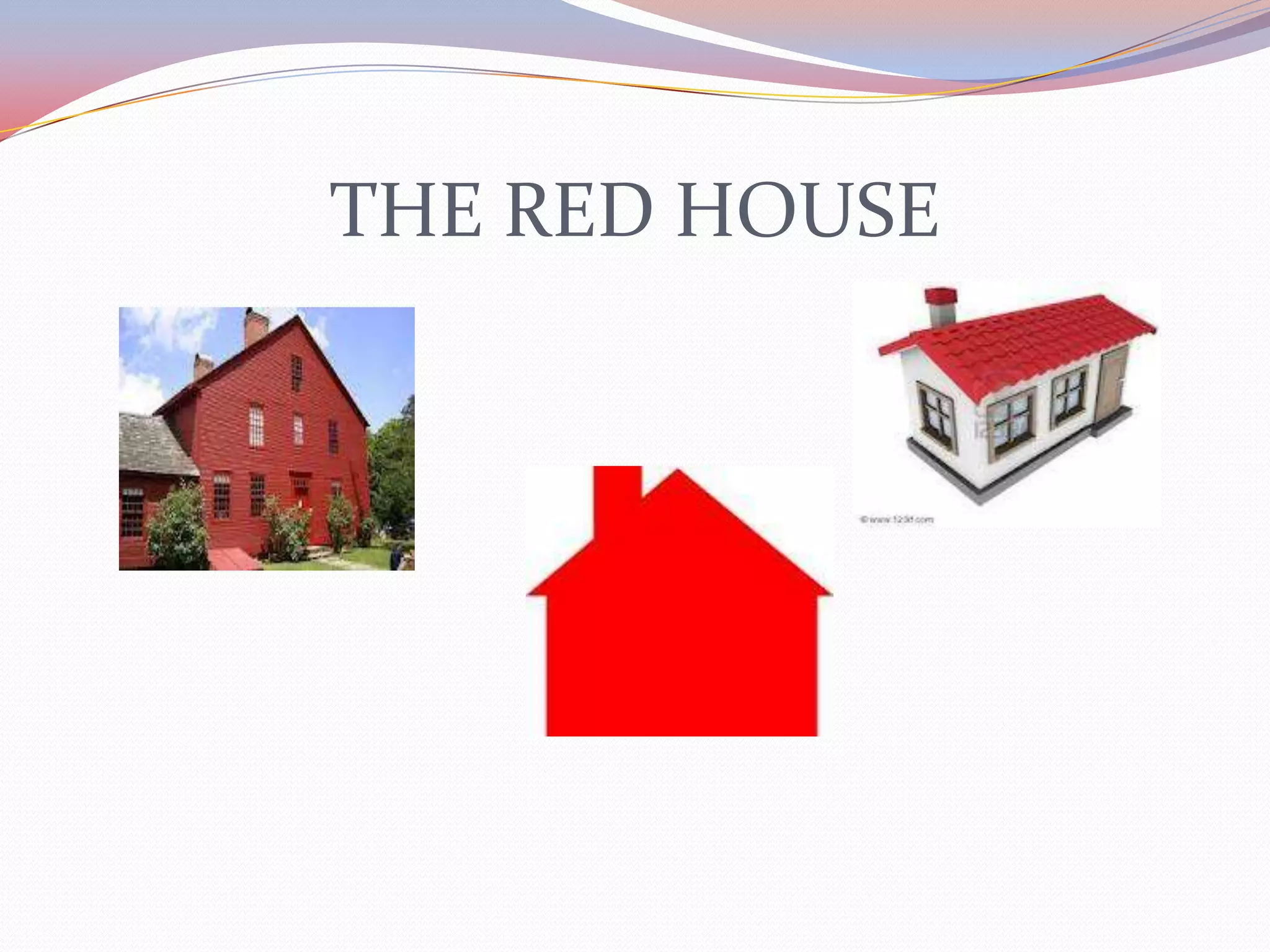
THE RED HOUSE
RED HOUSE & TREE
RED HOUSE, TREE & SUN
Learning Concerns

 Difficulty in pronouncing words.
 Poor phonological awareness
 Difficulty or slowness to add words.
 Inability to rhyme by age 4 years.
 Confusion in directionality, words and space
  concepts, left versus right, over versus
  under, before versus after.
 May have trouble learning the
  alphabets, numbers, day of the
  week, colors, shapes.
 May have difficulty telling or retelling a story in
  the correct sequence.
 Abnormal grip or refusal to write.
Behavioral concerns
 Hyperactivity
 Difficulty in following instructions
 Slow in ADLs
 Stubborness
 Temper tantrums
Dyslexia
 Avoids reading aloud
 Reads slowly
 Uses finger tracing
 Looses place or skips words
 Mispronounces or guesses words
 Has difficulty decoding or blending single words
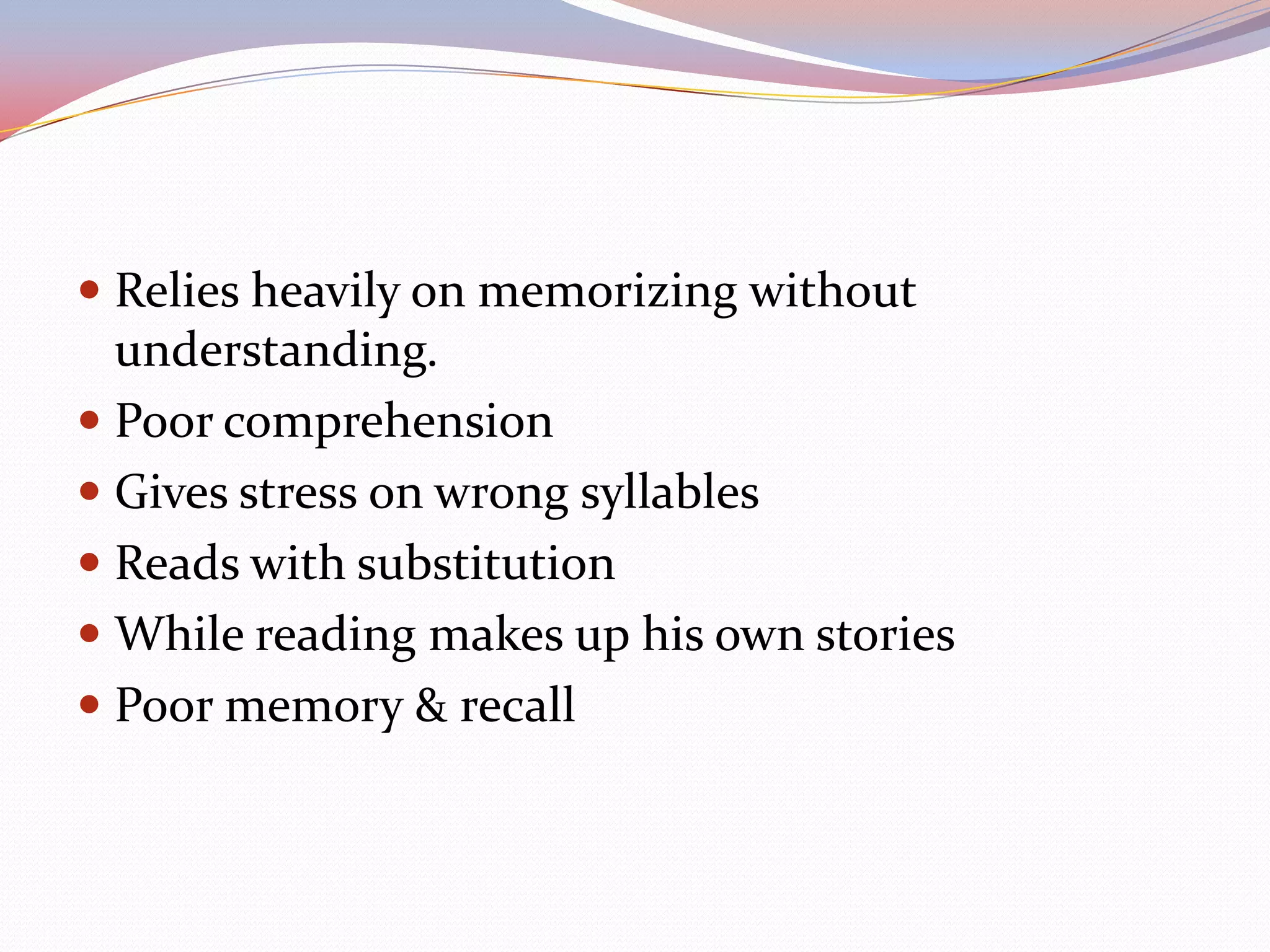
 Relies heavily on memorizing without
  understanding.
 Poor comprehension
 Gives stress on wrong syllables
 Reads with substitution
 While reading makes up his own stories
 Poor memory & recall
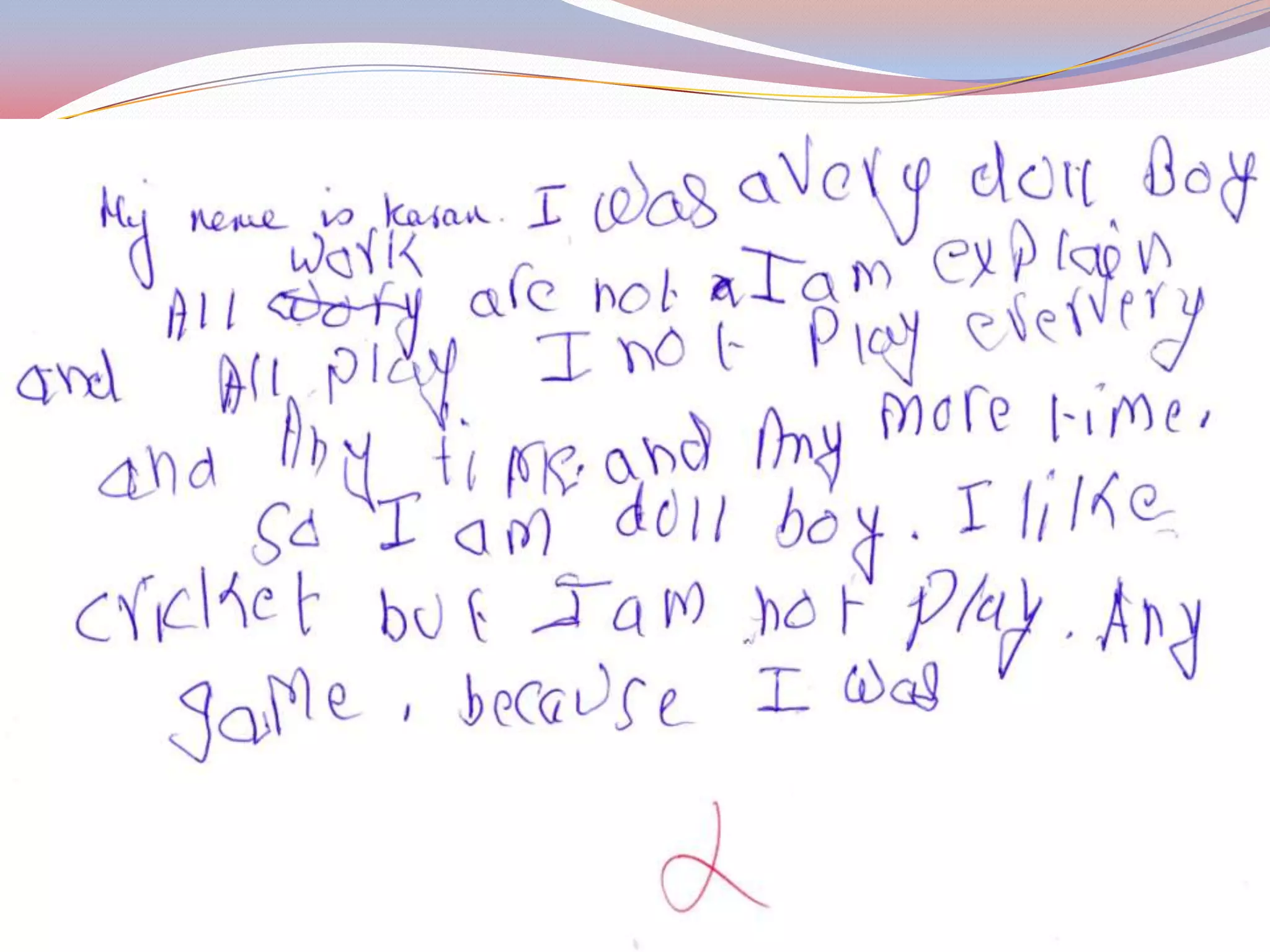
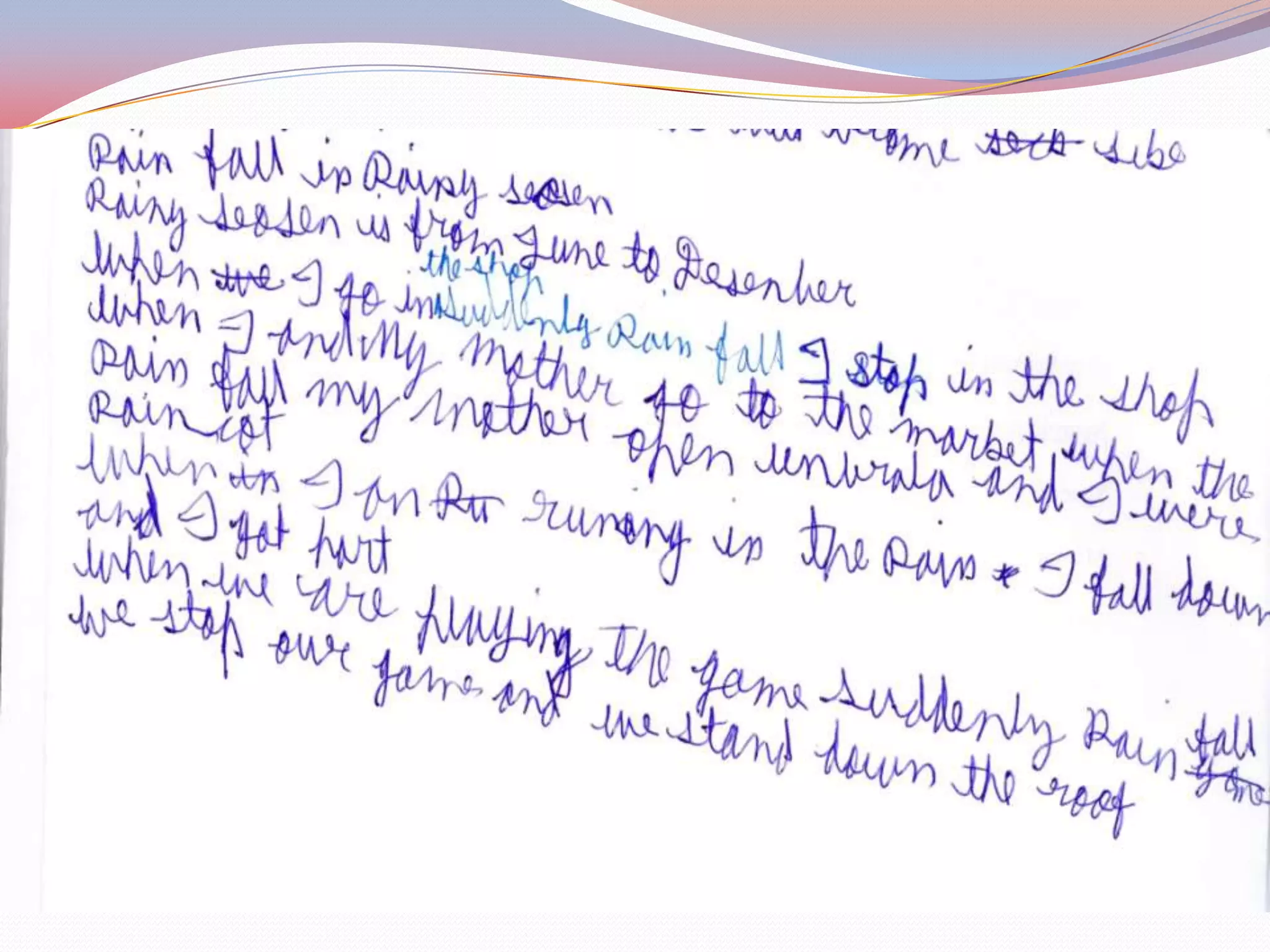
Dysgraphia
 Slow in writing or may avoid writing.
 Often uses an awkward pencil grip ( fist, thumb
  hooked over finger, etc.)
 Writes with illegible handwriting
 Poor letter formations
 Untidy written work
 Uses inappropriate pressure
 Uneven size of letters with poor spacing
 Spelling mistakes
 Bizarre spelling
 Spells the same word differently
 Punctuation & capitalization errors.
 Mixes upper & lowercase letters
 Problems with copy writing
Typical errors
 Letters reversals -d for b as in dog for bog.
 Word reversals – tip for pit.
 Inversions – m and w, u and n.
 Transpositions – felt and left.
 Substitutions – house and home.
 Omissions
 Additions.
Spelling errors
 Amount – aomunt
 Awards – awords
 Consent – conset
 Recent – resent
 Domestic – domistic
 Brain – brian
 Method - matheod
Dyscalculia
 May transpose number sequences , 231 as 312
 Confuse arithmetic signs. (+ - * / = )
 Has trouble with word problems
 Poor in mental maths
 Difficulty in learning tables
 Counting on fingers may be seen
 Difficulty in carrying over or borrowing sums
 May count from left to right
 Poor in geometry
 Poor in algebra
Other concerns
 Appears very clumsy and untidy.
 Has difficulty making friends.
 May not understand body language and facial
  expression of others.
 Has trouble with non-literal language
  (idioms, jokes, proverbs, slang)
 Difficulty following step by step instructions
 Difficulty in telling time
 Difficulty in telling/ following directions
 Slow in ADLs
 Poor understanding of abstract
 Disorganized behavior and thoughts
Associated behavioral issues..
 Hyperactivity
 Day dreaming
 Poor peer relations
 Aggressive behavior
 Poor participation
Pyschosocial concerns
 Poor self esteem
 Poor self confidence
 Poor interpersonal relations
 Emotional lability
Strengths
 Sensitive & compassionate
 Good at mechanical work
 Good at sports
 Usually good dancers
 Good at cooking & eating too…
Key Messages
 Hidden Handicap
 Neurological Disorder
 Present since Birth
 Multi-factorial
 Essentially Normal child
 Average / above average Intelligence
To Summarize…
 “Every learning problem is not a Learning
  Disability”
 With early intervention & provisions, they
  can be mainstreamed
 Secondary behavioral problems need
  effective management.
Specific Learning Disability

Specific Learning Disability

  • 1.
    Dr Anjana Thadhani ConsultantDevelopmental Pediatrician
  • 2.
    Specific Learning Disabilities Group of developmental disorders  Significant unexpected, specific and persistent difficulties in the acquisition and use of reading (dyslexia), writing (dysgraphia) or mathematical (dyscalculia) abilities,  despite conventional instruction, normal intelligence, proper motivation and adequate socio-cultural opportunity
  • 3.
    Salient Features Types: Dyslexia Dysgraphia Dyscalculia Creates a significant gap between the potential and academic performance Prevalence - 10% of school going children Difficulty with information processing
  • 4.
    LEARNING INPUT PROCESSING OUTPUT
  • 5.
    INFORMATION PROCESSING RECORDING INFORMATION(INPUT)  Perceptual →Visual →Auditory INTEGRATION  Sequencing  Abstraction  Organization STORAGE (MEMORY)  Short – term  Long – term
  • 6.
    READING  Phonological awareness Letter-sound association  Decoding & Blending  Focus on printed words  Control of eye movements across the page  Processing of images and ideas  Comparisons and associations of ideas  Storing of the information into memory
  • 7.
    CAUSES  Neuro-developmental condition Multi-factorial  Genetic predisposition  ADHD - Strong association  CO-MORBIDITY
  • 8.
    GENETICS • In 1950,Hallgren, an autosomal dominant disorder • Recent findings: Dyslexia is a genetically heterogeneous and complex trait that does not show classical mendelian inheritance Several chromosomal regions & genes affecting reading disability (chromosome 1, 2, 3, 6, 15, 18)
  • 9.
    NEUROIMAGING  Absence ofusual asymmetry of planum temporale (portion of temporal lobe lying posterior to Heschl’s gyrus)  Left is usually larger than right  Neuronal ectopias in frontal and parietal regions
  • 11.
    MANIFESTATIONS  Varied spectrumpresentation  Mild to severe  Academic  Behavioral  Co-morbidity  Psychosocial
  • 12.
    REFERRAL LETTER  Repeatedfailures  Does not write or read  Spelling mistakes  Oral work better than written work  Problems in math
  • 13.
  • 14.
    Developmental delays  Mildgross motor delays  Fine motor problems  Speech delay or difficulties  Lack of dominant handedness  Perceptual problems
  • 15.
    AUDITORY PERCEPTION  Auditoryperception  Auditory discrimination  Auditory memory & sequencing  Auditory filtering  Auditory processing
  • 16.
    VISUAL PERCEPTION  Visualperception  Visual discrimination  Visual memory & sequencing  Form constancy  Visuomotor integration  Figure ground discrimination
  • 17.
  • 18.
  • 19.
  • 20.
    Learning Concerns  Difficultyin pronouncing words.  Poor phonological awareness  Difficulty or slowness to add words.  Inability to rhyme by age 4 years.  Confusion in directionality, words and space concepts, left versus right, over versus under, before versus after.
  • 21.
     May havetrouble learning the alphabets, numbers, day of the week, colors, shapes.  May have difficulty telling or retelling a story in the correct sequence.  Abnormal grip or refusal to write.
  • 22.
    Behavioral concerns  Hyperactivity Difficulty in following instructions  Slow in ADLs  Stubborness  Temper tantrums
  • 24.
    Dyslexia  Avoids readingaloud  Reads slowly  Uses finger tracing  Looses place or skips words  Mispronounces or guesses words  Has difficulty decoding or blending single words
  • 25.
     Relies heavilyon memorizing without understanding.  Poor comprehension  Gives stress on wrong syllables  Reads with substitution  While reading makes up his own stories  Poor memory & recall
  • 26.
    Dysgraphia  Slow inwriting or may avoid writing.  Often uses an awkward pencil grip ( fist, thumb hooked over finger, etc.)  Writes with illegible handwriting  Poor letter formations  Untidy written work  Uses inappropriate pressure  Uneven size of letters with poor spacing
  • 27.
     Spelling mistakes Bizarre spelling  Spells the same word differently  Punctuation & capitalization errors.  Mixes upper & lowercase letters  Problems with copy writing
  • 30.
    Typical errors  Lettersreversals -d for b as in dog for bog.  Word reversals – tip for pit.  Inversions – m and w, u and n.  Transpositions – felt and left.  Substitutions – house and home.  Omissions  Additions.
  • 31.
    Spelling errors  Amount– aomunt  Awards – awords  Consent – conset  Recent – resent  Domestic – domistic  Brain – brian  Method - matheod
  • 32.
    Dyscalculia  May transposenumber sequences , 231 as 312  Confuse arithmetic signs. (+ - * / = )  Has trouble with word problems  Poor in mental maths  Difficulty in learning tables  Counting on fingers may be seen
  • 33.
     Difficulty incarrying over or borrowing sums  May count from left to right  Poor in geometry  Poor in algebra
  • 34.
    Other concerns  Appearsvery clumsy and untidy.  Has difficulty making friends.  May not understand body language and facial expression of others.  Has trouble with non-literal language (idioms, jokes, proverbs, slang)
  • 35.
     Difficulty followingstep by step instructions  Difficulty in telling time  Difficulty in telling/ following directions  Slow in ADLs  Poor understanding of abstract  Disorganized behavior and thoughts
  • 36.
    Associated behavioral issues.. Hyperactivity  Day dreaming  Poor peer relations  Aggressive behavior  Poor participation
  • 37.
    Pyschosocial concerns  Poorself esteem  Poor self confidence  Poor interpersonal relations  Emotional lability
  • 38.
    Strengths  Sensitive &compassionate  Good at mechanical work  Good at sports  Usually good dancers  Good at cooking & eating too…
  • 39.
    Key Messages  HiddenHandicap  Neurological Disorder  Present since Birth  Multi-factorial  Essentially Normal child  Average / above average Intelligence
  • 40.
    To Summarize…  “Everylearning problem is not a Learning Disability”  With early intervention & provisions, they can be mainstreamed  Secondary behavioral problems need effective management.