RECEPTIVE AND 
EXPRESSIVE 
COMMUNICATION 
SKILLS
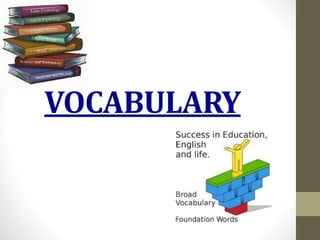
VOCABULARY
What does vocabulary mean ? 
• A person's vocabulary is 
the set of words within a 
language that are 
familiar to that person. A 
vocabulary usually 
develops with age, and 
serves as a useful and 
fundamental tool for 
communication and 
acquiring knowledge. 
Acquiring an extensive 
vocabulary is one of the 
largest challenges in 
learning a second 
language.
The Importance of Vocabulary 
in Writing : 
Every good mechanic has a toolbox full of tools. Some tools are 
used more than others, but every one has a specific purpose. In 
much the same way, writers have a “toolbox.” This “toolbox” is 
constantly growing and is filled with items like grammar, 
punctuation, and capitalization rules; figurative language; 
rhyme; rhythm; and vocabulary. Just as really good mechanics 
can pull out the right tools to make a good engine even more 
powerful, good writers can pull out the right tools at the right 
time to make good writing even more powerful. One tool that 
can “power up” your writing is a strong vocabulary.
• An extensive vocabulary aids expression and communication. 
• Vocabulary size has been directly linked to reading 
comprehension. 
• Linguistic vocabulary is synonymous with thinking vocabulary. 
• A person may be judged by others based on his or her 
vocabulary. 
• Wilkins (1972) once said," Without grammar, very little can be 
conveyed, without vocabulary, nothing can be conveyed.” 
• When you’re faced with a writing assignment, a good 
vocabulary is an indispensable (very important or necessary) 
tool. If you have several synonyms (words with similar 
meanings) in your repertoire (“toolbox”), you’ll be able to 
choose the best word for the job. Avoid vague words like 
“stuff” or “things” when you write. These words do not give 
the reader a good sense of your meaning. Also, use strong 
verbs that give the reader good information.
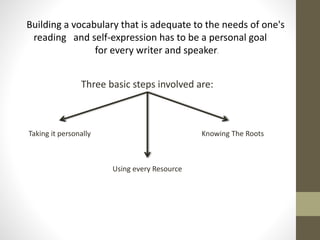
Building a vocabulary that is adequate to the needs of one's 
reading and self-expression has to be a personal goal 
for every writer and speaker. 
Three basic steps involved are: 
Knowing The Roots 
Using every Resource 
Taking it personally
 Read texts, literature, journals 
Try reading all the stuff and note down all the new words that 
you encounter with. 
 Look up for words 
Look for all the words you find difficult and are not aware of. 
Also read dictionary as it will help you t be updated with 
different terms and their meanings. 
 Bring words to use 
Start including those new words into you day to day 
communication. Practice them. 
 Write something 
Start writing journals blogs as this will provide confidence and 
it will also enhance your word using power.
BASICS OF VOCABULARY 
• The word vocabulary entered the English lexicon in the 1530s 
and is derived from the Latin word ‘vocabularium,’ meaning ‘a 
list of words.’ It gained its modern meaning, the sum of all 
words known by a person, in the 1700s. Eminent writers such 
as William Shakespeare and Charles Dickens are known for 
their large vocabularies. 
• There are basically 3 tiers of vocabulary which are : 
• Tier 1 – Basic vocabulary 
• Tier 2 – Multiple meaning vocabulary 
• Tier 3 - Context specific vocabulary
TYPES OF VOCABULARY 
• A person’s knowledge of words is divided into two parts: 
active and passive knowledge. 
• ACTIVE vocabulary are the sets of words which a person uses 
in his/her daily life whereas PASSIVE vocabulary is the one 
which he understands but never uses it. 
• A read vocabulary is a passive one. This means it is the words 
understood by the reader when he or she is reading a piece of 
written text. The person is able to recognize the form of the 
letters and how they correspond to one another, and how 
their sum is understood. This also includes understanding a 
word’s spelling, meaning and the exact meaning in its context. 
• Listening is another example of passive vocabulary.
ACTIVE VOCABULARY 
• Writing is the active vocabulary equivalent to reading. With 
reading, it forms the core skills needed for someone to be 
literate. The writer demonstrates his or her knowledge of a 
word in terms of its meaning and how to spell it and use it 
correctly. 
• Speaking is one of the types of vocabulary that demonstrates 
a person’s knowledge of words. It is an active demonstration 
that can also rely on other elements such as facial expressions, 
intonation, pitch and gestures to help others understand its 
meaning. Knowledge of a word is demonstrated by its good 
usage and pronunciation.
USES OF HOMONYMS 
• Homonyms (also called homophones) are words that sound 
like one another but have different meanings. Some 
homonyms are spelled the same, like bark (the sound a dog 
makes) and bark (the outer layer of a tree trunk). Some 
homonyms are spelled differently, like one (the number) and 
won (having been victorious). 
• Studying homonyms in typical phrases in which they are used 
will help you to distinguish one homonym from another when 
you hear them. 
• Some examples of homonyms are: 
• BUY – BY, CACHE – CASH, CELL – SELL, BRAKE – BREAK.
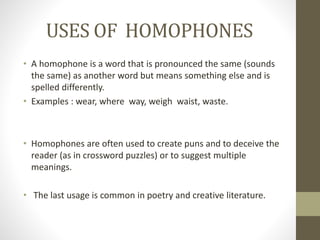
USES OF HOMOPHONES 
• A homophone is a word that is pronounced the same (sounds 
the same) as another word but means something else and is 
spelled differently. 
• Examples : wear, where way, weigh waist, waste. 
• Homophones are often used to create puns and to deceive the 
reader (as in crossword puzzles) or to suggest multiple 
meanings. 
• The last usage is common in poetry and creative literature.
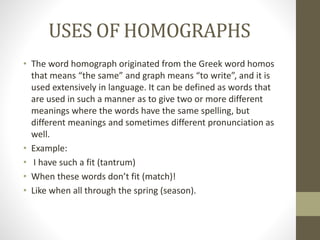
USES OF HOMOGRAPHS 
• The word homograph originated from the Greek word homos 
that means “the same” and graph means “to write”, and it is 
used extensively in language. It can be defined as words that 
are used in such a manner as to give two or more different 
meanings where the words have the same spelling, but 
different meanings and sometimes different pronunciation as 
well. 
• Example: 
• I have such a fit (tantrum) 
• When these words don’t fit (match)! 
• Like when all through the spring (season).

Receptive and Expressive Communication

  • 1.
    RECEPTIVE AND EXPRESSIVE COMMUNICATION SKILLS
  • 2.
  • 3.
    What does vocabularymean ? • A person's vocabulary is the set of words within a language that are familiar to that person. A vocabulary usually develops with age, and serves as a useful and fundamental tool for communication and acquiring knowledge. Acquiring an extensive vocabulary is one of the largest challenges in learning a second language.
  • 4.
    The Importance ofVocabulary in Writing : Every good mechanic has a toolbox full of tools. Some tools are used more than others, but every one has a specific purpose. In much the same way, writers have a “toolbox.” This “toolbox” is constantly growing and is filled with items like grammar, punctuation, and capitalization rules; figurative language; rhyme; rhythm; and vocabulary. Just as really good mechanics can pull out the right tools to make a good engine even more powerful, good writers can pull out the right tools at the right time to make good writing even more powerful. One tool that can “power up” your writing is a strong vocabulary.
  • 5.
    • An extensivevocabulary aids expression and communication. • Vocabulary size has been directly linked to reading comprehension. • Linguistic vocabulary is synonymous with thinking vocabulary. • A person may be judged by others based on his or her vocabulary. • Wilkins (1972) once said," Without grammar, very little can be conveyed, without vocabulary, nothing can be conveyed.” • When you’re faced with a writing assignment, a good vocabulary is an indispensable (very important or necessary) tool. If you have several synonyms (words with similar meanings) in your repertoire (“toolbox”), you’ll be able to choose the best word for the job. Avoid vague words like “stuff” or “things” when you write. These words do not give the reader a good sense of your meaning. Also, use strong verbs that give the reader good information.
  • 7.
    Building a vocabularythat is adequate to the needs of one's reading and self-expression has to be a personal goal for every writer and speaker. Three basic steps involved are: Knowing The Roots Using every Resource Taking it personally
  • 8.
     Read texts,literature, journals Try reading all the stuff and note down all the new words that you encounter with.  Look up for words Look for all the words you find difficult and are not aware of. Also read dictionary as it will help you t be updated with different terms and their meanings.  Bring words to use Start including those new words into you day to day communication. Practice them.  Write something Start writing journals blogs as this will provide confidence and it will also enhance your word using power.
  • 9.
    BASICS OF VOCABULARY • The word vocabulary entered the English lexicon in the 1530s and is derived from the Latin word ‘vocabularium,’ meaning ‘a list of words.’ It gained its modern meaning, the sum of all words known by a person, in the 1700s. Eminent writers such as William Shakespeare and Charles Dickens are known for their large vocabularies. • There are basically 3 tiers of vocabulary which are : • Tier 1 – Basic vocabulary • Tier 2 – Multiple meaning vocabulary • Tier 3 - Context specific vocabulary
  • 10.
    TYPES OF VOCABULARY • A person’s knowledge of words is divided into two parts: active and passive knowledge. • ACTIVE vocabulary are the sets of words which a person uses in his/her daily life whereas PASSIVE vocabulary is the one which he understands but never uses it. • A read vocabulary is a passive one. This means it is the words understood by the reader when he or she is reading a piece of written text. The person is able to recognize the form of the letters and how they correspond to one another, and how their sum is understood. This also includes understanding a word’s spelling, meaning and the exact meaning in its context. • Listening is another example of passive vocabulary.
  • 11.
    ACTIVE VOCABULARY •Writing is the active vocabulary equivalent to reading. With reading, it forms the core skills needed for someone to be literate. The writer demonstrates his or her knowledge of a word in terms of its meaning and how to spell it and use it correctly. • Speaking is one of the types of vocabulary that demonstrates a person’s knowledge of words. It is an active demonstration that can also rely on other elements such as facial expressions, intonation, pitch and gestures to help others understand its meaning. Knowledge of a word is demonstrated by its good usage and pronunciation.
  • 12.
    USES OF HOMONYMS • Homonyms (also called homophones) are words that sound like one another but have different meanings. Some homonyms are spelled the same, like bark (the sound a dog makes) and bark (the outer layer of a tree trunk). Some homonyms are spelled differently, like one (the number) and won (having been victorious). • Studying homonyms in typical phrases in which they are used will help you to distinguish one homonym from another when you hear them. • Some examples of homonyms are: • BUY – BY, CACHE – CASH, CELL – SELL, BRAKE – BREAK.
  • 13.
    USES OF HOMOPHONES • A homophone is a word that is pronounced the same (sounds the same) as another word but means something else and is spelled differently. • Examples : wear, where way, weigh waist, waste. • Homophones are often used to create puns and to deceive the reader (as in crossword puzzles) or to suggest multiple meanings. • The last usage is common in poetry and creative literature.
  • 14.
    USES OF HOMOGRAPHS • The word homograph originated from the Greek word homos that means “the same” and graph means “to write”, and it is used extensively in language. It can be defined as words that are used in such a manner as to give two or more different meanings where the words have the same spelling, but different meanings and sometimes different pronunciation as well. • Example: • I have such a fit (tantrum) • When these words don’t fit (match)! • Like when all through the spring (season).