Psychotherapies
• According to Approaches
– Behavioural Therapy
– Psychoanalytic
– Cognitive therapy
– Humanistic Therapy
• According to Client Involvement
– Individual therapy
– Group Therapy
• Others
– Interpersonal psychotherapy (family, marital)
– Occupational therapy
– Milieu therapy/ therapeutic community
– Recreational Therapy
– Supportive Therapy
• Counselling (Review)
Behavioural Therapy
Behaviour
• Adaptive
• Maladaptive- when it is age
inappropriate, interferes with adaptive
functioning or others misunderstand it in
terms of cultural inappropriateness.
• Behaviorism see psychological disorders as the
result of maladaptive learning, as people are
born tabula rasa (a blank slate).
• Basic assumption is that the maladaptive
behaviour can be corrected through the
provision of adequate learning experiences.
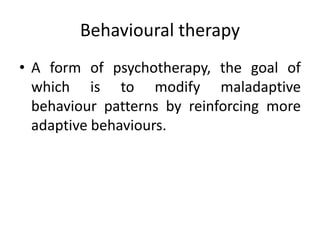
Behavioural therapy
• A form of psychotherapy, the goal of
which is to modify maladaptive
behaviour patterns by reinforcing more
adaptive behaviours.
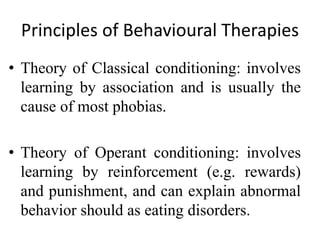
Principles of Behavioural Therapies
• Theory of Classical conditioning: involves
learning by association and is usually the
cause of most phobias.
• Theory of Operant conditioning: involves
learning by reinforcement (e.g. rewards)
and punishment, and can explain abnormal
behavior should as eating disorders.
• Social Learning Theory
• Cognitive Behavioural Approach
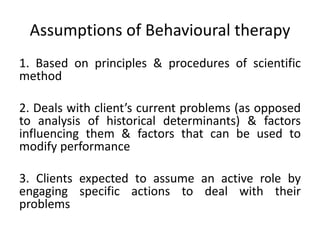
Assumptions of Behavioural therapy
1. Based on principles & procedures of scientific
method
2. Deals with client’s current problems (as opposed
to analysis of historical determinants) & factors
influencing them & factors that can be used to
modify performance
3. Clients expected to assume an active role by
engaging specific actions to deal with their
problems
4. Emphasizes teaching clients skills of
selfmanagement, with expectation they’re
responsible for transferring what’s learned in office
to everyday lives
5. Focus on assessing overt & covert behaviors
directly, identifying problem, & evaluating change
6. Emphasizes a self-control approach in which
clients learn self-management strategies
7. Interventions individually tailored to specific
problems “What treatment, by whom, is the
most effective for this individual with that
specific problem & under which set of
circumstances?”
8. Based on collaborative partnership between
therapist & client (clients informed about nature
& course of Rx)
9. Emphasis on practical application
Interventions applied to ALL facets of daily life in
which maladaptive behaviors are to be deceased
& adaptive behaviors are to be increased
10. Therapists strive to develop culture-specific
procedures & obtain clients’ adherence &
cooperation
Indications of Behavioural therapy
• obsessive-compulsive
disorder (OCD)
• post-traumatic stress
disorder (PTSD)
• depression
• social phobia
• bipolar disorder
• schizophrenia
• autism
• personality disorders
• substance abuse
• eating disorders
Behavioural Therapy Techniques
• Systemic
Desensitization
• Flooding
• Therapeutic Graded
Exposure
• Participant Modeling
• Assertiveness Training
• Social Skill Training
• Aversion Therapy
• Shaping
• Premack principle
• Extinction
• Token Economy
• Contingency
Contracting
• Overt Sensitization
• Covert Sensitization
• Time out
Systemic Desensitization
• Developed by Joseph Wolpe
• Steps
–Relaxation Training: Relaxation produces
physiological effects opposite to those of
anxiety.
–Hierarchy Construction: 10-12 conditions in
order of increasing anxiety
–Desensitization of Stimulus: gradual exposure of
individual from least to most anxiety provoking
situation in a deeply relaxed state.
• Suitable for
– Anxiety disorder
– Phobic anxiety disorder
– Obsessive compulsive disorder
– Certain sexual disorder
Flooding/Implosion
• No relaxation
• No Grading
• Exposing the individual directly with the situation
• Based on the principle that escaping from
anxiety reinforces the anxiety through
conditioning
• Prematurely withdrawing from the situation may
reinforce the phobia.
• Not suitable for client with heart disease and
fragile psychological adaptation.
Therapeutic Graded Exposure
• Therapeutic grade exposure is similar to
the systemic desensitization except that
relaxation training is not involved and
treatment is usually carried out in real
life context.
Participant Modeling
• In participant modeling, patients learn a new
behaviour by imitation, primarily by
observation, without having to perform the
behaviour until they feel ready.
• Useful in phobic children
• Children with problem are placed with
children of own age and sex, who approach
the feared situation together.
Assertiveness Training
• Assertiveness is a response that seeks to maintain an
appropriate balance between passivity and aggression.
Assertive responses promote fairness and equality in
human interactions, based on a positive sense of respect
for self and others.
• Assertiveness training is a form of behavior therapy
designed to help people stand up for themselves—to
empower themselves, in more contemporary terms.
Social Skill Training
• Social skills training (SST) is a form of behavior
therapy used by teachers, therapists, and trainers
to help persons who have difficulties relating to
other people
• A major goal of social skills training is teaching
persons who may or may not have emotional
problems about the verbal as well as nonverbal
behaviors involved in social interactions.
Some examples of social skills are
• Eye contact with others during conversation
• Smiling when greeting people
• Shaking hands when meeting someone
• Using the right tone and volume of voice
• Expressing opinions to others
• Perceiving how others are feeling and showing
empathy
• Appropriate emotional responses (e.g. crying
when something sad happens; laughing when
someone says something funny)
Aversion Theory
• When a noxious stimulus (punishment) is
presented immediately after a specific
behavioural response, theoretically, the
response is eventually, the response is
eventually inhibited and extinguished.
• Types of noxious stimulus
– Electric shock
– Substance that induce vomiting
– Corporal punishment
– Social disapproval
• Aversion therapy is suitable for
– Alcohol abuse
– Paraphilias
– Impulsive and obsessive behaviour
Shaping
• a method of training by which successive
approximations toward a target behavior are
reinforced
• Shaping, or behavior-shaping, is a variant of
operant conditioning. Instead of waiting for a
subject to exhibit a desired behavior, any behavior
leading to the target behavior is rewarded.
• Speech therapy in Autistic Child- suitable
Premack Principle
• The Premack principle was derived from a study
of Cebus monkeys by Professor David Premack
• Premack's principle suggests that if a person
wants to perform a given activity, the person will
perform a less desirable activity to get at the
more desirable activity; that is, activities may
themselves be reinforcers.
• An individual will be more motivated to perform
a particular activity if they know that they will be
able to partake of a more desirable activity as a
consequence.
• R1- Frequently occurring response
• R2- Less frequently occurring response
• Allowing R1to occur only afterR1
• R1 – Telephone talking with friends
• R2- Completing homework
• Completion of homework may get incentive of
telephone talking
Extinction
• Extinction is observed in both operantly
conditioned and classically
conditioned behavior.
• "Extinction as a procedure occurs when
reinforcement of a previously reinforced
behaviour is discontinued; as a result, the
frequency of that behaviour decreases in the
future.“
• Eg. Extinction in temper tantrum
Token Economy
• An operant technique applied to groups, such
as classrooms or mental hospital wards,
involving the distribution of "tokens" or other
indicators of reinforcement on desired
behaviors. The tokens can later be exchanged
for privileges, food, or other reinforcers.
Contingency Contracting
• A contract is drawn up among all parties
involved.
• Desired behavioural change is expressed in
writing
• Contract is made for the reinforcement of
compliance and punishment for non
compliance
Restitution/Over Correction
• Restitution means restoring the disturbed
situation to a state that is much better than
what it was before the ocuurrance of problem
behaviour.
• For example, if a patient passes urine in the
ward he would be required to clean the dirty
area but also mop the entire larger area of the
floor of the ward.
Time Out
• Time out is an aversive stimulus or
punishment during which the client is
removed from the environment where the
unacceptable behaviour is being exhibited.
• The client is usually isolated so that
reinforcement from attention of others is
absent.
Reciprocal Inhibition
• Also called counter conditioning, it decreases
or eliminates a behaviour by introducing a
more adaptive behaviour, but one that is
incompatible with unacceptable behaviour.
• Eg. Relaxation exercise for the phobic patient.
Overt Sensitization
• A type of aversion therapy
• Eg. Disulfiram for the person who wish to quit
the alcohol
Covert Sensitization
• Individual’s imagination to produce
unpleasant symptoms rather than on
medication
• The individual learns through mental imagery
to visualize nauseating scenes and even to
induce mild feeling of nausea.
Exposure and Response Prevention
• Exposure and response prevention (ERP) is a
treatment method available from
behavioral psychologists and cognitive-
behavioral therapists for a variety of anxiety
disorders, especially obsessive–compulsive
disorder and phobias.
• Advantages of Behavioural Therapy
– Behavioral therapists use empirically tested
techniques, assuring that clients are receiving both
effective and brief treatment
– Evidence-based therapies (EBT) are a hallmark of both
behavior therapy and cognitive behavior therapy
– Most studies show that behavior therapy methods are
more effective than no treatment
– Emphasis on ethical accountability (does not dictate
whose behavior or what behavior should be changed)
– Address ethical issues by stating that therapy is
basically an education process; an essential feature of
behavior therapy involves collaboration between
therapist & client
• Disadvantages of Behavioural Therapy
– Behavior therapy may change behaviors, but it
does not change feelings
– Behavior therapy ignores the important relational
factors in therapy
– Behavior therapy does not provide insight
– Behavior therapy treats symptoms rather than
causes
– Behavior therapy involves control & manipulation
by therapist

Behavioural therapy

  • 2.
    Psychotherapies • According toApproaches – Behavioural Therapy – Psychoanalytic – Cognitive therapy – Humanistic Therapy • According to Client Involvement – Individual therapy – Group Therapy
  • 3.
    • Others – Interpersonalpsychotherapy (family, marital) – Occupational therapy – Milieu therapy/ therapeutic community – Recreational Therapy – Supportive Therapy • Counselling (Review)
  • 4.
  • 5.
    Behaviour • Adaptive • Maladaptive-when it is age inappropriate, interferes with adaptive functioning or others misunderstand it in terms of cultural inappropriateness.
  • 6.
    • Behaviorism seepsychological disorders as the result of maladaptive learning, as people are born tabula rasa (a blank slate). • Basic assumption is that the maladaptive behaviour can be corrected through the provision of adequate learning experiences.
  • 7.
    Behavioural therapy • Aform of psychotherapy, the goal of which is to modify maladaptive behaviour patterns by reinforcing more adaptive behaviours.
  • 8.
    Principles of BehaviouralTherapies • Theory of Classical conditioning: involves learning by association and is usually the cause of most phobias. • Theory of Operant conditioning: involves learning by reinforcement (e.g. rewards) and punishment, and can explain abnormal behavior should as eating disorders.
  • 9.
    • Social LearningTheory • Cognitive Behavioural Approach
  • 10.
    Assumptions of Behaviouraltherapy 1. Based on principles & procedures of scientific method 2. Deals with client’s current problems (as opposed to analysis of historical determinants) & factors influencing them & factors that can be used to modify performance 3. Clients expected to assume an active role by engaging specific actions to deal with their problems
  • 11.
    4. Emphasizes teachingclients skills of selfmanagement, with expectation they’re responsible for transferring what’s learned in office to everyday lives 5. Focus on assessing overt & covert behaviors directly, identifying problem, & evaluating change 6. Emphasizes a self-control approach in which clients learn self-management strategies
  • 12.
    7. Interventions individuallytailored to specific problems “What treatment, by whom, is the most effective for this individual with that specific problem & under which set of circumstances?” 8. Based on collaborative partnership between therapist & client (clients informed about nature & course of Rx)
  • 13.
    9. Emphasis onpractical application Interventions applied to ALL facets of daily life in which maladaptive behaviors are to be deceased & adaptive behaviors are to be increased 10. Therapists strive to develop culture-specific procedures & obtain clients’ adherence & cooperation
  • 14.
    Indications of Behaviouraltherapy • obsessive-compulsive disorder (OCD) • post-traumatic stress disorder (PTSD) • depression • social phobia • bipolar disorder • schizophrenia • autism • personality disorders • substance abuse • eating disorders
  • 15.
    Behavioural Therapy Techniques •Systemic Desensitization • Flooding • Therapeutic Graded Exposure • Participant Modeling • Assertiveness Training • Social Skill Training • Aversion Therapy • Shaping • Premack principle • Extinction • Token Economy • Contingency Contracting • Overt Sensitization • Covert Sensitization • Time out
  • 16.
    Systemic Desensitization • Developedby Joseph Wolpe • Steps –Relaxation Training: Relaxation produces physiological effects opposite to those of anxiety. –Hierarchy Construction: 10-12 conditions in order of increasing anxiety –Desensitization of Stimulus: gradual exposure of individual from least to most anxiety provoking situation in a deeply relaxed state.
  • 17.
    • Suitable for –Anxiety disorder – Phobic anxiety disorder – Obsessive compulsive disorder – Certain sexual disorder
  • 18.
    Flooding/Implosion • No relaxation •No Grading • Exposing the individual directly with the situation • Based on the principle that escaping from anxiety reinforces the anxiety through conditioning • Prematurely withdrawing from the situation may reinforce the phobia. • Not suitable for client with heart disease and fragile psychological adaptation.
  • 19.
    Therapeutic Graded Exposure •Therapeutic grade exposure is similar to the systemic desensitization except that relaxation training is not involved and treatment is usually carried out in real life context.
  • 20.
    Participant Modeling • Inparticipant modeling, patients learn a new behaviour by imitation, primarily by observation, without having to perform the behaviour until they feel ready. • Useful in phobic children • Children with problem are placed with children of own age and sex, who approach the feared situation together.
  • 21.
    Assertiveness Training • Assertivenessis a response that seeks to maintain an appropriate balance between passivity and aggression. Assertive responses promote fairness and equality in human interactions, based on a positive sense of respect for self and others. • Assertiveness training is a form of behavior therapy designed to help people stand up for themselves—to empower themselves, in more contemporary terms.
  • 22.
    Social Skill Training •Social skills training (SST) is a form of behavior therapy used by teachers, therapists, and trainers to help persons who have difficulties relating to other people • A major goal of social skills training is teaching persons who may or may not have emotional problems about the verbal as well as nonverbal behaviors involved in social interactions.
  • 23.
    Some examples ofsocial skills are • Eye contact with others during conversation • Smiling when greeting people • Shaking hands when meeting someone • Using the right tone and volume of voice • Expressing opinions to others • Perceiving how others are feeling and showing empathy • Appropriate emotional responses (e.g. crying when something sad happens; laughing when someone says something funny)
  • 24.
    Aversion Theory • Whena noxious stimulus (punishment) is presented immediately after a specific behavioural response, theoretically, the response is eventually, the response is eventually inhibited and extinguished. • Types of noxious stimulus – Electric shock – Substance that induce vomiting – Corporal punishment – Social disapproval
  • 25.
    • Aversion therapyis suitable for – Alcohol abuse – Paraphilias – Impulsive and obsessive behaviour
  • 26.
    Shaping • a methodof training by which successive approximations toward a target behavior are reinforced • Shaping, or behavior-shaping, is a variant of operant conditioning. Instead of waiting for a subject to exhibit a desired behavior, any behavior leading to the target behavior is rewarded. • Speech therapy in Autistic Child- suitable
  • 27.
    Premack Principle • ThePremack principle was derived from a study of Cebus monkeys by Professor David Premack • Premack's principle suggests that if a person wants to perform a given activity, the person will perform a less desirable activity to get at the more desirable activity; that is, activities may themselves be reinforcers. • An individual will be more motivated to perform a particular activity if they know that they will be able to partake of a more desirable activity as a consequence.
  • 28.
    • R1- Frequentlyoccurring response • R2- Less frequently occurring response • Allowing R1to occur only afterR1 • R1 – Telephone talking with friends • R2- Completing homework • Completion of homework may get incentive of telephone talking
  • 29.
    Extinction • Extinction isobserved in both operantly conditioned and classically conditioned behavior. • "Extinction as a procedure occurs when reinforcement of a previously reinforced behaviour is discontinued; as a result, the frequency of that behaviour decreases in the future.“ • Eg. Extinction in temper tantrum
  • 30.
    Token Economy • Anoperant technique applied to groups, such as classrooms or mental hospital wards, involving the distribution of "tokens" or other indicators of reinforcement on desired behaviors. The tokens can later be exchanged for privileges, food, or other reinforcers.
  • 31.
    Contingency Contracting • Acontract is drawn up among all parties involved. • Desired behavioural change is expressed in writing • Contract is made for the reinforcement of compliance and punishment for non compliance
  • 32.
    Restitution/Over Correction • Restitutionmeans restoring the disturbed situation to a state that is much better than what it was before the ocuurrance of problem behaviour. • For example, if a patient passes urine in the ward he would be required to clean the dirty area but also mop the entire larger area of the floor of the ward.
  • 33.
    Time Out • Timeout is an aversive stimulus or punishment during which the client is removed from the environment where the unacceptable behaviour is being exhibited. • The client is usually isolated so that reinforcement from attention of others is absent.
  • 34.
    Reciprocal Inhibition • Alsocalled counter conditioning, it decreases or eliminates a behaviour by introducing a more adaptive behaviour, but one that is incompatible with unacceptable behaviour. • Eg. Relaxation exercise for the phobic patient.
  • 35.
    Overt Sensitization • Atype of aversion therapy • Eg. Disulfiram for the person who wish to quit the alcohol
  • 36.
    Covert Sensitization • Individual’simagination to produce unpleasant symptoms rather than on medication • The individual learns through mental imagery to visualize nauseating scenes and even to induce mild feeling of nausea.
  • 37.
    Exposure and ResponsePrevention • Exposure and response prevention (ERP) is a treatment method available from behavioral psychologists and cognitive- behavioral therapists for a variety of anxiety disorders, especially obsessive–compulsive disorder and phobias.
  • 38.
    • Advantages ofBehavioural Therapy – Behavioral therapists use empirically tested techniques, assuring that clients are receiving both effective and brief treatment – Evidence-based therapies (EBT) are a hallmark of both behavior therapy and cognitive behavior therapy – Most studies show that behavior therapy methods are more effective than no treatment – Emphasis on ethical accountability (does not dictate whose behavior or what behavior should be changed) – Address ethical issues by stating that therapy is basically an education process; an essential feature of behavior therapy involves collaboration between therapist & client
  • 39.
    • Disadvantages ofBehavioural Therapy – Behavior therapy may change behaviors, but it does not change feelings – Behavior therapy ignores the important relational factors in therapy – Behavior therapy does not provide insight – Behavior therapy treats symptoms rather than causes – Behavior therapy involves control & manipulation by therapist