Learning disorders
Moderator : Dr. Madhusudhan reddy
By : Dr. J vikas reddy
Terminology and epidemiology
- A neurodevelopmental function is a basic
brain process needed for learning and
productivity.
- Neurodevelopmental dysfunctions reflect
disruptions of neuroanatomicstructure or
psychophysiologic function and place a
child at-risk for developmental, cognitive,
emotional, behavioral, psychosocial and
adaptive challenges.
- In the latest edition of DSM-5, specific
learning disorder (SLD) is the umbrella term
for mathematics, reading, and written
expression disorders.
- It is now a single, overall diagnosis,
incorporating deficits that impact academic
achievement.
- Rather than limiting learning disorders to
diagnoses particular to reading, mathematics
and written expression, the criteria describe
shortcomings in general academic skills and
provide detailed specifiers for the areas of
reading, mathematics, and written expression.
- A student exhibiting a significant discrepancy
between scores on tests of intelligence and
tests of academic achievement could be
classified as a student with an SLD
- It is characterized by persistent difficulty
learning academic skills in reading, written
expression, or mathematics, beginning in early
childhood, that is inconsistent with the overall
intellectual ability of a child.
- Overall estimates of the prevalence of SLD’s
range from 3-10%.
Etiology and pathogenesis
- Reading disorders can be both familial and
heritable, and studies have linked some
reading disabilities to specific gene loci on
chromosomes 6 and 15.
- Chromosomal abnormalities such as
- visual–spatial deficits in girls diagnosed
with Turner syndrome
- language deficits in children with fragile X
syndrome
- Chromosome 22q11.2 deletion syndrome
(DiGeorge or velocardiofacial syndrome
- Perinatal risk factors :very-low birthweight, severe
intrauterine growth restriction, perinatal hypoxic–
ischemia encephalopathy, and prenatal exposure to
substances such as alcohol and drugs
- Increased risk of academic and frontal lobe
disorders also is associated : lead; cocaine;
infections such as meningitis and HIV; and brain
injury secondary to intraventricular hemorrhage,
periventricular leukomalacia, or head trauma.
- Early psychologic trauma can result in both
structural and neurochemical changes in the
developing brain, which may contribute to
neurodevelopmental dysfunction.
- Comorbid psychiatric disorders are also
frequent, such as ADHD, Oppositional
Defiant Disorder, Conduct Disorders and
Depressive Disorders, especially in
adolescents.
- Conversely, it is estimated that between 15
and 30 percent of children diagnosed
with ADHD have specific learning disorder.
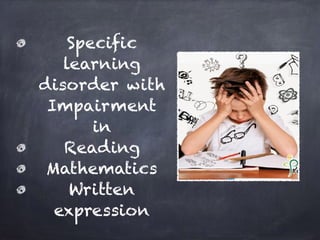
Specific
learning
disorder with
Impairment
in
Reading
Mathematics
Written
expression
“SPECIFIC LEARNING DISORDER WITH IMPAIRMENT IN
READING”
- Reading impairment is present in up to 75 percent of
children and adolescents with specific learning disorder.
- “Reading impairment is characterized by difficulty in
recognizing words, slow and inaccurate reading, poor
comprehension, and difficulties with spelling. ”
- The term developmental alexia was historically used to
define a developmental deficit in the recognition of
printed symbols. This was simplified by adopting the term
dyslexia in the 1960s. Dyslexia was used extensively for
many years to describe a reading disability syndrome
that often included speech and language deficits and
right–left confusion.
Clinical features
- Children with reading disabilities are usually identified by
the age of 7 years
- Children with reading impairment make many errors in
their oral reading.
- The errors are characterized by omissions, additions, and
distortions of words.
- Such children have difficulty in distinguishing between
printed letter characters and sizes.
- The problems in managing printed or written language can
pertain to individual letters, sentences, and even a page.
The child’s reading speed is slow, often with minimal
comprehension.
- Most children with reading disorder dislike and
avoid reading and writing.
- Their anxiety is heightened when they are
confronted with demands that involve printed
language.
- Many children with specific learning disorder who
do not receive remedial education have a sense of
shame and humiliation because of their continuing
failure and subsequent frustration.
- These feelings grow more intense with time. Older
children tend to be angry and depressed and
exhibit poor self-esteem
Tests
- No specific physical signs or laboratory
measures are helpful in the diagnosis
- The diagnostic battery generally includes a
standardized spelling test, written composition,
processing and using oral language, design
copying, and judgment of the adequacy of
pencil use.
- The reading subtests of the Woodcock-Johnson
Psycho-Educational Battery-Revised, and the
Peabody Individual Achievement Test-Revised
are useful in identifying reading disability.
Treatment
- Remediation strategies for children with reading
impairments focus on direct instruction that
leads a child’s attention to the connections
between speech sounds and spelling.
- Effective remediation programs begin by
teaching the child to make accurate associations
between letters and sounds.
- After individual letter-sound associations have
been mastered, remediation can target larger
components of reading such as syllables and
words.
- Positive coping strategies include small,
structured reading groups that offer
individual attention and make it easier for a
child to ask for help.
- Reading instruction programs such as the
Orton Gillingham and Direct Instructional
System for Teaching and Remediation
(DISTAR) approaches begin by concentrating
on individual letters and sounds, advance to
the mastery of simple phonetic units, and
then blend these units into words and
sentences.
- Other reading remediation programs, such
as the Merrill program, and the Science
Research Associates, Inc. (SRA) Basic
Reading Program, begin by introducing
whole words first and then teach children
how to break them down and recognize
the sounds of the syllables and the
individual letters in the word.
“SPECIFIC LEARNING DISORDER WITH IMPAIRMENT IN
MATHEMATICS”
- Children with mathematics difficulties have difficulty learning and
remembering numerals, cannot remember basic facts about numbers,
and are slow and inaccurate in computation.
- Poor achievement in four groups of skills have been identified in
mathematics disorder:
linguistic skills (those related to understanding mathematical terms
and converting written problems into mathematical symbols),
perceptual skills (the ability to recognize and understand symbols and
order clusters of numbers),
mathematical skills (basic addition, subtraction, multiplication,
division, and following sequencing of basic operations), and
attentional skills (copying figures correctly and observing operational
symbols correctly)
- A variety of terms over the years, including
dyscalculia, congenital arithmetic disorder,
acalculia, Gerstmann syndrome, and developmental
arithmetic disorder have been used to denote the
difficulties present in mathematics disorder.
- Core deficits in dyscalculia are in processing
numbers, and good language abilities are skills
needed for accurate counting, calculating, and
understanding mathematical principles
- Mathematics deficits can, however, occur in
isolation or in conjunction with language and
reading impairments.
Clinical features
- Common features of mathematics deficit
include difficulty
- learning number names,
- remembering the signs for addition and
subtraction,
- learning multiplication tables,
- translating word problems into computations,
- performing calculations at the expected pace.
- A child with poor mathematics abilities
typically has problems with concepts, such
as counting and adding even one-digit
numbers, compared with classmates of the
same age.
- Mathematics difficulty, in fact, often
coexists with other disorders affecting
reading, expressive writing, coordination,
and language.
Treatment
- Mathematics difficulties for children are best remediated
with early interventions that lead to improved skills in
basic computation.
- Children with indications of mathematics disorder as early
as in kindergarten require help in understanding which
digit in a pair is larger,
- counting abilities,
- identification of numbers, and
- remembering sequences of numbers.
- Flash cards, workbooks, and computer games can be a
viable part of this treatment.
- Computer programs can be helpful and can
increase compliance with remediation
efforts.
- Social skills deficits can contribute to a
child’s hesitation in asking for help, so a
child identified with a mathematics
disorder may benefit from gaining positive
problem-solving skills in the social arena
as well as in mathematics.
“SPECIFIC LEARNING DISORDER WITH IMPAIMRENT IN
WRITTEN EXPRESSION”
- Written expression is the most complex skill acquired to
convey an understanding of language and to express
thoughts and ideas.
- Deficits in written expression are characterized by writing
skills that are significantly below the expected level for
a child’s age and education.
- Such deficits impair the child’s academic performance
and writing in everyday life.
- Components of writing disorder include poor spelling,
errors in grammar and punctuation, and poor
handwriting.
- Spelling errors are among the most
common difficulties for a child with a
writing disorder.
- Spelling mistakes are most often phonetic
errors; that is, an erroneous spelling that
sounds like the correct spelling.
- Examples of common spelling errors are:
fone for phone, or beleeve for believe.
- Historically, dysgraphia (i.e., poor writing
skills) was considered to be a form of
reading disorder; however, it is now clear
that impairment in written expression can
occur on its own.
- Terms once used to describe writing
disability include spelling disorder and
spelling dyslexia.
Clinical features
- Children with impairments in written
expression struggle early in grade school
with spelling words and expressing their
thoughts according to age-appropriate
grammatical norms.
- Typical features of impaired written
expression include spelling errors,
grammatical errors, punctuation errors,
poor paragraph organization, and poor
handwriting.
- Many children with impaired written
expression understandably become
frustrated and angry, and harbor
feelings of shame and inadequacy
regarding poor academic achievement.
- Young adults with impaired written
expression who do not receive remedial
intervention continue to have writing
skills deficits and a persistent sense of
incompetence and inferiority.
Tests
- There is no physical signs of a writing disorder
exist, educational testing is used in making a
diagnosis of writing disorder.
- Diagnosis is based on a child’s writing
performance being markedly below expected
production for his age, as confirmed by an
individually administered standardized
expressive writing test.
- Currently available tests of written language
include the Test of Written Language (TOWL),
and the Test of Early Written Language (TEWL).
Treatment
- Remedial treatment for writing disability includes
direct practice in spelling and sentence writing as well
as a review of grammatical rules.
- The effectiveness of a writing intervention depends
largely on an optimal relationship between the child and
the writing specialist.
- Success or failure in sustaining the patient’s motivation
greatly affects the treatment’s long-term efficacy.
- Associated secondary emotional and behavioral problems
should be given prompt attention, with appropriate
psychiatric treatment and parental counseling.
Treatment in general
- DEMYSTIFICATION :Many children with
neurodevelopmental dysfunctions have
little or no understanding of the nature
or sources of their academic difficulties.
- Explanation should be provided in
nontechnical language, communicating a
sense of optimism and a desire to be
helpful and supportive
- BYPASS STRATEGIES (ACCOMODATION) :bypass
strategies include using a
- calculator while solving mathematical problems,
- writing essays with a word processor,
- presenting oral instead of written reports,
- solving fewer mathematical problems,
- being seated near the teacher to minimize
distraction, presenting correctly solved
mathematical problems visually, and
- taking standardized tests untimed.
- These bypass strategies do not cure
neurodevelopmental dysfunctions, but
they minimize their academic and
nonacademic effects and can provide a
scaffold for more successful academic
achievement
- INTERVENTION (REMEDIATION OF
SKILLS) :Interventions can be implemented
at home and in school to strengthen the
weak links in academic skills.
- Reading specialists, mathematics tutors,
and other such professionals can use
diagnostic data to select techniques that
use a student’s neurodevelopmental
strengths in an effort to improve
decoding skills, writing ability, or
mathematical computation skills
- CURRICULUM MODIFICATION :Many children
with neurodevelopmental dysfunctions
require alterations in the school curriculum
to succeed, especially as they progress
through secondary school.
- STRENGTHENING OF STRENGTHS :Affected
children need to have their affinities,
potentials, and talents identified clearly and
exploited widely. Athletic skills, creative
talents, and mechanical abilities are among
the potential assets of certain students who
are underachieving academically.
- INDIVIDUAL AND FAMILY COUNSELING :
When academic difficulties are
complicated by family problems or
identifiable psychiatric disorders,
psychotherapy may be indicated.
- Clinical psychologists or child
psychiatrists may offer long- orshort-term
therapy.
- MEDICATION :Psychopharmacologic agents
may be especially helpful in lessening the
neurodevelopmental dysfunctions.
- Most commonly, stimulant medications are
used in the treatment of children with
attention deficits.
- Medications such as methylphenidate,
dextroamphetamine, lisdexamfetamine, mixed
amphetamine salts, and atomoxetine can be
important adjuncts to treatment by helping
some children focus more selectively and
control their impulsivity.
- When depression or excessive anxiety is
a significant component of the clinical
picture, antidepressants or antianxiety
drugs may be helpful.
- CONTROVERSIAL THERAPIES :A variety of
treatment methods for
neurodevelopmental dysfunctions have
been proposed that currently have no
known scientific evidence base of
efficacy.
- This list includes dietary interventions
(vitamins, elimination of food additives or
potential allergens),
- neuromotor programs or medications to
address vestibular dysfunction,
- eye exercises, filters, tinted lenses, and
various technologic devices.
- Parents should be cautioned against
expending the excessive amounts of time and
financial resources usually demanded by
these remedies.
References :
- Kaplan & saddock’s
synopsis of psychiatry
11th edition
- Diagnostic and
statistical manual of
mental disorders vol5
- Nelson 20th edition
Thank you

Learning disorder

  • 1.
    Learning disorders Moderator :Dr. Madhusudhan reddy By : Dr. J vikas reddy
  • 2.
    Terminology and epidemiology -A neurodevelopmental function is a basic brain process needed for learning and productivity. - Neurodevelopmental dysfunctions reflect disruptions of neuroanatomicstructure or psychophysiologic function and place a child at-risk for developmental, cognitive, emotional, behavioral, psychosocial and adaptive challenges.
  • 3.
    - In thelatest edition of DSM-5, specific learning disorder (SLD) is the umbrella term for mathematics, reading, and written expression disorders. - It is now a single, overall diagnosis, incorporating deficits that impact academic achievement. - Rather than limiting learning disorders to diagnoses particular to reading, mathematics and written expression, the criteria describe shortcomings in general academic skills and provide detailed specifiers for the areas of reading, mathematics, and written expression.
  • 4.
    - A studentexhibiting a significant discrepancy between scores on tests of intelligence and tests of academic achievement could be classified as a student with an SLD - It is characterized by persistent difficulty learning academic skills in reading, written expression, or mathematics, beginning in early childhood, that is inconsistent with the overall intellectual ability of a child. - Overall estimates of the prevalence of SLD’s range from 3-10%.
  • 5.
    Etiology and pathogenesis -Reading disorders can be both familial and heritable, and studies have linked some reading disabilities to specific gene loci on chromosomes 6 and 15. - Chromosomal abnormalities such as - visual–spatial deficits in girls diagnosed with Turner syndrome - language deficits in children with fragile X syndrome - Chromosome 22q11.2 deletion syndrome (DiGeorge or velocardiofacial syndrome
  • 6.
    - Perinatal riskfactors :very-low birthweight, severe intrauterine growth restriction, perinatal hypoxic– ischemia encephalopathy, and prenatal exposure to substances such as alcohol and drugs - Increased risk of academic and frontal lobe disorders also is associated : lead; cocaine; infections such as meningitis and HIV; and brain injury secondary to intraventricular hemorrhage, periventricular leukomalacia, or head trauma. - Early psychologic trauma can result in both structural and neurochemical changes in the developing brain, which may contribute to neurodevelopmental dysfunction.
  • 7.
    - Comorbid psychiatricdisorders are also frequent, such as ADHD, Oppositional Defiant Disorder, Conduct Disorders and Depressive Disorders, especially in adolescents. - Conversely, it is estimated that between 15 and 30 percent of children diagnosed with ADHD have specific learning disorder.
  • 8.
  • 9.
    “SPECIFIC LEARNING DISORDERWITH IMPAIRMENT IN READING” - Reading impairment is present in up to 75 percent of children and adolescents with specific learning disorder. - “Reading impairment is characterized by difficulty in recognizing words, slow and inaccurate reading, poor comprehension, and difficulties with spelling. ” - The term developmental alexia was historically used to define a developmental deficit in the recognition of printed symbols. This was simplified by adopting the term dyslexia in the 1960s. Dyslexia was used extensively for many years to describe a reading disability syndrome that often included speech and language deficits and right–left confusion.
  • 10.
    Clinical features - Childrenwith reading disabilities are usually identified by the age of 7 years - Children with reading impairment make many errors in their oral reading. - The errors are characterized by omissions, additions, and distortions of words. - Such children have difficulty in distinguishing between printed letter characters and sizes. - The problems in managing printed or written language can pertain to individual letters, sentences, and even a page. The child’s reading speed is slow, often with minimal comprehension.
  • 11.
    - Most childrenwith reading disorder dislike and avoid reading and writing. - Their anxiety is heightened when they are confronted with demands that involve printed language. - Many children with specific learning disorder who do not receive remedial education have a sense of shame and humiliation because of their continuing failure and subsequent frustration. - These feelings grow more intense with time. Older children tend to be angry and depressed and exhibit poor self-esteem
  • 12.
    Tests - No specificphysical signs or laboratory measures are helpful in the diagnosis - The diagnostic battery generally includes a standardized spelling test, written composition, processing and using oral language, design copying, and judgment of the adequacy of pencil use. - The reading subtests of the Woodcock-Johnson Psycho-Educational Battery-Revised, and the Peabody Individual Achievement Test-Revised are useful in identifying reading disability.
  • 13.
    Treatment - Remediation strategiesfor children with reading impairments focus on direct instruction that leads a child’s attention to the connections between speech sounds and spelling. - Effective remediation programs begin by teaching the child to make accurate associations between letters and sounds. - After individual letter-sound associations have been mastered, remediation can target larger components of reading such as syllables and words.
  • 14.
    - Positive copingstrategies include small, structured reading groups that offer individual attention and make it easier for a child to ask for help. - Reading instruction programs such as the Orton Gillingham and Direct Instructional System for Teaching and Remediation (DISTAR) approaches begin by concentrating on individual letters and sounds, advance to the mastery of simple phonetic units, and then blend these units into words and sentences.
  • 15.
    - Other readingremediation programs, such as the Merrill program, and the Science Research Associates, Inc. (SRA) Basic Reading Program, begin by introducing whole words first and then teach children how to break them down and recognize the sounds of the syllables and the individual letters in the word.
  • 16.
    “SPECIFIC LEARNING DISORDERWITH IMPAIRMENT IN MATHEMATICS” - Children with mathematics difficulties have difficulty learning and remembering numerals, cannot remember basic facts about numbers, and are slow and inaccurate in computation. - Poor achievement in four groups of skills have been identified in mathematics disorder: linguistic skills (those related to understanding mathematical terms and converting written problems into mathematical symbols), perceptual skills (the ability to recognize and understand symbols and order clusters of numbers), mathematical skills (basic addition, subtraction, multiplication, division, and following sequencing of basic operations), and attentional skills (copying figures correctly and observing operational symbols correctly)
  • 17.
    - A varietyof terms over the years, including dyscalculia, congenital arithmetic disorder, acalculia, Gerstmann syndrome, and developmental arithmetic disorder have been used to denote the difficulties present in mathematics disorder. - Core deficits in dyscalculia are in processing numbers, and good language abilities are skills needed for accurate counting, calculating, and understanding mathematical principles - Mathematics deficits can, however, occur in isolation or in conjunction with language and reading impairments.
  • 18.
    Clinical features - Commonfeatures of mathematics deficit include difficulty - learning number names, - remembering the signs for addition and subtraction, - learning multiplication tables, - translating word problems into computations, - performing calculations at the expected pace.
  • 19.
    - A childwith poor mathematics abilities typically has problems with concepts, such as counting and adding even one-digit numbers, compared with classmates of the same age. - Mathematics difficulty, in fact, often coexists with other disorders affecting reading, expressive writing, coordination, and language.
  • 20.
    Treatment - Mathematics difficultiesfor children are best remediated with early interventions that lead to improved skills in basic computation. - Children with indications of mathematics disorder as early as in kindergarten require help in understanding which digit in a pair is larger, - counting abilities, - identification of numbers, and - remembering sequences of numbers. - Flash cards, workbooks, and computer games can be a viable part of this treatment.
  • 21.
    - Computer programscan be helpful and can increase compliance with remediation efforts. - Social skills deficits can contribute to a child’s hesitation in asking for help, so a child identified with a mathematics disorder may benefit from gaining positive problem-solving skills in the social arena as well as in mathematics.
  • 22.
    “SPECIFIC LEARNING DISORDERWITH IMPAIMRENT IN WRITTEN EXPRESSION” - Written expression is the most complex skill acquired to convey an understanding of language and to express thoughts and ideas. - Deficits in written expression are characterized by writing skills that are significantly below the expected level for a child’s age and education. - Such deficits impair the child’s academic performance and writing in everyday life. - Components of writing disorder include poor spelling, errors in grammar and punctuation, and poor handwriting.
  • 23.
    - Spelling errorsare among the most common difficulties for a child with a writing disorder. - Spelling mistakes are most often phonetic errors; that is, an erroneous spelling that sounds like the correct spelling. - Examples of common spelling errors are: fone for phone, or beleeve for believe.
  • 24.
    - Historically, dysgraphia(i.e., poor writing skills) was considered to be a form of reading disorder; however, it is now clear that impairment in written expression can occur on its own. - Terms once used to describe writing disability include spelling disorder and spelling dyslexia.
  • 25.
    Clinical features - Childrenwith impairments in written expression struggle early in grade school with spelling words and expressing their thoughts according to age-appropriate grammatical norms. - Typical features of impaired written expression include spelling errors, grammatical errors, punctuation errors, poor paragraph organization, and poor handwriting.
  • 26.
    - Many childrenwith impaired written expression understandably become frustrated and angry, and harbor feelings of shame and inadequacy regarding poor academic achievement. - Young adults with impaired written expression who do not receive remedial intervention continue to have writing skills deficits and a persistent sense of incompetence and inferiority.
  • 27.
    Tests - There isno physical signs of a writing disorder exist, educational testing is used in making a diagnosis of writing disorder. - Diagnosis is based on a child’s writing performance being markedly below expected production for his age, as confirmed by an individually administered standardized expressive writing test. - Currently available tests of written language include the Test of Written Language (TOWL), and the Test of Early Written Language (TEWL).
  • 28.
    Treatment - Remedial treatmentfor writing disability includes direct practice in spelling and sentence writing as well as a review of grammatical rules. - The effectiveness of a writing intervention depends largely on an optimal relationship between the child and the writing specialist. - Success or failure in sustaining the patient’s motivation greatly affects the treatment’s long-term efficacy. - Associated secondary emotional and behavioral problems should be given prompt attention, with appropriate psychiatric treatment and parental counseling.
  • 29.
    Treatment in general -DEMYSTIFICATION :Many children with neurodevelopmental dysfunctions have little or no understanding of the nature or sources of their academic difficulties. - Explanation should be provided in nontechnical language, communicating a sense of optimism and a desire to be helpful and supportive
  • 30.
    - BYPASS STRATEGIES(ACCOMODATION) :bypass strategies include using a - calculator while solving mathematical problems, - writing essays with a word processor, - presenting oral instead of written reports, - solving fewer mathematical problems, - being seated near the teacher to minimize distraction, presenting correctly solved mathematical problems visually, and - taking standardized tests untimed.
  • 31.
    - These bypassstrategies do not cure neurodevelopmental dysfunctions, but they minimize their academic and nonacademic effects and can provide a scaffold for more successful academic achievement - INTERVENTION (REMEDIATION OF SKILLS) :Interventions can be implemented at home and in school to strengthen the weak links in academic skills.
  • 32.
    - Reading specialists,mathematics tutors, and other such professionals can use diagnostic data to select techniques that use a student’s neurodevelopmental strengths in an effort to improve decoding skills, writing ability, or mathematical computation skills
  • 33.
    - CURRICULUM MODIFICATION:Many children with neurodevelopmental dysfunctions require alterations in the school curriculum to succeed, especially as they progress through secondary school. - STRENGTHENING OF STRENGTHS :Affected children need to have their affinities, potentials, and talents identified clearly and exploited widely. Athletic skills, creative talents, and mechanical abilities are among the potential assets of certain students who are underachieving academically.
  • 34.
    - INDIVIDUAL ANDFAMILY COUNSELING : When academic difficulties are complicated by family problems or identifiable psychiatric disorders, psychotherapy may be indicated. - Clinical psychologists or child psychiatrists may offer long- orshort-term therapy.
  • 35.
    - MEDICATION :Psychopharmacologicagents may be especially helpful in lessening the neurodevelopmental dysfunctions. - Most commonly, stimulant medications are used in the treatment of children with attention deficits. - Medications such as methylphenidate, dextroamphetamine, lisdexamfetamine, mixed amphetamine salts, and atomoxetine can be important adjuncts to treatment by helping some children focus more selectively and control their impulsivity.
  • 36.
    - When depressionor excessive anxiety is a significant component of the clinical picture, antidepressants or antianxiety drugs may be helpful. - CONTROVERSIAL THERAPIES :A variety of treatment methods for neurodevelopmental dysfunctions have been proposed that currently have no known scientific evidence base of efficacy.
  • 37.
    - This listincludes dietary interventions (vitamins, elimination of food additives or potential allergens), - neuromotor programs or medications to address vestibular dysfunction, - eye exercises, filters, tinted lenses, and various technologic devices. - Parents should be cautioned against expending the excessive amounts of time and financial resources usually demanded by these remedies.
  • 38.
    References : - Kaplan& saddock’s synopsis of psychiatry 11th edition - Diagnostic and statistical manual of mental disorders vol5 - Nelson 20th edition Thank you