Welingkar’s Distance Learning Division

Effective HR
CHAPTER-1

Theories of Learning

We Learn – A Continuous Learning Forum
Objectives
• After completing this chapter. you should be
able to:
– Understand what is learning.
– Classify the learned capabilities.
– Understand the various theories of Learning.
Nature and importance of learning
• Learning is the basic objective of all the
training and development activities.
• Learning may be defined as
– the process of acquiring, assimilating, and
internalizing cognitive, motor or behavioral inputs
for their effective and varied use when required,
leading to an enhanced capability for further selfmonitored learning.
Nature and importance of learning
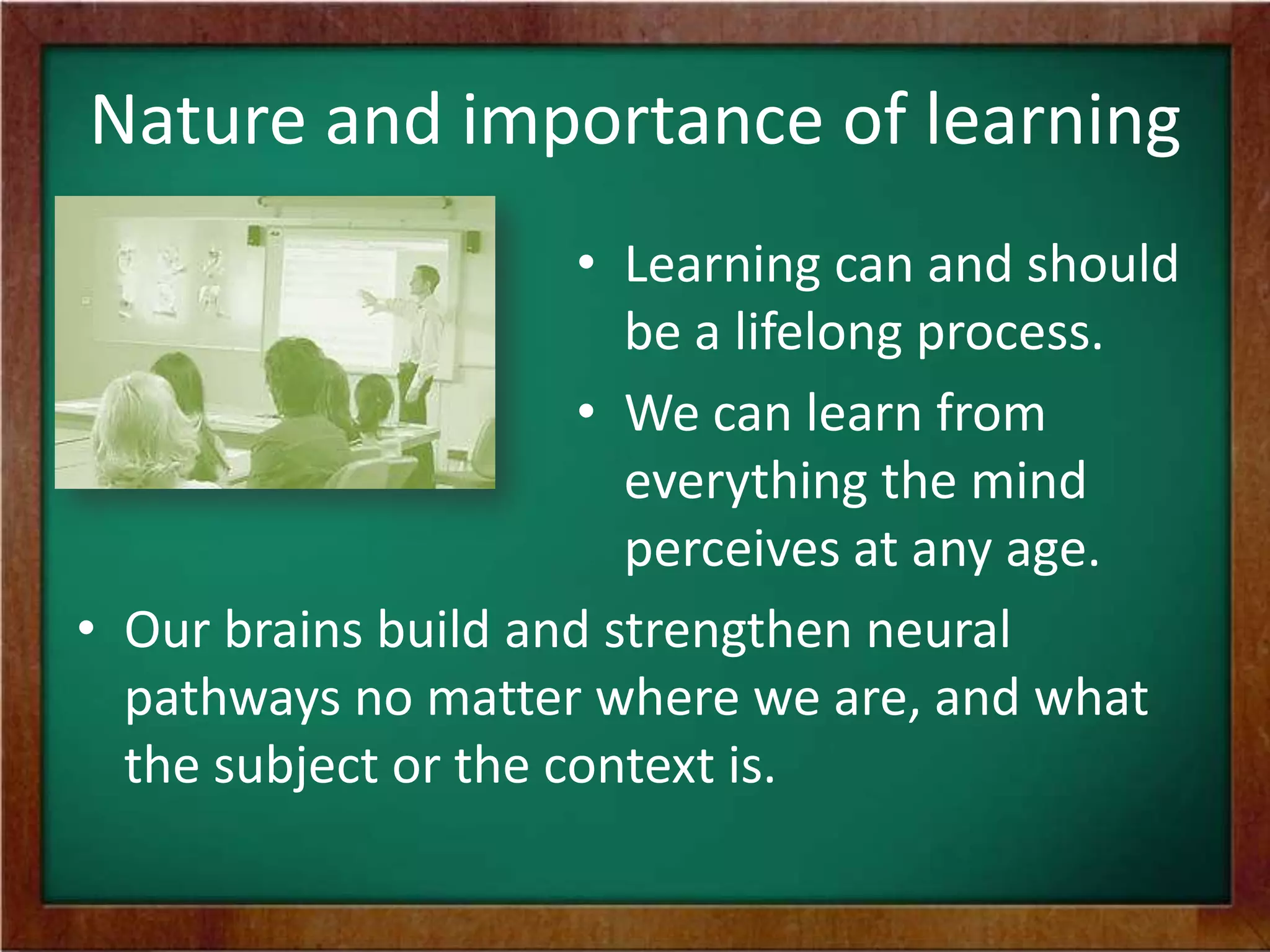
• Learning can and should
be a lifelong process.
• We can learn from
everything the mind
perceives at any age.
• Our brains build and strengthen neural
pathways no matter where we are, and what
the subject or the context is.
Classification of learned capabilities
• The capabilities that human beings can learn
are classified into five types:
– Verbal information
– Intellectual skills
– Motor skills
– Attitudes
– Cognitive strategies
Classification of learned capabilities
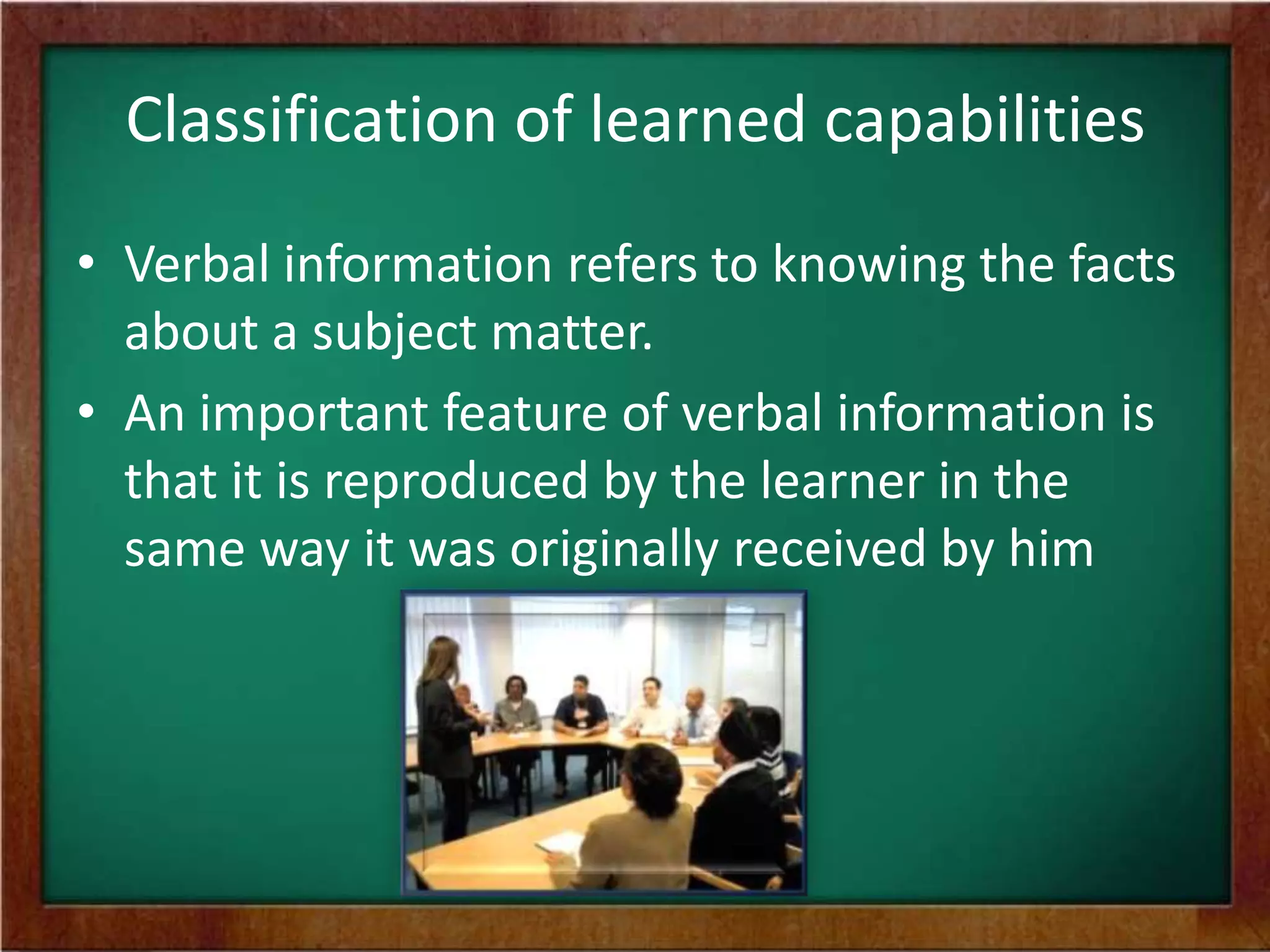
• Verbal information refers to knowing the facts
about a subject matter.
• An important feature of verbal information is
that it is reproduced by the learner in the
same way it was originally received by him
Classification of learned capabilities
• Intellectual skills are also known as procedural
knowledge which is aimed at addressing ‘how’
aspects of learning of a phenomenon.
• In this category, the capabilities of an individual
can be customized to suit the requirement of the
situation.
• Motor skills are the capabilities which necessitate
the physical movement of individuals or their
body parts for learning and performance.
• They may also involve co-ordination with the
sensory organs and other limbs.
Classification of learned capabilities
• Attitudes are evaluative judgments by individuals
about particular objects, people or events,
favorable or unfavorable, formed fundamentally
on the basis of one’s own feelings, beliefs and
practices.
• Attitudes are learned and not innate, it is
necessary to have a positive attitude to be
successful.
• Attitudes are not visible unless they are
expressed in the form of behavior.
Classification of learned capabilities
• Cognitive strategies can also be termed as
strategic knowledge.
• Cognitive strategies play a supervisory or
coordinative role for the effective development
and use of other capabilities in the individual.
• Cognitive strategies may involve creativity and
algorithm to find solutions in an unstructured
situation for which readymade solutions are not
known.
Learning behaviors — Bloom’s
Taxonomy
• During the 1950’s, a team of educational
psychologists were led by Benjamin Bloom in the
analysis of learning behaviors.
• The results of this team’s research produced what
is known today in the field of education, as
Bloom’s Taxonomy.
• This hierarchy of learning behaviors was
categorized into three interrelated and
overlapping learning domains —
– cognitive (knowledge), affective (attitude), and
psychomotor (skills).
Learning behaviors — Bloom’s
Taxonomy
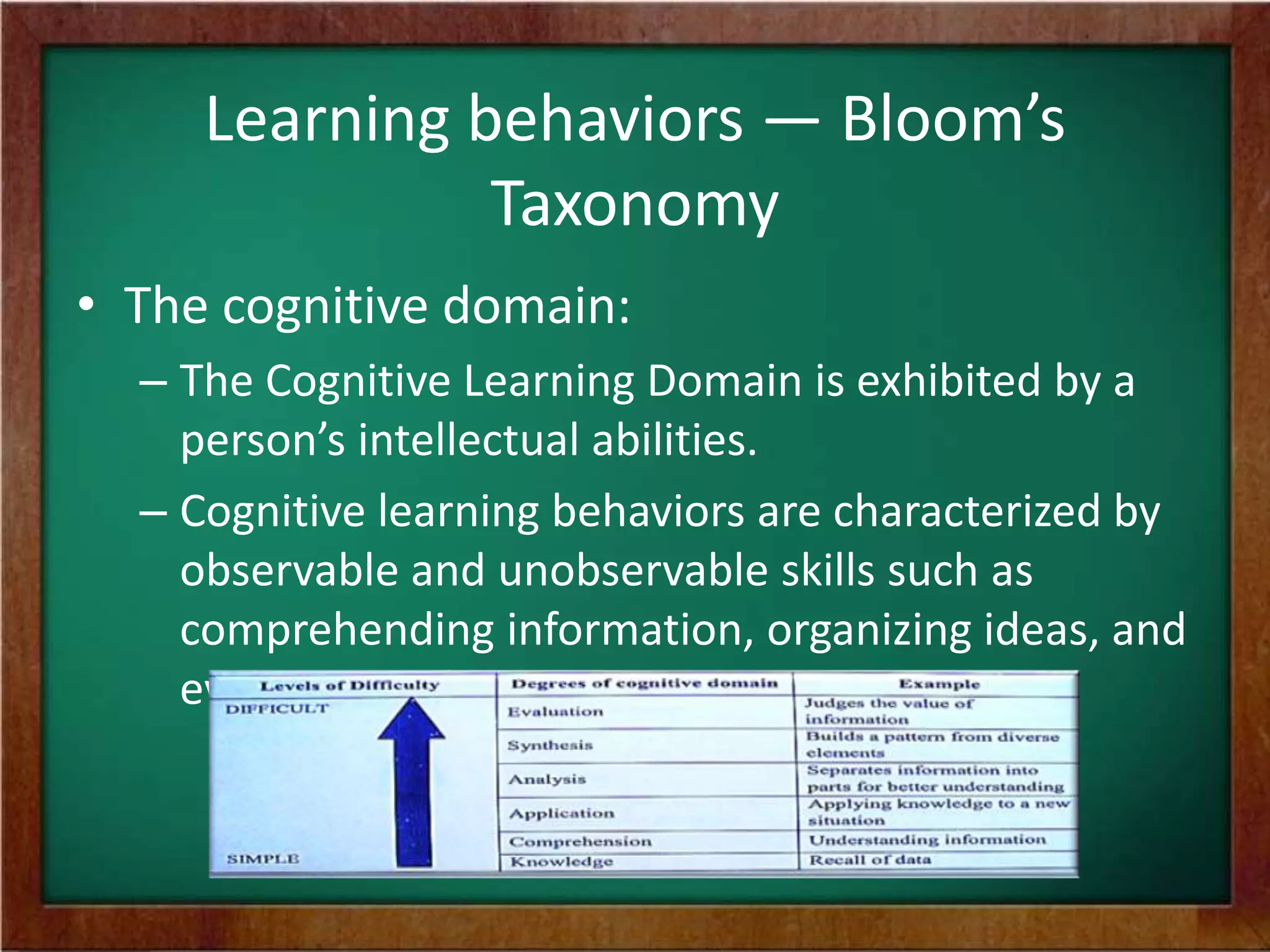
• The cognitive domain:
– The Cognitive Learning Domain is exhibited by a
person’s intellectual abilities.
– Cognitive learning behaviors are characterized by
observable and unobservable skills such as
comprehending information, organizing ideas, and
evaluation information and actions.
Learning behaviors — Bloom’s
Taxonomy
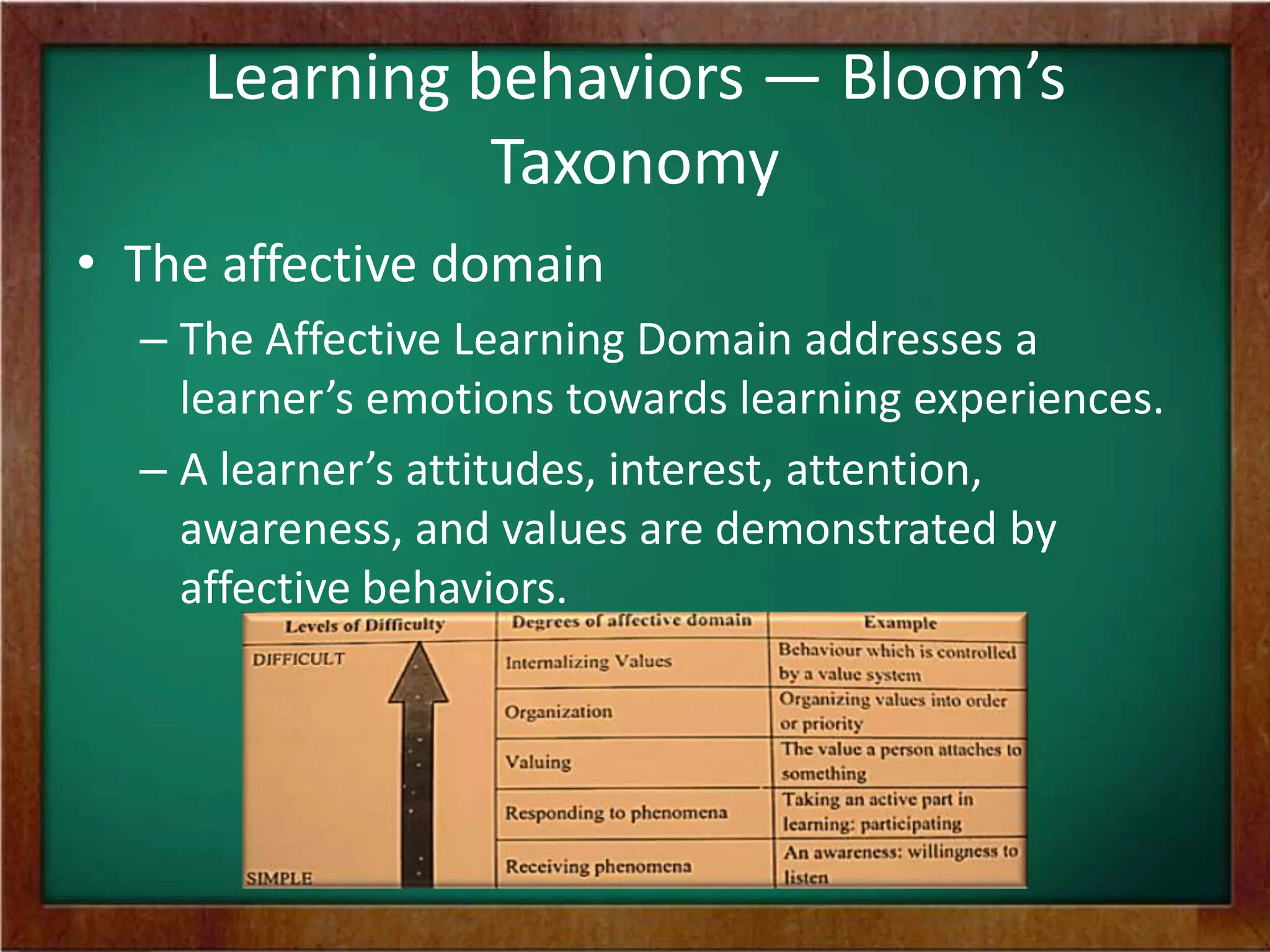
• The affective domain
– The Affective Learning Domain addresses a
learner’s emotions towards learning experiences.
– A learner’s attitudes, interest, attention,
awareness, and values are demonstrated by
affective behaviors.
Learning behaviors — Bloom’s
Taxonomy
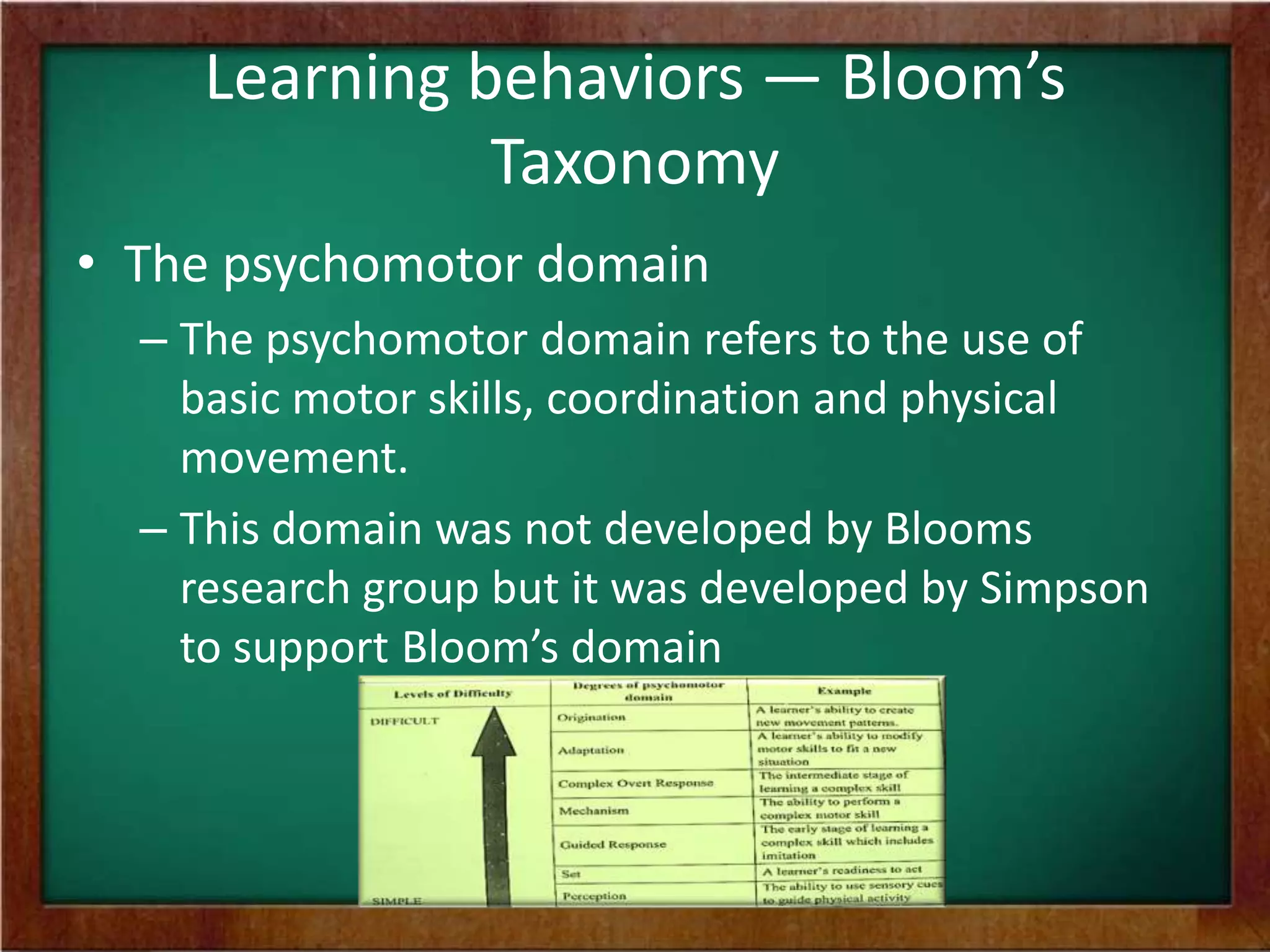
• The psychomotor domain
– The psychomotor domain refers to the use of
basic motor skills, coordination and physical
movement.
– This domain was not developed by Blooms
research group but it was developed by Simpson
to support Bloom’s domain
Theories of Learning
• David Kolb’s learning styles model and
experiential learning theory (ELT)
– Having developed the model over many years prior,
David Kolb published his learning styles model in
1984. The model gave rise to related terms such as
Kolb’s experiential learning theory (ELT) and Kolb’s
learning styles inventory (LSI).
– ELT are today acknowledged by academics, teachers,
managers and trainers as fundamental concepts which
help in understanding and explaining human learning
behavior, and towards helping others to learn.
Theories of Learning
• David Kolb’s learning styles model and
experiential learning theory (ELT)
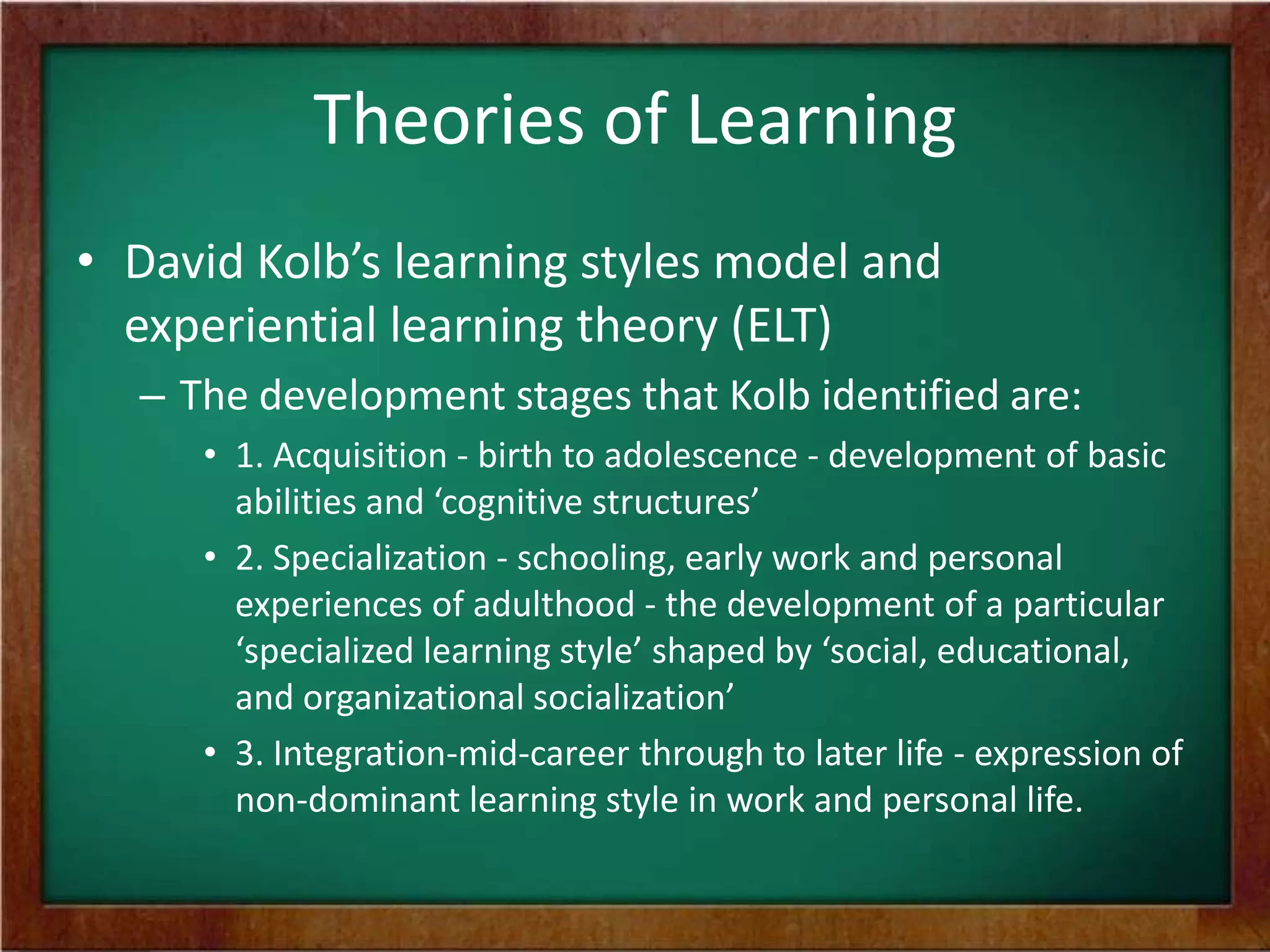
– The development stages that Kolb identified are:
• 1. Acquisition - birth to adolescence - development of basic
abilities and ‘cognitive structures’
• 2. Specialization - schooling, early work and personal
experiences of adulthood - the development of a particular
‘specialized learning style’ shaped by ‘social, educational,
and organizational socialization’
• 3. Integration-mid-career through to later life - expression of
non-dominant learning style in work and personal life.
Theories of Learning
• David Kolb’s learning styles model and
experiential learning theory (ELT)
– Whatever influences the choice of style, the learning
style preference itself is actually the product of two
pairs of variables, or two separate ‘choices’ that we
make, which Kolb presented as lines of axis, each with
‘conflicting’ modes at either end:
• Concrete Experience - CE (feeling) ----- V ----- Abstract
Conceptualization - AC (thinking)
• Active Experimentation - AE (doing) ----- V ----- Reflective
Observation - RO (watching)
Theories of Learning
• David Kolb’s learning styles model and
experiential learning theory (ELT)
– Our learning style is a product of these two
choice decisions:
• 1. How to approach a task - i.e.., ‘grasping experience’ preferring to (a) watch or (b) do, and
• 2. Our emotional response to the experience - i.e.,
‘transforming experience’ - preferring to (a) think or (b)
feel.
Theories of Learning
• David Kolb’s learning styles model and
experiential learning theory (ELT)
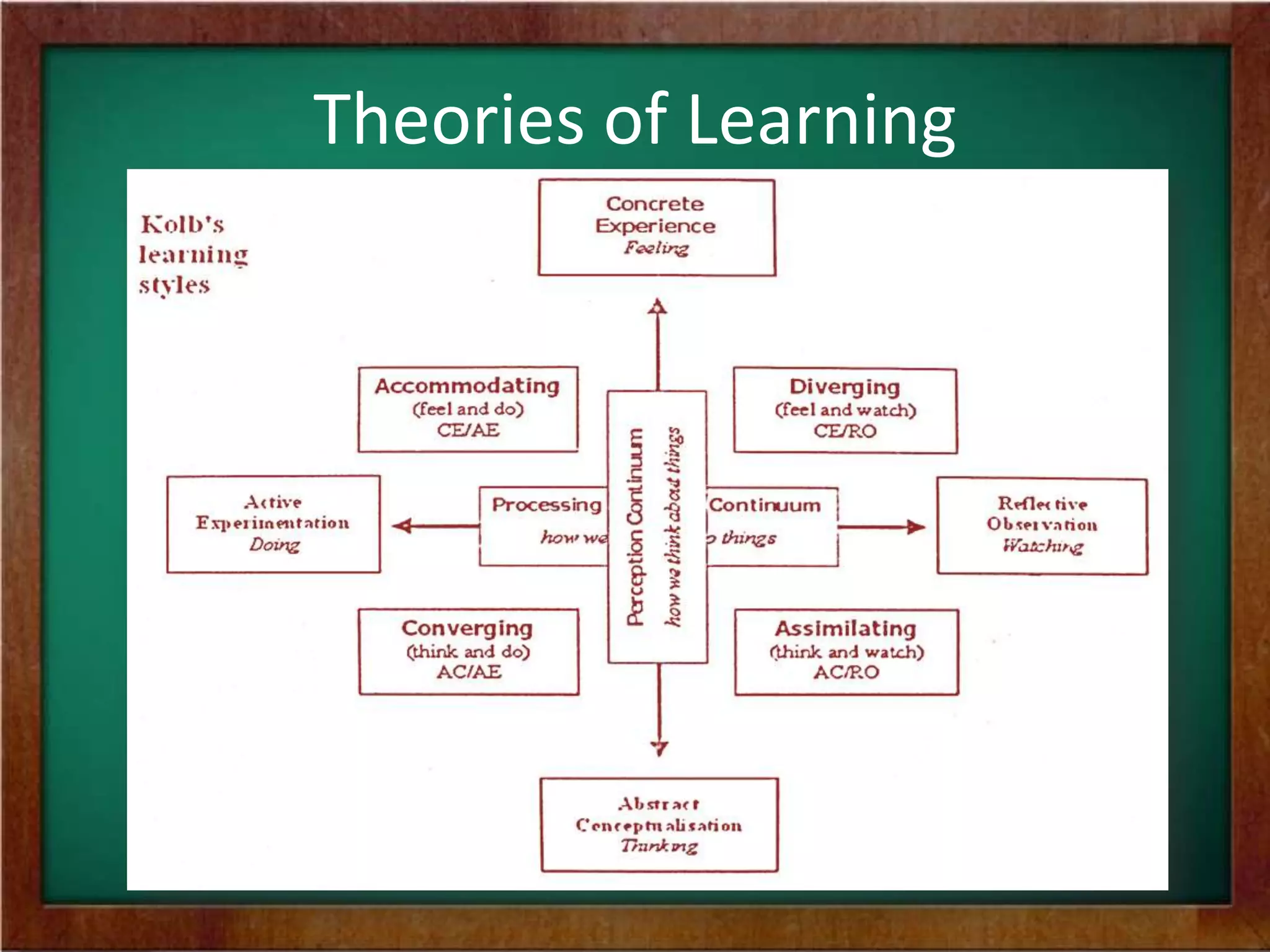
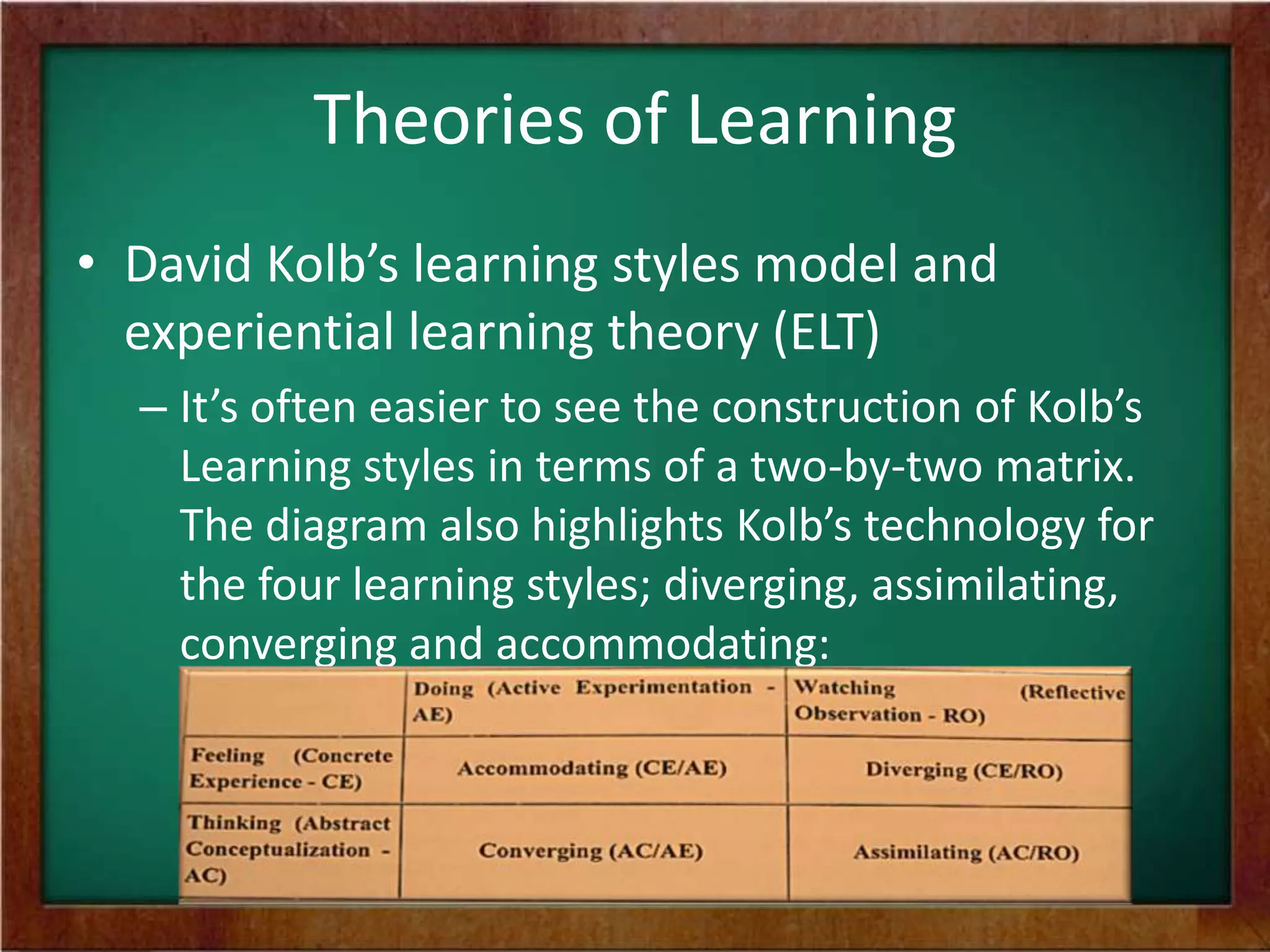
– It’s often easier to see the construction of Kolb’s
Learning styles in terms of a two-by-two matrix.
The diagram also highlights Kolb’s technology for
the four learning styles; diverging, assimilating,
converging and accommodating:
Theories of Learning
situations several
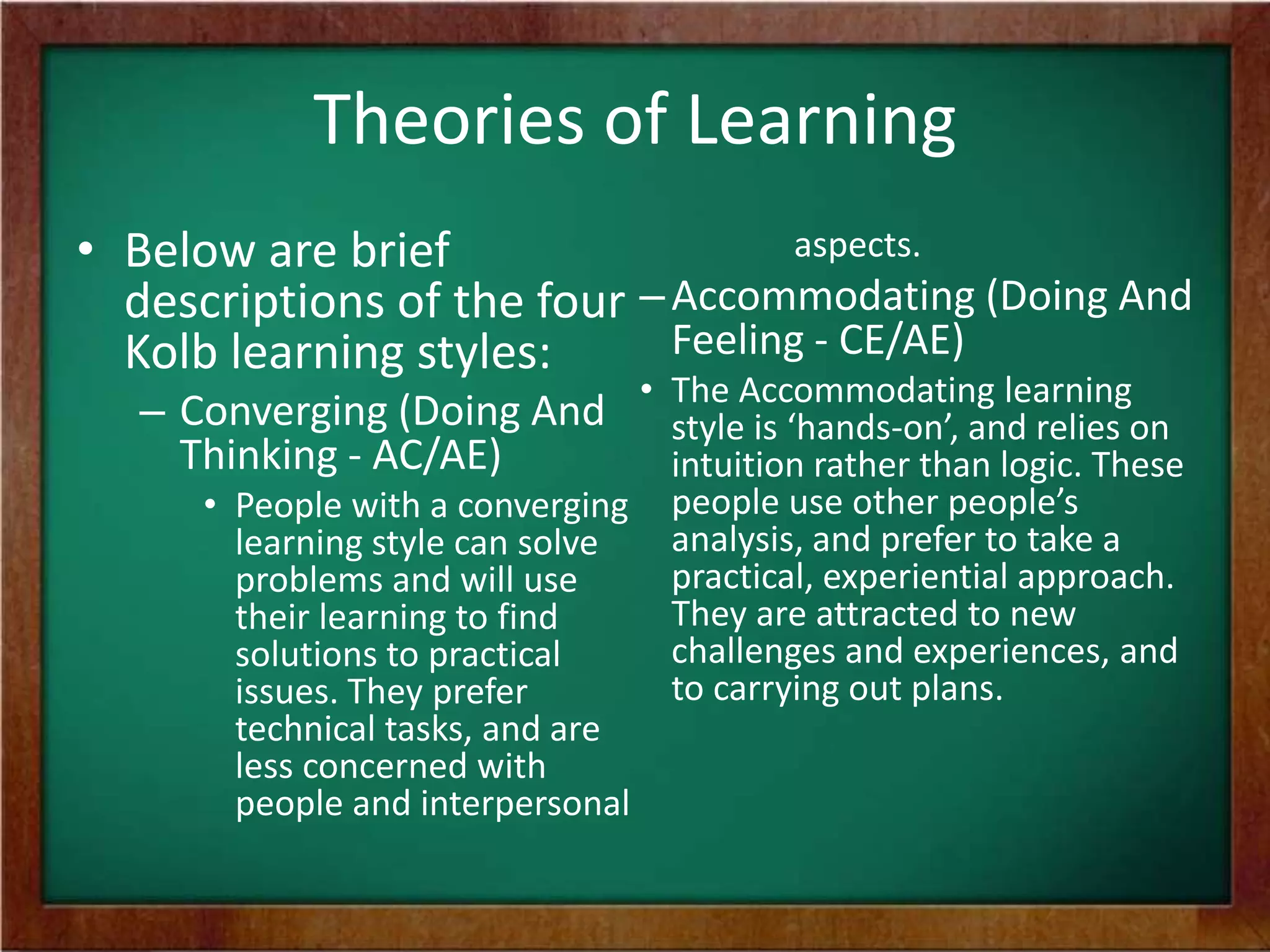
• Below are brief
different viewpoints.
descriptions of the four
– Assimilating (Watching
Kolb learning styles:
And Thinking - AC/RO)

– Diverging (Feeling And
Watching - CE/RO)

• This is for a concise, logical
approach. Ideas and concepts
are more important than
• These people are able to
people. These people require
look at things from
good clear explanation rather
different perspectives,
sensitive, prefer to watch than practical opportunity. They
excel at understanding widerather than do, tending
ranging information and
to gather information
organizing it a clear logical
and use imagination to
format.
solve problems, best at
viewing concrete
Theories of Learning
aspects.
• Below are brief
descriptions of the four – Accommodating (Doing And
Feeling - CE/AE)
Kolb learning styles:

– Converging (Doing And • The Accommodating learningon
style is ‘hands-on’, and relies
Thinking - AC/AE)
intuition rather than logic. These
• People with a converging
learning style can solve
problems and will use
their learning to find
solutions to practical
issues. They prefer
technical tasks, and are
less concerned with
people and interpersonal

people use other people’s
analysis, and prefer to take a
practical, experiential approach.
They are attracted to new
challenges and experiences, and
to carrying out plans.
Theories of Learning
• Andragogy for adult learning
– Andragogy, meaning adults teaching other adults,
provides a different role for the trainers.
– Here the trainer serves more as a facilitator or catalyst
for the learners’ activities.
– An advantage of andragogy is that learners’
motivation is enhanced through greater responsibility
for, and involvement in learning.
– But andragogy methods are often situationdependent and cannot be applied to codify or
standardize information for mass use.
Theories of Learning
• Andragogy for adult learning
– Becoming an effective trainer involves understanding
how adults learn best.
– Adults have many responsibilities that they’ must
balance against the demands of learning.
– Because of these responsibilities. adults have harriers
against participating in learning.
– Some of these barriers include lack of time, money,
confidence, interest, information about opportunities
to learn, scheduling problems, mid problems with
child care and transportation.
Theories of Learning
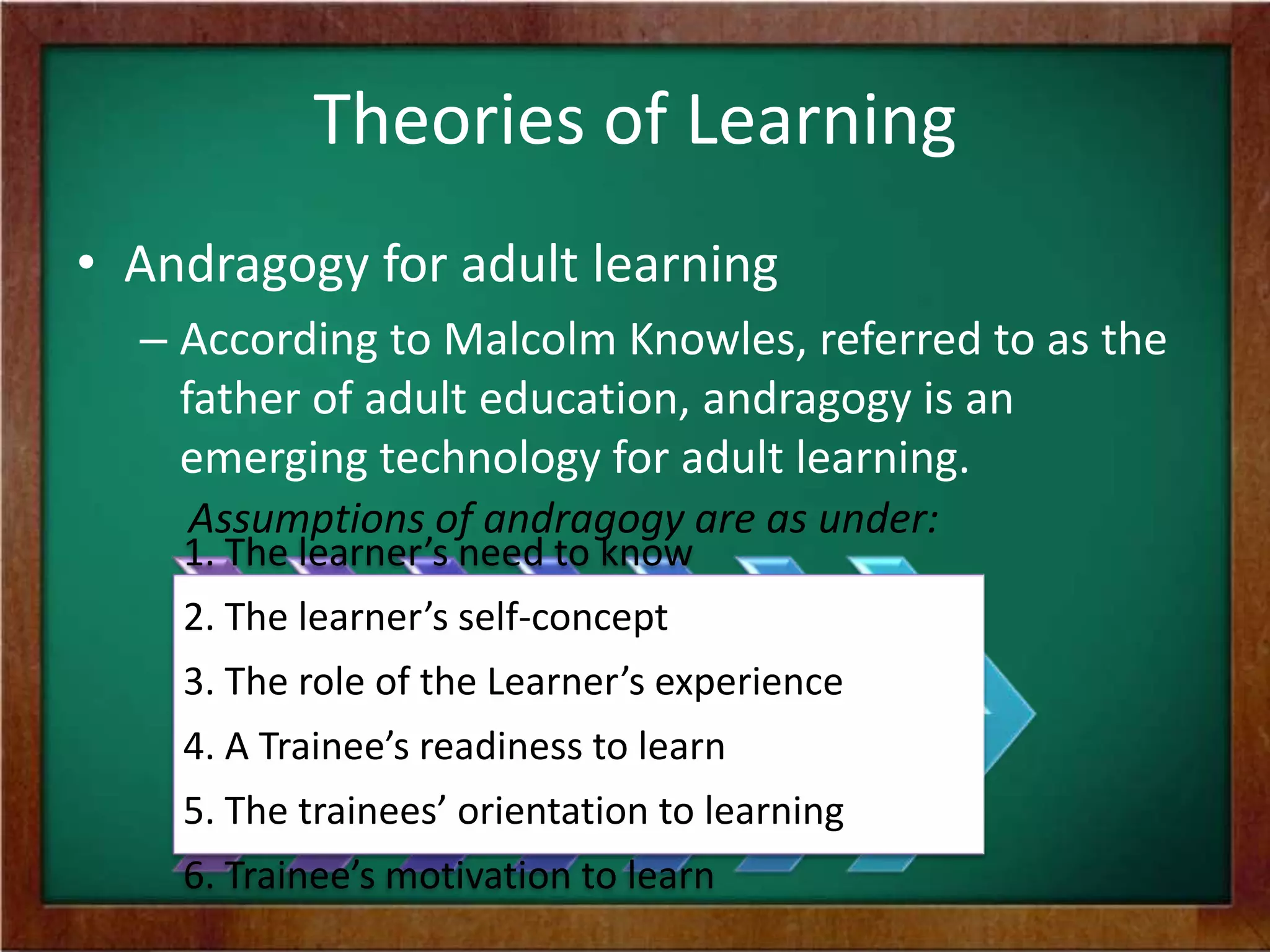
• Andragogy for adult learning
– According to Malcolm Knowles, referred to as the
father of adult education, andragogy is an
emerging technology for adult learning.
Assumptions of andragogy are as under:

1. The learner’s need to know

2. The learner’s self-concept
3. The role of the Learner’s experience
4. A Trainee’s readiness to learn

5. The trainees’ orientation to learning
6. Trainee’s motivation to learn
Theories of Learning
• Facilitation Theory
– Facilitation theory or humanistic theory was
advocated by Carl Rogers.
– Carl Rogers is best known as an American
psychologist and has made significant
contributions to the field of adult education.
– Rogers maintained that all human beings have a
natural desire to learn.
Theories of Learning
• Facilitation Theory
– He defined two categories of learning:
• Meaningless or cognitive learning.
• Experiential applied knowledge which addresses the needs
and wants of the learner

– According to Rogers, the role of the teacher is to
facilitate experiential learning by
•
•
•
•

Setting a positive climate for learning.
Clarifying the purposes to the learner.
Organizing and making available learning resources
Balancing intellectual & emotional components of learning
Theories of Learning
• Facilitation Theory
– According to this theory, facilitative teachers are:
• Less protective of their constructs and beliefs than
other teachers.
• More able to listen to learners, especially to their
feelings.
• Inclined to pay as much attention to their relationship
with learners as to the content of the course.
• Apt to accept feedback, both positive and negative, and
to use it as constructive insight into themselves and
their behavior.
Theories of Learning
• Synergogy For Team Learning
– Synergogy is a systematic approach to learning in
which the members of small teams learn from one
another through structured interactions and nondirective intervention.
– Challenge and stimulation are created through social
situation under which real as well as felt needs for
learning can be satisfied.
– The instructor or learning administrator provides
educational materials from which knowledge or
insights can be acquired and create designsinstruction for team action-that stimulate learning.
Theories of Learning
• Synergogy For Team Learning
– Synergogy differs from other learner-centered
methodologies in three basic principles that promote
educational success.
• First, synergogy offers meaningful direction to learners in the
form of learning designs and learning instruments.
• Secondly, synergogy relies on teamwork rather than
individual or group work to enhance learners’ involvement
and participation.
• The third principle essential to synergogic method is that of
synergy-the concept that under certain conditions the whole
can be more than the sum of its parts.
Theories of Learning
• Transformative Learning

– Transformative learning is
basically the kind of
learning a person engages
in as he/she makes
meaning of his/her life.

– It has become a very
popular topic in adult
education because it does
not just involve classroom
learning — it involves
learning about one’s lite.
– One of’ the best-known
experts in this area is a
scholar named Jack
Mezirow, who began
researching on this topic
in the 1970s.
Theories of Learning
• Transformative Learning
– He came up with a set of phases that people go
through when they experience transformation and
those steps are:
•
•
•
•
•
•

Experiencing a disorienting dilemma
Self examination and critical assessment of assumptions
Recognizing that others have gone through a similar process
Exploring options
Formulating a plan of action
Reintegration.
Theories of Learning
• Transformative Learning
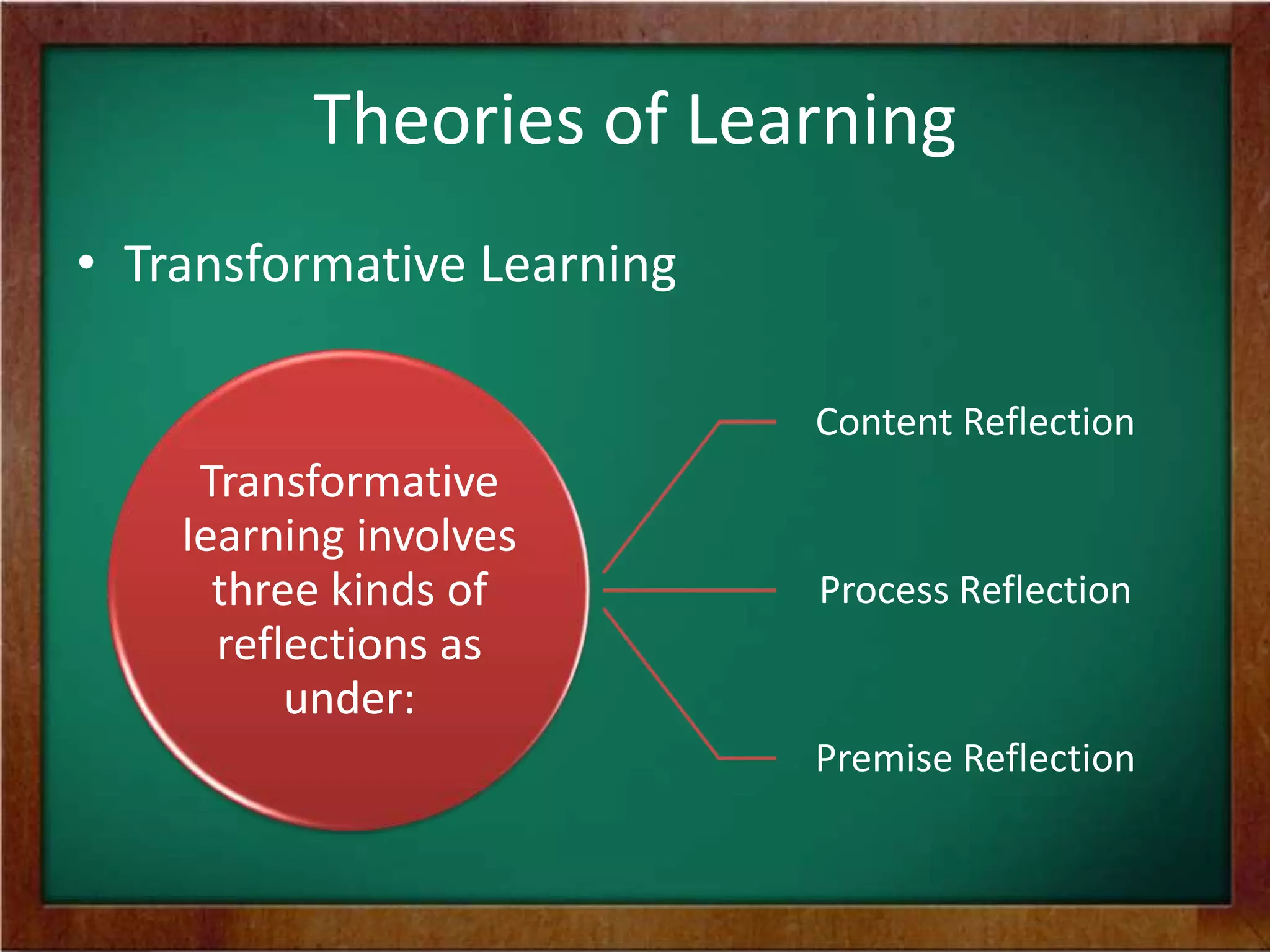
Content Reflection

Transformative
learning involves
three kinds of
reflections as
under:

Process Reflection

Premise Reflection

Theories of Learning

  • 1.
    Welingkar’s Distance LearningDivision Effective HR CHAPTER-1 Theories of Learning We Learn – A Continuous Learning Forum
  • 2.
    Objectives • After completingthis chapter. you should be able to: – Understand what is learning. – Classify the learned capabilities. – Understand the various theories of Learning.
  • 3.
    Nature and importanceof learning • Learning is the basic objective of all the training and development activities. • Learning may be defined as – the process of acquiring, assimilating, and internalizing cognitive, motor or behavioral inputs for their effective and varied use when required, leading to an enhanced capability for further selfmonitored learning.
  • 4.
    Nature and importanceof learning • Learning can and should be a lifelong process. • We can learn from everything the mind perceives at any age. • Our brains build and strengthen neural pathways no matter where we are, and what the subject or the context is.
  • 5.
    Classification of learnedcapabilities • The capabilities that human beings can learn are classified into five types: – Verbal information – Intellectual skills – Motor skills – Attitudes – Cognitive strategies
  • 6.
    Classification of learnedcapabilities • Verbal information refers to knowing the facts about a subject matter. • An important feature of verbal information is that it is reproduced by the learner in the same way it was originally received by him
  • 7.
    Classification of learnedcapabilities • Intellectual skills are also known as procedural knowledge which is aimed at addressing ‘how’ aspects of learning of a phenomenon. • In this category, the capabilities of an individual can be customized to suit the requirement of the situation. • Motor skills are the capabilities which necessitate the physical movement of individuals or their body parts for learning and performance. • They may also involve co-ordination with the sensory organs and other limbs.
  • 8.
    Classification of learnedcapabilities • Attitudes are evaluative judgments by individuals about particular objects, people or events, favorable or unfavorable, formed fundamentally on the basis of one’s own feelings, beliefs and practices. • Attitudes are learned and not innate, it is necessary to have a positive attitude to be successful. • Attitudes are not visible unless they are expressed in the form of behavior.
  • 9.
    Classification of learnedcapabilities • Cognitive strategies can also be termed as strategic knowledge. • Cognitive strategies play a supervisory or coordinative role for the effective development and use of other capabilities in the individual. • Cognitive strategies may involve creativity and algorithm to find solutions in an unstructured situation for which readymade solutions are not known.
  • 10.
    Learning behaviors —Bloom’s Taxonomy • During the 1950’s, a team of educational psychologists were led by Benjamin Bloom in the analysis of learning behaviors. • The results of this team’s research produced what is known today in the field of education, as Bloom’s Taxonomy. • This hierarchy of learning behaviors was categorized into three interrelated and overlapping learning domains — – cognitive (knowledge), affective (attitude), and psychomotor (skills).
  • 11.
    Learning behaviors —Bloom’s Taxonomy • The cognitive domain: – The Cognitive Learning Domain is exhibited by a person’s intellectual abilities. – Cognitive learning behaviors are characterized by observable and unobservable skills such as comprehending information, organizing ideas, and evaluation information and actions.
  • 12.
    Learning behaviors —Bloom’s Taxonomy • The affective domain – The Affective Learning Domain addresses a learner’s emotions towards learning experiences. – A learner’s attitudes, interest, attention, awareness, and values are demonstrated by affective behaviors.
  • 13.
    Learning behaviors —Bloom’s Taxonomy • The psychomotor domain – The psychomotor domain refers to the use of basic motor skills, coordination and physical movement. – This domain was not developed by Blooms research group but it was developed by Simpson to support Bloom’s domain
  • 14.
    Theories of Learning •David Kolb’s learning styles model and experiential learning theory (ELT) – Having developed the model over many years prior, David Kolb published his learning styles model in 1984. The model gave rise to related terms such as Kolb’s experiential learning theory (ELT) and Kolb’s learning styles inventory (LSI). – ELT are today acknowledged by academics, teachers, managers and trainers as fundamental concepts which help in understanding and explaining human learning behavior, and towards helping others to learn.
  • 15.
    Theories of Learning •David Kolb’s learning styles model and experiential learning theory (ELT) – The development stages that Kolb identified are: • 1. Acquisition - birth to adolescence - development of basic abilities and ‘cognitive structures’ • 2. Specialization - schooling, early work and personal experiences of adulthood - the development of a particular ‘specialized learning style’ shaped by ‘social, educational, and organizational socialization’ • 3. Integration-mid-career through to later life - expression of non-dominant learning style in work and personal life.
  • 16.
  • 17.
    Theories of Learning •David Kolb’s learning styles model and experiential learning theory (ELT) – Whatever influences the choice of style, the learning style preference itself is actually the product of two pairs of variables, or two separate ‘choices’ that we make, which Kolb presented as lines of axis, each with ‘conflicting’ modes at either end: • Concrete Experience - CE (feeling) ----- V ----- Abstract Conceptualization - AC (thinking) • Active Experimentation - AE (doing) ----- V ----- Reflective Observation - RO (watching)
  • 18.
    Theories of Learning •David Kolb’s learning styles model and experiential learning theory (ELT) – Our learning style is a product of these two choice decisions: • 1. How to approach a task - i.e.., ‘grasping experience’ preferring to (a) watch or (b) do, and • 2. Our emotional response to the experience - i.e., ‘transforming experience’ - preferring to (a) think or (b) feel.
  • 19.
    Theories of Learning •David Kolb’s learning styles model and experiential learning theory (ELT) – It’s often easier to see the construction of Kolb’s Learning styles in terms of a two-by-two matrix. The diagram also highlights Kolb’s technology for the four learning styles; diverging, assimilating, converging and accommodating:
  • 20.
    Theories of Learning situationsseveral • Below are brief different viewpoints. descriptions of the four – Assimilating (Watching Kolb learning styles: And Thinking - AC/RO) – Diverging (Feeling And Watching - CE/RO) • This is for a concise, logical approach. Ideas and concepts are more important than • These people are able to people. These people require look at things from good clear explanation rather different perspectives, sensitive, prefer to watch than practical opportunity. They excel at understanding widerather than do, tending ranging information and to gather information organizing it a clear logical and use imagination to format. solve problems, best at viewing concrete
  • 21.
    Theories of Learning aspects. •Below are brief descriptions of the four – Accommodating (Doing And Feeling - CE/AE) Kolb learning styles: – Converging (Doing And • The Accommodating learningon style is ‘hands-on’, and relies Thinking - AC/AE) intuition rather than logic. These • People with a converging learning style can solve problems and will use their learning to find solutions to practical issues. They prefer technical tasks, and are less concerned with people and interpersonal people use other people’s analysis, and prefer to take a practical, experiential approach. They are attracted to new challenges and experiences, and to carrying out plans.
  • 22.
    Theories of Learning •Andragogy for adult learning – Andragogy, meaning adults teaching other adults, provides a different role for the trainers. – Here the trainer serves more as a facilitator or catalyst for the learners’ activities. – An advantage of andragogy is that learners’ motivation is enhanced through greater responsibility for, and involvement in learning. – But andragogy methods are often situationdependent and cannot be applied to codify or standardize information for mass use.
  • 23.
    Theories of Learning •Andragogy for adult learning – Becoming an effective trainer involves understanding how adults learn best. – Adults have many responsibilities that they’ must balance against the demands of learning. – Because of these responsibilities. adults have harriers against participating in learning. – Some of these barriers include lack of time, money, confidence, interest, information about opportunities to learn, scheduling problems, mid problems with child care and transportation.
  • 24.
    Theories of Learning •Andragogy for adult learning – According to Malcolm Knowles, referred to as the father of adult education, andragogy is an emerging technology for adult learning. Assumptions of andragogy are as under: 1. The learner’s need to know 2. The learner’s self-concept 3. The role of the Learner’s experience 4. A Trainee’s readiness to learn 5. The trainees’ orientation to learning 6. Trainee’s motivation to learn
  • 25.
    Theories of Learning •Facilitation Theory – Facilitation theory or humanistic theory was advocated by Carl Rogers. – Carl Rogers is best known as an American psychologist and has made significant contributions to the field of adult education. – Rogers maintained that all human beings have a natural desire to learn.
  • 26.
    Theories of Learning •Facilitation Theory – He defined two categories of learning: • Meaningless or cognitive learning. • Experiential applied knowledge which addresses the needs and wants of the learner – According to Rogers, the role of the teacher is to facilitate experiential learning by • • • • Setting a positive climate for learning. Clarifying the purposes to the learner. Organizing and making available learning resources Balancing intellectual & emotional components of learning
  • 27.
    Theories of Learning •Facilitation Theory – According to this theory, facilitative teachers are: • Less protective of their constructs and beliefs than other teachers. • More able to listen to learners, especially to their feelings. • Inclined to pay as much attention to their relationship with learners as to the content of the course. • Apt to accept feedback, both positive and negative, and to use it as constructive insight into themselves and their behavior.
  • 28.
    Theories of Learning •Synergogy For Team Learning – Synergogy is a systematic approach to learning in which the members of small teams learn from one another through structured interactions and nondirective intervention. – Challenge and stimulation are created through social situation under which real as well as felt needs for learning can be satisfied. – The instructor or learning administrator provides educational materials from which knowledge or insights can be acquired and create designsinstruction for team action-that stimulate learning.
  • 29.
    Theories of Learning •Synergogy For Team Learning – Synergogy differs from other learner-centered methodologies in three basic principles that promote educational success. • First, synergogy offers meaningful direction to learners in the form of learning designs and learning instruments. • Secondly, synergogy relies on teamwork rather than individual or group work to enhance learners’ involvement and participation. • The third principle essential to synergogic method is that of synergy-the concept that under certain conditions the whole can be more than the sum of its parts.
  • 30.
    Theories of Learning •Transformative Learning – Transformative learning is basically the kind of learning a person engages in as he/she makes meaning of his/her life. – It has become a very popular topic in adult education because it does not just involve classroom learning — it involves learning about one’s lite. – One of’ the best-known experts in this area is a scholar named Jack Mezirow, who began researching on this topic in the 1970s.
  • 31.
    Theories of Learning •Transformative Learning – He came up with a set of phases that people go through when they experience transformation and those steps are: • • • • • • Experiencing a disorienting dilemma Self examination and critical assessment of assumptions Recognizing that others have gone through a similar process Exploring options Formulating a plan of action Reintegration.
  • 32.
    Theories of Learning •Transformative Learning Content Reflection Transformative learning involves three kinds of reflections as under: Process Reflection Premise Reflection