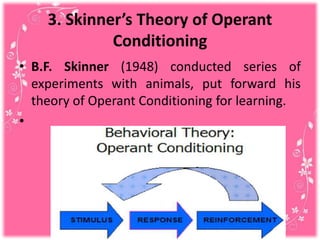
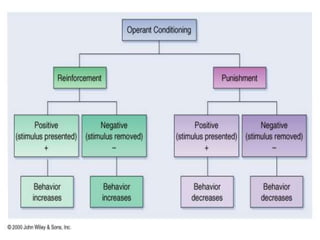
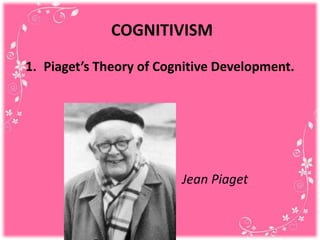
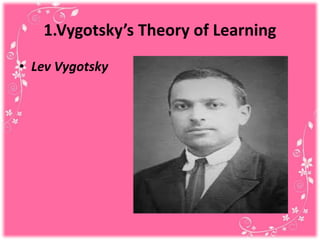
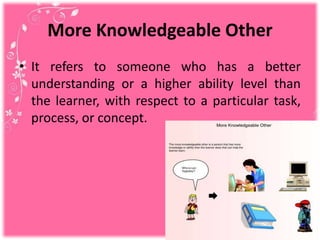
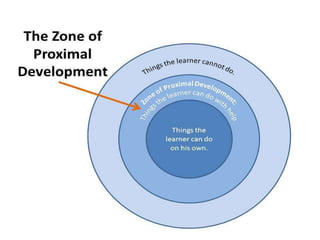
Vygotsky's theory of cognitive development states that social interaction plays a key role in the development of cognition. Children can solve problems with guidance from others that they cannot solve independently. Vygotsky identified the "zone of proximal development" as the difference between what a learner can do with guidance and without it. Piaget's stages of cognitive development include the sensorimotor, preoperational, concrete operational, and formal operational stages through which children progress as they interact with their environment. Skinner's theory of operant conditioning explains that we learn from the consequences of our behaviors - behaviors that are rewarded tend to be repeated.