1 
LEARNING THEORIES
22 
Learning objectives 
At the end of this session, the learner will able 
to 
Define learning 
Explore the perspectives of learning by 
psychologist 
Develop skills to analyze how the learning theories 
could be interacted in a classroom environment 
What methods could be adopted to improves 
learning through learning theories
33 
Definitions: Learning is: 
1. “A persisting change in human performance or 
performance potential . . . (brought) about a result of the 
learner’s interaction with the environment” 
2. “The relatively permanent change in a person’s knowledge 
or behavior due to experience” 
3. “An enduring change in behavior, or in the capacity to 
behave in a given fashion, which results from practice or 
other forms of experience”
44 
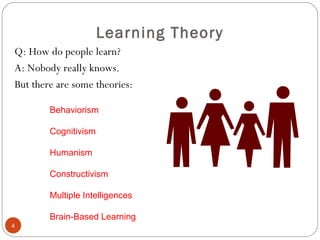
Learning Theory 
Q: How do people learn? 
A: Nobody really knows. 
But there are some theories: 
Behaviorism 
Cognitivism 
Humanism 
Constructivism 
Multiple Intelligences 
Brain-Based Learning
55 
What is behaviorism? 
Learning is the result of an association between a 
stimulus and a response 
Learning are measured through changes in the 
individual behavior. 
Classical conditioning: 
Watson 1920 
Pavlov 1927 
Operant conditioning: 
Thorndike 1898 
Skinner
66 
Classical conditioning - 
Watson 
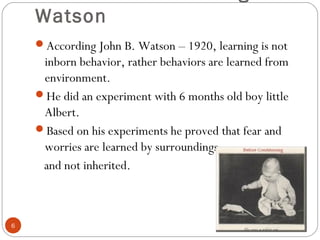
According John B. Watson – 1920, learning is not 
inborn behavior, rather behaviors are learned from 
environment. 
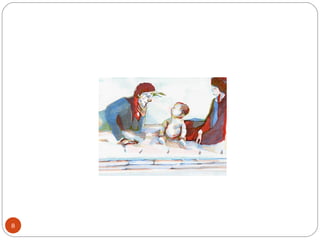
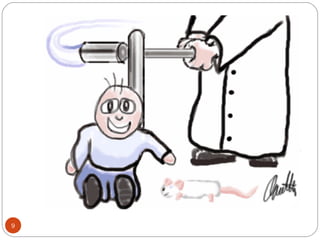
He did an experiment with 6 months old boy little 
Albert. 
Based on his experiments he proved that fear and 
worries are learned by surroundings 
and not inherited.
77 
Little Albert experiment 
This experiment led to the following progression of 
results: 
Introduction of a loud sound resulted in fear, a 
natural response. 
Introduction of a rat paired with the loud sound 
resulted in fear. 
Successive introductions of a rat resulted in fear. 
Here, learning is demonstrated.
88
99
1100 
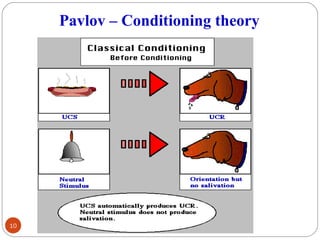
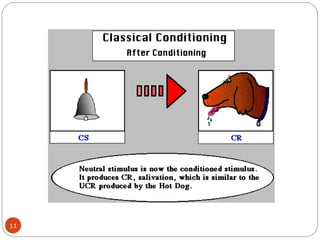
Pavlov – Conditioning theory
1111
1122 
Results: 
This theory discovered that the people or 
animals could learn to respond in a particular 
way if certain conditions exist.
1133 
Thorndike's “law of effect” 
Law of effect means “responses that produce a 
satisfying effect in a particular situation 
become more likely to occur again in that 
situation, and responses that produce a 
discomforting effect become less likely to 
occur again in that situation.”
1144 
Thorndike's “law of effect” 
(S-R) 
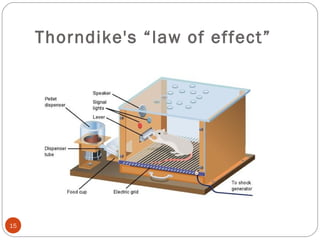
Puzzle box experiments: 
A cat put in a puzzle box and food placed outside. 
Random movements of cat eventually opened the 
door & cat ate the food before being put back into 
box. Over a period of trials his movements became 
less random & eventually he was able to open the 
door immediately he was placed in the puzzle box 
Behavior that results in success or reward is more 
likely to be repeated than behavior that does not
1155 
Thorndike's “law of effect”
1166 
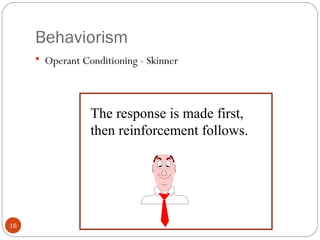
Behaviorism 
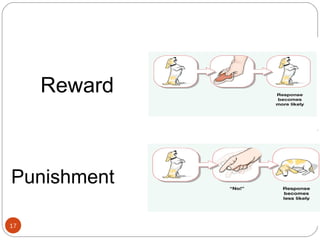
 Operant Conditioning - Skinner 
The response is made first, 
then reinforcement follows.
Punishment 
1177 
Reward
1188 
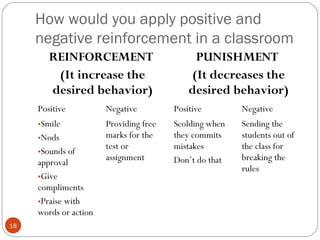
How would you apply positive and 
negative reinforcement in a classroom 
REINFORCEMENT 
(It increase the 
desired behavior) 
PUNISHMENT 
(It decreases the 
desired behavior) 
Positive Negative Positive Negative 
•Smile 
Providing free 
Scolding when 
•Nods 
marks for the 
they commits 
•Sounds of 
test or 
mistakes 
approval 
assignment 
Don’t do that 
•Give 
compliments 
•Praise with 
words or action 
Sending the 
students out of 
the class for 
breaking the 
rules
1199 
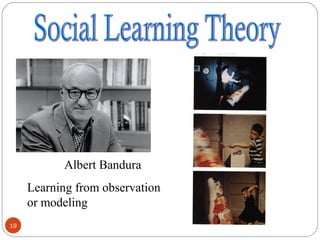
Albert Bandura 
Learning from observation 
or modeling
2200 
What is Social Learning or 
modeling theory 
Learning takes place through 
observation and sensorial experiences 
Imitating the others action
2211 
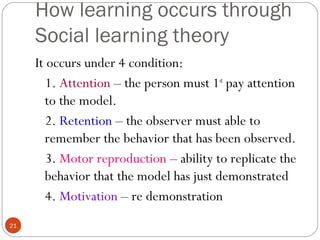
How learning occurs through 
Social learning theory 
It occurs under 4 condition: 
1. Attention – the person must 1st pay attention 
to the model. 
2. Retention – the observer must able to 
remember the behavior that has been observed. 
3. Motor reproduction – ability to replicate the 
behavior that the model has just demonstrated 
4. Motivation – re demonstration
2222 
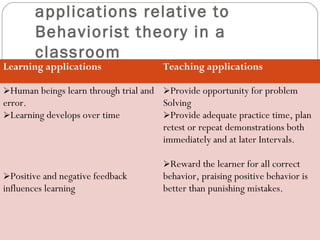
Learning and teaching 
applications relative to 
Behaviorist theory in a 
classroom 
Learning applications Teaching applications 
Human beings learn through trial and 
error. 
Learning develops over time 
Positive and negative feedback 
influences learning 
Provide opportunity for problem 
Solving 
Provide adequate practice time, plan 
retest or repeat demonstrations both 
immediately and at later Intervals. 
Reward the learner for all correct 
behavior, praising positive behavior is 
better than punishing mistakes.
2233 
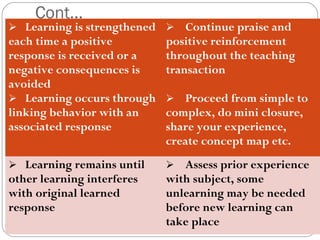
Cont… 
 Learning is strengthened 
each time a positive 
response is received or a 
negative consequences is 
avoided 
 Learning occurs through 
linking behavior with an 
associated response 
 Continue praise and 
positive reinforcement 
throughout the teaching 
transaction 
 Proceed from simple to 
complex, do mini closure, 
share your experience, 
create concept map etc. 
 Learning remains until 
other learning interferes 
with original learned 
response 
 Assess prior experience 
with subject, some 
unlearning may be needed 
before new learning can 
take place
2244 
Exercise 
Reflect about some positive and negative 
reinforcement which could you received from 
your school teachers. 
Reflect and compare about your starting stage 
of learning occurred in diploma nursing and 
degree nursing 
Reflect on How you will analyze the learning 
response of the learners in a practice teaching?
2255 
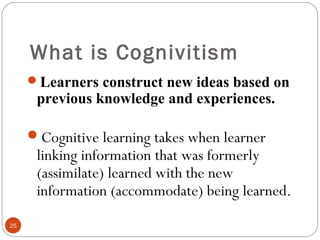
What is Cognivitism 
Learners construct new ideas based on 
previous knowledge and experiences. 
Cognitive learning takes when learner 
linking information that was formerly 
(assimilate) learned with the new 
information (accommodate) being learned.
2266 
Cognivitism 
Concerned with thinking, perception, 
organisation & insight 
Learners actively involved in problem-solving, 
seeking out new information & 
drawing on past experiences to gain 
understanding
2277 
Cognitive Learning Theories are 
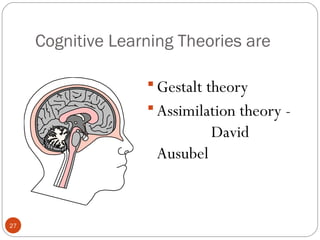
Gestalt theory 
Assimilation theory - 
David 
Ausubel
2288 
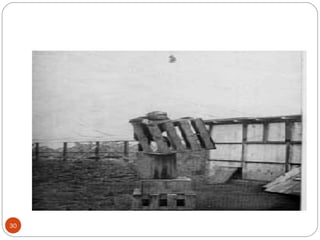
Gestalt theory – Kohler’s Experiment 
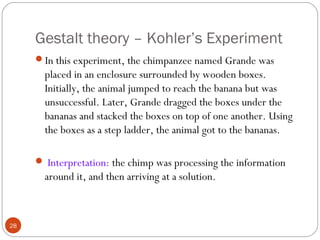
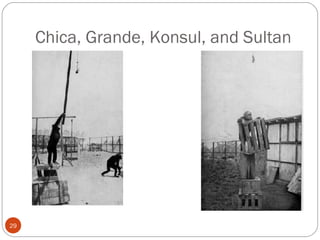
In this experiment, the chimpanzee named Grande was 
placed in an enclosure surrounded by wooden boxes. 
Initially, the animal jumped to reach the banana but was 
unsuccessful. Later, Grande dragged the boxes under the 
bananas and stacked the boxes on top of one another. Using 
the boxes as a step ladder, the animal got to the bananas. 
 Interpretation: the chimp was processing the information 
around it, and then arriving at a solution.
2299 
Chica, Grande, Konsul, and Sultan
3300
3311 
The importance of this theory in 
teaching are: 
Insightful learning occurs when the student analyzes the 
available information in relation to the problems and 
attempts to create an appropriate responses the solve the 
problem. 
Here, the students needs supervision, to ensure that the 
student does not omit an important aspect or suggest 
something which could be harmful, but the teacher is not 
controlling the student’s behavior.
3322 
Assimilation learning theory 
Cognitive learning depends on the adaptation of 
previous & existing knowledge &/or experiences 
to form new insights. 
Ausubel (1978) sees that the way mentors select 
& present information is the key to effective 
learning. In his ‘assimilation theory of learning’ 
he states that the most meaning cognitive 
learning takes place as a result of interaction 
between new information the individual acquires 
& the specifically relevant cognitive structures 
s/he already possesses.
3333 
Responsibility of teacher in CT: 
Ask the students regarding pre requisite knowledge before 
planning and teaching a lesson. 
Present organized lessons. 
Teacher should understand a student’s experience and stage 
of development and lessons developed are mentally 
appropriate. 
Students to be prepared for learning to assimilate and 
accommodate all information. 
Allow space for the students to share their experience.
3344 
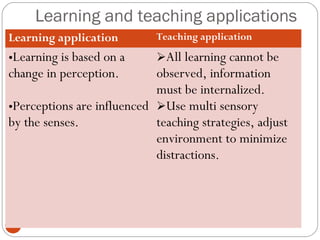
Learning and teaching applications 
Learnriengla atpipvleic attoio ncognitTievaech itnhg eapoplricyation 
•Learning is based on a 
change in perception. 
•Perceptions are influenced 
by the senses. 
All learning cannot be 
observed, information 
must be internalized. 
Use multi sensory 
teaching strategies, adjust 
environment to minimize 
distractions.
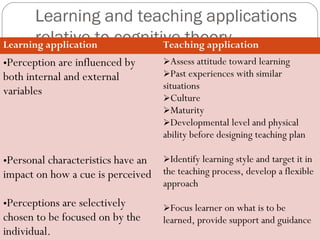
Learning and teaching applications 
relative to cognitive theory Learning application Teaching application 
•Perception are influenced by 
both internal and external 
variables 
•Personal characteristics have an 
impact on how a cue is perceived 
•Perceptions are selectively 
chosen to be focused on by the 
individual. 
3355 
Assess attitude toward learning 
Past experiences with similar 
situations 
Culture 
Maturity 
Developmental level and physical 
ability before designing teaching plan 
Identify learning style and target it in 
the teaching process, develop a flexible 
approach 
Focus learner on what is to be 
learned, provide support and guidance
3366 
Constructivism 
It is an active process in which learners 
construct the concept or new ideas 
based on their current/ past 
knowledge.
3377 
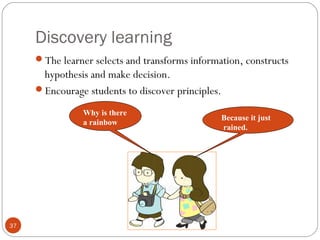
Discovery learning 
The learner selects and transforms information, constructs 
hypothesis and make decision. 
Encourage students to discover principles. 
Why is there 
a rainbow Because it just 
rained.
3388 
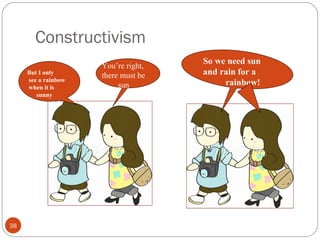
Constructivism 
But I only 
see a rainbow 
when it is 
sunny 
You’re right, 
there must be 
sun 
So we need sun 
and rain for a 
rainbow!
3399 
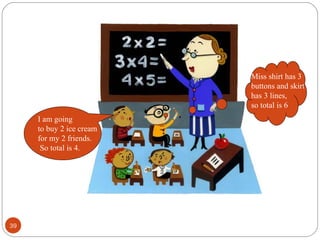
I am going 
to buy 2 ice cream 
for my 2 friends. 
So total is 4. 
Miss shirt has 3 
buttons and skirt 
has 3 lines, 
so total is 6
4400 
question 
comment 
i 
dc 
oe 
Opinion & 
idea
4411 
Application of constructivism 
hands on experiences of physical objects (manipulative 
learning of objects ) 
using models and pictures.( make mental images world by 
learn with brightly colored pictures ) 
Use symbol or numbers to teach
4422 
3. Humanistic theorist believe that: 
The student who is the one should 
determine what is to be learned, and that 
learning should relate to their own 
experiences.
4433 
3. Humanism 
(Rogers 1983,Knowles 1984) 
Rogers (1983) sees the purpose of education as 
individual growth, to enable the development of a 
fully functioning person. So focus on human 
values and concerns. 
Here the teacher should act as a facilitator , 
provider of resources for learning and shares 
feelings as well as knowledge with their students
4444 
How the teachers should approach the 
learners through humanistic theory? 
The most important factor in learning is the relationship that 
exists between facilitator & student. The relationship is based 
on few key factors: 
o Genuineness: the mentor should come over as a real 
person & be able to develop a normal relationship 
with the learner 
o Trust & acceptance: the mentor should see & accept 
the learner as an individual worthy of their care & 
respect 
o Empathetic understanding: the mentor should be able 
to see things from the learners perspective & act 
appropriately in response to this
4455 
..cont.. 
o Encourage learners to set their own 
goals and work toward them 
oAvoid imposing own values and 
views on learner 
o Expose learners to new, necessary 
information 
oPose relevant questions to encourage 
learner to seek answers.
4466 
Newer theories
4477 
Multiple intelligence theory 
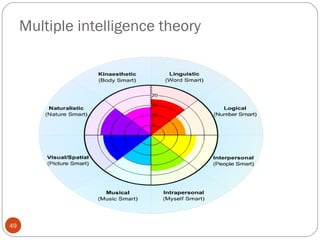
Howard Gardner -1983 
All people born with 8 intelligence 
1. verbal – linguistic (good in words and languages) 
2. visual – spatial ( ability to visualize the mind’s eye) 
3. kinesthetic – capacity to handle objects skillfully. 
4. logical - mathematical
4488 
Multiple intelligence theory 
5. musical – sensitivity to sounds, rhythms, tones and 
music. 
6. interpersonal – extrovert 
7. intrapersonal – introvert, self reflective capacity. 
8. naturalistic – nurturing and relating information to 
one’s natural surroundings.
4499 
Multiple intelligence theory
5500 
Brain based learning 
D. Souza (1980)
5511 
Application of brain based learning in 
classroom 
Creating a learning environment 
Incorporation of music 
Atmosphere consideration 
Temperature 
Light 
Water 
Taking a brain break 
“settling time” – brain need break in order to incorporate 
information learned and connect the neural networks. 
REM sleep
5522 
What happens when we 
learn?
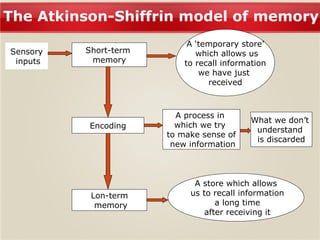
The Atkinson-Shiffrin model of memory 
Sensory 
inputs 
Short-term 
memory 
5533 MS.DEBERAL,SEGI K.L 
A ‘temporary store’ 
which allows us 
to recall information 
we have just 
received 
Encoding 
A process in 
which we try 
to make sense of 
new information 
What we don’t 
understand 
is discarded 
Lon-term 
memory 
A store which allows 
us to recall information 
a long time 
after receiving it
5544

Learning Theories

  • 1.
  • 2.
    22 Learning objectives At the end of this session, the learner will able to Define learning Explore the perspectives of learning by psychologist Develop skills to analyze how the learning theories could be interacted in a classroom environment What methods could be adopted to improves learning through learning theories
  • 3.
    33 Definitions: Learningis: 1. “A persisting change in human performance or performance potential . . . (brought) about a result of the learner’s interaction with the environment” 2. “The relatively permanent change in a person’s knowledge or behavior due to experience” 3. “An enduring change in behavior, or in the capacity to behave in a given fashion, which results from practice or other forms of experience”
  • 4.
    44 Learning Theory Q: How do people learn? A: Nobody really knows. But there are some theories: Behaviorism Cognitivism Humanism Constructivism Multiple Intelligences Brain-Based Learning
  • 5.
    55 What isbehaviorism? Learning is the result of an association between a stimulus and a response Learning are measured through changes in the individual behavior. Classical conditioning: Watson 1920 Pavlov 1927 Operant conditioning: Thorndike 1898 Skinner
  • 6.
    66 Classical conditioning- Watson According John B. Watson – 1920, learning is not inborn behavior, rather behaviors are learned from environment. He did an experiment with 6 months old boy little Albert. Based on his experiments he proved that fear and worries are learned by surroundings and not inherited.
  • 7.
    77 Little Albertexperiment This experiment led to the following progression of results: Introduction of a loud sound resulted in fear, a natural response. Introduction of a rat paired with the loud sound resulted in fear. Successive introductions of a rat resulted in fear. Here, learning is demonstrated.
  • 8.
  • 9.
  • 10.
    1100 Pavlov –Conditioning theory
  • 11.
  • 12.
    1122 Results: Thistheory discovered that the people or animals could learn to respond in a particular way if certain conditions exist.
  • 13.
    1133 Thorndike's “lawof effect” Law of effect means “responses that produce a satisfying effect in a particular situation become more likely to occur again in that situation, and responses that produce a discomforting effect become less likely to occur again in that situation.”
  • 14.
    1144 Thorndike's “lawof effect” (S-R) Puzzle box experiments: A cat put in a puzzle box and food placed outside. Random movements of cat eventually opened the door & cat ate the food before being put back into box. Over a period of trials his movements became less random & eventually he was able to open the door immediately he was placed in the puzzle box Behavior that results in success or reward is more likely to be repeated than behavior that does not
  • 15.
  • 16.
    1166 Behaviorism Operant Conditioning - Skinner The response is made first, then reinforcement follows.
  • 17.
  • 18.
    1188 How wouldyou apply positive and negative reinforcement in a classroom REINFORCEMENT (It increase the desired behavior) PUNISHMENT (It decreases the desired behavior) Positive Negative Positive Negative •Smile Providing free Scolding when •Nods marks for the they commits •Sounds of test or mistakes approval assignment Don’t do that •Give compliments •Praise with words or action Sending the students out of the class for breaking the rules
  • 19.
    1199 Albert Bandura Learning from observation or modeling
  • 20.
    2200 What isSocial Learning or modeling theory Learning takes place through observation and sensorial experiences Imitating the others action
  • 21.
    2211 How learningoccurs through Social learning theory It occurs under 4 condition: 1. Attention – the person must 1st pay attention to the model. 2. Retention – the observer must able to remember the behavior that has been observed. 3. Motor reproduction – ability to replicate the behavior that the model has just demonstrated 4. Motivation – re demonstration
  • 22.
    2222 Learning andteaching applications relative to Behaviorist theory in a classroom Learning applications Teaching applications Human beings learn through trial and error. Learning develops over time Positive and negative feedback influences learning Provide opportunity for problem Solving Provide adequate practice time, plan retest or repeat demonstrations both immediately and at later Intervals. Reward the learner for all correct behavior, praising positive behavior is better than punishing mistakes.
  • 23.
    2233 Cont… Learning is strengthened each time a positive response is received or a negative consequences is avoided  Learning occurs through linking behavior with an associated response  Continue praise and positive reinforcement throughout the teaching transaction  Proceed from simple to complex, do mini closure, share your experience, create concept map etc.  Learning remains until other learning interferes with original learned response  Assess prior experience with subject, some unlearning may be needed before new learning can take place
  • 24.
    2244 Exercise Reflectabout some positive and negative reinforcement which could you received from your school teachers. Reflect and compare about your starting stage of learning occurred in diploma nursing and degree nursing Reflect on How you will analyze the learning response of the learners in a practice teaching?
  • 25.
    2255 What isCognivitism Learners construct new ideas based on previous knowledge and experiences. Cognitive learning takes when learner linking information that was formerly (assimilate) learned with the new information (accommodate) being learned.
  • 26.
    2266 Cognivitism Concernedwith thinking, perception, organisation & insight Learners actively involved in problem-solving, seeking out new information & drawing on past experiences to gain understanding
  • 27.
    2277 Cognitive LearningTheories are Gestalt theory Assimilation theory - David Ausubel
  • 28.
    2288 Gestalt theory– Kohler’s Experiment In this experiment, the chimpanzee named Grande was placed in an enclosure surrounded by wooden boxes. Initially, the animal jumped to reach the banana but was unsuccessful. Later, Grande dragged the boxes under the bananas and stacked the boxes on top of one another. Using the boxes as a step ladder, the animal got to the bananas.  Interpretation: the chimp was processing the information around it, and then arriving at a solution.
  • 29.
    2299 Chica, Grande,Konsul, and Sultan
  • 30.
  • 31.
    3311 The importanceof this theory in teaching are: Insightful learning occurs when the student analyzes the available information in relation to the problems and attempts to create an appropriate responses the solve the problem. Here, the students needs supervision, to ensure that the student does not omit an important aspect or suggest something which could be harmful, but the teacher is not controlling the student’s behavior.
  • 32.
    3322 Assimilation learningtheory Cognitive learning depends on the adaptation of previous & existing knowledge &/or experiences to form new insights. Ausubel (1978) sees that the way mentors select & present information is the key to effective learning. In his ‘assimilation theory of learning’ he states that the most meaning cognitive learning takes place as a result of interaction between new information the individual acquires & the specifically relevant cognitive structures s/he already possesses.
  • 33.
    3333 Responsibility ofteacher in CT: Ask the students regarding pre requisite knowledge before planning and teaching a lesson. Present organized lessons. Teacher should understand a student’s experience and stage of development and lessons developed are mentally appropriate. Students to be prepared for learning to assimilate and accommodate all information. Allow space for the students to share their experience.
  • 34.
    3344 Learning andteaching applications Learnriengla atpipvleic attoio ncognitTievaech itnhg eapoplricyation •Learning is based on a change in perception. •Perceptions are influenced by the senses. All learning cannot be observed, information must be internalized. Use multi sensory teaching strategies, adjust environment to minimize distractions.
  • 35.
    Learning and teachingapplications relative to cognitive theory Learning application Teaching application •Perception are influenced by both internal and external variables •Personal characteristics have an impact on how a cue is perceived •Perceptions are selectively chosen to be focused on by the individual. 3355 Assess attitude toward learning Past experiences with similar situations Culture Maturity Developmental level and physical ability before designing teaching plan Identify learning style and target it in the teaching process, develop a flexible approach Focus learner on what is to be learned, provide support and guidance
  • 36.
    3366 Constructivism Itis an active process in which learners construct the concept or new ideas based on their current/ past knowledge.
  • 37.
    3377 Discovery learning The learner selects and transforms information, constructs hypothesis and make decision. Encourage students to discover principles. Why is there a rainbow Because it just rained.
  • 38.
    3388 Constructivism ButI only see a rainbow when it is sunny You’re right, there must be sun So we need sun and rain for a rainbow!
  • 39.
    3399 I amgoing to buy 2 ice cream for my 2 friends. So total is 4. Miss shirt has 3 buttons and skirt has 3 lines, so total is 6
  • 40.
    4400 question comment i dc oe Opinion & idea
  • 41.
    4411 Application ofconstructivism hands on experiences of physical objects (manipulative learning of objects ) using models and pictures.( make mental images world by learn with brightly colored pictures ) Use symbol or numbers to teach
  • 42.
    4422 3. Humanistictheorist believe that: The student who is the one should determine what is to be learned, and that learning should relate to their own experiences.
  • 43.
    4433 3. Humanism (Rogers 1983,Knowles 1984) Rogers (1983) sees the purpose of education as individual growth, to enable the development of a fully functioning person. So focus on human values and concerns. Here the teacher should act as a facilitator , provider of resources for learning and shares feelings as well as knowledge with their students
  • 44.
    4444 How theteachers should approach the learners through humanistic theory? The most important factor in learning is the relationship that exists between facilitator & student. The relationship is based on few key factors: o Genuineness: the mentor should come over as a real person & be able to develop a normal relationship with the learner o Trust & acceptance: the mentor should see & accept the learner as an individual worthy of their care & respect o Empathetic understanding: the mentor should be able to see things from the learners perspective & act appropriately in response to this
  • 45.
    4455 ..cont.. oEncourage learners to set their own goals and work toward them oAvoid imposing own values and views on learner o Expose learners to new, necessary information oPose relevant questions to encourage learner to seek answers.
  • 46.
  • 47.
    4477 Multiple intelligencetheory Howard Gardner -1983 All people born with 8 intelligence 1. verbal – linguistic (good in words and languages) 2. visual – spatial ( ability to visualize the mind’s eye) 3. kinesthetic – capacity to handle objects skillfully. 4. logical - mathematical
  • 48.
    4488 Multiple intelligencetheory 5. musical – sensitivity to sounds, rhythms, tones and music. 6. interpersonal – extrovert 7. intrapersonal – introvert, self reflective capacity. 8. naturalistic – nurturing and relating information to one’s natural surroundings.
  • 49.
  • 50.
    5500 Brain basedlearning D. Souza (1980)
  • 51.
    5511 Application ofbrain based learning in classroom Creating a learning environment Incorporation of music Atmosphere consideration Temperature Light Water Taking a brain break “settling time” – brain need break in order to incorporate information learned and connect the neural networks. REM sleep
  • 52.
    5522 What happenswhen we learn?
  • 53.
    The Atkinson-Shiffrin modelof memory Sensory inputs Short-term memory 5533 MS.DEBERAL,SEGI K.L A ‘temporary store’ which allows us to recall information we have just received Encoding A process in which we try to make sense of new information What we don’t understand is discarded Lon-term memory A store which allows us to recall information a long time after receiving it
  • 54.

Editor's Notes

  • #21 Imitation: Individuals adopt the modeled behavior more readily and completely if the person they are observing is admired by the observer We more readily model behavior if it results in outcomes we value or approve of