What is Learning? A definition
Learning A definition Learning as a quantitative increase in knowledge. Learning is acquiring information or ‘knowing a lot’. Learning as memorising. Learning is storing information that can be reproduced.  Learning as acquiring facts, skills, and methods that can be retained and used as necessary.  Learning as making sense or abstracting meaning. Learning involves relating parts of the subject matter to each other and to the real world.  Learning as interpreting and understanding reality in a different way. Learning involves comprehending the world by reinterpreting knowledge. (quoted in Ramsden 1992: 26)  Säljö (1979) asked a number of adult students what they understood by learning:
Learning A definition An experience which produces a relatively permanent change in behaviour, or potential behaviour. Learning could be thought of as 'a process by which behaviour changes as a result of experience' (Maples and Webster 1980 quoted in Merriam and Caffarella 1991: 124).
Learning Types Acquisition learning  is seen as going on all the time. It is 'concrete, immediate and confined to a specific activity; it is not concerned with general principles' (Rogers 2003: 18).  Whilst the learner may not be conscious of learning, they are usually aware of the specific task in hand.
Learning Types Formalized learning  arises from the process of facilitating learning. It is 'educative learning' rather than the accumulation of experience.  There is a consciousness of learning - people are aware that the task they are engaged in entails learning (Rogers 2003: 27).
Behaviourism A definition
Behaviourism A theory of human learning that only focuses on objectively observable behaviours . Behaviour theorists define learning as nothing more than the acquisition of new behaviour.
Behaviourism Borger and Seaborne (1966:16) suggest that learning is ‘any more or less permanent change in behaviour which is the result of experience’.
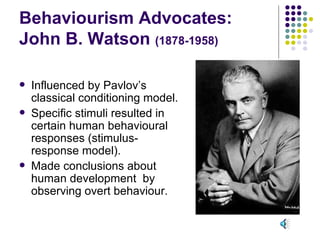
Behaviourism Advocates: John B. Watson  (1878-1958) Influenced by Pavlov’s classical conditioning model. Specific stimuli resulted in certain human behavioural responses (stimulus-response model). Made conclusions about human development  by observing overt behaviour.
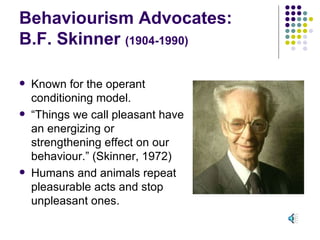
Behaviourism Advocates: B.F. Skinner  (1904-1990) Known for the operant conditioning model. “ Things we call pleasant have an energizing or strengthening effect on our behaviour.” (Skinner, 1972) Humans and animals repeat pleasurable acts and stop unpleasant ones.
Behaviourism Conditioning Classic conditioning  occurs when a natural reflex responds to a stimulus. The most popular example is Pavlov's observation that dogs salivate when they eat or even see food. Essentially, animals and people are biologically "wired" so that a certain stimulus will produce a specific response.
Behaviourism Conditioning Behavioural  or  operant conditioning  occurs when a response to a stimulus is reinforced. Basically, operant conditioning is a simple feedback system: If a reward or reinforcement follows the response to a stimulus, then the response becomes more probable in the future. For example, leading behaviourist B.F. Skinner used reinforcement techniques to teach pigeons to dance and bowl a ball in a mini-alley.
Behaviourism Criticisms of behaviorism:  Behaviorism does not account for all kinds of learning, since it disregards the activities of the mind.  Behaviorism does not explain some learning--such as the recognition of new language patterns by young children--for which there is no reinforcement mechanism.  Research has shown that animals adapt their reinforced patterns to new information. For instance, a rat can shift its behavior to respond to changes in the layout of a maze it had previously mastered through reinforcements.
Behaviourism Impact on Learning Its positive and negative reinforcement techniques can be very effective--both in animals, and in treatments for human disorders such as autism and antisocial behavior.  Behaviorism often is used by teachers, who reward or punish student behaviors.
Constructivism “ a theory about knowledge and learning.” (Fosnot,1996)
Constructivism - Premises Learners actively construct their own knowledge by anchoring new information to pre-existing knowledge. Learners interact with knowledge, the learning environment, and with other learners. The Learner
Constructivism - Premises Knowledge is "temporary, developmental, nonobjective, internally constructed, and socially and culturally mediated." (Fosnot,1996)  Knowledge
Constructivism - Premises Learning is a self-regulatory process of struggling with the conflict between existing personal models of the world and discrepant new insights. Learning
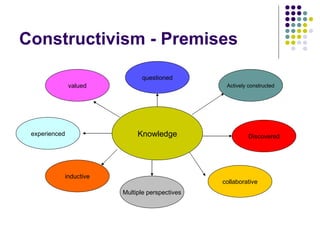
Constructivism - Premises Knowledge Actively constructed Discovered collaborative Multiple perspectives valued questioned experienced inductive
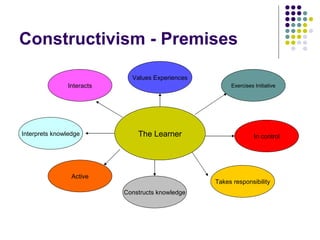
Constructivism - Premises The Learner Exercises Initiative In control Takes responsibility Constructs knowledge Interacts Values Experiences Interprets knowledge Active
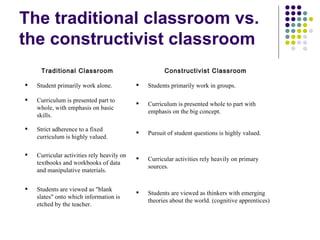
The traditional classroom vs. the constructivist classroom Students are viewed as thinkers with emerging theories about the world. (cognitive apprentices)  Students are viewed as "blank slates" onto which information is etched by the teacher. Curricular activities rely heavily on primary sources.  Curricular activities rely heavily on textbooks and workbooks of data and manipulative materials.  Pursuit of student questions is highly valued.  Strict adherence to a fixed curriculum is highly valued. Curriculum is presented whole to part with emphasis on the big concept.  Curriculum is presented part to whole, with emphasis on basic skills. Students primarily work in groups.  Student primarily work alone. Constructivist Classroom Traditional Classroom
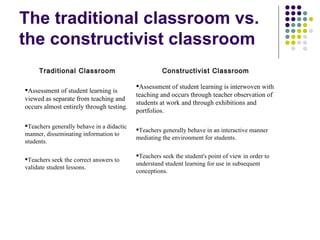
The traditional classroom vs. the constructivist classroom Teachers generally behave in an interactive manner mediating the environment for students.  Teachers generally behave in a didactic manner, disseminating information to students. Teachers seek the student's point of view in order to understand student learning for use in subsequent conceptions.  Teachers seek the correct answers to validate student lessons.  Assessment of student learning is interwoven with teaching and occurs through teacher observation of students at work and through exhibitions and portfolios.  Assessment of student learning is viewed as separate from teaching and occurs almost entirely through testing.  Constructivist Classroom Traditional Classroom
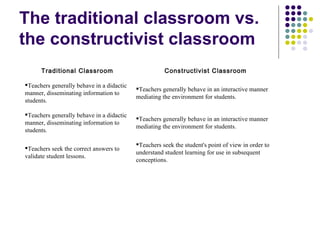
The traditional classroom vs. the constructivist classroom Teachers generally behave in an interactive manner mediating the environment for students.  Teachers generally behave in a didactic manner, disseminating information to students. Teachers seek the student's point of view in order to understand student learning for use in subsequent conceptions.  Teachers seek the correct answers to validate student lessons.  Teachers generally behave in an interactive manner mediating the environment for students.  Teachers generally behave in a didactic manner, disseminating information to students. Constructivist Classroom Traditional Classroom
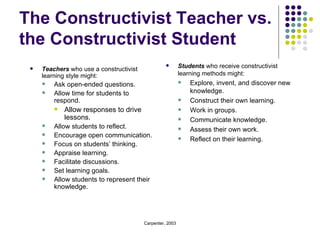
The Constructivist Teacher vs. the Constructivist Student Teachers  who use a constructivist learning style might: Ask open-ended questions. Allow time for students to respond. Allow responses to drive lessons. Allow students to reflect. Encourage open communication. Focus on students’ thinking. Appraise learning. Facilitate discussions. Set learning goals. Allow students to represent their knowledge. Students  who receive constructivist learning methods might: Explore, invent, and discover new knowledge. Construct their own learning. Work in groups. Communicate knowledge. Assess their own work. Reflect on their learning.
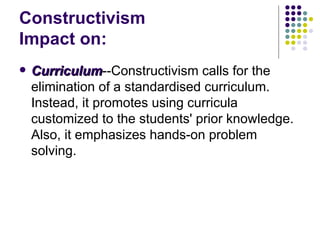
Constructivism  Impact on: Curriculum --Constructivism calls for the elimination of a standardised curriculum. Instead, it promotes using curricula customized to the students' prior knowledge. Also, it emphasizes hands-on problem solving.
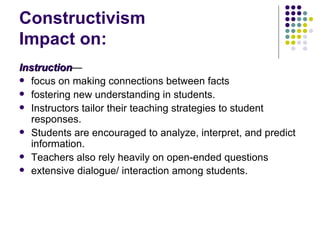
Constructivism  Impact on: Instruction — focus on making connections between facts fostering new understanding in students. Instructors tailor their teaching strategies to student responses. Students are encouraged to analyze, interpret, and predict information.  Teachers also rely heavily on open-ended questions extensive dialogue/ interaction among students.
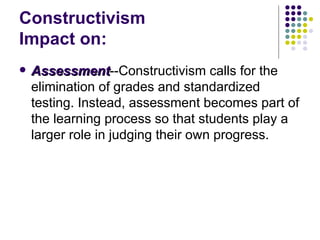
Constructivism  Impact on: Assessment --Constructivism calls for the elimination of grades and standardized testing. Instead, assessment becomes part of the learning process so that students play a larger role in judging their own progress.
Sources http://www.ncsu.edu/felder-public/Learning_Styles.html http://www.ldpride.net/learningstyles.MI.htm  http://www.cyg.net/~jblackmo/diglib/styl-a.html

Theories of learning

  • 1.
    What is Learning?A definition
  • 2.
    Learning A definitionLearning as a quantitative increase in knowledge. Learning is acquiring information or ‘knowing a lot’. Learning as memorising. Learning is storing information that can be reproduced. Learning as acquiring facts, skills, and methods that can be retained and used as necessary. Learning as making sense or abstracting meaning. Learning involves relating parts of the subject matter to each other and to the real world. Learning as interpreting and understanding reality in a different way. Learning involves comprehending the world by reinterpreting knowledge. (quoted in Ramsden 1992: 26) Säljö (1979) asked a number of adult students what they understood by learning:
  • 3.
    Learning A definitionAn experience which produces a relatively permanent change in behaviour, or potential behaviour. Learning could be thought of as 'a process by which behaviour changes as a result of experience' (Maples and Webster 1980 quoted in Merriam and Caffarella 1991: 124).
  • 4.
    Learning Types Acquisitionlearning is seen as going on all the time. It is 'concrete, immediate and confined to a specific activity; it is not concerned with general principles' (Rogers 2003: 18). Whilst the learner may not be conscious of learning, they are usually aware of the specific task in hand.
  • 5.
    Learning Types Formalizedlearning arises from the process of facilitating learning. It is 'educative learning' rather than the accumulation of experience. There is a consciousness of learning - people are aware that the task they are engaged in entails learning (Rogers 2003: 27).
  • 6.
  • 7.
    Behaviourism A theoryof human learning that only focuses on objectively observable behaviours . Behaviour theorists define learning as nothing more than the acquisition of new behaviour.
  • 8.
    Behaviourism Borger andSeaborne (1966:16) suggest that learning is ‘any more or less permanent change in behaviour which is the result of experience’.
  • 9.
    Behaviourism Advocates: JohnB. Watson (1878-1958) Influenced by Pavlov’s classical conditioning model. Specific stimuli resulted in certain human behavioural responses (stimulus-response model). Made conclusions about human development by observing overt behaviour.
  • 10.
    Behaviourism Advocates: B.F.Skinner (1904-1990) Known for the operant conditioning model. “ Things we call pleasant have an energizing or strengthening effect on our behaviour.” (Skinner, 1972) Humans and animals repeat pleasurable acts and stop unpleasant ones.
  • 11.
    Behaviourism Conditioning Classicconditioning occurs when a natural reflex responds to a stimulus. The most popular example is Pavlov's observation that dogs salivate when they eat or even see food. Essentially, animals and people are biologically "wired" so that a certain stimulus will produce a specific response.
  • 12.
    Behaviourism Conditioning Behavioural or operant conditioning occurs when a response to a stimulus is reinforced. Basically, operant conditioning is a simple feedback system: If a reward or reinforcement follows the response to a stimulus, then the response becomes more probable in the future. For example, leading behaviourist B.F. Skinner used reinforcement techniques to teach pigeons to dance and bowl a ball in a mini-alley.
  • 13.
    Behaviourism Criticisms ofbehaviorism: Behaviorism does not account for all kinds of learning, since it disregards the activities of the mind. Behaviorism does not explain some learning--such as the recognition of new language patterns by young children--for which there is no reinforcement mechanism. Research has shown that animals adapt their reinforced patterns to new information. For instance, a rat can shift its behavior to respond to changes in the layout of a maze it had previously mastered through reinforcements.
  • 14.
    Behaviourism Impact onLearning Its positive and negative reinforcement techniques can be very effective--both in animals, and in treatments for human disorders such as autism and antisocial behavior. Behaviorism often is used by teachers, who reward or punish student behaviors.
  • 15.
    Constructivism “ atheory about knowledge and learning.” (Fosnot,1996)
  • 16.
    Constructivism - PremisesLearners actively construct their own knowledge by anchoring new information to pre-existing knowledge. Learners interact with knowledge, the learning environment, and with other learners. The Learner
  • 17.
    Constructivism - PremisesKnowledge is "temporary, developmental, nonobjective, internally constructed, and socially and culturally mediated." (Fosnot,1996) Knowledge
  • 18.
    Constructivism - PremisesLearning is a self-regulatory process of struggling with the conflict between existing personal models of the world and discrepant new insights. Learning
  • 19.
    Constructivism - PremisesKnowledge Actively constructed Discovered collaborative Multiple perspectives valued questioned experienced inductive
  • 20.
    Constructivism - PremisesThe Learner Exercises Initiative In control Takes responsibility Constructs knowledge Interacts Values Experiences Interprets knowledge Active
  • 21.
    The traditional classroomvs. the constructivist classroom Students are viewed as thinkers with emerging theories about the world. (cognitive apprentices) Students are viewed as "blank slates" onto which information is etched by the teacher. Curricular activities rely heavily on primary sources. Curricular activities rely heavily on textbooks and workbooks of data and manipulative materials. Pursuit of student questions is highly valued. Strict adherence to a fixed curriculum is highly valued. Curriculum is presented whole to part with emphasis on the big concept. Curriculum is presented part to whole, with emphasis on basic skills. Students primarily work in groups. Student primarily work alone. Constructivist Classroom Traditional Classroom
  • 22.
    The traditional classroomvs. the constructivist classroom Teachers generally behave in an interactive manner mediating the environment for students. Teachers generally behave in a didactic manner, disseminating information to students. Teachers seek the student's point of view in order to understand student learning for use in subsequent conceptions. Teachers seek the correct answers to validate student lessons. Assessment of student learning is interwoven with teaching and occurs through teacher observation of students at work and through exhibitions and portfolios. Assessment of student learning is viewed as separate from teaching and occurs almost entirely through testing. Constructivist Classroom Traditional Classroom
  • 23.
    The traditional classroomvs. the constructivist classroom Teachers generally behave in an interactive manner mediating the environment for students. Teachers generally behave in a didactic manner, disseminating information to students. Teachers seek the student's point of view in order to understand student learning for use in subsequent conceptions. Teachers seek the correct answers to validate student lessons. Teachers generally behave in an interactive manner mediating the environment for students. Teachers generally behave in a didactic manner, disseminating information to students. Constructivist Classroom Traditional Classroom
  • 24.
    The Constructivist Teachervs. the Constructivist Student Teachers who use a constructivist learning style might: Ask open-ended questions. Allow time for students to respond. Allow responses to drive lessons. Allow students to reflect. Encourage open communication. Focus on students’ thinking. Appraise learning. Facilitate discussions. Set learning goals. Allow students to represent their knowledge. Students who receive constructivist learning methods might: Explore, invent, and discover new knowledge. Construct their own learning. Work in groups. Communicate knowledge. Assess their own work. Reflect on their learning.
  • 25.
    Constructivism Impacton: Curriculum --Constructivism calls for the elimination of a standardised curriculum. Instead, it promotes using curricula customized to the students' prior knowledge. Also, it emphasizes hands-on problem solving.
  • 26.
    Constructivism Impacton: Instruction — focus on making connections between facts fostering new understanding in students. Instructors tailor their teaching strategies to student responses. Students are encouraged to analyze, interpret, and predict information. Teachers also rely heavily on open-ended questions extensive dialogue/ interaction among students.
  • 27.
    Constructivism Impacton: Assessment --Constructivism calls for the elimination of grades and standardized testing. Instead, assessment becomes part of the learning process so that students play a larger role in judging their own progress.
  • 28.

Editor's Notes

  • #25 In a study on the use of constructivism in the classroom, Carpenter developed criteria for teachers and students involved in a constructivist learning curriculum. She concluded that: Teachers who apply a constructivist learning system in their classes might: Ask open-ended questions, allow time for students to respond, all student responses to drive lessons, encourage open communication in the classroom, focus on students’ thinking, rather than on whether they answer questions correctly, appraise learning, facilitate classroom discussions, set learning goals, and provide opportunities for students to represent their knowledge. Students who receive constructivist learning might: Explore, invent, discover, and apply new ideas and knowledge, construct their own learning, work in groups, discuss ideas with others, asses their own work, and reflect on what they learn.