1 
Learner Language 
1. What is learner language? 
2. The purpose of studying learner language 
3. Learner language and errors 
4. Developmental sequences of learner 
language 
5. L1 influence and learner language
I. What is learner language? 
 Second language learner language is also 
called “interlanguage” – learners’ developing 
second language knowledge (Selinker,1972). 
 Interlanguage is a developing system with its 
interim structure, rather than an imperfect 
imitation of the TL. 
• it is systematic, predictable but also dynamic, 
continually evolving as learners receive more 
input and revise their hypotheses about the TL. 
2
I. What is learner language? 
3 
 Interlanguage has the following 
characteristics: 
1) some characteristics influenced by the 
learner’s previous learned language(s), 
2) some characteristics of the L2, and 
3) some characteristics which seem to be 
general and tend to occur in all or most 
interlanguage systems.
I. What is learner language? 
 The study of L2 learner language includes 
• What types of errors learners make 
• How their errors show their TL knowledge and 
ability to use the TL 
• How L2 learners develop their interlanguage 
• What factors influence their interlanguage 
4
II. Purpose of studying learner language 
 The study of leaner language helps teachers to 
assess teaching procedures in the light of what 
they can reasonably expect to accomplish in the 
classroom. 
 It also helps learners to be aware of the steps that 
they go through in acquiring L2 features. 
 It provides a deeper understanding of errors that 
L2 learners make. An increase in error may not 
result from a lack of practice or transfer from L1; 
rather, it can be an indication of progress (e.g., 
due to overgeneralization). 
5
III. Learner language and errors 
 During the 1960s: 
• Most people regarded L2 learners’ speech as an 
incorrect version of the TL. 
• Their errors were believed to be the result mainly 
of transfer from their L1. 
• Contrastive analysis was the basis for 
identifying differences between the L1 and the 
L2 and for predicting areas of potential errors 
(i.e., based on CAH). 
6
III. Learner language and errors 
 Why is CAH problematic? 
A number of SLA research studies show that 
• Many errors can be explained better in terms of 
learners’ attempts to discover the structure of 
the language being learned rather than an 
attempt to transfer patterns of their L1. 
• Some errors are remarkably similar to the kinds 
of errors made by young L1 learners (e.g., the 
use of a regular -ed past tense for an irregular verb). 
7
III. Learner language and errors 
 Why is CAH problematic? (continued) 
A number of SLA research studies show that 
• Errors are not always “bi-directional” when 
differences between L1 and L2 exist. 
• Learners have intuitions that certain features of 
their L1 are less likely to be transferable than 
others. For example, they believe that idiomatic 
or metaphorical expressions cannot simply be 
translated word for word. 
8
III. Learner language and errors 
 During the 1970s: 
• The research goal was to discover what learners really 
know about the TL. Their errors reflect their current 
understanding of the rules and patterns of the TL. 
• Error analysis replaced contrastive analysis. It did not 
set out to predict L2 learners’ errors; rather, it aims to 
discover and describe different kinds of errors in an 
effort to understand how learners process the L2. 
• Error analysis is based on the assumption that L2 
learner language is a system in its own right – one 
which is rule-governed and predictable. 
9
10 
* Activity – Error Analysis 
 Looking at the activity on p. 74 
“The Great Toy Robbery” 
• Read the two texts and examine the errors made 
by the two learners of English (a French-speaking 
secondary school student and a Chinese-speaking 
adult learner). 
• Do they make the same kinds of errors? In what 
ways do the two interlanguages differ?
III. Learner language and errors 
11 
- Types of errors 
 Developmental errors: the errors that might very well be made 
by children acquiring their L1 (e.g., “a cowboy go”). 
 Overgeneralization errors: the errors that are caused by trying 
to use a rule in a context where it does not belong (e.g., “They 
plays toys in the bar”, “She buyed a dress.”). 
 Simplification errors: the errors that are caused by simplifying 
or leaving out some elements (e.g., all verbs have the same 
form regardless of person, number or tense). 
 Misuse of formulaic expressions: (e.g., “Santa Claus ride a 
one horse open sleigh to sent present for children”). 
*See the lyric of Jingle Bell 
 Interference errors (transfer from L1): (e.g., “On the back of 
his body has big packet” 在他身體背後有個大背包)
III. Learner language and errors 
- Discussion of Error Analysis 
12 
 Advantage: 
It permits a description of some systematic aspects of 
learner language. 
 Constraints: 
It does not always give us clear insights into what 
causes learners to do what they do, because 
• It is very often difficult to determine the source of errors. 
• Learners sometimes avoid using certain features of 
language which they perceive difficult. The avoidance of 
particular features will be difficult to observe, but it may also 
be a part of the learner’s systematic L2 performance.
IV. Developmental sequences 
 SLA research has revealed that 
• L2 learners, like L1 learners, pass through sequences 
of development. 
• In a given language, many of these developmental 
sequences are similar for L1 and L2 learners. 
• It is not always the case that L2 features which are 
heard or read most frequently are easier to learn (e.g., 
articles - ‘a’ & ‘the’). 
• Even among L2 learners from different L1 backgrounds 
and different learning environments, many of these 
developmental sequences are similar. 
13
IV. Developmental sequences 
Grammatical morphemes 
 Negation 
Questions 
 Relative clauses 
 Reference to past 
14
IV. Developmental sequences 
- Grammatical morphemes 
 Learners are often more accurate in using plural -s than 
in using possessive -s’. 
 Learners are often more accurate in using -ing than in 
using -ed past. 
 The learner’s L1 has some effect on the accuracy order 
of grammatical morphemes; however, it is not entirely 
determined by the learner’s L1. There are some strong 
patterns of similarity among learners of different L1 
backgrounds. 
(* Please see p. 5 for the L1 development of grammatical morphemes) 
15
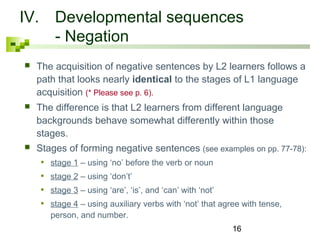
IV. Developmental sequences 
16 
- Negation 
 The acquisition of negative sentences by L2 learners follows a 
path that looks nearly identical to the stages of L1 language 
acquisition (* Please see p. 6). 
 The difference is that L2 learners from different language 
backgrounds behave somewhat differently within those 
stages. 
 Stages of forming negative sentences (see examples on pp. 77-78): 
• stage 1 – using ‘no’ before the verb or noun 
• stage 2 – using ‘don’t’ 
• stage 3 – using ‘are’, ‘is’, and ‘can’ with ‘not’ 
• stage 4 – using auxiliary verbs with ‘not’ that agree with tense, 
person, and number.
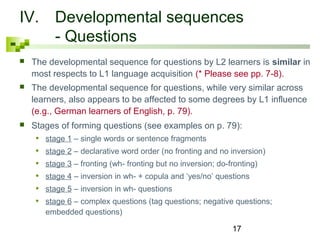
IV. Developmental sequences 
17 
- Questions 
 The developmental sequence for questions by L2 learners is similar in 
most respects to L1 language acquisition (* Please see pp. 7-8). 
 The developmental sequence for questions, while very similar across 
learners, also appears to be affected to some degrees by L1 influence 
(e.g., German learners of English, p. 79). 
 Stages of forming questions (see examples on p. 79): 
• stage 1 – single words or sentence fragments 
• stage 2 – declarative word order (no fronting and no inversion) 
• stage 3 – fronting (wh- fronting but no inversion; do-fronting) 
• stage 4 – inversion in wh- + copula and ‘yes/no’ questions 
• stage 5 – inversion in wh- questions 
• stage 6 – complex questions (tag questions; negative questions; 
embedded questions)
IV. Developmental sequences 
18 
- Relative clauses 
 The pattern of acquisition for relative clauses (the 
“accessibility hierarchy” for relative clause in English): 
• Subject (‘The girl who was sick went home’) 
• Direct object (‘The story that/which I read was long’) 
• Indirect object (‘The man who[m] I gave the present to was 
absent’) 
• Object of preposition (‘I found the book that John was talking 
about’) 
• Possessive (‘I know the woman whose father is visiting’) 
• Object of comparison (‘The person that Susan is taller than is 
Mary’)
IV. Developmental sequences 
19 
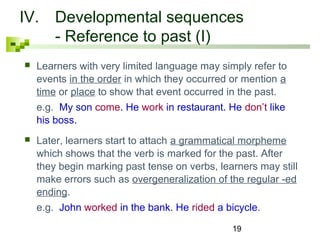
- Reference to past (I) 
 Learners with very limited language may simply refer to 
events in the order in which they occurred or mention a 
time or place to show that event occurred in the past. 
e.g. My son come. He work in restaurant. He don’t like 
his boss. 
 Later, learners start to attach a grammatical morpheme 
which shows that the verb is marked for the past. After 
they begin marking past tense on verbs, learners may still 
make errors such as overgeneralization of the regular -ed 
ending. 
e.g. John worked in the bank. He rided a bicycle.
IV. Developmental sequences 
20 
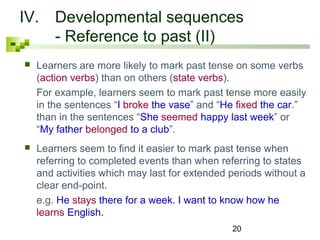
- Reference to past (II) 
 Learners are more likely to mark past tense on some verbs 
(action verbs) than on others (state verbs). 
For example, learners seem to mark past tense more easily 
in the sentences “I broke the vase” and “He fixed the car.” 
than in the sentences “She seemed happy last week” or 
“My father belonged to a club”. 
 Learners seem to find it easier to mark past tense when 
referring to completed events than when referring to states 
and activities which may last for extended periods without a 
clear end-point. 
e.g. He stays there for a week. I want to know how he 
learns English.
IV. Developmental sequences 
21 
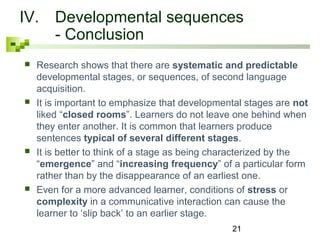
- Conclusion 
 Research shows that there are systematic and predictable 
developmental stages, or sequences, of second language 
acquisition. 
 It is important to emphasize that developmental stages are not 
liked “closed rooms”. Learners do not leave one behind when 
they enter another. It is common that learners produce 
sentences typical of several different stages. 
 It is better to think of a stage as being characterized by the 
“emergence” and “increasing frequency” of a particular form 
rather than by the disappearance of an earliest one. 
 Even for a more advanced learner, conditions of stress or 
complexity in a communicative interaction can cause the 
learner to ‘slip back’ to an earlier stage.
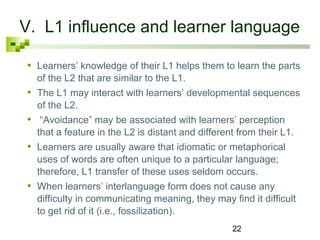
V. L1 influence and learner language 
• Learners’ knowledge of their L1 helps them to learn the parts 
of the L2 that are similar to the L1. 
• The L1 may interact with learners’ developmental sequences 
of the L2. 
• “Avoidance” may be associated with learners’ perception 
that a feature in the L2 is distant and different from their L1. 
• Learners are usually aware that idiomatic or metaphorical 
uses of words are often unique to a particular language; 
therefore, L1 transfer of these uses seldom occurs. 
• When learners’ interlanguage form does not cause any 
difficulty in communicating meaning, they may find it difficult 
to get rid of it (i.e., fossilization). 
22
23 
Summary 
 Researchers have found that learners who receive grammar-based 
instruction still pass through the same developmental sequences and 
make the same types of errors as those who acquire language in 
natural settings. 
 Research also shows that L2 learners from different L1 backgrounds 
often make the same kinds of errors when learning the L2. 
 The transfer of patterns from the L1 is only one of the major sources 
of errors in learner language; however, there are other causes for 
errors too, such as developmental errors, overgeneralization errors, 
and simplification errors, which constantly affect interlanguage. 
 Therefore, interlanguage errors are evidence of the learners’ efforts 
to discover the structure of the TL itself rather than just attempts to 
transfer patterns from their L1.

Learner Language

  • 1.
    1 Learner Language 1. What is learner language? 2. The purpose of studying learner language 3. Learner language and errors 4. Developmental sequences of learner language 5. L1 influence and learner language
  • 2.
    I. What islearner language?  Second language learner language is also called “interlanguage” – learners’ developing second language knowledge (Selinker,1972).  Interlanguage is a developing system with its interim structure, rather than an imperfect imitation of the TL. • it is systematic, predictable but also dynamic, continually evolving as learners receive more input and revise their hypotheses about the TL. 2
  • 3.
    I. What islearner language? 3  Interlanguage has the following characteristics: 1) some characteristics influenced by the learner’s previous learned language(s), 2) some characteristics of the L2, and 3) some characteristics which seem to be general and tend to occur in all or most interlanguage systems.
  • 4.
    I. What islearner language?  The study of L2 learner language includes • What types of errors learners make • How their errors show their TL knowledge and ability to use the TL • How L2 learners develop their interlanguage • What factors influence their interlanguage 4
  • 5.
    II. Purpose ofstudying learner language  The study of leaner language helps teachers to assess teaching procedures in the light of what they can reasonably expect to accomplish in the classroom.  It also helps learners to be aware of the steps that they go through in acquiring L2 features.  It provides a deeper understanding of errors that L2 learners make. An increase in error may not result from a lack of practice or transfer from L1; rather, it can be an indication of progress (e.g., due to overgeneralization). 5
  • 6.
    III. Learner languageand errors  During the 1960s: • Most people regarded L2 learners’ speech as an incorrect version of the TL. • Their errors were believed to be the result mainly of transfer from their L1. • Contrastive analysis was the basis for identifying differences between the L1 and the L2 and for predicting areas of potential errors (i.e., based on CAH). 6
  • 7.
    III. Learner languageand errors  Why is CAH problematic? A number of SLA research studies show that • Many errors can be explained better in terms of learners’ attempts to discover the structure of the language being learned rather than an attempt to transfer patterns of their L1. • Some errors are remarkably similar to the kinds of errors made by young L1 learners (e.g., the use of a regular -ed past tense for an irregular verb). 7
  • 8.
    III. Learner languageand errors  Why is CAH problematic? (continued) A number of SLA research studies show that • Errors are not always “bi-directional” when differences between L1 and L2 exist. • Learners have intuitions that certain features of their L1 are less likely to be transferable than others. For example, they believe that idiomatic or metaphorical expressions cannot simply be translated word for word. 8
  • 9.
    III. Learner languageand errors  During the 1970s: • The research goal was to discover what learners really know about the TL. Their errors reflect their current understanding of the rules and patterns of the TL. • Error analysis replaced contrastive analysis. It did not set out to predict L2 learners’ errors; rather, it aims to discover and describe different kinds of errors in an effort to understand how learners process the L2. • Error analysis is based on the assumption that L2 learner language is a system in its own right – one which is rule-governed and predictable. 9
  • 10.
    10 * Activity– Error Analysis  Looking at the activity on p. 74 “The Great Toy Robbery” • Read the two texts and examine the errors made by the two learners of English (a French-speaking secondary school student and a Chinese-speaking adult learner). • Do they make the same kinds of errors? In what ways do the two interlanguages differ?
  • 11.
    III. Learner languageand errors 11 - Types of errors  Developmental errors: the errors that might very well be made by children acquiring their L1 (e.g., “a cowboy go”).  Overgeneralization errors: the errors that are caused by trying to use a rule in a context where it does not belong (e.g., “They plays toys in the bar”, “She buyed a dress.”).  Simplification errors: the errors that are caused by simplifying or leaving out some elements (e.g., all verbs have the same form regardless of person, number or tense).  Misuse of formulaic expressions: (e.g., “Santa Claus ride a one horse open sleigh to sent present for children”). *See the lyric of Jingle Bell  Interference errors (transfer from L1): (e.g., “On the back of his body has big packet” 在他身體背後有個大背包)
  • 12.
    III. Learner languageand errors - Discussion of Error Analysis 12  Advantage: It permits a description of some systematic aspects of learner language.  Constraints: It does not always give us clear insights into what causes learners to do what they do, because • It is very often difficult to determine the source of errors. • Learners sometimes avoid using certain features of language which they perceive difficult. The avoidance of particular features will be difficult to observe, but it may also be a part of the learner’s systematic L2 performance.
  • 13.
    IV. Developmental sequences  SLA research has revealed that • L2 learners, like L1 learners, pass through sequences of development. • In a given language, many of these developmental sequences are similar for L1 and L2 learners. • It is not always the case that L2 features which are heard or read most frequently are easier to learn (e.g., articles - ‘a’ & ‘the’). • Even among L2 learners from different L1 backgrounds and different learning environments, many of these developmental sequences are similar. 13
  • 14.
    IV. Developmental sequences Grammatical morphemes  Negation Questions  Relative clauses  Reference to past 14
  • 15.
    IV. Developmental sequences - Grammatical morphemes  Learners are often more accurate in using plural -s than in using possessive -s’.  Learners are often more accurate in using -ing than in using -ed past.  The learner’s L1 has some effect on the accuracy order of grammatical morphemes; however, it is not entirely determined by the learner’s L1. There are some strong patterns of similarity among learners of different L1 backgrounds. (* Please see p. 5 for the L1 development of grammatical morphemes) 15
  • 16.
    IV. Developmental sequences 16 - Negation  The acquisition of negative sentences by L2 learners follows a path that looks nearly identical to the stages of L1 language acquisition (* Please see p. 6).  The difference is that L2 learners from different language backgrounds behave somewhat differently within those stages.  Stages of forming negative sentences (see examples on pp. 77-78): • stage 1 – using ‘no’ before the verb or noun • stage 2 – using ‘don’t’ • stage 3 – using ‘are’, ‘is’, and ‘can’ with ‘not’ • stage 4 – using auxiliary verbs with ‘not’ that agree with tense, person, and number.
  • 17.
    IV. Developmental sequences 17 - Questions  The developmental sequence for questions by L2 learners is similar in most respects to L1 language acquisition (* Please see pp. 7-8).  The developmental sequence for questions, while very similar across learners, also appears to be affected to some degrees by L1 influence (e.g., German learners of English, p. 79).  Stages of forming questions (see examples on p. 79): • stage 1 – single words or sentence fragments • stage 2 – declarative word order (no fronting and no inversion) • stage 3 – fronting (wh- fronting but no inversion; do-fronting) • stage 4 – inversion in wh- + copula and ‘yes/no’ questions • stage 5 – inversion in wh- questions • stage 6 – complex questions (tag questions; negative questions; embedded questions)
  • 18.
    IV. Developmental sequences 18 - Relative clauses  The pattern of acquisition for relative clauses (the “accessibility hierarchy” for relative clause in English): • Subject (‘The girl who was sick went home’) • Direct object (‘The story that/which I read was long’) • Indirect object (‘The man who[m] I gave the present to was absent’) • Object of preposition (‘I found the book that John was talking about’) • Possessive (‘I know the woman whose father is visiting’) • Object of comparison (‘The person that Susan is taller than is Mary’)
  • 19.
    IV. Developmental sequences 19 - Reference to past (I)  Learners with very limited language may simply refer to events in the order in which they occurred or mention a time or place to show that event occurred in the past. e.g. My son come. He work in restaurant. He don’t like his boss.  Later, learners start to attach a grammatical morpheme which shows that the verb is marked for the past. After they begin marking past tense on verbs, learners may still make errors such as overgeneralization of the regular -ed ending. e.g. John worked in the bank. He rided a bicycle.
  • 20.
    IV. Developmental sequences 20 - Reference to past (II)  Learners are more likely to mark past tense on some verbs (action verbs) than on others (state verbs). For example, learners seem to mark past tense more easily in the sentences “I broke the vase” and “He fixed the car.” than in the sentences “She seemed happy last week” or “My father belonged to a club”.  Learners seem to find it easier to mark past tense when referring to completed events than when referring to states and activities which may last for extended periods without a clear end-point. e.g. He stays there for a week. I want to know how he learns English.
  • 21.
    IV. Developmental sequences 21 - Conclusion  Research shows that there are systematic and predictable developmental stages, or sequences, of second language acquisition.  It is important to emphasize that developmental stages are not liked “closed rooms”. Learners do not leave one behind when they enter another. It is common that learners produce sentences typical of several different stages.  It is better to think of a stage as being characterized by the “emergence” and “increasing frequency” of a particular form rather than by the disappearance of an earliest one.  Even for a more advanced learner, conditions of stress or complexity in a communicative interaction can cause the learner to ‘slip back’ to an earlier stage.
  • 22.
    V. L1 influenceand learner language • Learners’ knowledge of their L1 helps them to learn the parts of the L2 that are similar to the L1. • The L1 may interact with learners’ developmental sequences of the L2. • “Avoidance” may be associated with learners’ perception that a feature in the L2 is distant and different from their L1. • Learners are usually aware that idiomatic or metaphorical uses of words are often unique to a particular language; therefore, L1 transfer of these uses seldom occurs. • When learners’ interlanguage form does not cause any difficulty in communicating meaning, they may find it difficult to get rid of it (i.e., fossilization). 22
  • 23.
    23 Summary Researchers have found that learners who receive grammar-based instruction still pass through the same developmental sequences and make the same types of errors as those who acquire language in natural settings.  Research also shows that L2 learners from different L1 backgrounds often make the same kinds of errors when learning the L2.  The transfer of patterns from the L1 is only one of the major sources of errors in learner language; however, there are other causes for errors too, such as developmental errors, overgeneralization errors, and simplification errors, which constantly affect interlanguage.  Therefore, interlanguage errors are evidence of the learners’ efforts to discover the structure of the TL itself rather than just attempts to transfer patterns from their L1.