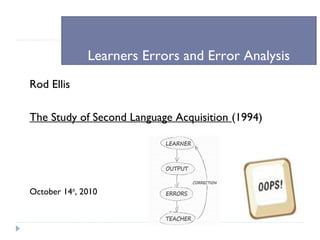
Learners Errors and Error Analysis
Rod Ellis
The Study of Second Language Acquisition (1994)
October 14th
, 2010
Learner errors and error analysis
 Human learning is fundamentally a process that involves the making
of mistakes.
 They form an important aspect of learning virtually any skill or
acquiring information.
 Language learning is like any other human learning.
 L2 learning is a process that is clearly not unlike L1 learning in its
trial-and-error nature. Inevitably, learners will make mistakes in the
process of acquisition, and that process will be impeded if they do
not commit errors and then benefit from various forms of feedback
on those errors.
 Corder (1967) noted: “a learner’s errors are significant in that they
provide to the researcher evidence of how language is learned or
acquired, what strategies or procedures the learner is employing in
the discovery of the language.”
Learner errors and error analysis
Errors produced by * L2 learner: “unwanted forms”
* Children: “transitional forms”
* Adult native speaker: “slips of the
tongue”
Learner errors and error analysis
 In order to analyze learner language in an appropriate
perspective, it is crucial to make a distinction between
mistakes and errors, technically two very different
phenomena.
 Mistake –refers to a performance error that is either a
random guess or a “slip”, in that is a failure to utilize a known
system correctly. Native speakers make mistakes. When
attention is called to them, they can be self-corrected.
 Error –a noticeable deviation from the adult grammar of a
native speaker, reflects the competence of the learner (Does
John can sing?)
Learner errors and error analysis
 The fact that learners do make errors, and these
errors can be analyzed, led to a surge of study of
learners’ errors, called error analysis.
 Error analysis became distinguished from contrastive
analysis by its examination of errors attributable to all
possible sources, not just those resulting from negative
transfer of the native language.
Learner errors and error analysis
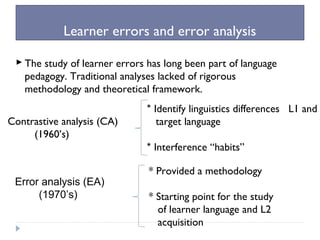
 The study of learner errors has long been part of language
pedagogy. Traditional analyses lacked of rigorous
methodology and theoretical framework.
Contrastive analysis (CA)
(1960’s)
Error analysis (EA)
(1970’s)
* Identify linguistics differences L1 and
target language
* Interference “habits”
* Provided a methodology
* Starting point for the study
of learner language and L2
acquisition
Learner errors and error analysis
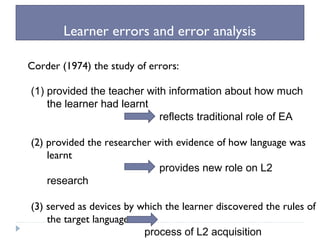
Corder (1974) the study of errors:
(1) provided the teacher with information about how much
the learner had learnt
reflects traditional role of EA
(2) provided the researcher with evidence of how language was
learnt
provides new role on L2
research
(3) served as devices by which the learner discovered the rules of
the target language
process of L2 acquisition
Learner errors and error analysis
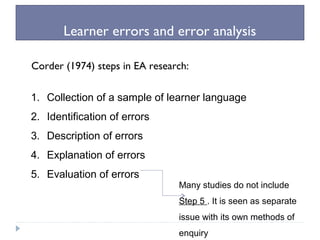
Corder (1974) steps in EA research:
1. Collection of a sample of learner language
2. Identification of errors
3. Description of errors
4. Explanation of errors
5. Evaluation of errors
Many studies do not include
Step 5 . It is seen as separate
issue with its own methods of
enquiry
Learner errors and error analysis
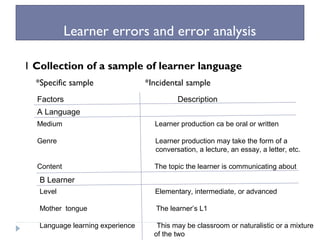
1 Collection of a sample of learner language
*Specific sample *Incidental sample
Factors Description
A Language
B Learner
Medium Learner production ca be oral or written
Genre Learner production may take the form of a
conversation, a lecture, an essay, a letter, etc.
Content The topic the learner is communicating about
Level Elementary, intermediate, or advanced
Mother tongue The learner’s L1
Language learning experience This may be classroom or naturalistic or a mixture
of the two
Learner errors and error analysis
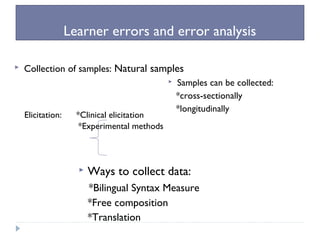
 Collection of samples: Natural samples
Elicitation: *Clinical elicitation
*Experimental methods
 Ways to collect data:
*Bilingual Syntax Measure
*Free composition
*Translation
 Samples can be collected:
*cross-sectionally
*longitudinally
Learner errors and error analysis
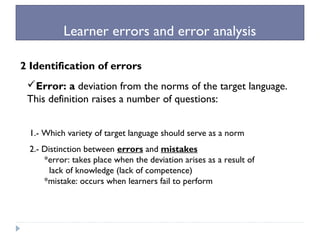
2 Identification of errors
Error: a deviation from the norms of the target language.
This definition raises a number of questions:
1.- Which variety of target language should serve as a norm
2.- Distinction between errors and mistakes
*error: takes place when the deviation arises as a result of
lack of knowledge (lack of competence)
*mistake: occurs when learners fail to perform
Learner errors and error analysis
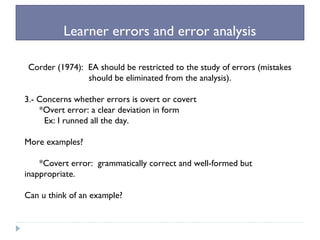
Corder (1974): EA should be restricted to the study of errors (mistakes
should be eliminated from the analysis).
3.- Concerns whether errors is overt or covert
*Overt error: a clear deviation in form
Ex: I runned all the day.
More examples?
*Covert error: grammatically correct and well-formed but
inappropriate.
Can u think of an example?
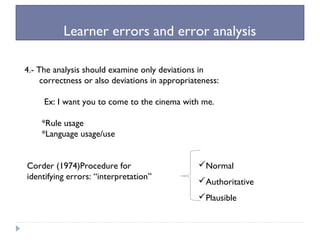
Learner errors and error analysis
4.- The analysis should examine only deviations in
correctness or also deviations in appropriateness:
Ex: I want you to come to the cinema with me.
*Rule usage
*Language usage/use
Corder (1974)Procedure for
identifying errors: “interpretation”
Normal
Authoritative
Plausible
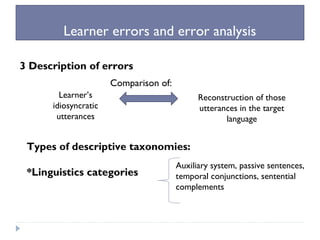
Learner errors and error analysis
3 Description of errors
Comparison of:
Learner’s
idiosyncratic
utterances
Reconstruction of those
utterances in the target
language
Types of descriptive taxonomies:
*Linguistics categories
Auxiliary system, passive sentences,
temporal conjunctions, sentential
complements
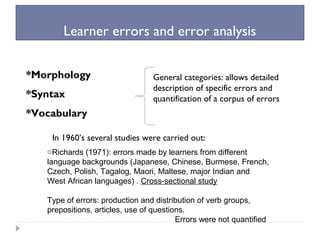
Learner errors and error analysis
*Morphology
*Syntax
*Vocabulary
General categories: allows detailed
description of specific errors and
quantification of a corpus of errors
In 1960’s several studies were carried out:
oRichards (1971): errors made by learners from different
language backgrounds (Japanese, Chinese, Burmese, French,
Czech, Polish, Tagalog, Maori, Maltese, major Indian and
West African languages) . Cross-sectional study
Type of errors: production and distribution of verb groups,
prepositions, articles, use of questions.
Errors were not quantified
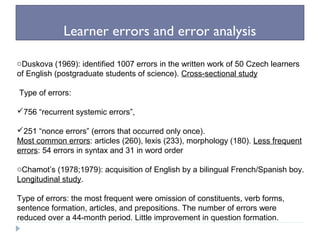
Learner errors and error analysis
oDuskova (1969): identified 1007 errors in the written work of 50 Czech learners
of English (postgraduate students of science). Cross-sectional study
Type of errors:
756 “recurrent systemic errors”,
251 “nonce errors” (errors that occurred only once).
Most common errors: articles (260), lexis (233), morphology (180). Less frequent
errors: 54 errors in syntax and 31 in word order
oChamot’s (1978;1979): acquisition of English by a bilingual French/Spanish boy.
Longitudinal study.
Type of errors: the most frequent were omission of constituents, verb forms,
sentence formation, articles, and prepositions. The number of errors were
reduced over a 44-month period. Little improvement in question formation.
Learner errors and error analysis
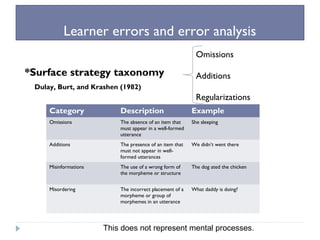
*Surface strategy taxonomy
Dulay, Burt, and Krashen (1982)
Omissions
Additions
Regularizations
Category Description Example
Omissions The absence of an item that
must appear in a well-formed
utterance
She sleeping
Additions The presence of an item that
must not appear in well-
formed utterances
We didn’t went there
Misinformations The use of a wrong form of
the morpheme or structure
The dog ated the chicken
Misordering The incorrect placement of a
morpheme or group of
morphemes in an utterance
What daddy is doing?
This does not represent mental processes.
Learner errors and error analysis
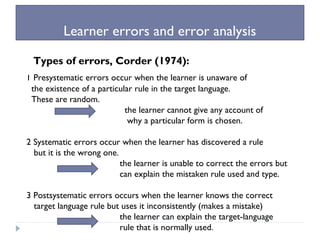
Types of errors, Corder (1974):
1 Presystematic errors occur when the learner is unaware of
the existence of a particular rule in the target language.
These are random.
the learner cannot give any account of
why a particular form is chosen.
2 Systematic errors occur when the learner has discovered a rule
but it is the wrong one.
the learner is unable to correct the errors but
can explain the mistaken rule used and type.
3 Postsystematic errors occurs when the learner knows the correct
target language rule but uses it inconsistently (makes a mistake)
the learner can explain the target-language
rule that is normally used.
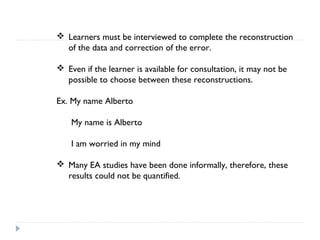
 Learners must be interviewed to complete the reconstruction
of the data and correction of the error.
 Even if the learner is available for consultation, it may not be
possible to choose between these reconstructions.
Ex. My name Alberto
My name is Alberto
I am worried in my mind
 Many EA studies have been done informally, therefore, these
results could not be quantified.
Learner errors and error analysis
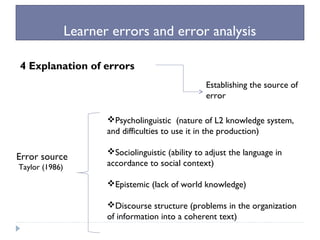
4 Explanation of errors
Establishing the source of
error
Error source
Taylor (1986)
Psycholinguistic (nature of L2 knowledge system,
and difficulties to use it in the production)
Sociolinguistic (ability to adjust the language in
accordance to social context)
Epistemic (lack of world knowledge)
Discourse structure (problems in the organization
of information into a coherent text)
Learner errors and error analysis
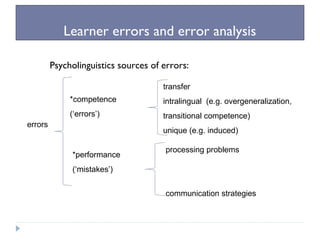
Psycholinguistics sources of errors:
errors
*competence
(‘errors’)
*performance
(‘mistakes’)
transfer
intralingual (e.g. overgeneralization,
transitional competence)
unique (e.g. induced)
processing problems
communication strategies
Learner errors and error analysis
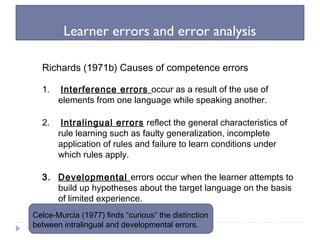
Richards (1971b) Causes of competence errors
1. Interference errors occur as a result of the use of
elements from one language while speaking another.
2. Intralingual errors reflect the general characteristics of
rule learning such as faulty generalization, incomplete
application of rules and failure to learn conditions under
which rules apply.
3. Developmental errors occur when the learner attempts to
build up hypotheses about the target language on the basis
of limited experience.
Celce-Murcia (1977) finds “curious” the distinction
between intralingual and developmental errors.
Learner errors and error analysis
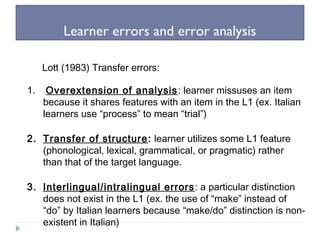
Lott (1983) Transfer errors:
1. Overextension of analysis: learner missuses an item
because it shares features with an item in the L1 (ex. Italian
learners use “process” to mean “trial”)
2. Transfer of structure: learner utilizes some L1 feature
(phonological, lexical, grammatical, or pragmatic) rather
than that of the target language.
3. Interlingual/intralingual errors: a particular distinction
does not exist in the L1 (ex. the use of “make” instead of
“do” by Italian learners because “make/do” distinction is non-
existent in Italian)
Learner errors and error analysis
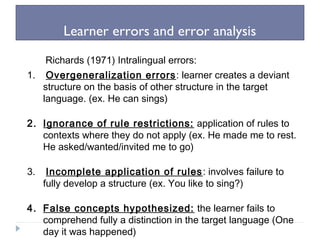
Richards (1971) Intralingual errors:
1. Overgeneralization errors: learner creates a deviant
structure on the basis of other structure in the target
language. (ex. He can sings)
2. Ignorance of rule restrictions: application of rules to
contexts where they do not apply (ex. He made me to rest.
He asked/wanted/invited me to go)
3. Incomplete application of rules: involves failure to
fully develop a structure (ex. You like to sing?)
4. False concepts hypothesized: the learner fails to
comprehend fully a distinction in the target language (One
day it was happened)
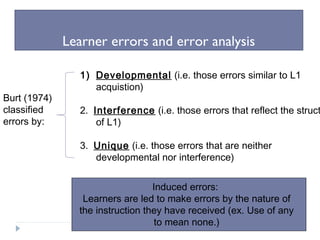
Learner errors and error analysis
Burt (1974)
classified
errors by:
1) Developmental (i.e. those errors similar to L1
acquistion)
2. Interference (i.e. those errors that reflect the struct
of L1)
3. Unique (i.e. those errors that are neither
developmental nor interference)
Induced errors:
Learners are led to make errors by the nature of
the instruction they have received (ex. Use of any
to mean none.)
Learner errors and error analysis
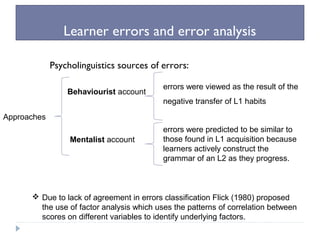
Psycholinguistics sources of errors:
Approaches
Behaviourist account
Mentalist account
errors were viewed as the result of the
negative transfer of L1 habits
errors were predicted to be similar to
those found in L1 acquisition because
learners actively construct the
grammar of an L2 as they progress.
 Due to lack of agreement in errors classification Flick (1980) proposed
the use of factor analysis which uses the patterns of correlation between
scores on different variables to identify underlying factors.
Learner errors and error analysis
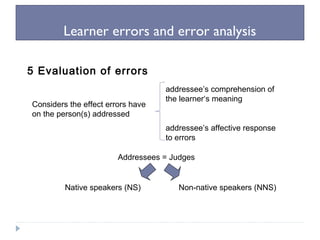
5 Evaluation of errors
Considers the effect errors have
on the person(s) addressed
addressee’s comprehension of
the learner‘s meaning
addressee’s affective response
to errors
Addressees = Judges
Native speakers (NS) Non-native speakers (NNS)
Learner errors and error analysis
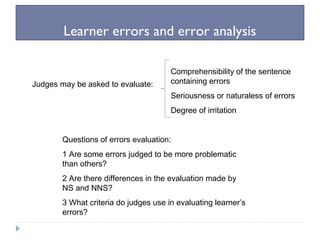
Judges may be asked to evaluate:
Comprehensibility of the sentence
containing errors
Seriousness or naturaless of errors
Degree of irritation
Questions of errors evaluation:
1 Are some errors judged to be more problematic
than others?
2 Are there differences in the evaluation made by
NS and NNS?
3 What criteria do judges use in evaluating learner’s
errors?
Learner errors and error analysis
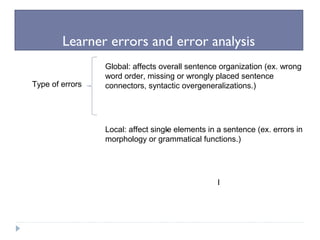
Type of errors
Global: affects overall sentence organization (ex. wrong
word order, missing or wrongly placed sentence
connectors, syntactic overgeneralizations.)
Local: affect single elements in a sentence (ex. errors in
morphology or grammatical functions.)
*
I
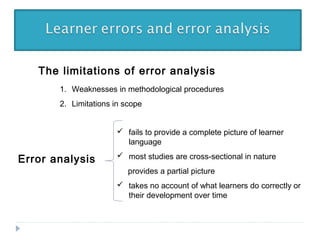
1. Weaknesses in methodological procedures
2. Limitations in scope
The limitations of error analysis
Error analysis
 fails to provide a complete picture of learner
language
 most studies are cross-sectional in nature
provides a partial picture
 takes no account of what learners do correctly or
their development over time
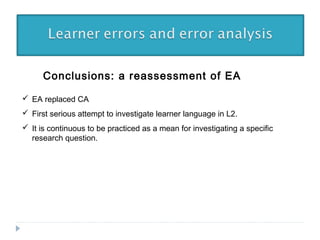
Conclusions: a reassessment of EA
 EA replaced CA
 First serious attempt to investigate learner language in L2.
 It is continuous to be practiced as a mean for investigating a specific
research question.
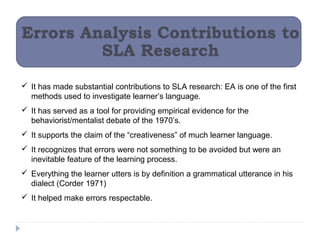
 It has made substantial contributions to SLA research: EA is one of the first
methods used to investigate learner’s language.
 It has served as a tool for providing empirical evidence for the
behaviorist/mentalist debate of the 1970’s.
 It supports the claim of the “creativeness” of much learner language.
 It recognizes that errors were not something to be avoided but were an
inevitable feature of the learning process.
 Everything the learner utters is by definition a grammatical utterance in his
dialect (Corder 1971)
 It helped make errors respectable.

Error. analysis

  • 1.
    Learners Errors andError Analysis Rod Ellis The Study of Second Language Acquisition (1994) October 14th , 2010
  • 2.
    Learner errors anderror analysis  Human learning is fundamentally a process that involves the making of mistakes.  They form an important aspect of learning virtually any skill or acquiring information.  Language learning is like any other human learning.  L2 learning is a process that is clearly not unlike L1 learning in its trial-and-error nature. Inevitably, learners will make mistakes in the process of acquisition, and that process will be impeded if they do not commit errors and then benefit from various forms of feedback on those errors.  Corder (1967) noted: “a learner’s errors are significant in that they provide to the researcher evidence of how language is learned or acquired, what strategies or procedures the learner is employing in the discovery of the language.”
  • 3.
    Learner errors anderror analysis Errors produced by * L2 learner: “unwanted forms” * Children: “transitional forms” * Adult native speaker: “slips of the tongue”
  • 4.
    Learner errors anderror analysis  In order to analyze learner language in an appropriate perspective, it is crucial to make a distinction between mistakes and errors, technically two very different phenomena.  Mistake –refers to a performance error that is either a random guess or a “slip”, in that is a failure to utilize a known system correctly. Native speakers make mistakes. When attention is called to them, they can be self-corrected.  Error –a noticeable deviation from the adult grammar of a native speaker, reflects the competence of the learner (Does John can sing?)
  • 5.
    Learner errors anderror analysis  The fact that learners do make errors, and these errors can be analyzed, led to a surge of study of learners’ errors, called error analysis.  Error analysis became distinguished from contrastive analysis by its examination of errors attributable to all possible sources, not just those resulting from negative transfer of the native language.
  • 6.
    Learner errors anderror analysis  The study of learner errors has long been part of language pedagogy. Traditional analyses lacked of rigorous methodology and theoretical framework. Contrastive analysis (CA) (1960’s) Error analysis (EA) (1970’s) * Identify linguistics differences L1 and target language * Interference “habits” * Provided a methodology * Starting point for the study of learner language and L2 acquisition
  • 7.
    Learner errors anderror analysis Corder (1974) the study of errors: (1) provided the teacher with information about how much the learner had learnt reflects traditional role of EA (2) provided the researcher with evidence of how language was learnt provides new role on L2 research (3) served as devices by which the learner discovered the rules of the target language process of L2 acquisition
  • 8.
    Learner errors anderror analysis Corder (1974) steps in EA research: 1. Collection of a sample of learner language 2. Identification of errors 3. Description of errors 4. Explanation of errors 5. Evaluation of errors Many studies do not include Step 5 . It is seen as separate issue with its own methods of enquiry
  • 9.
    Learner errors anderror analysis 1 Collection of a sample of learner language *Specific sample *Incidental sample Factors Description A Language B Learner Medium Learner production ca be oral or written Genre Learner production may take the form of a conversation, a lecture, an essay, a letter, etc. Content The topic the learner is communicating about Level Elementary, intermediate, or advanced Mother tongue The learner’s L1 Language learning experience This may be classroom or naturalistic or a mixture of the two
  • 10.
    Learner errors anderror analysis  Collection of samples: Natural samples Elicitation: *Clinical elicitation *Experimental methods  Ways to collect data: *Bilingual Syntax Measure *Free composition *Translation  Samples can be collected: *cross-sectionally *longitudinally
  • 11.
    Learner errors anderror analysis 2 Identification of errors Error: a deviation from the norms of the target language. This definition raises a number of questions: 1.- Which variety of target language should serve as a norm 2.- Distinction between errors and mistakes *error: takes place when the deviation arises as a result of lack of knowledge (lack of competence) *mistake: occurs when learners fail to perform
  • 12.
    Learner errors anderror analysis Corder (1974): EA should be restricted to the study of errors (mistakes should be eliminated from the analysis). 3.- Concerns whether errors is overt or covert *Overt error: a clear deviation in form Ex: I runned all the day. More examples? *Covert error: grammatically correct and well-formed but inappropriate. Can u think of an example?
  • 13.
    Learner errors anderror analysis 4.- The analysis should examine only deviations in correctness or also deviations in appropriateness: Ex: I want you to come to the cinema with me. *Rule usage *Language usage/use Corder (1974)Procedure for identifying errors: “interpretation” Normal Authoritative Plausible
  • 14.
    Learner errors anderror analysis 3 Description of errors Comparison of: Learner’s idiosyncratic utterances Reconstruction of those utterances in the target language Types of descriptive taxonomies: *Linguistics categories Auxiliary system, passive sentences, temporal conjunctions, sentential complements
  • 15.
    Learner errors anderror analysis *Morphology *Syntax *Vocabulary General categories: allows detailed description of specific errors and quantification of a corpus of errors In 1960’s several studies were carried out: oRichards (1971): errors made by learners from different language backgrounds (Japanese, Chinese, Burmese, French, Czech, Polish, Tagalog, Maori, Maltese, major Indian and West African languages) . Cross-sectional study Type of errors: production and distribution of verb groups, prepositions, articles, use of questions. Errors were not quantified
  • 16.
    Learner errors anderror analysis oDuskova (1969): identified 1007 errors in the written work of 50 Czech learners of English (postgraduate students of science). Cross-sectional study Type of errors: 756 “recurrent systemic errors”, 251 “nonce errors” (errors that occurred only once). Most common errors: articles (260), lexis (233), morphology (180). Less frequent errors: 54 errors in syntax and 31 in word order oChamot’s (1978;1979): acquisition of English by a bilingual French/Spanish boy. Longitudinal study. Type of errors: the most frequent were omission of constituents, verb forms, sentence formation, articles, and prepositions. The number of errors were reduced over a 44-month period. Little improvement in question formation.
  • 17.
    Learner errors anderror analysis *Surface strategy taxonomy Dulay, Burt, and Krashen (1982) Omissions Additions Regularizations Category Description Example Omissions The absence of an item that must appear in a well-formed utterance She sleeping Additions The presence of an item that must not appear in well- formed utterances We didn’t went there Misinformations The use of a wrong form of the morpheme or structure The dog ated the chicken Misordering The incorrect placement of a morpheme or group of morphemes in an utterance What daddy is doing? This does not represent mental processes.
  • 18.
    Learner errors anderror analysis Types of errors, Corder (1974): 1 Presystematic errors occur when the learner is unaware of the existence of a particular rule in the target language. These are random. the learner cannot give any account of why a particular form is chosen. 2 Systematic errors occur when the learner has discovered a rule but it is the wrong one. the learner is unable to correct the errors but can explain the mistaken rule used and type. 3 Postsystematic errors occurs when the learner knows the correct target language rule but uses it inconsistently (makes a mistake) the learner can explain the target-language rule that is normally used.
  • 19.
     Learners mustbe interviewed to complete the reconstruction of the data and correction of the error.  Even if the learner is available for consultation, it may not be possible to choose between these reconstructions. Ex. My name Alberto My name is Alberto I am worried in my mind  Many EA studies have been done informally, therefore, these results could not be quantified.
  • 20.
    Learner errors anderror analysis 4 Explanation of errors Establishing the source of error Error source Taylor (1986) Psycholinguistic (nature of L2 knowledge system, and difficulties to use it in the production) Sociolinguistic (ability to adjust the language in accordance to social context) Epistemic (lack of world knowledge) Discourse structure (problems in the organization of information into a coherent text)
  • 21.
    Learner errors anderror analysis Psycholinguistics sources of errors: errors *competence (‘errors’) *performance (‘mistakes’) transfer intralingual (e.g. overgeneralization, transitional competence) unique (e.g. induced) processing problems communication strategies
  • 22.
    Learner errors anderror analysis Richards (1971b) Causes of competence errors 1. Interference errors occur as a result of the use of elements from one language while speaking another. 2. Intralingual errors reflect the general characteristics of rule learning such as faulty generalization, incomplete application of rules and failure to learn conditions under which rules apply. 3. Developmental errors occur when the learner attempts to build up hypotheses about the target language on the basis of limited experience. Celce-Murcia (1977) finds “curious” the distinction between intralingual and developmental errors.
  • 23.
    Learner errors anderror analysis Lott (1983) Transfer errors: 1. Overextension of analysis: learner missuses an item because it shares features with an item in the L1 (ex. Italian learners use “process” to mean “trial”) 2. Transfer of structure: learner utilizes some L1 feature (phonological, lexical, grammatical, or pragmatic) rather than that of the target language. 3. Interlingual/intralingual errors: a particular distinction does not exist in the L1 (ex. the use of “make” instead of “do” by Italian learners because “make/do” distinction is non- existent in Italian)
  • 24.
    Learner errors anderror analysis Richards (1971) Intralingual errors: 1. Overgeneralization errors: learner creates a deviant structure on the basis of other structure in the target language. (ex. He can sings) 2. Ignorance of rule restrictions: application of rules to contexts where they do not apply (ex. He made me to rest. He asked/wanted/invited me to go) 3. Incomplete application of rules: involves failure to fully develop a structure (ex. You like to sing?) 4. False concepts hypothesized: the learner fails to comprehend fully a distinction in the target language (One day it was happened)
  • 25.
    Learner errors anderror analysis Burt (1974) classified errors by: 1) Developmental (i.e. those errors similar to L1 acquistion) 2. Interference (i.e. those errors that reflect the struct of L1) 3. Unique (i.e. those errors that are neither developmental nor interference) Induced errors: Learners are led to make errors by the nature of the instruction they have received (ex. Use of any to mean none.)
  • 26.
    Learner errors anderror analysis Psycholinguistics sources of errors: Approaches Behaviourist account Mentalist account errors were viewed as the result of the negative transfer of L1 habits errors were predicted to be similar to those found in L1 acquisition because learners actively construct the grammar of an L2 as they progress.  Due to lack of agreement in errors classification Flick (1980) proposed the use of factor analysis which uses the patterns of correlation between scores on different variables to identify underlying factors.
  • 27.
    Learner errors anderror analysis 5 Evaluation of errors Considers the effect errors have on the person(s) addressed addressee’s comprehension of the learner‘s meaning addressee’s affective response to errors Addressees = Judges Native speakers (NS) Non-native speakers (NNS)
  • 28.
    Learner errors anderror analysis Judges may be asked to evaluate: Comprehensibility of the sentence containing errors Seriousness or naturaless of errors Degree of irritation Questions of errors evaluation: 1 Are some errors judged to be more problematic than others? 2 Are there differences in the evaluation made by NS and NNS? 3 What criteria do judges use in evaluating learner’s errors?
  • 29.
    Learner errors anderror analysis Type of errors Global: affects overall sentence organization (ex. wrong word order, missing or wrongly placed sentence connectors, syntactic overgeneralizations.) Local: affect single elements in a sentence (ex. errors in morphology or grammatical functions.) * I
  • 30.
    1. Weaknesses inmethodological procedures 2. Limitations in scope The limitations of error analysis Error analysis  fails to provide a complete picture of learner language  most studies are cross-sectional in nature provides a partial picture  takes no account of what learners do correctly or their development over time
  • 31.
    Conclusions: a reassessmentof EA  EA replaced CA  First serious attempt to investigate learner language in L2.  It is continuous to be practiced as a mean for investigating a specific research question.
  • 32.
     It hasmade substantial contributions to SLA research: EA is one of the first methods used to investigate learner’s language.  It has served as a tool for providing empirical evidence for the behaviorist/mentalist debate of the 1970’s.  It supports the claim of the “creativeness” of much learner language.  It recognizes that errors were not something to be avoided but were an inevitable feature of the learning process.  Everything the learner utters is by definition a grammatical utterance in his dialect (Corder 1971)  It helped make errors respectable.

Editor's Notes

  • #11 Together, the Bilingual Syntax Measure (BSM) I and II offer a unified system for continuous assessment of oral proficiency in English and Spanish in children kind- grade 2