
SPEAKING
Discourse and Context in Language
Teaching Marianne Celce-Murcia and
Elite Olshtain
Chapter 9
Learning to speak a new
language
● The most difficult or the easiest skill?
❖listening comprehension and speech
production subskills.
❖body language, demonstration, and
repetition among other strategies.
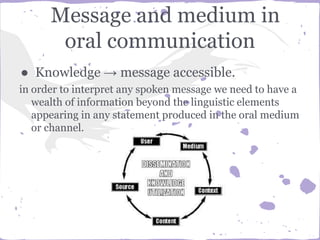
Message and medium in
oral communication
● Knowledge → message accessible.
in order to interpret any spoken message we need to have a
wealth of information beyond the linguistic elements
appearing in any statement produced in the oral medium
or channel.
Mismatches and
Misunderstanding causes
● The speaker produces unintelligible forms in
phonology, grammar, or lexical choice.
● The necessary background is not shared by
the speaker and hearer.
● The speaker and the hearer do not share
sociocultural rules of appropriacy.
How to ensure proper
interpretation?
● FACTORS OF FORM: linguistically
controlled, relate to the speaker´s
competence as well as to the possibility of
the faulty delivery of the spoken utterance.
● FACTORS OF APPROPRIACY:
pragmatically controlled by the speech
situation and by the prevailing cultural and
social forms.
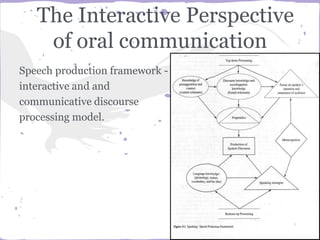
The Interactive Perspective
of oral communication
Speech production framework -
interactive and and
communicative discourse
processing model.
Choosing the Linguistic
Features
Spoken discourse* → grammatical competence
→ linguistic realization of the utterance.
a speaker moves from conceptualization of a message to the
capacity for performance.
Level of knowledge and the processing skill
→ interfere
→ facilitate
Contextual features → affects the efficacy of
communication.
(*)
Contextual factors in speech
production - LEVELT (1978)
● DEMAND: The amount of processing
required by a task. (complex sequence → repetition
of the basic information)
● AROUSAL: The speaker’s emotional and
cognitive response to a task. The importance
that the individual attaches to the
communicative interaction. (deeper
understanding of mutual expectations → how the
communicative exchange can be improved)
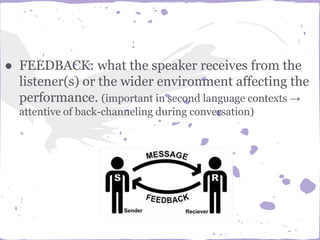
● FEEDBACK: what the speaker receives from the
listener(s) or the wider environment affecting the
performance. (important in second language contexts →
attentive of back-channeling during conversation)
 Question formation, word order, placing propper stress.
→ facilitate
→ hinder
❖ Speech production → sociocultural considerations.
Sociocultural norms may play a significant role in successful
interaction.
communication
McCarthy and Carter (1995)
● Colloquial speech has some unique language
features.
spoken =/= written
Grammatical features of spoken English:
❖pervasive ellipsis of subjects, predicates, and
auxiliary verbs.
❖an initial slot frame or introduce topics.
❖tails (or final slots) for amplification or
extension.
❖reporting verbs with past continuous tense.
Rules of Appropriacy
Sociocultural rules of appropriacy are viewed today as an
integral part of a person’s communicative competence.
Leech (1983:11)
PRAGMATICS → use and meaning of linguistic utterances.
↓
pragmalinguistics: use of language in context.
↓
sociopragmatics: societal rules of behaviour.
↓
SOCIOLINGUISTIC COMPETENCE
enables the speaker to produce utterances that are both
linguistically and pragmatically appropriate.
Pragmalinguistic and
Sociopragmatic Rules
1. characteristics of the individuals who take part in the
communicative exchange,
2. features of the situation in which this exchange takes
place,
3. the goal of the exchange, and
4. features of the communicative medium through which
the exchange is carried out.
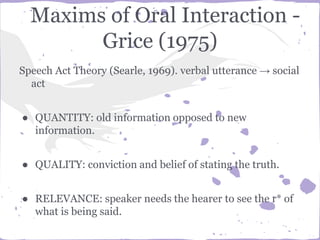
Maxims of Oral Interaction -
Grice (1975)
Speech Act Theory (Searle, 1969). verbal utterance → social
act
● QUANTITY: old information opposed to new
information.
● QUALITY: conviction and belief of stating the truth.
● RELEVANCE: speaker needs the hearer to see the r* of
what is being said.
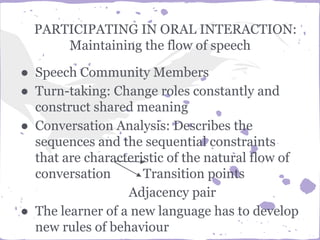
PARTICIPATING IN ORAL INTERACTION:
Maintaining the flow of speech
● Speech Community Members
● Turn-taking: Change roles constantly and
construct shared meaning
● Conversation Analysis: Describes the
sequences and the sequential constraints
that are characteristic of the natural flow of
conversation Transition points
Adjacency pair
● The learner of a new language has to develop
new rules of behaviour
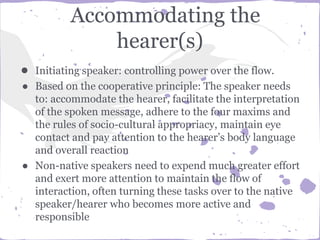
Accommodating the
hearer(s)
● Initiating speaker: controlling power over the flow.
● Based on the cooperative principle: The speaker needs
to: accommodate the hearer, facilitate the interpretation
of the spoken message, adhere to the four maxims and
the rules of socio-cultural appropriacy, maintain eye
contact and pay attention to the hearer’s body language
and overall reaction
● Non-native speakers need to expend much greater effort
and exert more attention to maintain the flow of
interaction, often turning these tasks over to the native
speaker/hearer who becomes more active and
responsible
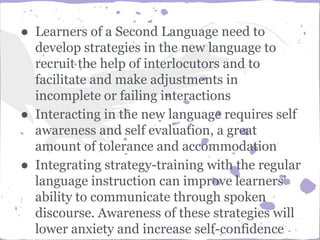
● Learners of a Second Language need to
develop strategies in the new language to
recruit the help of interlocutors and to
facilitate and make adjustments in
incomplete or failing interactions
● Interacting in the new language requires self
awareness and self evaluation, a great
amount of tolerance and accommodation
● Integrating strategy-training with the regular
language instruction can improve learners’
ability to communicate through spoken
discourse. Awareness of these strategies will
lower anxiety and increase self-confidence
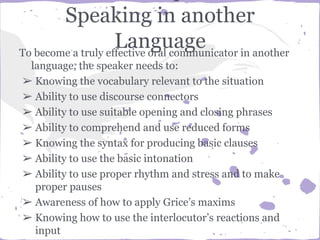
Speaking in another
LanguageTo become a truly effective oral communicator in another
language, the speaker needs to:
➢ Knowing the vocabulary relevant to the situation
➢ Ability to use discourse connectors
➢ Ability to use suitable opening and closing phrases
➢ Ability to comprehend and use reduced forms
➢ Knowing the syntax for producing basic clauses
➢ Ability to use the basic intonation
➢ Ability to use proper rhythm and stress and to make
proper pauses
➢ Awareness of how to apply Grice’s maxims
➢ Knowing how to use the interlocutor’s reactions and
input
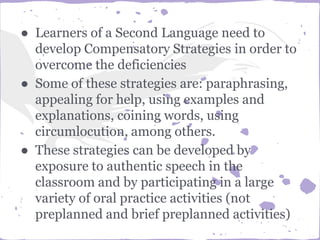
● Learners of a Second Language need to
develop Compensatory Strategies in order to
overcome the deficiencies
● Some of these strategies are: paraphrasing,
appealing for help, using examples and
explanations, coining words, using
circumlocution, among others.
● These strategies can be developed by
exposure to authentic speech in the
classroom and by participating in a large
variety of oral practice activities (not
preplanned and brief preplanned activities)
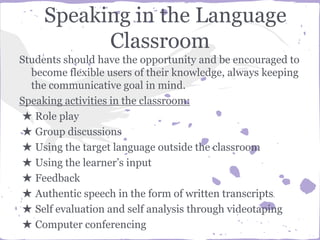
Speaking in the Language
Classroom
Students should have the opportunity and be encouraged to
become flexible users of their knowledge, always keeping
the communicative goal in mind.
Speaking activities in the classroom:
★ Role play
★ Group discussions
★ Using the target language outside the classroom
★ Using the learner’s input
★ Feedback
★ Authentic speech in the form of written transcripts
★ Self evaluation and self analysis through videotaping
★ Computer conferencing
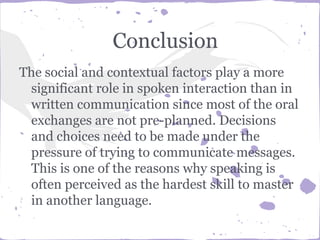
Conclusion
The social and contextual factors play a more
significant role in spoken interaction than in
written communication since most of the oral
exchanges are not pre-planned. Decisions
and choices need to be made under the
pressure of trying to communicate messages.
This is one of the reasons why speaking is
often perceived as the hardest skill to master
in another language.

Isfd 41 chapter 9 speaking

  • 1.
    SPEAKING Discourse and Contextin Language Teaching Marianne Celce-Murcia and Elite Olshtain Chapter 9
  • 2.
    Learning to speaka new language ● The most difficult or the easiest skill? ❖listening comprehension and speech production subskills. ❖body language, demonstration, and repetition among other strategies.
  • 3.
    Message and mediumin oral communication ● Knowledge → message accessible. in order to interpret any spoken message we need to have a wealth of information beyond the linguistic elements appearing in any statement produced in the oral medium or channel.
  • 4.
    Mismatches and Misunderstanding causes ●The speaker produces unintelligible forms in phonology, grammar, or lexical choice. ● The necessary background is not shared by the speaker and hearer. ● The speaker and the hearer do not share sociocultural rules of appropriacy.
  • 5.
    How to ensureproper interpretation? ● FACTORS OF FORM: linguistically controlled, relate to the speaker´s competence as well as to the possibility of the faulty delivery of the spoken utterance. ● FACTORS OF APPROPRIACY: pragmatically controlled by the speech situation and by the prevailing cultural and social forms.
  • 6.
    The Interactive Perspective oforal communication Speech production framework - interactive and and communicative discourse processing model.
  • 7.
    Choosing the Linguistic Features Spokendiscourse* → grammatical competence → linguistic realization of the utterance. a speaker moves from conceptualization of a message to the capacity for performance. Level of knowledge and the processing skill → interfere → facilitate Contextual features → affects the efficacy of communication. (*)
  • 8.
    Contextual factors inspeech production - LEVELT (1978) ● DEMAND: The amount of processing required by a task. (complex sequence → repetition of the basic information) ● AROUSAL: The speaker’s emotional and cognitive response to a task. The importance that the individual attaches to the communicative interaction. (deeper understanding of mutual expectations → how the communicative exchange can be improved)
  • 9.
    ● FEEDBACK: whatthe speaker receives from the listener(s) or the wider environment affecting the performance. (important in second language contexts → attentive of back-channeling during conversation)
  • 10.
     Question formation,word order, placing propper stress. → facilitate → hinder ❖ Speech production → sociocultural considerations. Sociocultural norms may play a significant role in successful interaction. communication
  • 11.
    McCarthy and Carter(1995) ● Colloquial speech has some unique language features. spoken =/= written Grammatical features of spoken English: ❖pervasive ellipsis of subjects, predicates, and auxiliary verbs. ❖an initial slot frame or introduce topics. ❖tails (or final slots) for amplification or extension. ❖reporting verbs with past continuous tense.
  • 12.
    Rules of Appropriacy Socioculturalrules of appropriacy are viewed today as an integral part of a person’s communicative competence. Leech (1983:11) PRAGMATICS → use and meaning of linguistic utterances. ↓ pragmalinguistics: use of language in context. ↓ sociopragmatics: societal rules of behaviour. ↓ SOCIOLINGUISTIC COMPETENCE enables the speaker to produce utterances that are both linguistically and pragmatically appropriate.
  • 13.
    Pragmalinguistic and Sociopragmatic Rules 1.characteristics of the individuals who take part in the communicative exchange, 2. features of the situation in which this exchange takes place, 3. the goal of the exchange, and 4. features of the communicative medium through which the exchange is carried out.
  • 14.
    Maxims of OralInteraction - Grice (1975) Speech Act Theory (Searle, 1969). verbal utterance → social act ● QUANTITY: old information opposed to new information. ● QUALITY: conviction and belief of stating the truth. ● RELEVANCE: speaker needs the hearer to see the r* of what is being said.
  • 15.
    PARTICIPATING IN ORALINTERACTION: Maintaining the flow of speech ● Speech Community Members ● Turn-taking: Change roles constantly and construct shared meaning ● Conversation Analysis: Describes the sequences and the sequential constraints that are characteristic of the natural flow of conversation Transition points Adjacency pair ● The learner of a new language has to develop new rules of behaviour
  • 16.
    Accommodating the hearer(s) ● Initiatingspeaker: controlling power over the flow. ● Based on the cooperative principle: The speaker needs to: accommodate the hearer, facilitate the interpretation of the spoken message, adhere to the four maxims and the rules of socio-cultural appropriacy, maintain eye contact and pay attention to the hearer’s body language and overall reaction ● Non-native speakers need to expend much greater effort and exert more attention to maintain the flow of interaction, often turning these tasks over to the native speaker/hearer who becomes more active and responsible
  • 17.
    ● Learners ofa Second Language need to develop strategies in the new language to recruit the help of interlocutors and to facilitate and make adjustments in incomplete or failing interactions ● Interacting in the new language requires self awareness and self evaluation, a great amount of tolerance and accommodation ● Integrating strategy-training with the regular language instruction can improve learners’ ability to communicate through spoken discourse. Awareness of these strategies will lower anxiety and increase self-confidence
  • 18.
    Speaking in another LanguageTobecome a truly effective oral communicator in another language, the speaker needs to: ➢ Knowing the vocabulary relevant to the situation ➢ Ability to use discourse connectors ➢ Ability to use suitable opening and closing phrases ➢ Ability to comprehend and use reduced forms ➢ Knowing the syntax for producing basic clauses ➢ Ability to use the basic intonation ➢ Ability to use proper rhythm and stress and to make proper pauses ➢ Awareness of how to apply Grice’s maxims ➢ Knowing how to use the interlocutor’s reactions and input
  • 19.
    ● Learners ofa Second Language need to develop Compensatory Strategies in order to overcome the deficiencies ● Some of these strategies are: paraphrasing, appealing for help, using examples and explanations, coining words, using circumlocution, among others. ● These strategies can be developed by exposure to authentic speech in the classroom and by participating in a large variety of oral practice activities (not preplanned and brief preplanned activities)
  • 20.
    Speaking in theLanguage Classroom Students should have the opportunity and be encouraged to become flexible users of their knowledge, always keeping the communicative goal in mind. Speaking activities in the classroom: ★ Role play ★ Group discussions ★ Using the target language outside the classroom ★ Using the learner’s input ★ Feedback ★ Authentic speech in the form of written transcripts ★ Self evaluation and self analysis through videotaping ★ Computer conferencing
  • 21.
    Conclusion The social andcontextual factors play a more significant role in spoken interaction than in written communication since most of the oral exchanges are not pre-planned. Decisions and choices need to be made under the pressure of trying to communicate messages. This is one of the reasons why speaking is often perceived as the hardest skill to master in another language.