Error Analysis
The study of
learners’interlanguage
Brown (2000)
outline
Introduction
How to detect learner’s interlanguage
What is the difference btw an error and a
mistake
Procedures of error analysis
Stages of errors
Sources of errors
Communication strategies
conclusion
Introduction
The contrastive analysis hypothesis
emphasized the interfering effects of the 1st
language acquisition with the 2nd
language
learning. However, the CAH has ignored,
according to brown, the “Intralingual”
effects of learning. He highlighted that 2nd
LL is a “creative process” which build a
legitimate system in which the learner
consciously tests hypotheses about the
target language from a range of different
sources of knowledge:
Knowledge of the target language
Knowledge about the communicative
function of language
Knowledge about language in general
Knowledge about life, human beings
and universe
In the 60s, researches of second
language learning concluded that
students, through repeated process
of trial and error and hypotheses,
succeed in establishing a closer
approximation to the rules|sytems
used by native speakers of a
language.
The process of interfering 2nd
LL WITH
1ST
LA has been described by Selinker
(1972) as “interlanguage”
Corder (1971), on the other hand, clarified
that learning a language is particular to a
specific individual in the sense that the
learner forms his/her own “self contained
linguistic system”; mainly referred to as
“idiosyncratic dialect”.
In the 70s, researchers and teachers of 2nd
LL focused on the “interlanguage
hypotheses” which is derived from the
shackles of the CAH.
How to detect learners’
interlanguage
Learner’s speech → production data
The learner’s speech, as an
observable data, reflects and
underlines the learner’s competence-
production competence.
Learner’s speech helps teachers to
detect errors and gives them
information about the system of the
target language which the learner has
already acquired.
Error analysis
Errors are fundamentally considered
as a means to learn skills and acquire
information. 2nd
LL is not different from
1ST
LA in the sense of its trial-and error
nature.
Through errors and mistakes,
teachers are capable to define
possible keys to understand how 2nd
LL functions:
“ A learner’s errors….are significant in
that they provide to the researcher
evidence of how language is learned
or acquired, what strategies or
procedures the learner is employing
in the discovery of the language”
(Corder, 1967: 167)
What is the difference between
an error and a mistake?
Errors and mistakes are technically 2
different phenomenon:
A mistake refers to “ a performance error
that is either a random guess or a “slip”,
in that it is a failure to utilize a known
system correctly” (Brown: 165)
An error is a “noticeable deviation from
the adult grammar of a native speaker,
reflecting the interlanguage competence
of the learner” (Ibid).
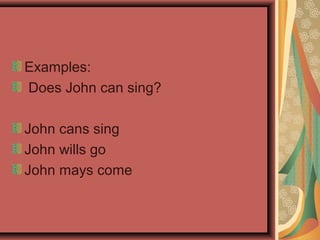
Examples:
Does John can sing?
John cans sing
John wills go
John mays come
Error analysis is distinguished from
contrastive analysis due to its examination
of errors attributable to all possible
sources. It doesn’t deal only with errors
that result from negative transfer of the
native language but also from other
possible sources such as :interlingual
errors within the target language, the
sociolinguistic context of communication,
psycholinguistic or cognitive strategies and
other affective variables.
Procedures of error analysis
One of the main difficulties in
understanding the linguistic system of
1st
LA and 2nd
LL is the instability and
unpredictability of learner’s system.
Through frequent observations of
learners, teachers and researches
notice a certain paradoxical use of
linguistic systems by learners.
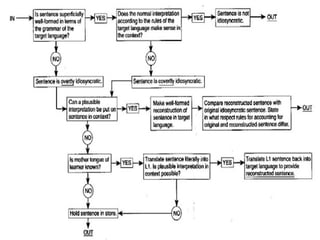
1. Identifying errors:
Corder (1971) provided a model of
identifying errors in a 2nd
LL
 Overt errors: errors that are
unquestionably ungrammatical
 Covert errors: errors that are
grammatically well formed but not
interpretable within the normal
content of communication
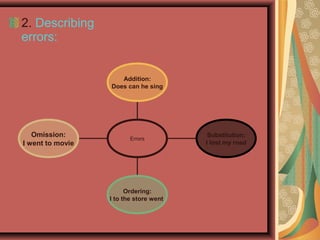
2. Describing
errors:
Omission:
I went to movie
Ordering:
I to the store went
Substitution:
I lost my road
Addition:
Does can he sing
Errors
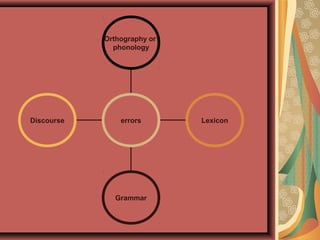
Discourse
Grammar
Lexicon
Orthography or
phonology
errors
Stages of errors
Presystematic stage: the stage in which the
learner is only vaguely aware that there is some
systematic order to a particular class of order.
There is a partial consistency because the learner
is not able yet to correct his error nor to explain it
Systematic stage: at this stage, the learner has
begun to discern a system, to be consistent and to
exhibit consistent errors that indicate his
internalization of rules even incorrect. The learner
cannot explain his error but provide different
wording or structures to clarify what he means:
Example:
-Learner: I lost my road
-Native speaker: what?
-L: I lost my road
-NS: you lost your road?
-L: ahhh…uhh… I lost myself….i got lost
-Ns: oh you lost your way
-L: oh yes I lost my way
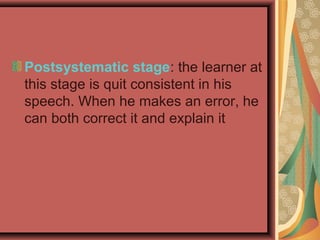
Postsystematic stage: the learner at
this stage is quit consistent in his
speech. When he makes an error, he
can both correct it and explain it
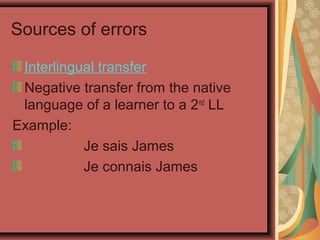
Sources of errors
Interlingual transfer
Negative transfer from the native
language of a learner to a 2nd
LL
Example:
Je sais James
Je connais James
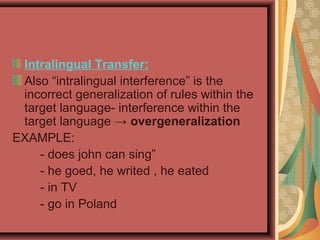
Intralingual Transfer:
Also “intralingual interference” is the
incorrect generalization of rules within the
target language- interference within the
target language → overgeneralization
EXAMPLE:
- does john can sing”
- he goed, he writed , he eated
- in TV
- go in Poland
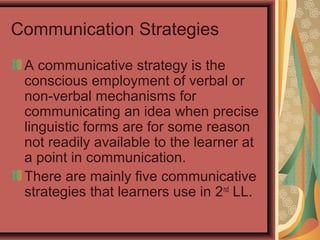
Communication Strategies
A communicative strategy is the
conscious employment of verbal or
non-verbal mechanisms for
communicating an idea when precise
linguistic forms are for some reason
not readily available to the learner at
a point in communication.
There are mainly five communicative
strategies that learners use in 2nd
LL.
I.I. Avoidance:Avoidance:
A syntactic or lexical avoidance
within a semantic category
Example: I lost my road
Phonological avoidance
Topic avoidance
II Prefabricated patterns:
Memorization of certain stock
phrases or sentences without
internalized knowledge of the
components of the phrase.
Hakuta (1976:333) described
prefabricated patterns as storing
phrases in a large lexical items.
III Cognitive and personality style
Personality style or style of thinking can be a
source of error.
A person with high self-esteem may provide lot of
errors since he does not feel threatened by
committing errors as a person of low self-esteem.
Such errors appear at the level of discourse
example:
- I drove my bicycle
- I pedaled my bicycle.
IV Appeal to authority
A learner may appeal the authority of
a native speaker or a teacher to
speak properly for the form of (how
do you say-----?).
To look up a word in bilingual
dictionary
V Language Switch
When the learner fails to come up
with a sentence, he resorts to
language switch. He simply uses his
native language slipping from time to
time in the hope that the hearer gets
the gist of what he tries to
communicate
Conclusion
Limitations of error analysis
Despite the importance of error analysis,
placing too much attention on errors is not
all the time required. Brown highlighted that
teachers should also give value to the
positive reinforcement of clear and free
communication.
He added that the main purpose of 2nd
LL is
to attain a communicative fluency in a
language.
Error analysis stresses data
production. Yet, speaking and
listening, writing and reading are all
required in 2nd
LL
The comprehension of language is
also important as speaking a
language
Error analysis

Error analysis

  • 1.
    Error Analysis The studyof learners’interlanguage Brown (2000)
  • 2.
    outline Introduction How to detectlearner’s interlanguage What is the difference btw an error and a mistake Procedures of error analysis Stages of errors Sources of errors Communication strategies conclusion
  • 3.
    Introduction The contrastive analysishypothesis emphasized the interfering effects of the 1st language acquisition with the 2nd language learning. However, the CAH has ignored, according to brown, the “Intralingual” effects of learning. He highlighted that 2nd LL is a “creative process” which build a legitimate system in which the learner consciously tests hypotheses about the target language from a range of different sources of knowledge:
  • 4.
    Knowledge of thetarget language Knowledge about the communicative function of language Knowledge about language in general Knowledge about life, human beings and universe
  • 5.
    In the 60s,researches of second language learning concluded that students, through repeated process of trial and error and hypotheses, succeed in establishing a closer approximation to the rules|sytems used by native speakers of a language. The process of interfering 2nd LL WITH 1ST LA has been described by Selinker (1972) as “interlanguage”
  • 6.
    Corder (1971), onthe other hand, clarified that learning a language is particular to a specific individual in the sense that the learner forms his/her own “self contained linguistic system”; mainly referred to as “idiosyncratic dialect”. In the 70s, researchers and teachers of 2nd LL focused on the “interlanguage hypotheses” which is derived from the shackles of the CAH.
  • 7.
    How to detectlearners’ interlanguage Learner’s speech → production data The learner’s speech, as an observable data, reflects and underlines the learner’s competence- production competence. Learner’s speech helps teachers to detect errors and gives them information about the system of the target language which the learner has already acquired.
  • 8.
    Error analysis Errors arefundamentally considered as a means to learn skills and acquire information. 2nd LL is not different from 1ST LA in the sense of its trial-and error nature. Through errors and mistakes, teachers are capable to define possible keys to understand how 2nd LL functions:
  • 9.
    “ A learner’serrors….are significant in that they provide to the researcher evidence of how language is learned or acquired, what strategies or procedures the learner is employing in the discovery of the language” (Corder, 1967: 167)
  • 10.
    What is thedifference between an error and a mistake? Errors and mistakes are technically 2 different phenomenon: A mistake refers to “ a performance error that is either a random guess or a “slip”, in that it is a failure to utilize a known system correctly” (Brown: 165) An error is a “noticeable deviation from the adult grammar of a native speaker, reflecting the interlanguage competence of the learner” (Ibid).
  • 11.
    Examples: Does John cansing? John cans sing John wills go John mays come
  • 12.
    Error analysis isdistinguished from contrastive analysis due to its examination of errors attributable to all possible sources. It doesn’t deal only with errors that result from negative transfer of the native language but also from other possible sources such as :interlingual errors within the target language, the sociolinguistic context of communication, psycholinguistic or cognitive strategies and other affective variables.
  • 13.
    Procedures of erroranalysis One of the main difficulties in understanding the linguistic system of 1st LA and 2nd LL is the instability and unpredictability of learner’s system. Through frequent observations of learners, teachers and researches notice a certain paradoxical use of linguistic systems by learners.
  • 14.
    1. Identifying errors: Corder(1971) provided a model of identifying errors in a 2nd LL  Overt errors: errors that are unquestionably ungrammatical  Covert errors: errors that are grammatically well formed but not interpretable within the normal content of communication
  • 16.
    2. Describing errors: Omission: I wentto movie Ordering: I to the store went Substitution: I lost my road Addition: Does can he sing Errors
  • 17.
  • 18.
    Stages of errors Presystematicstage: the stage in which the learner is only vaguely aware that there is some systematic order to a particular class of order. There is a partial consistency because the learner is not able yet to correct his error nor to explain it Systematic stage: at this stage, the learner has begun to discern a system, to be consistent and to exhibit consistent errors that indicate his internalization of rules even incorrect. The learner cannot explain his error but provide different wording or structures to clarify what he means:
  • 19.
    Example: -Learner: I lostmy road -Native speaker: what? -L: I lost my road -NS: you lost your road? -L: ahhh…uhh… I lost myself….i got lost -Ns: oh you lost your way -L: oh yes I lost my way
  • 20.
    Postsystematic stage: thelearner at this stage is quit consistent in his speech. When he makes an error, he can both correct it and explain it
  • 21.
    Sources of errors Interlingualtransfer Negative transfer from the native language of a learner to a 2nd LL Example: Je sais James Je connais James
  • 22.
    Intralingual Transfer: Also “intralingualinterference” is the incorrect generalization of rules within the target language- interference within the target language → overgeneralization EXAMPLE: - does john can sing” - he goed, he writed , he eated - in TV - go in Poland
  • 23.
    Communication Strategies A communicativestrategy is the conscious employment of verbal or non-verbal mechanisms for communicating an idea when precise linguistic forms are for some reason not readily available to the learner at a point in communication. There are mainly five communicative strategies that learners use in 2nd LL.
  • 24.
    I.I. Avoidance:Avoidance: A syntacticor lexical avoidance within a semantic category Example: I lost my road Phonological avoidance Topic avoidance
  • 25.
    II Prefabricated patterns: Memorizationof certain stock phrases or sentences without internalized knowledge of the components of the phrase. Hakuta (1976:333) described prefabricated patterns as storing phrases in a large lexical items.
  • 26.
    III Cognitive andpersonality style Personality style or style of thinking can be a source of error. A person with high self-esteem may provide lot of errors since he does not feel threatened by committing errors as a person of low self-esteem. Such errors appear at the level of discourse example: - I drove my bicycle - I pedaled my bicycle.
  • 27.
    IV Appeal toauthority A learner may appeal the authority of a native speaker or a teacher to speak properly for the form of (how do you say-----?). To look up a word in bilingual dictionary
  • 28.
    V Language Switch Whenthe learner fails to come up with a sentence, he resorts to language switch. He simply uses his native language slipping from time to time in the hope that the hearer gets the gist of what he tries to communicate
  • 29.
    Conclusion Limitations of erroranalysis Despite the importance of error analysis, placing too much attention on errors is not all the time required. Brown highlighted that teachers should also give value to the positive reinforcement of clear and free communication. He added that the main purpose of 2nd LL is to attain a communicative fluency in a language.
  • 30.
    Error analysis stressesdata production. Yet, speaking and listening, writing and reading are all required in 2nd LL The comprehension of language is also important as speaking a language