A Presentation by Dhanya Vijay. P.V
Noam Chomsky was an American linguist,
philosopher, cognitive scientist, logician,
political commentator and activist.
He is also known as the “father of modern
linguistics.”
Chomsky is of the view that children are
born with an innate propensity for language
acquisition, and that this ability makes the task
of learning a first language easier than it
would otherwise be.
The human brain is ready naturally for language in
the sense when children are exposed to speech,
certain general principles for discovering or
structuring language automatically begin to operate.
Chomsky originally theorized that children were
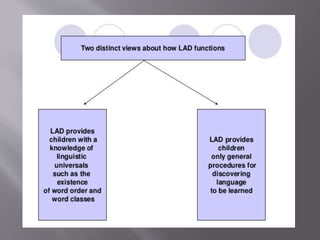
born with a hardwired language acquisition
device(LAD) in their brains. He later expanded this
idea into that of Universal Grammar, a set of innate
principles and adjustable parameters that is common
to all languages.
The LAD is activated when the child enters the
world.
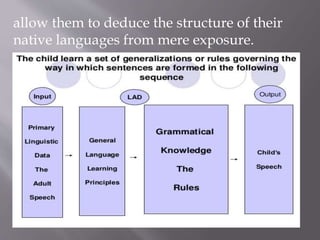
The child exploits its LAD to make sense of
the utterances heard around it, deriving from
this ‘primary linguistic data’- the grammar of
the language.
LAD is exploited to explain the remarkable
speed with which children learn to speak, and
the considerable similarity in the way
grammatical patterns are acquired across
different children and languages.
According to Chomsky, the presence of
Universal Grammar in the brains of children
allow them to deduce the structure of their
native languages from mere exposure.
Universal Grammar:
According to Chomsky UG focuses to
answer three basic questions about human
language:
1. What constitutes knowledge of language?
2. How knowledge of language is acquired?
3. How is knowledge of language put to use?
Answers for 1 and 2:
UG claims that, a set of principles and
parameters of grammar is inherited
genetically by all human beings.
Chomsky’s proposed principles are
unvarying and apply to all human languages
similar to one another.
The biologically endowed UG equip the
children naturally with a clear set of
expectations about the shape of the language .
It also helps the child to construct an
internalized grammar quickly when they are
exposed to a particular language.
Competence and Performance:
Linguistic competence is concerned with the
child’s grammar, the linguistic input and
construction of the grammatical structures.
Performance deals with the nature of child’s
rule system; the psychological processes the
child uses in learning the language.
Criticism of Universal Grammar:
Primary concern of UG is only syntax.
Semantics, Pragmatics and Discourse are
completely excluded.
Social and psychological variables are
ignored.
LAD

LAD

  • 2.
    A Presentation byDhanya Vijay. P.V
  • 3.
    Noam Chomsky wasan American linguist, philosopher, cognitive scientist, logician, political commentator and activist. He is also known as the “father of modern linguistics.” Chomsky is of the view that children are born with an innate propensity for language acquisition, and that this ability makes the task of learning a first language easier than it would otherwise be.
  • 4.
    The human brainis ready naturally for language in the sense when children are exposed to speech, certain general principles for discovering or structuring language automatically begin to operate. Chomsky originally theorized that children were born with a hardwired language acquisition device(LAD) in their brains. He later expanded this idea into that of Universal Grammar, a set of innate principles and adjustable parameters that is common to all languages. The LAD is activated when the child enters the world.
  • 5.
    The child exploitsits LAD to make sense of the utterances heard around it, deriving from this ‘primary linguistic data’- the grammar of the language. LAD is exploited to explain the remarkable speed with which children learn to speak, and the considerable similarity in the way grammatical patterns are acquired across different children and languages. According to Chomsky, the presence of Universal Grammar in the brains of children
  • 6.
    allow them todeduce the structure of their native languages from mere exposure.
  • 8.
    Universal Grammar: According toChomsky UG focuses to answer three basic questions about human language: 1. What constitutes knowledge of language? 2. How knowledge of language is acquired? 3. How is knowledge of language put to use? Answers for 1 and 2: UG claims that, a set of principles and parameters of grammar is inherited genetically by all human beings.
  • 9.
    Chomsky’s proposed principlesare unvarying and apply to all human languages similar to one another. The biologically endowed UG equip the children naturally with a clear set of expectations about the shape of the language . It also helps the child to construct an internalized grammar quickly when they are exposed to a particular language.
  • 10.
    Competence and Performance: Linguisticcompetence is concerned with the child’s grammar, the linguistic input and construction of the grammatical structures. Performance deals with the nature of child’s rule system; the psychological processes the child uses in learning the language.
  • 11.
    Criticism of UniversalGrammar: Primary concern of UG is only syntax. Semantics, Pragmatics and Discourse are completely excluded. Social and psychological variables are ignored.