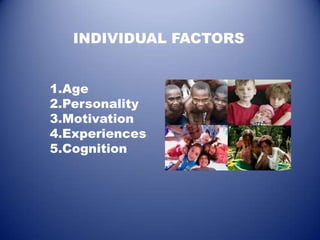
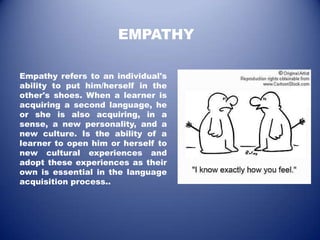
This document discusses factors that affect second language acquisition. It examines both individual factors like age, personality, motivation, experiences, and cognition, as well as affective factors including self-esteem, inhibition, risk-taking, anxiety, and empathy. For individual factors, it suggests that younger learners generally acquire a second language more efficiently, while motivated older learners can also be successful. Outgoing learners with more life experiences tend to progress faster than introverted learners or those without experiences. Higher motivation and cognitive ability also contribute to stronger second language acquisition. Regarding affective factors, low self-esteem, inhibition to take risks, and anxiety can negatively impact learning, while empathy and a willingness to take chances












![REFERENCES
Schütz, R. (2007) . Stephen Krashen's Theory of Second Language
Acquisition [Document Online] Available : http://www.sk.com.br/sk-
krash.html [Consulted : 2012, June, 30]
Inter American University of Puerto Rico (n.d.) Psycholinguistic and
Affective Factors. [Document Online] Available :
http://ocw.inter.edu:8080/eduCommons/ingles/english-fundamentals-of-
second-language-acquisition/modules/unit-6-psycholinguistic-and-
affective-factors [Consulted : 2012,June, 30]
Universidad de Jaen. (n.d.) . Factors affecting L2 learning [Document
Online] Available: Factors affecting L2 learning [Consulted : 2012,June,
30]](https://image.slidesharecdn.com/factorsaffectingsecondlanguageacquisition-120706013447-phpapp01/85/Factors-affecting-second-language-acquisition-15-320.jpg)


![Getting Started with Apache Spark: Big Data Made Simple [Free Meetup]](https://cdn.slidesharecdn.com/ss_thumbnails/apachesparkgettingstarted-260203175547-8361bcc3-thumbnail.jpg?width=640&height=640&fit=bounds)


