



A Research Agenda for LESLLA/A Second Language AcquisitionMartha BigelowElaine TaroneUniversity of Minnesota
An Ecology of SLA Research
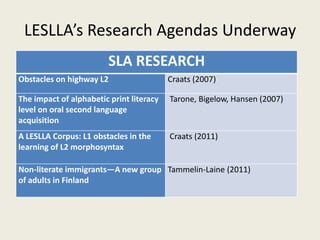
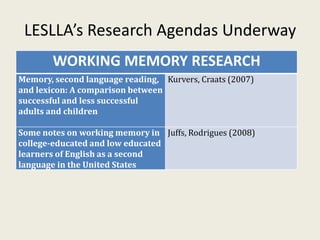
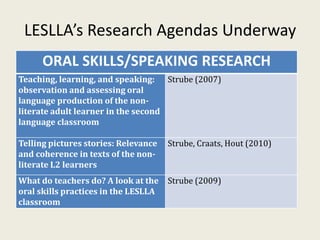
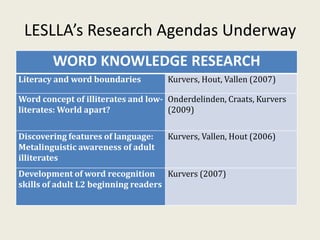
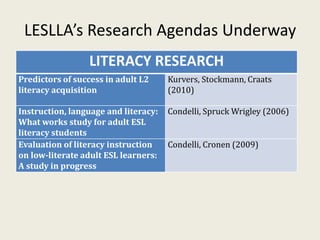
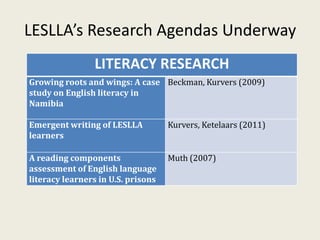
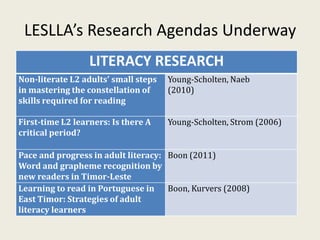
LESLLA’s Research Agendas Underway
The Goal of SLA ResearchDescribe & explain cognitive processesDocument development of L2 interlanguage over timeFocus on the learnerOral interlanguage, as used in communication
What does SLA research tell us about LESLLA/A learners?Very little in mainstream journals, conferences, booksThe SLA of the emergent reader is little known
Omission of LESLLA/A RiskyFor SLA TheoryFor Pedagogy
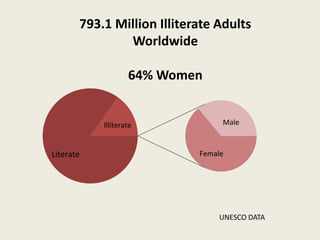
793.1 Million Illiterate Adults Worldwide64% WomenUNESCO DATA
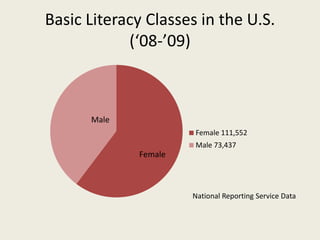
Basic Literacy Classes in the U.S. (‘08-’09)National Reporting Service Data
Illiteracy and MultilingualismBurkina Faso21% literate68 languagesAfghanistan28% literacy49 languages(CIA Factsheet Ethnologue.com)
Transnationalism and Migration
SLA Research BasicsFundamental assumptions and relevant findings of SLA researchWhy these assumptions and findings do not fit low literate L2 learners
Fundamental Assumptions in SLA1968 – S.P. Corder: L2 learner has innate cognitive implicit ‘built-in syllabus’ independent of teacher’s syllabus & of L1.1972 – Selinker: interlanguage rules used implicitly to generate utterances1980’s – Krashen: implicit L2 knowledge (acquired) is different from explicit L2 knowledge (learned) Difference explicit and implicit L2 knowledge
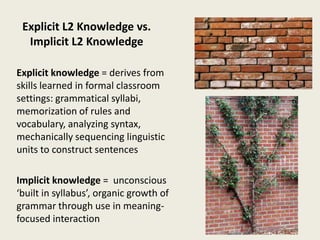
Explicit L2 Knowledge vs.Implicit L2 KnowledgeExplicit knowledge = derives from skills learned in formal classroom settings: grammatical syllabi, memorization of rules and vocabulary, analyzing syntax, mechanically sequencing linguistic units to construct sentences  Implicit knowledge =  unconscious ‘built in syllabus’, organic growth of grammar through use in meaning-focused interaction
Independence of Explicit & Implicit Grammar KnowledgeTeaching past counterfactual rule (e.g.  ‘I wish I had known’ )ESL teacher unconsciously gives this example:  	            ‘I wish I would have known’Implicit knowledge without explicit awarenessExplicit knowledge without implicit ability to use the language
Metalinguistic Cognitive Processes in SLA Theory (Educated L2 Learners)Mainstream theories (input, interaction, sociocultural) assume that L2 learners must be explicitly aware of linguistic units like phonemes, morphemes, words to acquire L2sThey must explicitly notice differences between the order of such units in the input and in their own speech (= notice the gap)Consider research on corrective feedback
Corrective feedbackLearner:   *What she is doing?         (error)Teacher:     What is she doing?      (recast)
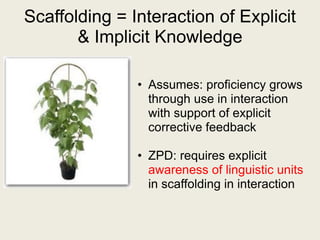
Scaffolding = Interaction of Explicit & Implicit KnowledgeAssumes: proficiency grows through use in interaction with support of explicit corrective feedback
ZPD: requires explicit awareness of linguistic units in scaffolding in interactionResearch with Preliterate L2 LearnersIncreasingly suggests that adults who aren’t alphabetically literate do not have same kind of awareness of linguistic units like phonemes, morphemes, wordsScholes (1993): preliterate adults view segmenting speech into words as ‘meaningless’Olson (2002) & Ong (2002): awareness of ‘words’ and phonological awareness result from alphabetic literacy
Selected LESLLA Findings:Kurvers, Hout & Vallen (2006, 2007):        alphabetic literacy --> awareness of the word and the phoneme as unitsNon alphabetically literate adults viewed language as means of communication, but not a string of linguistic unitsOnderlinden et al. (2009): degree of alphabetic literacy correlates with degree of ability to identify word boundaries Young-Scholten & Strom (2006): phonemic awareness only after learning to read; notions of syllable, onset, rhyme developed independently
Deficit or Difference?Is lack of phonological awareness a deficit?Bassetti (2005): different writing systems teach you to segment oral language in distinctive ways; not a deficit but definitely a differenceEnglish writing represents words and Chinese writing represents monosyllabic morphemesLiterate English CFL learners segmented oral Chinese into “words” according to spacing conventions of the English writing system, different from segmentation conventions of literate Chinese, based on “hanzi”
Dividing L2 Input into UnitsSo into what kind of units do pre-literate adults and adolescents – who are not aware of words and phonemes – segment their oral L2 input?
Abukar15 years old, in 9th gradeBegan formal schooling in US 4.5 years earlier (after 4 yrs in refugee camp)Scores show relatively low literacy level but developing oral proficiency:English literacy: 6 out of 9 possibleSomali literacy: 4 out of 9SPEAK: 50 out of 60 possibleQuestion stage: 5 out of 6 possible
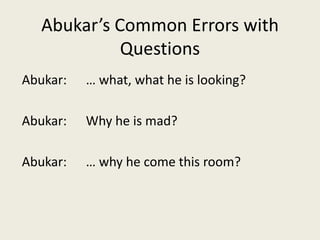
Abukar’s Common Errors with QuestionsAbukar: 	… what, what he is looking?Abukar: 	Why he is mad?Abukar: 	… why he come this room?
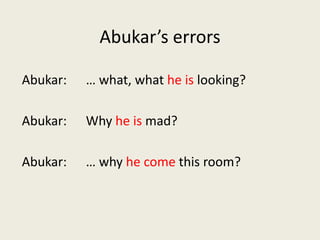
Abukar’s errors Abukar: 	… what, what he is looking?Abukar: 	Why he is mad?Abukar: 	… why he come this room?
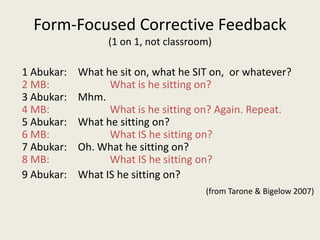
Form-Focused Corrective Feedback(1 on 1, not classroom)	1 Abukar: 	What he sit on, what he SIT on,  or whatever?2 MB: 		What is he sitting on?	3 Abukar: 	Mhm.4 MB: 		What is he sitting on? Again. Repeat.	5 Abukar: 	What he sitting on?6 MB: 		What IS he sitting on?	7 Abukar: 	Oh. What he sitting on?8 MB: 		What IS he sitting on?	9 Abukar: 	What IS he sitting on?(from Tarone & Bigelow 2007)
What does Abukar notice?01 Abukar:	Why he is mad? Why [he], he is mad?02 MB:					[yeah]03 MB:	Why IS he mad?04 Abukar:	Why HE is mad? Why05 MB:	Why IS he mad?06 Abukar:	Why IS he mad? Why is, [is he]…
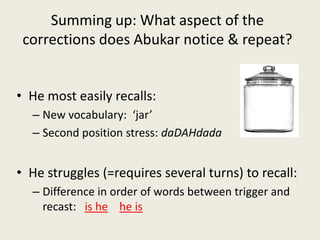
Focus on Vocabulary in Recast01 Abukar:	OK (pause) what is barrel, what is, what is the 02			thing in it? What is there? Is it, is there pennies in it?03 MB:		Yeah. Um, again.  Are pennies in the jar?04 Abukar:	Is, are the penny in the jar?05 MB:		Yes.  And, um, 06 Abukar:	(whispers) jar07 MB:		you know she’s a waitress, so she gets tips,08 Abukar:	O K09 MB:		at the diner, 10 Abukar:	mhm11 MB:		and every day she puts her tips in a jar12 Abukar:	oh. (pause) (xxx xxx)13 MB:		Here’s the jar.14 Abukar:	A jar?15 Abukar:	(20 turns later) Is this jar have, this jar, is this jar full of money?
Summing up: What aspect of the corrections does Abukar notice & repeat?He most easily recalls:New vocabulary:  ‘jar’Second position stress: daDAHdadaHe struggles (=requires several turns) to recall:Difference in order of words between trigger and recast:   is hehe is
Implications & QuestionsSLA theory says that L2 learners must ‘notice the gap’ between linguistic forms in interlanguage, and those in the inputIs Abukar ‘noticing the gap’ at all?Is he noticing it in terms of his awareness of units like syllable and syllable stress patterns, rather than in terms of units like ‘words’ and ‘word order’?
We wonder…     Do all L2 forms have to be explicitly noticed to be acquired?
Can LESLLA/A learners acquire some L2  forms implicitly, without explicit analysis? OR,
Do these learners structure their explicit working memory for language in some way that researchers don’t see?
Can we capitalize on what preliterate learners do notice in oral input to improve their acquisition of L2 grammar?Strands of a SLA research agendaThe metalinguistic awareness emergent readers use in oral SLAThe longitudinal development of LESLLA/A learners’ interlanguage, including the linguistic forms they acquire before, during and after becoming literateImpact of different forms of corrective feedback on noticing of different linguistic forms by preliterate learnersImpact of social context on cognitive processes in LESLLA/A SLAResearcher access, ethical and political issues with LESLLA/A populations
1. Metalinguistic Awareness:  Possible HypothesesNot metalinguistically aware of any linguistic forms in L2 input; all processing is semantic. Explicitly aware of some linguistic forms but not others.    Is explicitly aware of linguistic forms, but those forms are not phonemes or words.
2. Longitudinal Case Studies:  Possible HypothesesInterlanguage develops systematically across time and social context, in ways related to literacy development, in unique patterns of emergence and spread.Some linguistic forms may emerge early in casual contexts, spreading later to classrooms.  Others may be literacy related, emerging later in classroom contexts, and spread to casual contexts.
3. Corrective Feedback: Possible HypothesesWhen corrective feedback is structured in terms of phonemes, morphemes and words, only some linguistic units are noticed.More noticing will occur when teacher is:Structuring corrective feedback in terms of other formal units (e.g. syllables, syllable stress patterns, or intonation)Using symbols that are not script-based (e.g. colored blocks like Cuisinnaire rods)Framing corrective feedback in sociocultural terms
4. Social Contexts of SLA: Possible HypothesesWe assume learners have different purposes for using language in different social contexts (e.g. formal vs. naturalistic – classrooms vs. communities), and this affects their patterns of interlanguage use and acquisition. Language use skills used in out-of-school cultural practices can be identified, and engaged in classrooms to promote SLA.
Needed: More Research in Intact Classroom Contexts

A research agenda for leslla_

  • 1.
    A Research Agendafor LESLLA/A Second Language AcquisitionMartha BigelowElaine TaroneUniversity of Minnesota
  • 2.
    An Ecology ofSLA Research
  • 3.
  • 4.
  • 5.
  • 6.
  • 7.
  • 8.
  • 9.
  • 10.
    The Goal ofSLA ResearchDescribe & explain cognitive processesDocument development of L2 interlanguage over timeFocus on the learnerOral interlanguage, as used in communication
  • 11.
    What does SLAresearch tell us about LESLLA/A learners?Very little in mainstream journals, conferences, booksThe SLA of the emergent reader is little known
  • 12.
    Omission of LESLLA/ARiskyFor SLA TheoryFor Pedagogy
  • 13.
    793.1 Million IlliterateAdults Worldwide64% WomenUNESCO DATA
  • 14.
    Basic Literacy Classesin the U.S. (‘08-’09)National Reporting Service Data
  • 15.
    Illiteracy and MultilingualismBurkinaFaso21% literate68 languagesAfghanistan28% literacy49 languages(CIA Factsheet Ethnologue.com)
  • 16.
  • 17.
    SLA Research BasicsFundamentalassumptions and relevant findings of SLA researchWhy these assumptions and findings do not fit low literate L2 learners
  • 18.
    Fundamental Assumptions inSLA1968 – S.P. Corder: L2 learner has innate cognitive implicit ‘built-in syllabus’ independent of teacher’s syllabus & of L1.1972 – Selinker: interlanguage rules used implicitly to generate utterances1980’s – Krashen: implicit L2 knowledge (acquired) is different from explicit L2 knowledge (learned) Difference explicit and implicit L2 knowledge
  • 19.
    Explicit L2 Knowledgevs.Implicit L2 KnowledgeExplicit knowledge = derives from skills learned in formal classroom settings: grammatical syllabi, memorization of rules and vocabulary, analyzing syntax, mechanically sequencing linguistic units to construct sentences Implicit knowledge = unconscious ‘built in syllabus’, organic growth of grammar through use in meaning-focused interaction
  • 20.
    Independence of Explicit& Implicit Grammar KnowledgeTeaching past counterfactual rule (e.g. ‘I wish I had known’ )ESL teacher unconsciously gives this example: ‘I wish I would have known’Implicit knowledge without explicit awarenessExplicit knowledge without implicit ability to use the language
  • 21.
    Metalinguistic Cognitive Processesin SLA Theory (Educated L2 Learners)Mainstream theories (input, interaction, sociocultural) assume that L2 learners must be explicitly aware of linguistic units like phonemes, morphemes, words to acquire L2sThey must explicitly notice differences between the order of such units in the input and in their own speech (= notice the gap)Consider research on corrective feedback
  • 22.
    Corrective feedbackLearner: *What she is doing? (error)Teacher: What is she doing? (recast)
  • 23.
    Scaffolding = Interactionof Explicit & Implicit KnowledgeAssumes: proficiency grows through use in interaction with support of explicit corrective feedback
  • 24.
    ZPD: requires explicitawareness of linguistic units in scaffolding in interactionResearch with Preliterate L2 LearnersIncreasingly suggests that adults who aren’t alphabetically literate do not have same kind of awareness of linguistic units like phonemes, morphemes, wordsScholes (1993): preliterate adults view segmenting speech into words as ‘meaningless’Olson (2002) & Ong (2002): awareness of ‘words’ and phonological awareness result from alphabetic literacy
  • 25.
    Selected LESLLA Findings:Kurvers,Hout & Vallen (2006, 2007): alphabetic literacy --> awareness of the word and the phoneme as unitsNon alphabetically literate adults viewed language as means of communication, but not a string of linguistic unitsOnderlinden et al. (2009): degree of alphabetic literacy correlates with degree of ability to identify word boundaries Young-Scholten & Strom (2006): phonemic awareness only after learning to read; notions of syllable, onset, rhyme developed independently
  • 26.
    Deficit or Difference?Islack of phonological awareness a deficit?Bassetti (2005): different writing systems teach you to segment oral language in distinctive ways; not a deficit but definitely a differenceEnglish writing represents words and Chinese writing represents monosyllabic morphemesLiterate English CFL learners segmented oral Chinese into “words” according to spacing conventions of the English writing system, different from segmentation conventions of literate Chinese, based on “hanzi”
  • 27.
    Dividing L2 Inputinto UnitsSo into what kind of units do pre-literate adults and adolescents – who are not aware of words and phonemes – segment their oral L2 input?
  • 28.
    Abukar15 years old,in 9th gradeBegan formal schooling in US 4.5 years earlier (after 4 yrs in refugee camp)Scores show relatively low literacy level but developing oral proficiency:English literacy: 6 out of 9 possibleSomali literacy: 4 out of 9SPEAK: 50 out of 60 possibleQuestion stage: 5 out of 6 possible
  • 29.
    Abukar’s Common Errorswith QuestionsAbukar: … what, what he is looking?Abukar: Why he is mad?Abukar: … why he come this room?
  • 30.
    Abukar’s errors Abukar: … what, what he is looking?Abukar: Why he is mad?Abukar: … why he come this room?
  • 31.
    Form-Focused Corrective Feedback(1on 1, not classroom) 1 Abukar: What he sit on, what he SIT on, or whatever?2 MB: What is he sitting on? 3 Abukar: Mhm.4 MB: What is he sitting on? Again. Repeat. 5 Abukar: What he sitting on?6 MB: What IS he sitting on? 7 Abukar: Oh. What he sitting on?8 MB: What IS he sitting on? 9 Abukar: What IS he sitting on?(from Tarone & Bigelow 2007)
  • 32.
    What does Abukarnotice?01 Abukar: Why he is mad? Why [he], he is mad?02 MB: [yeah]03 MB: Why IS he mad?04 Abukar: Why HE is mad? Why05 MB: Why IS he mad?06 Abukar: Why IS he mad? Why is, [is he]…
  • 33.
    Focus on Vocabularyin Recast01 Abukar: OK (pause) what is barrel, what is, what is the 02 thing in it? What is there? Is it, is there pennies in it?03 MB: Yeah. Um, again. Are pennies in the jar?04 Abukar: Is, are the penny in the jar?05 MB: Yes. And, um, 06 Abukar: (whispers) jar07 MB: you know she’s a waitress, so she gets tips,08 Abukar: O K09 MB: at the diner, 10 Abukar: mhm11 MB: and every day she puts her tips in a jar12 Abukar: oh. (pause) (xxx xxx)13 MB: Here’s the jar.14 Abukar: A jar?15 Abukar: (20 turns later) Is this jar have, this jar, is this jar full of money?
  • 34.
    Summing up: Whataspect of the corrections does Abukar notice & repeat?He most easily recalls:New vocabulary: ‘jar’Second position stress: daDAHdadaHe struggles (=requires several turns) to recall:Difference in order of words between trigger and recast: is hehe is
  • 35.
    Implications & QuestionsSLAtheory says that L2 learners must ‘notice the gap’ between linguistic forms in interlanguage, and those in the inputIs Abukar ‘noticing the gap’ at all?Is he noticing it in terms of his awareness of units like syllable and syllable stress patterns, rather than in terms of units like ‘words’ and ‘word order’?
  • 36.
    We wonder… Do all L2 forms have to be explicitly noticed to be acquired?
  • 37.
    Can LESLLA/A learnersacquire some L2 forms implicitly, without explicit analysis? OR,
  • 38.
    Do these learnersstructure their explicit working memory for language in some way that researchers don’t see?
  • 39.
    Can we capitalizeon what preliterate learners do notice in oral input to improve their acquisition of L2 grammar?Strands of a SLA research agendaThe metalinguistic awareness emergent readers use in oral SLAThe longitudinal development of LESLLA/A learners’ interlanguage, including the linguistic forms they acquire before, during and after becoming literateImpact of different forms of corrective feedback on noticing of different linguistic forms by preliterate learnersImpact of social context on cognitive processes in LESLLA/A SLAResearcher access, ethical and political issues with LESLLA/A populations
  • 40.
    1. Metalinguistic Awareness: Possible HypothesesNot metalinguistically aware of any linguistic forms in L2 input; all processing is semantic. Explicitly aware of some linguistic forms but not others. Is explicitly aware of linguistic forms, but those forms are not phonemes or words.
  • 41.
    2. Longitudinal CaseStudies: Possible HypothesesInterlanguage develops systematically across time and social context, in ways related to literacy development, in unique patterns of emergence and spread.Some linguistic forms may emerge early in casual contexts, spreading later to classrooms. Others may be literacy related, emerging later in classroom contexts, and spread to casual contexts.
  • 42.
    3. Corrective Feedback:Possible HypothesesWhen corrective feedback is structured in terms of phonemes, morphemes and words, only some linguistic units are noticed.More noticing will occur when teacher is:Structuring corrective feedback in terms of other formal units (e.g. syllables, syllable stress patterns, or intonation)Using symbols that are not script-based (e.g. colored blocks like Cuisinnaire rods)Framing corrective feedback in sociocultural terms
  • 43.
    4. Social Contextsof SLA: Possible HypothesesWe assume learners have different purposes for using language in different social contexts (e.g. formal vs. naturalistic – classrooms vs. communities), and this affects their patterns of interlanguage use and acquisition. Language use skills used in out-of-school cultural practices can be identified, and engaged in classrooms to promote SLA.
  • 44.
    Needed: More Researchin Intact Classroom Contexts

Editor's Notes

  • #3 MARTHA
  • #12 Wave around the Ellis and Long FAT BOOKS of research summaries. Only Ellis mentions, on 2 pages, the Bigelow delMas Hansen & Tarone study.
  • #19 ELAINE-Pre-1968. Assumption: L2 learning was simple matter of replacing L1 forms with L2 forms; all difficulties caused by transferring L1 forms into L2Corder (1969) following Chomsky: focus on innate knowledge of language of L2 learners. ‘built-in syllabus’ for SLA, different from taught syllabi. Not justL1 transfer, but also other cognitive processes; Selinker 1972: overgeneralization of L2 rules (as in FLA), transfer of training, learning strategies-Overly cognitive orientation in the ensuing decades of research: mind of L2 learner imagined as like a computer; give it language input, it processes the input in the CPU to formulate IL rules of grammar, morphology, phonology; no attention paid to social context, or impact of contexts outside of school on the L2 learning process. All L2 learners imagined to be like those accessible to the researchers: educated learners in school contexts.
  • #20 ELAINETelling learners the rules ,memorizing the rules, painstakingly assembling sentences rule by rule … this did not seem to result in the ability to actually USE those rules unconsciously in communication.Implicit learner knowledge seems to develop organically, like a plant. And for the educated learners studied, a balance needed to be struck between focus on explicit rules, and focus on meaning in communication, which fostered development of implicit knowledge
  • #22 ELAINE
  • #23 Learner has the order of two linguistic units wrong: ‘she’ and ‘is’. Her meaning is clear without it.Teacher changes the order of these words thus providing INPUT that the learner must process. Literate educated learners can process it. Learner must notice that change, which doesn’t change the meaning, and adopt it.
  • #25 BUT. (read notes)
  • #37 Data like this lead us to wonder …
  • #38 Based on our wondering, we have tried out identify next steps in an SLA research agenda, to describe and explain the way pre-literate and low literate learners acquire linguistic forms in L2: the grammar. We lay out 5 interrelated strands of an SLA research agenda, listed on your handout. In the next 5 slides, we will propose some testable hypotheses in each strand. Ask and we’ll email these to you. The 5 strands are (READ).
  • #39 Research is needed on the way pre-literate or low-literate adolescent learners like Abukar perceive and acquire the linguistic structures of L2, and this strand of research has tremendous potential to revolutionize the way SLA research understands the role of Explicit and Implicit knowledge in SLA. *ONE possibility is that such learners don’t have to be explicitly aware of form at all – maybe they acquire L2 grammar forms implicitly, through semantic processing. While that is one possibility, we wonder when we hear persistent reports of community members memorizing and reciting long texts … and not just Somali texts, but the Koran in Arabic L2 which they do not understand. You can’t use semantic processing to recite text you don’t understand. In Strand 4 we’ll urge research on whether these persistent reports are true and if so how preliterate or low literate learners seem to process these Arabic L2 texts. *Returning to THIS strand, a second hypothesis is that some linguistic forms can be acquired implicitly through semantic processing, while others must be explicitly processed. Maybe basic word order is implicitly internalized, but changes in word order that don’t affect meaning require phonological awareness.*A third hypothesis is that preliterate learners HAVE explicit awareness of linguistic forms, but these are different forms that we expect …not phonemes or words, but maybe syllable stress or rhythm or rhyme.
  • #40 Longitudinal ethnographic case studies have provided tremendous insight into the way L2 learners develop their interlanguages. Howard Nicholas has directed several doctoral dissertations, longitudinal case studies of child L2 learners, including Liu (1991)’s … notes
  • #41 A number of hypotheses relate to the way preliterate learners process corrective feedback on the accuracy of their utterances. We’ve seen an example of how we tried to test one such hypothesis in the study that included Abukar. And I’ve hinted at some of these hypotheses already.
  • #43 A lot of our research has been one on one, outside the classroom. How do classroom dynamics affect SLA? Record desk work, group work, reading lessons, corrective feedback in teacher fronted interaction, etc.