Cross-Linguistic Influence
and Learner Language
By
Komang Satya Permadi
Cross-Linguistic Influence and Learner Language
Preview
Cross-Linguistic Influence and Learner Language
The Contrastive Analysis Hypothesis
 Deeply rooted in the behavioristic and structuralist
approaches, the CAH claimed that the principal barrier to L2
is the interference of L1system with the 2nd system.
 A scientific- structural analysis will develop a taxonomy of
linguistic contrasts between them which will enable the
linguist to predict the difficulties a learner would encounter.
 Clifford Prator (1967) captured the essence of the
grammatical hierarchy (Stockwell, Bowen, and Martin, 1965)
in six categories of difficulty –it was applicable to both
grammatical and phonological features of language.
 Most of the examples are taken from English and Spanish
Cross-Linguistic Influence and Learner Language
Six Categories of Hierarchy of Difficulty (A Native English Speaker Learning Spanish as L2)
Level 0
No difference or contrast is present
between the two languages. The
learner can simply transfer a sound,
structure, or lexical item from the
native language to the target
language
Level 1
coalescence two items in the native
language become coalesced into
essentially one item in the target
language. Example: English 3rd p.
possessives require gender distinction
(his/her) and in Spanish they do not
(su)
Level 2
Underdifferentiation –an item in the
native language is absent in the target
language. The learner must avoid that
item. Example: (adjectives in Spanish
require gender (alto/alta)
Level 3
Reinterpretation –an item that exists in
the native language is given a new
shape or distribution. Example: new
phonemes require new distribution of
speech articulators -/r/, etc.
Level 4
Overdifferentiation –a new item
entirely, bearing any similarity to the
native language item, must be
learned. Example: English speakers
must learn the use of determiners in
Spanish –man is mortal/El hombre es
mortal
Level 5
Split –one item in the native language
becomes two or more in the target
language requiring the learner to
make a new distinction. English
speakers must learn the distinction
between (ser) and (estar)
Cross-Linguistic Influence and Learner Language
 Predictions of difficulty by means of contrastive procedures had
many shortcomings. The process could not account for all
linguistic problems or situations not even with the 6 categories.
Lastly, the predictions of difficulty level could not be verified with
reliability.
 The attempt to predict difficulty by means of contrastive analysis
was called the strong version of the CAH (Wardaugh, 1970) –a
version that he believed unrealistic and impractible.
 Wardaugh also recognized the weak version of the CAH –one in
which the linguistic difficulties can be more profitably explained a
posteriori by teachers and linguists. When language and errors
appear, teachers can utilize their knowledge of the target
language and native language to understand the sources of
error.
From the CAH (Contrastive Analysis Hypothesis) to CLI (cross-linguistic influence)
Cross-Linguistic Influence and Learner Language
 The so-called weak version of the CAH is what remains today
under the label cross-linguistic influence (CLI) –suggesting that
we all recognize the significant role that prior experience plays in
any learning act, and the influence of the native language as prior
experience must not be overlooked.
 Syntactic , lexical, and semantic interference show far more
variation among learners than psycho-motor-based
pronunciation interference.
From the CAH (Contrastive Analysis Hypothesis) to CLI (cross-linguistic influence)
Cross-Linguistic Influence and Learner Language
 Eckman (1977,1981) proposed a useful method for determining
directionality of difficulty-markedness theory.
 It accounted for degrees of principles of universal
grammar.Eckman showed that marked items in a language will be
more difficult to acquire than unmarked, and that degree of
markedness will correspond to degrees of difficulty.
Markedness and Universal Grammar
Cross-Linguistic Influence and Learner Language
 Celse-Murcia and Hawkins (1985) in Brown (2007) sum up
markedness theory:
“It distinguishes members of a pair of related forms or structures by
assuming that the marked member of a pair contains at least one
more feature than the unmarked one. In addition, the unmarked
(neutral) member has a wider range of distribution than the marked
one. In the English indefinite articles (a and an) an is the more
complex or marked form. Verbs are the classic example for this
pattern.”
Markedness and Universal Grammar
Cross-Linguistic Influence and Learner Language
 CAH stressed the interfering effects of L1 on L2 learning and
claimed, in its strong form, that L2 learning is primarily a process
of acquiring whatever items are different from the L1.
 This narrow view of interference ignored the intralingual effects
of learning.
 Learners are consciously testing hypotheses about the target
language from many possible sources of knowledge.
1. knowledge of the native language
2. limited knowledge of the target language itself
3. knowledge of communicative functions of language
4. knowledge about language in general
5. knowledge about life, human beings, and the universe.
 Learners act upon the environment and construct what to them is
a legitimate system of language in its own right.
Learner language
Cross-Linguistic Influence and Learner Language
 The most obvious approach to analyzing interlanguage is to
study the speech and writing of learners –learner language
(Lightbown & Spada 1993) in Brown (2007)
 Production data is publicly observable and is presumably
reflective of a learner’s underlying competence.
 It follows that the study of the speech and writing of learners is
largely the study of the errors of learners. “Correct” production
yields little information about the actual linguistic system of
learners.
Learner language
Cross-Linguistic Influence and Learner Language
 Human learning is fundamentally a process that involves the
making of mistakes.
 They form an important aspect of learning virtually any skill or
acquiring information.
 Language learning is like any other human learning.
 L2 learning is a process that is clearly not unlike L1 learning in its
trial-and-error nature. Inevitably, learners will make mistakes in
the process of acquisition, and that process will be impeded if
they do not commit errors and then benefit from various forms of
feedback on those errors.
 Corder (1967) noted: “a learner’s errors are significant in that they
provide to the researcher evidence of how language is learned or
acquired, what strategies or procedures the learner is employing in
the discovery of the language.”
Error Analysis
Error Analysis
 In order to analyze learner language in an appropriate
perspective, it is crucial to make a distinction between mistakes
and errors, technically two very different phenomena.
 Mistake –refers to a performance error that is either a random
guess or a “slip”, in that is a failure to utilize a known system
correctly. Native speakers make mistakes. When attention is
called to them, they can be self-corrected.
 Error –a noticeable deviation from the adult grammar of a native
speaker, reflects the competence of the learner (Does John can
sing?)
Mistakes and errors
Error Analysis
 The fact that learners do make errors, and these errors can be
analyzed, led to a surge of study of learners’ errors, called error
analysis.
 Error analysis became distinguished from contrastive analysis by
its examination of errors attributable to all possible sources, not
just those resulting from negative transfer of the native language.
Mistakes and errors
Error Analysis
 There is a danger in too much attention to learner’s errors.
 A classroom teacher can become so preoccupied with noticing
errors that the correct utterances in L2 go unnoticed.
 While the diminishing of errors is an important criterion for
increasing language proficiency, the ultimate goal of L2 learning
is the attainment of communicative fluency.
Errors in error analysis
Error Analysis
 One of the most common difficulties in understanding the
linguistic systems of both L1 and L2 is the fact that such systems
cannot be directly observed –they must be inferred by means of
analyzing production and comprehension data.
 The first step in the process of analysis is the identification and
description of errors. Corder (1971) in Brown (2007) provided a
model for identifying erroneous or idiosyncratic utterances in a
second language. (chart 8.1) p. 221
 A major distinction is made between overt and covert errors.
a) overt –erroneous utterances ungrammatically at the sentence level
b) covert –grammatically well-formed but not according to context of
communication.
Identifying and describing errors
Error Analysis
Examples
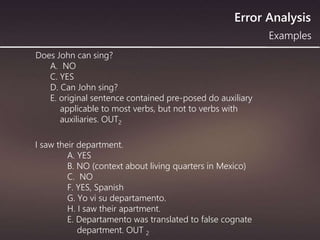
Does John can sing?
A. NO
C. YES
D. Can John sing?
E. original sentence contained pre-posed do auxiliary
applicable to most verbs, but not to verbs with
auxiliaries. OUT2
I saw their department.
A. YES
B. NO (context about living quarters in Mexico)
C. NO
F. YES, Spanish
G. Yo vi su departamento.
H. I saw their apartment.
E. Departamento was translated to false cognate
department. OUT 2
Error Analysis
 Errors of addition, omission, substitution, and ordering (math)
 Phonology or orthography, lexicon, grammar, and discourse
 Global or local (a scissors)
 Domain and extent
Source of Error
Source of Error
 Interlingual (L1 and L2) transfer is a significant source of error for
all learners.
 It is now clear that intralingual transfer (within the target
language itself) is a major factor in L2 learning. It is referred to as
overgeneralization. (see examples on p. 225)
Interlingual and intralingual Transfer
Source of Error
 A third major source of error, although it overlaps both types of
transfer, is the context of learning.
 Context refers, for example, to the classroom with its teacher and
its materials in the case of school learning or the social situation
in the case of untutored second language learning.
 In a classroom context the teacher or the textbook can lead to
the learner to make faulty hypotheses about the language.
Richards (1971) in Brown (2007) called it “false concepts”
Contexts of learning
Cross-Linguistic Influence and Learner Language
 Corder (1973) presents the progression of language learners in
four stages based on observations of what the learner does in
terms of errors alone.
 1st stage –random errors, called pre-systematic in which the
learner is only vaguely aware that there is some systematic
order to a particular class of items.
 2nd stage –(emergent) stage of learner language finds the
learner growing in consistency in linguistic production.
Learner has begun to discern a system and to internalize
certain rules. Its characterized by ‘backsliding” –seems to
grasp a a rule or principle and then regresses to previous
stages.
Stages of Learner Language Development
Cross-Linguistic Influence and Learner Language
 3. 3rd stage –truly systematic stage in which the learner is now
able to manifest more consistency in producing the second
language. The most salient difference between the 2nd and the
3rd stages is the ability of learners to correct their errors when
they are pointed out.
 4. Final stage –stabilization stage; Corder (1973) called it
postsystematic stage. Here the learner has relatively few errors
and has mastered the system to the point that fluency and
intended meanings are not problematic. This fourth stage is
characterized by the learner’s ability to self-correct.
Stages of Learner Language Development
Cross-Linguistic Influence and Learner Language
 A great deal of attention has been given to the variability of
interlanguage development. Just like native speakers hesitate with
expressions in their own language, the same occurs in L2.
 Tarone (1988) focused her research on contextual variability, that
is, the extent to which both linguistic and situational contexts may
help to systematically describe what appear simply as
unexplained variation. Tarone suggested four categories of
variation:
1. according to linguistic context
2. according to psychological processing factors
3. according to social context
4. according to language function
Variation in Learner Language
Cross-Linguistic Influence and Learner Language
 It is quite common to encounter in a learner’s language various
erroneous features that persist despite what is otherwise a
reasonably fluent command of the language.
 This phenomenon is most saliently manifested phonologically in
‘foreign accents’ in the speech of those who have learned a L2
after puberty (chapter 3).
 The relatively permanent incorporation of incorrect linguistic
forms into a person’s second language competence has been
referred to as FOSSILIZATION.
 It is a normal and natural stage for many learners and should not
be viewed as some sort of terminal illness.
Fossilization
Cross-Linguistic Influence and Learner Language
 Should errors be treated? How they should be treated? When?
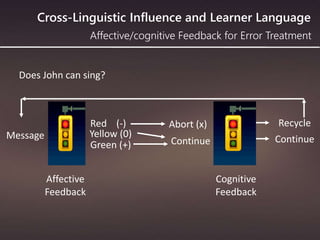
 Vigil and Oller (1976) provided feedback about these questions
with the following model:
 Fossilization may be the result of too many green lights when
there should have been some yellow or red lights.
Error treatment
Cross-Linguistic Influence and Learner Language
Affective/cognitive Feedback for Error Treatment
Red (-)
Yellow (0)
Green (+)
Abort (x)
Continue
Recycle
Message Continue
Affective
Feedback
Cognitive
Feedback
Does John can sing?
Cross-Linguistic Influence and Learner Language
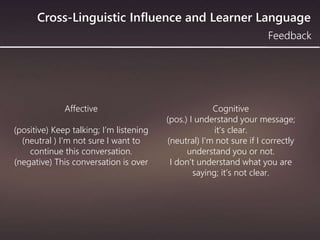
Feedback
Affective
(positive) Keep talking; I’m listening
(neutral ) I’m not sure I want to
continue this conversation.
(negative) This conversation is over
Cognitive
(pos.) I understand your message;
it’s clear.
(neutral) I’m not sure if I correctly
understand you or not.
I don’t understand what you are
saying; it’s not clear.
Cross-Linguistic Influence and Learner Language
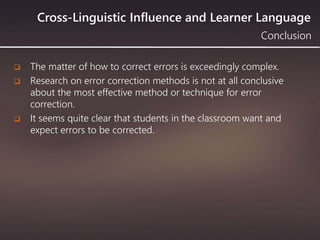
Conclusion
 The matter of how to correct errors is exceedingly complex.
 Research on error correction methods is not at all conclusive
about the most effective method or technique for error
correction.
 It seems quite clear that students in the classroom want and
expect errors to be corrected.
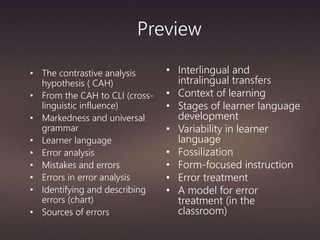
Preview
• The contrastive analysis
hypothesis ( CAH)
• From the CAH to CLI (cross-
linguistic influence)
• Markedness and universal
grammar
• Learner language
• Error analysis
• Mistakes and errors
• Errors in error analysis
• Identifying and describing
errors (chart)
• Sources of errors
• Interlingual and
intralingual transfers
• Context of learning
• Stages of learner language
development
• Variability in learner
language
• Fossilization
• Form-focused instruction
• Error treatment
• A model for error
treatment (in the
classroom)

Second-Language Acquisition (Cross-Linguistic Influence and Learner Language)

  • 1.
    Cross-Linguistic Influence and LearnerLanguage By Komang Satya Permadi
  • 2.
    Cross-Linguistic Influence andLearner Language Preview
  • 3.
    Cross-Linguistic Influence andLearner Language The Contrastive Analysis Hypothesis  Deeply rooted in the behavioristic and structuralist approaches, the CAH claimed that the principal barrier to L2 is the interference of L1system with the 2nd system.  A scientific- structural analysis will develop a taxonomy of linguistic contrasts between them which will enable the linguist to predict the difficulties a learner would encounter.  Clifford Prator (1967) captured the essence of the grammatical hierarchy (Stockwell, Bowen, and Martin, 1965) in six categories of difficulty –it was applicable to both grammatical and phonological features of language.  Most of the examples are taken from English and Spanish
  • 4.
    Cross-Linguistic Influence andLearner Language Six Categories of Hierarchy of Difficulty (A Native English Speaker Learning Spanish as L2) Level 0 No difference or contrast is present between the two languages. The learner can simply transfer a sound, structure, or lexical item from the native language to the target language Level 1 coalescence two items in the native language become coalesced into essentially one item in the target language. Example: English 3rd p. possessives require gender distinction (his/her) and in Spanish they do not (su) Level 2 Underdifferentiation –an item in the native language is absent in the target language. The learner must avoid that item. Example: (adjectives in Spanish require gender (alto/alta) Level 3 Reinterpretation –an item that exists in the native language is given a new shape or distribution. Example: new phonemes require new distribution of speech articulators -/r/, etc. Level 4 Overdifferentiation –a new item entirely, bearing any similarity to the native language item, must be learned. Example: English speakers must learn the use of determiners in Spanish –man is mortal/El hombre es mortal Level 5 Split –one item in the native language becomes two or more in the target language requiring the learner to make a new distinction. English speakers must learn the distinction between (ser) and (estar)
  • 5.
    Cross-Linguistic Influence andLearner Language  Predictions of difficulty by means of contrastive procedures had many shortcomings. The process could not account for all linguistic problems or situations not even with the 6 categories. Lastly, the predictions of difficulty level could not be verified with reliability.  The attempt to predict difficulty by means of contrastive analysis was called the strong version of the CAH (Wardaugh, 1970) –a version that he believed unrealistic and impractible.  Wardaugh also recognized the weak version of the CAH –one in which the linguistic difficulties can be more profitably explained a posteriori by teachers and linguists. When language and errors appear, teachers can utilize their knowledge of the target language and native language to understand the sources of error. From the CAH (Contrastive Analysis Hypothesis) to CLI (cross-linguistic influence)
  • 6.
    Cross-Linguistic Influence andLearner Language  The so-called weak version of the CAH is what remains today under the label cross-linguistic influence (CLI) –suggesting that we all recognize the significant role that prior experience plays in any learning act, and the influence of the native language as prior experience must not be overlooked.  Syntactic , lexical, and semantic interference show far more variation among learners than psycho-motor-based pronunciation interference. From the CAH (Contrastive Analysis Hypothesis) to CLI (cross-linguistic influence)
  • 7.
    Cross-Linguistic Influence andLearner Language  Eckman (1977,1981) proposed a useful method for determining directionality of difficulty-markedness theory.  It accounted for degrees of principles of universal grammar.Eckman showed that marked items in a language will be more difficult to acquire than unmarked, and that degree of markedness will correspond to degrees of difficulty. Markedness and Universal Grammar
  • 8.
    Cross-Linguistic Influence andLearner Language  Celse-Murcia and Hawkins (1985) in Brown (2007) sum up markedness theory: “It distinguishes members of a pair of related forms or structures by assuming that the marked member of a pair contains at least one more feature than the unmarked one. In addition, the unmarked (neutral) member has a wider range of distribution than the marked one. In the English indefinite articles (a and an) an is the more complex or marked form. Verbs are the classic example for this pattern.” Markedness and Universal Grammar
  • 9.
    Cross-Linguistic Influence andLearner Language  CAH stressed the interfering effects of L1 on L2 learning and claimed, in its strong form, that L2 learning is primarily a process of acquiring whatever items are different from the L1.  This narrow view of interference ignored the intralingual effects of learning.  Learners are consciously testing hypotheses about the target language from many possible sources of knowledge. 1. knowledge of the native language 2. limited knowledge of the target language itself 3. knowledge of communicative functions of language 4. knowledge about language in general 5. knowledge about life, human beings, and the universe.  Learners act upon the environment and construct what to them is a legitimate system of language in its own right. Learner language
  • 10.
    Cross-Linguistic Influence andLearner Language  The most obvious approach to analyzing interlanguage is to study the speech and writing of learners –learner language (Lightbown & Spada 1993) in Brown (2007)  Production data is publicly observable and is presumably reflective of a learner’s underlying competence.  It follows that the study of the speech and writing of learners is largely the study of the errors of learners. “Correct” production yields little information about the actual linguistic system of learners. Learner language
  • 11.
    Cross-Linguistic Influence andLearner Language  Human learning is fundamentally a process that involves the making of mistakes.  They form an important aspect of learning virtually any skill or acquiring information.  Language learning is like any other human learning.  L2 learning is a process that is clearly not unlike L1 learning in its trial-and-error nature. Inevitably, learners will make mistakes in the process of acquisition, and that process will be impeded if they do not commit errors and then benefit from various forms of feedback on those errors.  Corder (1967) noted: “a learner’s errors are significant in that they provide to the researcher evidence of how language is learned or acquired, what strategies or procedures the learner is employing in the discovery of the language.” Error Analysis
  • 12.
    Error Analysis  Inorder to analyze learner language in an appropriate perspective, it is crucial to make a distinction between mistakes and errors, technically two very different phenomena.  Mistake –refers to a performance error that is either a random guess or a “slip”, in that is a failure to utilize a known system correctly. Native speakers make mistakes. When attention is called to them, they can be self-corrected.  Error –a noticeable deviation from the adult grammar of a native speaker, reflects the competence of the learner (Does John can sing?) Mistakes and errors
  • 13.
    Error Analysis  Thefact that learners do make errors, and these errors can be analyzed, led to a surge of study of learners’ errors, called error analysis.  Error analysis became distinguished from contrastive analysis by its examination of errors attributable to all possible sources, not just those resulting from negative transfer of the native language. Mistakes and errors
  • 14.
    Error Analysis  Thereis a danger in too much attention to learner’s errors.  A classroom teacher can become so preoccupied with noticing errors that the correct utterances in L2 go unnoticed.  While the diminishing of errors is an important criterion for increasing language proficiency, the ultimate goal of L2 learning is the attainment of communicative fluency. Errors in error analysis
  • 15.
    Error Analysis  Oneof the most common difficulties in understanding the linguistic systems of both L1 and L2 is the fact that such systems cannot be directly observed –they must be inferred by means of analyzing production and comprehension data.  The first step in the process of analysis is the identification and description of errors. Corder (1971) in Brown (2007) provided a model for identifying erroneous or idiosyncratic utterances in a second language. (chart 8.1) p. 221  A major distinction is made between overt and covert errors. a) overt –erroneous utterances ungrammatically at the sentence level b) covert –grammatically well-formed but not according to context of communication. Identifying and describing errors
  • 16.
    Error Analysis Examples Does Johncan sing? A. NO C. YES D. Can John sing? E. original sentence contained pre-posed do auxiliary applicable to most verbs, but not to verbs with auxiliaries. OUT2 I saw their department. A. YES B. NO (context about living quarters in Mexico) C. NO F. YES, Spanish G. Yo vi su departamento. H. I saw their apartment. E. Departamento was translated to false cognate department. OUT 2
  • 17.
    Error Analysis  Errorsof addition, omission, substitution, and ordering (math)  Phonology or orthography, lexicon, grammar, and discourse  Global or local (a scissors)  Domain and extent Source of Error
  • 18.
    Source of Error Interlingual (L1 and L2) transfer is a significant source of error for all learners.  It is now clear that intralingual transfer (within the target language itself) is a major factor in L2 learning. It is referred to as overgeneralization. (see examples on p. 225) Interlingual and intralingual Transfer
  • 19.
    Source of Error A third major source of error, although it overlaps both types of transfer, is the context of learning.  Context refers, for example, to the classroom with its teacher and its materials in the case of school learning or the social situation in the case of untutored second language learning.  In a classroom context the teacher or the textbook can lead to the learner to make faulty hypotheses about the language. Richards (1971) in Brown (2007) called it “false concepts” Contexts of learning
  • 20.
    Cross-Linguistic Influence andLearner Language  Corder (1973) presents the progression of language learners in four stages based on observations of what the learner does in terms of errors alone.  1st stage –random errors, called pre-systematic in which the learner is only vaguely aware that there is some systematic order to a particular class of items.  2nd stage –(emergent) stage of learner language finds the learner growing in consistency in linguistic production. Learner has begun to discern a system and to internalize certain rules. Its characterized by ‘backsliding” –seems to grasp a a rule or principle and then regresses to previous stages. Stages of Learner Language Development
  • 21.
    Cross-Linguistic Influence andLearner Language  3. 3rd stage –truly systematic stage in which the learner is now able to manifest more consistency in producing the second language. The most salient difference between the 2nd and the 3rd stages is the ability of learners to correct their errors when they are pointed out.  4. Final stage –stabilization stage; Corder (1973) called it postsystematic stage. Here the learner has relatively few errors and has mastered the system to the point that fluency and intended meanings are not problematic. This fourth stage is characterized by the learner’s ability to self-correct. Stages of Learner Language Development
  • 22.
    Cross-Linguistic Influence andLearner Language  A great deal of attention has been given to the variability of interlanguage development. Just like native speakers hesitate with expressions in their own language, the same occurs in L2.  Tarone (1988) focused her research on contextual variability, that is, the extent to which both linguistic and situational contexts may help to systematically describe what appear simply as unexplained variation. Tarone suggested four categories of variation: 1. according to linguistic context 2. according to psychological processing factors 3. according to social context 4. according to language function Variation in Learner Language
  • 23.
    Cross-Linguistic Influence andLearner Language  It is quite common to encounter in a learner’s language various erroneous features that persist despite what is otherwise a reasonably fluent command of the language.  This phenomenon is most saliently manifested phonologically in ‘foreign accents’ in the speech of those who have learned a L2 after puberty (chapter 3).  The relatively permanent incorporation of incorrect linguistic forms into a person’s second language competence has been referred to as FOSSILIZATION.  It is a normal and natural stage for many learners and should not be viewed as some sort of terminal illness. Fossilization
  • 24.
    Cross-Linguistic Influence andLearner Language  Should errors be treated? How they should be treated? When?  Vigil and Oller (1976) provided feedback about these questions with the following model:  Fossilization may be the result of too many green lights when there should have been some yellow or red lights. Error treatment
  • 25.
    Cross-Linguistic Influence andLearner Language Affective/cognitive Feedback for Error Treatment Red (-) Yellow (0) Green (+) Abort (x) Continue Recycle Message Continue Affective Feedback Cognitive Feedback Does John can sing?
  • 26.
    Cross-Linguistic Influence andLearner Language Feedback Affective (positive) Keep talking; I’m listening (neutral ) I’m not sure I want to continue this conversation. (negative) This conversation is over Cognitive (pos.) I understand your message; it’s clear. (neutral) I’m not sure if I correctly understand you or not. I don’t understand what you are saying; it’s not clear.
  • 27.
    Cross-Linguistic Influence andLearner Language Conclusion  The matter of how to correct errors is exceedingly complex.  Research on error correction methods is not at all conclusive about the most effective method or technique for error correction.  It seems quite clear that students in the classroom want and expect errors to be corrected.
  • 28.
    Preview • The contrastiveanalysis hypothesis ( CAH) • From the CAH to CLI (cross- linguistic influence) • Markedness and universal grammar • Learner language • Error analysis • Mistakes and errors • Errors in error analysis • Identifying and describing errors (chart) • Sources of errors • Interlingual and intralingual transfers • Context of learning • Stages of learner language development • Variability in learner language • Fossilization • Form-focused instruction • Error treatment • A model for error treatment (in the classroom)