SCHOOL : NOMBRES : PSYCHOLOGY AND LANGUAGE LEARNING  FECHA : OCTUBRE  – FEBRERO 2008 Econ. Ana Gates Lic. Eliana Pinza Languages
The study of the people and of the process Areas of study are both the formal and informal settings for SLA The broad questions in SLA are: What does the second language learner come to know? How do they come to know it? Why are some more successful than others ?
Linguists:  They want to know about the differences and similarities between languages being learned They want to understand the linguistic competence, or the underlying knowledge and linguistic performance, or what is being produced, at different stages in the language learning process Sociolinguists: They are interested in how differences in the learners themselves accounts for their communicative competence, or the ability to successfully communicate in the second language Social Psychologists: They are curious about how the social context of learners influences the process
They may take one or many approaches to understanding language acquisition but their final goal is to identify the implications of research findings in the teaching realm.  They are our allies, as they help us to be scientifically grounded, and therefore, better teachers
Each field of SLA study approaches the questions from different angles Sometimes findings conflict and contradict Each offers insight to one or more aspects of this very complicated process
Linguistics of Second Language Acquisition
What do all languages have in common Languages are systematic Languages are symbolic Languages are social
Lexicon (vocabulary) Meaning Pronunciation, spelling,  Part of speech Collocations Phonology (sound system) Phonemes (sounds that make a difference in meaning Possible sequences of vowels and consonents Intonation patterns (stress, pitch, duration) Rhythmic patterns (starts and stops)
Morphology (word structure) Morphemes  Inflections that have grammatical information Suffixes and prefixes that change meaning or grammatical category Syntax (grammar) Word order Agreement between sentence elements (nouns and verbs, articles and gender, etc.) Ways to form questions, negate assertions , etc.
Discourse Ways to connect sentences, paragraphs, etc. Ways to tell stories, have conversations, etc. Scripts for interacting and events
FACTS: Children come to master all these aspects of language by the time they are 6, with further refinement as they mature and gain more experience Second language learners  rarely master  all linguistics categories
Contrastive Analysis (CA) Predicts and explains SL learner problems by comparing and contrasting L1 and L2 Goal was to improve language teaching and testing
Assumes language learning to involve mainly habit formation Stimulus-Response-Reinforcement (S-R-R)
SLA success in part attributed to the differences and similarities of the L1 and L2 More important are insistences of good or poor habit formation Warns against attaining fluency too soon in the SLA process
Compares and describes languages level by level in a specific order from smaller to larger units Phonology Morphology Syntax Lexicon (little emphasis) Discourse (very little emphasis) Gives more importance to structure than to meaning for language learning hence the term Structural Linguistics
Elements habituated in L1 are applied to the learning of the L2 Positive transfer (same structures present in both languages) eg.  Plurals indicated by adding an “s” to the end of the noun. This rule is the same in English and in Spanish Negative transfer (when L1 structures are applied when they don’t exist in the L2) eg. Page 36 has several examples
Described L1 and L2 at each level Analyzed comparable segments of the languages in search of things that are likely to cause problems for the L2 learner These elements were given attention in the development of lessons and determine What needs to be practiced  What order to present structures
CA doesn’t explain how learners know more than they have heard or have been taught (Logical problem of language learning) CA analysis not always validated by actual learner errors Some expected errors didn’t happen Some unexpected errors did Not as much positive transfer as expected happened Not very useful as a pedagogical tool Too language specific, doesn’t work in a multilingual L1 classroom (may work better in EFL classrooms
 
Focus on learners creative abilities Based on actual learner errors, rather than predicted errors By 1970’s had pretty much replaced CA for the following reasons: Real learner errors couldn’t be explained by transfer of L1 to L2 Shift in linguistics focus from surface structures to underlying rules Behaviorist assumptions called into question Mentalism (focus on innate capacities) Shift away from purely teaching concerns Norm Chomsky’s theories
Inner forces work with environment for language acquisition Child is active participant in the process, not simply the receiver of stimuli Child language and SL learner language come to be regarded in their own right
Not considered bad habits Offer insight to the process of language learning Errors are part of learning itself
Collected of a sample of learner language Identified errors Errors vs. mistakes Described errors Usually as one of the linguistic categories of language Explained errors Interlingual (interference, techniques from CA) Intralingual Incomplete L2 knowledge Over-generalizing L2 rules Evaluated errors Seriousness of error in communication
Ambiguity in classification (how do we really know what has occurred is an error or a mistake?) Lack of positive data What the learner knows Correct use overlooked Potential for avoidance Learners avoid difficult language
 
Term coined by Larry Selinker in 1972 Refers to language states in progress towards the final state of L2
Creative process Inner forces in interaction with the environment Influenced by L1  and  target language Considered as a language of its own World English?
Systematic During stages of L2 development, language is governed by rules or internal grammar Rules can be discovered by analyzing the grammar used by the learner at any point in L2 development Dynamic Rules are frequently changing Succession of interim grammars Moves from plateau to plateau Variable Different contexts results in different language use Reduced system Form Function
Boundaries unclear Begins when a person first attempts to express meaning in L2 or when some grammatical structures change? Ends when learning permanently stops
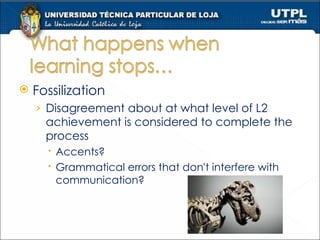
Fossilization Disagreement about at what level of L2 achievement is considered to complete the  process Accents? Grammatical errors that don't interfere with communication?
 
Is there a natural order or universal sequence for learning a second language across languages? If so, does L1 transfer really exist? Is this natural order that same in L2A and L1A?
L1 and L2 order of acquisition very similar L2 order of acquisition almost identical independent of the L1 of the learner These conclusions provide further evidence of innate language acquisition Later studies made to see if syntactical order the same in L2 acquisition
Assumes a Language Acquisition Device Made up of 5 hypotheses Acquisition-learning hypothesis Monitor hypothesis What is learned serves only to alter what has been acquired Natural order hypothesis Input hypothesis (Comprehensible input) Affective Filter Hypothesis
This model made a huge impact in the teaching field Communicative approach Indirect grammar teaching
Claims not scientifically verifiable Definitions vague and imprecise
What  is being acquired in SLA is a rule governed system Development is progression through dynamic interlanguage which differs from L1 and from L2 Final state of L2 differs from the native speaker system
How SLA takes place? Creative mental process Development follows predictable sequences similar for both L1 and L2 acquisition Why some learners are more successful in SLA than others? Relative success attributed mostly to the age of the learner
Norm Chomsky Two questions still of interest in the linguists field: What do language learners really know about the language they are learning? How do learners know more than the input they receive? Logical problem of language learning =Poverty of the stimulus
Learner competence only explainable by an innate capacity Genetically endowed ability- Language Faculty All children born with the general knowledge needed to learn language All children already “know” the rules that govern all natural languages Language Faculty a potential solution to the Logical Problem Children only need to build upon an already existing system. Social interaction determines  what  is built upon the innate system
So what is happening in the mind of the language learner? Principles are the elements that all languages of the world share Some principles have parameters, or limitations depending on the specific language
Since P&P are innate, the child is able to interpret and analyze input to construct the correct grammar UG strictly constrains the process, which explains why children lean so quickly
Lexical items include rich specification of properties These important because needed for parameter setting and other features of grammar and semantics Knowing a word means knowing its meaning, pronunciation, place in the sentence
The  Initial State  of L1A is UG. What is acquired in the process is information from input (especially vocabulary) that learner matches with UG options The  Final State  of L1A is adult grammar The  Intermediate States  are: The initial state transformed by experience and determined by the processes of maturation Several stable stages, finally end at about puberty
Natural, instinctive, internal to the cognitive system Attitudes, motivation and social context (beyond minimal input) play no role
What is the  initial state  in SLA? What is the nature of  interlanguage ? How does interlanguage change over time? What is the  final state  of SLA
At the beginning of L2A, the learner has already gone through the process of L1A Some L1 knowledge is transferred to L2 Circumstances of L2 learning When L1 and L2 parameter settings are the same, positive transfer is likely When L1 and L2 parameter settings are different, negative transfer (interference) may occur
Disagreement about whether or not L2 learners have access to UG Four Possibilities Learners have  full access  to UG in L2 learning Learners have  partial access Learners retain  indirect access , through what they know in the L1 Learners have  no access , but must learn the L2 through different means
Interlanguage=intermediate states of L2 development=interim grammars If  some access to UG is available, IL is a matter of “resetting” the parameters on the basis of input of new language This happens because new input doesn’t match the L1 parameters Choices limited and thus new language won’t deviate from UG If  learning principles that are part of the  language faculty  are still available there is enough information is available to make changes Positive Evidence: input from natural or formal setting Negative Evidence:  explicit correction
If  L2 learners  don't  have access to UG then L2A needs to be explained in a fundamentally different process Arguments against the  no access  hypothesis  No evidence that IL violates UG L1 transfer and L2 input can’t account entirely for the L2A process
Why are some SL learners more successful than others? Huge variability in learner “success” All may not have same access to UG Different relationships between L1s and L2s = different levels of transfer Different access to L2 input Some learners more sensitive to the mismatches in L2 input and L1 parameters Different degrees of specification of lexical features
Functional Approaches Originate in Eastern Europe in the early 1900’s Emphasize information of language produced in real situations  Consider language as a means of communication rather than a set of rules Greater interest in discourse structure, how language used for interaction, include aspects of communication beyond language
 
The Psychology of Second Language Acquisition
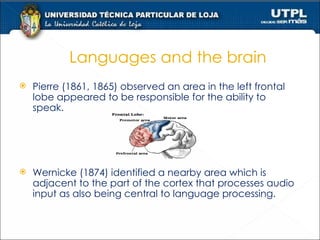
  Languages and the brain Pierre (1861, 1865) observed an area in the left frontal lobe appeared to be responsible for the ability to speak. Wernicke (1874) identified a nearby area which is adjacent to the part of the cortex that processes audio input as also being central to language processing.
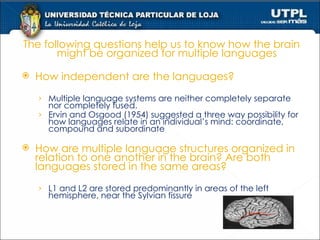
The following questions help us to know how the brain might be organized for multiple languages  How independent are the languages? Multiple language systems are neither completely separate nor completely fused. Ervin and Osgood (1954) suggested a three way possibility for how languages relate in an individual’s mind: coordinate, compound and subordinate How are multiple language structures organized in relation to one another in the brain? Are both languages stored in the same areas? L1 and L2 are stored predominantly in areas of the left hemisphere, near the Sylvian fissure
Does the organization of the brain for L2 in relation to L1 differ with age acquisition, how it is learned, or level of proficiency? Vaid (1983) concludes that individuals who acquire L2 later in life show more right hemisphere involvement Cook suggests that the variation in right hemisphere involvement may be due to the lack of a single route to L2 knowledge The organization of L2 knowledge is more diffuse for lower levels of proficiency  and more compact for highly fluent L2 users.  Do two or more languages show the same sort of loss or disruption after brain damage? Obler and Gjerlow (1999) conclude rather that a significant factor in initial recovery is which language was most used in the years prior to the incident which caused the damage, whether this is L1 or L2. Not only can different languages be affected differentially by brain damage, but different abilities in the same language may be differentially impaired.  What is being added in the brain when a second language is acquired is not very different from, nor usually entirely separate from, what is already there for the first.
Learning processes Learning language is essentially like learning other domains of knowledge Information Processing   Stages Input (Perception) Central processing  Controlled-automatic processing  Declarative-procedural knowledge Restructuring Output (Production) Fluency
Theories regarding order of acquisition Multidimensional Model  Learners acquire certain grammatical structures in a developmental sequence. Developmental sequences reflect how learners overcome processing limitation Language instruction which targets developmental features will be successful only if learners have already mastered the processing operations which are associated with the precious stage of acquisition
Competition Model The form of a lexical item is represented by its auditory properties, and its function by its semantic properties; the forms of strings of lexical items are word-order patterns and morphological inflections, and their functions are grammatical
Differences in Learners AGE Younger advantage : brain plasticity, not analytical, fewer inhibitions, weaker group identity, simplified input more likely Older advantage : learning capacity, analytic ability, pragmatic skills, greater knowledge of L1, real-world knowledge SEX Females : to be better at memorizing complex forms Males : to be better at computing compositional rules
APTITUDE Phonemic coding ability Inductive language learning ability Grammatical sensitivity Associative memory capacity MOTIVATION Sigificant goal or need Desire to attain the goal Perception that learning L2 is relevant to fulfilling the goal or meeting the need Belief in the likely success or failure of learning L2 Value of potential outcomes/rewards
Cognitive style It  refers to individuals’ preferred way of processing, conceptualizing, organizing, and recalling information.  It  is also related to and interacts with  personality factors  (imaginative, self-confident, risk-taking, etc) and  learning strategies  (behaviors and techniques they adopt in their efforts to learn a second language).
The effects of multilingualism Multilingualism has positive effects on intellectual functions Advantages in tasks of both verbal and nonverbal abilities  Advanced metalinguistic abilities  Cognitive and metalinguistic advantages  Advantages in the use of language for verbal mediation
THANK YOU
 

Psichology And Languaje Learning

  • 1.
    SCHOOL : NOMBRES: PSYCHOLOGY AND LANGUAGE LEARNING FECHA : OCTUBRE – FEBRERO 2008 Econ. Ana Gates Lic. Eliana Pinza Languages
  • 2.
    The study ofthe people and of the process Areas of study are both the formal and informal settings for SLA The broad questions in SLA are: What does the second language learner come to know? How do they come to know it? Why are some more successful than others ?
  • 3.
    Linguists: Theywant to know about the differences and similarities between languages being learned They want to understand the linguistic competence, or the underlying knowledge and linguistic performance, or what is being produced, at different stages in the language learning process Sociolinguists: They are interested in how differences in the learners themselves accounts for their communicative competence, or the ability to successfully communicate in the second language Social Psychologists: They are curious about how the social context of learners influences the process
  • 4.
    They may takeone or many approaches to understanding language acquisition but their final goal is to identify the implications of research findings in the teaching realm. They are our allies, as they help us to be scientifically grounded, and therefore, better teachers
  • 5.
    Each field ofSLA study approaches the questions from different angles Sometimes findings conflict and contradict Each offers insight to one or more aspects of this very complicated process
  • 6.
    Linguistics of SecondLanguage Acquisition
  • 7.
    What do alllanguages have in common Languages are systematic Languages are symbolic Languages are social
  • 8.
    Lexicon (vocabulary) MeaningPronunciation, spelling, Part of speech Collocations Phonology (sound system) Phonemes (sounds that make a difference in meaning Possible sequences of vowels and consonents Intonation patterns (stress, pitch, duration) Rhythmic patterns (starts and stops)
  • 9.
    Morphology (word structure)Morphemes Inflections that have grammatical information Suffixes and prefixes that change meaning or grammatical category Syntax (grammar) Word order Agreement between sentence elements (nouns and verbs, articles and gender, etc.) Ways to form questions, negate assertions , etc.
  • 10.
    Discourse Ways toconnect sentences, paragraphs, etc. Ways to tell stories, have conversations, etc. Scripts for interacting and events
  • 11.
    FACTS: Children cometo master all these aspects of language by the time they are 6, with further refinement as they mature and gain more experience Second language learners rarely master all linguistics categories
  • 12.
    Contrastive Analysis (CA)Predicts and explains SL learner problems by comparing and contrasting L1 and L2 Goal was to improve language teaching and testing
  • 13.
    Assumes language learningto involve mainly habit formation Stimulus-Response-Reinforcement (S-R-R)
  • 14.
    SLA success inpart attributed to the differences and similarities of the L1 and L2 More important are insistences of good or poor habit formation Warns against attaining fluency too soon in the SLA process
  • 15.
    Compares and describeslanguages level by level in a specific order from smaller to larger units Phonology Morphology Syntax Lexicon (little emphasis) Discourse (very little emphasis) Gives more importance to structure than to meaning for language learning hence the term Structural Linguistics
  • 16.
    Elements habituated inL1 are applied to the learning of the L2 Positive transfer (same structures present in both languages) eg. Plurals indicated by adding an “s” to the end of the noun. This rule is the same in English and in Spanish Negative transfer (when L1 structures are applied when they don’t exist in the L2) eg. Page 36 has several examples
  • 17.
    Described L1 andL2 at each level Analyzed comparable segments of the languages in search of things that are likely to cause problems for the L2 learner These elements were given attention in the development of lessons and determine What needs to be practiced What order to present structures
  • 18.
    CA doesn’t explainhow learners know more than they have heard or have been taught (Logical problem of language learning) CA analysis not always validated by actual learner errors Some expected errors didn’t happen Some unexpected errors did Not as much positive transfer as expected happened Not very useful as a pedagogical tool Too language specific, doesn’t work in a multilingual L1 classroom (may work better in EFL classrooms
  • 19.
  • 20.
    Focus on learnerscreative abilities Based on actual learner errors, rather than predicted errors By 1970’s had pretty much replaced CA for the following reasons: Real learner errors couldn’t be explained by transfer of L1 to L2 Shift in linguistics focus from surface structures to underlying rules Behaviorist assumptions called into question Mentalism (focus on innate capacities) Shift away from purely teaching concerns Norm Chomsky’s theories
  • 21.
    Inner forces workwith environment for language acquisition Child is active participant in the process, not simply the receiver of stimuli Child language and SL learner language come to be regarded in their own right
  • 22.
    Not considered badhabits Offer insight to the process of language learning Errors are part of learning itself
  • 23.
    Collected of asample of learner language Identified errors Errors vs. mistakes Described errors Usually as one of the linguistic categories of language Explained errors Interlingual (interference, techniques from CA) Intralingual Incomplete L2 knowledge Over-generalizing L2 rules Evaluated errors Seriousness of error in communication
  • 24.
    Ambiguity in classification(how do we really know what has occurred is an error or a mistake?) Lack of positive data What the learner knows Correct use overlooked Potential for avoidance Learners avoid difficult language
  • 25.
  • 26.
    Term coined byLarry Selinker in 1972 Refers to language states in progress towards the final state of L2
  • 27.
    Creative process Innerforces in interaction with the environment Influenced by L1 and target language Considered as a language of its own World English?
  • 28.
    Systematic During stagesof L2 development, language is governed by rules or internal grammar Rules can be discovered by analyzing the grammar used by the learner at any point in L2 development Dynamic Rules are frequently changing Succession of interim grammars Moves from plateau to plateau Variable Different contexts results in different language use Reduced system Form Function
  • 29.
    Boundaries unclear Beginswhen a person first attempts to express meaning in L2 or when some grammatical structures change? Ends when learning permanently stops
  • 30.
    Fossilization Disagreement aboutat what level of L2 achievement is considered to complete the process Accents? Grammatical errors that don't interfere with communication?
  • 31.
  • 32.
    Is there anatural order or universal sequence for learning a second language across languages? If so, does L1 transfer really exist? Is this natural order that same in L2A and L1A?
  • 33.
    L1 and L2order of acquisition very similar L2 order of acquisition almost identical independent of the L1 of the learner These conclusions provide further evidence of innate language acquisition Later studies made to see if syntactical order the same in L2 acquisition
  • 34.
    Assumes a LanguageAcquisition Device Made up of 5 hypotheses Acquisition-learning hypothesis Monitor hypothesis What is learned serves only to alter what has been acquired Natural order hypothesis Input hypothesis (Comprehensible input) Affective Filter Hypothesis
  • 35.
    This model madea huge impact in the teaching field Communicative approach Indirect grammar teaching
  • 36.
    Claims not scientificallyverifiable Definitions vague and imprecise
  • 37.
    What isbeing acquired in SLA is a rule governed system Development is progression through dynamic interlanguage which differs from L1 and from L2 Final state of L2 differs from the native speaker system
  • 38.
    How SLA takesplace? Creative mental process Development follows predictable sequences similar for both L1 and L2 acquisition Why some learners are more successful in SLA than others? Relative success attributed mostly to the age of the learner
  • 39.
    Norm Chomsky Twoquestions still of interest in the linguists field: What do language learners really know about the language they are learning? How do learners know more than the input they receive? Logical problem of language learning =Poverty of the stimulus
  • 40.
    Learner competence onlyexplainable by an innate capacity Genetically endowed ability- Language Faculty All children born with the general knowledge needed to learn language All children already “know” the rules that govern all natural languages Language Faculty a potential solution to the Logical Problem Children only need to build upon an already existing system. Social interaction determines what is built upon the innate system
  • 41.
    So what ishappening in the mind of the language learner? Principles are the elements that all languages of the world share Some principles have parameters, or limitations depending on the specific language
  • 42.
    Since P&P areinnate, the child is able to interpret and analyze input to construct the correct grammar UG strictly constrains the process, which explains why children lean so quickly
  • 43.
    Lexical items includerich specification of properties These important because needed for parameter setting and other features of grammar and semantics Knowing a word means knowing its meaning, pronunciation, place in the sentence
  • 44.
    The InitialState of L1A is UG. What is acquired in the process is information from input (especially vocabulary) that learner matches with UG options The Final State of L1A is adult grammar The Intermediate States are: The initial state transformed by experience and determined by the processes of maturation Several stable stages, finally end at about puberty
  • 45.
    Natural, instinctive, internalto the cognitive system Attitudes, motivation and social context (beyond minimal input) play no role
  • 46.
    What is the initial state in SLA? What is the nature of interlanguage ? How does interlanguage change over time? What is the final state of SLA
  • 47.
    At the beginningof L2A, the learner has already gone through the process of L1A Some L1 knowledge is transferred to L2 Circumstances of L2 learning When L1 and L2 parameter settings are the same, positive transfer is likely When L1 and L2 parameter settings are different, negative transfer (interference) may occur
  • 48.
    Disagreement about whetheror not L2 learners have access to UG Four Possibilities Learners have full access to UG in L2 learning Learners have partial access Learners retain indirect access , through what they know in the L1 Learners have no access , but must learn the L2 through different means
  • 49.
    Interlanguage=intermediate states ofL2 development=interim grammars If some access to UG is available, IL is a matter of “resetting” the parameters on the basis of input of new language This happens because new input doesn’t match the L1 parameters Choices limited and thus new language won’t deviate from UG If learning principles that are part of the language faculty are still available there is enough information is available to make changes Positive Evidence: input from natural or formal setting Negative Evidence: explicit correction
  • 50.
    If L2learners don't have access to UG then L2A needs to be explained in a fundamentally different process Arguments against the no access hypothesis No evidence that IL violates UG L1 transfer and L2 input can’t account entirely for the L2A process
  • 51.
    Why are someSL learners more successful than others? Huge variability in learner “success” All may not have same access to UG Different relationships between L1s and L2s = different levels of transfer Different access to L2 input Some learners more sensitive to the mismatches in L2 input and L1 parameters Different degrees of specification of lexical features
  • 52.
    Functional Approaches Originatein Eastern Europe in the early 1900’s Emphasize information of language produced in real situations Consider language as a means of communication rather than a set of rules Greater interest in discourse structure, how language used for interaction, include aspects of communication beyond language
  • 53.
  • 54.
    The Psychology ofSecond Language Acquisition
  • 55.
    Languagesand the brain Pierre (1861, 1865) observed an area in the left frontal lobe appeared to be responsible for the ability to speak. Wernicke (1874) identified a nearby area which is adjacent to the part of the cortex that processes audio input as also being central to language processing.
  • 56.
    The following questionshelp us to know how the brain might be organized for multiple languages How independent are the languages? Multiple language systems are neither completely separate nor completely fused. Ervin and Osgood (1954) suggested a three way possibility for how languages relate in an individual’s mind: coordinate, compound and subordinate How are multiple language structures organized in relation to one another in the brain? Are both languages stored in the same areas? L1 and L2 are stored predominantly in areas of the left hemisphere, near the Sylvian fissure
  • 57.
    Does the organizationof the brain for L2 in relation to L1 differ with age acquisition, how it is learned, or level of proficiency? Vaid (1983) concludes that individuals who acquire L2 later in life show more right hemisphere involvement Cook suggests that the variation in right hemisphere involvement may be due to the lack of a single route to L2 knowledge The organization of L2 knowledge is more diffuse for lower levels of proficiency and more compact for highly fluent L2 users. Do two or more languages show the same sort of loss or disruption after brain damage? Obler and Gjerlow (1999) conclude rather that a significant factor in initial recovery is which language was most used in the years prior to the incident which caused the damage, whether this is L1 or L2. Not only can different languages be affected differentially by brain damage, but different abilities in the same language may be differentially impaired. What is being added in the brain when a second language is acquired is not very different from, nor usually entirely separate from, what is already there for the first.
  • 58.
    Learning processes Learninglanguage is essentially like learning other domains of knowledge Information Processing Stages Input (Perception) Central processing Controlled-automatic processing Declarative-procedural knowledge Restructuring Output (Production) Fluency
  • 59.
    Theories regarding orderof acquisition Multidimensional Model Learners acquire certain grammatical structures in a developmental sequence. Developmental sequences reflect how learners overcome processing limitation Language instruction which targets developmental features will be successful only if learners have already mastered the processing operations which are associated with the precious stage of acquisition
  • 60.
    Competition Model Theform of a lexical item is represented by its auditory properties, and its function by its semantic properties; the forms of strings of lexical items are word-order patterns and morphological inflections, and their functions are grammatical
  • 61.
    Differences in LearnersAGE Younger advantage : brain plasticity, not analytical, fewer inhibitions, weaker group identity, simplified input more likely Older advantage : learning capacity, analytic ability, pragmatic skills, greater knowledge of L1, real-world knowledge SEX Females : to be better at memorizing complex forms Males : to be better at computing compositional rules
  • 62.
    APTITUDE Phonemic codingability Inductive language learning ability Grammatical sensitivity Associative memory capacity MOTIVATION Sigificant goal or need Desire to attain the goal Perception that learning L2 is relevant to fulfilling the goal or meeting the need Belief in the likely success or failure of learning L2 Value of potential outcomes/rewards
  • 63.
    Cognitive style It refers to individuals’ preferred way of processing, conceptualizing, organizing, and recalling information. It is also related to and interacts with personality factors (imaginative, self-confident, risk-taking, etc) and learning strategies (behaviors and techniques they adopt in their efforts to learn a second language).
  • 64.
    The effects ofmultilingualism Multilingualism has positive effects on intellectual functions Advantages in tasks of both verbal and nonverbal abilities Advanced metalinguistic abilities Cognitive and metalinguistic advantages Advantages in the use of language for verbal mediation
  • 65.
  • 66.