SPEAKINGWILSON BURGOS AROCAMARTHA LILIANA CARRILLO ARIASCandidates to Master’s Degree on English DidacticsSurcolombiana  and Caldas Universities AgreementNeiva, November 2009
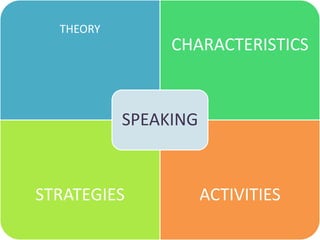
THEORYAccording to Bailey and Savage, 1994.Speaking  in a second or foreign language has often been viewed as the most demanding of the four skills. Canale and Swain (1980) proposed that the teaching of speaking must aim at the development of the communicative competence.   Oral skill classes  at all levels are often structured around functional uses of language.
PROBLEMS
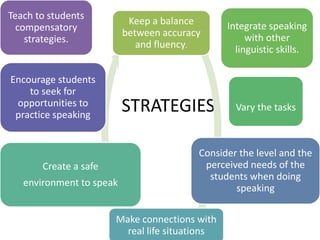
STRATEGIES
STRATEGIES
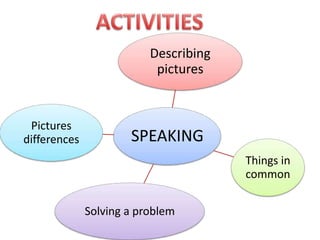
ACTIVITIES
ACTIVITIES
Useful websites for Speakingwww.eslgo.comThis webpage includes speaking activities such as role-plays, “Find someone who...” speaking activities, information gap activities, examination rubrics for ESL oral tests, and discussion questions. http://www.teachingenglish.org.ukThis British Council and BBC webpage has a varied set of activities for speaking. Once you type it, go to try and then to activity and finally to speaking. http://www.esldiscussions.comThis webpage provides several speaking activities for your students to discuss. Topics such as abortion, AIDS, immigration among others are available. You type the webpage and the discussion topics are alphabetically ordered. http://www.spokenskills.comThis webpage provides English teachers with a variety of speaking activities for oral communication such as English for specific purposes, everyday English, consonant sounds, vowel sounds, business English, dialogues, arts, sports, entertainment, current events among other areas.
BibliographyKenworthy, J (1987).  Teaching English  Pronunciation.Brown, G and Yule, G. (1983). Teaching the spoken language. Cambridge University Press.Lazaraton, A. (2001). Teaching Oral skills.Bailey, K.M. and Savage, Eds. (1994).  New Ways in Teaching Speaking. Alexandria, VA:TESOL.Murphy, J.M. (1991). Oral Communication in TESOL. Integrating Speaking, Listening and Pronunciations TESOL Quarterly  25 (D1): 51-75.Riggenbach, H. (1999). Discourse Analysis in the Language Classroom. Volume 1. The Spoken Language. Ann Arbor, MI: University of Michigan Press.Underhill, N. (1987). Testing Spoken Language. A Handbook of Oral Testing Techniques. Cambridge University Press.

Speaking

  • 1.
    SPEAKINGWILSON BURGOS AROCAMARTHALILIANA CARRILLO ARIASCandidates to Master’s Degree on English DidacticsSurcolombiana and Caldas Universities AgreementNeiva, November 2009
  • 3.
    THEORYAccording to Baileyand Savage, 1994.Speaking in a second or foreign language has often been viewed as the most demanding of the four skills. Canale and Swain (1980) proposed that the teaching of speaking must aim at the development of the communicative competence. Oral skill classes at all levels are often structured around functional uses of language.
  • 5.
  • 6.
  • 7.
  • 9.
  • 10.
  • 11.
    Useful websites forSpeakingwww.eslgo.comThis webpage includes speaking activities such as role-plays, “Find someone who...” speaking activities, information gap activities, examination rubrics for ESL oral tests, and discussion questions. http://www.teachingenglish.org.ukThis British Council and BBC webpage has a varied set of activities for speaking. Once you type it, go to try and then to activity and finally to speaking. http://www.esldiscussions.comThis webpage provides several speaking activities for your students to discuss. Topics such as abortion, AIDS, immigration among others are available. You type the webpage and the discussion topics are alphabetically ordered. http://www.spokenskills.comThis webpage provides English teachers with a variety of speaking activities for oral communication such as English for specific purposes, everyday English, consonant sounds, vowel sounds, business English, dialogues, arts, sports, entertainment, current events among other areas.
  • 12.
    BibliographyKenworthy, J (1987). Teaching English Pronunciation.Brown, G and Yule, G. (1983). Teaching the spoken language. Cambridge University Press.Lazaraton, A. (2001). Teaching Oral skills.Bailey, K.M. and Savage, Eds. (1994). New Ways in Teaching Speaking. Alexandria, VA:TESOL.Murphy, J.M. (1991). Oral Communication in TESOL. Integrating Speaking, Listening and Pronunciations TESOL Quarterly 25 (D1): 51-75.Riggenbach, H. (1999). Discourse Analysis in the Language Classroom. Volume 1. The Spoken Language. Ann Arbor, MI: University of Michigan Press.Underhill, N. (1987). Testing Spoken Language. A Handbook of Oral Testing Techniques. Cambridge University Press.