LEAD POISONING
CONTENTS
  •Source  & Uses
  •Body stores & Distribution
  •Lead poisoning
  •Clinical features
  •Diagnosis
  •Management
  •Prevention
SOURCE & USES
•Lead(Pb)  is a heavy metal
•Occupational & Non-occupational sources
•Main source of environmental(non-occupational)
source of Pb is Gasoline
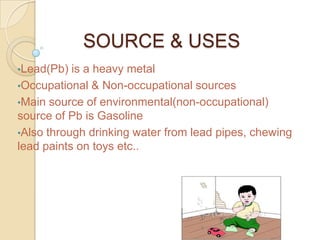
•Also through drinking water from lead pipes, chewing
lead paints on toys etc..
Contd…
Pb is used in various industries due to:-
       low B.P
      anticorrosive
      easily oxidised
      mixes with other metals easily to form alloys.
It is used in:- Storage batteries, glass manufacture,
ship building, printing and potteries, rubber industry
etc..
Body Stores & Distribution
Body store:- 150 to 400mg(blood level- 25µg/100ml)
Clinical symptoms- >70µg/100ml in blood
Normal adult ingest-0.2 to 0.3mg of lead/day
DISTRIBUTION


                                                       LIVER
INGESTION   ABSORPTION   CIRCULATION   ERYTHROCYTES      &     BONES
                                                      KIDNEY


  9
  5
  %


FAECES
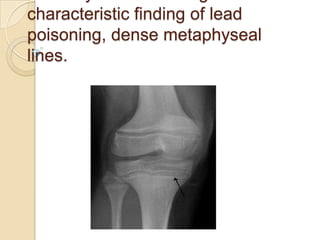
characteristic finding of lead
poisoning, dense metaphyseal
lines.
LEAD
  POISONING(PLUMBISM)
All lead compounds are toxic
MOST Dangerous- lead arsenate,lead oxide,lead
carbonate.
Least toxic-lead sulphide.
Plumbism occur in 3 ways-
INHALATION(most common), INGESTION, through
SKIN.
PATHOLOGY
Pb + essential SH-groups of certain enzymes

       Increase in permeability


           Potassium leakage
CLINICAL FEATURES
INORGANIC Pb exposure:- Abd. Colic
                         obstinate constipation
                         loss of appetite
                         blue lines on gums
                         stippling of red cells
                         anaemia
                         wrist drop
                          foot drop
Contd..
Organic Pb compounds:- (toxic effect mainly on CNS)
          Insomnia
          Headache
          Mental confusion
          Delirium etc..
DIAGNOSIS
History
Clinical
        features
Laboratory diagnosis
    a)Coproporphyrin in urine(CPU)
              Normal- <150µg/L
    b)Amino levulinic acid in urine(ALAU)
            >5mg/L
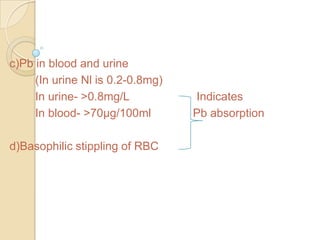
c)Pb in blood and urine
     (In urine Nl is 0.2-0.8mg)
     In urine- >0.8mg/L           Indicates
     In blood- >70µg/100ml        Pb absorption

d)Basophilic stippling of RBC
MANAGEMENT
Aim
a)   To prevent further absorption
b)   To remove lead from soft tissues
c)   To prevent recurrence
                 TREATMENT
     Saline purge (remove lead from the gut)
     d-penicillamine(promote Pb excretion in urine)
PREVENTIVE
  MEASURES
a)Substitution
    Pb compounds should be substituted by less toxic
materials.
b)Isolation
     Pb dust or fumes should be enclosed and segregated
c)Local exhaust ventillation
    To remove dust & fumes
Contd…
d)Personal protection
      By approved respirators
e)Good housekeeping
f)In working atmosphere
    Pb conc. Should be kept <2mg per 10cu.m of air
g)Periodic medical examination of workers
h)Personal hygiene (Hand washing)
i)Health education
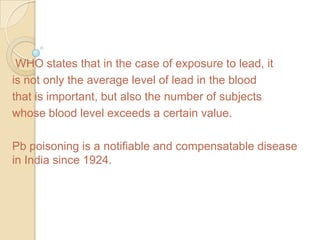
WHO states that in the case of exposure to lead, it
is not only the average level of lead in the blood
that is important, but also the number of subjects
whose blood level exceeds a certain value.

Pb poisoning is a notifiable and compensatable disease
in India since 1924.
Lead poisoning
Lead poisoning

Lead poisoning

  • 1.
  • 2.
    CONTENTS •Source & Uses •Body stores & Distribution •Lead poisoning •Clinical features •Diagnosis •Management •Prevention
  • 3.
    SOURCE & USES •Lead(Pb) is a heavy metal •Occupational & Non-occupational sources •Main source of environmental(non-occupational) source of Pb is Gasoline •Also through drinking water from lead pipes, chewing lead paints on toys etc..
  • 4.
    Contd… Pb is usedin various industries due to:- low B.P anticorrosive easily oxidised mixes with other metals easily to form alloys. It is used in:- Storage batteries, glass manufacture, ship building, printing and potteries, rubber industry etc..
  • 5.
    Body Stores &Distribution Body store:- 150 to 400mg(blood level- 25µg/100ml) Clinical symptoms- >70µg/100ml in blood Normal adult ingest-0.2 to 0.3mg of lead/day
  • 6.
    DISTRIBUTION LIVER INGESTION ABSORPTION CIRCULATION ERYTHROCYTES & BONES KIDNEY 9 5 % FAECES
  • 7.
    characteristic finding oflead poisoning, dense metaphyseal lines.
  • 8.
    LEAD POISONING(PLUMBISM) Alllead compounds are toxic MOST Dangerous- lead arsenate,lead oxide,lead carbonate. Least toxic-lead sulphide. Plumbism occur in 3 ways- INHALATION(most common), INGESTION, through SKIN.
  • 9.
    PATHOLOGY Pb + essentialSH-groups of certain enzymes Increase in permeability Potassium leakage
  • 10.
    CLINICAL FEATURES INORGANIC Pbexposure:- Abd. Colic obstinate constipation loss of appetite blue lines on gums stippling of red cells anaemia wrist drop foot drop
  • 11.
    Contd.. Organic Pb compounds:-(toxic effect mainly on CNS) Insomnia Headache Mental confusion Delirium etc..
  • 13.
    DIAGNOSIS History Clinical features Laboratory diagnosis a)Coproporphyrin in urine(CPU) Normal- <150µg/L b)Amino levulinic acid in urine(ALAU) >5mg/L
  • 14.
    c)Pb in bloodand urine (In urine Nl is 0.2-0.8mg) In urine- >0.8mg/L Indicates In blood- >70µg/100ml Pb absorption d)Basophilic stippling of RBC
  • 15.
    MANAGEMENT Aim a) To prevent further absorption b) To remove lead from soft tissues c) To prevent recurrence TREATMENT  Saline purge (remove lead from the gut)  d-penicillamine(promote Pb excretion in urine)
  • 16.
    PREVENTIVE MEASURES a)Substitution Pb compounds should be substituted by less toxic materials. b)Isolation Pb dust or fumes should be enclosed and segregated c)Local exhaust ventillation To remove dust & fumes
  • 17.
    Contd… d)Personal protection By approved respirators e)Good housekeeping f)In working atmosphere Pb conc. Should be kept <2mg per 10cu.m of air g)Periodic medical examination of workers h)Personal hygiene (Hand washing) i)Health education
  • 18.
    WHO states thatin the case of exposure to lead, it is not only the average level of lead in the blood that is important, but also the number of subjects whose blood level exceeds a certain value. Pb poisoning is a notifiable and compensatable disease in India since 1924.