Inorganic Metallic Irritants
Dr. Abhishek Varun, MD
Assistant Professor
Department of Forensic
Medicine & Toxicology
Heavy Metal Toxicity
Heavy metal poisoning occurs when microscopic molecules of metals accumulate
within your body after exposure.
Heavy metals attach to your cells and prevent them from performing their
functions, which causes symptoms that could be life threatening without treatment.
Heavy metals are toxic to human health.
They are mainly produced by industrial activities, and deposit slowly in the
surrounding water and soil
Metals are of Public interest because of exposures related to
environmental contamination and through bioaccumulation
within the food chain.
Major Toxic metals are
Lead
Lead is a chemical element with the symbol Pb and atomic number 82.
Lead is a naturally occurring toxic metal found in the Earth’s crust. Its widespread
use has resulted in extensive environmental contamination, human exposure and
significant public health problems in many parts of the world
• Soft blue-gray metal
• Was added to paint
and gasoline in past
• Still used in consumer
products
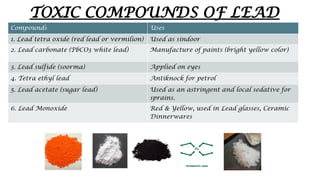
TOXIC COMPOUNDS OF LEAD
Compounds Uses
1. Lead tetra oxide (red lead or vermilion) Used as sindoor
2. Lead carbonate (PbCO3 white lead) Manufacture of paints (bright yellow color)
3. Lead sulfide (soorma) Applied on eyes
4. Tetra ethyl lead Antiknock for petrol
5. Lead acetate (sugar lead) Used as an astringent and local sedative for
sprains.
6. Lead Monoxide Red & Yellow, used in Lead glasses, Ceramic
Dinnerwares
Lead combines with Sulfhydryl groups and
interferes with mitochondrial oxidative
phosphorylation, ATPases, Calcium dependent
messengers and enhances oxidation and cell
apoptosis. This causes defective heme
synthesis, proximal renal tubular and osteoblast
dysfunction.
Distribution of Lead
• 95% stored in long bones.
• Binds into matrix.
• Released during osteolysis.
• Lead breaks the blood-brain barrier and
interferes with the normal development of brain
in infants.
Lead is absorbed through all portals of entry. Occupational
exposure results mainly from inhalation. Tetraethyl lead can
be absorbed rapidly through intact skin.
Following absorption, it is stored in the bones as phosphate
and carbonate. In children about 70% of total body lead is
skeletal, while in adults over 95% is in osseous tissues.
Lead is drawn to those areas of the skeleton which are
growing most rapidly. These include the radius, tibia, and
femur, which are the most metabolically active.
Lead Toxicity, cont.
Clinical features, plumbism:
Acute intoxication:
GIT CNS
• Colic
• Metallic taste to mouth
• Vomiting, diarrhea or constipation
• Increased thirst (dry throat)
• Hemolysis, hemoglobinuria
• Oliguria
Headache
Lethargy
Arthralgia
Myalgia
Anorexia
Insomnia
Paresis & paresthesias
Chronic lead Poisoning
Anemia:
Burtons/ Burtonian Line:
Colic:
Constipation:
Lead Palsy: (wrist drop and foot drop)
Lead Encephalopathy
Facial Pallor
Lead Toxicity, cont.
• Consider lead poisoning whenever a small child presents with
peculiar symptoms that do not match any one particular disease
entity.
• Especially:
• Irritability
• sleeplessness
• poor appetite
• headaches
• if parents use folk remedies or their parents work in a lead-related
occupation
Fatal Dose:
Lead Carbonate- 40 g
Lead Acetate- 20 g
Fatal Period: 1-2 days
Complete Blood Count
• May show basophilic stippling* in patients with extended significant exposure, presence
of dark blue colored pinhead size spots in the cytoplasm of the RBCs representing
aggregated ribosomes, due to toxic action of lead on porphyrin metabolism.
* Also seen in Arsenic poisoning
Lead poisoning Normal red blood cells
basophilic
stippling
Abdominal Radiograph
Charm in Stomach
Lead
Lead charm found in
child’s stomach
Longbone radiographs
Lead Lines
Lead Lines
“Lead Lines” in five year
old male with
radiological growth
retardation and blood
lead level of 37.7µg/dl
Lead Lines in Legs
“Lead Lines” in three-
year-two-month-old girl
with Blood lead level of
10.6 µg/dl
Notice the increased
density on the
metaphysis growth plate
of the knee.
Lead Lines
Gastric lavage with 1% solution of Sodium
or Magnesium Sulfate- (forms insoluble lead
sulfate)
Whole bowel irrigation with polythelene glycol
electrolyte solution at 1-2 L/ hour for adult and
25-40ml/kg/h for children.
Demulcents and cathartics.
Calcium disodium EDTA 50mg/kg/day
Calcium Chloride 5mg as 10% solution IV or
Calcium gluconate 10ml of 10% solution IV
causes deposition of lead in bones from blood.
Lead Toxicity
Patient management / Treatment:
Post Mortem Findings of Acute Poisoning
• Body looks emaciated.
• Rigor mortis appears early.
• Stomach wall swollen.
• Mucus membrane is congested and grayish in color.
It is softened with eroded patches.
• Reddish color mucosa is seen in acute lead tetraoxide
ingestion.
Mercury
Mercury is a liquid metal, having bright silver appearance. It’s
toxic to people, so even low levels of exposure can cause health
problems.
Fatal Dose: 1-4gm of Mercuric Chloride (30-50mg/kg),
Methyl Mercury :10-60mg/kg,
Mercury vapor: 10mg/m3
Mercury exists in various forms:
Elemental (or metallic, it is non poisonous, if swallowed poorly
absorbed from GIT)
Inorganic (to which people may be exposed through their
occupation, Metallic Mercury (Hg), Mercurous Mercury (Hg+),
Mercuric Mercury (Hg2+))
Organic (e.g., methyl mercury, to which people may be
exposed through their diet).
Mercury
Sources of mercury
Natural sources of mercury (elemental form or as mercury compounds):
volcanoes, hot springs, weathering products of of some minerals in rocks.
Elemental mercury associated with human activity: thermometers, electrical
switches, fluorescent lights, thermostats, barometers, batteries, dental fillings.
About 80 % of elemental mercury released into the atmosphere is linked to
fossil fuel combustion in power plants, mining, smelting, and solid waste
incineration.
Inorganic mercury compounds associated with human activity: pigments
(such as tattoo dyes), vaccines, medicines (as a preservative, for example),
skin bleaching creams, disinfectants or antiseptics, paints* and pesticides.
Use of mercury in paint phased out in 1991.
Organic mercury compounds: most common is methylmercury (produced by
activities of microbes- but source of mercury often human-related) . Taken up
by living things and concentrated up food chain.
Inorganic Hg may be methylated and demethylated by
microorganisms.
Elemental Hg at ambient air temperatures volatilizes and is
extremely dangerous
• Most human exposure to Hg is by inhalation because it readily
diffuses across the alveolar membrane due to its lipid solubility.
Because of this property it has a high affinity for RBCs and the
CNS.
• Oral absorption of organic Hg is nearly 100%.
• Transfer through the placenta and the blood-brain barrier is
complete.
• Inorganic Hg is eliminated in urine and feces, while organic Hg is
eliminated primarily in the feces.
• Mechanism of Action:
Mercury binds with Sulfhdryl groups resulting in inactivation of
various enzymes, structural proteins, and alterations of cell
membrane permeability.
Increased oxidative stress, disruption of microtubule formation,
interference with protein synthesis, DNA replication, and Ca
homeostasis
Health effects of mercury
• Disruption of the nervous system
• Damage to brain functions
• DNA damage and chromosomal damage
• Allergic reactions, resulting in skin rashes, tiredness and
headaches
• Negative reproductive effects, such as sperm damage, birth
defects and miscarriages
Signs and Symptoms of Acute Toxicity
(Inhalation and Ingestion)
Lungs: cough, dyspnea, and tightness and burning pain in the chest.
GI: Metallic taste, acute inflammation of the oral cavity, abdominal pain,
nausea, and vomiting.
Cardiovascular: Hypertension, tachycardia, difficulty in breathing and
circulatory collapse.
Renal: Proteinuria, hematuria, and oliguria
Skin: Penetrating ulcers on fingers, nails & knuckles.
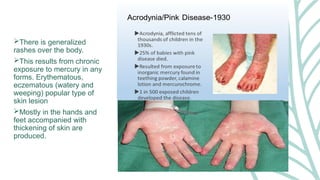
Acrodynia/ Pink disease : Pink cheeks, nose, hands and feet.
• Ingestion of inorganic mercurial salts
• GI irritation, including pain, vomiting, diarrhea, and renal failure.
Contact dermatitis, acrodynia (pink disease), shock, and
cardiovascular collapse.
• Subacute or Chronic Poisoning:
• Neurologic: damage to small neurons in the cerebellum and visual
cortex.
Clinical Management of Hg Poisoning
In case of inhalation: remove the victim immediately from source of
exposure, supplemental oxygen
For dermal or ocular exposure, washing of exposed areas are suggested.
Oral administration of a protein solution has been suggested to reduce
absorption, depending on Hg’s affinity for binding to SH groups.
Administration of activated charcoal: acute high-dose
Gastric lavage with 250 ml of sodium formaldehyde sulphoxylate. Sodium
formaldehyde sulphoxylate is the chemical antidote that reduces the perchloride
to metallic mercury.
• Chelation therapy: depends on the form of Hg, route of exposure,
and possible side effects that might be experienced.
• BAL is one of the more effective chelators for inorganic Hg salts,
while D-penicillamine is marginally effective as a chelator for
elemental and inorganic Hg.
• Maintain electrolyte and fluid balance.
Postmortem Findings
Body looks emaciated.
GIT: Mucosa shows inflammation, congestion and greyish corrosion.
Ulceration or gangrene of large intestine may be seen
Kidney: Interstitial nephritis
Heart: Subendocardial petechial hemorrhages
Liver: congested, fatty changes
Environmental effects of mercury
• Fish are organisms that absorb great amounts of methyl
mercury from surface waters every day (mercury can
accumulate in fish and in the food chains)
• The effects that mercury has on animals are: kidneys damage,
stomach disruption, damage to intestines, reproductive failure and
DNA alteration
There is generalized
rashes over the body.
This results from chronic
exposure to mercury in any
forms. Erythematous,
eczematous (watery and
weeping) popular type of
skin lesion
Mostly in the hands and
feet accompanied with
thickening of skin are
produced.
How does mercury affect human health ?
On a basic level, mercury causes a net loss of nerve tissue (due to
degeneration of nerve tissue and prevention of normal nerve development –
gets in the way of the way proteins bind).
In turn, nerve damage is reflected in abnormal functioning of nerve-
controlled processes (both physical and mental).
Kidney damage: long term exposure can lead to eventual kidney failure and
death (due to inability of kidneys to remove waste products).
Other effects: possible effects on fertility, birth defects, cancer- but less well
documented than above
Minamata Disease
We have already looked at the
consequences of short-term exposure to
high concentrations of mercury.
Remember, Minamata disease was found
to be linked to ingestion of mercury-
contaminated fish in Japan.
Again, the symptoms of mercury
poisoning were acute (and long-lasting)
due to irreparable nerve damage
(including intrauterine victims)
UN Minamata Convention
Hatter’s shake or Glass Blower’s Shake:
These are moderately coarse tremors starting from hands than to the lips
and tongue and finally arms and legs occur (DANBURY TREMORS).
These are detected early in the writing.
These are excited by voluntary movements and are absent during sleep.
These are interspersed with jerky movements, in coordination of
movements, increased deep reflexes, paresis of limbs and peripheral
neuritis.
The tremors should be differentiated from thyrotoxicosis in which there is
presence of fine tremors, exophthalomos, raised pulse and goiter.
During the 18th to 20th centuries, hat makers used mercury to stiffen
felt for hats. They used a type of mercury called mercuric nitrate and
worked in poorly ventilated rooms.
Over time, the hatters inhaled mercury vapors. Many developed
symptoms of chronic mercury poisoning, including psychosis,
excitability, and tremors. These symptoms became so common in
hatters that the phrase “mad as a hatter” was born.
In the United States, mercury was used in hat making until 1941.
Madhatter Syndrome
The “Mad hatter” character in Lewis Carroll’s Alice in Wonderland (1865) is not
as whimsical as one might think
Most people associate the phrase “mad as a hatter” Alice in
Wonderland, but was in use well before this work.
For example, Thomas Chandler Haliburton (writer from Nova
Scotia) in The Clockmaker (1836) wrote: “Father he larfed out like
anything; I thought he would never stop—and sister Sall got right
up and walked out of the room, as mad as a hatter”
In this case, “mad” appears to refer to anger. But the term was
more commonly used to indicate insanity.
An interesting aside:
Lewis Carroll (1832-1898), was, in real life, the Oxford Mathematics Lecturer (1855-81), the Reverend
Charles Lutwidge Dodgson.
His pseudonym reflects the derivation of his Christian names
Lewis Ludovicus Lutwidge
Carroll Carolus Charles
Alice’s Adventures in Wonderland and later Through the
Looking Glass written for Alice Liddell.
Alice Liddell (in 1859- age 7)
What do hats have to do with mercury ?
Felt hats (e.g. top hats) were all the rage in the 1800s
Early manufacturers used beaver fur, which matted well in its natural state
As beaver fur was becoming scarce (and was very expensive), hat
manufacturers started making hats from cheaper fibres, such as rabbit fur.
These cheaper fibres did not mat as well as beaver fur, so were chemically
treated to enhance matting ability.
THANK
YOU
Thank You
Insert the Sub Title of Your Presentation

Lead and Mercury.pptx............................

  • 1.
    Inorganic Metallic Irritants Dr.Abhishek Varun, MD Assistant Professor Department of Forensic Medicine & Toxicology
  • 2.
    Heavy Metal Toxicity Heavymetal poisoning occurs when microscopic molecules of metals accumulate within your body after exposure. Heavy metals attach to your cells and prevent them from performing their functions, which causes symptoms that could be life threatening without treatment. Heavy metals are toxic to human health. They are mainly produced by industrial activities, and deposit slowly in the surrounding water and soil
  • 3.
    Metals are ofPublic interest because of exposures related to environmental contamination and through bioaccumulation within the food chain. Major Toxic metals are
  • 4.
    Lead Lead is achemical element with the symbol Pb and atomic number 82. Lead is a naturally occurring toxic metal found in the Earth’s crust. Its widespread use has resulted in extensive environmental contamination, human exposure and significant public health problems in many parts of the world • Soft blue-gray metal • Was added to paint and gasoline in past • Still used in consumer products
  • 5.
    TOXIC COMPOUNDS OFLEAD Compounds Uses 1. Lead tetra oxide (red lead or vermilion) Used as sindoor 2. Lead carbonate (PbCO3 white lead) Manufacture of paints (bright yellow color) 3. Lead sulfide (soorma) Applied on eyes 4. Tetra ethyl lead Antiknock for petrol 5. Lead acetate (sugar lead) Used as an astringent and local sedative for sprains. 6. Lead Monoxide Red & Yellow, used in Lead glasses, Ceramic Dinnerwares
  • 8.
    Lead combines withSulfhydryl groups and interferes with mitochondrial oxidative phosphorylation, ATPases, Calcium dependent messengers and enhances oxidation and cell apoptosis. This causes defective heme synthesis, proximal renal tubular and osteoblast dysfunction.
  • 9.
    Distribution of Lead •95% stored in long bones. • Binds into matrix. • Released during osteolysis. • Lead breaks the blood-brain barrier and interferes with the normal development of brain in infants. Lead is absorbed through all portals of entry. Occupational exposure results mainly from inhalation. Tetraethyl lead can be absorbed rapidly through intact skin. Following absorption, it is stored in the bones as phosphate and carbonate. In children about 70% of total body lead is skeletal, while in adults over 95% is in osseous tissues. Lead is drawn to those areas of the skeleton which are growing most rapidly. These include the radius, tibia, and femur, which are the most metabolically active.
  • 10.
    Lead Toxicity, cont. Clinicalfeatures, plumbism: Acute intoxication: GIT CNS • Colic • Metallic taste to mouth • Vomiting, diarrhea or constipation • Increased thirst (dry throat) • Hemolysis, hemoglobinuria • Oliguria Headache Lethargy Arthralgia Myalgia Anorexia Insomnia Paresis & paresthesias
  • 11.
    Chronic lead Poisoning Anemia: Burtons/Burtonian Line: Colic: Constipation: Lead Palsy: (wrist drop and foot drop) Lead Encephalopathy Facial Pallor
  • 12.
    Lead Toxicity, cont. •Consider lead poisoning whenever a small child presents with peculiar symptoms that do not match any one particular disease entity. • Especially: • Irritability • sleeplessness • poor appetite • headaches • if parents use folk remedies or their parents work in a lead-related occupation
  • 13.
    Fatal Dose: Lead Carbonate-40 g Lead Acetate- 20 g Fatal Period: 1-2 days
  • 14.
    Complete Blood Count •May show basophilic stippling* in patients with extended significant exposure, presence of dark blue colored pinhead size spots in the cytoplasm of the RBCs representing aggregated ribosomes, due to toxic action of lead on porphyrin metabolism. * Also seen in Arsenic poisoning Lead poisoning Normal red blood cells basophilic stippling
  • 15.
    Abdominal Radiograph Charm inStomach Lead Lead charm found in child’s stomach
  • 16.
    Longbone radiographs Lead Lines LeadLines “Lead Lines” in five year old male with radiological growth retardation and blood lead level of 37.7µg/dl
  • 17.
    Lead Lines inLegs “Lead Lines” in three- year-two-month-old girl with Blood lead level of 10.6 µg/dl Notice the increased density on the metaphysis growth plate of the knee. Lead Lines
  • 21.
    Gastric lavage with1% solution of Sodium or Magnesium Sulfate- (forms insoluble lead sulfate) Whole bowel irrigation with polythelene glycol electrolyte solution at 1-2 L/ hour for adult and 25-40ml/kg/h for children. Demulcents and cathartics. Calcium disodium EDTA 50mg/kg/day Calcium Chloride 5mg as 10% solution IV or Calcium gluconate 10ml of 10% solution IV causes deposition of lead in bones from blood. Lead Toxicity Patient management / Treatment:
  • 22.
    Post Mortem Findingsof Acute Poisoning • Body looks emaciated. • Rigor mortis appears early. • Stomach wall swollen. • Mucus membrane is congested and grayish in color. It is softened with eroded patches. • Reddish color mucosa is seen in acute lead tetraoxide ingestion.
  • 25.
    Mercury Mercury is aliquid metal, having bright silver appearance. It’s toxic to people, so even low levels of exposure can cause health problems. Fatal Dose: 1-4gm of Mercuric Chloride (30-50mg/kg), Methyl Mercury :10-60mg/kg, Mercury vapor: 10mg/m3
  • 26.
    Mercury exists invarious forms: Elemental (or metallic, it is non poisonous, if swallowed poorly absorbed from GIT) Inorganic (to which people may be exposed through their occupation, Metallic Mercury (Hg), Mercurous Mercury (Hg+), Mercuric Mercury (Hg2+)) Organic (e.g., methyl mercury, to which people may be exposed through their diet). Mercury
  • 27.
    Sources of mercury Naturalsources of mercury (elemental form or as mercury compounds): volcanoes, hot springs, weathering products of of some minerals in rocks. Elemental mercury associated with human activity: thermometers, electrical switches, fluorescent lights, thermostats, barometers, batteries, dental fillings. About 80 % of elemental mercury released into the atmosphere is linked to fossil fuel combustion in power plants, mining, smelting, and solid waste incineration. Inorganic mercury compounds associated with human activity: pigments (such as tattoo dyes), vaccines, medicines (as a preservative, for example), skin bleaching creams, disinfectants or antiseptics, paints* and pesticides. Use of mercury in paint phased out in 1991. Organic mercury compounds: most common is methylmercury (produced by activities of microbes- but source of mercury often human-related) . Taken up by living things and concentrated up food chain.
  • 28.
    Inorganic Hg maybe methylated and demethylated by microorganisms. Elemental Hg at ambient air temperatures volatilizes and is extremely dangerous
  • 29.
    • Most humanexposure to Hg is by inhalation because it readily diffuses across the alveolar membrane due to its lipid solubility. Because of this property it has a high affinity for RBCs and the CNS. • Oral absorption of organic Hg is nearly 100%. • Transfer through the placenta and the blood-brain barrier is complete. • Inorganic Hg is eliminated in urine and feces, while organic Hg is eliminated primarily in the feces.
  • 30.
    • Mechanism ofAction: Mercury binds with Sulfhdryl groups resulting in inactivation of various enzymes, structural proteins, and alterations of cell membrane permeability. Increased oxidative stress, disruption of microtubule formation, interference with protein synthesis, DNA replication, and Ca homeostasis
  • 31.
    Health effects ofmercury • Disruption of the nervous system • Damage to brain functions • DNA damage and chromosomal damage • Allergic reactions, resulting in skin rashes, tiredness and headaches • Negative reproductive effects, such as sperm damage, birth defects and miscarriages
  • 32.
    Signs and Symptomsof Acute Toxicity (Inhalation and Ingestion) Lungs: cough, dyspnea, and tightness and burning pain in the chest. GI: Metallic taste, acute inflammation of the oral cavity, abdominal pain, nausea, and vomiting. Cardiovascular: Hypertension, tachycardia, difficulty in breathing and circulatory collapse. Renal: Proteinuria, hematuria, and oliguria Skin: Penetrating ulcers on fingers, nails & knuckles. Acrodynia/ Pink disease : Pink cheeks, nose, hands and feet.
  • 33.
    • Ingestion ofinorganic mercurial salts • GI irritation, including pain, vomiting, diarrhea, and renal failure. Contact dermatitis, acrodynia (pink disease), shock, and cardiovascular collapse. • Subacute or Chronic Poisoning: • Neurologic: damage to small neurons in the cerebellum and visual cortex.
  • 34.
    Clinical Management ofHg Poisoning In case of inhalation: remove the victim immediately from source of exposure, supplemental oxygen For dermal or ocular exposure, washing of exposed areas are suggested. Oral administration of a protein solution has been suggested to reduce absorption, depending on Hg’s affinity for binding to SH groups. Administration of activated charcoal: acute high-dose Gastric lavage with 250 ml of sodium formaldehyde sulphoxylate. Sodium formaldehyde sulphoxylate is the chemical antidote that reduces the perchloride to metallic mercury.
  • 35.
    • Chelation therapy:depends on the form of Hg, route of exposure, and possible side effects that might be experienced. • BAL is one of the more effective chelators for inorganic Hg salts, while D-penicillamine is marginally effective as a chelator for elemental and inorganic Hg. • Maintain electrolyte and fluid balance.
  • 36.
    Postmortem Findings Body looksemaciated. GIT: Mucosa shows inflammation, congestion and greyish corrosion. Ulceration or gangrene of large intestine may be seen Kidney: Interstitial nephritis Heart: Subendocardial petechial hemorrhages Liver: congested, fatty changes
  • 37.
    Environmental effects ofmercury • Fish are organisms that absorb great amounts of methyl mercury from surface waters every day (mercury can accumulate in fish and in the food chains) • The effects that mercury has on animals are: kidneys damage, stomach disruption, damage to intestines, reproductive failure and DNA alteration
  • 38.
    There is generalized rashesover the body. This results from chronic exposure to mercury in any forms. Erythematous, eczematous (watery and weeping) popular type of skin lesion Mostly in the hands and feet accompanied with thickening of skin are produced.
  • 40.
    How does mercuryaffect human health ? On a basic level, mercury causes a net loss of nerve tissue (due to degeneration of nerve tissue and prevention of normal nerve development – gets in the way of the way proteins bind). In turn, nerve damage is reflected in abnormal functioning of nerve- controlled processes (both physical and mental). Kidney damage: long term exposure can lead to eventual kidney failure and death (due to inability of kidneys to remove waste products). Other effects: possible effects on fertility, birth defects, cancer- but less well documented than above
  • 41.
    Minamata Disease We havealready looked at the consequences of short-term exposure to high concentrations of mercury. Remember, Minamata disease was found to be linked to ingestion of mercury- contaminated fish in Japan. Again, the symptoms of mercury poisoning were acute (and long-lasting) due to irreparable nerve damage (including intrauterine victims)
  • 42.
  • 43.
    Hatter’s shake orGlass Blower’s Shake: These are moderately coarse tremors starting from hands than to the lips and tongue and finally arms and legs occur (DANBURY TREMORS). These are detected early in the writing. These are excited by voluntary movements and are absent during sleep. These are interspersed with jerky movements, in coordination of movements, increased deep reflexes, paresis of limbs and peripheral neuritis. The tremors should be differentiated from thyrotoxicosis in which there is presence of fine tremors, exophthalomos, raised pulse and goiter.
  • 44.
    During the 18thto 20th centuries, hat makers used mercury to stiffen felt for hats. They used a type of mercury called mercuric nitrate and worked in poorly ventilated rooms. Over time, the hatters inhaled mercury vapors. Many developed symptoms of chronic mercury poisoning, including psychosis, excitability, and tremors. These symptoms became so common in hatters that the phrase “mad as a hatter” was born. In the United States, mercury was used in hat making until 1941.
  • 46.
    Madhatter Syndrome The “Madhatter” character in Lewis Carroll’s Alice in Wonderland (1865) is not as whimsical as one might think Most people associate the phrase “mad as a hatter” Alice in Wonderland, but was in use well before this work. For example, Thomas Chandler Haliburton (writer from Nova Scotia) in The Clockmaker (1836) wrote: “Father he larfed out like anything; I thought he would never stop—and sister Sall got right up and walked out of the room, as mad as a hatter” In this case, “mad” appears to refer to anger. But the term was more commonly used to indicate insanity.
  • 47.
    An interesting aside: LewisCarroll (1832-1898), was, in real life, the Oxford Mathematics Lecturer (1855-81), the Reverend Charles Lutwidge Dodgson. His pseudonym reflects the derivation of his Christian names Lewis Ludovicus Lutwidge Carroll Carolus Charles Alice’s Adventures in Wonderland and later Through the Looking Glass written for Alice Liddell. Alice Liddell (in 1859- age 7)
  • 48.
    What do hatshave to do with mercury ? Felt hats (e.g. top hats) were all the rage in the 1800s Early manufacturers used beaver fur, which matted well in its natural state As beaver fur was becoming scarce (and was very expensive), hat manufacturers started making hats from cheaper fibres, such as rabbit fur. These cheaper fibres did not mat as well as beaver fur, so were chemically treated to enhance matting ability.
  • 50.
  • 51.
    Thank You Insert theSub Title of Your Presentation

Editor's Notes

  • #19 Perjury- Giving willful false/fabricated evidences.