DEMONSTRATION CLASS
CORROSIVE POSIONS
Dr. Salam Bitam Singh
Senior Resident
Sulphuric acid (Oil of Vitriol)
Poison Classification : Corrosive Mineral Acid
Corrosive Acids: Defined as those poisons which
fixes, destroys and erodes the surface with which
it comes in contact.
a) Mineral Acids: H2SO4,HNO3,HCl,Oxalic acid,
Phenol.
b) Caustic Alkalis.
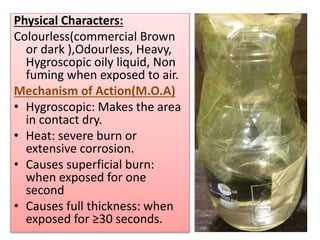
Physical Characters:
Colourless(commercial Brown
or dark ),Odourless, Heavy,
Hygroscopic oily liquid, Non
fuming when exposed to air.
Mechanism of Action(M.O.A)
• Hygroscopic: Makes the area
in contact dry.
• Heat: severe burn or
extensive corrosion.
• Causes superficial burn:
when exposed for one
second
• Causes full thickness: when
exposed for ≥30 seconds.
Clinical Features :
 Lips: swollen and extensive excoriation and brown or black streaks
extending from angle of mouth –chin - front of neck. Corrosion of
the mucus membranes of mouth,throat,and oesophagus.
 Tongue: extremely corroded excoriated or completely disorganised
and transformed into a pulpy mass.
 Teeth: Chalky white with loss of polish of enamel.
 Immediate burning pain stridor,drooling,odynopghagia and
dysphasia.
 Epigastric pain
 Pharyngeal pain(most common presenting symptom.
 Eructation, nausea,vomiting and vomitus contains brown or black
mucoid, strongly acidic containing shreds of charred stomach wall.
Severe thirst.
 Voice : Hoarse.
 Eyes: shrunken.
 Pupil: Dilated.
 CNS: cleared mind till death.
 G.I.T: constipation and Tinnitus, Thirst, Vomiting.
Causes of Death:
Immediate:
1. Circulatory collapse.
2. Asphyxia due to oedema of glottis.
3. Collapse due to perforation of stomach
4. Toxaemia.
Delayed Death
• Hypostatic pneumonia
• 20 Infection.
• Renal Failure.
• Starvation due to stricture.
Fatal Dose: 5-10ml(10-15ml in reddy.)
Fatal Period: 1-2 hrs.
Treatment:
Contraindications:
 Gastric lavage
 Emetics
 Alkali carbonates and bicarbonates
A. If within 30 minutes: Acid dilution and mineralization with ¼ L of
water or milk or milk of magnesia or lime water or Al(OH)3 gel.
B. Demulcent.( olive oil, milk, egg white, starch water, mineral oil, melted
butter.
C. Prednisolone(60mg/day)
D. Circulatory correction
E. Tracheostomy.
F. Skin surface: wash with water or a paste of MgO or NaHCO3 is applied.
G. Eyes: water irrigation or NaHCO3 soln fo 10-15minutes.
Postmortem Appearnces:
Depends on the quantity and strength of the acid as well as
the time period of survival.
• Corrosion of the mucus membrane of lips, mouth and
the throat and hand.Colour of the necrotic area: Greyish
white –brown or black and leathery.
• G.I.T
 Inflamed or swollen by oedema
 Severe intestinal haemorrhage(even when corrosion is
absent)
 Superficial erosion and coagulation with escar formation.
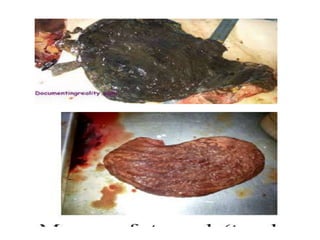
 Stomach soft,spongy,black mass readily. Ridges more
involved than the furrows.
 Perforation with chemical peritonitis of the organs
 20toxic swelling of the liver.
Medico-legal Significance:
Judicious use: Use in the art and manufacturing
of chemicals(95%),battery(30-35%),Drain
Cleaner(10%)
Injudicious use: Homicidal/suicidal(common
amongst women)
• Accidental: mistaken as syrup,glycerine,oil etc.
• Abortificent.
• Vitriolage
• Acute exposure to vapour can lead to
respiratory distress, even death.
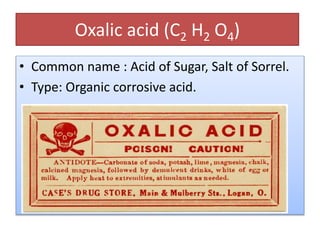
Oxalic acid (C2 H2 O4)
• Common name : Acid of Sugar, Salt of Sorrel.
• Type: Organic corrosive acid.
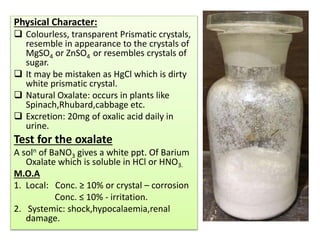
Physical Character:
 Colourless, transparent Prismatic crystals,
resemble in appearance to the crystals of
MgSO4 or ZnSO4 or resembles crystals of
sugar.
 It may be mistaken as HgCl which is dirty
white prismatic crystal.
 Natural Oxalate: occurs in plants like
Spinach,Rhubard,cabbage etc.
 Excretion: 20mg of oxalic acid daily in
urine.
Test for the oxalate
A soln of BaNO3 gives a white ppt. Of Barium
Oxalate which is soluble in HCl or HNO3.
M.O.A
1. Local: Conc. ≥ 10% or crystal – corrosion
Conc. ≤ 10% - irritation.
2. Systemic: shock,hypocalaemia,renal
damage.
Clinical Features:
 Fulminating Poisoning: Occurs when the intake is more than 15g :-
immediate symptoms and death within minutes
 Burning, sour, bitter taste in the mouth with a sense of constriction
around the throat.
 Severe burning pain in the mouth to stomach.
 Nausea ,eructation
 Vomiting (vomitus contains altered blood and mucus has a coffee
ground appearances.
 Acute Poisoning(large dose and the patient survives for few hours)
 Hypocalcaemia symptoms (Muscle irritability and tenderness, titany,
convulsion.
 Signs of cardiovascular collapse.
 Delayed poisoning
 Symptoms of uraemia
 Urine scanty contains traces of blood and albumin and calcium oxalate
 Metabolic acidosis and ventricular fibrillation.
Fatal Dose: 15-20g
Fatal Period: 1-2 hrs.
Treatment:
 Emesis (No warm water as it dissolves the acids.)
 Stomach wash with calcium lactate or gluconate (two
teaspoonful in each lavage.)
 Antidote: Nay preparations of calcium which converts the
poison into insoluble Calcium Oxalate.e.g Lime
water,Calcium Lactate,Calcium Gluconate,Calcium Chloride,
a suspension of Chalk in Glass of water or milk.
 (1.5 g of Chalk will neutralizes 1g of Oxalic acid.
 Demulcent
 Calcium gluconate10%( 10ml I.V frequently)
 Parathyroid extract 100unit I.M
 Enema with castor oil.
 Symptomatic.
Post Mortem Appearances:
• Mucus membranes of the tongue,mouth,phyrnx and
oesophagus whitened and scalded appeances.
• Oesophagus: corrugated and shows longitudinal
erosions.
• Stomach: mucus membrane reddened and punctuate
from erosion or almost black, Perforation and contains
dark brown gummous liquid due to the formation of
acid haematoma. Blood vessels under the mucosa
appears dark brown or black streaks in the form of
network due to deposition of calcium oxalate crystals.
• Kidney: swollen,congested,tubules filled with oxalate
crystals.PCT Necrosed,Glomerulus intact.(hyaline
degeneration of cellular tissues within the tubular
necrosis.
Medico legal Significances:
Judicious use:
• Removes stains/Inks,Rust,Cleans brass,copper
utensils.
• Use in Calico paintings, book bindings, leather
works, photography.
Injudicious Use:
• Malpractice : removal of writing signatures
• Accidental : mistaken for saline purgatives
• Suicidal
• Homicidal
• Abortificent .
Carbolic Acid (Phenol) C 6H 4OH.
• Lysol: 50% soln of cresol in saponifeid vegetable oil.
• Toxicity of Phenol: Lysol=8:1
• Detol : Chlorinated Phenol with turpenol.
• Derivatives of phenol: Cresol,thymol,menthol,Tannic
acid, Creosole(Coal Tar).
• Macdougall’s powder(disinfecting powder): Crude
carbolic acid + CaSO4
• Calvert’s Powder: Carbolic acid + Selicious residue.
• Liquid soap ingredient.: hexachlorophene(chlorinated
bisphenol)
• Why called acid though not acidic on litmus : As Phenol
+ Strong base forms Carbonates
Physical Characters:
Pure form:
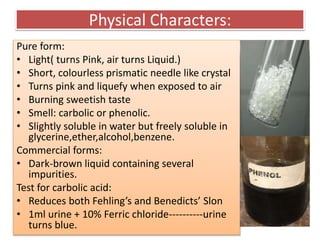
• Light( turns Pink, air turns Liquid.)
• Short, colourless prismatic needle like crystal
• Turns pink and liquefy when exposed to air
• Burning sweetish taste
• Smell: carbolic or phenolic.
• Slightly soluble in water but freely soluble in
glycerine,ether,alcohol,benzene.
Commercial forms:
• Dark-brown liquid containing several
impurities.
Test for carbolic acid:
• Reduces both Fehling’s and Benedicts’ Slon
• 1ml urine + 10% Ferric chloride----------urine
turns blue.
Clinical Features:
M.O.A
• Locally: corrosive
• Remote: Narcotic effect, Protoplasmic poison,
extensive capillary damage.
Carbolism(Poisoning by carbolic Acid):
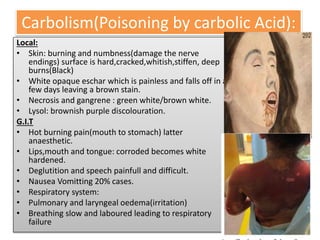
Local:
• Skin: burning and numbness(damage the nerve
endings) surface is hard,cracked,whitish,stiffen, deep
burns(Black)
• White opaque eschar which is painless and falls off in a
few days leaving a brown stain.
• Necrosis and gangrene : green white/brown white.
• Lysol: brownish purple discolouration.
G.I.T
• Hot burning pain(mouth to stomach) latter
anaesthetic.
• Lips,mouth and tongue: corroded becomes white
hardened.
• Deglutition and speech painfull and difficult.
• Nausea Vomitting 20% cases.
• Respiratory system:
• Pulmonary and laryngeal oedema(irritation)
• Breathing slow and laboured leading to respiratory
failure
Systemic effects:
CNS depression especially respiratory centre.
Headache,Giddiness,unconscious
Tempt.: subnormal.
Pupil: contracted.
Breathing : stertorous.
Pulse: rapid,feeble and irregular.
Face: covered with cold sweat and dusky cyanosis.
Respiratory alkalosis,metabolic acidosis
Convulsion and lock jaw.
Strong odour of the phenolic smell.
Carboluria
Urine is scanty contains albumin and free
haemoglobin. Colour is slightly green at first.
Urine(contains Phenol)---oxidized----
Hydroquinone + paracatechol-----further oxidized(
& combination with sulphuric acid or glucoronic
acid---green or black urine.
Chronis Poisoning:
• Phenol Marasmus characterized by
anorexia,weight loss, headache, vertigo, dark
urine, pigmentation of skin and cornea.
• Oochronosis.: pigmentationof the cornea and
various cartilage due to deposition of
hydroquinone and pyrocatechol.
Cause of Death:
• Syncope
• Asphyxia due to failuere of
respiration,oedema glottis etc.
Fatal Dose: 10-15g
Fatal Period: 3-4hrs.
Treatment:
 Emetics: fails due to the anaesthetic effects
 Gastric lavage with lukewarm water with olive oil or castor
oil,Ground nut oil,activated
charcoal(1g/Kg),MgSO4,NaSO4,NaHCO3,Saccharide Lime,Soap
Slon,10% glycerine,20% alcohol.(left 30g MgSO4
 Demulcent
 I.V saline containing 7g of NaHCO3/Litre
 Hemodialysis
 Skin wash with undiluted polyethylene glycol or soap and
water 15 times the apply olive oil or any vegetable oil.

 Antidote: NaSO4 or MgSO4 as they forms insoluble
sulphocarbonates.
 Best known antidote: equal amount of (NaSO4 + MgSO4) + ½
L of water in the stomach tube.
Post Mortem Appearances:
Externally
 Angle of the mouth,chin,check shows dark brown stain with
excoriation.
 Tongue : white swollen and smell of phenol
 Mucus membrane of mouth,lip,oesophagus,stomach:
 ashy-grey or brownish or whitiend.
 Corrugated,sodden,hardened prominent rugae and leathery in feel.
 Partial detachement with numerous small sub mucous
Haemorrhage.
Internally :
 Stomach contains reddish fluid mixed with mucus and shred of
epithelium and smell of phenol.
 Kidney: haemorrhagic nephritis,intensely congested.
 Brain: congested and oedematous.
 Blood: dark and semifluid
 Laryngeal and pulmonary oedema.
Medico Legal Significance:
Judicious use:
• Antiseptic,disinfectant,germicide,caustic,
manufacturing of
explosive,fertilizer,rubber,textile plastic etc.
• Preservatives for vaccine,sera etc.
Injudicious use:
• Accidental ( like using as enema)
• Suicidal.
• Homicidal
• Abortificent.
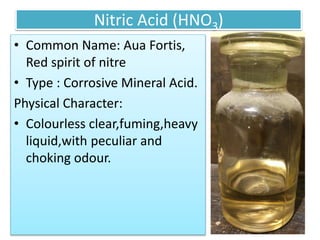
Nitric Acid (HNO3)
• Common Name: Aua Fortis,
Red spirit of nitre
• Type : Corrosive Mineral Acid.
Physical Character:
• Colourless clear,fuming,heavy
liquid,with peculiar and
choking odour.
Xanthoprotic reaction
• Conc. HNO3 + Organic matter ------- Yellowish
discolouration of the tissue( due to Production
of picric acid).
Test
• Aim: to detect the presence of Nitrates
• Strong Fe2(SO4)2 + Conc. H2SO4+ Soln Containing
HNO3-----Brown Ring at the junction of the two
fluid.
Clinical Features:
• Same with that of H2 SO4
• Yellowish discolouration of tissues including crown
of teeth.
• Yellow stain on clothings.
• Inhalation of fumes causes
lacrimation,photophobia,irritation of air passage
and lungs producing sneezing,
coughing,dysphoea,asphyxia.
• Urine : brown colour.
Fatal Dose: 10-15ml.
Fatal Period: 12-24 hrs.
Treatment:
• Same as H2SO4
Post Mortem Appearances:
Same as H2SO4
• Tissue stained Yellow except the stomach and the
oesophagus mucosa which appears brown black due to
acid Haematin.
Medicolegal Significance :
A. Judicious/ Commercial
• Dissolves all metals except Gold and Platinum ( So use
to separate)
• Art,chemical industries,metal
refining,electroplating,cleaning necklace
• Manufacturing fertilizers,nitrogylcerine,green
cotton,picric acid, H2SO4
Injudicious use : Same as H2SO4

Corrosive poisons

  • 1.
    DEMONSTRATION CLASS CORROSIVE POSIONS Dr.Salam Bitam Singh Senior Resident
  • 2.
    Sulphuric acid (Oilof Vitriol) Poison Classification : Corrosive Mineral Acid Corrosive Acids: Defined as those poisons which fixes, destroys and erodes the surface with which it comes in contact. a) Mineral Acids: H2SO4,HNO3,HCl,Oxalic acid, Phenol. b) Caustic Alkalis.
  • 3.
    Physical Characters: Colourless(commercial Brown ordark ),Odourless, Heavy, Hygroscopic oily liquid, Non fuming when exposed to air. Mechanism of Action(M.O.A) • Hygroscopic: Makes the area in contact dry. • Heat: severe burn or extensive corrosion. • Causes superficial burn: when exposed for one second • Causes full thickness: when exposed for ≥30 seconds.
  • 4.
    Clinical Features : Lips: swollen and extensive excoriation and brown or black streaks extending from angle of mouth –chin - front of neck. Corrosion of the mucus membranes of mouth,throat,and oesophagus.  Tongue: extremely corroded excoriated or completely disorganised and transformed into a pulpy mass.  Teeth: Chalky white with loss of polish of enamel.  Immediate burning pain stridor,drooling,odynopghagia and dysphasia.  Epigastric pain  Pharyngeal pain(most common presenting symptom.  Eructation, nausea,vomiting and vomitus contains brown or black mucoid, strongly acidic containing shreds of charred stomach wall. Severe thirst.  Voice : Hoarse.  Eyes: shrunken.  Pupil: Dilated.  CNS: cleared mind till death.  G.I.T: constipation and Tinnitus, Thirst, Vomiting.
  • 5.
    Causes of Death: Immediate: 1.Circulatory collapse. 2. Asphyxia due to oedema of glottis. 3. Collapse due to perforation of stomach 4. Toxaemia. Delayed Death • Hypostatic pneumonia • 20 Infection. • Renal Failure. • Starvation due to stricture. Fatal Dose: 5-10ml(10-15ml in reddy.) Fatal Period: 1-2 hrs.
  • 6.
    Treatment: Contraindications:  Gastric lavage Emetics  Alkali carbonates and bicarbonates A. If within 30 minutes: Acid dilution and mineralization with ¼ L of water or milk or milk of magnesia or lime water or Al(OH)3 gel. B. Demulcent.( olive oil, milk, egg white, starch water, mineral oil, melted butter. C. Prednisolone(60mg/day) D. Circulatory correction E. Tracheostomy. F. Skin surface: wash with water or a paste of MgO or NaHCO3 is applied. G. Eyes: water irrigation or NaHCO3 soln fo 10-15minutes.
  • 7.
    Postmortem Appearnces: Depends onthe quantity and strength of the acid as well as the time period of survival. • Corrosion of the mucus membrane of lips, mouth and the throat and hand.Colour of the necrotic area: Greyish white –brown or black and leathery. • G.I.T  Inflamed or swollen by oedema  Severe intestinal haemorrhage(even when corrosion is absent)  Superficial erosion and coagulation with escar formation.  Stomach soft,spongy,black mass readily. Ridges more involved than the furrows.  Perforation with chemical peritonitis of the organs  20toxic swelling of the liver.
  • 8.
    Medico-legal Significance: Judicious use:Use in the art and manufacturing of chemicals(95%),battery(30-35%),Drain Cleaner(10%) Injudicious use: Homicidal/suicidal(common amongst women) • Accidental: mistaken as syrup,glycerine,oil etc. • Abortificent. • Vitriolage • Acute exposure to vapour can lead to respiratory distress, even death.
  • 9.
    Oxalic acid (C2H2 O4) • Common name : Acid of Sugar, Salt of Sorrel. • Type: Organic corrosive acid.
  • 10.
    Physical Character:  Colourless,transparent Prismatic crystals, resemble in appearance to the crystals of MgSO4 or ZnSO4 or resembles crystals of sugar.  It may be mistaken as HgCl which is dirty white prismatic crystal.  Natural Oxalate: occurs in plants like Spinach,Rhubard,cabbage etc.  Excretion: 20mg of oxalic acid daily in urine. Test for the oxalate A soln of BaNO3 gives a white ppt. Of Barium Oxalate which is soluble in HCl or HNO3. M.O.A 1. Local: Conc. ≥ 10% or crystal – corrosion Conc. ≤ 10% - irritation. 2. Systemic: shock,hypocalaemia,renal damage.
  • 11.
    Clinical Features:  FulminatingPoisoning: Occurs when the intake is more than 15g :- immediate symptoms and death within minutes  Burning, sour, bitter taste in the mouth with a sense of constriction around the throat.  Severe burning pain in the mouth to stomach.  Nausea ,eructation  Vomiting (vomitus contains altered blood and mucus has a coffee ground appearances.  Acute Poisoning(large dose and the patient survives for few hours)  Hypocalcaemia symptoms (Muscle irritability and tenderness, titany, convulsion.  Signs of cardiovascular collapse.  Delayed poisoning  Symptoms of uraemia  Urine scanty contains traces of blood and albumin and calcium oxalate  Metabolic acidosis and ventricular fibrillation.
  • 12.
    Fatal Dose: 15-20g FatalPeriod: 1-2 hrs. Treatment:  Emesis (No warm water as it dissolves the acids.)  Stomach wash with calcium lactate or gluconate (two teaspoonful in each lavage.)  Antidote: Nay preparations of calcium which converts the poison into insoluble Calcium Oxalate.e.g Lime water,Calcium Lactate,Calcium Gluconate,Calcium Chloride, a suspension of Chalk in Glass of water or milk.  (1.5 g of Chalk will neutralizes 1g of Oxalic acid.  Demulcent  Calcium gluconate10%( 10ml I.V frequently)  Parathyroid extract 100unit I.M  Enema with castor oil.  Symptomatic.
  • 13.
    Post Mortem Appearances: •Mucus membranes of the tongue,mouth,phyrnx and oesophagus whitened and scalded appeances. • Oesophagus: corrugated and shows longitudinal erosions. • Stomach: mucus membrane reddened and punctuate from erosion or almost black, Perforation and contains dark brown gummous liquid due to the formation of acid haematoma. Blood vessels under the mucosa appears dark brown or black streaks in the form of network due to deposition of calcium oxalate crystals. • Kidney: swollen,congested,tubules filled with oxalate crystals.PCT Necrosed,Glomerulus intact.(hyaline degeneration of cellular tissues within the tubular necrosis.
  • 14.
    Medico legal Significances: Judicioususe: • Removes stains/Inks,Rust,Cleans brass,copper utensils. • Use in Calico paintings, book bindings, leather works, photography. Injudicious Use: • Malpractice : removal of writing signatures • Accidental : mistaken for saline purgatives • Suicidal • Homicidal • Abortificent .
  • 15.
    Carbolic Acid (Phenol)C 6H 4OH. • Lysol: 50% soln of cresol in saponifeid vegetable oil. • Toxicity of Phenol: Lysol=8:1 • Detol : Chlorinated Phenol with turpenol. • Derivatives of phenol: Cresol,thymol,menthol,Tannic acid, Creosole(Coal Tar). • Macdougall’s powder(disinfecting powder): Crude carbolic acid + CaSO4 • Calvert’s Powder: Carbolic acid + Selicious residue. • Liquid soap ingredient.: hexachlorophene(chlorinated bisphenol) • Why called acid though not acidic on litmus : As Phenol + Strong base forms Carbonates
  • 16.
    Physical Characters: Pure form: •Light( turns Pink, air turns Liquid.) • Short, colourless prismatic needle like crystal • Turns pink and liquefy when exposed to air • Burning sweetish taste • Smell: carbolic or phenolic. • Slightly soluble in water but freely soluble in glycerine,ether,alcohol,benzene. Commercial forms: • Dark-brown liquid containing several impurities. Test for carbolic acid: • Reduces both Fehling’s and Benedicts’ Slon • 1ml urine + 10% Ferric chloride----------urine turns blue.
  • 17.
    Clinical Features: M.O.A • Locally:corrosive • Remote: Narcotic effect, Protoplasmic poison, extensive capillary damage.
  • 18.
    Carbolism(Poisoning by carbolicAcid): Local: • Skin: burning and numbness(damage the nerve endings) surface is hard,cracked,whitish,stiffen, deep burns(Black) • White opaque eschar which is painless and falls off in a few days leaving a brown stain. • Necrosis and gangrene : green white/brown white. • Lysol: brownish purple discolouration. G.I.T • Hot burning pain(mouth to stomach) latter anaesthetic. • Lips,mouth and tongue: corroded becomes white hardened. • Deglutition and speech painfull and difficult. • Nausea Vomitting 20% cases. • Respiratory system: • Pulmonary and laryngeal oedema(irritation) • Breathing slow and laboured leading to respiratory failure
  • 20.
    Systemic effects: CNS depressionespecially respiratory centre. Headache,Giddiness,unconscious Tempt.: subnormal. Pupil: contracted. Breathing : stertorous. Pulse: rapid,feeble and irregular. Face: covered with cold sweat and dusky cyanosis. Respiratory alkalosis,metabolic acidosis Convulsion and lock jaw. Strong odour of the phenolic smell.
  • 21.
    Carboluria Urine is scantycontains albumin and free haemoglobin. Colour is slightly green at first. Urine(contains Phenol)---oxidized---- Hydroquinone + paracatechol-----further oxidized( & combination with sulphuric acid or glucoronic acid---green or black urine. Chronis Poisoning: • Phenol Marasmus characterized by anorexia,weight loss, headache, vertigo, dark urine, pigmentation of skin and cornea. • Oochronosis.: pigmentationof the cornea and various cartilage due to deposition of hydroquinone and pyrocatechol.
  • 22.
    Cause of Death: •Syncope • Asphyxia due to failuere of respiration,oedema glottis etc. Fatal Dose: 10-15g Fatal Period: 3-4hrs.
  • 23.
    Treatment:  Emetics: failsdue to the anaesthetic effects  Gastric lavage with lukewarm water with olive oil or castor oil,Ground nut oil,activated charcoal(1g/Kg),MgSO4,NaSO4,NaHCO3,Saccharide Lime,Soap Slon,10% glycerine,20% alcohol.(left 30g MgSO4  Demulcent  I.V saline containing 7g of NaHCO3/Litre  Hemodialysis  Skin wash with undiluted polyethylene glycol or soap and water 15 times the apply olive oil or any vegetable oil.   Antidote: NaSO4 or MgSO4 as they forms insoluble sulphocarbonates.  Best known antidote: equal amount of (NaSO4 + MgSO4) + ½ L of water in the stomach tube.
  • 24.
    Post Mortem Appearances: Externally Angle of the mouth,chin,check shows dark brown stain with excoriation.  Tongue : white swollen and smell of phenol  Mucus membrane of mouth,lip,oesophagus,stomach:  ashy-grey or brownish or whitiend.  Corrugated,sodden,hardened prominent rugae and leathery in feel.  Partial detachement with numerous small sub mucous Haemorrhage. Internally :  Stomach contains reddish fluid mixed with mucus and shred of epithelium and smell of phenol.  Kidney: haemorrhagic nephritis,intensely congested.  Brain: congested and oedematous.  Blood: dark and semifluid  Laryngeal and pulmonary oedema.
  • 25.
    Medico Legal Significance: Judicioususe: • Antiseptic,disinfectant,germicide,caustic, manufacturing of explosive,fertilizer,rubber,textile plastic etc. • Preservatives for vaccine,sera etc. Injudicious use: • Accidental ( like using as enema) • Suicidal. • Homicidal • Abortificent.
  • 26.
    Nitric Acid (HNO3) •Common Name: Aua Fortis, Red spirit of nitre • Type : Corrosive Mineral Acid. Physical Character: • Colourless clear,fuming,heavy liquid,with peculiar and choking odour.
  • 27.
    Xanthoprotic reaction • Conc.HNO3 + Organic matter ------- Yellowish discolouration of the tissue( due to Production of picric acid). Test • Aim: to detect the presence of Nitrates • Strong Fe2(SO4)2 + Conc. H2SO4+ Soln Containing HNO3-----Brown Ring at the junction of the two fluid.
  • 28.
    Clinical Features: • Samewith that of H2 SO4 • Yellowish discolouration of tissues including crown of teeth. • Yellow stain on clothings. • Inhalation of fumes causes lacrimation,photophobia,irritation of air passage and lungs producing sneezing, coughing,dysphoea,asphyxia. • Urine : brown colour. Fatal Dose: 10-15ml. Fatal Period: 12-24 hrs.
  • 29.
  • 30.
    Post Mortem Appearances: Sameas H2SO4 • Tissue stained Yellow except the stomach and the oesophagus mucosa which appears brown black due to acid Haematin. Medicolegal Significance : A. Judicious/ Commercial • Dissolves all metals except Gold and Platinum ( So use to separate) • Art,chemical industries,metal refining,electroplating,cleaning necklace • Manufacturing fertilizers,nitrogylcerine,green cotton,picric acid, H2SO4 Injudicious use : Same as H2SO4