LASERS AND ANAESTHESIA Dr.P.Narasimha Reddy, Professor, Dept of Anaesthesiology, Narayana medical college, Nellore.
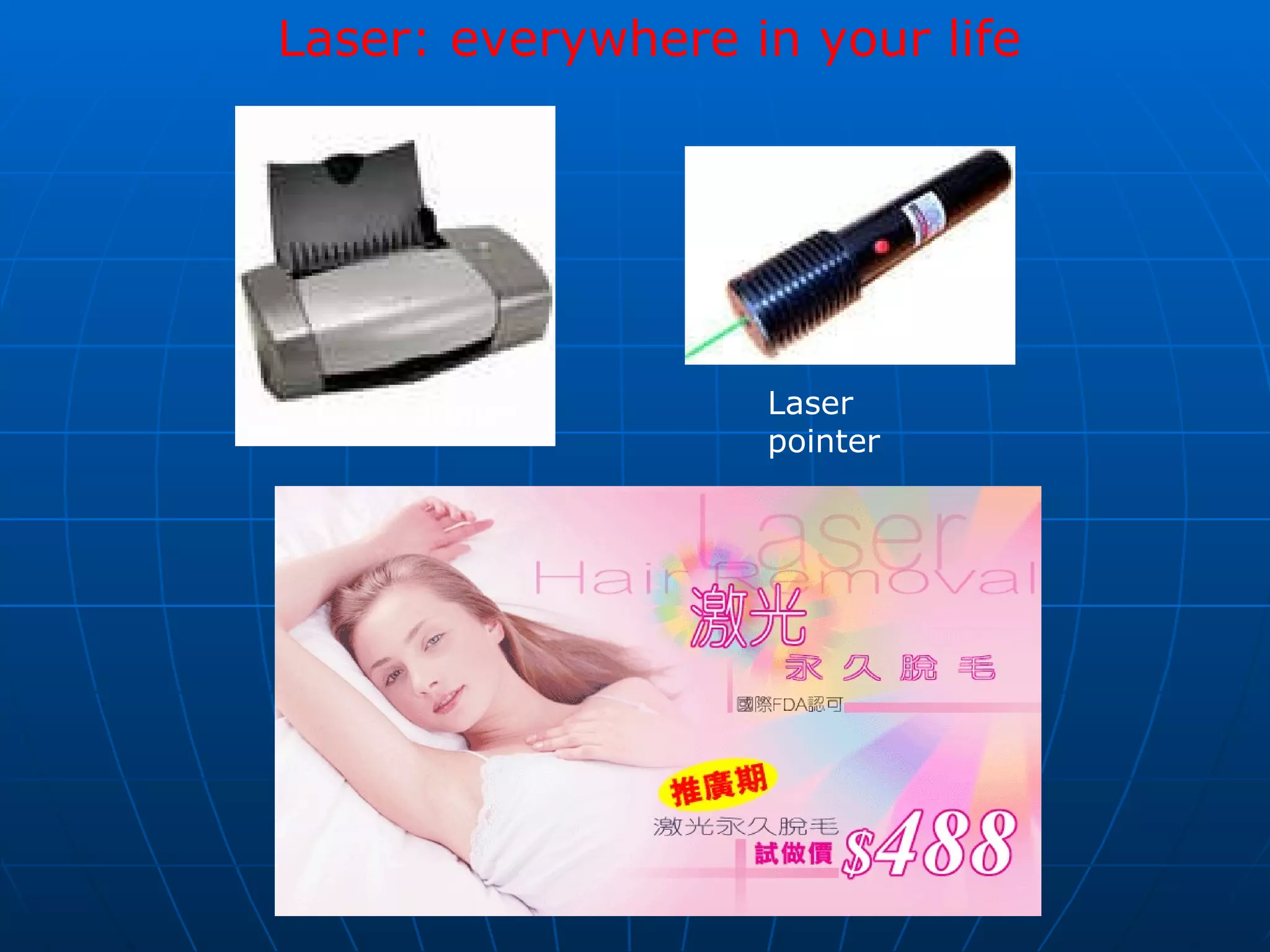
Laser printer Laser pointer Laser: everywhere in your life                                                                                          
“ Never are cooperation and communication between surgeon and anaesthetist more impartant than during head and neck surgery.” -  MORGAN  Clinical anaesthesia
Introduction 1. history 2.properties of laser 3.basic physics 4.proreties of laser 5.laser hardware 6.biological effects 7.applications of laser 8.dangers of lasers 9.anaesthesia considerations 10.protection strategies
L - LIGHT A - AMPLIFICATION  BY S - STIMULATED E - EMISSION  OF R - RADIATION TRANSFER OF LARGE QUANTITIES OF ENERGY RAPIDLY TO REMOTE LOCATIONS LASER
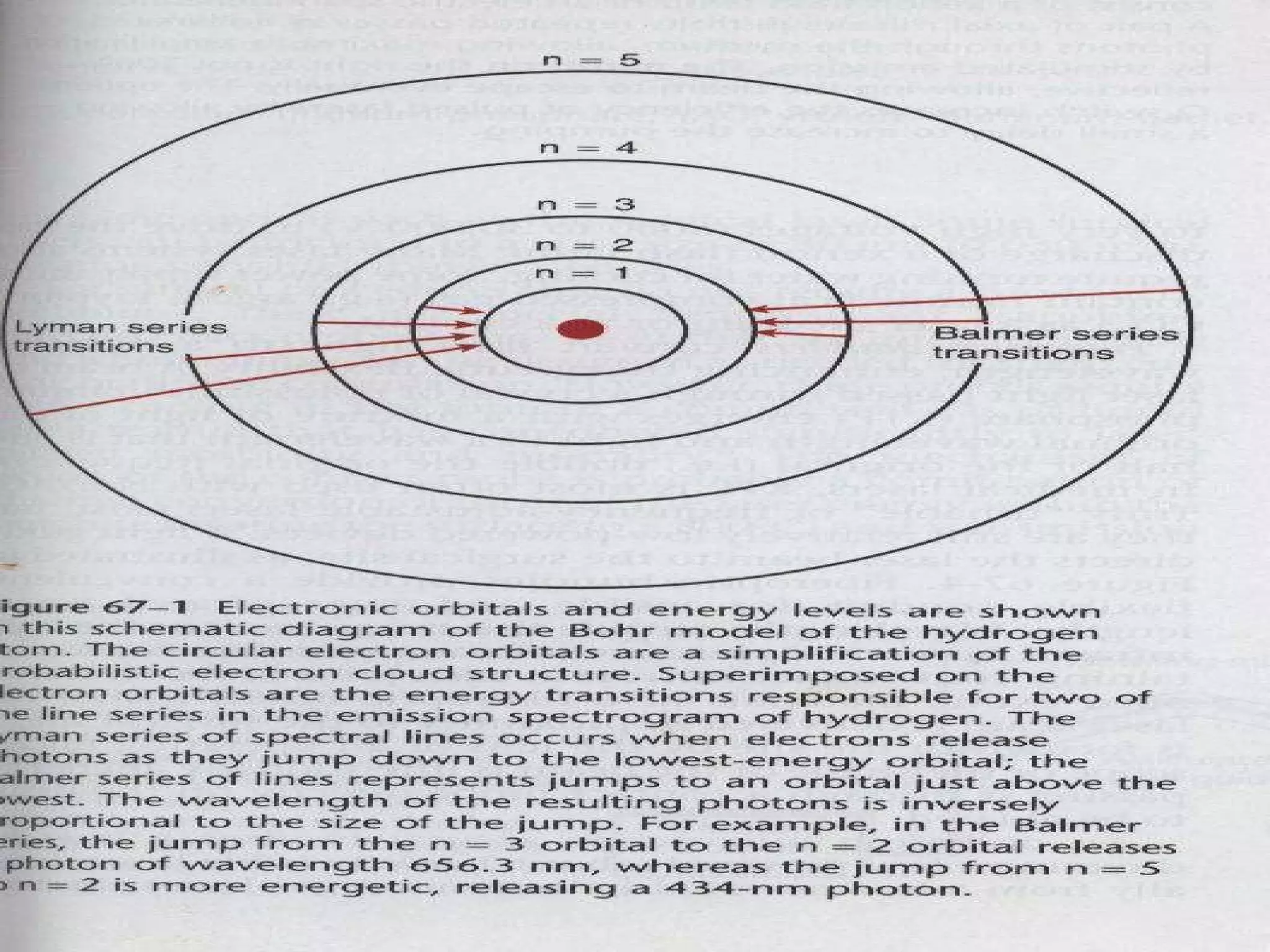
VISUAL LIGHT IS ELECTROMAGNETIC RADIATION (RADIOWAVES,X- RAYS,GAMMA RAYS) 1864 – MAXWELL-ELECTRICAL,MAGNETIC    OSCILLATIONS- 299,792,458 m/sec -  MAX PLANCK-PHOTO ELECTRIC  EFFECT-1 st STEP TOWARDS  LASER PHYSICS PHYSICS
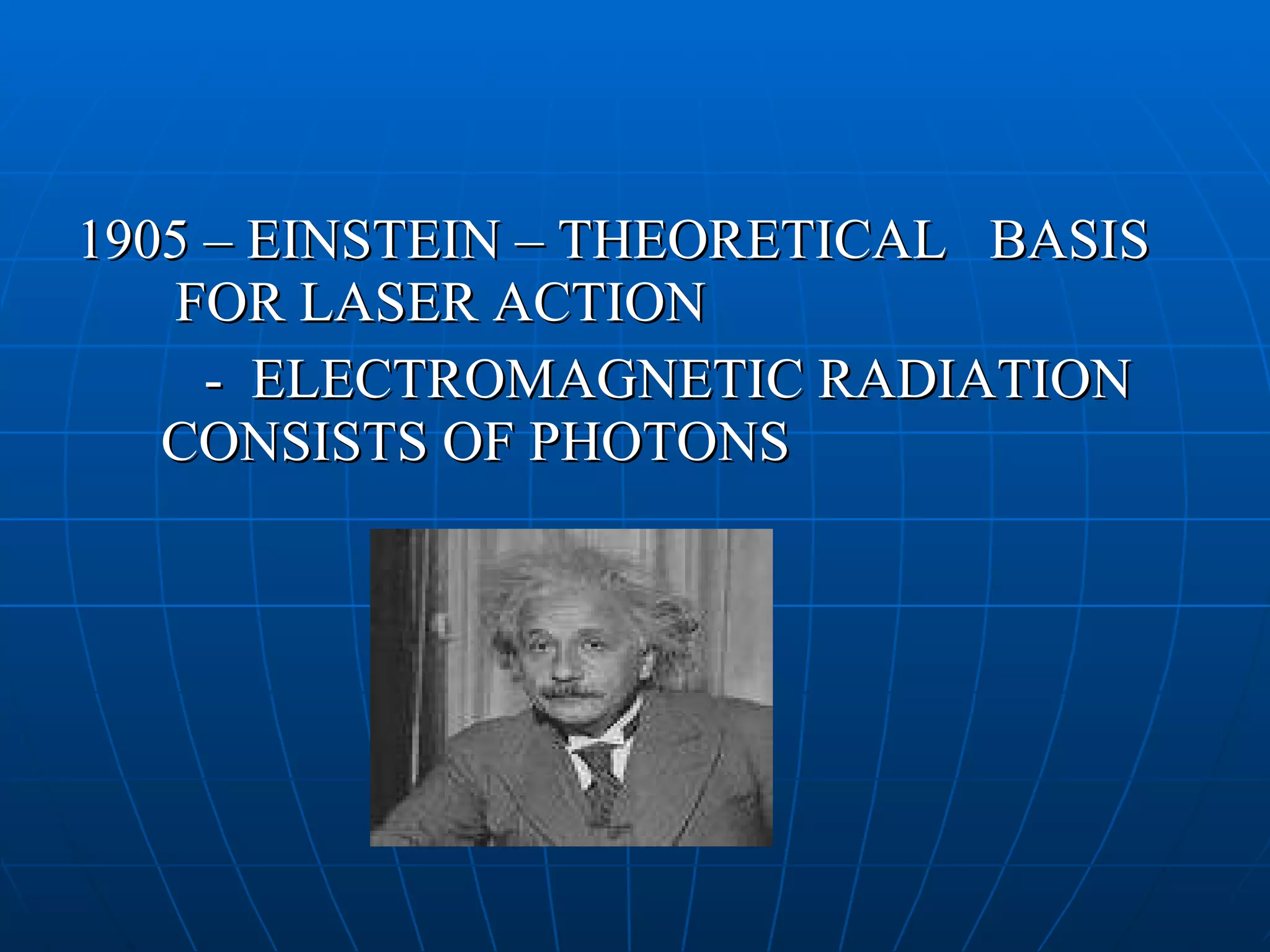
1905 – EINSTEIN – THEORETICAL  BASIS  FOR LASER ACTION -  ELECTROMAGNETIC RADIATION  CONSISTS OF PHOTONS
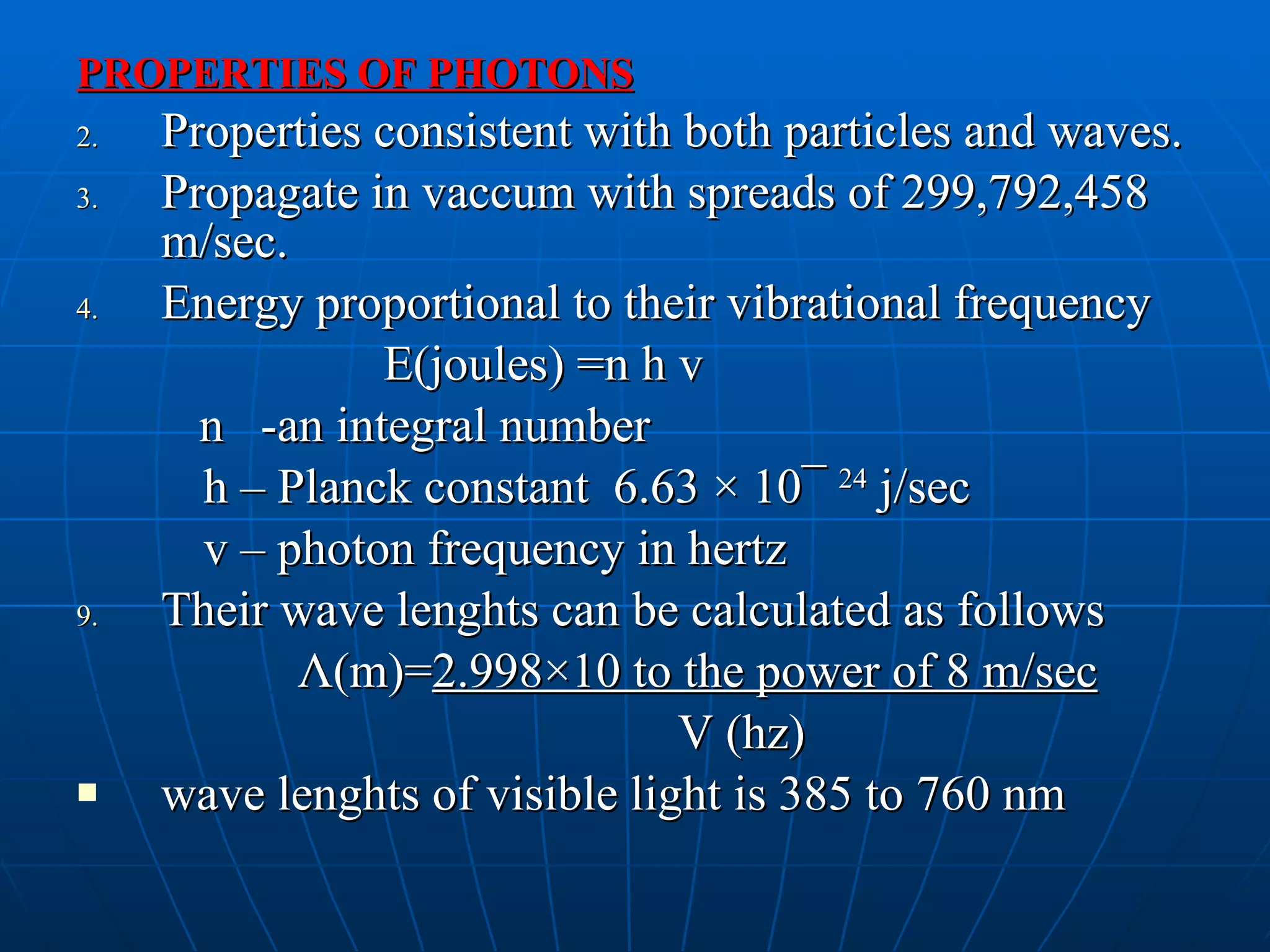
PROPERTIES OF PHOTONS Properties consistent with both particles and waves. Propagate in vaccum with spreads of 299,792,458 m/sec. Energy proportional to their vibrational frequency E(joules) =n h v n  -an integral number h – Planck constant  6.63  × 10¯   24  j/sec v – photon frequency in hertz Their wave lenghts can be calculated as follows Λ (m)= 2.998×10 to the power of 8 m/sec V (hz) wave lenghts of visible light is 385 to 760 nm
 
 
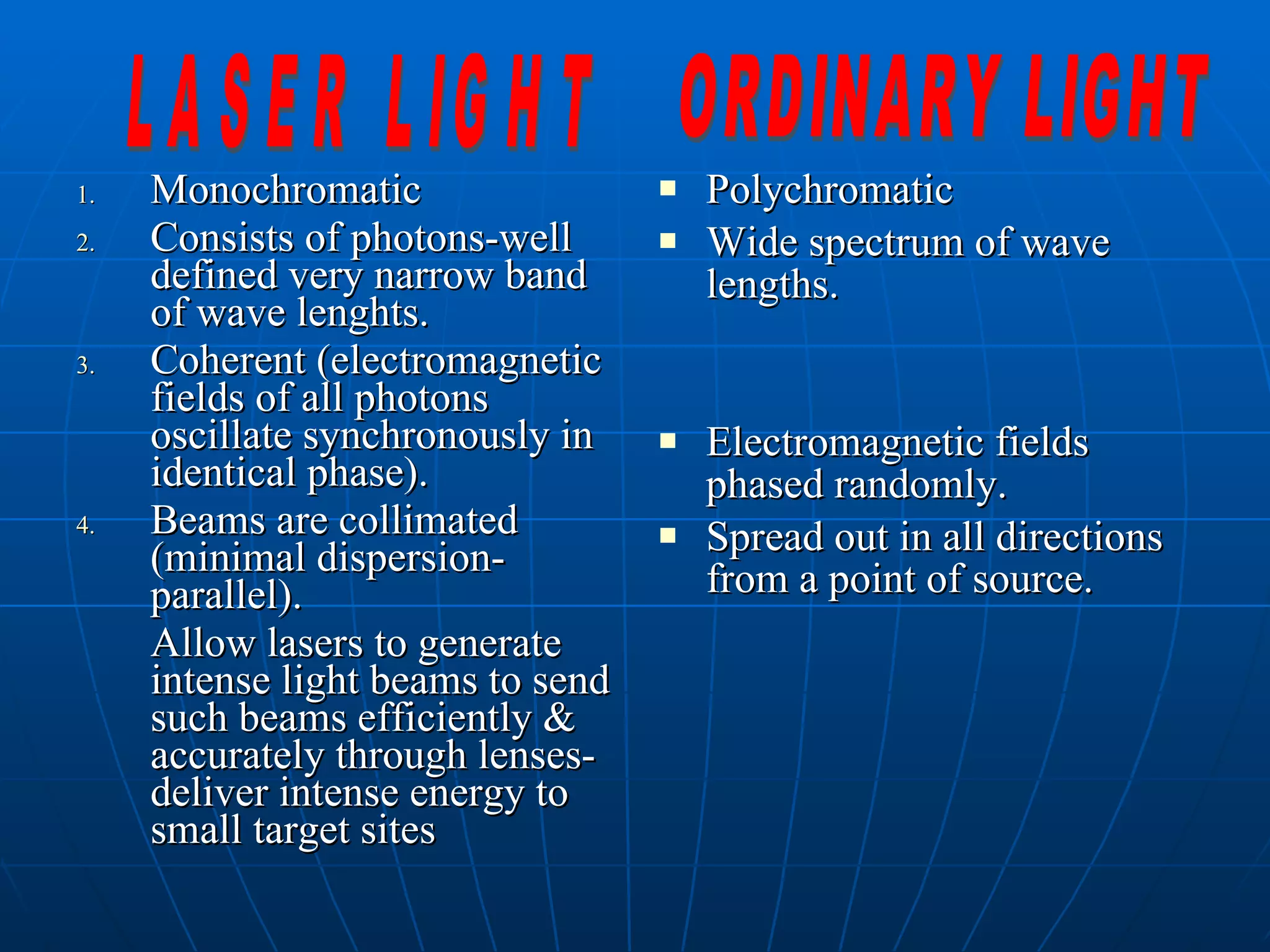
Monochromatic Consists of photons-well defined very narrow band of wave lenghts. Coherent (electromagnetic fields of all photons oscillate synchronously in identical phase). Beams are collimated (minimal dispersion-parallel). Allow lasers to generate intense light beams to send such beams efficiently & accurately through lenses-deliver intense energy to small target sites Polychromatic Wide spectrum of wave lengths. Electromagnetic fields phased randomly. Spread out in all directions from a point of source. LASER LIGHT ORDINARY LIGHT
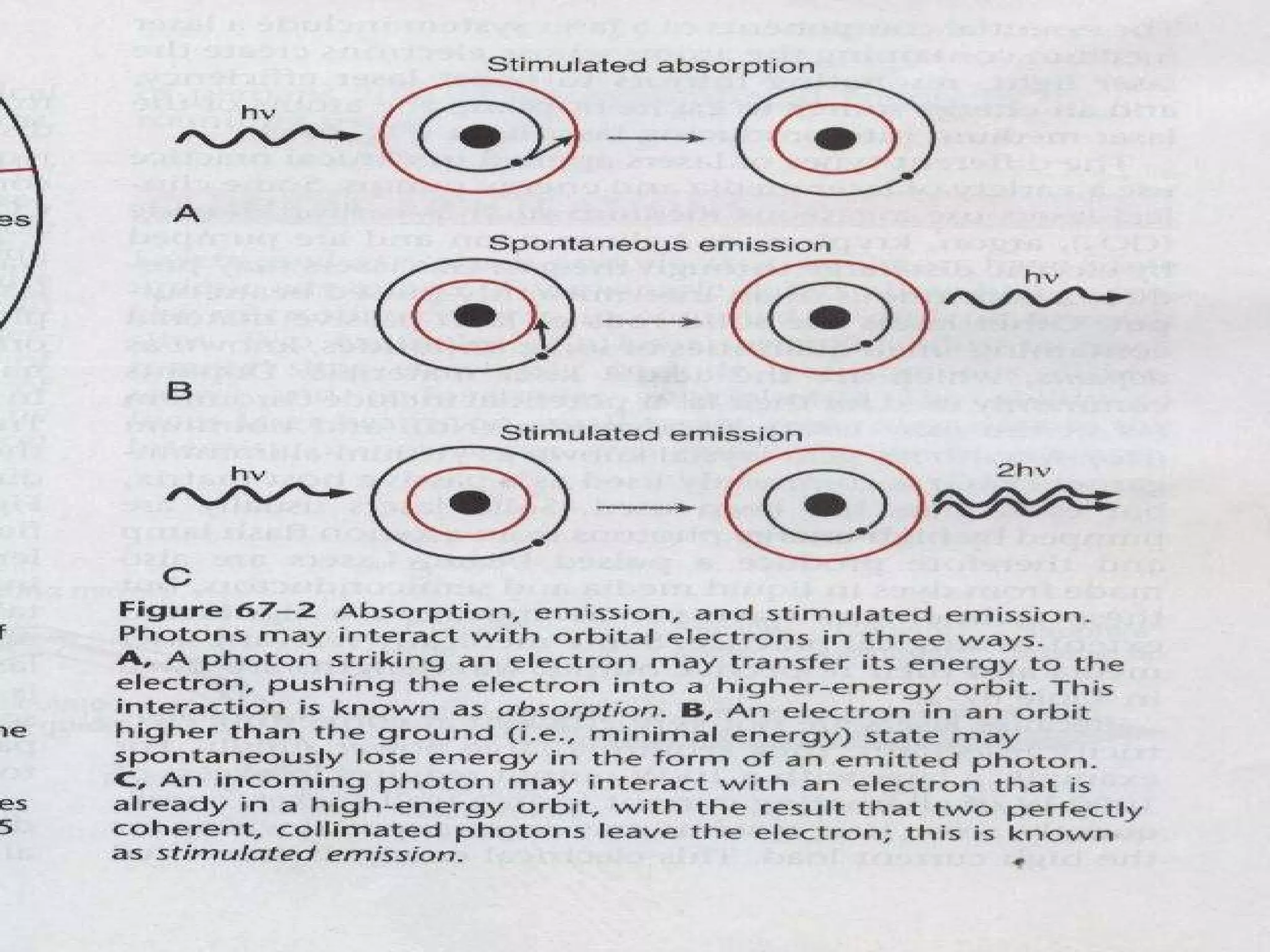
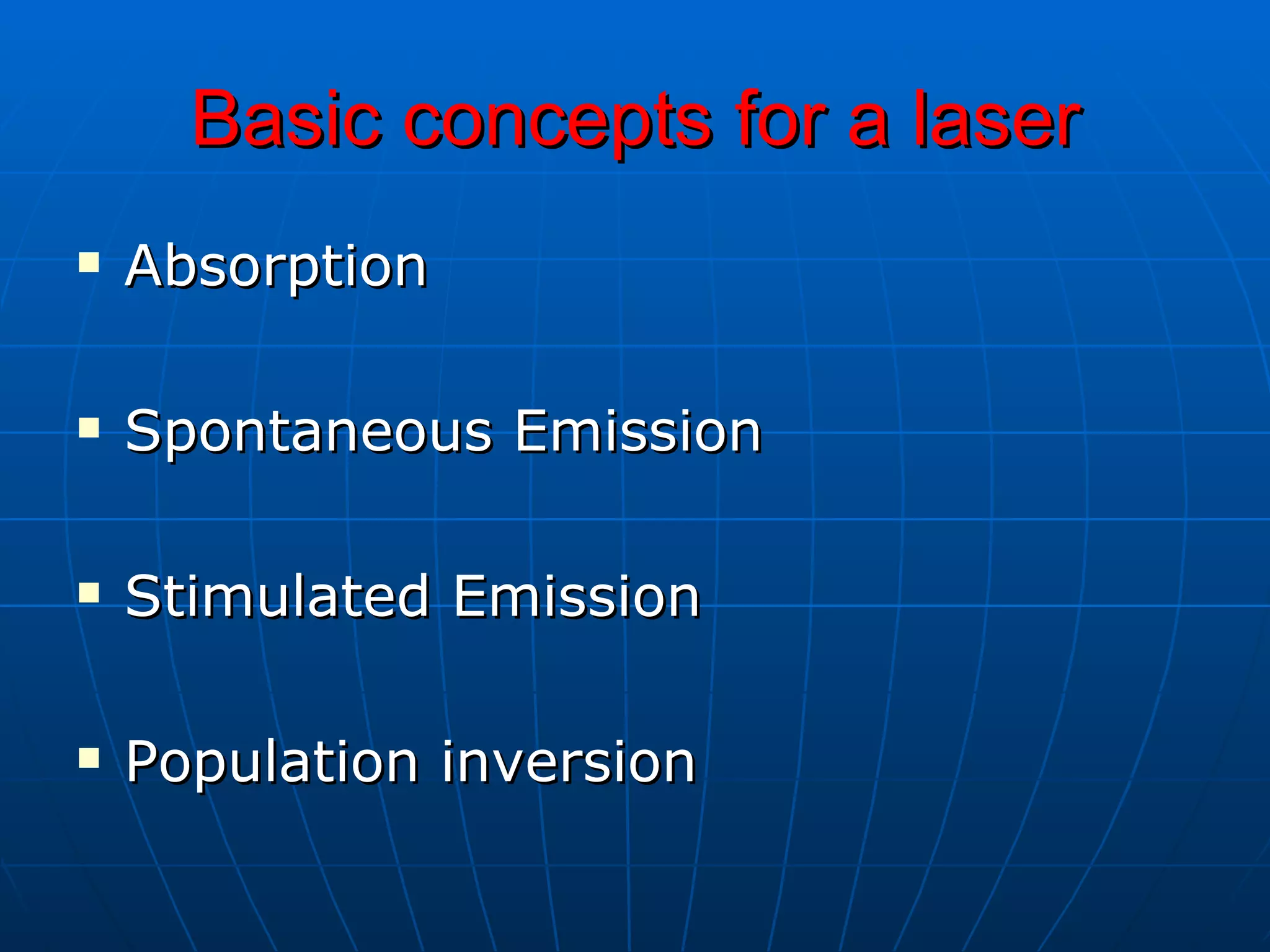
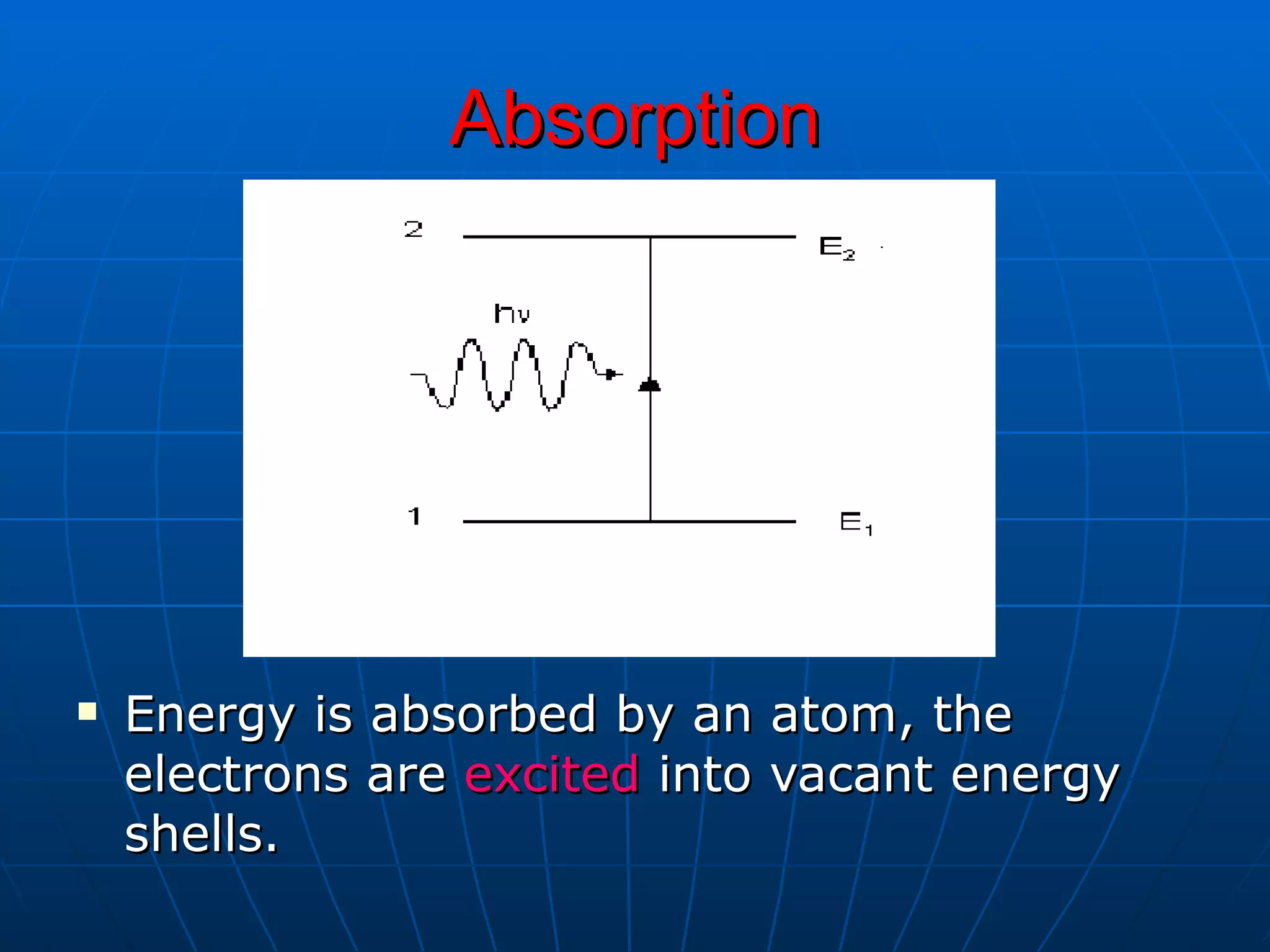
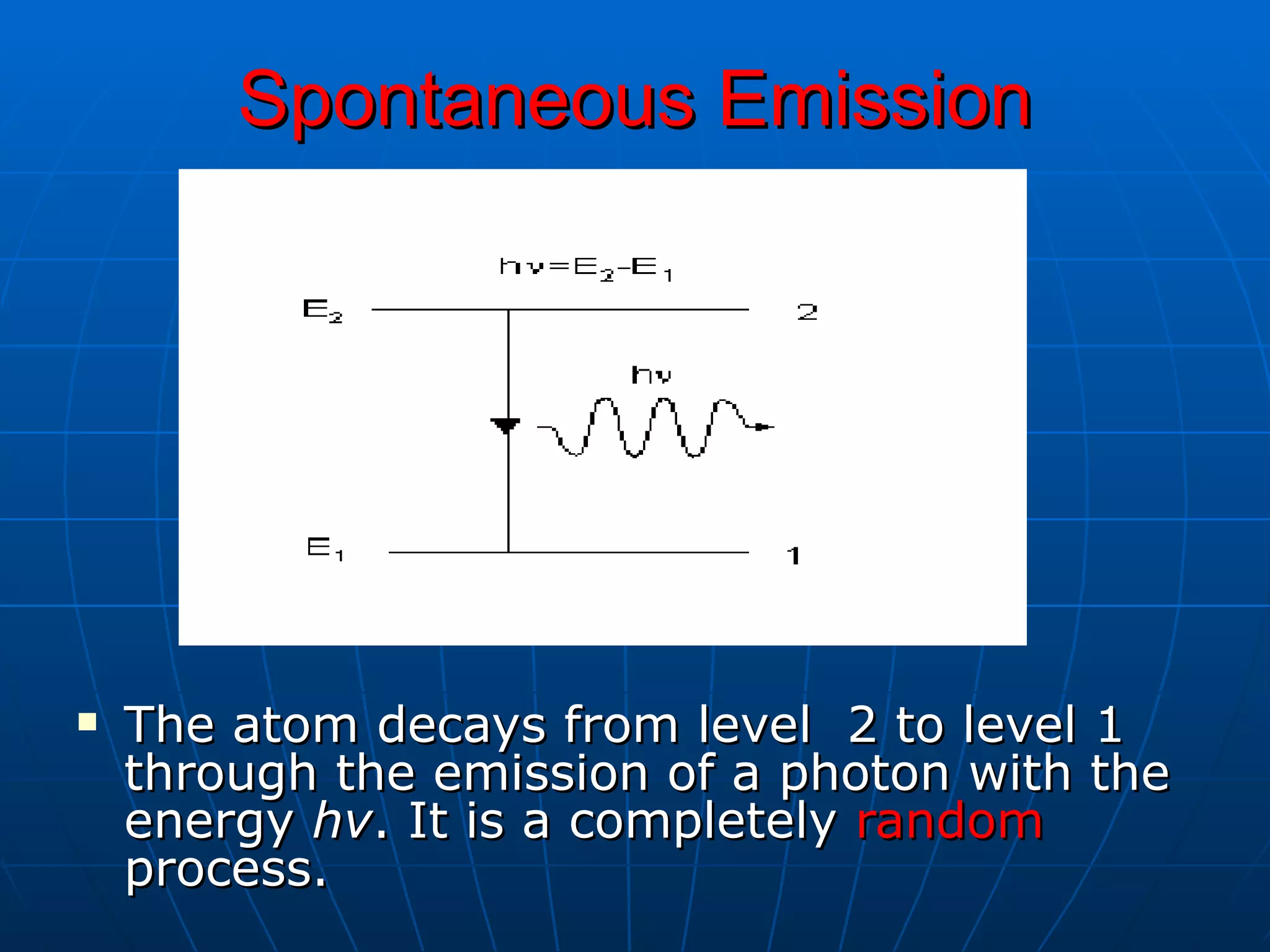
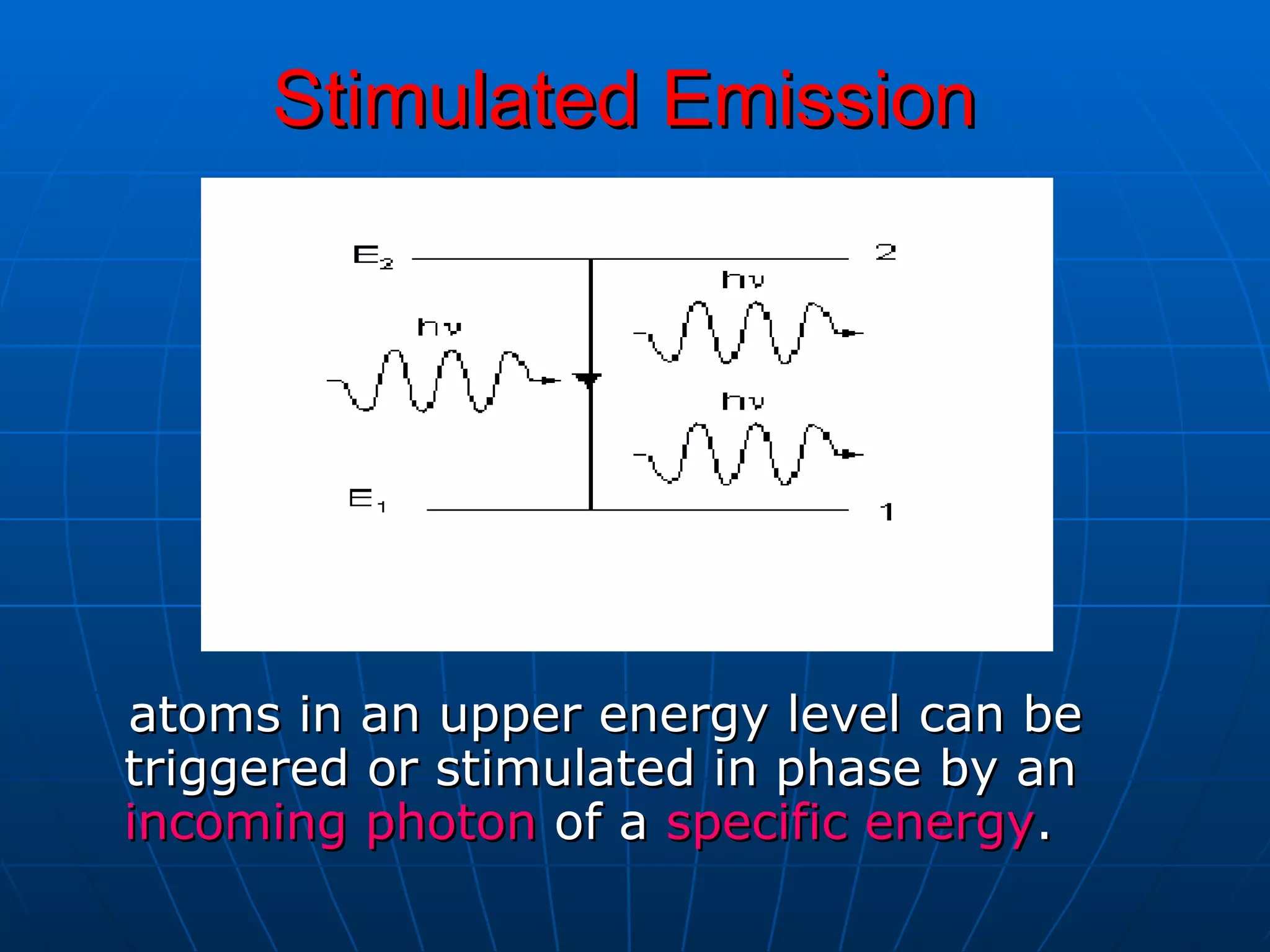
Basic concepts for a laser Absorption  Spontaneous Emission  Stimulated Emission  Population inversion
Absorption Energy is absorbed by an atom, the electrons are  excited  into vacant energy shells.
Spontaneous Emission The atom decays from level  2 to level 1  through the emission of a photon with the energy  hv . It is a completely  random  process.
Stimulated Emission  atoms in an upper energy level can be triggered or stimulated in phase by an  incoming photon  of a  specific energy .
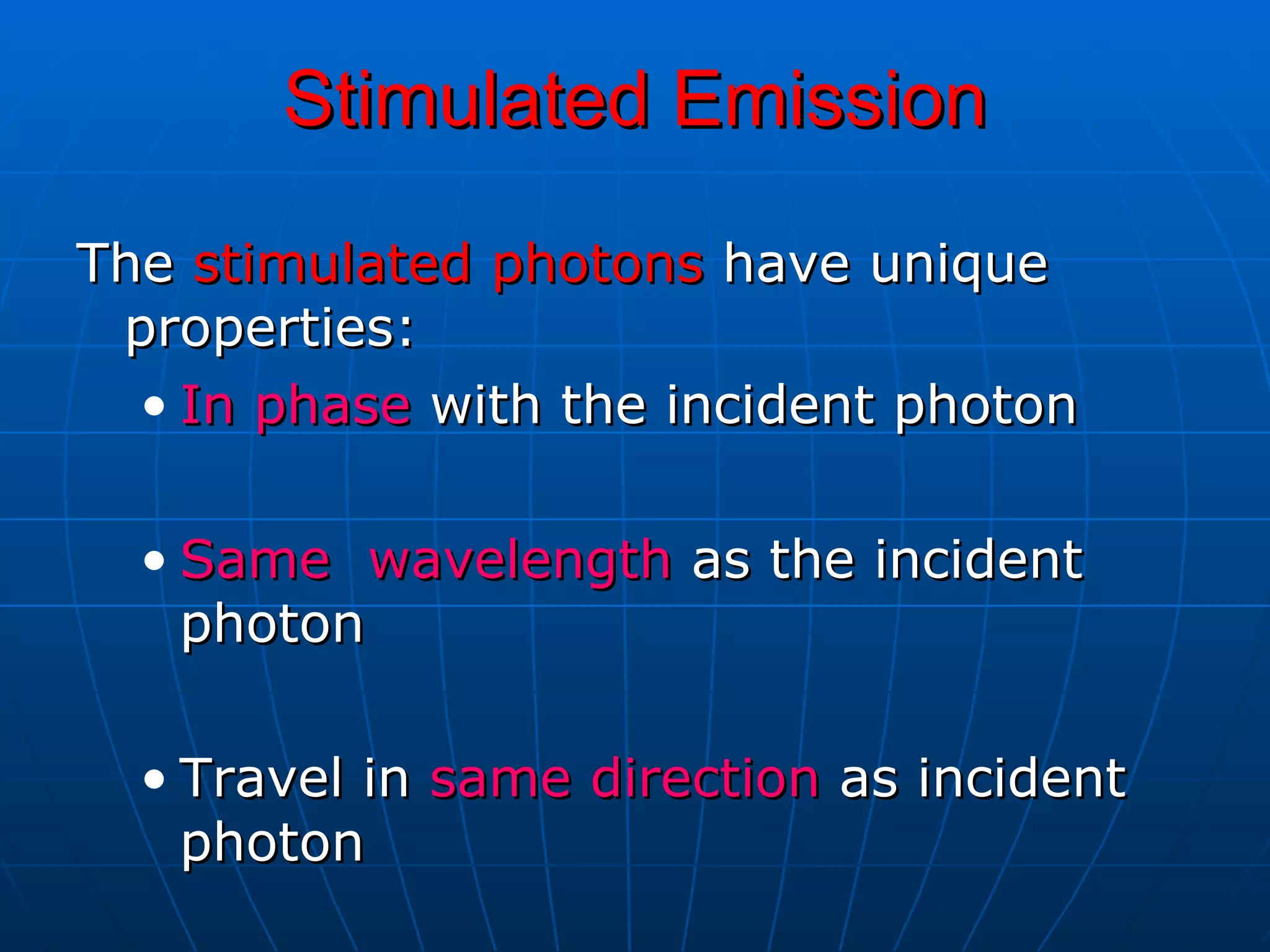
Stimulated Emission The  stimulated photons  have unique properties:  In phase  with the incident photon  Same  wavelength  as the incident photon  Travel in  same direction  as incident photon
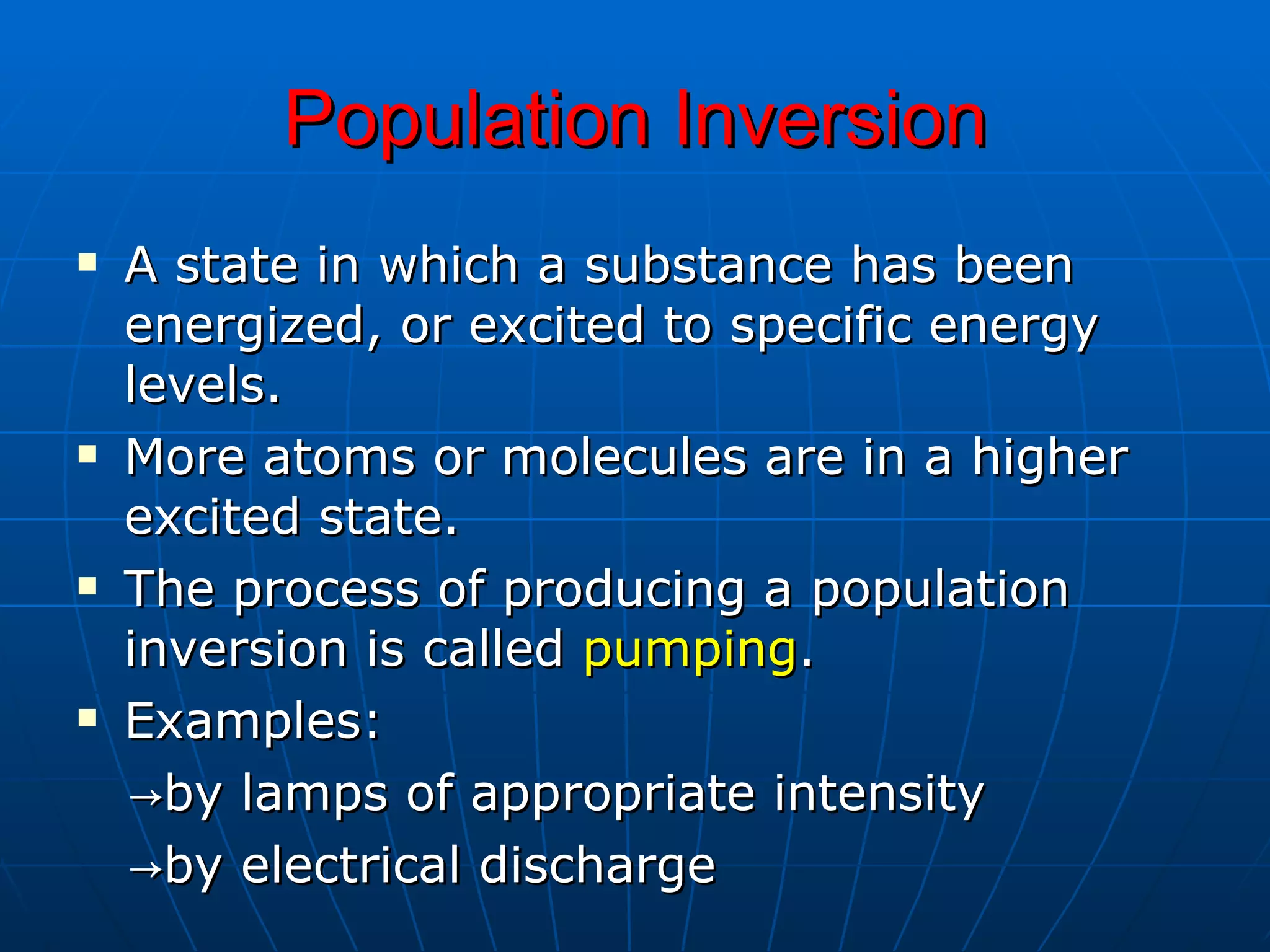
Population Inversion A state in which a substance has been energized, or excited to specific energy levels. More atoms or molecules are in a higher excited state.  The process of producing a population inversion is called  pumping . Examples:  -> by lamps of appropriate intensity -> by electrical discharge
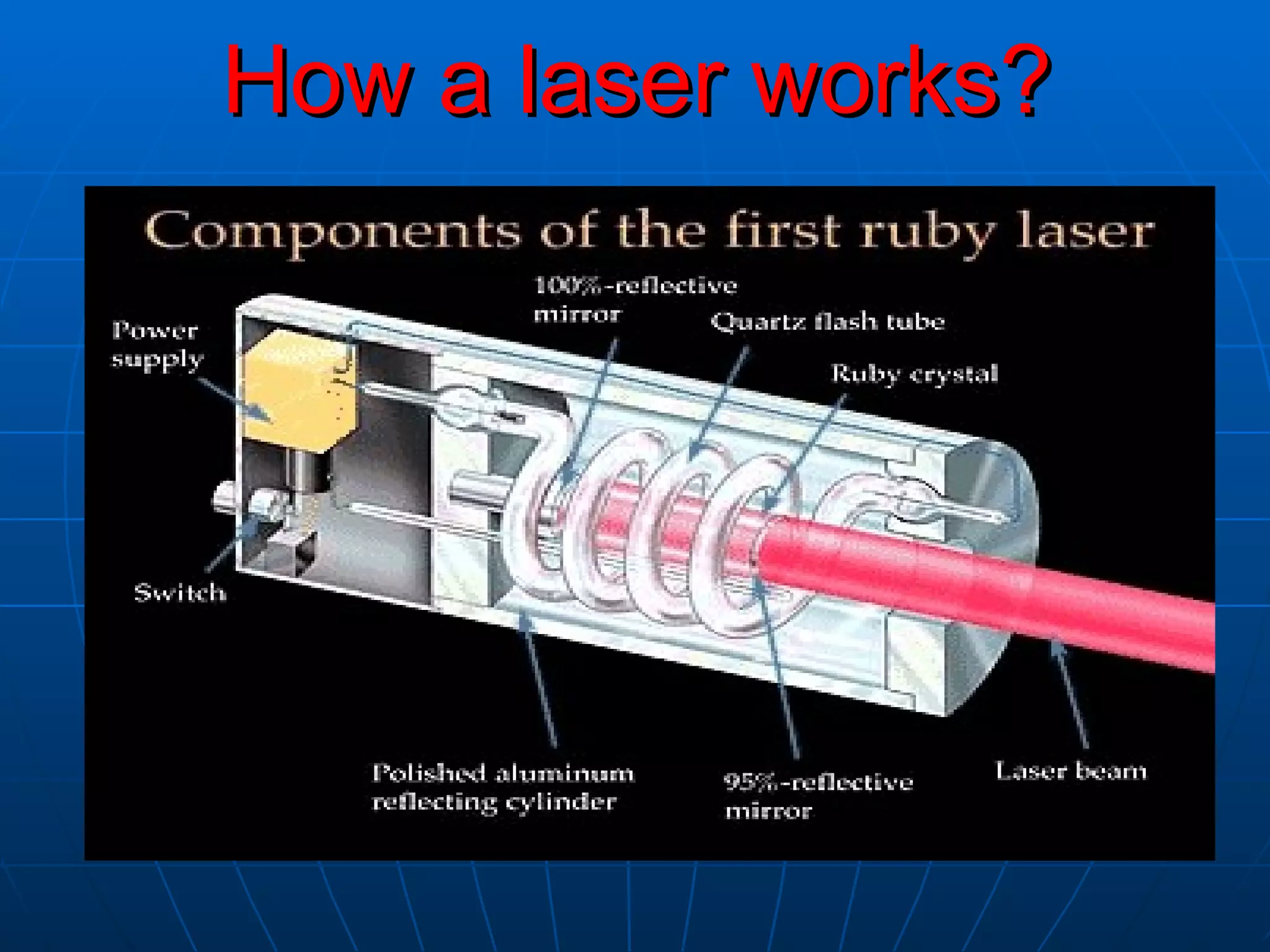
How a laser works?
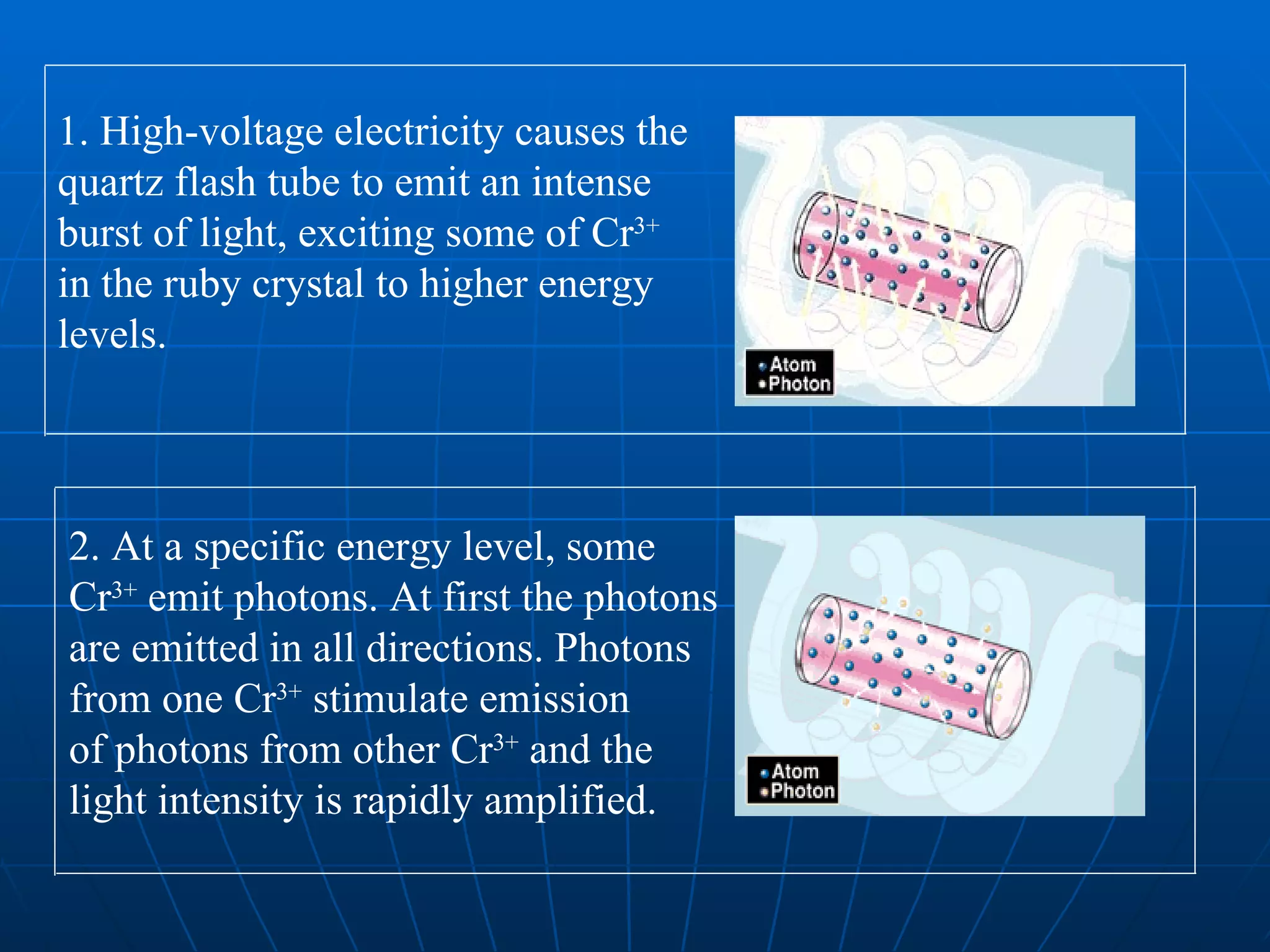
1. High-voltage electricity causes the quartz flash tube to emit an intense burst of light, exciting some of Cr 3+  in the ruby crystal to higher energy levels.  2. At a specific energy level, some  Cr 3+  emit photons. At first the photons  are emitted in all directions. Photons  from one Cr 3+  stimulate emission  of photons from other Cr 3+  and the  light intensity is rapidly amplified.
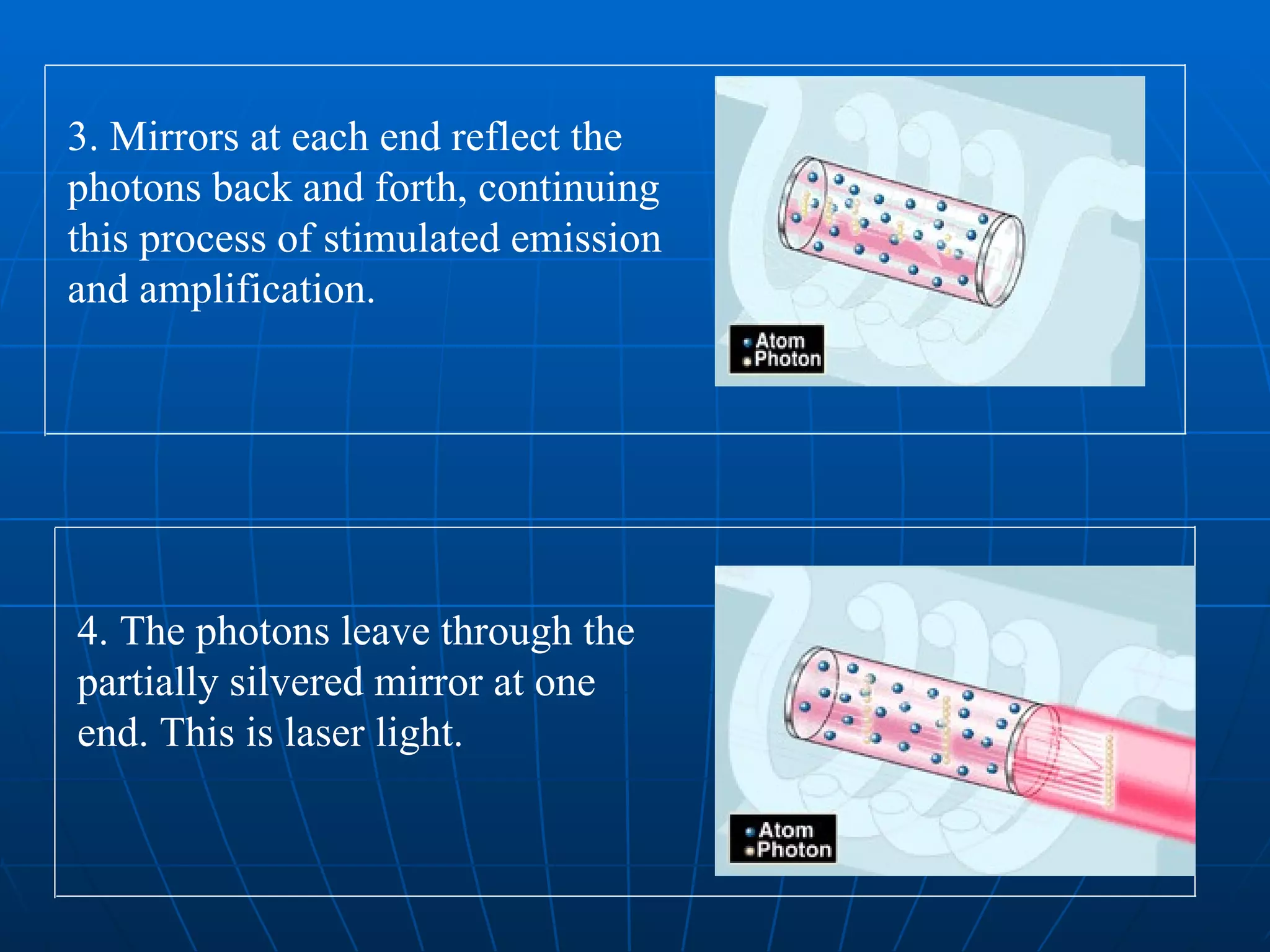
3. Mirrors at each end reflect the photons back and forth, continuing this process of stimulated emission and amplification.  4. The photons leave through the  partially silvered mirror at one  end. This is laser light.
Laser Construction A  pump source A  gain medium  or laser medium.  Mirrors forming an  optical resonator.
Pump Source Provides energy  to the laser system  Examples: electrical discharges, flashlamps, arc lamps and chemical reactions.  The type of pump source used depends on the gain medium.  -> A helium-neon (HeNe) laser uses an  electrical discharge in the helium-neon gas mixture. -> Excimer lasers use a chemical reaction.
Optical Resonator Two parallel mirrors placed around the gain medium. Light is reflected by the mirrors back into the medium and is amplified . The design and alignment of the mirrors with respect to the medium is  crucial . Spinning mirrors, modulators, filters and absorbers may be added to produce a variety of effects on the laser output.
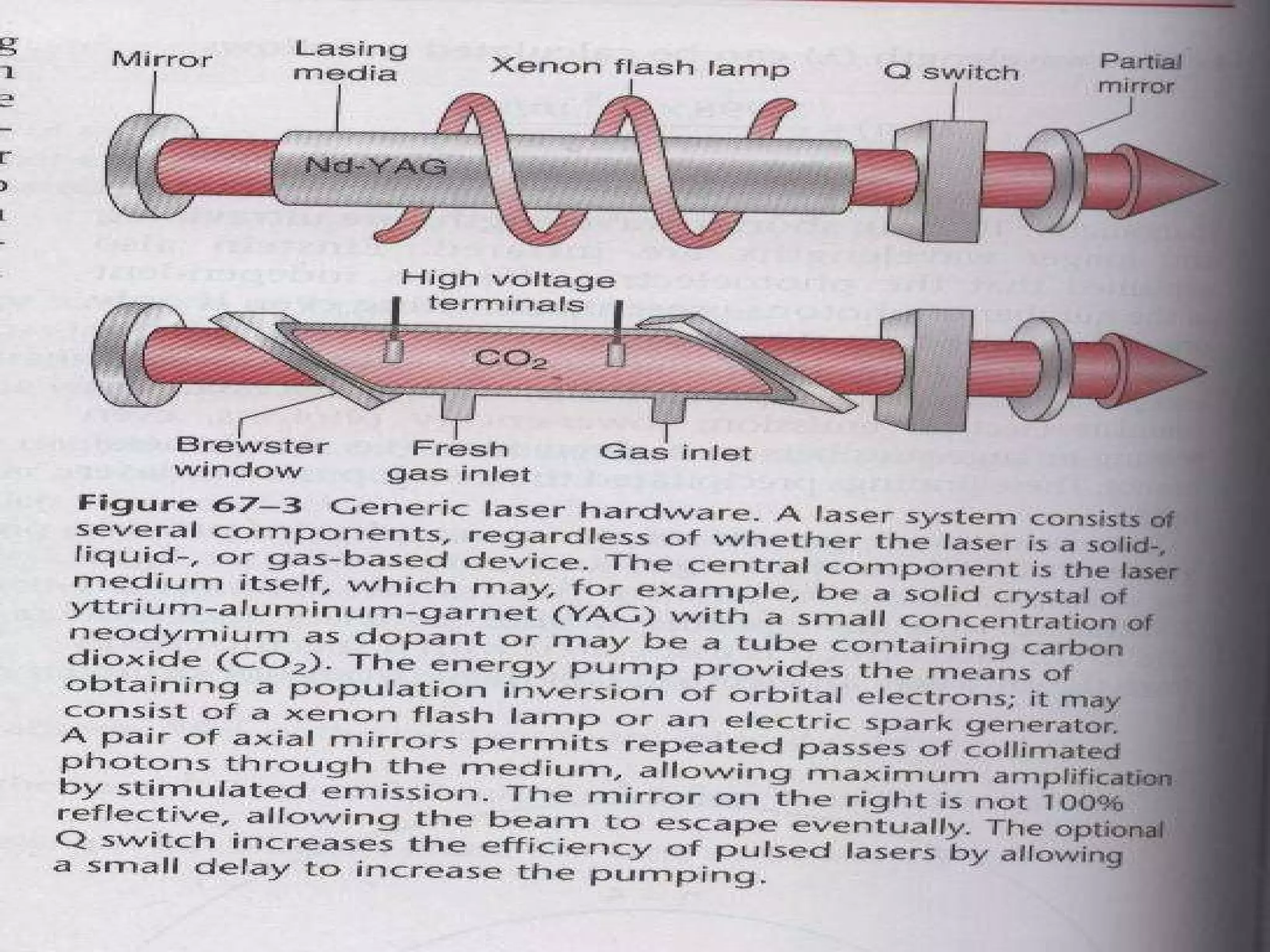
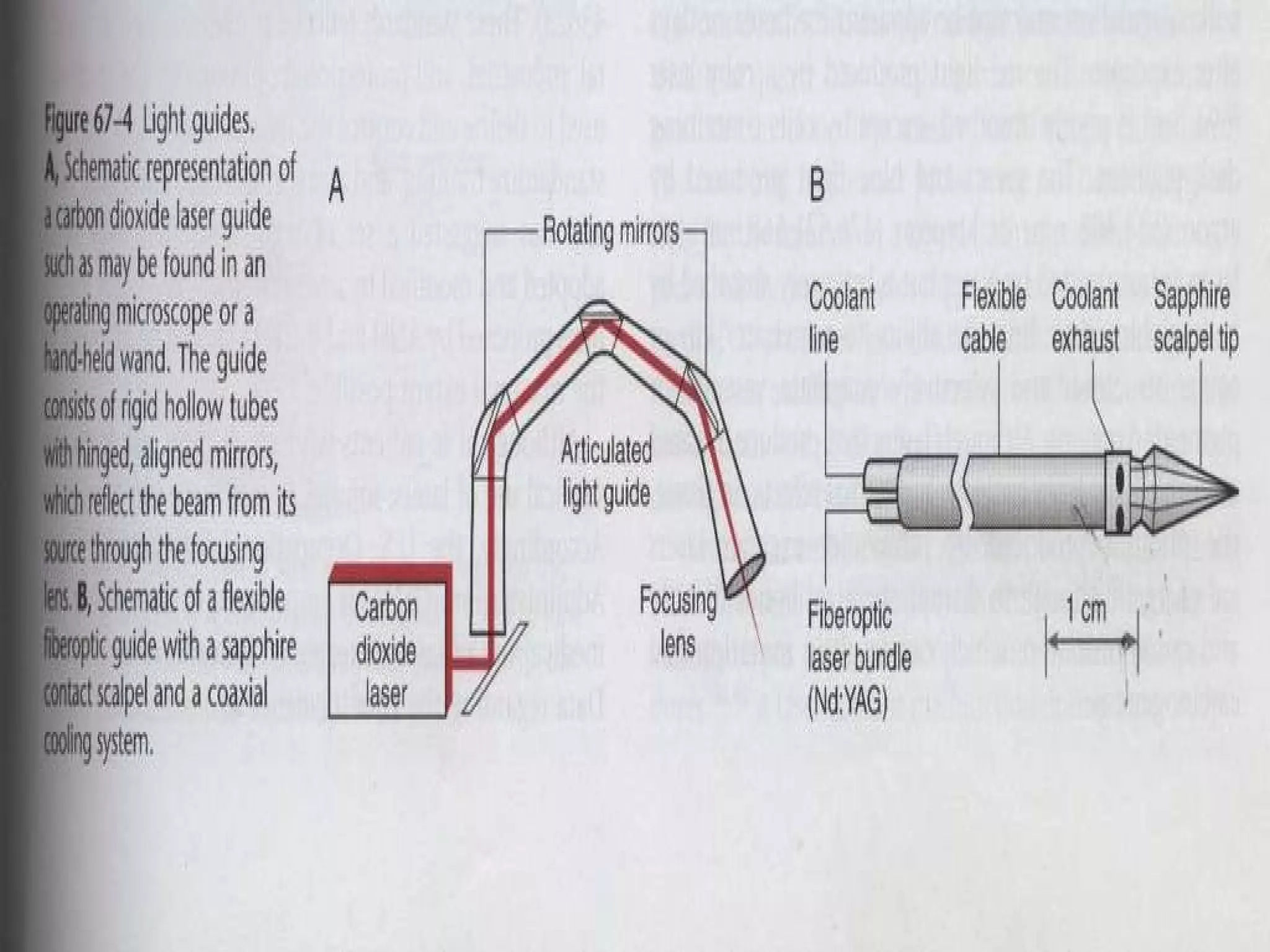
Laser medium containing the atoms whose electrons create the laser light Resonating mirrors - to boost laser efficiency Energy source- excite or pump the atoms of the laser medium into producing laser light. Gas lasers- co2 ,Argon, krypton, helium – neon LASER SYSTEM HARDWARE
Laser Types According to the  active material :  solid-state, liquid, gas, excimer or semiconductor lasers. According to the  wavelength :  infra-red, visible, ultra-violet (UV) or x-ray lasers.
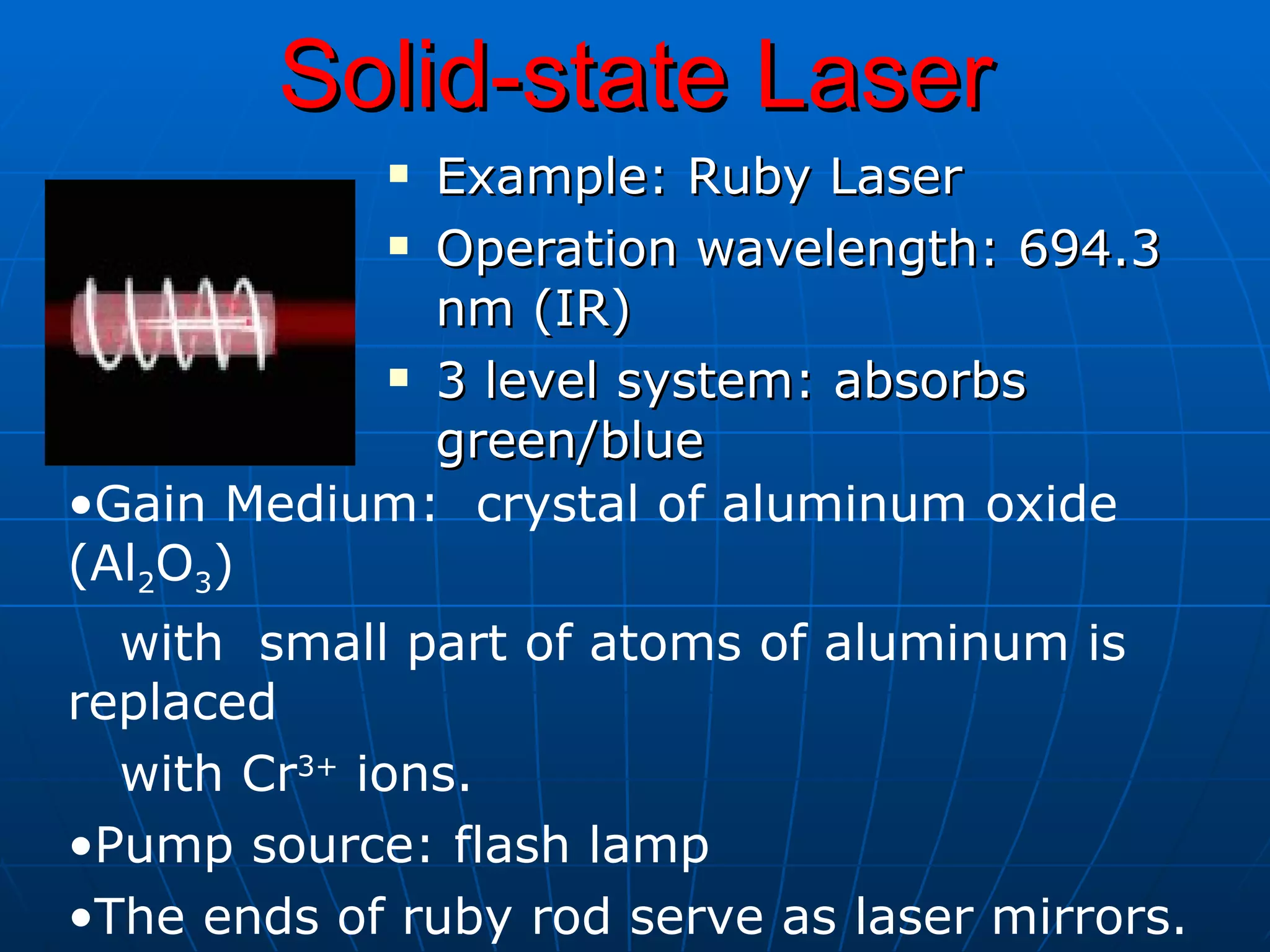
Solid-state Laser Example: Ruby Laser Operation wavelength: 694.3 nm (IR) 3 level system: absorbs green/blue Gain Medium:  crystal of aluminum oxide (Al 2 O 3 )  with  small part of atoms of aluminum is replaced  with Cr 3+  ions. Pump source: flash lamp  The ends of ruby rod serve as laser mirrors.
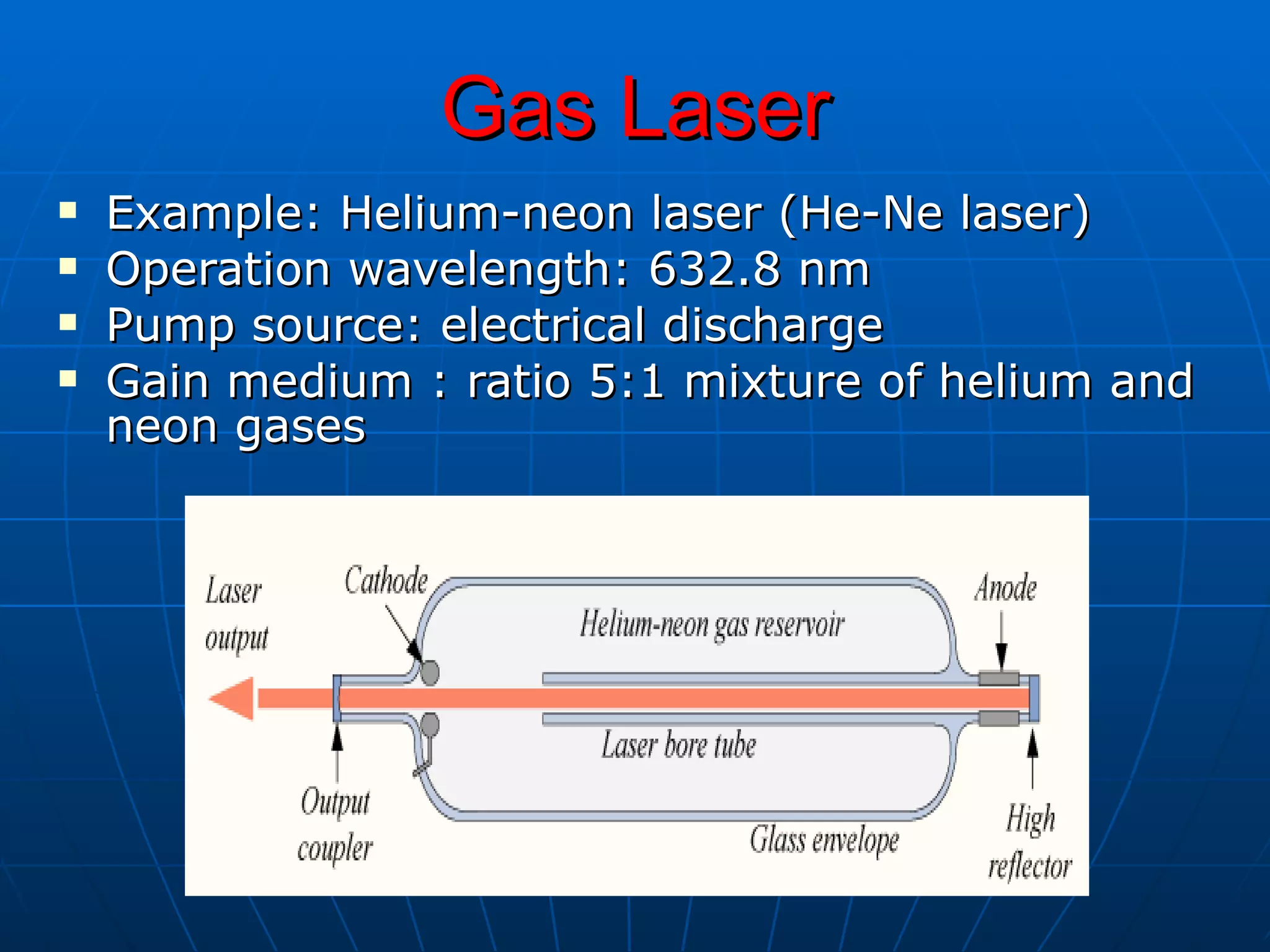
Gas Laser Example: Helium-neon laser (He-Ne laser) Operation wavelength: 632.8 nm  Pump source: electrical discharge Gain medium : ratio 5:1 mixture of helium and neon gases
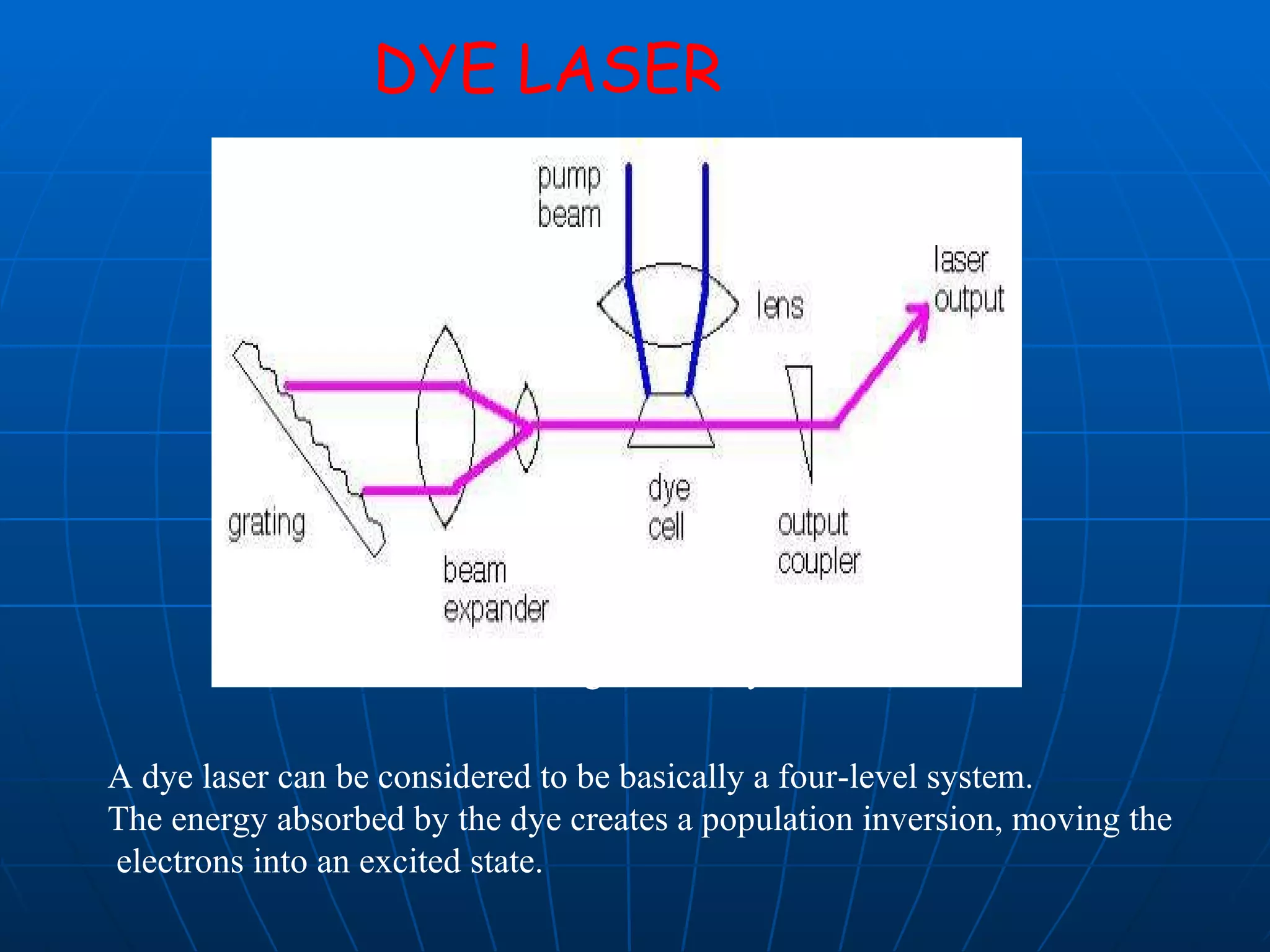
Schematic diagram of a dye laser   DYE LASER A dye laser can be considered to be basically a four-level system.  The energy absorbed by the dye creates a population inversion, moving the electrons into an excited state.
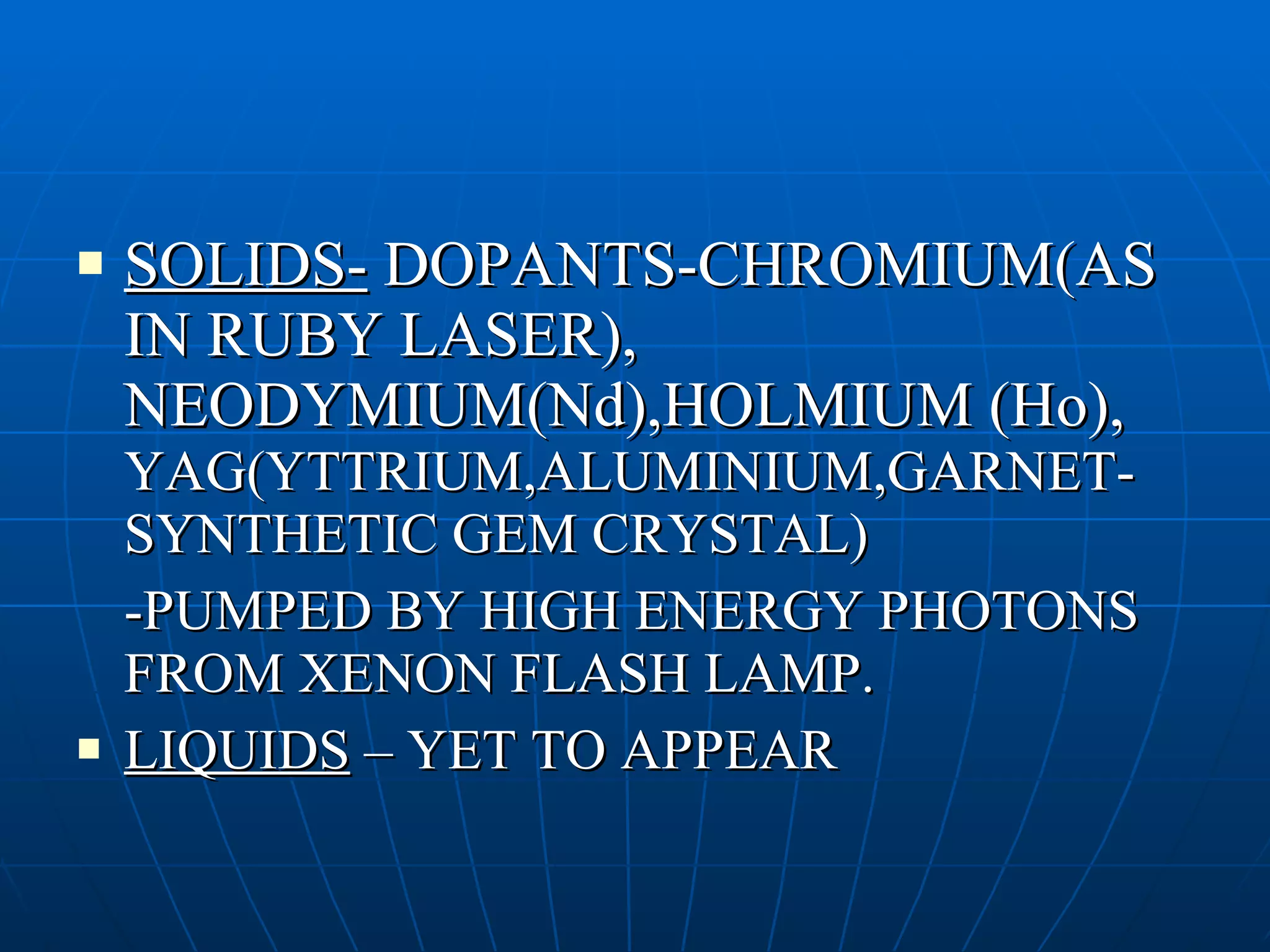
SOLIDS-  DOPANTS-CHROMIUM(AS IN RUBY LASER), NEODYMIUM(Nd),HOLMIUM (Ho),  YAG(YTTRIUM,ALUMINIUM,GARNET-SYNTHETIC GEM CRYSTAL) -PUMPED BY HIGH ENERGY PHOTONS FROM XENON FLASH LAMP. LIQUIDS  – YET TO APPEAR


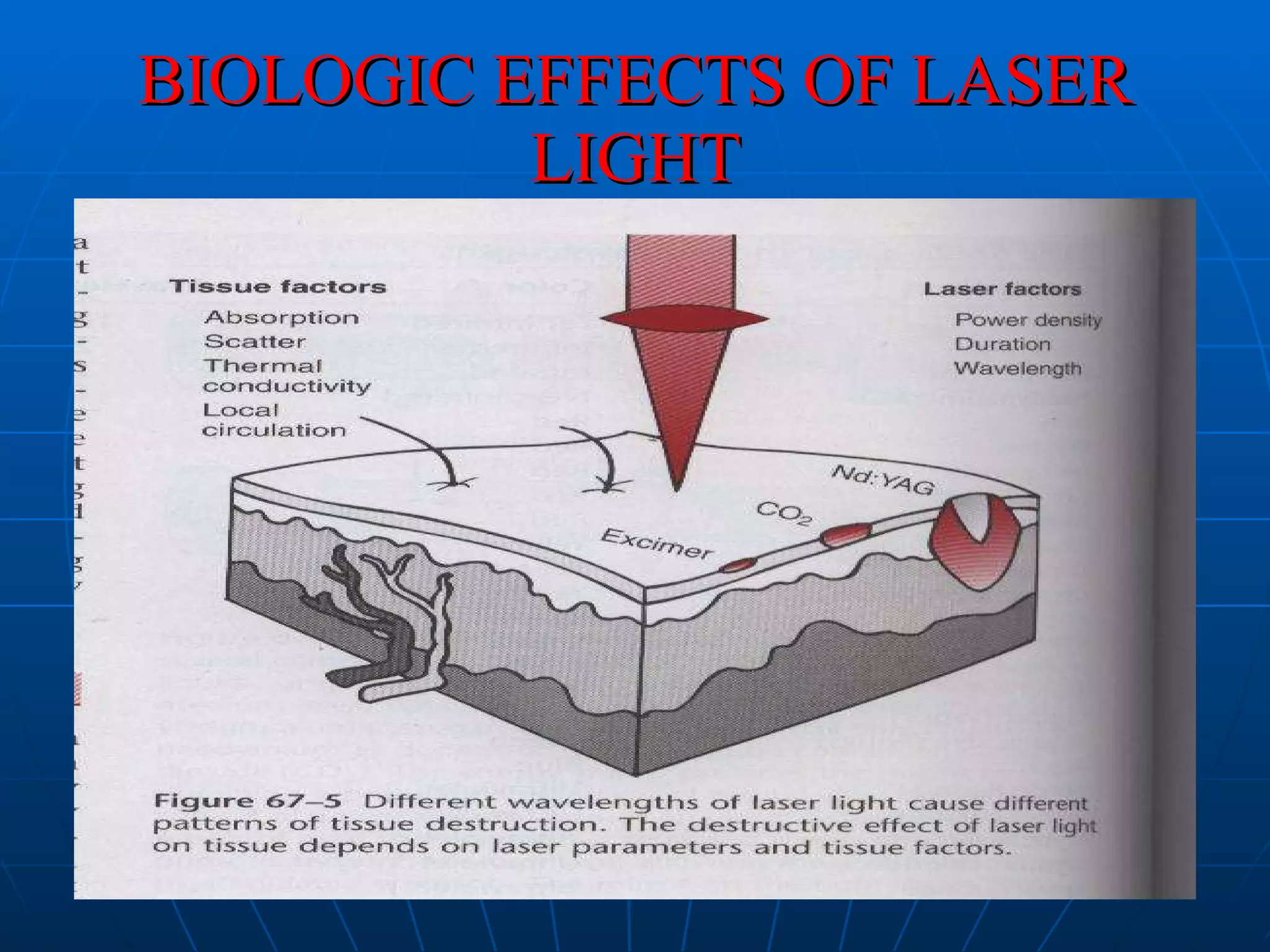
BIOLOGIC EFFECTS OF LASER LIGHT
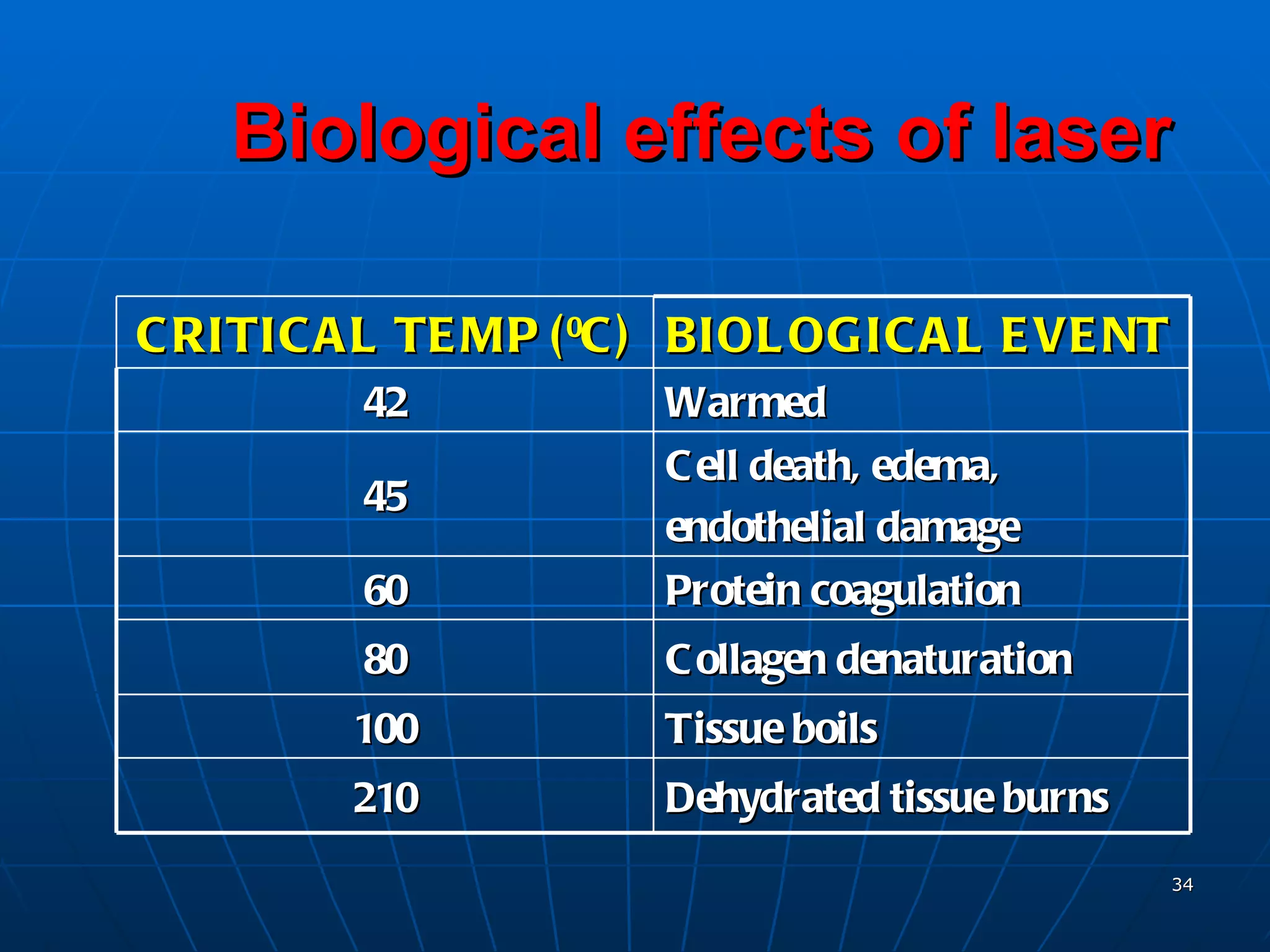
Biological effects of laser CRITICAL TEMP ( 0 C) BIOLOGICAL EVENT 42 Warmed 45 Cell death, edema, endothelial damage 60 Protein coagulation 80 Collagen denaturation 100 Tissue boils 210 Dehydrated tissue burns
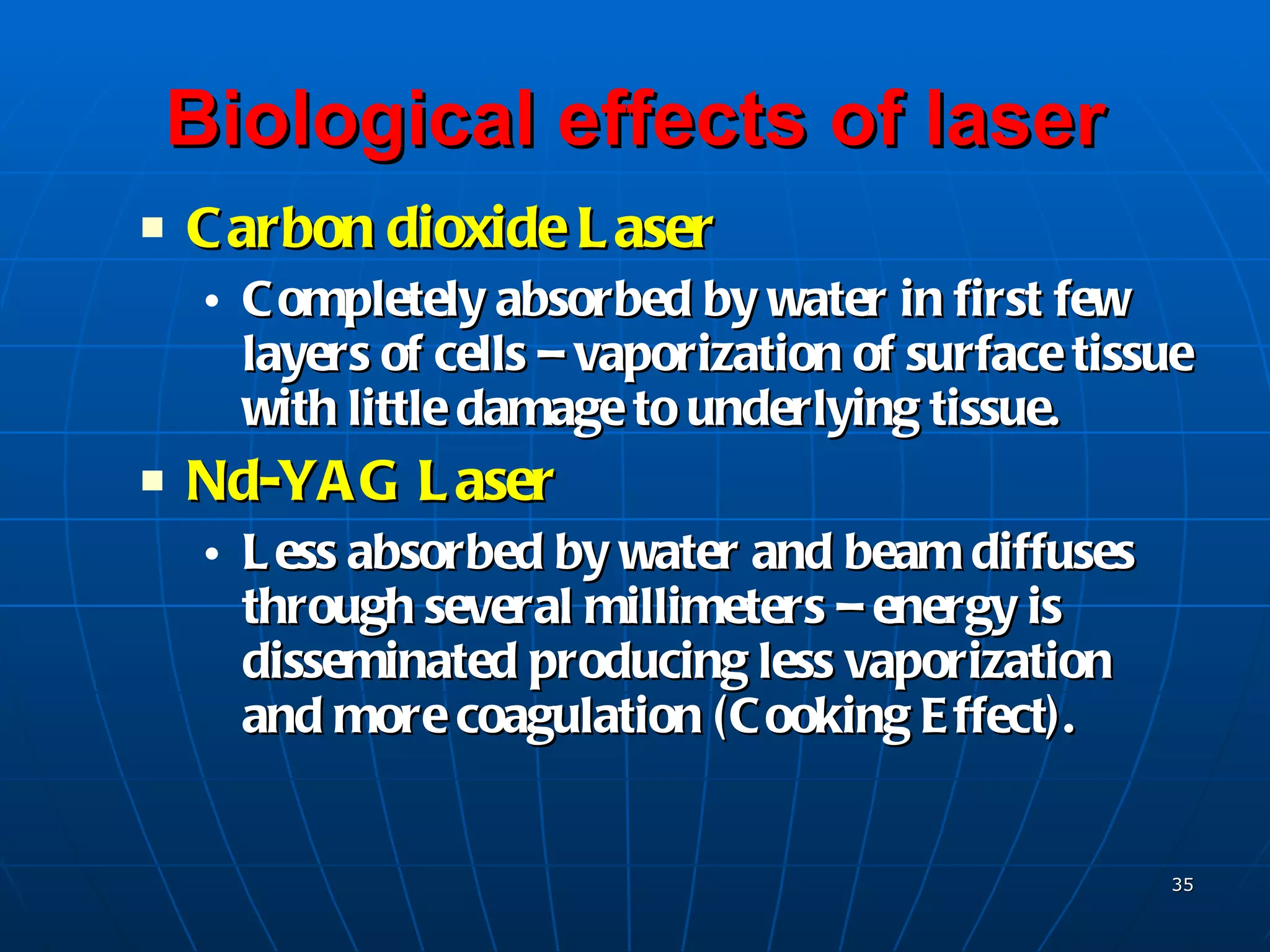
Biological effects of laser Carbon dioxide Laser Completely absorbed by water in first few layers of cells – vaporization of surface tissue with little damage to underlying tissue. Nd-YAG Laser Less absorbed by water and beam diffuses through several millimeters – energy is disseminated producing less vaporization and more coagulation (Cooking Effect).
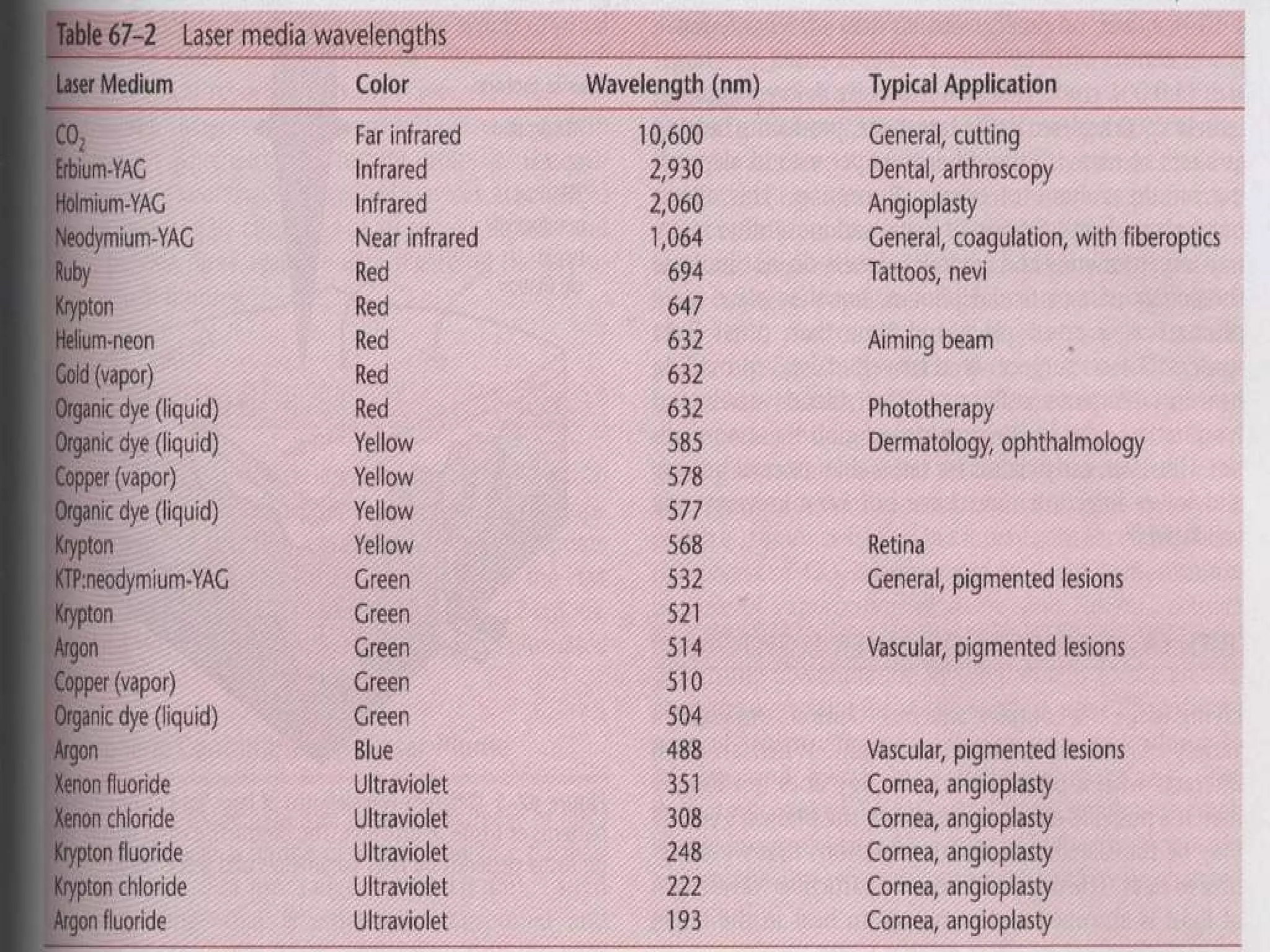
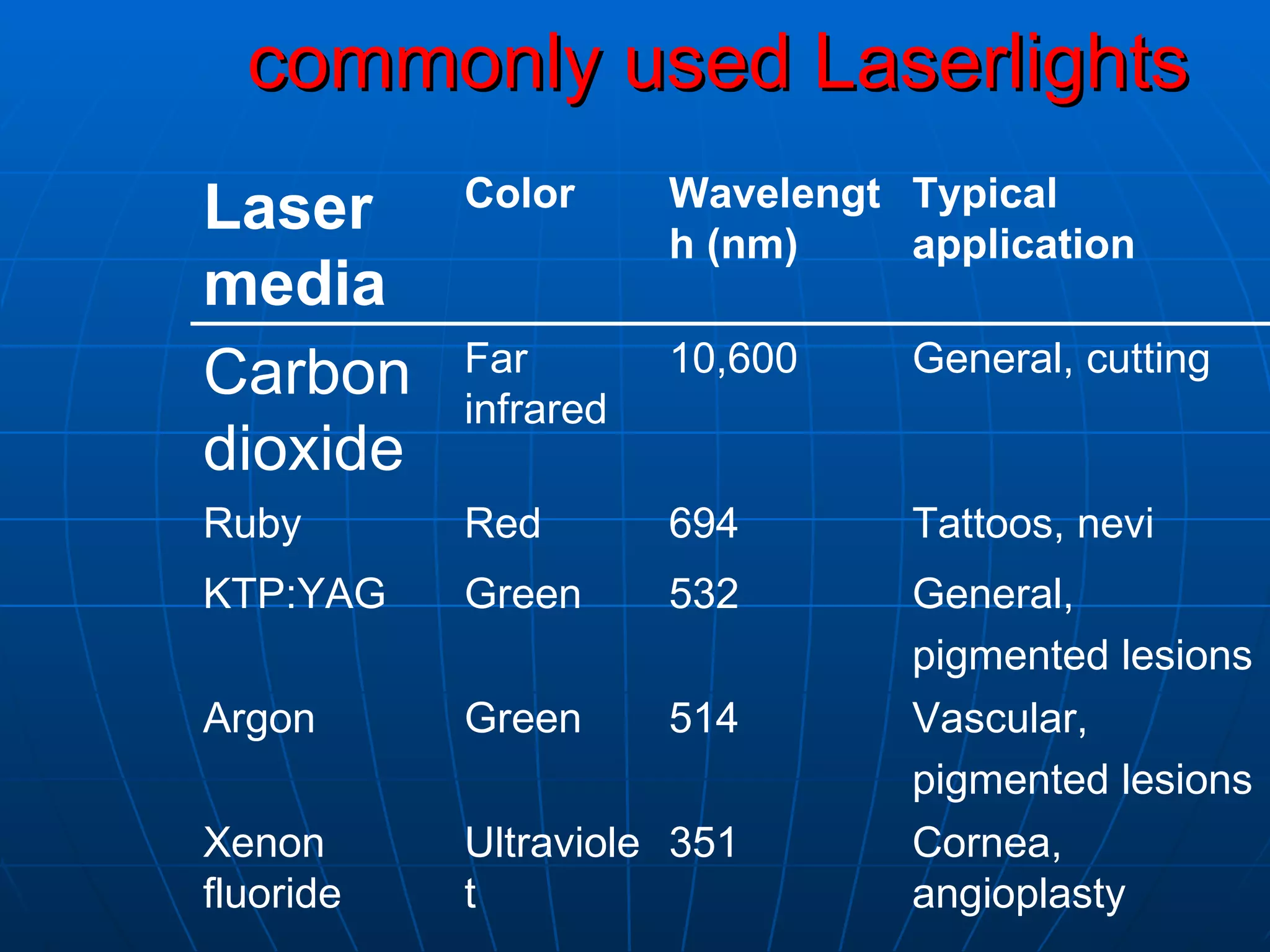
commonly used Laserlights Laser media Color Wavelength (nm) Typical application Carbon dioxide Far infrared 10,600 General, cutting Ruby Red 694 Tattoos, nevi KTP:YAG Green 532 General,  pigmented lesions Argon Green 514 Vascular,  pigmented lesions Xenon fluoride Ultraviolet 351 Cornea, angioplasty
LASERS ARE NOT VERY EFFICIENT AT CONVERTING ELECTRICITY INTO LIGHT,THEY REQUIRE A LARGE POWER SUPPLY. FREQENCY DOUBLES TO CONVERT LASER LIGHT TO DIFFERRENT WAVE LENGTH ENHANCING THERAUPETIC FLEXIBILITY
DR.GERRY ROSS CLINICAL APPLICATIONS PIONEER OF LASER THERAPY
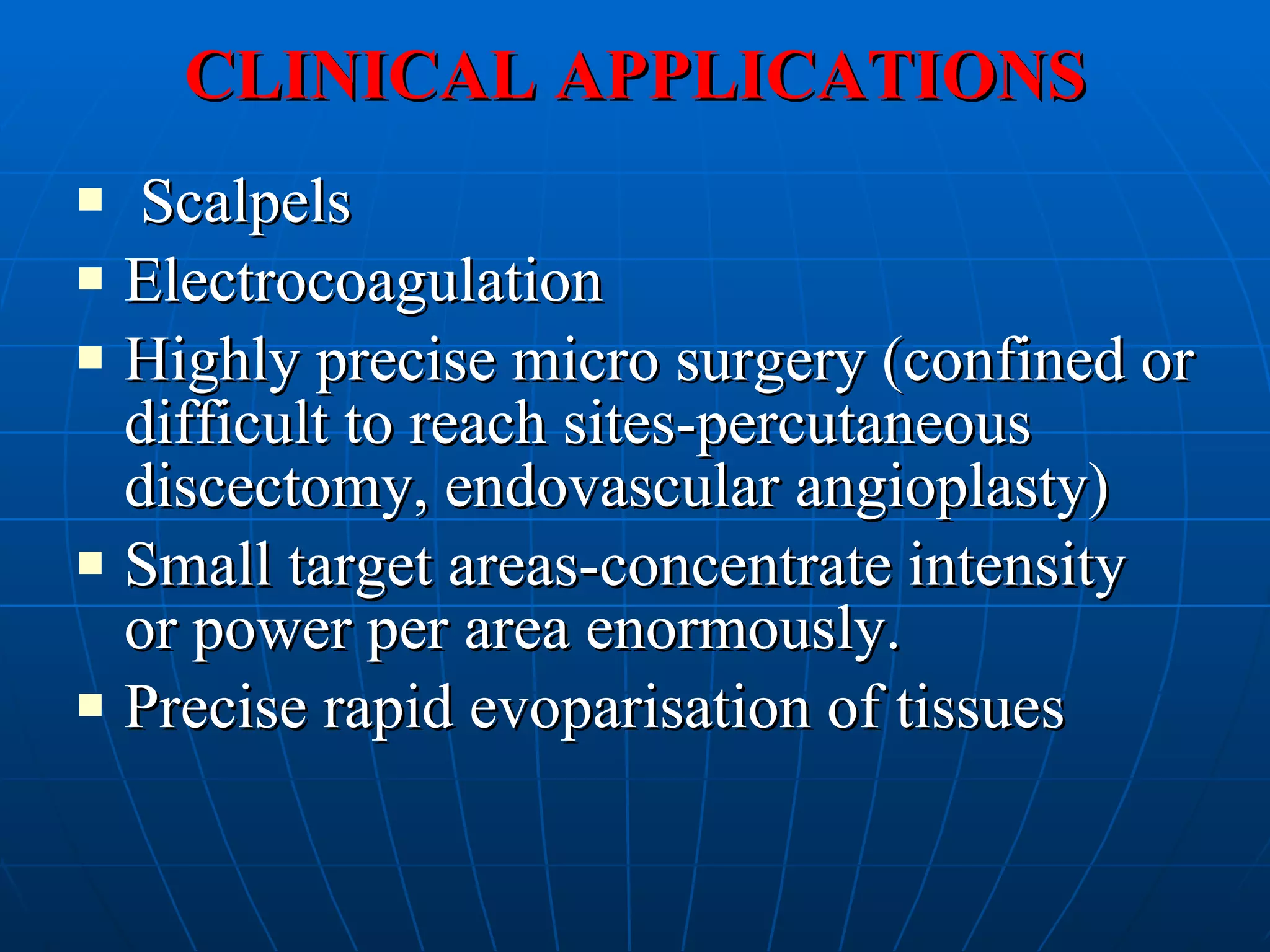
CLINICAL APPLICATIONS Scalpels Electrocoagulation Highly precise micro surgery (confined or difficult to reach sites-percutaneous discectomy, endovascular angioplasty) Small target areas-concentrate intensity or power per area enormously. Precise rapid evoparisation of tissues
 
 
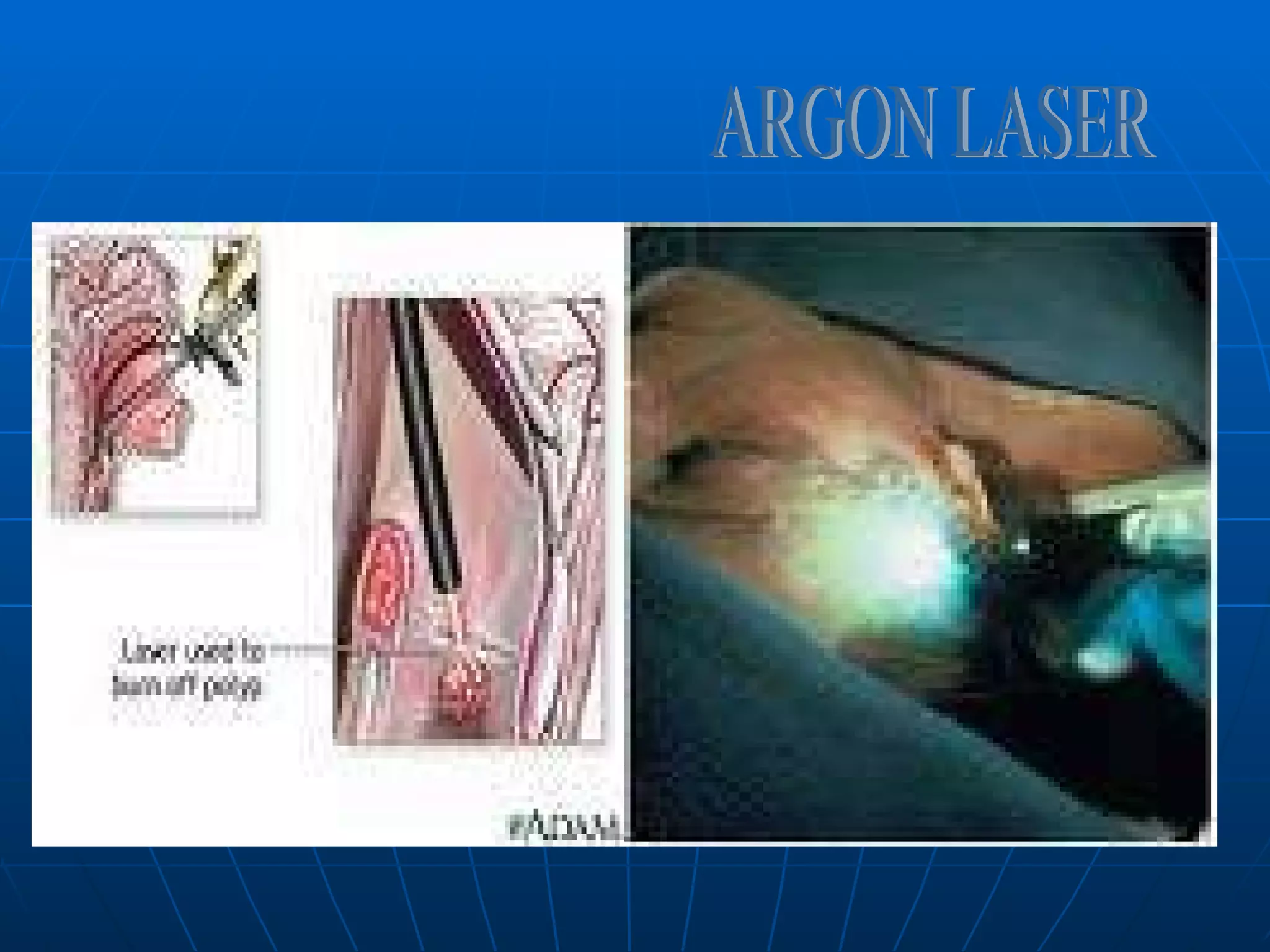
ARGON LASER
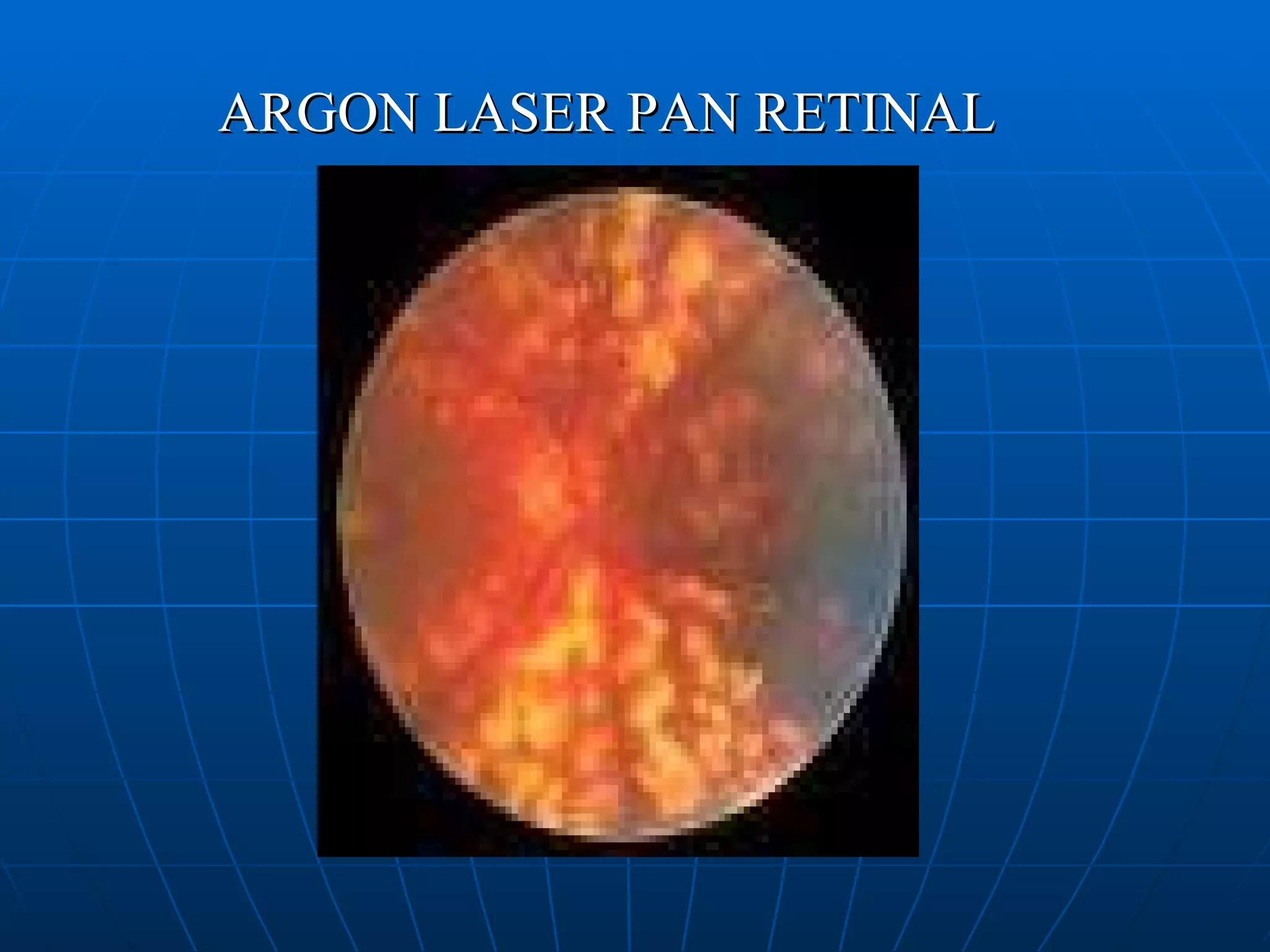
ARGON LASER PAN RETINAL
COSMETIC LASER  SURGERY
LASER IRIDOTOMY
LASER REVASCULARISATION
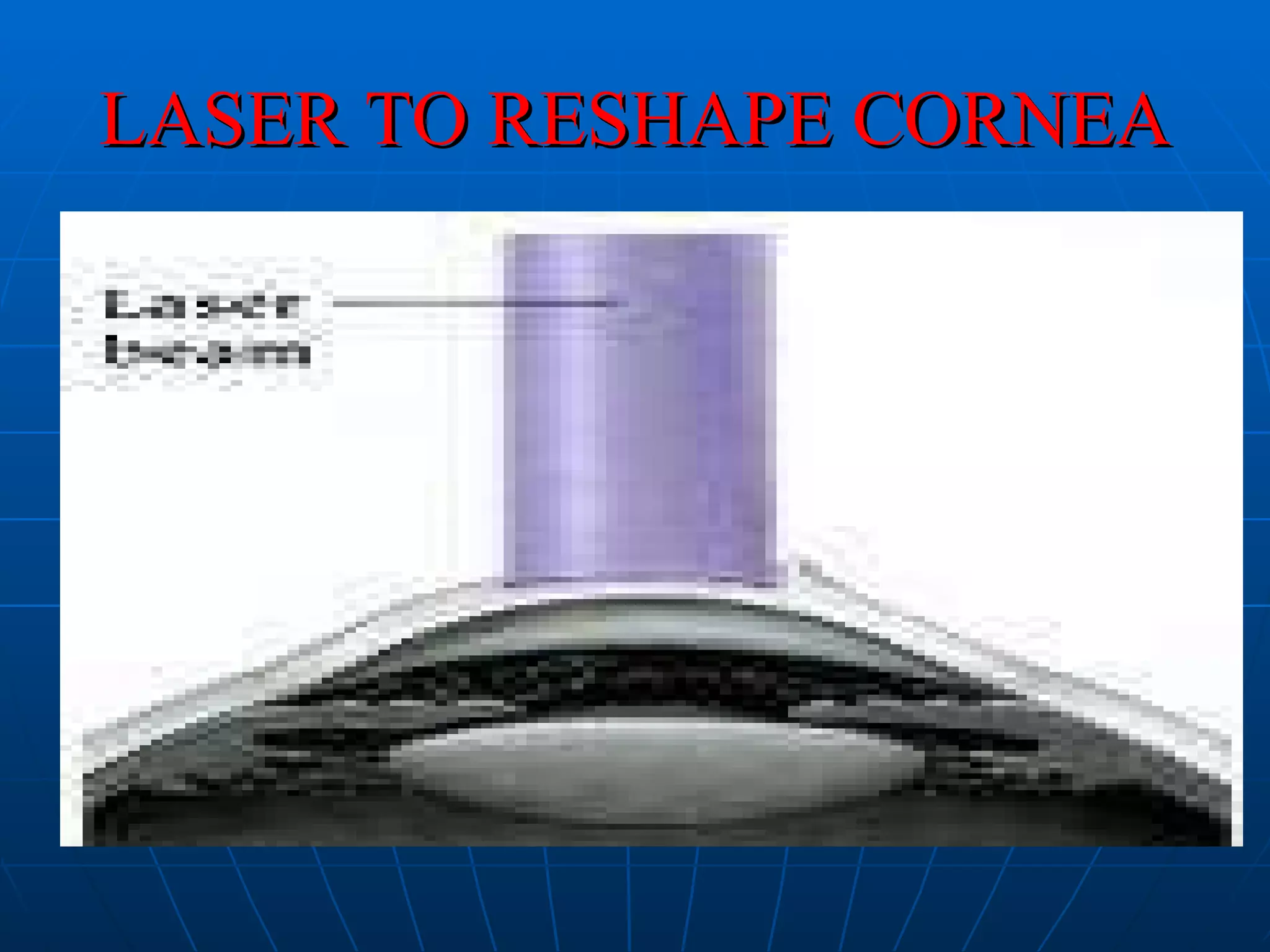
LASER TO RESHAPE CORNEA
LASER SKIN RESURFACING
LASER LIPOSUCTION
 
HAIR REMOVAL
LASER PLASTIC SURGERY-SAGGING
LASER TO MAKE AN INCISION
LASER VISION CORRECTION
ADVANTAGES Laser surgery Relatively dry Near instantaneous ceiling of blood vessels, lymphatics even in presence of coagulation abnormalities Faster healing Lower infection rates
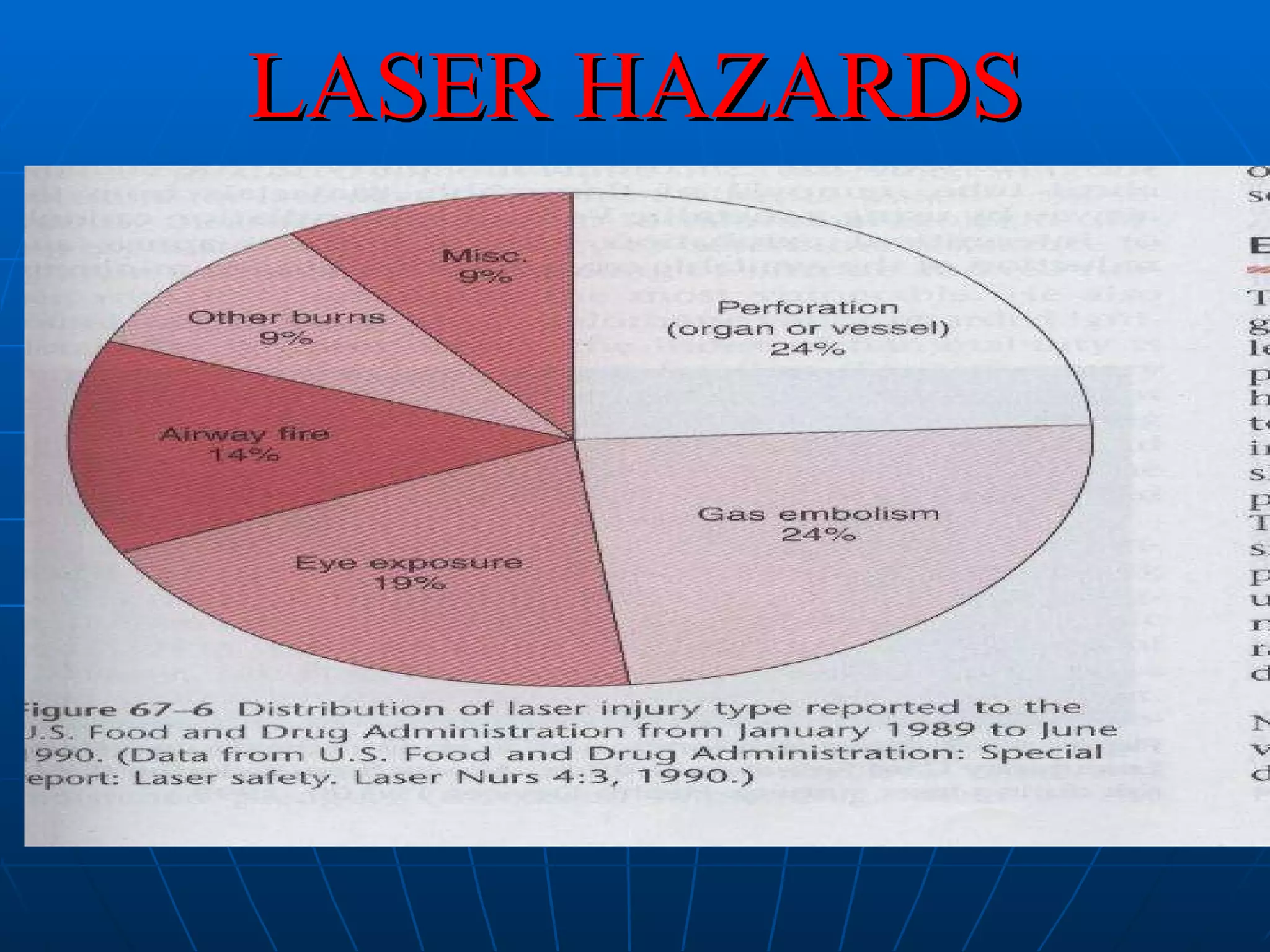
LASER HAZARDS
Safety Considerations
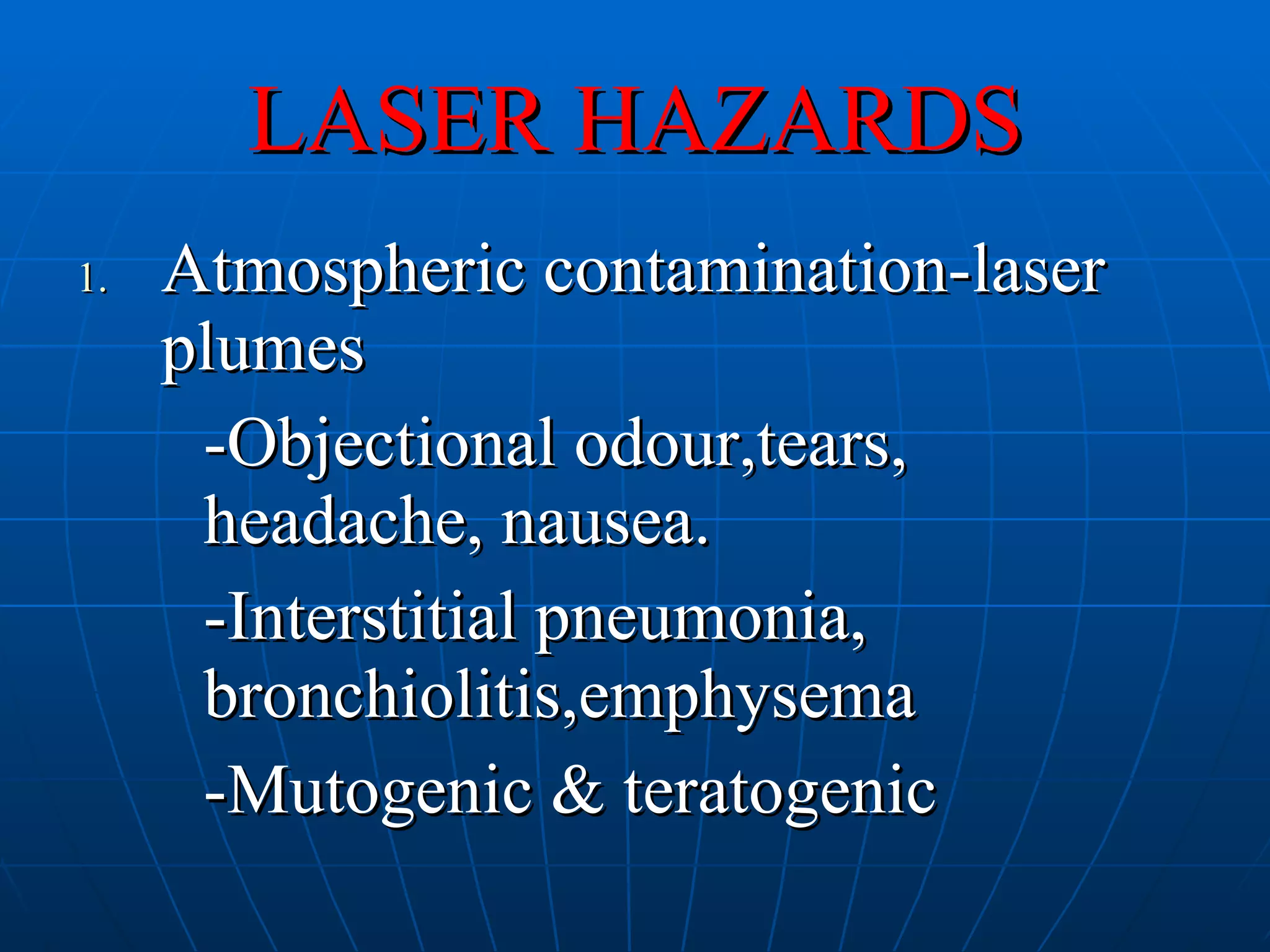
LASER HAZARDS Atmospheric contamination-laser plumes -Objectional odour,tears,  headache, nausea. -Interstitial pneumonia,  bronchiolitis,emphysema -Mutogenic & teratogenic
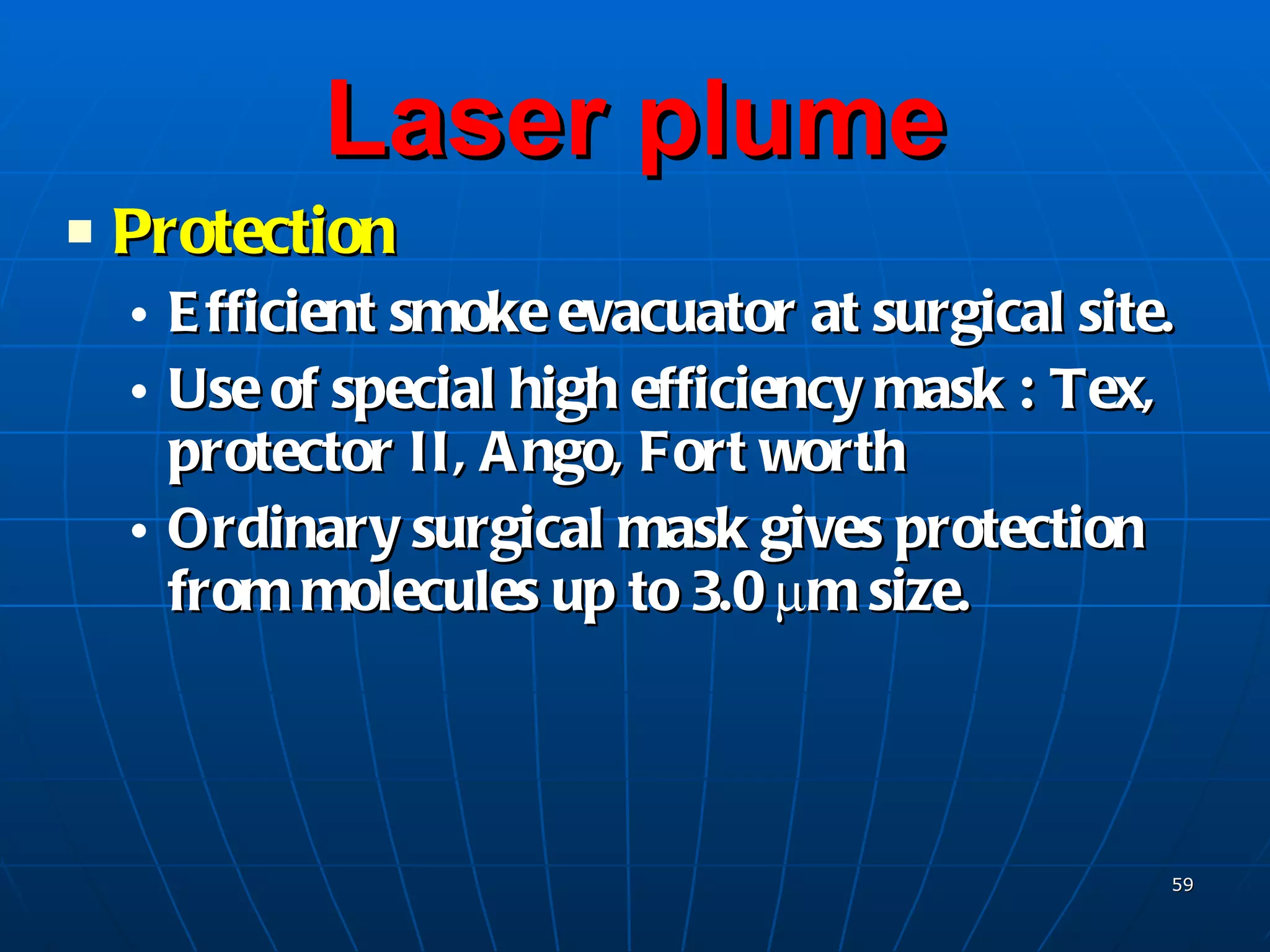
Laser plume Protection Efficient smoke evacuator at surgical site. Use of special high efficiency mask :  Tex, protector II, Ango, Fort worth Ordinary surgical mask gives protection from molecules up to 3.0 µm size.
Plume of smoke and fine particulates (mean size 0.31um) Efficiently transported and deposited in the alveoli Sensitive individuals: headaches, tearing, and nausea after inhalation Animal study: interstitial pneumonia, bronchiolitis, reduced mucociliary clearance, inflammation, emphysema Prevention   ->  smoke evacuator ->  high-efficiency masks Atmospheric contamination
LASER HAZARDS CONTD … 2.Tissue and vessel perforation(misdirected  laser energy) -Viscous perforation -vessels more than 5 mm not  coaguable by  lasers -Pneumothorax(after  laryngeal perforation) Perforational bleeding after several days post operatively with edema and necrosis. 3.Embolism- VAE 4.Energy transfer to an inappropriate location
Incidentally pressing the laser control trigger Tissue damage outside of surgical site Drape fire Eye (patient or other medical staff) Endotracheal tube fires Inappropriate energy transfer
EYE PROTECTION Operating room staff- goggles or lenses specific for specific laser wave length. Patient-non operated eye-taped, closed,covered with an opaque saline soaked knit or metal shields.
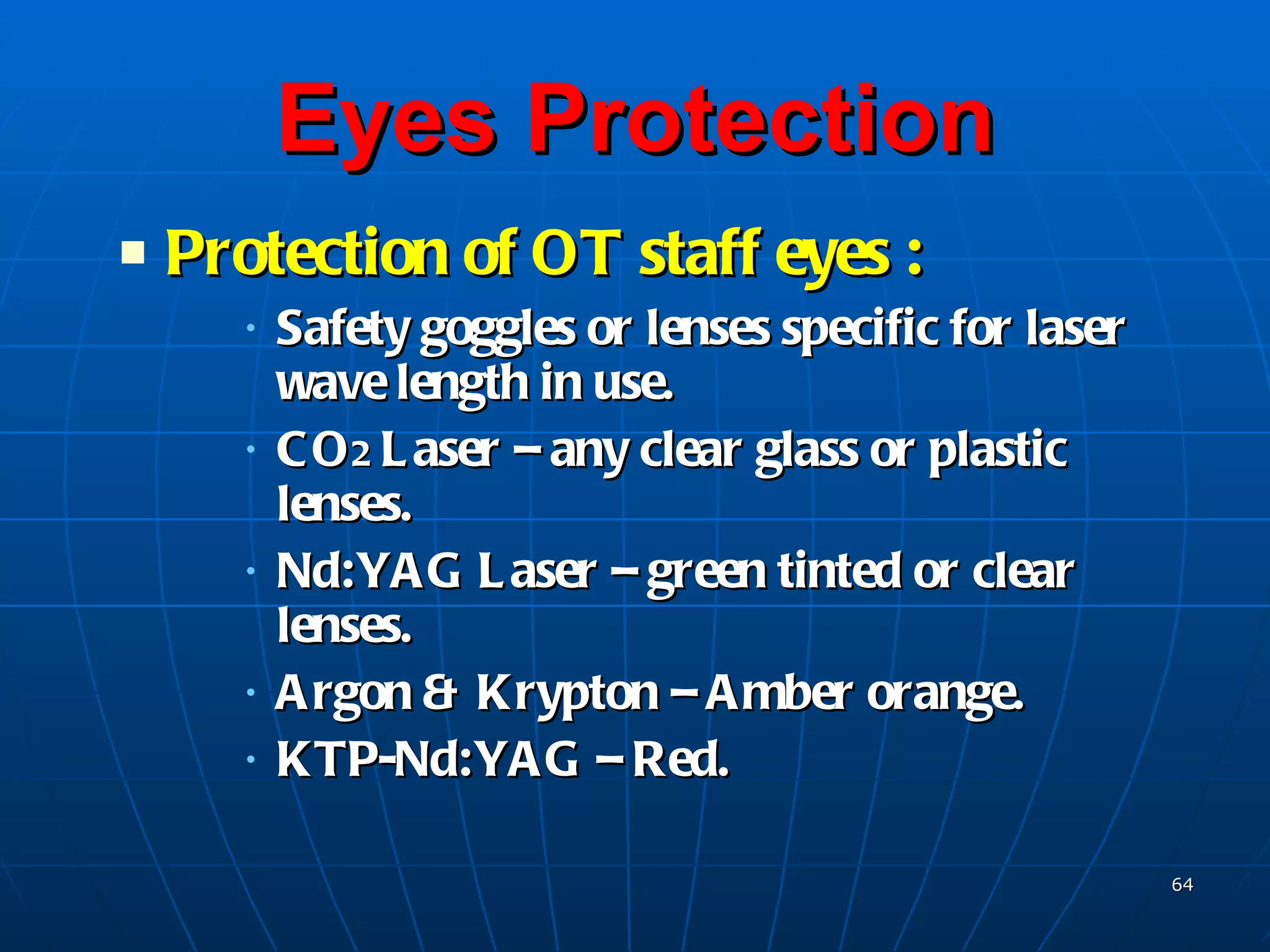
Eyes Protection Protection of OT staff eyes : Safety goggles or lenses specific for laser wave length in use. CO 2  Laser – any clear glass or plastic lenses. Nd:YAG Laser – green tinted or clear lenses. Argon & Krypton – Amber orange. KTP-Nd:YAG – Red.
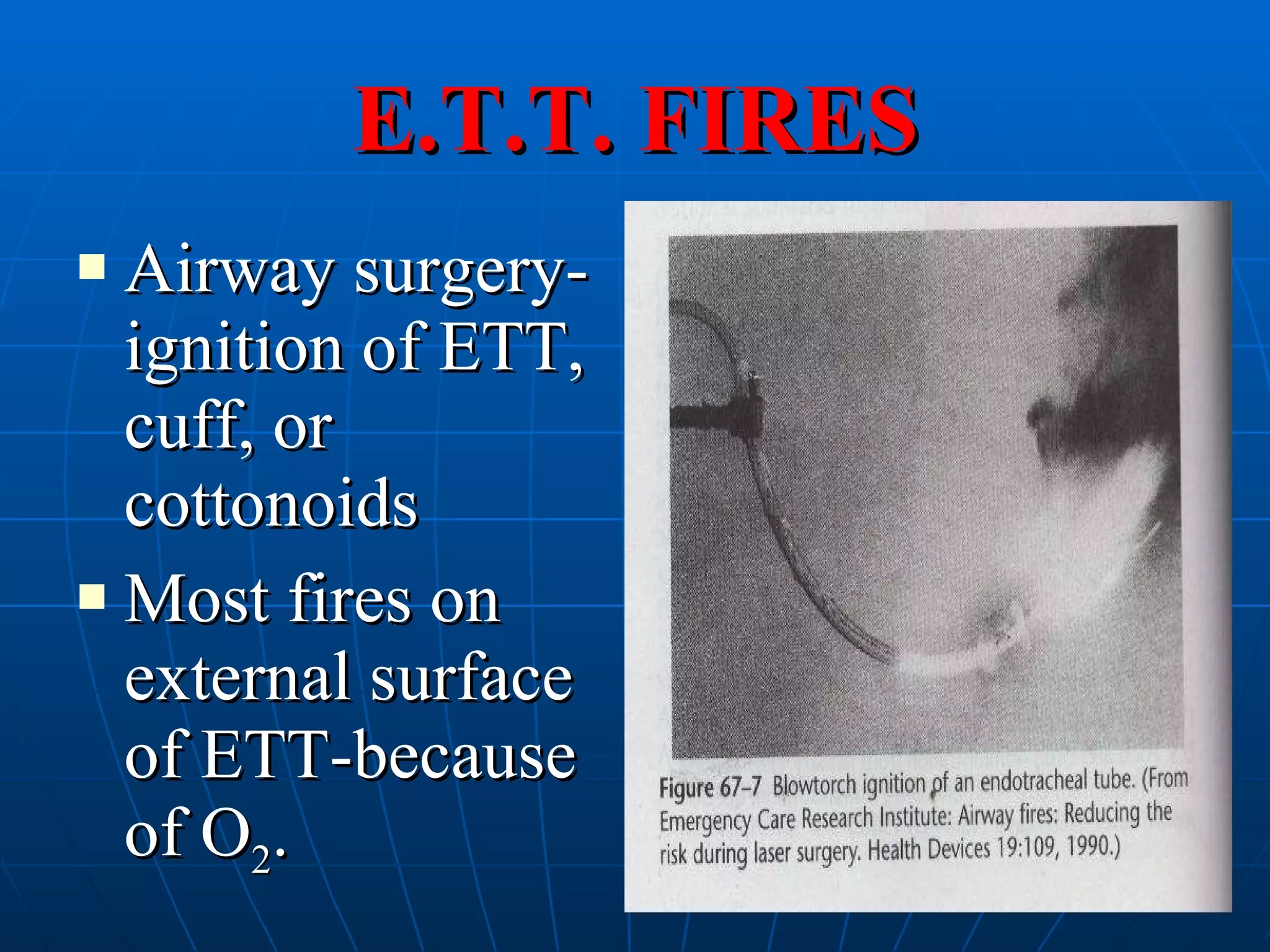
E.T.T. FIRES Airway surgery-ignition of ETT, cuff, or cottonoids Most fires on external surface of ETT-because of O 2 .
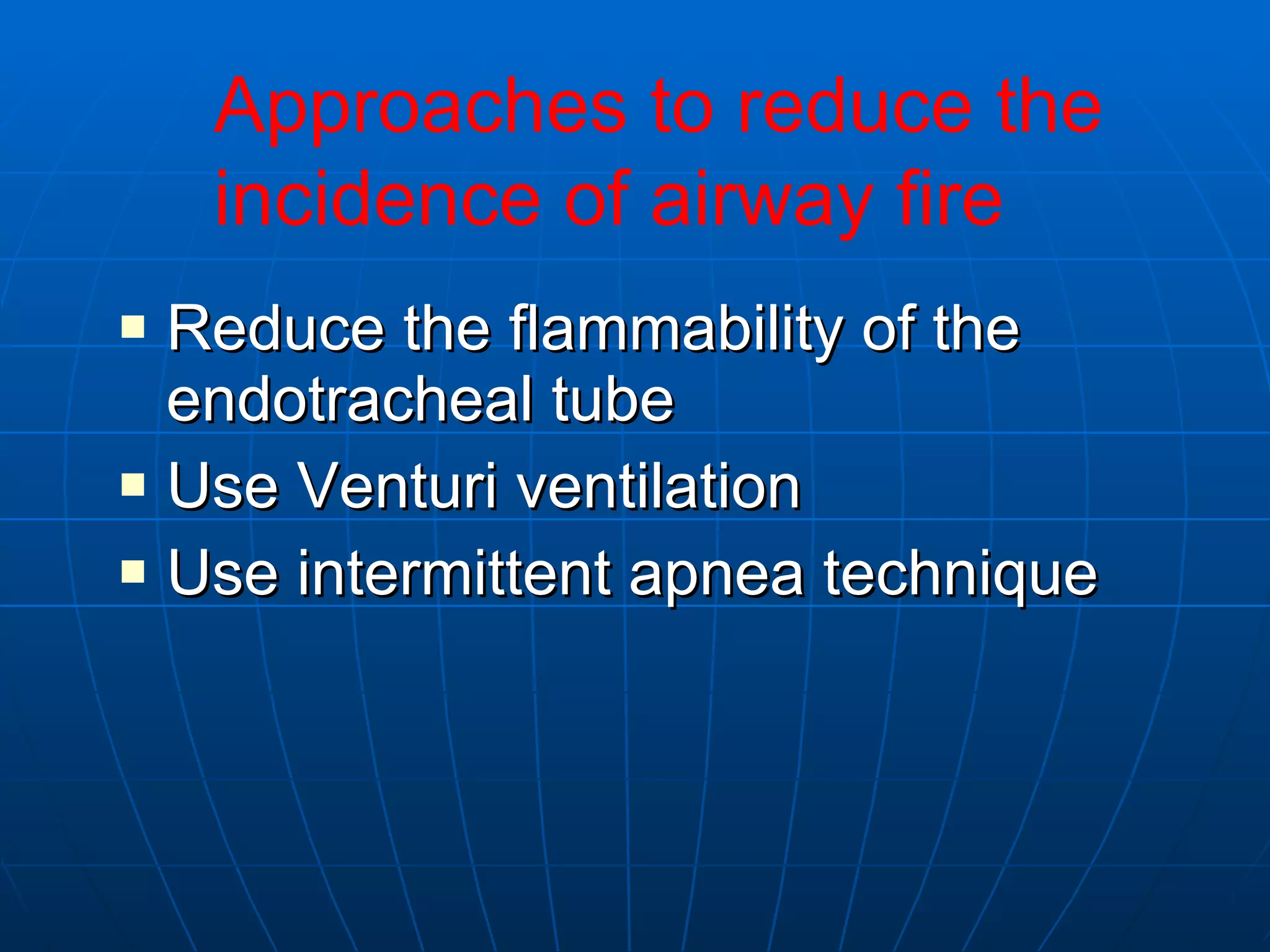
Reduce the flammability of the endotracheal tube Use Venturi ventilation Use intermittent apnea technique Approaches to reduce the incidence of airway fire
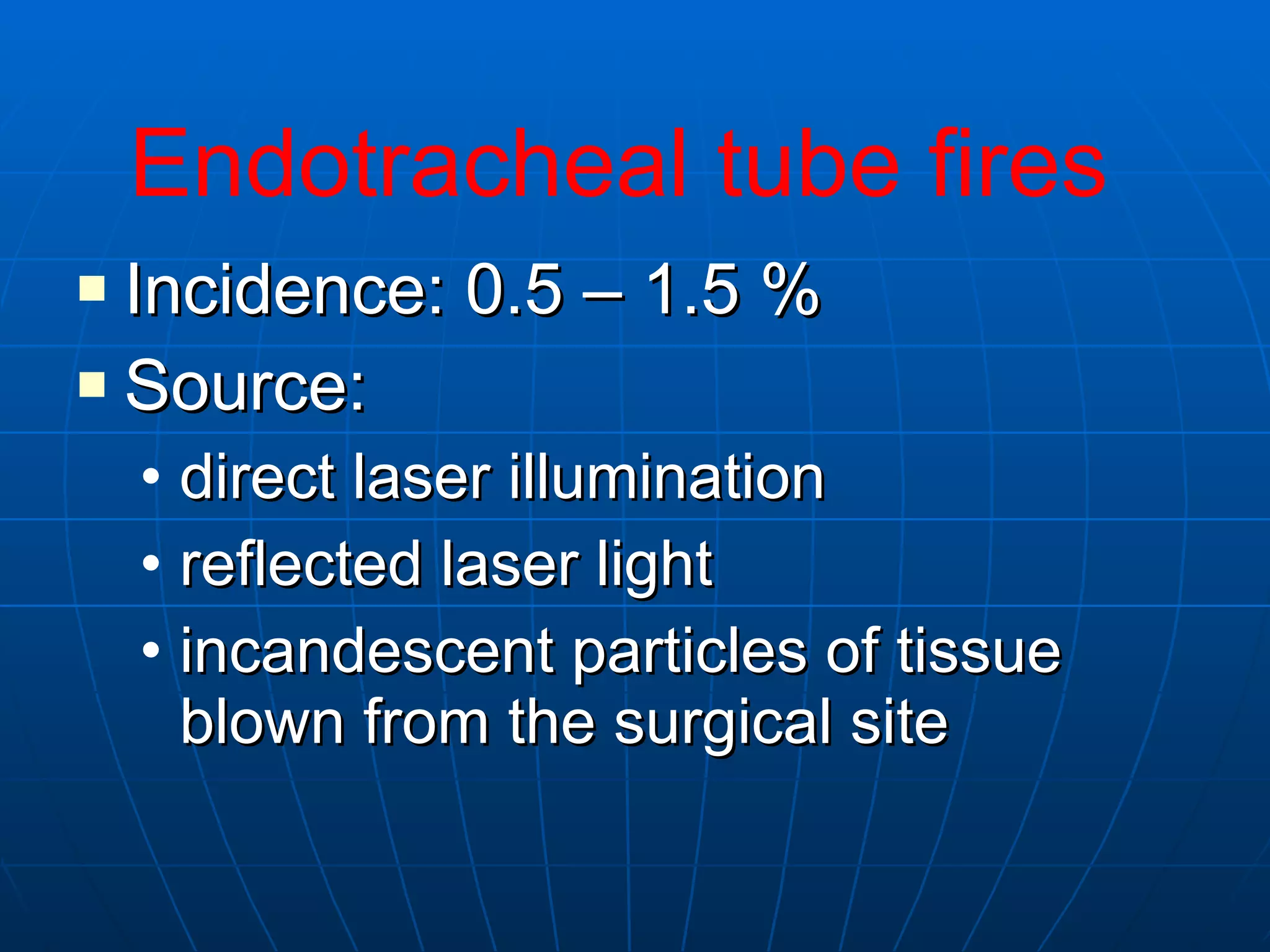
Incidence: 0.5 – 1.5 % Source:  direct laser illumination reflected laser light incandescent particles of tissue blown from the surgical site Endotracheal tube fires
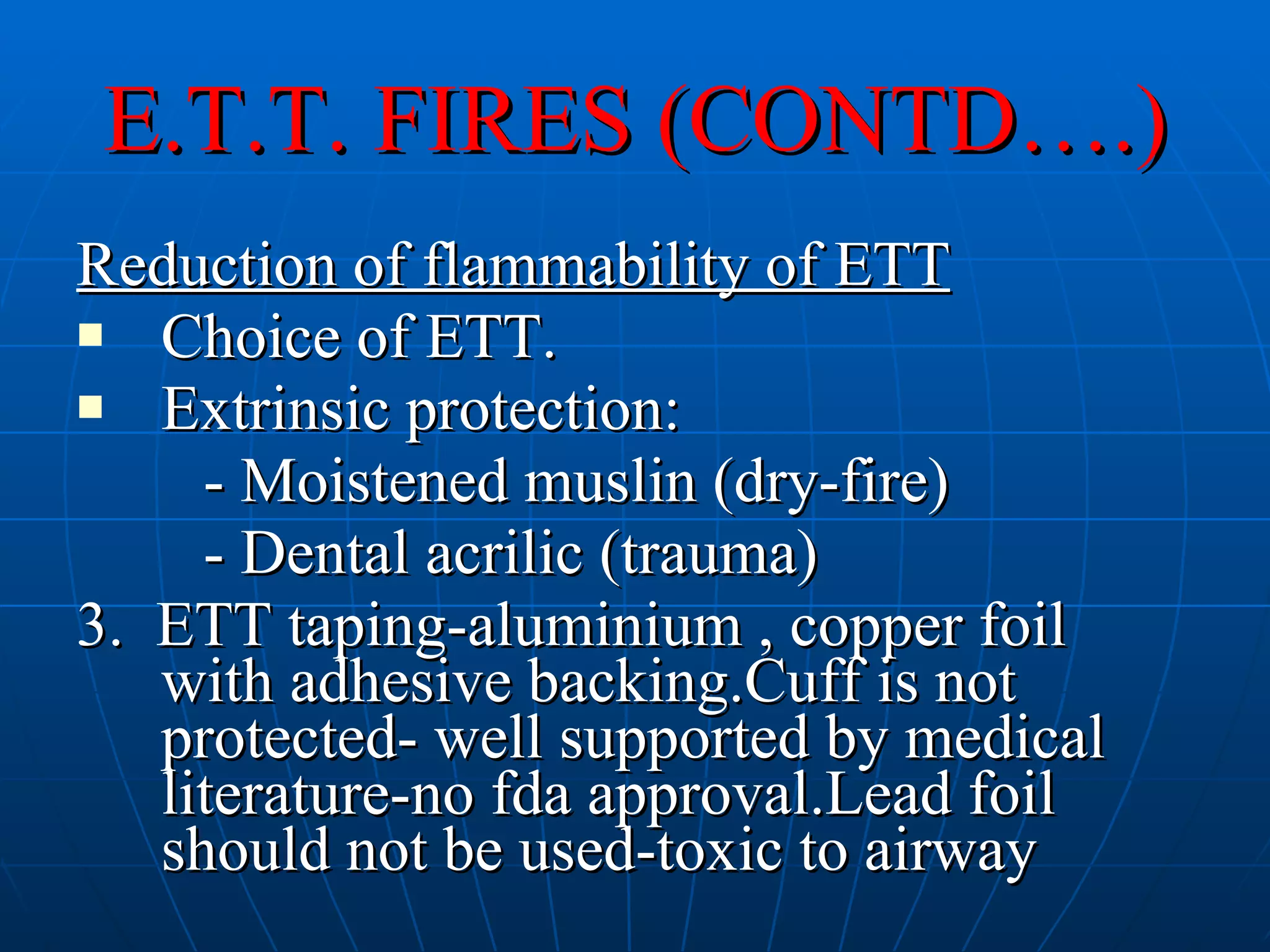
E.T.T. FIRES (CONTD….) Reduction of flammability of ETT Choice of ETT. Extrinsic protection: - Moistened muslin (dry-fire) - Dental acrilic (trauma) 3.  ETT taping-aluminium , copper foil with adhesive backing.Cuff is not protected- well supported by medical literature-no fda approval.Lead foil should not be used-toxic to airway
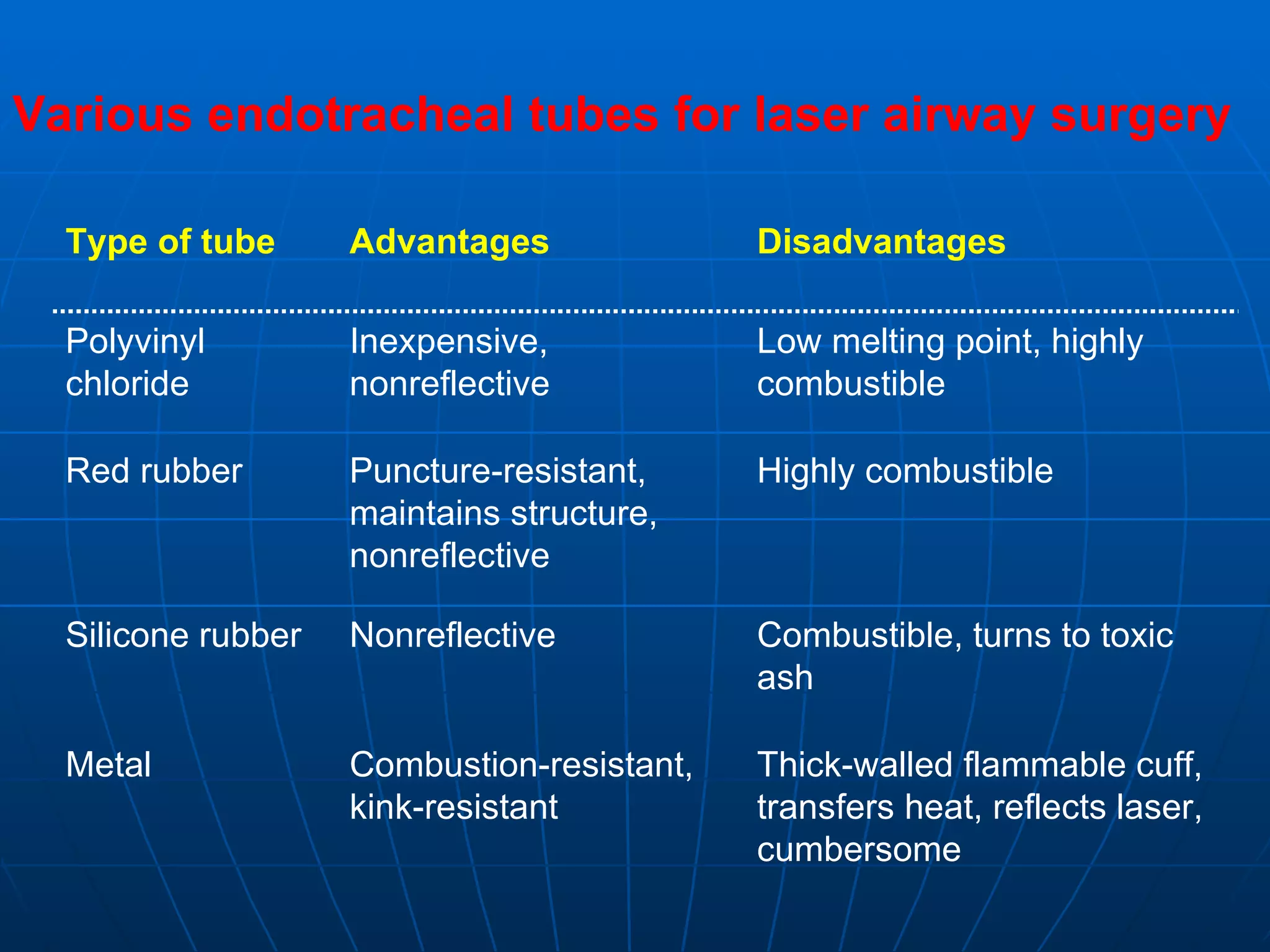
Various endotracheal tubes for laser airway surgery Type of tube Advantages Disadvantages Polyvinyl chloride Inexpensive, nonreflective Low melting point, highly combustible Red rubber Puncture-resistant, maintains structure, nonreflective Highly combustible Silicone rubber Nonreflective Combustible, turns to toxic ash Metal Combustion-resistant, kink-resistant Thick-walled flammable cuff, transfers heat, reflects laser, cumbersome
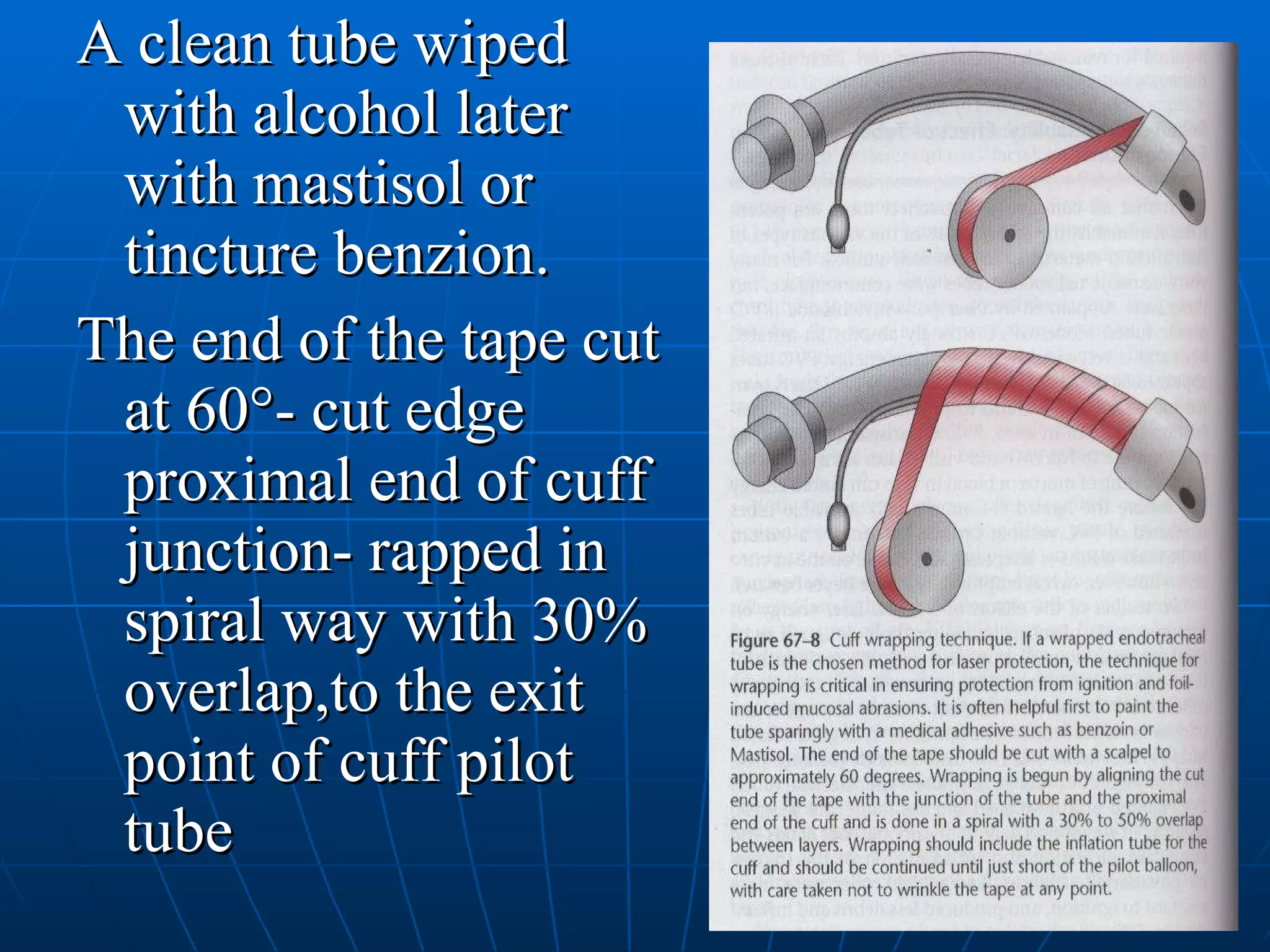
A clean tube wiped with alcohol later with mastisol or tincture benzion. The end of the tape cut at 60°- cut edge proximal end of cuff junction- rapped in spiral way with 30% overlap,to the exit point of cuff pilot tube
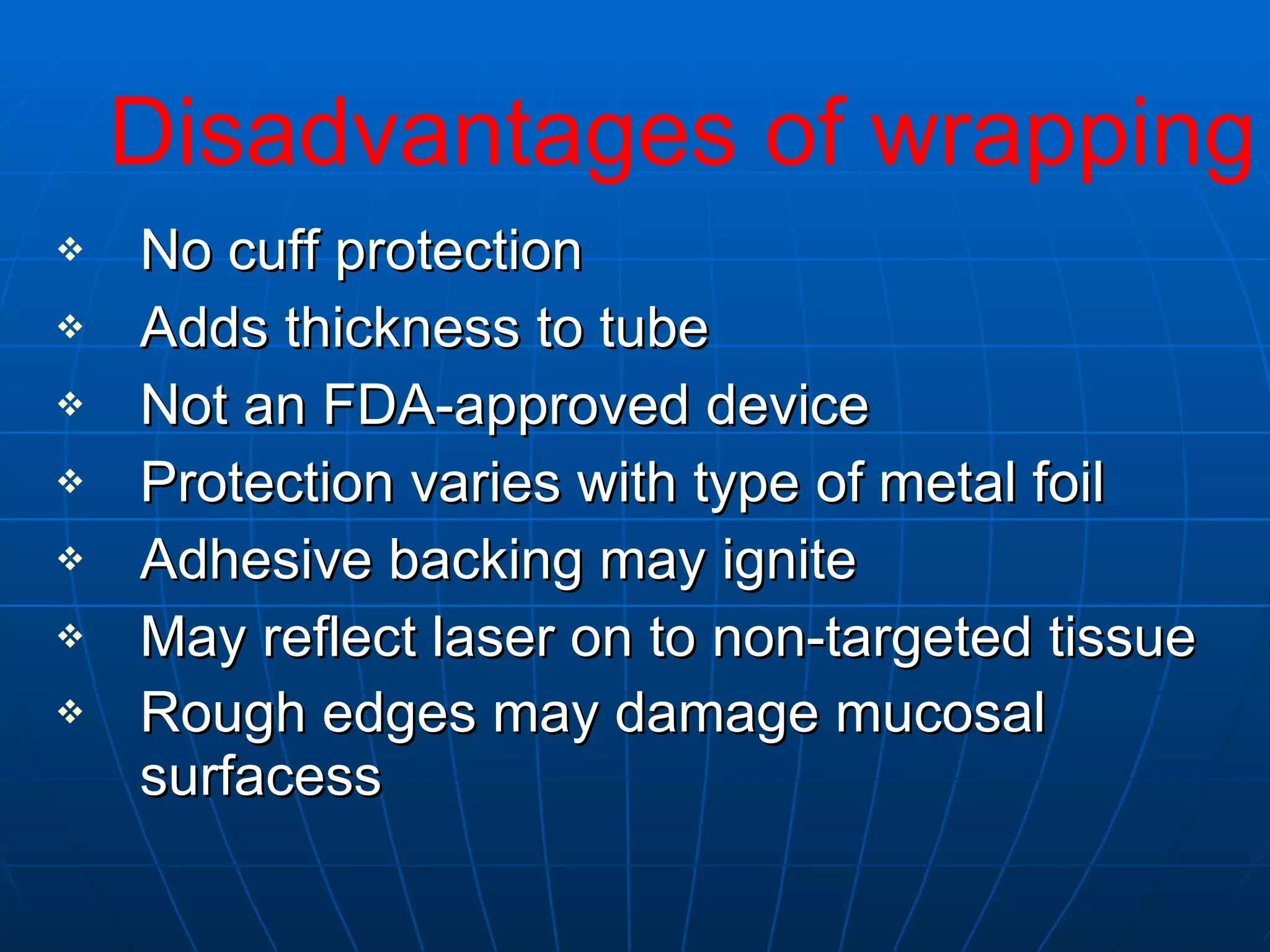
No cuff protection Adds thickness to tube Not an FDA-approved device Protection varies with type of metal foil Adhesive backing may ignite May reflect laser on to non-targeted tissue Rough edges may damage mucosal surfacess   Disadvantages of wrapping
Oxygen and nitrous oxide are powerful oxidizers Reduce FiO 2  to minimum concentration Helium may benefit as a diluent gas Volatile anesthetics currently used are nonflammable and nonexplosive Pyrolized toxic compounds Effect of high oxygen and nitrous oxide gas mixture
FDA APPROVED ETT WRAPS Merocel laser guard - - Metal foil laminated to a  synthetic sponge kept moist  - protection against  co2, argon, ktp:nd:yag (but not yag) lasers - ETT diameter increased by 2 mm. - No protection for the cuff.
FDA APPROVED ETT WRAPS CONTD … Integrated laser resistent coating in the manufacture of ett- CO 2  laser -  Xomed  laser shield tube (fabricated from silicon with an outer layer of aluminium powder with silicon-aluminised layer extends over inflatable cuff.)
FDA APPROVED ETT WRAPS CONTD… .Laser shield ii- CO 2  ,ktp laser  -silicon based wrapped by a coated alluminium tape - The cuff-unshielded silicon elastoma-designed to be expanded with saline and methylene blue.
PROTECTION OF ETT CUFF standard hi-lo cuff -colored saline. Cuff-placed as far distal in the trachea as possible. Surgeon should cover the visible cuff with moistened cotton pledges-cotton strings attached to pledges replaced by wire- pledges re moistened as needed.
METAL ETT NORTON DE VOS(1978 ) - Interlocking stainless spiral coil (resembling electrical cable armour)-no cuff. - Difficult ventillation-non compliance
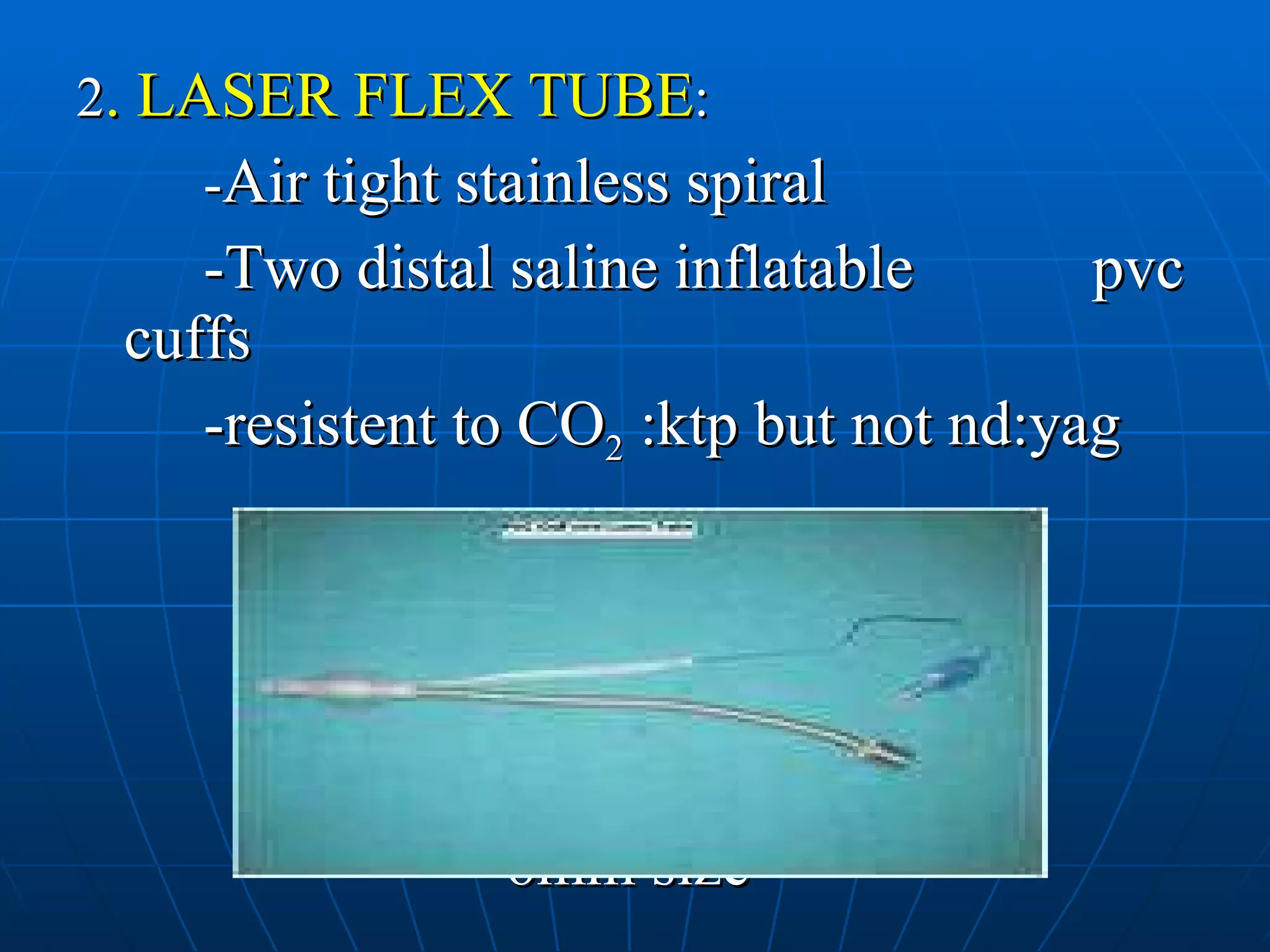
2 . LASER FLEX TUBE : - Air tight stainless spiral -Two distal saline inflatable  pvc cuffs -resistent to CO 2  :ktp but not nd:yag 6mm size
THE BIVONA FOAM CUFF: - Aluminium spiral tube -Outer covering of silicon -Unique self inflating foam sponge filled cuff which prevents deflation after puncture.
Precautions to prevent fire Low FiO 2. Avoid nitrous oxide. Cuff should be filled with saline with methylene blue. Addition of 2% lignocaine jelly in water for filling of cuff. Limit laser density and duration. Laser resistant tubes. Saline soaked swabs in airway. Availability of source of water.
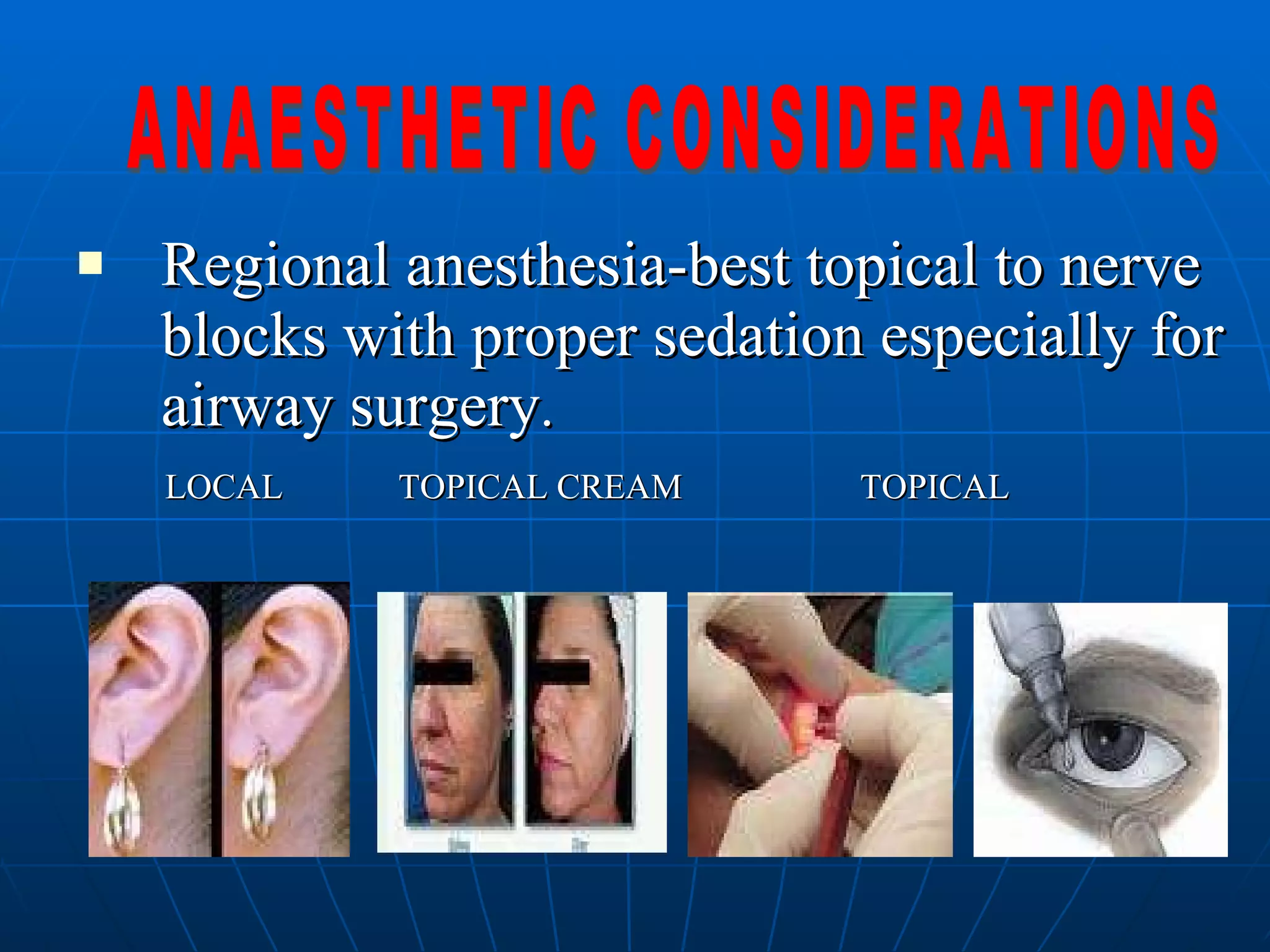
Regional anesthesia-best topical to nerve blocks with proper sedation especially for airway surgery . LOCAL  TOPICAL CREAM  TOPICAL ANAESTHETIC CONSIDERATIONS
2.  GENERAL ANESTHESIA-LARGE BORE IV NEEDLE - MAC - TIVA - G.A.
G.A. Premedication :-sedation,analgesia, Parasympatholytics must(vagal hyperactivity-for airway surgery). Induction:-  i.V.,Inhalational better avoided. ETT :relaxant Maintainance :no N 2 O, inhalational anaesthetic, FIO 2  should be less than 40%. Spontaneous ventilation :(TIVA) Controlled ventilation Jet ventilation( close or  remote) -Endolaryngeal surgery -Complications:barotrauma,pneumothorax,co poisoning,hypoxia.
Barotrauma Pneumothorax Restriction to only intravenous agents Gastric distention Relative requirement for compliant lungs Jet ventilation Intermittent apnea technique Hypoventilation Pulmonary aspiration
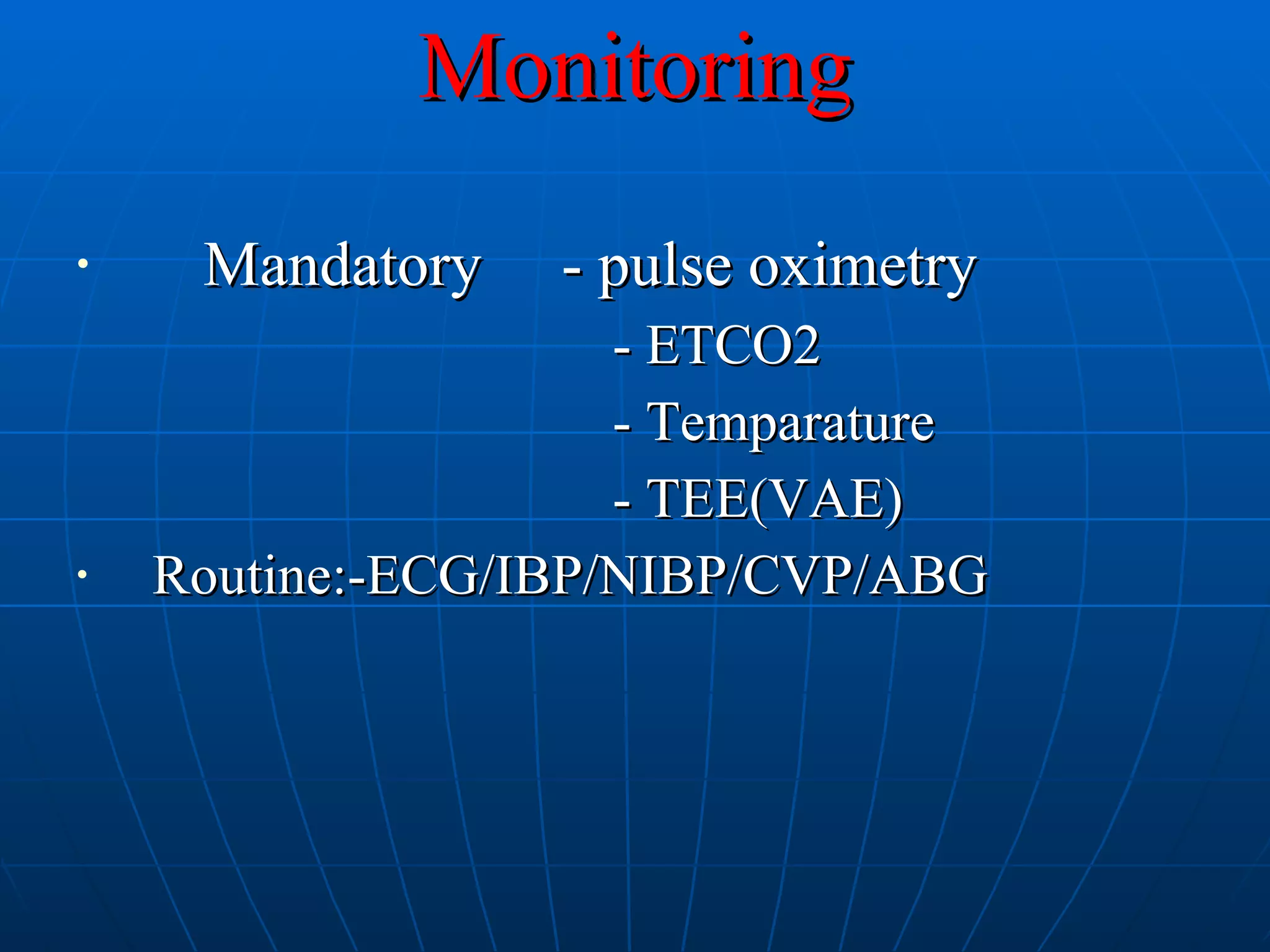
Monitoring Mandatory  - pulse oximetry   - ETCO2   - Temparature   - TEE(VAE) Routine:-ECG/IBP/NIBP/CVP/ABG
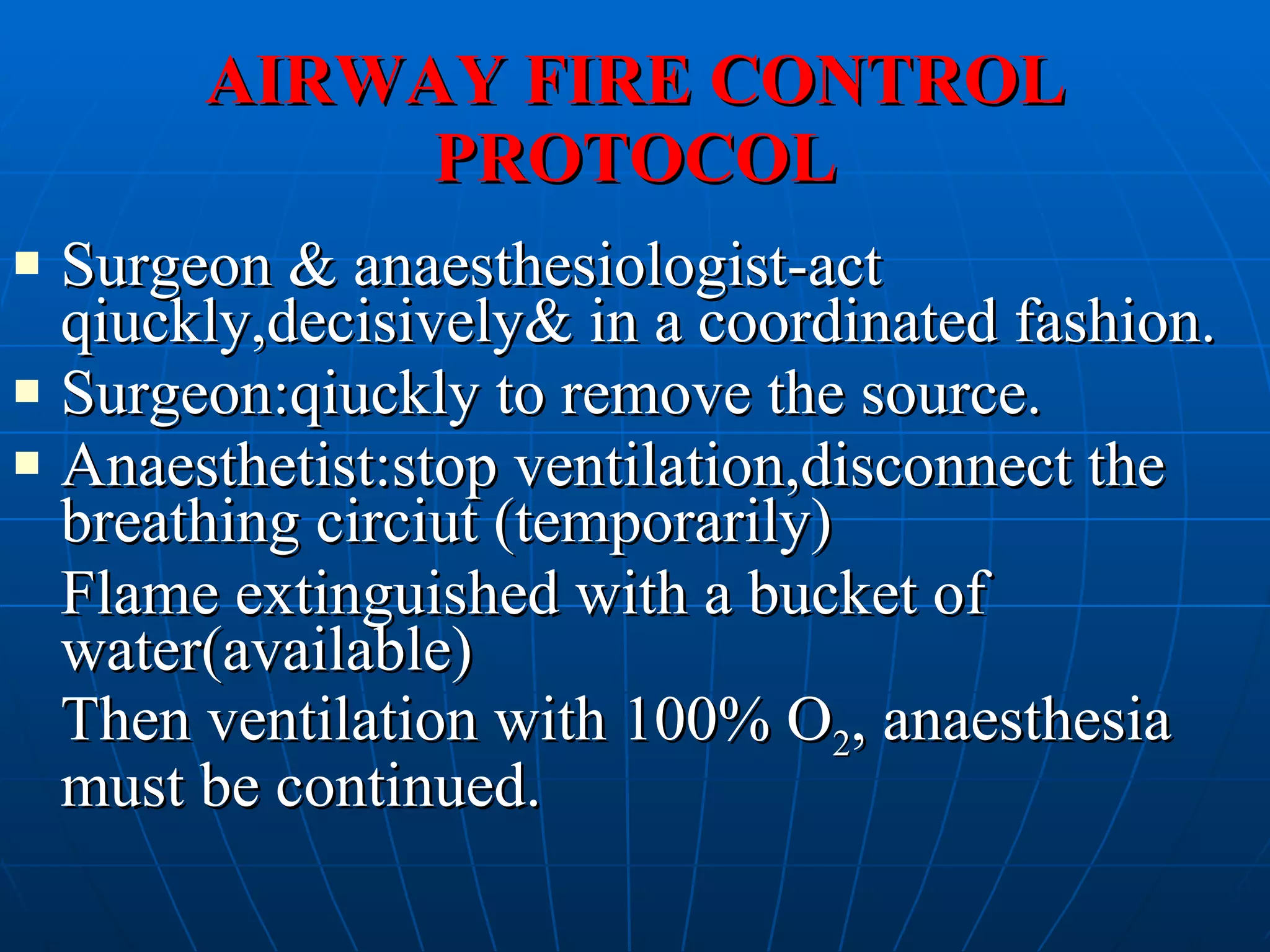
AIRWAY FIRE CONTROL PROTOCOL Surgeon & anaesthesiologist-act qiuckly,decisively& in a coordinated fashion. Surgeon:qiuckly to remove the source. Anaesthetist:stop ventilation,disconnect the breathing circiut (temporarily) Flame extinguished with a bucket of water(available) Then ventilation with 100% O 2 , anaesthesia must be continued.
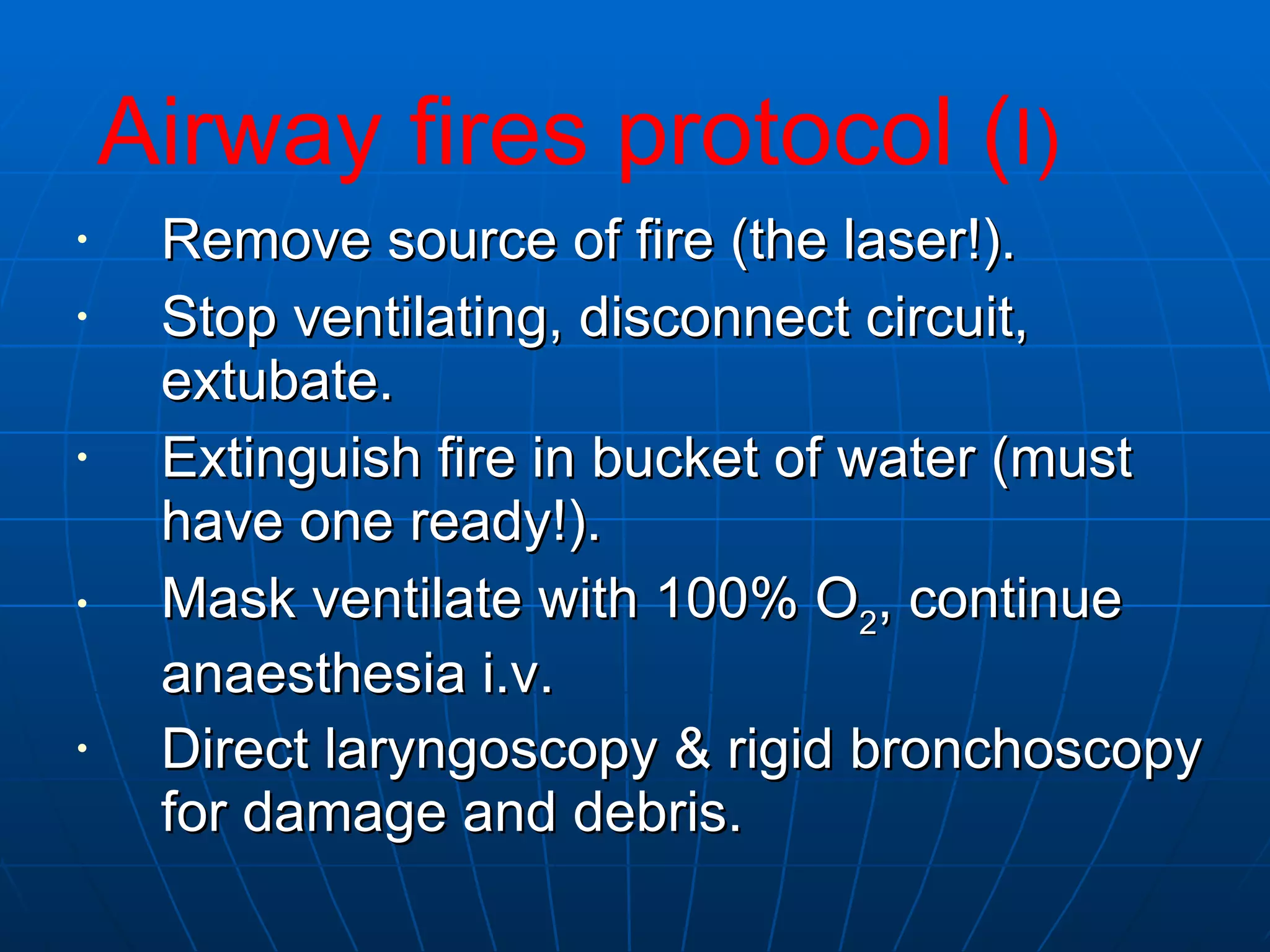
Remove source of fire (the laser!).  Stop ventilating, disconnect circuit, extubate.  Extinguish fire in bucket of water (must have one ready!).  Mask ventilate with 100% O 2 , continue anaesthesia i.v.  Direct laryngoscopy & rigid bronchoscopy for damage and debris.   Airway fires protocol ( I)
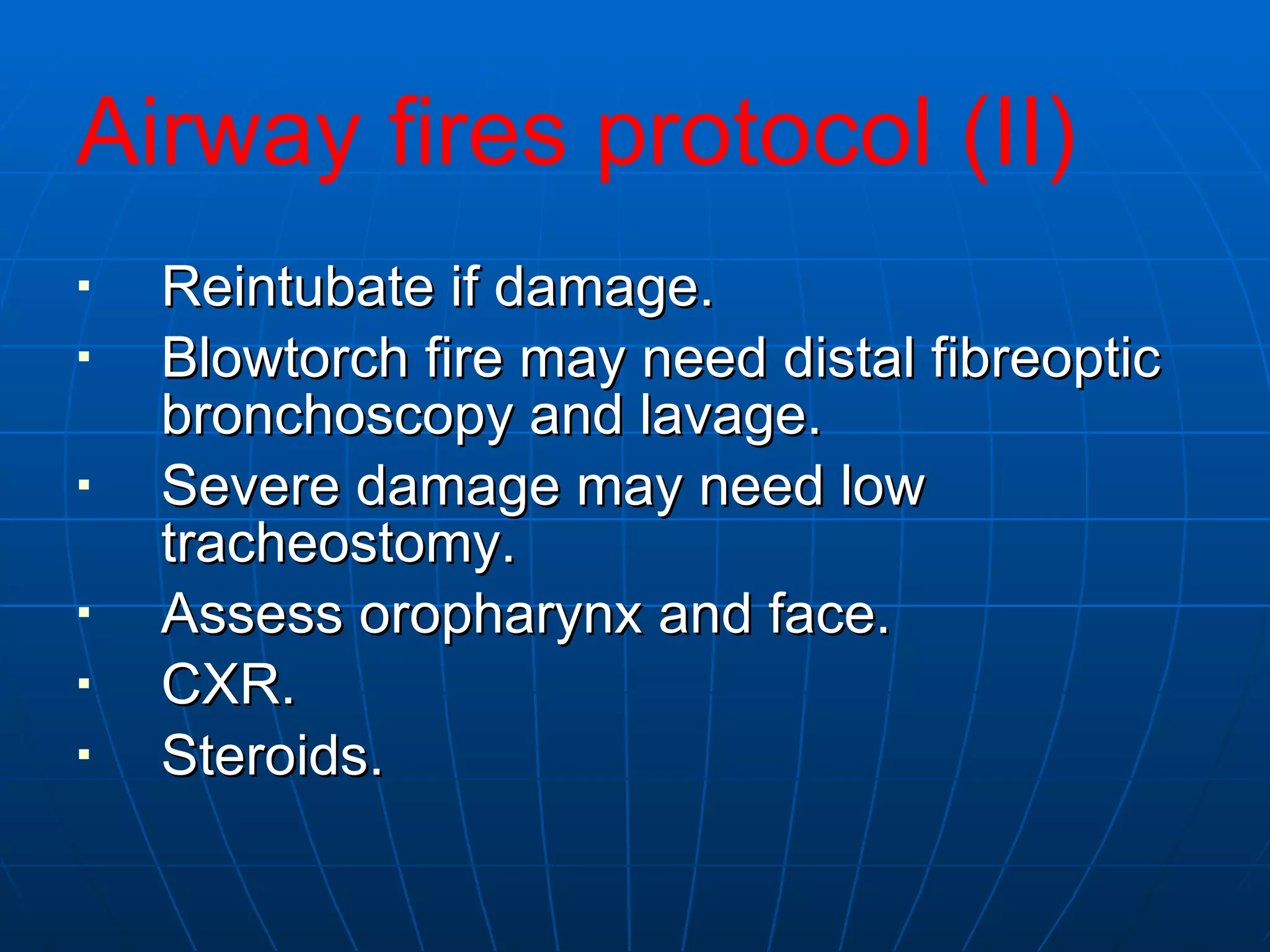
Reintubate if damage.  Blowtorch fire may need distal fibreoptic bronchoscopy and lavage.  Severe damage may need low tracheostomy.  Assess oropharynx and face.  CXR.  Steroids.  Airway fires protocol (II)
AIRWAY FIRE CONTROL PROTOCOL Direct laryngoscopy-survey damage, remove debris,gentle bronchial lavage. Fibre optic assessment of most distal airways If pulmonary damage prolonged intubation & mechanical ventilation,brief course of high dose steroids
Applications of laser 1.  Scientific a. Spectroscopy   b. Lunar laser ranging  c. Photochemistry    d. Laser cooling e. Nuclear fusion
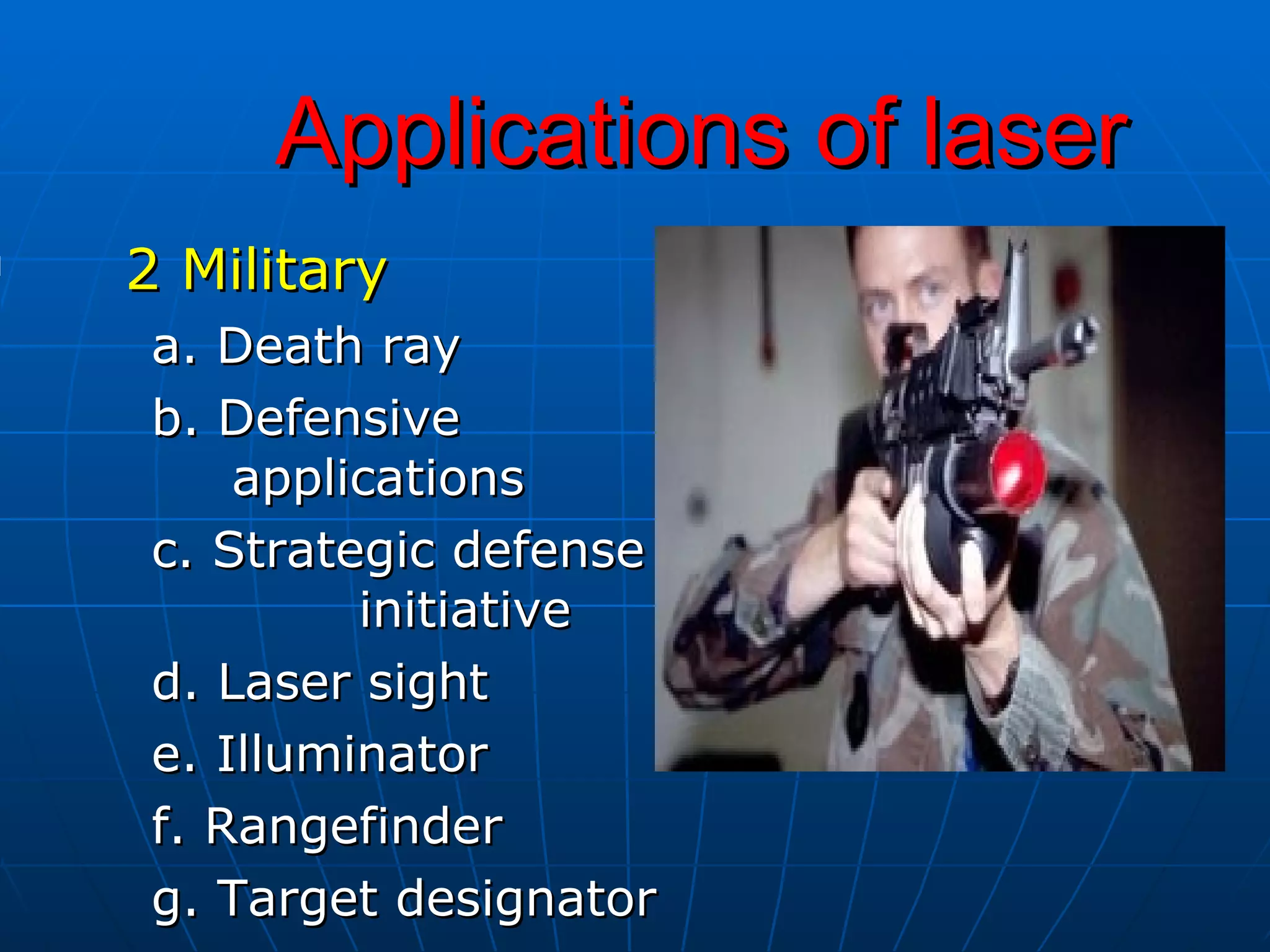
2 Military  a. Death ray b. Defensive  applications c. Strategic defense  initiative d. Laser sight e. Illuminator f. Rangefinder g. Target designator Applications of laser
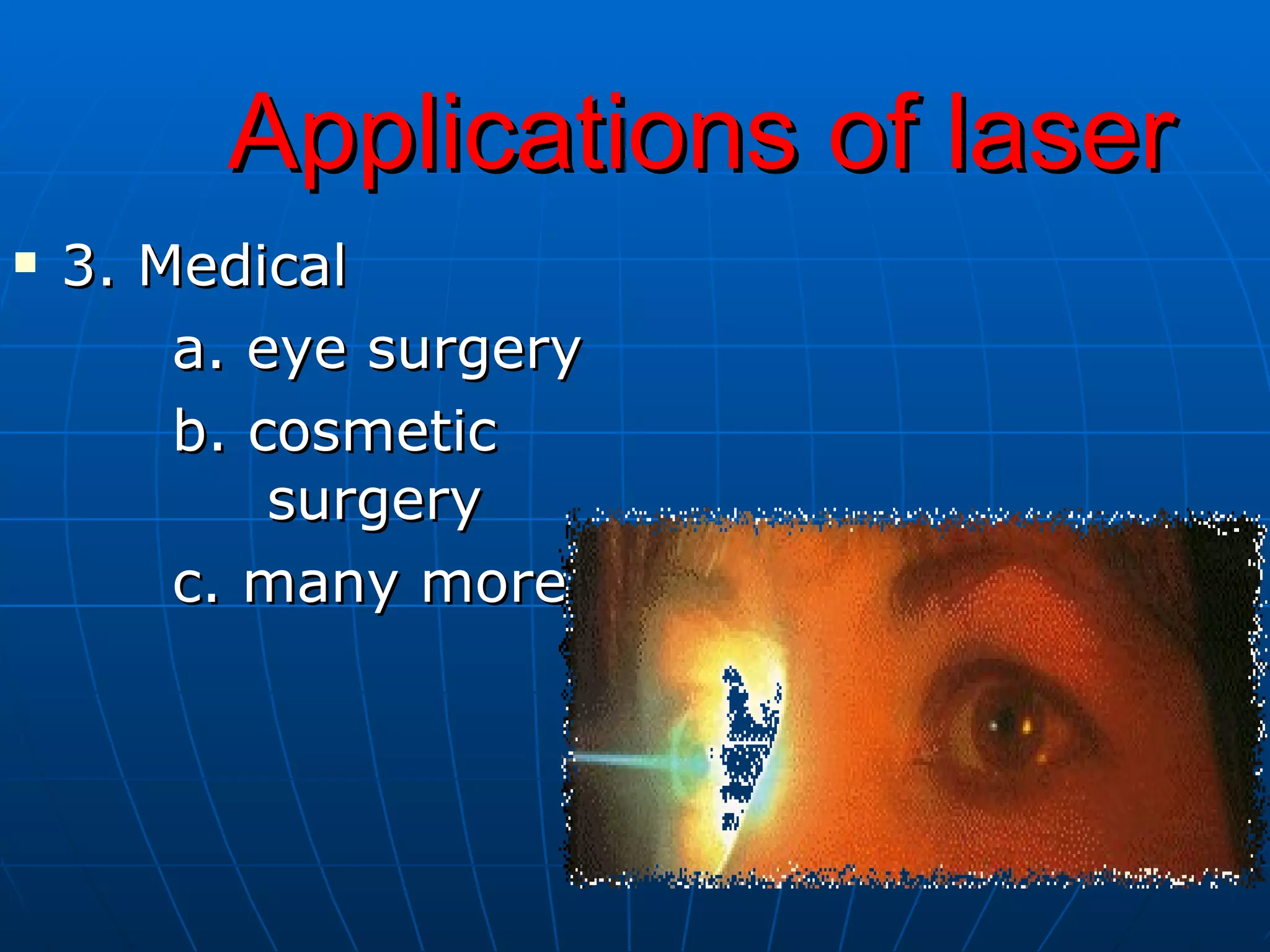
3. Medical a. eye surgery b. cosmetic  surgery c. many more Applications of laser
4.  Industry & Commercial a. cutting, welding, marking b. CD player, DVD player c. Laser printers, laser pointers d. Photolithography e. Laser light display Applications of laser
CONCLUSIONS Stimulation emission is the basis of laser phenomenon CO 2  laser high risk of remote fires-invisible infrared –transmitted to surgical site in a beam through free air
CONCLUSIONS (CONTD….) Different laser sources – different eye protection - Co2  any glass / plastic -Others-type specific protection
CONCLUSIONS  (CONTD..) SPECIAL ETT N 2 0,FIO 2 ,inhalational anaesthetics support combustion Special anaesthetic techniques Careful monitoring. Effective prevention,management of complications
THANK YOU THANK Q
Any questions?

Lasers and anaesthesia .bapu

  • 1.
    LASERS AND ANAESTHESIADr.P.Narasimha Reddy, Professor, Dept of Anaesthesiology, Narayana medical college, Nellore.
  • 2.
    Laser printer Laserpointer Laser: everywhere in your life                                                                                          
  • 3.
    “ Never arecooperation and communication between surgeon and anaesthetist more impartant than during head and neck surgery.” - MORGAN Clinical anaesthesia
  • 4.
    Introduction 1. history2.properties of laser 3.basic physics 4.proreties of laser 5.laser hardware 6.biological effects 7.applications of laser 8.dangers of lasers 9.anaesthesia considerations 10.protection strategies
  • 5.
    L - LIGHTA - AMPLIFICATION BY S - STIMULATED E - EMISSION OF R - RADIATION TRANSFER OF LARGE QUANTITIES OF ENERGY RAPIDLY TO REMOTE LOCATIONS LASER
  • 6.
    VISUAL LIGHT ISELECTROMAGNETIC RADIATION (RADIOWAVES,X- RAYS,GAMMA RAYS) 1864 – MAXWELL-ELECTRICAL,MAGNETIC OSCILLATIONS- 299,792,458 m/sec - MAX PLANCK-PHOTO ELECTRIC EFFECT-1 st STEP TOWARDS LASER PHYSICS PHYSICS
  • 7.
    1905 – EINSTEIN– THEORETICAL BASIS FOR LASER ACTION - ELECTROMAGNETIC RADIATION CONSISTS OF PHOTONS
  • 8.
    PROPERTIES OF PHOTONSProperties consistent with both particles and waves. Propagate in vaccum with spreads of 299,792,458 m/sec. Energy proportional to their vibrational frequency E(joules) =n h v n -an integral number h – Planck constant 6.63 × 10¯ 24 j/sec v – photon frequency in hertz Their wave lenghts can be calculated as follows Λ (m)= 2.998×10 to the power of 8 m/sec V (hz) wave lenghts of visible light is 385 to 760 nm
  • 9.
  • 10.
  • 11.
    Monochromatic Consists ofphotons-well defined very narrow band of wave lenghts. Coherent (electromagnetic fields of all photons oscillate synchronously in identical phase). Beams are collimated (minimal dispersion-parallel). Allow lasers to generate intense light beams to send such beams efficiently & accurately through lenses-deliver intense energy to small target sites Polychromatic Wide spectrum of wave lengths. Electromagnetic fields phased randomly. Spread out in all directions from a point of source. LASER LIGHT ORDINARY LIGHT
  • 12.
    Basic concepts fora laser Absorption Spontaneous Emission Stimulated Emission Population inversion
  • 13.
    Absorption Energy isabsorbed by an atom, the electrons are excited into vacant energy shells.
  • 14.
    Spontaneous Emission Theatom decays from level 2 to level 1 through the emission of a photon with the energy hv . It is a completely random process.
  • 15.
    Stimulated Emission atoms in an upper energy level can be triggered or stimulated in phase by an incoming photon of a specific energy .
  • 16.
    Stimulated Emission The stimulated photons have unique properties: In phase with the incident photon Same wavelength as the incident photon Travel in same direction as incident photon
  • 17.
    Population Inversion Astate in which a substance has been energized, or excited to specific energy levels. More atoms or molecules are in a higher excited state. The process of producing a population inversion is called pumping . Examples: -> by lamps of appropriate intensity -> by electrical discharge
  • 18.
  • 19.
    1. High-voltage electricitycauses the quartz flash tube to emit an intense burst of light, exciting some of Cr 3+ in the ruby crystal to higher energy levels. 2. At a specific energy level, some Cr 3+ emit photons. At first the photons are emitted in all directions. Photons from one Cr 3+ stimulate emission of photons from other Cr 3+ and the light intensity is rapidly amplified.
  • 20.
    3. Mirrors ateach end reflect the photons back and forth, continuing this process of stimulated emission and amplification. 4. The photons leave through the partially silvered mirror at one end. This is laser light.
  • 21.
    Laser Construction A pump source A gain medium or laser medium. Mirrors forming an optical resonator.
  • 22.
    Pump Source Providesenergy to the laser system Examples: electrical discharges, flashlamps, arc lamps and chemical reactions. The type of pump source used depends on the gain medium. -> A helium-neon (HeNe) laser uses an electrical discharge in the helium-neon gas mixture. -> Excimer lasers use a chemical reaction.
  • 23.
    Optical Resonator Twoparallel mirrors placed around the gain medium. Light is reflected by the mirrors back into the medium and is amplified . The design and alignment of the mirrors with respect to the medium is crucial . Spinning mirrors, modulators, filters and absorbers may be added to produce a variety of effects on the laser output.
  • 24.
    Laser medium containingthe atoms whose electrons create the laser light Resonating mirrors - to boost laser efficiency Energy source- excite or pump the atoms of the laser medium into producing laser light. Gas lasers- co2 ,Argon, krypton, helium – neon LASER SYSTEM HARDWARE
  • 25.
    Laser Types Accordingto the active material : solid-state, liquid, gas, excimer or semiconductor lasers. According to the wavelength : infra-red, visible, ultra-violet (UV) or x-ray lasers.
  • 26.
    Solid-state Laser Example:Ruby Laser Operation wavelength: 694.3 nm (IR) 3 level system: absorbs green/blue Gain Medium: crystal of aluminum oxide (Al 2 O 3 ) with small part of atoms of aluminum is replaced with Cr 3+ ions. Pump source: flash lamp The ends of ruby rod serve as laser mirrors.
  • 27.
    Gas Laser Example:Helium-neon laser (He-Ne laser) Operation wavelength: 632.8 nm Pump source: electrical discharge Gain medium : ratio 5:1 mixture of helium and neon gases
  • 28.
    Schematic diagram ofa dye laser DYE LASER A dye laser can be considered to be basically a four-level system. The energy absorbed by the dye creates a population inversion, moving the electrons into an excited state.
  • 29.
    SOLIDS- DOPANTS-CHROMIUM(ASIN RUBY LASER), NEODYMIUM(Nd),HOLMIUM (Ho), YAG(YTTRIUM,ALUMINIUM,GARNET-SYNTHETIC GEM CRYSTAL) -PUMPED BY HIGH ENERGY PHOTONS FROM XENON FLASH LAMP. LIQUIDS – YET TO APPEAR
  • 30.
  • 31.
  • 32.
  • 33.
  • 34.
    Biological effects oflaser CRITICAL TEMP ( 0 C) BIOLOGICAL EVENT 42 Warmed 45 Cell death, edema, endothelial damage 60 Protein coagulation 80 Collagen denaturation 100 Tissue boils 210 Dehydrated tissue burns
  • 35.
    Biological effects oflaser Carbon dioxide Laser Completely absorbed by water in first few layers of cells – vaporization of surface tissue with little damage to underlying tissue. Nd-YAG Laser Less absorbed by water and beam diffuses through several millimeters – energy is disseminated producing less vaporization and more coagulation (Cooking Effect).
  • 36.
    commonly used LaserlightsLaser media Color Wavelength (nm) Typical application Carbon dioxide Far infrared 10,600 General, cutting Ruby Red 694 Tattoos, nevi KTP:YAG Green 532 General, pigmented lesions Argon Green 514 Vascular, pigmented lesions Xenon fluoride Ultraviolet 351 Cornea, angioplasty
  • 37.
    LASERS ARE NOTVERY EFFICIENT AT CONVERTING ELECTRICITY INTO LIGHT,THEY REQUIRE A LARGE POWER SUPPLY. FREQENCY DOUBLES TO CONVERT LASER LIGHT TO DIFFERRENT WAVE LENGTH ENHANCING THERAUPETIC FLEXIBILITY
  • 38.
    DR.GERRY ROSS CLINICALAPPLICATIONS PIONEER OF LASER THERAPY
  • 39.
    CLINICAL APPLICATIONS ScalpelsElectrocoagulation Highly precise micro surgery (confined or difficult to reach sites-percutaneous discectomy, endovascular angioplasty) Small target areas-concentrate intensity or power per area enormously. Precise rapid evoparisation of tissues
  • 40.
  • 41.
  • 42.
  • 43.
  • 44.
  • 45.
  • 46.
  • 47.
  • 48.
  • 49.
  • 50.
  • 51.
  • 52.
  • 53.
    LASER TO MAKEAN INCISION
  • 54.
  • 55.
    ADVANTAGES Laser surgeryRelatively dry Near instantaneous ceiling of blood vessels, lymphatics even in presence of coagulation abnormalities Faster healing Lower infection rates
  • 56.
  • 57.
  • 58.
    LASER HAZARDS Atmosphericcontamination-laser plumes -Objectional odour,tears, headache, nausea. -Interstitial pneumonia, bronchiolitis,emphysema -Mutogenic & teratogenic
  • 59.
    Laser plume ProtectionEfficient smoke evacuator at surgical site. Use of special high efficiency mask : Tex, protector II, Ango, Fort worth Ordinary surgical mask gives protection from molecules up to 3.0 µm size.
  • 60.
    Plume of smokeand fine particulates (mean size 0.31um) Efficiently transported and deposited in the alveoli Sensitive individuals: headaches, tearing, and nausea after inhalation Animal study: interstitial pneumonia, bronchiolitis, reduced mucociliary clearance, inflammation, emphysema Prevention -> smoke evacuator -> high-efficiency masks Atmospheric contamination
  • 61.
    LASER HAZARDS CONTD… 2.Tissue and vessel perforation(misdirected laser energy) -Viscous perforation -vessels more than 5 mm not coaguable by lasers -Pneumothorax(after laryngeal perforation) Perforational bleeding after several days post operatively with edema and necrosis. 3.Embolism- VAE 4.Energy transfer to an inappropriate location
  • 62.
    Incidentally pressing thelaser control trigger Tissue damage outside of surgical site Drape fire Eye (patient or other medical staff) Endotracheal tube fires Inappropriate energy transfer
  • 63.
    EYE PROTECTION Operatingroom staff- goggles or lenses specific for specific laser wave length. Patient-non operated eye-taped, closed,covered with an opaque saline soaked knit or metal shields.
  • 64.
    Eyes Protection Protectionof OT staff eyes : Safety goggles or lenses specific for laser wave length in use. CO 2 Laser – any clear glass or plastic lenses. Nd:YAG Laser – green tinted or clear lenses. Argon & Krypton – Amber orange. KTP-Nd:YAG – Red.
  • 65.
    E.T.T. FIRES Airwaysurgery-ignition of ETT, cuff, or cottonoids Most fires on external surface of ETT-because of O 2 .
  • 66.
    Reduce the flammabilityof the endotracheal tube Use Venturi ventilation Use intermittent apnea technique Approaches to reduce the incidence of airway fire
  • 67.
    Incidence: 0.5 –1.5 % Source: direct laser illumination reflected laser light incandescent particles of tissue blown from the surgical site Endotracheal tube fires
  • 68.
    E.T.T. FIRES (CONTD….)Reduction of flammability of ETT Choice of ETT. Extrinsic protection: - Moistened muslin (dry-fire) - Dental acrilic (trauma) 3. ETT taping-aluminium , copper foil with adhesive backing.Cuff is not protected- well supported by medical literature-no fda approval.Lead foil should not be used-toxic to airway
  • 69.
    Various endotracheal tubesfor laser airway surgery Type of tube Advantages Disadvantages Polyvinyl chloride Inexpensive, nonreflective Low melting point, highly combustible Red rubber Puncture-resistant, maintains structure, nonreflective Highly combustible Silicone rubber Nonreflective Combustible, turns to toxic ash Metal Combustion-resistant, kink-resistant Thick-walled flammable cuff, transfers heat, reflects laser, cumbersome
  • 70.
    A clean tubewiped with alcohol later with mastisol or tincture benzion. The end of the tape cut at 60°- cut edge proximal end of cuff junction- rapped in spiral way with 30% overlap,to the exit point of cuff pilot tube
  • 71.
    No cuff protectionAdds thickness to tube Not an FDA-approved device Protection varies with type of metal foil Adhesive backing may ignite May reflect laser on to non-targeted tissue Rough edges may damage mucosal surfacess Disadvantages of wrapping
  • 72.
    Oxygen and nitrousoxide are powerful oxidizers Reduce FiO 2 to minimum concentration Helium may benefit as a diluent gas Volatile anesthetics currently used are nonflammable and nonexplosive Pyrolized toxic compounds Effect of high oxygen and nitrous oxide gas mixture
  • 73.
    FDA APPROVED ETTWRAPS Merocel laser guard - - Metal foil laminated to a synthetic sponge kept moist - protection against co2, argon, ktp:nd:yag (but not yag) lasers - ETT diameter increased by 2 mm. - No protection for the cuff.
  • 74.
    FDA APPROVED ETTWRAPS CONTD … Integrated laser resistent coating in the manufacture of ett- CO 2 laser - Xomed laser shield tube (fabricated from silicon with an outer layer of aluminium powder with silicon-aluminised layer extends over inflatable cuff.)
  • 75.
    FDA APPROVED ETTWRAPS CONTD… .Laser shield ii- CO 2 ,ktp laser -silicon based wrapped by a coated alluminium tape - The cuff-unshielded silicon elastoma-designed to be expanded with saline and methylene blue.
  • 76.
    PROTECTION OF ETTCUFF standard hi-lo cuff -colored saline. Cuff-placed as far distal in the trachea as possible. Surgeon should cover the visible cuff with moistened cotton pledges-cotton strings attached to pledges replaced by wire- pledges re moistened as needed.
  • 77.
    METAL ETT NORTONDE VOS(1978 ) - Interlocking stainless spiral coil (resembling electrical cable armour)-no cuff. - Difficult ventillation-non compliance
  • 78.
    2 . LASERFLEX TUBE : - Air tight stainless spiral -Two distal saline inflatable pvc cuffs -resistent to CO 2 :ktp but not nd:yag 6mm size
  • 79.
    THE BIVONA FOAMCUFF: - Aluminium spiral tube -Outer covering of silicon -Unique self inflating foam sponge filled cuff which prevents deflation after puncture.
  • 80.
    Precautions to preventfire Low FiO 2. Avoid nitrous oxide. Cuff should be filled with saline with methylene blue. Addition of 2% lignocaine jelly in water for filling of cuff. Limit laser density and duration. Laser resistant tubes. Saline soaked swabs in airway. Availability of source of water.
  • 81.
    Regional anesthesia-best topicalto nerve blocks with proper sedation especially for airway surgery . LOCAL TOPICAL CREAM TOPICAL ANAESTHETIC CONSIDERATIONS
  • 82.
    2. GENERALANESTHESIA-LARGE BORE IV NEEDLE - MAC - TIVA - G.A.
  • 83.
    G.A. Premedication :-sedation,analgesia,Parasympatholytics must(vagal hyperactivity-for airway surgery). Induction:- i.V.,Inhalational better avoided. ETT :relaxant Maintainance :no N 2 O, inhalational anaesthetic, FIO 2 should be less than 40%. Spontaneous ventilation :(TIVA) Controlled ventilation Jet ventilation( close or remote) -Endolaryngeal surgery -Complications:barotrauma,pneumothorax,co poisoning,hypoxia.
  • 84.
    Barotrauma Pneumothorax Restrictionto only intravenous agents Gastric distention Relative requirement for compliant lungs Jet ventilation Intermittent apnea technique Hypoventilation Pulmonary aspiration
  • 85.
    Monitoring Mandatory - pulse oximetry - ETCO2 - Temparature - TEE(VAE) Routine:-ECG/IBP/NIBP/CVP/ABG
  • 86.
    AIRWAY FIRE CONTROLPROTOCOL Surgeon & anaesthesiologist-act qiuckly,decisively& in a coordinated fashion. Surgeon:qiuckly to remove the source. Anaesthetist:stop ventilation,disconnect the breathing circiut (temporarily) Flame extinguished with a bucket of water(available) Then ventilation with 100% O 2 , anaesthesia must be continued.
  • 87.
    Remove source offire (the laser!). Stop ventilating, disconnect circuit, extubate. Extinguish fire in bucket of water (must have one ready!). Mask ventilate with 100% O 2 , continue anaesthesia i.v. Direct laryngoscopy & rigid bronchoscopy for damage and debris. Airway fires protocol ( I)
  • 88.
    Reintubate if damage. Blowtorch fire may need distal fibreoptic bronchoscopy and lavage. Severe damage may need low tracheostomy. Assess oropharynx and face. CXR. Steroids. Airway fires protocol (II)
  • 89.
    AIRWAY FIRE CONTROLPROTOCOL Direct laryngoscopy-survey damage, remove debris,gentle bronchial lavage. Fibre optic assessment of most distal airways If pulmonary damage prolonged intubation & mechanical ventilation,brief course of high dose steroids
  • 90.
    Applications of laser1. Scientific a. Spectroscopy b. Lunar laser ranging c. Photochemistry d. Laser cooling e. Nuclear fusion
  • 91.
    2 Military a. Death ray b. Defensive applications c. Strategic defense initiative d. Laser sight e. Illuminator f. Rangefinder g. Target designator Applications of laser
  • 92.
    3. Medical a.eye surgery b. cosmetic surgery c. many more Applications of laser
  • 93.
    4. Industry& Commercial a. cutting, welding, marking b. CD player, DVD player c. Laser printers, laser pointers d. Photolithography e. Laser light display Applications of laser
  • 94.
    CONCLUSIONS Stimulation emissionis the basis of laser phenomenon CO 2 laser high risk of remote fires-invisible infrared –transmitted to surgical site in a beam through free air
  • 95.
    CONCLUSIONS (CONTD….) Differentlaser sources – different eye protection - Co2 any glass / plastic -Others-type specific protection
  • 96.
    CONCLUSIONS (CONTD..)SPECIAL ETT N 2 0,FIO 2 ,inhalational anaesthetics support combustion Special anaesthetic techniques Careful monitoring. Effective prevention,management of complications
  • 97.
  • 98.