Modern Trends in Paediatric
preparation and Premedication
Dr. P. Narasimha Reddy, MD, DA
Professor & Head
Department of Anaesthesiology
Narayana Medical College,
Nellore.
1
AIM

1.
2.

After this lecture the Anesthesiologist must be
able to recognise
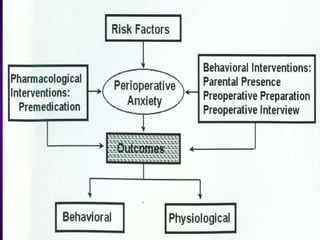
Various risk factors for pre-op anxiety
Interventions
a.
b.

3.
4.

Behavioral
Pharmacological

Various psychological effects of surgery &
Anaesthesia
Standards of pre-medication
2
AIM contd..
5.
6.
7.
8.
9.

Monitoring the patient under sedation
Various levels of sedation,
Various drugs, doses, routes &
complications,
Fasting guidelines,
Necessary investigations
3
Modern Trends in Paediatric
Preparation and Premedication
Introduction
Whole family is under Stress
Anxiety increased by mis information
and Preconceived ideas
Psychological stress - Long
behavioural disturbances
Work of Leigh, Belton and SmithModified Anaethetic Practice.

4
Parental Anxiety
General: Guilt, (inability to protect the
child), loss of control, separation
anxiety,Can I manage? Financial.
Surgical: Failure of proceedure,
disfigurement, death.
Anaesthetic: Pain, Brain damage, death.
Staff Reactions: Miscommunication,
apparent lack of concern and paternalism.
5
Childhood Anxieties
Some Thing is going to happen
Fantasies, hidden fears (more
dangerous)
Truthful announcement of
details
Gentle
Avoid Medical Jargon
6
SEPARATION ANXIETY
Between ages of 6months to 5years more
regression after separation
Between ages of 2-6years five fold increase in
anxiety than older child
No familiarity with medical team
Dependency behaviour
Loss of self identity, autonomy, control and
function
Individualisation of approach
7
8
Pre-op Anxiety - predictors
1.
2.
3.
4.
5.
6.

Age
Parental Anxiety
Temperament
Social adaptability
Coping style
Lack of pre-medication
9
Fear of Unknown is common to
human being
Older Child is concerned about
What does “put to sleep” really
mean?
Will I be awaken during operation?
Will I move during Operation?
Am I going to die?
Will I be naked totally?
Concerns of mutilation and torture
10
Needle Phobia - Rice summarised
perception of needle phobia
Needle is perceived as direct threat
to body integrity.
Scratching my bones or pushing it
all the way in
Needle Phobia-decades of
inadequate postoperative analgesia
for children.
Anything is better than needle.
11
Frank and truthful disclosure of anticipated events.
Family Preparation
Paediatric Play therapy
Encouraging physical expression
Use of toy tools and art material.
Parental presence
Pre-operative interview
Pre-operative preparation programs

12
Psychological consequences
of Anaesthesia and Surgery.
Acute: at the time of emergence from anaesthesia.
Calm arousal
Arousable
Abrupt arousal
Excited emergence
Eckenhoff, Kneale and Dripps showed – fear of
disfigurement is significant factor in emergence.
Quiet to sleep, quiet to arouse, Screaming going
down screaming coming up
13
Chronic: Some changes continue to
adulthood.
Factors- Age, Stability of family, cultural
patterns, socio economic situations.
Psychological consequences of Anaesthesia
and Surgery.

14
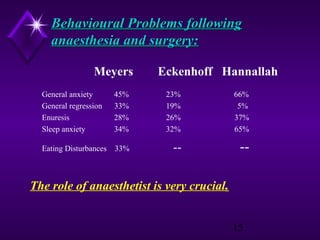
Behavioural Problems following
anaesthesia and surgery:
Meyers

Eckenhoff Hannallah

General anxiety
General regression
Enuresis
Sleep anxiety

45%
33%
28%
34%

23%
19%
26%
32%

66%
5%
37%
65%

Eating Disturbances

33%

--

--

The role of anaesthetist is very crucial.
15
“Little in medicine is tainted with antiquity
more than the sight of a waiting, fearful
screaming child being taken from the arms
of his mother and carried fighting to an
anaesthetic room. There he is held
forcefully on a table and a mask
unceremoniously thrust on his face while he
battles and screams into oblivion”.
16
Preoperative visit by
Anaesthesiologist
Positively affects quality of induction
Allowing child choices
Smooth induction decreases 50-70% of
postoperative emotional changes.

17
Parental Presence
Makes sense.
Induction less frightening to child
but more frightening to the anaesthetist.
Less amount of drugs.
Less postoperative behavioral problems.

18
Premedication
Aims
Numerous combinations of drugs
Now premedication is primarily to
produce anxiolysis.
Calm, sedated, with spontaneous
respiration with obtunded autonomic
reflexes.
Modern preoperative regimens- often
painless, rapid anxiolysis with rapid
19
emergence.
Universal needle phobia must be weighed
against global threat of suffocation by
mask.
EMLA made insertion of iv cannulae, LP
pain free.
Induction in the lap of the mother is
comfortable
Parent sent out after induction.
20
Pre-op preparation programs
1.
2.
3.
4.
5.
6.

Narrative information
Orientation tour to O.T’s
Role rehearsal using dolls
Puppet shows
Coping education &
Relaxation skills
21
Protective net
Safe sedation of children requires a
protective net
Skilled personnel
Vigilance
Monitoring
Appropriate drugs depending on age,
weight
life saving equipment.
22
SEDATION GUIDELINES
Written in 1985
Rewritten in 1992
Monitoring guidelines by Anaesthetist.
Proper drug in proper dosage.
Conscious Sedation
Medically controlled state of depressed
consciousness that
‘allows protective reflexes to be maintained, ability
to maintain spont. Resp. independently and
continuously and permits appropriate response to
physical or verbal stimuli’.
23
Monitoring
1.

Pulse oximetry

2.

Blood pressure

3.

Electro Cardiography &

4.

If intubated capnography
24
DEEP SEDATION (Procedural sedation)
Deep sedation is defined as medically controlled
state of depressed consciousness or
unconsciousness from which patients are not
easily aroused. May be accompanied by a partial
or complete loss of protective reflexes and
includes inability to maintain a patent airway
independently and respond purposefully to
physical verbal stimuli.
Conscious sedation may change to deep sedationMonitor with Pulse oximeter.
25
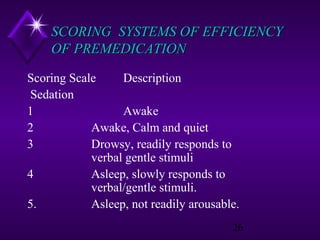
SCORING SYSTEMS OF EFFICIENCY
OF PREMEDICATION
Scoring Scale
Description
Sedation
1
Awake
2
Awake, Calm and quiet
3
Drowsy, readily responds to
verbal gentle stimuli
4
Asleep, slowly responds to
verbal/gentle stimuli.
5.
Asleep, not readily arousable.
26
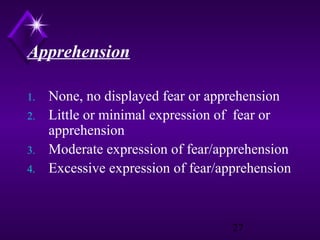
Apprehension
1.
2.
3.
4.

None, no displayed fear or apprehension
Little or minimal expression of fear or
apprehension
Moderate expression of fear/apprehension
Excessive expression of fear/apprehension

27
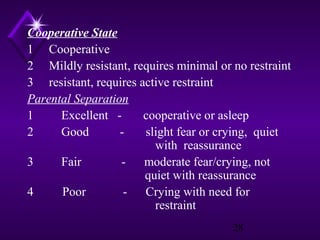
Cooperative State
1 Cooperative
2 Mildly resistant, requires minimal or no restraint
3 resistant, requires active restraint
Parental Separation
1
Excellent cooperative or asleep
2
Good
slight fear or crying, quiet
with reassurance
3
Fair
- moderate fear/crying, not
quiet with reassurance
4
Poor
- Crying with need for
restraint
28
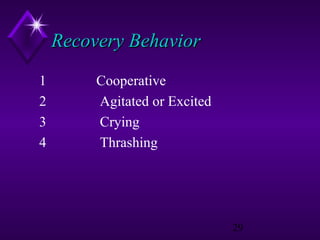
Recovery Behavior
1
2
3
4

Cooperative
Agitated or Excited
Crying
Thrashing

29
Steps of preparation
Psychological
Premedication
Fasting guidelines
Laboratory Investigations

30
Preparation of Whole Family
Advantages
Ease of Induction
Increased tolerance to stress
Decreased long lasting behavioural
effects.

31
Drugs and routes of
Administration
Narcotics
Morphine - Duration of action 3-4Hrs, iv,
im sc, s/l and or rectally
Usual dose 0.1 to 0.2mg/kg
For painful procedures
Rectal Admn: delayed, irregular absorption
and Respiratory depression
32
Fentanyl
100 times more potent than morphine
High degree of solubility
Penetrates Blood Brain Barrier
Intermittently used – termination of action is due
to redistribution
Effects lasts for 30-45 minutes
Cause chest wall and glottic contracture and
respiratory depression
Dose 0.5 to 1.0mcgm/kg slowly – titrate.
33
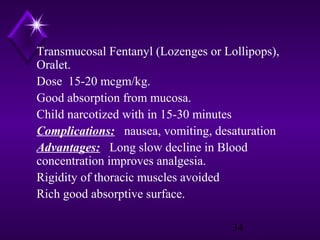
Transmucosal Fentanyl (Lozenges or Lollipops),
Oralet.
Dose 15-20 mcgm/kg.
Good absorption from mucosa.
Child narcotized with in 15-30 minutes
Complications: nausea, vomiting, desaturation
Advantages: Long slow decline in Blood
concentration improves analgesia.
Rigidity of thoracic muscles avoided
Rich good absorptive surface.
34
Benzodiazepines: Very useful family of drugs in
children
Diazepam:
0.1 to 0.3 mgm/kg iv or oral.
im erratic absorption, very painful
Iv Thrombophlebitis
Respiratory Depression- Combined with other
drugs.
Disadvantages – long action, painful iv injection
CNS depression common than midazolam
35
Midazolam – Most Popular sedative
Soluble in water
No pain at iv or im
B- elimination is 106minutes vs 18hrs diazepam
Good for short procedures
Route: iv, im, orally, sublingually, nasally and
rectally. It produces anterograde and retrograde
amnesia produces calm, compliant child.
Respiratory Depression is common in elderly but
not in children. It can occur if combined with
other drugs.
Study: Fraction of midazolam available compared
with iv administration:
Iv-1.0, im-0.9, nasal-0.6, Rectal-0.4 to 0.5,oral36
0.3
Nasal-0.2 to 0.3 mgm /kg.
Effective, uncomfortable
Effect in less than 10-15minutes.
Neurotoxicity can occur in intranasal
administration of drugs.
Children prefer sublingual than nasal.
Rectal-0.5-1.0 mgm/kg. Satisfactory level of
sedation and anxiolysis in less than 15-20minutes.
Children does not fall asleep even with 3mgm/kg

37
Midazolam
Sublingual – rapid uptake, Bitter taste is very
difficult to suppress.
Given with sweetening agents orally dose 0.5 to
0.75 mgm/kg. Satisfactory sedation in 10-15
minutes, peak effect at 20-30 minutes.
Note: Drugs capable of decreasing cytochrome
P3A isoenzymes like Erythro, Dilti, itracono,
ranitidine, cimeti, and even grape juice, may
increase serum concentration.
They must be asked to gulp as much as possible ,
other wise refusing or spitting is possible.
38
KETAMINE

Excellent analgesic and amnesic agent
Route: iv, im, oral, rectal, nasal (4-6mgm)
Increase in HR, BP, CMRO2, IOP, ICP
Increase in airway secretions
Contraindicated in URI
No sure protection in full stomach
Emergence delerium
Sedatives or narcotics reduce hallucinations but
increase sedation levels.
Oral Admn: 6-10mgm/kg with orange juice or
Rasna with 0.02-0.04 mgm/kg atropine gives
excellent results in 10-15minutes .
39
KETAMINE
It is not known if dreaming occurs with oral
Ketamine
Some tried oral ketamine 3-6 mgm/kg with
midazolam 0.25-0.5 mgm/kg with profound
sedation.
Increase in oral dose can result in more success
rate but adverse reactions like vomiting and
profound sedation can happen.
Involuntary movements can occur..

40
BARBITURATES
These are best for babies with diapers . Child is
sedated in parents lap. No need of parental
presence in induction.(Jeffcoate)
Methohexitone: rectally 20-30mgm/kg , 10%
solution.
Produces a state of slight to deep sedation.
Absorption is fast but irregular.
Seizures in temporal lobe epilepsy.
Airway obstruction and Apnoea can occur.
Monitoring is very much essential.
Thiopentone: Rectally 30mgm/kg.
Used in epilepsy.. Children sleep longer. These are
best premedicants provided the baby is monitored.
41
Ketorolac
NSAID, no resp. depression
Dose - 0.5to1mgm/kg.
Route-oral, im and iv too
Careful in Renal problems, Asthmatics,
bleeding diathesis.

42
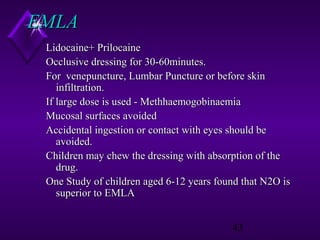
EMLA
Lidocaine+ Prilocaine
Occlusive dressing for 30-60minutes.
For venepuncture, Lumbar Puncture or before skin
infiltration.
If large dose is used - Methhaemogobinaemia
Mucosal surfaces avoided
Accidental ingestion or contact with eyes should be
avoided.
Children may chew the dressing with absorption of the
drug.
One Study of children aged 6-12 years found that N2O is
superior to EMLA
43
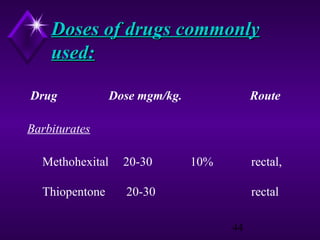
Doses of drugs commonly
used:
Drug

Dose mgm/kg.

Route

Barbiturates
Methohexital

20-30

Thiopentone

10%

rectal,

20-30

rectal
44
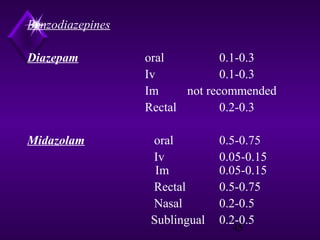
Benzodiazepines
Diazepam

Midazolam

oral
0.1-0.3
Iv
0.1-0.3
Im
not recommended
Rectal
0.2-0.3
oral
Iv
Im
Rectal
Nasal
Sublingual

0.5-0.75
0.05-0.15
0.05-0.15
0.5-0.75
0.2-0.5
0.2-0.5
45
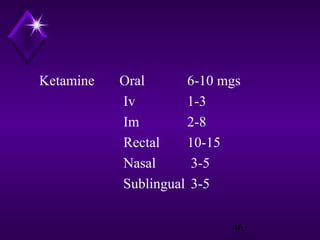
Ketamine

Oral
6-10 mgs
Iv
1-3
Im
2-8
Rectal
10-15
Nasal
3-5
Sublingual 3-5
46
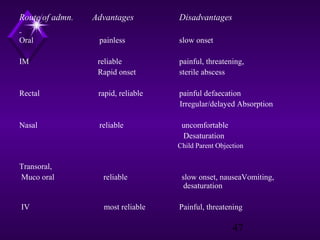
Route of admn.

Advantages

Disadvantages

Oral

painless

slow onset

IM

reliable
Rapid onset

painful, threatening,
sterile abscess

Rectal

rapid, reliable

painful defaecation
Irregular/delayed Absorption

Nasal

reliable

uncomfortable
Desaturation
Child Parent Objection

Transoral,
Muco oral

reliable

IV

most reliable

slow onset, nauseaVomiting,
desaturation
Painful, threatening

47
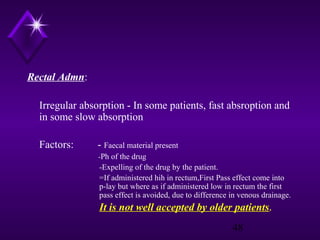
Rectal Admn:
Irregular absorption - In some patients, fast absroption and
in some slow absorption
Factors:

- Faecal material present
-Ph of the drug

-Expelling of the drug by the patient.
=If administered hih in rectum,First Pass effect come into
p-lay but where as if administered low in rectum the first
pass effect is avoided, due to difference in venous drainage.

It is not well accepted by older patients.
48
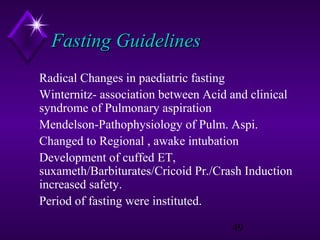
Fasting Guidelines
Radical Changes in paediatric fasting
Winternitz- association between Acid and clinical
syndrome of Pulmonary aspiration
Mendelson-Pathophysiology of Pulm. Aspi.
Changed to Regional , awake intubation
Development of cuffed ET,
suxameth/Barbiturates/Cricoid Pr./Crash Induction
increased safety.
Period of fasting were instituted.
49
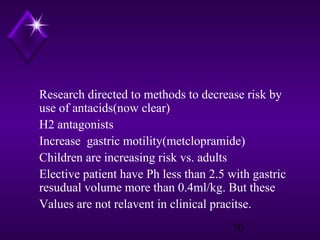
Research directed to methods to decrease risk by
use of antacids(now clear)
H2 antagonists
Increase gastric motility(metclopramide)
Children are increasing risk vs. adults
Elective patient have Ph less than 2.5 with gastric
resudual volume more than 0.4ml/kg. But these
Values are not relavent in clinical pracitse.
50
Factors that increase aspiration
1.Obesity
2.GI Pathology
3.Bowel Obst. 4.Opiods
5.Trauma
6.Neuro. Dysfunc.
7.Prior oesophageal surgery
8.Difficult airway 9.Lack of Experience in
Paed. Anaesthesia.
51
Fasting
Metclopramide increase lower oesophageal
Sphincter tone and promote gastric emptying.
H2 antagonists.
Delaying the operation (if possible) can decrease
the problem .
Gastric fluid 1ml/kg on admission after 4hrs.
0.54ml/kg
52
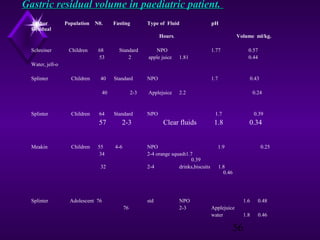
What is the true risk of aspiration in paediatric
patients?
Olsson et al. retrospectively reported threefold
increase in child less than 10years.
7/10 aspiration are preceded by laryngospasm.
Difficult airways – more associated with
aspiration.
Gastric distension of stomach during induction.
Tiret etal. Reported 2 children aspirationg during
Induction and maintenance and 2 more aspiration
druing recovery period out of 40,240 cases.
1/10,000 incidence. No deaths.
Bortland et al reported an incidence of 10/10,000
case with five patients having recognised risk
factors. In ASA I & II incidence is 5/10,000 and
53
all recovered.
Optimal period of Fasting
A review of gastric physiology demonstrates that
half of the ingested Normal saline is emptied from
stomach with in 11 mins.
Fat Content, Osmolality and glucose content delay
emptying.
Clear fluids administered (Adlib) to infants,
children, teenagers and even adults with in 2-3
hrs. of induction do not alter gastric residual
volume compared to patient standard fasting
Some paper found higher PH and lower residual
Volume.
54
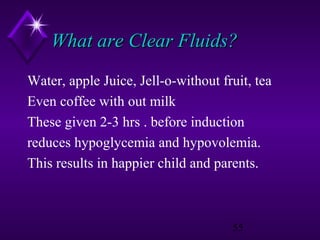
What are Clear Fluids?
Water, apple Juice, Jell-o-without fruit, tea
Even coffee with out milk
These given 2-3 hrs . before induction
reduces hypoglycemia and hypovolemia.
This results in happier child and parents.

55
Gastric residual volume in paediatric patient.
Author
Residual

Population

N0.

Fasting

Type of Fluid

pH

Hours.
Schreiner

Children

68
53

Standard
2

NPO
apple juice

Volume ml/kg.
1.77

0.57
0.44

1.7

0.43

1.81

Water, jell-o
Splinter

Children

40

Standard

40

Splinter

Children

64

57
Meakin

Children

55
34

2-3

Standard

Applejuice

4-6

2.2

NPO

2-3

Adolescent 76

Clear fluids

std
76

0.24

1.7

NPO
2-4 orange squash1.7
0.39
2-4
drinks,biscuits

32

Splinter

NPO

NPO
2-3

0.39

1.8

0.34

1.9

0.25

1.8
0.46

1.6
1.8

0.46

Applejuice
water

0.48

56
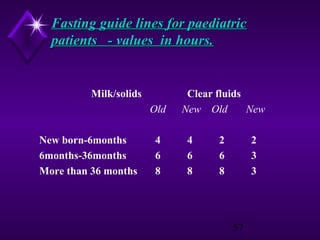
Fasting guide lines for paediatric
patients - values in hours.

Milk/solids
Old
New born-6months
6months-36months
More than 36 months

4
6
8

Clear fluids
New Old
New
4
6
8

2
6
8

2
3
3

57
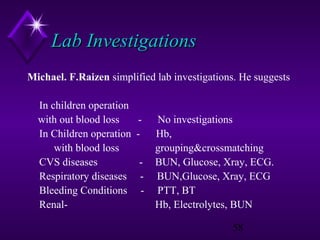
Lab Investigations
Michael. F.Raizen simplified lab investigations. He suggests
In children operation
with out blood loss
In Children operation
with blood loss
CVS diseases
Respiratory diseases
Bleeding Conditions
Renal-

-

No investigations
Hb,
grouping&crossmatching
BUN, Glucose, Xray, ECG.
BUN,Glucose, Xray, ECG
PTT, BT
Hb, Electrolytes, BUN
58
Conclusions
1.
2.
3.
4.
5.
6.
7.
8.

Better Psychological preparation of the child
Preparation of the parents
Creating congenial atmosphere
Protective net
Correct drug , dosage & route
Prevention of complications
Sedation guidelines
Lab investigations
59
60
61
62
63
64
65
66
67
68
69
70
71
72
73
74
75
76
77
78
79
80
81
82
83
84
85
PleaseWake Up
&
Thank You

86

peadiatric premedication and preparation

  • 1.
    Modern Trends inPaediatric preparation and Premedication Dr. P. Narasimha Reddy, MD, DA Professor & Head Department of Anaesthesiology Narayana Medical College, Nellore. 1
  • 2.
    AIM 1. 2. After this lecturethe Anesthesiologist must be able to recognise Various risk factors for pre-op anxiety Interventions a. b. 3. 4. Behavioral Pharmacological Various psychological effects of surgery & Anaesthesia Standards of pre-medication 2
  • 3.
    AIM contd.. 5. 6. 7. 8. 9. Monitoring thepatient under sedation Various levels of sedation, Various drugs, doses, routes & complications, Fasting guidelines, Necessary investigations 3
  • 4.
    Modern Trends inPaediatric Preparation and Premedication Introduction Whole family is under Stress Anxiety increased by mis information and Preconceived ideas Psychological stress - Long behavioural disturbances Work of Leigh, Belton and SmithModified Anaethetic Practice. 4
  • 5.
    Parental Anxiety General: Guilt,(inability to protect the child), loss of control, separation anxiety,Can I manage? Financial. Surgical: Failure of proceedure, disfigurement, death. Anaesthetic: Pain, Brain damage, death. Staff Reactions: Miscommunication, apparent lack of concern and paternalism. 5
  • 6.
    Childhood Anxieties Some Thingis going to happen Fantasies, hidden fears (more dangerous) Truthful announcement of details Gentle Avoid Medical Jargon 6
  • 7.
    SEPARATION ANXIETY Between agesof 6months to 5years more regression after separation Between ages of 2-6years five fold increase in anxiety than older child No familiarity with medical team Dependency behaviour Loss of self identity, autonomy, control and function Individualisation of approach 7
  • 8.
  • 9.
    Pre-op Anxiety -predictors 1. 2. 3. 4. 5. 6. Age Parental Anxiety Temperament Social adaptability Coping style Lack of pre-medication 9
  • 10.
    Fear of Unknownis common to human being Older Child is concerned about What does “put to sleep” really mean? Will I be awaken during operation? Will I move during Operation? Am I going to die? Will I be naked totally? Concerns of mutilation and torture 10
  • 11.
    Needle Phobia -Rice summarised perception of needle phobia Needle is perceived as direct threat to body integrity. Scratching my bones or pushing it all the way in Needle Phobia-decades of inadequate postoperative analgesia for children. Anything is better than needle. 11
  • 12.
    Frank and truthfuldisclosure of anticipated events. Family Preparation Paediatric Play therapy Encouraging physical expression Use of toy tools and art material. Parental presence Pre-operative interview Pre-operative preparation programs 12
  • 13.
    Psychological consequences of Anaesthesiaand Surgery. Acute: at the time of emergence from anaesthesia. Calm arousal Arousable Abrupt arousal Excited emergence Eckenhoff, Kneale and Dripps showed – fear of disfigurement is significant factor in emergence. Quiet to sleep, quiet to arouse, Screaming going down screaming coming up 13
  • 14.
    Chronic: Some changescontinue to adulthood. Factors- Age, Stability of family, cultural patterns, socio economic situations. Psychological consequences of Anaesthesia and Surgery. 14
  • 15.
    Behavioural Problems following anaesthesiaand surgery: Meyers Eckenhoff Hannallah General anxiety General regression Enuresis Sleep anxiety 45% 33% 28% 34% 23% 19% 26% 32% 66% 5% 37% 65% Eating Disturbances 33% -- -- The role of anaesthetist is very crucial. 15
  • 16.
    “Little in medicineis tainted with antiquity more than the sight of a waiting, fearful screaming child being taken from the arms of his mother and carried fighting to an anaesthetic room. There he is held forcefully on a table and a mask unceremoniously thrust on his face while he battles and screams into oblivion”. 16
  • 17.
    Preoperative visit by Anaesthesiologist Positivelyaffects quality of induction Allowing child choices Smooth induction decreases 50-70% of postoperative emotional changes. 17
  • 18.
    Parental Presence Makes sense. Inductionless frightening to child but more frightening to the anaesthetist. Less amount of drugs. Less postoperative behavioral problems. 18
  • 19.
    Premedication Aims Numerous combinations ofdrugs Now premedication is primarily to produce anxiolysis. Calm, sedated, with spontaneous respiration with obtunded autonomic reflexes. Modern preoperative regimens- often painless, rapid anxiolysis with rapid 19 emergence.
  • 20.
    Universal needle phobiamust be weighed against global threat of suffocation by mask. EMLA made insertion of iv cannulae, LP pain free. Induction in the lap of the mother is comfortable Parent sent out after induction. 20
  • 21.
    Pre-op preparation programs 1. 2. 3. 4. 5. 6. Narrativeinformation Orientation tour to O.T’s Role rehearsal using dolls Puppet shows Coping education & Relaxation skills 21
  • 22.
    Protective net Safe sedationof children requires a protective net Skilled personnel Vigilance Monitoring Appropriate drugs depending on age, weight life saving equipment. 22
  • 23.
    SEDATION GUIDELINES Written in1985 Rewritten in 1992 Monitoring guidelines by Anaesthetist. Proper drug in proper dosage. Conscious Sedation Medically controlled state of depressed consciousness that ‘allows protective reflexes to be maintained, ability to maintain spont. Resp. independently and continuously and permits appropriate response to physical or verbal stimuli’. 23
  • 24.
    Monitoring 1. Pulse oximetry 2. Blood pressure 3. ElectroCardiography & 4. If intubated capnography 24
  • 25.
    DEEP SEDATION (Proceduralsedation) Deep sedation is defined as medically controlled state of depressed consciousness or unconsciousness from which patients are not easily aroused. May be accompanied by a partial or complete loss of protective reflexes and includes inability to maintain a patent airway independently and respond purposefully to physical verbal stimuli. Conscious sedation may change to deep sedationMonitor with Pulse oximeter. 25
  • 26.
    SCORING SYSTEMS OFEFFICIENCY OF PREMEDICATION Scoring Scale Description Sedation 1 Awake 2 Awake, Calm and quiet 3 Drowsy, readily responds to verbal gentle stimuli 4 Asleep, slowly responds to verbal/gentle stimuli. 5. Asleep, not readily arousable. 26
  • 27.
    Apprehension 1. 2. 3. 4. None, no displayedfear or apprehension Little or minimal expression of fear or apprehension Moderate expression of fear/apprehension Excessive expression of fear/apprehension 27
  • 28.
    Cooperative State 1 Cooperative 2Mildly resistant, requires minimal or no restraint 3 resistant, requires active restraint Parental Separation 1 Excellent cooperative or asleep 2 Good slight fear or crying, quiet with reassurance 3 Fair - moderate fear/crying, not quiet with reassurance 4 Poor - Crying with need for restraint 28
  • 29.
  • 30.
    Steps of preparation Psychological Premedication Fastingguidelines Laboratory Investigations 30
  • 31.
    Preparation of WholeFamily Advantages Ease of Induction Increased tolerance to stress Decreased long lasting behavioural effects. 31
  • 32.
    Drugs and routesof Administration Narcotics Morphine - Duration of action 3-4Hrs, iv, im sc, s/l and or rectally Usual dose 0.1 to 0.2mg/kg For painful procedures Rectal Admn: delayed, irregular absorption and Respiratory depression 32
  • 33.
    Fentanyl 100 times morepotent than morphine High degree of solubility Penetrates Blood Brain Barrier Intermittently used – termination of action is due to redistribution Effects lasts for 30-45 minutes Cause chest wall and glottic contracture and respiratory depression Dose 0.5 to 1.0mcgm/kg slowly – titrate. 33
  • 34.
    Transmucosal Fentanyl (Lozengesor Lollipops), Oralet. Dose 15-20 mcgm/kg. Good absorption from mucosa. Child narcotized with in 15-30 minutes Complications: nausea, vomiting, desaturation Advantages: Long slow decline in Blood concentration improves analgesia. Rigidity of thoracic muscles avoided Rich good absorptive surface. 34
  • 35.
    Benzodiazepines: Very usefulfamily of drugs in children Diazepam: 0.1 to 0.3 mgm/kg iv or oral. im erratic absorption, very painful Iv Thrombophlebitis Respiratory Depression- Combined with other drugs. Disadvantages – long action, painful iv injection CNS depression common than midazolam 35
  • 36.
    Midazolam – MostPopular sedative Soluble in water No pain at iv or im B- elimination is 106minutes vs 18hrs diazepam Good for short procedures Route: iv, im, orally, sublingually, nasally and rectally. It produces anterograde and retrograde amnesia produces calm, compliant child. Respiratory Depression is common in elderly but not in children. It can occur if combined with other drugs. Study: Fraction of midazolam available compared with iv administration: Iv-1.0, im-0.9, nasal-0.6, Rectal-0.4 to 0.5,oral36 0.3
  • 37.
    Nasal-0.2 to 0.3mgm /kg. Effective, uncomfortable Effect in less than 10-15minutes. Neurotoxicity can occur in intranasal administration of drugs. Children prefer sublingual than nasal. Rectal-0.5-1.0 mgm/kg. Satisfactory level of sedation and anxiolysis in less than 15-20minutes. Children does not fall asleep even with 3mgm/kg 37
  • 38.
    Midazolam Sublingual – rapiduptake, Bitter taste is very difficult to suppress. Given with sweetening agents orally dose 0.5 to 0.75 mgm/kg. Satisfactory sedation in 10-15 minutes, peak effect at 20-30 minutes. Note: Drugs capable of decreasing cytochrome P3A isoenzymes like Erythro, Dilti, itracono, ranitidine, cimeti, and even grape juice, may increase serum concentration. They must be asked to gulp as much as possible , other wise refusing or spitting is possible. 38
  • 39.
    KETAMINE Excellent analgesic andamnesic agent Route: iv, im, oral, rectal, nasal (4-6mgm) Increase in HR, BP, CMRO2, IOP, ICP Increase in airway secretions Contraindicated in URI No sure protection in full stomach Emergence delerium Sedatives or narcotics reduce hallucinations but increase sedation levels. Oral Admn: 6-10mgm/kg with orange juice or Rasna with 0.02-0.04 mgm/kg atropine gives excellent results in 10-15minutes . 39
  • 40.
    KETAMINE It is notknown if dreaming occurs with oral Ketamine Some tried oral ketamine 3-6 mgm/kg with midazolam 0.25-0.5 mgm/kg with profound sedation. Increase in oral dose can result in more success rate but adverse reactions like vomiting and profound sedation can happen. Involuntary movements can occur.. 40
  • 41.
    BARBITURATES These are bestfor babies with diapers . Child is sedated in parents lap. No need of parental presence in induction.(Jeffcoate) Methohexitone: rectally 20-30mgm/kg , 10% solution. Produces a state of slight to deep sedation. Absorption is fast but irregular. Seizures in temporal lobe epilepsy. Airway obstruction and Apnoea can occur. Monitoring is very much essential. Thiopentone: Rectally 30mgm/kg. Used in epilepsy.. Children sleep longer. These are best premedicants provided the baby is monitored. 41
  • 42.
    Ketorolac NSAID, no resp.depression Dose - 0.5to1mgm/kg. Route-oral, im and iv too Careful in Renal problems, Asthmatics, bleeding diathesis. 42
  • 43.
    EMLA Lidocaine+ Prilocaine Occlusive dressingfor 30-60minutes. For venepuncture, Lumbar Puncture or before skin infiltration. If large dose is used - Methhaemogobinaemia Mucosal surfaces avoided Accidental ingestion or contact with eyes should be avoided. Children may chew the dressing with absorption of the drug. One Study of children aged 6-12 years found that N2O is superior to EMLA 43
  • 44.
    Doses of drugscommonly used: Drug Dose mgm/kg. Route Barbiturates Methohexital 20-30 Thiopentone 10% rectal, 20-30 rectal 44
  • 45.
  • 46.
  • 47.
    Route of admn. Advantages Disadvantages Oral painless slowonset IM reliable Rapid onset painful, threatening, sterile abscess Rectal rapid, reliable painful defaecation Irregular/delayed Absorption Nasal reliable uncomfortable Desaturation Child Parent Objection Transoral, Muco oral reliable IV most reliable slow onset, nauseaVomiting, desaturation Painful, threatening 47
  • 48.
    Rectal Admn: Irregular absorption- In some patients, fast absroption and in some slow absorption Factors: - Faecal material present -Ph of the drug -Expelling of the drug by the patient. =If administered hih in rectum,First Pass effect come into p-lay but where as if administered low in rectum the first pass effect is avoided, due to difference in venous drainage. It is not well accepted by older patients. 48
  • 49.
    Fasting Guidelines Radical Changesin paediatric fasting Winternitz- association between Acid and clinical syndrome of Pulmonary aspiration Mendelson-Pathophysiology of Pulm. Aspi. Changed to Regional , awake intubation Development of cuffed ET, suxameth/Barbiturates/Cricoid Pr./Crash Induction increased safety. Period of fasting were instituted. 49
  • 50.
    Research directed tomethods to decrease risk by use of antacids(now clear) H2 antagonists Increase gastric motility(metclopramide) Children are increasing risk vs. adults Elective patient have Ph less than 2.5 with gastric resudual volume more than 0.4ml/kg. But these Values are not relavent in clinical pracitse. 50
  • 51.
    Factors that increaseaspiration 1.Obesity 2.GI Pathology 3.Bowel Obst. 4.Opiods 5.Trauma 6.Neuro. Dysfunc. 7.Prior oesophageal surgery 8.Difficult airway 9.Lack of Experience in Paed. Anaesthesia. 51
  • 52.
    Fasting Metclopramide increase loweroesophageal Sphincter tone and promote gastric emptying. H2 antagonists. Delaying the operation (if possible) can decrease the problem . Gastric fluid 1ml/kg on admission after 4hrs. 0.54ml/kg 52
  • 53.
    What is thetrue risk of aspiration in paediatric patients? Olsson et al. retrospectively reported threefold increase in child less than 10years. 7/10 aspiration are preceded by laryngospasm. Difficult airways – more associated with aspiration. Gastric distension of stomach during induction. Tiret etal. Reported 2 children aspirationg during Induction and maintenance and 2 more aspiration druing recovery period out of 40,240 cases. 1/10,000 incidence. No deaths. Bortland et al reported an incidence of 10/10,000 case with five patients having recognised risk factors. In ASA I & II incidence is 5/10,000 and 53 all recovered.
  • 54.
    Optimal period ofFasting A review of gastric physiology demonstrates that half of the ingested Normal saline is emptied from stomach with in 11 mins. Fat Content, Osmolality and glucose content delay emptying. Clear fluids administered (Adlib) to infants, children, teenagers and even adults with in 2-3 hrs. of induction do not alter gastric residual volume compared to patient standard fasting Some paper found higher PH and lower residual Volume. 54
  • 55.
    What are ClearFluids? Water, apple Juice, Jell-o-without fruit, tea Even coffee with out milk These given 2-3 hrs . before induction reduces hypoglycemia and hypovolemia. This results in happier child and parents. 55
  • 56.
    Gastric residual volumein paediatric patient. Author Residual Population N0. Fasting Type of Fluid pH Hours. Schreiner Children 68 53 Standard 2 NPO apple juice Volume ml/kg. 1.77 0.57 0.44 1.7 0.43 1.81 Water, jell-o Splinter Children 40 Standard 40 Splinter Children 64 57 Meakin Children 55 34 2-3 Standard Applejuice 4-6 2.2 NPO 2-3 Adolescent 76 Clear fluids std 76 0.24 1.7 NPO 2-4 orange squash1.7 0.39 2-4 drinks,biscuits 32 Splinter NPO NPO 2-3 0.39 1.8 0.34 1.9 0.25 1.8 0.46 1.6 1.8 0.46 Applejuice water 0.48 56
  • 57.
    Fasting guide linesfor paediatric patients - values in hours. Milk/solids Old New born-6months 6months-36months More than 36 months 4 6 8 Clear fluids New Old New 4 6 8 2 6 8 2 3 3 57
  • 58.
    Lab Investigations Michael. F.Raizensimplified lab investigations. He suggests In children operation with out blood loss In Children operation with blood loss CVS diseases Respiratory diseases Bleeding Conditions Renal- - No investigations Hb, grouping&crossmatching BUN, Glucose, Xray, ECG. BUN,Glucose, Xray, ECG PTT, BT Hb, Electrolytes, BUN 58
  • 59.
    Conclusions 1. 2. 3. 4. 5. 6. 7. 8. Better Psychological preparationof the child Preparation of the parents Creating congenial atmosphere Protective net Correct drug , dosage & route Prevention of complications Sedation guidelines Lab investigations 59
  • 60.
  • 61.
  • 62.
  • 63.
  • 64.
  • 65.
  • 66.
  • 67.
  • 68.
  • 69.
  • 70.
  • 71.
  • 72.
  • 73.
  • 74.
  • 75.
  • 76.
  • 77.
  • 78.
  • 79.
  • 80.
  • 81.
  • 82.
  • 83.
  • 84.
  • 85.
  • 86.