AL JADIDI SULAIMAN MODERATOR: DR TUAN NORIZAN 14/04/2011
Involves administering a combination of drugs for  anxiolytic ,  hypnotic ,  amnestic , and  analgesic  effect
Refers to instances in which an  anaesthesiologist  has been called upon to  provide specific anaesthesia  services to a particular patient undergoing  a planned procedure,  in  connection with which a  patient receives local anaesthesia ,  or  in some cases,  no anaesthesia at all .
In such a case the  anaesthesiologist  is providing specific services to the patient and is in control of the patient non-surgical or non-obstetrical medical care, including the  responsibility  of monitoring the patient’s vital sign , and is available to administer anaesthetics or provide other medical care as appropriate.
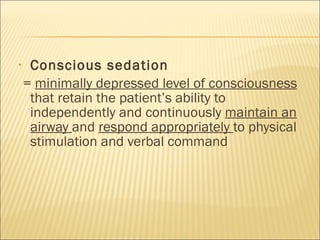
Conscious sedation  =  minimally depressed level of consciousness  that retain the patient’s ability to independently and continuously  maintain an airway  and  respond appropriately  to physical stimulation and verbal command
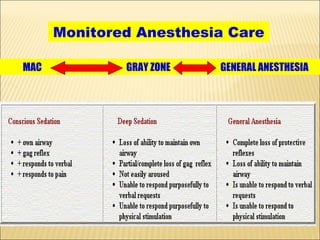
MAC   GRAY ZONE   GENERAL ANESTHESIA Monitored Anesthesia Care
To maintain patient safety & sense of well-being To alleviate pain, minimise discomfort To minimise psychological response - anxiolysis, analgesia, amnesia To control behaviour To return to pre-procedural state - recognised criteria - safe discharge
Should be no different than for other patients Assess ability to remain motionless and cooperate, verbally communicate Important in monitoring level of sedation and cardiorespiratory function cardiorespiratory disease is often the indication for MAC over GA However, problem such as persistent cough or orthopnoea may prevent immobility
 
End points: Providing patient comfort Maintaining cardiorespiratory stability Improving operating condition Prevent recall of unpleasant perioperative event
MAC usually involves IV administration of drugs- alone/supplemental to LA/RA Drug should allow rapid+complete recovery, min N&V A level of sedation that allows verbal communication is optimal Increased pt agitation may be due to pain or anxiety
Agitation causes: pain, hypoxia, hypercarbia, impending local toxicity, cerebral hypoperfusion others: bladder distension, hypothermia, hyperthermia, pruritus, nausea, positional discomfort, IV site, tourniquet inflation,  and member of the surgical team leaning on the patient
 
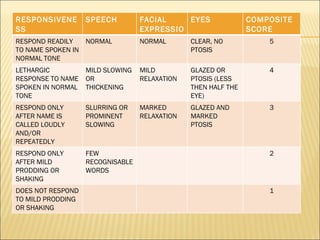
RESPONSIVENESS SPEECH FACIAL EXPRESSION EYES COMPOSITE SCORE LEVEL RESPOND READILY TO NAME SPOKEN IN NORMAL TONE NORMAL NORMAL CLEAR, NO PTOSIS 5 LETHARGIC RESPONSE TO NAME SPOKEN IN NORMAL TONE MILD SLOWING OR THICKENING MILD RELAXATION GLAZED OR PTOSIS (LESS THEN HALF THE EYE) 4 RESPOND ONLY AFTER NAME IS CALLED LOUDLY AND/OR REPEATEDLY SLURRING OR PROMINENT SLOWING MARKED RELAXATION GLAZED AND MARKED PTOSIS 3 RESPOND ONLY AFTER MILD PRODDING OR SHAKING FEW RECOGNISABLE WORDS 2 DOES NOT RESPOND TO MILD PRODDING OR SHAKING 1
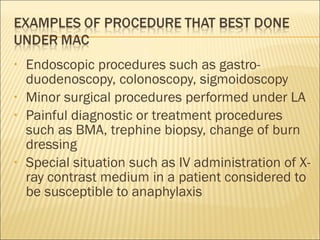
Endoscopic procedures such as gastro-duodenoscopy, colonoscopy, sigmoidoscopy Minor surgical procedures performed under LA Painful diagnostic or treatment procedures such as BMA, trephine biopsy, change of burn dressing Special situation such as IV administration of X-ray contrast medium in a patient considered to be susceptible to anaphylaxis
 
Predict the effect of drugs Understand p/kinetic & p/dynamic properties ( context-sensitive half time, effect site equilibration time, drug interactions ) Cont infusion are superior to intermittent bolus -less-fluctuate in drug conc, prompt recovery
Accumulation of drugs in the poorly perfused fatty tissues during a long case can contribute to a prolonged recovery It is difficult to predict duration of action based on elimination half life alone
Describes the  time  required for the plasma  drug concentration  to  decline by 50%  after  terminating  an  infusion of a particular duration The CSHT increases as the duration of infusion increases (particularly fentanyl & STP) -thus STP is not ideal drug for ambulatory procedures
There is no constant relationship between elimination half-life and context-sensitive half-time eg: fentanyl’s elimination is shorter than sufentanil (462 vs 577 minutes), its CSHT is twice that of sufentanil at 2H and 8-10x longer at 5H
Q: How does the CSHT relate to the time of recovery?
Describes the time from rapid iv admin of a drug until its clinical effect is manifest Half time of equlibration between drug concentration in the blood and drug effect = t1/2 keo Smaller values correspond with rapidity of onset
Drugs with shorter values: thiopental, propofol, alfentanil Drugs with longer values: midazolam (0.9-5.6 m), sufentanil, and fentanyl  t1/2keo is a key factor in determining  bolus spacing eg: even using the shortest value for midazolam, 2.7 minutes is required for 87.5% effect-site equlibration of a bolus dose # low cardiac output is another factor that will slow onset time
No one inhaled/IV can provide all the component of MAC Combination of drugs that act synergistically  needed eg opiod-benzodiazepine combination to achieve the components of hypnosis, amnesia & analgesia
Cpss50  = plasma concentration at a steady state required to abolish purposeful movement upon skin incision in 50% of patients
It has a context-sensitive half-time that is short even after a prolonged infusion, and a short effect-site equlibration-time As it doesn’t posses analgesic properties, analgesia is provided by means of local infiltration or small doses of opiod. Initial bolus 0.5mg/kg then 10mg intermittent bolus as necessary
Alternatively, -continuous infusion at a rate 4mg/kg/h -Patient-controlled sedation (PCS) -Targer-controlled infusion, maintain target plasma concentration 0.5-1.5mcg/ml, titrating to response Ramifentanil may also be administered at rate 0.01-0.05mcg/kg/min #there is evidence that a single 10mg dose possess direct antiemetic properties
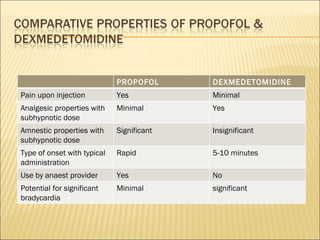
PROPOFOL DEXMEDETOMIDINE Pain upon injection Yes Minimal Analgesic properties with subhypnotic dose Minimal Yes Amnestic properties with subhypnotic dose Significant Insignificant Type of onset with typical administration Rapid 5-10 minutes Use by anaest provider Yes No Potential for significant bradycardia Minimal significant
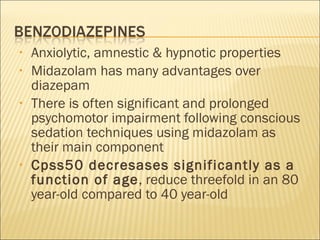
Anxiolytic, amnestic & hypnotic properties Midazolam has many advantages over diazepam There is often significant and prolonged psychomotor impairment following conscious sedation techniques using midazolam as their main component Cpss50 decresases significantly as a function of age , reduce threefold in an 80 year-old compared to 40 year-old
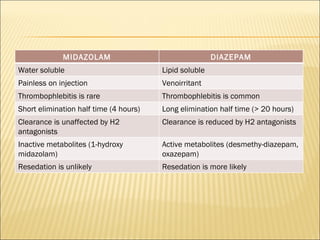
MIDAZOLAM DIAZEPAM Water soluble Lipid soluble Painless on injection Venoirritant Thrombophlebitis is rare Thrombophlebitis is common Short elimination half time (4 hours) Long elimination half time (> 20 hours) Clearance is unaffected by H2 antagonists Clearance is reduced by H2 antagonists Inactive metabolites (1-hydroxy midazolam) Active metabolites (desmethy-diazepam, oxazepam) Resedation is unlikely Resedation is more likely
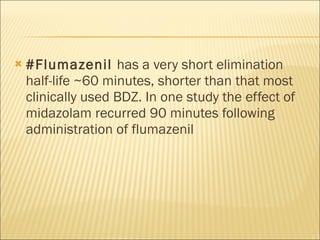
#Flumazenil  has a very short elimination half-life ~60 minutes, shorter than that most clinically used BDZ. In one study the effect of midazolam recurred 90 minutes following administration of flumazenil
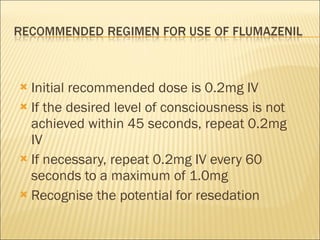
Initial recommended dose is 0.2mg IV If the desired level of consciousness is not achieved within 45 seconds, repeat 0.2mg IV If necessary, repeat 0.2mg IV every 60 seconds to a maximum of 1.0mg Recognise the potential for resedation
α 2- adenoreceptor agonists, anxiolytic and sedatives Clonidine- good analgesia at high dose 4mcg/kg iv or 5mcg/kg orally w/out effect on respiration / PONV  slow on & offset –necessitating given well before surgery and possible delay in discharge after operation
Dexmedetominidine provides dose-related sedation and prolongation of sensory block but cause significant haemodynamic impairemet & PONV Elimination half-life of 2H indicates a fast offset, which is the major advantages over clonidine
Low-dose (0.5-1mg/kg) ketamine reported to provide weak sedation but excellent analgesia Didn’t reduce propofol requirement But +ve effect on haemodynamic stability and counteract propofol-induced resp depression due to its sympatomimetic properties & CNS effects Bad dreams/hallucination were not reported at sedatives dose
Among opiods ramifentanil is a potent analgesic with excellent p/kinetic profile: TPE 1.5min, p/dynamic offset 5.8min, short elmination half-life & time-independent CSHT. s/e: n&v, pruritus, muscular rigidity at high dose (>1mcg/kg/min) infusion rate of 0.1mcg/kg/min suggested as optimal balance between sedatives/side-effects
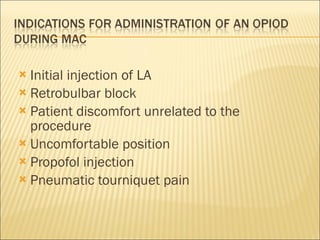
Initial injection of LA Retrobulbar block Patient discomfort unrelated to the procedure Uncomfortable position Propofol injection Pneumatic tourniquet pain
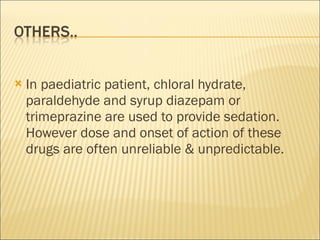
In paediatric patient, chloral hydrate, paraldehyde and syrup diazepam or trimeprazine are used to provide sedation. However dose and onset of action of these drugs are often unreliable & unpredictable.
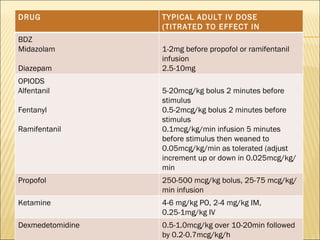
DRUG TYPICAL ADULT IV DOSE (TITRATED TO EFFECT IN INCREAMENT0 BDZ Midazolam Diazepam 1-2mg before propofol or ramifentanil infusion 2.5-10mg OPIODS Alfentanil Fentanyl Ramifentanil 5-20mcg/kg bolus 2 minutes before stimulus 0.5-2mcg/kg bolus 2 minutes before stimulus 0.1mcg/kg/min infusion 5 minutes before stimulus then weaned to 0.05mcg/kg/min as tolerated (adjust increment up or down in 0.025mcg/kg/min  Propofol 250-500 mcg/kg bolus, 25-75 mcg/kg/min infusion Ketamine 4-6 mg/kg PO, 2-4 mg/kg IM, 0.25-1mg/kg IV Dexmedetomidine 0.5-1.0mcg/kg over 10-20min followed by 0.2-0.7mcg/kg/h
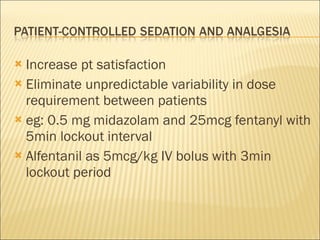
Increase pt satisfaction Eliminate unpredictable variability in dose requirement between patients eg: 0.5 mg midazolam and 25mcg fentanyl with 5min lockout interval Alfentanil as 5mcg/kg IV bolus with 3min lockout period
 
During normal inspiration is subatmospheric creating a tendency to collapse This tendency is opposed by upper airway muscles which contract just prior to diaphragmatic contraction This control appears sensitive to sedative-hypnotic drug administration Eg: sedatives dose of midazolam have been reported to increase upper airway resistance 3-4 fold, an effect exaggerated in elderly..
Protective pharyngeal and laryngeal reflexes are depressed by sedation, debilitation and advanced age Complete recovery of swallowing reflex occur ~15 minutes after the return of consciousness from propofol anaesthesia It is depressed up to 2H after midazolam
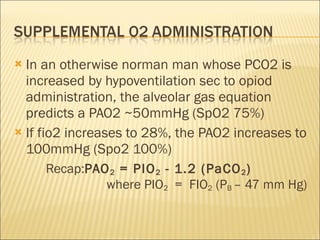
In an otherwise norman man whose PCO2 is increased by hypoventilation sec to opiod administration, the alveolar gas equation predicts a PAO2 ~50mmHg (SpO2 75%) If fio2 increases to 28%, the PAO2 increases to 100mmHg (Spo2 100%) Recap: PAO 2  = PIO 2  - 1.2 (PaCO 2 )   where PIO 2   =  FIO 2  (P B  – 47 mm Hg)
 
 
ASA Standards for Basic Anaesthetic monitoring -applicable to all levels of anesthesia care Communication & Observation Preparedness to recognise and treat LA toxicity
Visual, tactile and Auditory assessment -rate, depth & pattern of breathing -palpation of arterial pulse -peripheral perfusion, Cap refill -diaphoresis -pallor -shivering -cyanosis -acute change in neurological status
Auscultation -heart & breath sounds (precordial stethoscope) Pulse oximetry  (an ASA standard) Capnography Electrocardiography Temperature Bispectral index  (value <80 minimise recall)
 
This study was designed to determine the optimal infusion rates of propofol and alfentanil when administering during LA Randomised, double-blind study effect of different propofol infusion rates on the alfentanil requirement, level of sedation, intraoperative recall, respiratory and cardiovascular variables, and recovery evaluated. 72 ASA I or II female outpatients undergoing breast biopsy procedures with local anesthesia were randomly assigned to 1 of 4 treatment groups
All patients received IV midazolam 2mg for premedication Propofol was infused at 0, 25, 50 or 75 mcg/kg/min Sedation was evaluated using OAA/S scale at 5 min intervals by blinded observer 2 minutes before infiltration of LA, bolus of alfentanil 2.5mcg/kg IV given, folllowed by infusion 0.5mcg/kg/min Alfentanil infusion titrated varied to patient comfort and stable cardiovascular and respiratory fx.
Results: Propofol produced dose-dependant increases in the level of sedation (with median OAA/S scores of 2-4, P<0.05. Higher infusion rates of propofol (50-75mcg/kg/min) produced significant amnesia, opiod-sparing effect (alfentanil 0.3±0.2 vs 0.6±0.2 mcg/kg/min) and less PONV. Thus in healthy outpatients premedicated with IV midazolam 2mg, a  propofol infusion 25-50mcg/kg/min  in combination with an  alfentanil infusion 0.2-0.4mcg/kg/min  is recommended for sedation and analgesia during MAC in the ambulatory setting.
 
Study found that 13 of 98 (12%) patients with an UL block without sedation for  hand surgery would like to be sedated for future similar surgery Sedatives can help to decrease the requirement of opiod analgesics, reduce PONV Sedation allows the choice of shorter anaesthetic method (local or RA vs spinal or GA) Sedation does involve risks especially respiratory depression, haemodynamic instability or uncontrolled movement
Patient factors: Dose requirement for sedative agents are decreased in elderly patients Risk of desaturation/haemodynamic instability is increased I patients >70 yr Similar in ASA III/IV or ASA I/II Elderly people are expected to be less anxious Thus sedation should be more restricted in the elderly
Factors influencing the level of sedation.. Several studies have shown that spinal and epidural can reduce anaesthetic requirement and induce sedation The peak sedation effect is usually detected 30-45 minutes after starting the block Enhance sedation by adding adrenaline Listen to music..
Ideal pharmacokinetic & pharmacodynamic properties Rapid onset, easy titration and high clearance p/dynamic dep on actions w/in the effect-site compartment = constant k Time to peak effect (TPE) seems to be a better measure as it is independent of the p/kinetic model, and the time course is predictable Elimination half life is of limited use
A short Context-sensitive half-time and a high clearance are essential for rapid offset of sedation and fast recovery The ideal sedative agent should also have minimal side effect
 
326 patients were randomised  to DEX 0.5, DEX 1 mcg/kg or saline placebo as initial loading dose Followed by maintenance 0.2-1.0 mcg/kg/h, titrate until <4 on OAA/S Midazolam given for OAA/S >4, and fentanyl for pain Primary end point - % of patients not requiring rescue midazolam
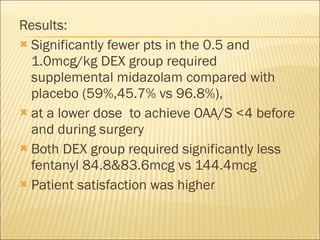
Results: Significantly fewer pts in the 0.5 and 1.0mcg/kg DEX group required supplemental midazolam compared with placebo (59%,45.7% vs 96.8%), at a lower dose  to achieve OAA/S <4 before and during surgery Both DEX group required significantly less fentanyl 84.8&83.6mcg vs 144.4mcg Patient satisfaction was higher
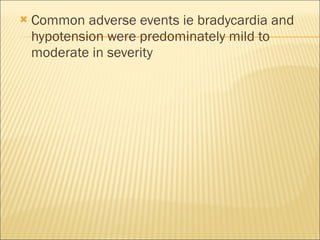
Common adverse events ie bradycardia and hypotension were predominately mild to moderate in severity
Thank you for listening…

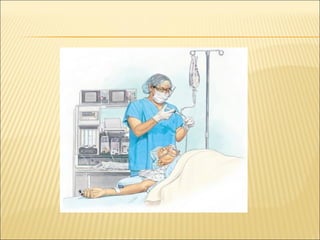
Monitored anaesthesia care

  • 1.
    AL JADIDI SULAIMANMODERATOR: DR TUAN NORIZAN 14/04/2011
  • 2.
    Involves administering acombination of drugs for anxiolytic , hypnotic , amnestic , and analgesic effect
  • 3.
    Refers to instancesin which an anaesthesiologist has been called upon to provide specific anaesthesia services to a particular patient undergoing a planned procedure, in connection with which a patient receives local anaesthesia , or in some cases, no anaesthesia at all .
  • 4.
    In such acase the anaesthesiologist is providing specific services to the patient and is in control of the patient non-surgical or non-obstetrical medical care, including the responsibility of monitoring the patient’s vital sign , and is available to administer anaesthetics or provide other medical care as appropriate.
  • 5.
    Conscious sedation = minimally depressed level of consciousness that retain the patient’s ability to independently and continuously maintain an airway and respond appropriately to physical stimulation and verbal command
  • 6.
    MAC GRAY ZONE GENERAL ANESTHESIA Monitored Anesthesia Care
  • 7.
    To maintain patientsafety & sense of well-being To alleviate pain, minimise discomfort To minimise psychological response - anxiolysis, analgesia, amnesia To control behaviour To return to pre-procedural state - recognised criteria - safe discharge
  • 8.
    Should be nodifferent than for other patients Assess ability to remain motionless and cooperate, verbally communicate Important in monitoring level of sedation and cardiorespiratory function cardiorespiratory disease is often the indication for MAC over GA However, problem such as persistent cough or orthopnoea may prevent immobility
  • 9.
  • 10.
    End points: Providingpatient comfort Maintaining cardiorespiratory stability Improving operating condition Prevent recall of unpleasant perioperative event
  • 11.
    MAC usually involvesIV administration of drugs- alone/supplemental to LA/RA Drug should allow rapid+complete recovery, min N&V A level of sedation that allows verbal communication is optimal Increased pt agitation may be due to pain or anxiety
  • 12.
    Agitation causes: pain,hypoxia, hypercarbia, impending local toxicity, cerebral hypoperfusion others: bladder distension, hypothermia, hyperthermia, pruritus, nausea, positional discomfort, IV site, tourniquet inflation, and member of the surgical team leaning on the patient
  • 13.
  • 14.
    RESPONSIVENESS SPEECH FACIALEXPRESSION EYES COMPOSITE SCORE LEVEL RESPOND READILY TO NAME SPOKEN IN NORMAL TONE NORMAL NORMAL CLEAR, NO PTOSIS 5 LETHARGIC RESPONSE TO NAME SPOKEN IN NORMAL TONE MILD SLOWING OR THICKENING MILD RELAXATION GLAZED OR PTOSIS (LESS THEN HALF THE EYE) 4 RESPOND ONLY AFTER NAME IS CALLED LOUDLY AND/OR REPEATEDLY SLURRING OR PROMINENT SLOWING MARKED RELAXATION GLAZED AND MARKED PTOSIS 3 RESPOND ONLY AFTER MILD PRODDING OR SHAKING FEW RECOGNISABLE WORDS 2 DOES NOT RESPOND TO MILD PRODDING OR SHAKING 1
  • 15.
    Endoscopic procedures suchas gastro-duodenoscopy, colonoscopy, sigmoidoscopy Minor surgical procedures performed under LA Painful diagnostic or treatment procedures such as BMA, trephine biopsy, change of burn dressing Special situation such as IV administration of X-ray contrast medium in a patient considered to be susceptible to anaphylaxis
  • 16.
  • 17.
    Predict the effectof drugs Understand p/kinetic & p/dynamic properties ( context-sensitive half time, effect site equilibration time, drug interactions ) Cont infusion are superior to intermittent bolus -less-fluctuate in drug conc, prompt recovery
  • 18.
    Accumulation of drugsin the poorly perfused fatty tissues during a long case can contribute to a prolonged recovery It is difficult to predict duration of action based on elimination half life alone
  • 19.
    Describes the time required for the plasma drug concentration to decline by 50% after terminating an infusion of a particular duration The CSHT increases as the duration of infusion increases (particularly fentanyl & STP) -thus STP is not ideal drug for ambulatory procedures
  • 20.
    There is noconstant relationship between elimination half-life and context-sensitive half-time eg: fentanyl’s elimination is shorter than sufentanil (462 vs 577 minutes), its CSHT is twice that of sufentanil at 2H and 8-10x longer at 5H
  • 21.
    Q: How doesthe CSHT relate to the time of recovery?
  • 22.
    Describes the timefrom rapid iv admin of a drug until its clinical effect is manifest Half time of equlibration between drug concentration in the blood and drug effect = t1/2 keo Smaller values correspond with rapidity of onset
  • 23.
    Drugs with shortervalues: thiopental, propofol, alfentanil Drugs with longer values: midazolam (0.9-5.6 m), sufentanil, and fentanyl t1/2keo is a key factor in determining bolus spacing eg: even using the shortest value for midazolam, 2.7 minutes is required for 87.5% effect-site equlibration of a bolus dose # low cardiac output is another factor that will slow onset time
  • 24.
    No one inhaled/IVcan provide all the component of MAC Combination of drugs that act synergistically needed eg opiod-benzodiazepine combination to achieve the components of hypnosis, amnesia & analgesia
  • 25.
    Cpss50 =plasma concentration at a steady state required to abolish purposeful movement upon skin incision in 50% of patients
  • 26.
    It has acontext-sensitive half-time that is short even after a prolonged infusion, and a short effect-site equlibration-time As it doesn’t posses analgesic properties, analgesia is provided by means of local infiltration or small doses of opiod. Initial bolus 0.5mg/kg then 10mg intermittent bolus as necessary
  • 27.
    Alternatively, -continuous infusionat a rate 4mg/kg/h -Patient-controlled sedation (PCS) -Targer-controlled infusion, maintain target plasma concentration 0.5-1.5mcg/ml, titrating to response Ramifentanil may also be administered at rate 0.01-0.05mcg/kg/min #there is evidence that a single 10mg dose possess direct antiemetic properties
  • 28.
    PROPOFOL DEXMEDETOMIDINE Painupon injection Yes Minimal Analgesic properties with subhypnotic dose Minimal Yes Amnestic properties with subhypnotic dose Significant Insignificant Type of onset with typical administration Rapid 5-10 minutes Use by anaest provider Yes No Potential for significant bradycardia Minimal significant
  • 29.
    Anxiolytic, amnestic &hypnotic properties Midazolam has many advantages over diazepam There is often significant and prolonged psychomotor impairment following conscious sedation techniques using midazolam as their main component Cpss50 decresases significantly as a function of age , reduce threefold in an 80 year-old compared to 40 year-old
  • 30.
    MIDAZOLAM DIAZEPAM Watersoluble Lipid soluble Painless on injection Venoirritant Thrombophlebitis is rare Thrombophlebitis is common Short elimination half time (4 hours) Long elimination half time (> 20 hours) Clearance is unaffected by H2 antagonists Clearance is reduced by H2 antagonists Inactive metabolites (1-hydroxy midazolam) Active metabolites (desmethy-diazepam, oxazepam) Resedation is unlikely Resedation is more likely
  • 31.
    #Flumazenil hasa very short elimination half-life ~60 minutes, shorter than that most clinically used BDZ. In one study the effect of midazolam recurred 90 minutes following administration of flumazenil
  • 32.
    Initial recommended doseis 0.2mg IV If the desired level of consciousness is not achieved within 45 seconds, repeat 0.2mg IV If necessary, repeat 0.2mg IV every 60 seconds to a maximum of 1.0mg Recognise the potential for resedation
  • 33.
    α 2- adenoreceptoragonists, anxiolytic and sedatives Clonidine- good analgesia at high dose 4mcg/kg iv or 5mcg/kg orally w/out effect on respiration / PONV slow on & offset –necessitating given well before surgery and possible delay in discharge after operation
  • 34.
    Dexmedetominidine provides dose-relatedsedation and prolongation of sensory block but cause significant haemodynamic impairemet & PONV Elimination half-life of 2H indicates a fast offset, which is the major advantages over clonidine
  • 35.
    Low-dose (0.5-1mg/kg) ketaminereported to provide weak sedation but excellent analgesia Didn’t reduce propofol requirement But +ve effect on haemodynamic stability and counteract propofol-induced resp depression due to its sympatomimetic properties & CNS effects Bad dreams/hallucination were not reported at sedatives dose
  • 36.
    Among opiods ramifentanilis a potent analgesic with excellent p/kinetic profile: TPE 1.5min, p/dynamic offset 5.8min, short elmination half-life & time-independent CSHT. s/e: n&v, pruritus, muscular rigidity at high dose (>1mcg/kg/min) infusion rate of 0.1mcg/kg/min suggested as optimal balance between sedatives/side-effects
  • 37.
    Initial injection ofLA Retrobulbar block Patient discomfort unrelated to the procedure Uncomfortable position Propofol injection Pneumatic tourniquet pain
  • 38.
    In paediatric patient,chloral hydrate, paraldehyde and syrup diazepam or trimeprazine are used to provide sedation. However dose and onset of action of these drugs are often unreliable & unpredictable.
  • 39.
    DRUG TYPICAL ADULTIV DOSE (TITRATED TO EFFECT IN INCREAMENT0 BDZ Midazolam Diazepam 1-2mg before propofol or ramifentanil infusion 2.5-10mg OPIODS Alfentanil Fentanyl Ramifentanil 5-20mcg/kg bolus 2 minutes before stimulus 0.5-2mcg/kg bolus 2 minutes before stimulus 0.1mcg/kg/min infusion 5 minutes before stimulus then weaned to 0.05mcg/kg/min as tolerated (adjust increment up or down in 0.025mcg/kg/min Propofol 250-500 mcg/kg bolus, 25-75 mcg/kg/min infusion Ketamine 4-6 mg/kg PO, 2-4 mg/kg IM, 0.25-1mg/kg IV Dexmedetomidine 0.5-1.0mcg/kg over 10-20min followed by 0.2-0.7mcg/kg/h
  • 40.
    Increase pt satisfactionEliminate unpredictable variability in dose requirement between patients eg: 0.5 mg midazolam and 25mcg fentanyl with 5min lockout interval Alfentanil as 5mcg/kg IV bolus with 3min lockout period
  • 41.
  • 42.
    During normal inspirationis subatmospheric creating a tendency to collapse This tendency is opposed by upper airway muscles which contract just prior to diaphragmatic contraction This control appears sensitive to sedative-hypnotic drug administration Eg: sedatives dose of midazolam have been reported to increase upper airway resistance 3-4 fold, an effect exaggerated in elderly..
  • 43.
    Protective pharyngeal andlaryngeal reflexes are depressed by sedation, debilitation and advanced age Complete recovery of swallowing reflex occur ~15 minutes after the return of consciousness from propofol anaesthesia It is depressed up to 2H after midazolam
  • 44.
    In an otherwisenorman man whose PCO2 is increased by hypoventilation sec to opiod administration, the alveolar gas equation predicts a PAO2 ~50mmHg (SpO2 75%) If fio2 increases to 28%, the PAO2 increases to 100mmHg (Spo2 100%) Recap: PAO 2 = PIO 2 - 1.2 (PaCO 2 ) where PIO 2 = FIO 2 (P B – 47 mm Hg)
  • 45.
  • 46.
  • 47.
    ASA Standards forBasic Anaesthetic monitoring -applicable to all levels of anesthesia care Communication & Observation Preparedness to recognise and treat LA toxicity
  • 48.
    Visual, tactile andAuditory assessment -rate, depth & pattern of breathing -palpation of arterial pulse -peripheral perfusion, Cap refill -diaphoresis -pallor -shivering -cyanosis -acute change in neurological status
  • 49.
    Auscultation -heart &breath sounds (precordial stethoscope) Pulse oximetry (an ASA standard) Capnography Electrocardiography Temperature Bispectral index (value <80 minimise recall)
  • 50.
  • 51.
    This study wasdesigned to determine the optimal infusion rates of propofol and alfentanil when administering during LA Randomised, double-blind study effect of different propofol infusion rates on the alfentanil requirement, level of sedation, intraoperative recall, respiratory and cardiovascular variables, and recovery evaluated. 72 ASA I or II female outpatients undergoing breast biopsy procedures with local anesthesia were randomly assigned to 1 of 4 treatment groups
  • 52.
    All patients receivedIV midazolam 2mg for premedication Propofol was infused at 0, 25, 50 or 75 mcg/kg/min Sedation was evaluated using OAA/S scale at 5 min intervals by blinded observer 2 minutes before infiltration of LA, bolus of alfentanil 2.5mcg/kg IV given, folllowed by infusion 0.5mcg/kg/min Alfentanil infusion titrated varied to patient comfort and stable cardiovascular and respiratory fx.
  • 53.
    Results: Propofol produceddose-dependant increases in the level of sedation (with median OAA/S scores of 2-4, P<0.05. Higher infusion rates of propofol (50-75mcg/kg/min) produced significant amnesia, opiod-sparing effect (alfentanil 0.3±0.2 vs 0.6±0.2 mcg/kg/min) and less PONV. Thus in healthy outpatients premedicated with IV midazolam 2mg, a propofol infusion 25-50mcg/kg/min in combination with an alfentanil infusion 0.2-0.4mcg/kg/min is recommended for sedation and analgesia during MAC in the ambulatory setting.
  • 54.
  • 55.
    Study found that13 of 98 (12%) patients with an UL block without sedation for hand surgery would like to be sedated for future similar surgery Sedatives can help to decrease the requirement of opiod analgesics, reduce PONV Sedation allows the choice of shorter anaesthetic method (local or RA vs spinal or GA) Sedation does involve risks especially respiratory depression, haemodynamic instability or uncontrolled movement
  • 56.
    Patient factors: Doserequirement for sedative agents are decreased in elderly patients Risk of desaturation/haemodynamic instability is increased I patients >70 yr Similar in ASA III/IV or ASA I/II Elderly people are expected to be less anxious Thus sedation should be more restricted in the elderly
  • 57.
    Factors influencing thelevel of sedation.. Several studies have shown that spinal and epidural can reduce anaesthetic requirement and induce sedation The peak sedation effect is usually detected 30-45 minutes after starting the block Enhance sedation by adding adrenaline Listen to music..
  • 58.
    Ideal pharmacokinetic &pharmacodynamic properties Rapid onset, easy titration and high clearance p/dynamic dep on actions w/in the effect-site compartment = constant k Time to peak effect (TPE) seems to be a better measure as it is independent of the p/kinetic model, and the time course is predictable Elimination half life is of limited use
  • 59.
    A short Context-sensitivehalf-time and a high clearance are essential for rapid offset of sedation and fast recovery The ideal sedative agent should also have minimal side effect
  • 60.
  • 61.
    326 patients wererandomised to DEX 0.5, DEX 1 mcg/kg or saline placebo as initial loading dose Followed by maintenance 0.2-1.0 mcg/kg/h, titrate until <4 on OAA/S Midazolam given for OAA/S >4, and fentanyl for pain Primary end point - % of patients not requiring rescue midazolam
  • 62.
    Results: Significantly fewerpts in the 0.5 and 1.0mcg/kg DEX group required supplemental midazolam compared with placebo (59%,45.7% vs 96.8%), at a lower dose to achieve OAA/S <4 before and during surgery Both DEX group required significantly less fentanyl 84.8&83.6mcg vs 144.4mcg Patient satisfaction was higher
  • 63.
    Common adverse eventsie bradycardia and hypotension were predominately mild to moderate in severity
  • 64.
    Thank you forlistening…