ACTIVE LEARNING ASSIGHMENT ON
TYPES OF LASER AND ITS APPLICATIONS
PRESENTED BY FACULTY
BHARGAV DESAI – 035
PRUTHVIGABANI -
PARTH CHOVATIA-
BATCH A2
DEPERTMENT-CE
GANDHINAGAR INSTITUTE OF TECHNOLOGY
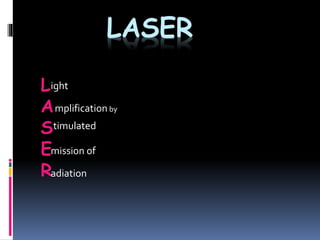
LASER
L
A
S
E
R
ight
mplification by
timulated
mission of
adiation
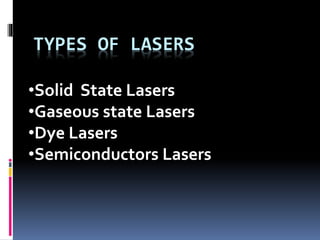
TYPES OF LASERS
•Solid State Lasers
•Gaseous state Lasers
•Dye Lasers
•Semiconductors Lasers
Main Working of Lasers
 A Laser covers mainly below given points:
 Population Inversion
 Pumping
 Direct Conversion
 Lasing
 LifeTime
 Metastable State
 Active Medium
 Optical Resonator
Different Types of Lasers
Solid State Lasers Gaseous state Lasers
 Ruby Lasers
 Ne- He Laser
Semi conductors Lasers
 Ga-As Laser
Active Medium:
•The active laser medium (laser gain/amplification medium) is a
synthetic ruby rod.
•Ruby is an aluminum oxide crystal in which some of the aluminum
atoms have been replaced with chromium atoms(0.05% by weight).
•Chromium gives ruby its characteristic red color and is responsible
for the lasing behavior of the crystal.
•Chromium atoms absorb green and blue light and emit or reflect only
red light. For a ruby laser, a crystal of ruby is formed into a cylinder.
Resonator Cavity : A resonator cavity is made of flash tube like
solenoid with a ruby rod in the centre , both the side mirrors one
partial reflecting mirror and other fully.
1. RUBY LASER
OPTICAL PUMPING:
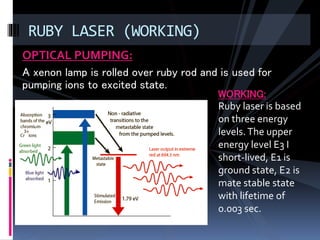
A xenon lamp is rolled over ruby rod and is used for
pumping ions to excited state.
RUBY LASER (WORKING)
WORKING:
Ruby laser is based
on three energy
levels.The upper
energy level E3 I
short-lived, E1 is
ground state, E2 is
mate stable state
with lifetime of
0.003 sec.
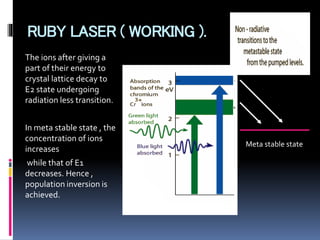
RUBY LASER ( WORKING ).
The ions after giving a
part of their energy to
crystal lattice decay to
E2 state undergoing
radiation less transition.
In meta stable state , the
concentration of ions
increases
while that of E1
decreases. Hence ,
population inversion is
achieved.
Meta stable state
Application
 Ruby lasers have declined in use with the discovery
of better lasing media. They are still used in a
number of applications where short pulses of red
light are required. Holography around the world
produce holographic portraits with ruby lasers, in
sizes up to a meter squared.
 Many non-destructive testing labs use ruby lasers to
create holograms of large objects such as aircraft
tires to look for weaknesses in the lining.
 Ruby lasers were used extensively in tattoo and hair
removal
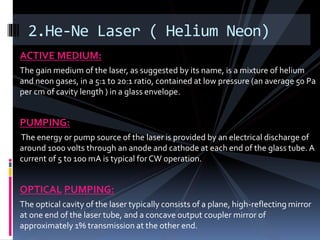
ACTIVE MEDIUM:
The gain medium of the laser, as suggested by its name, is a mixture of helium
and neon gases, in a 5:1 to 20:1 ratio, contained at low pressure (an average 50 Pa
per cm of cavity length ) in a glass envelope.
PUMPING:
The energy or pump source of the laser is provided by an electrical discharge of
around 1000 volts through an anode and cathode at each end of the glass tube. A
current of 5 to 100 mA is typical for CW operation.
OPTICAL PUMPING:
The optical cavity of the laser typically consists of a plane, high-reflecting mirror
at one end of the laser tube, and a concave output coupler mirror of
approximately 1% transmission at the other end.
2.He-Ne Laser ( Helium Neon)
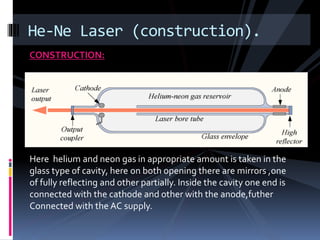
CONSTRUCTION:
Here helium and neon gas in appropriate amount is taken in the
glass type of cavity, here on both opening there are mirrors ,one
of fully reflecting and other partially. Inside the cavity one end is
connected with the cathode and other with the anode,futher
Connected with the AC supply.
He-Ne Laser (construction).
WORKING:
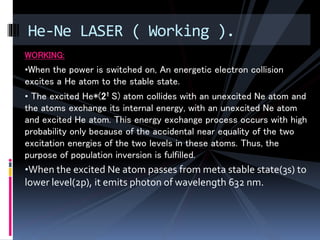
•When the power is switched on, An energetic electron collision
excites a He atom to the stable state.
• The excited He*(21 S) atom collides with an unexcited Ne atom and
the atoms exchange its internal energy, with an unexcited Ne atom
and excited He atom. This energy exchange process occurs with high
probability only because of the accidental near equality of the two
excitation energies of the two levels in these atoms. Thus, the
purpose of population inversion is fulfilled.
•When the excited Ne atom passes from meta stable state(3s) to
lower level(2p), it emits photon of wavelength 632 nm.
He-Ne LASER ( Working ).
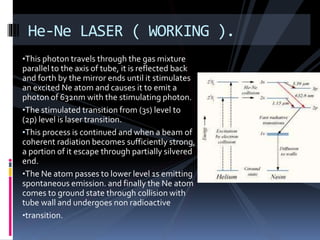
•This photon travels through the gas mixture
parallel to the axis of tube, it is reflected back
and forth by the mirror ends until it stimulates
an excited Ne atom and causes it to emit a
photon of 632nm with the stimulating photon.
•The stimulated transition from (3s) level to
(2p) level is laser transition.
•This process is continued and when a beam of
coherent radiation becomes sufficiently strong,
a portion of it escape through partially silvered
end.
•The Ne atom passes to lower level 1s emitting
spontaneous emission. and finally the Ne atom
comes to ground state through collision with
tube wall and undergoes non radioactive
•transition.
He-Ne LASER ( WORKING ).
Application:
•The Narrow red beam of He-Ne laser is
used in supermarkets to read bar codes.
•The He- Ne Laser is used in Holography in
producing the 3d images of objects.
•He-Ne lasers have many industrial and
scientific uses, and are often used in
laboratory demonstrations of optics.
He-Ne Laser (Application).
3. SEMI CONDUCTOR LASER
INTREODUCTION:
 Stimulated, organized photon emission occurs when two electrons
with the same energy and phase meet. The two photons leave with
the same frequency and direction.
 In 1916 Einstein devised an improved fundamental statistical theory
of heat, embracing the quantum of energy. His theory predicted that
as light passed through a substance it could stimulate the emission
of more light. This effect is at the heart of the modern laser.
 Mainly there are two types in semiconductor laser:
(1)Homo junction laser
(2)Hetero junction laser
PUMPING:
When PN junction diode is forward biased, the electrons
from ‘n’ region and holes from ‘p’ region recombine with
each other at the junction .
During the recombination process light radiations (photons)
is released from certain specified direct band gap
semiconductors like Ga-As.
This radiation is called recombination radiation and the
corresponding energy is called activation energy.
Ga-As LASER
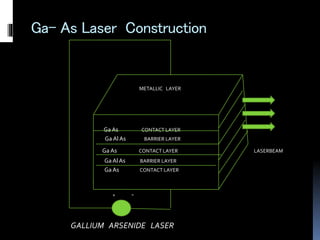
METALLIC LAYER
GaAs CONTACT LAYER
Ga AlAs BARRIER LAYER
Ga As CONTACT LAYER LASERBEAM
GaAlAs BARRIER LAYER
GaAs CONTACT LAYER
+ -
GALLIUM ARSENIDE LASER
Ga- As Laser Construction
WORKING:
When the forward bias is applied to the metallic layer through contact
points. The electric field is produced. This electric field causes the
electrons to move from lower band of energy towards high band of
energy level.
Population inversion take place at the higher band of energy level and
when the electrons falls back at the lower energy band, it emits light,
through the polished end of the laser.
Cross reflection of the light take place which multiplies strength of
laser beam. At the end strong beam of laser comes out through the
partially polished end.
Ga-As LASER
 Advantages of semiconductor laser
 It is very small in dimension.
 The arrangement is simple and compact.
 It exhibits high efficiency.
 Disadvantages of semiconductor laser
The output is usually in the form of wide beam.
The purity & mono chromaticity are poorer than
other type of laser.
Applications:
Semiconductor diode lasers used in CD
and DVD players.
Fiber optic transceivers are manufactured using
alternating layers of various III-V and II-
VI compound semiconductors to form lasing hetero
structures.
Used in laser printers & in laser diodes.
THANK YOU.....

Phy lasers

  • 1.
    ACTIVE LEARNING ASSIGHMENTON TYPES OF LASER AND ITS APPLICATIONS PRESENTED BY FACULTY BHARGAV DESAI – 035 PRUTHVIGABANI - PARTH CHOVATIA- BATCH A2 DEPERTMENT-CE GANDHINAGAR INSTITUTE OF TECHNOLOGY
  • 2.
  • 3.
    TYPES OF LASERS •SolidState Lasers •Gaseous state Lasers •Dye Lasers •Semiconductors Lasers
  • 4.
    Main Working ofLasers  A Laser covers mainly below given points:  Population Inversion  Pumping  Direct Conversion  Lasing  LifeTime  Metastable State  Active Medium  Optical Resonator
  • 5.
    Different Types ofLasers Solid State Lasers Gaseous state Lasers  Ruby Lasers  Ne- He Laser Semi conductors Lasers  Ga-As Laser
  • 6.
    Active Medium: •The activelaser medium (laser gain/amplification medium) is a synthetic ruby rod. •Ruby is an aluminum oxide crystal in which some of the aluminum atoms have been replaced with chromium atoms(0.05% by weight). •Chromium gives ruby its characteristic red color and is responsible for the lasing behavior of the crystal. •Chromium atoms absorb green and blue light and emit or reflect only red light. For a ruby laser, a crystal of ruby is formed into a cylinder. Resonator Cavity : A resonator cavity is made of flash tube like solenoid with a ruby rod in the centre , both the side mirrors one partial reflecting mirror and other fully. 1. RUBY LASER
  • 7.
    OPTICAL PUMPING: A xenonlamp is rolled over ruby rod and is used for pumping ions to excited state. RUBY LASER (WORKING) WORKING: Ruby laser is based on three energy levels.The upper energy level E3 I short-lived, E1 is ground state, E2 is mate stable state with lifetime of 0.003 sec.
  • 8.
    RUBY LASER (WORKING ). The ions after giving a part of their energy to crystal lattice decay to E2 state undergoing radiation less transition. In meta stable state , the concentration of ions increases while that of E1 decreases. Hence , population inversion is achieved. Meta stable state
  • 9.
    Application  Ruby lasershave declined in use with the discovery of better lasing media. They are still used in a number of applications where short pulses of red light are required. Holography around the world produce holographic portraits with ruby lasers, in sizes up to a meter squared.  Many non-destructive testing labs use ruby lasers to create holograms of large objects such as aircraft tires to look for weaknesses in the lining.  Ruby lasers were used extensively in tattoo and hair removal
  • 10.
    ACTIVE MEDIUM: The gainmedium of the laser, as suggested by its name, is a mixture of helium and neon gases, in a 5:1 to 20:1 ratio, contained at low pressure (an average 50 Pa per cm of cavity length ) in a glass envelope. PUMPING: The energy or pump source of the laser is provided by an electrical discharge of around 1000 volts through an anode and cathode at each end of the glass tube. A current of 5 to 100 mA is typical for CW operation. OPTICAL PUMPING: The optical cavity of the laser typically consists of a plane, high-reflecting mirror at one end of the laser tube, and a concave output coupler mirror of approximately 1% transmission at the other end. 2.He-Ne Laser ( Helium Neon)
  • 11.
    CONSTRUCTION: Here helium andneon gas in appropriate amount is taken in the glass type of cavity, here on both opening there are mirrors ,one of fully reflecting and other partially. Inside the cavity one end is connected with the cathode and other with the anode,futher Connected with the AC supply. He-Ne Laser (construction).
  • 12.
    WORKING: •When the poweris switched on, An energetic electron collision excites a He atom to the stable state. • The excited He*(21 S) atom collides with an unexcited Ne atom and the atoms exchange its internal energy, with an unexcited Ne atom and excited He atom. This energy exchange process occurs with high probability only because of the accidental near equality of the two excitation energies of the two levels in these atoms. Thus, the purpose of population inversion is fulfilled. •When the excited Ne atom passes from meta stable state(3s) to lower level(2p), it emits photon of wavelength 632 nm. He-Ne LASER ( Working ).
  • 13.
    •This photon travelsthrough the gas mixture parallel to the axis of tube, it is reflected back and forth by the mirror ends until it stimulates an excited Ne atom and causes it to emit a photon of 632nm with the stimulating photon. •The stimulated transition from (3s) level to (2p) level is laser transition. •This process is continued and when a beam of coherent radiation becomes sufficiently strong, a portion of it escape through partially silvered end. •The Ne atom passes to lower level 1s emitting spontaneous emission. and finally the Ne atom comes to ground state through collision with tube wall and undergoes non radioactive •transition. He-Ne LASER ( WORKING ).
  • 14.
    Application: •The Narrow redbeam of He-Ne laser is used in supermarkets to read bar codes. •The He- Ne Laser is used in Holography in producing the 3d images of objects. •He-Ne lasers have many industrial and scientific uses, and are often used in laboratory demonstrations of optics. He-Ne Laser (Application).
  • 15.
    3. SEMI CONDUCTORLASER INTREODUCTION:  Stimulated, organized photon emission occurs when two electrons with the same energy and phase meet. The two photons leave with the same frequency and direction.  In 1916 Einstein devised an improved fundamental statistical theory of heat, embracing the quantum of energy. His theory predicted that as light passed through a substance it could stimulate the emission of more light. This effect is at the heart of the modern laser.  Mainly there are two types in semiconductor laser: (1)Homo junction laser (2)Hetero junction laser
  • 16.
    PUMPING: When PN junctiondiode is forward biased, the electrons from ‘n’ region and holes from ‘p’ region recombine with each other at the junction . During the recombination process light radiations (photons) is released from certain specified direct band gap semiconductors like Ga-As. This radiation is called recombination radiation and the corresponding energy is called activation energy. Ga-As LASER
  • 17.
    METALLIC LAYER GaAs CONTACTLAYER Ga AlAs BARRIER LAYER Ga As CONTACT LAYER LASERBEAM GaAlAs BARRIER LAYER GaAs CONTACT LAYER + - GALLIUM ARSENIDE LASER Ga- As Laser Construction
  • 18.
    WORKING: When the forwardbias is applied to the metallic layer through contact points. The electric field is produced. This electric field causes the electrons to move from lower band of energy towards high band of energy level. Population inversion take place at the higher band of energy level and when the electrons falls back at the lower energy band, it emits light, through the polished end of the laser. Cross reflection of the light take place which multiplies strength of laser beam. At the end strong beam of laser comes out through the partially polished end. Ga-As LASER
  • 19.
     Advantages ofsemiconductor laser  It is very small in dimension.  The arrangement is simple and compact.  It exhibits high efficiency.  Disadvantages of semiconductor laser The output is usually in the form of wide beam. The purity & mono chromaticity are poorer than other type of laser.
  • 20.
    Applications: Semiconductor diode lasersused in CD and DVD players. Fiber optic transceivers are manufactured using alternating layers of various III-V and II- VI compound semiconductors to form lasing hetero structures. Used in laser printers & in laser diodes.
  • 21.