SARVAJANIK COLLEGE OF
ENGINEERING AND
TECHNOLOGY
Physics
(2110011)
Computer Engineering – II
B.E. – I year
Topic:
Laser and its application
Group members
Name Roll no.
barodiya priyank 56
Vadodariya keyur 57
Jain Rishika 58
Thakur pathik 59
Patel palak 60
Patel Ishani 61
Patel Himani 62
Shah priyansh 63
Shah abhinandan 64
Khandwala mudra 65
Parmar siddhant 66
Patel harsh 67
Annexure
 History of Laser
 Characteristics of Laser
 Basic Principles of Laser
 ND-YAG LASER
 Applications of Laser
What is Laser?
Light Amplification by Stimulated
Emission of Radiation
 A device produces a coherent beam of optical rad
iation by stimulating electronic, ionic, or molecul
ar transitions to higher energy levels
 When they return to lower energy levels by stimu
lated emission, they emit energy.
History of Laser
 In 1917, Albert Einstein established the
theoretical foundations for the laser and
the maser in the paper Zur Quantentheorie der
Strahlung (On the Quantum Theory of
Radiation) via a re-derivation of Max Plank’s
law of radiation, conceptually based upon
probability coefficients (Einstein’s coefficient)
for the absorption, spontaneous emission, and
stimulated emission of electromagnetic
radiation.
 In 1928, Rudolf W. Ladenburg confirmed
the existence of the phenomenon of
stimulated emission and negative
absorption. In 1939, Valentin A. Fabrikant
predicted the use of stimulated emission
to amplify "short" waves.
Characteristics of Laser
Highly Monochromatic
Highly Coherent
Highly Directional
Highly Intense (brightness)
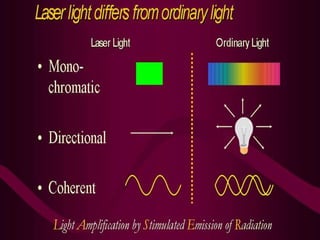
 The light emitted from a laser is monochromatic,
that is, it is of one color/wavelength. In contrast,
ordinary white light is a combination of many col
ors (or wavelengths) of light.
 Lasers emit light that is highly directional, that is,
laser light is emitted as a relatively narrow beam i
n a specific direction. Ordinary light, such as fro
m a light bulb, is emitted in many directions awa
y from the source
 The light from a laser is said to be coherent, which
means that the wavelengths of the laser light are in
phase in space and time. Ordinary light can be a
mixture of many wavelengths.
 The intensity of a light source is the power emitted
per unit surface area per unit solid angle. Laser is
highly intense beam
Basic Principles of Laser
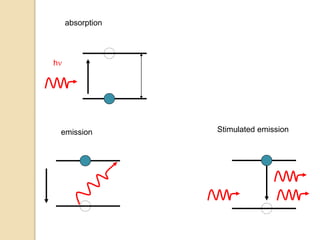
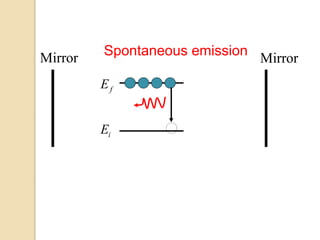
 Spontaneous emission
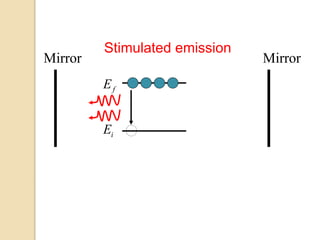
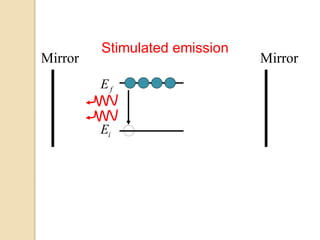
 Stimulated emission
 Amplification
 Population inversion
 Active medium
 Pumping
 Optical resonators
hn
absorption
emission Stimulated emission
iE
fE
MirrorMirror
Stimulated emission
Amplification
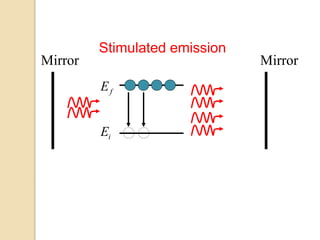
 Amplification is the act or means of
increase of the physical quantity.
 We can see that in stimulated
emission , there is an increase in
numbers of photons.
 For amplification of light we need
stimulated emission only
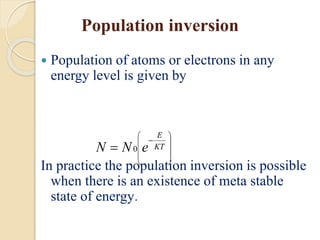
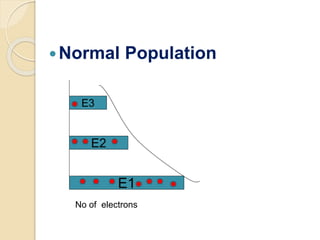
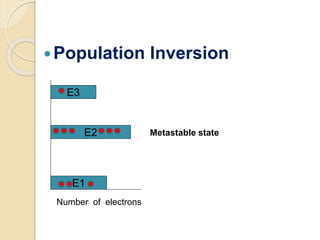
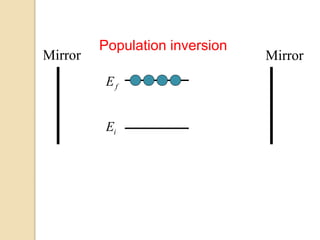
Population inversion
 Population of atoms or electrons in any
energy level is given by
In practice the population inversion is possible
when there is an existence of meta stable
state of energy.











 KT
E
eNN 0
Normal Population
E1
E2
E3
No of electrons
Population Inversion
E1
E2
E3
Metastable state
Number of electrons
Active Medium
 The Active medium is the solid , gas
or any solid state medium which has
meta stable state and able to create
population inversion and can amplify
the light.
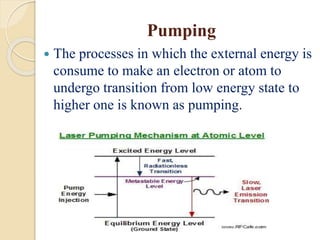
Pumping
 The processes in which the external energy is
consume to make an electron or atom to
undergo transition from low energy state to
higher one is known as pumping.
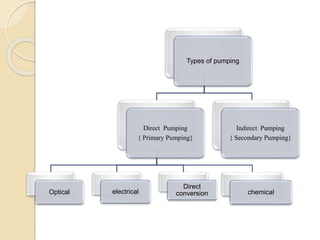
Types of pumping
Direct Pumping
{ Primary Pumping}
Optical electrical
Direct
conversion chemical
Indirect Pumping
{ Secondary Pumping}
OPTICAL PUMPING
 If the luminous energy [light] is supplied to a
medium for causing population inversion , then
pumping is known as OPTICAL PUMPING
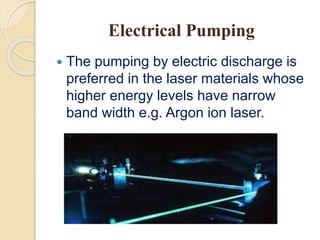
Electrical Pumping
 The pumping by electric discharge is
preferred in the laser materials whose
higher energy levels have narrow
band width e.g. Argon ion laser.
Direct conversion
 A direct conversion of electrical energy
to radiant energy. e.g. LED and semi
conductor laser.
Chemical
 In the chemical pumping energy from
a chemical reaction is use for the
excitation of atoms.
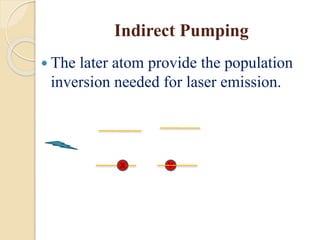
Indirect Pumping
 The later atom provide the population
inversion needed for laser emission.
X Y
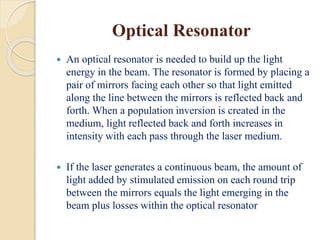
Optical Resonator
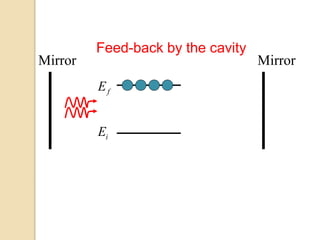
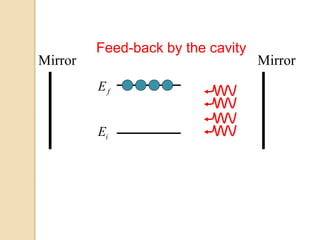
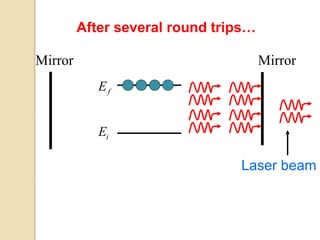
 An optical resonator is needed to build up the light
energy in the beam. The resonator is formed by placing a
pair of mirrors facing each other so that light emitted
along the line between the mirrors is reflected back and
forth. When a population inversion is created in the
medium, light reflected back and forth increases in
intensity with each pass through the laser medium.
 If the laser generates a continuous beam, the amount of
light added by stimulated emission on each round trip
between the mirrors equals the light emerging in the
beam plus losses within the optical resonator
Working of laser
iE
fE
Mirror Mirror
Population inversion
iE
fE
Mirror Mirror
Spontaneous emission
iE
fE
MirrorMirror
Stimulated emission
iE
fE
MirrorMirror
Feed-back by the cavity
iE
fE
MirrorMirror
Stimulated emission
iE
fE
MirrorMirror
Feed-back by the cavity
iE
fE
MirrorMirror
Laser beam
After several round trips…
Nd:YAG laser
Nd:YAG (neodymium-doped yttrium
aluminium garnet;)
Nd:Y3Al5O12
Nd: YAG laser is Four level laser
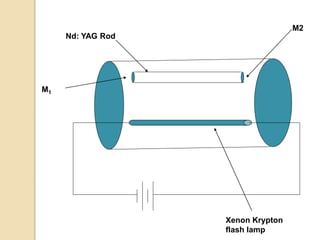
Nd:YAG lasers are optically pumped using
a Xenon / Krypton flash lamp
Nd: YAG Rod
M1
M2
Xenon Krypton
flash lamp
Applications of laser
 Transmission and processing of
information
 Laser scanners
 Optical discs
 Fibre-optic communication systems
 Alignment, measurement, and imaging
 Surveying
Industrial uses
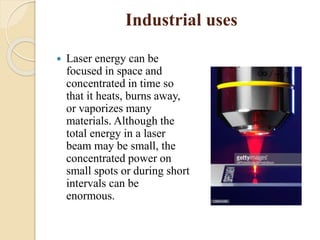
 Laser energy can be
focused in space and
concentrated in time so
that it heats, burns away,
or vaporizes many
materials. Although the
total energy in a laser
beam may be small, the
concentrated power on
small spots or during short
intervals can be
enormous.
Medical applications
 Surgical removal of tissue with a laser is a
physical process similar to industrial laser
drilling. Carbon-dioxide lasers burn away
tissue because their infrared beams are
strongly absorbed by the water that makes
up the bulk of living cells. A laser beam
cauterizes the cuts, stopping bleeding in
blood-rich tissues such as the female
reproductive tract or the gums.
High-energy lasers
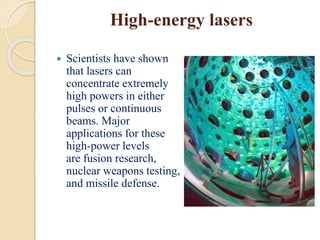
 Scientists have shown
that lasers can
concentrate extremely
high powers in either
pulses or continuous
beams. Major
applications for these
high-power levels
are fusion research,
nuclear weapons testing,
and missile defense.
THANK YOU

Laser And It's Application

  • 1.
    SARVAJANIK COLLEGE OF ENGINEERINGAND TECHNOLOGY Physics (2110011) Computer Engineering – II B.E. – I year Topic: Laser and its application
  • 2.
    Group members Name Rollno. barodiya priyank 56 Vadodariya keyur 57 Jain Rishika 58 Thakur pathik 59 Patel palak 60 Patel Ishani 61 Patel Himani 62 Shah priyansh 63 Shah abhinandan 64 Khandwala mudra 65 Parmar siddhant 66 Patel harsh 67
  • 3.
    Annexure  History ofLaser  Characteristics of Laser  Basic Principles of Laser  ND-YAG LASER  Applications of Laser
  • 4.
    What is Laser? LightAmplification by Stimulated Emission of Radiation  A device produces a coherent beam of optical rad iation by stimulating electronic, ionic, or molecul ar transitions to higher energy levels  When they return to lower energy levels by stimu lated emission, they emit energy.
  • 5.
    History of Laser In 1917, Albert Einstein established the theoretical foundations for the laser and the maser in the paper Zur Quantentheorie der Strahlung (On the Quantum Theory of Radiation) via a re-derivation of Max Plank’s law of radiation, conceptually based upon probability coefficients (Einstein’s coefficient) for the absorption, spontaneous emission, and stimulated emission of electromagnetic radiation.
  • 6.
     In 1928,Rudolf W. Ladenburg confirmed the existence of the phenomenon of stimulated emission and negative absorption. In 1939, Valentin A. Fabrikant predicted the use of stimulated emission to amplify "short" waves.
  • 7.
    Characteristics of Laser HighlyMonochromatic Highly Coherent Highly Directional Highly Intense (brightness)
  • 8.
     The lightemitted from a laser is monochromatic, that is, it is of one color/wavelength. In contrast, ordinary white light is a combination of many col ors (or wavelengths) of light.  Lasers emit light that is highly directional, that is, laser light is emitted as a relatively narrow beam i n a specific direction. Ordinary light, such as fro m a light bulb, is emitted in many directions awa y from the source
  • 9.
     The lightfrom a laser is said to be coherent, which means that the wavelengths of the laser light are in phase in space and time. Ordinary light can be a mixture of many wavelengths.  The intensity of a light source is the power emitted per unit surface area per unit solid angle. Laser is highly intense beam
  • 11.
    Basic Principles ofLaser  Spontaneous emission  Stimulated emission  Amplification  Population inversion  Active medium  Pumping  Optical resonators
  • 12.
  • 13.
  • 14.
    Amplification  Amplification isthe act or means of increase of the physical quantity.  We can see that in stimulated emission , there is an increase in numbers of photons.  For amplification of light we need stimulated emission only
  • 15.
    Population inversion  Populationof atoms or electrons in any energy level is given by In practice the population inversion is possible when there is an existence of meta stable state of energy.             KT E eNN 0
  • 16.
  • 17.
  • 18.
    Active Medium  TheActive medium is the solid , gas or any solid state medium which has meta stable state and able to create population inversion and can amplify the light.
  • 19.
    Pumping  The processesin which the external energy is consume to make an electron or atom to undergo transition from low energy state to higher one is known as pumping.
  • 20.
    Types of pumping DirectPumping { Primary Pumping} Optical electrical Direct conversion chemical Indirect Pumping { Secondary Pumping}
  • 21.
    OPTICAL PUMPING  Ifthe luminous energy [light] is supplied to a medium for causing population inversion , then pumping is known as OPTICAL PUMPING
  • 22.
    Electrical Pumping  Thepumping by electric discharge is preferred in the laser materials whose higher energy levels have narrow band width e.g. Argon ion laser.
  • 23.
    Direct conversion  Adirect conversion of electrical energy to radiant energy. e.g. LED and semi conductor laser.
  • 24.
    Chemical  In thechemical pumping energy from a chemical reaction is use for the excitation of atoms.
  • 25.
    Indirect Pumping  Thelater atom provide the population inversion needed for laser emission. X Y
  • 26.
    Optical Resonator  Anoptical resonator is needed to build up the light energy in the beam. The resonator is formed by placing a pair of mirrors facing each other so that light emitted along the line between the mirrors is reflected back and forth. When a population inversion is created in the medium, light reflected back and forth increases in intensity with each pass through the laser medium.  If the laser generates a continuous beam, the amount of light added by stimulated emission on each round trip between the mirrors equals the light emerging in the beam plus losses within the optical resonator
  • 27.
  • 28.
  • 29.
  • 30.
  • 31.
  • 32.
  • 33.
  • 34.
  • 35.
    Nd:YAG laser Nd:YAG (neodymium-dopedyttrium aluminium garnet;) Nd:Y3Al5O12 Nd: YAG laser is Four level laser Nd:YAG lasers are optically pumped using a Xenon / Krypton flash lamp
  • 36.
    Nd: YAG Rod M1 M2 XenonKrypton flash lamp
  • 37.
    Applications of laser Transmission and processing of information  Laser scanners  Optical discs  Fibre-optic communication systems  Alignment, measurement, and imaging  Surveying
  • 38.
    Industrial uses  Laserenergy can be focused in space and concentrated in time so that it heats, burns away, or vaporizes many materials. Although the total energy in a laser beam may be small, the concentrated power on small spots or during short intervals can be enormous.
  • 39.
    Medical applications  Surgicalremoval of tissue with a laser is a physical process similar to industrial laser drilling. Carbon-dioxide lasers burn away tissue because their infrared beams are strongly absorbed by the water that makes up the bulk of living cells. A laser beam cauterizes the cuts, stopping bleeding in blood-rich tissues such as the female reproductive tract or the gums.
  • 41.
    High-energy lasers  Scientistshave shown that lasers can concentrate extremely high powers in either pulses or continuous beams. Major applications for these high-power levels are fusion research, nuclear weapons testing, and missile defense.
  • 42.