Ms. Chanda Jabeen
PhD (Scholar) Epidemiology & Public Health
1

OBJECTIVES
At the end of this presentation students will be able
to:-
 Define the Leprosy
 Discuss the Epidemiology and its etiology
 Describe its signs & symptoms.
 Explore Preventive measures and Control of
Leprosy
 Explain its complications.

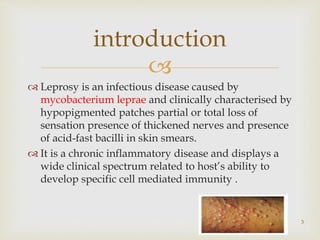
 Leprosy is an infectious disease caused by
mycobacterium leprae and clinically characterised by
hypopigmented patches partial or total loss of
sensation presence of thickened nerves and presence
of acid-fast bacilli in skin smears.
 It is a chronic inflammatory disease and displays a
wide clinical spectrum related to host’s ability to
develop specific cell mediated immunity .
3
introduction
Distribution
1. By time:
Climate more common in warm and humid climate.
2. By place:
• Poor environmental surroundings
• Low stander of living
• Poverty
• Substandard house
• Overcrowding
• Lack of education
• Unhygenic personal habit
• Use of common clothing and linen
4
Epidemiological feature

3. By person :
• Age:
Person of any age suffers on exposure . A survey shows
70% of cases above 25 years of age and 80% of cases
above 20 years of age .a highly prevalence of disease
among children indicates that the disease is active and
spreading.
• Sex:
more commonly seen in Men’s then in women’s in
proportion of 2:1 .
5
cont’s

• Race:
All humans races are susceptible.
• Susceptibility:
Genetic susceptibility(only small percentage infected
with disease due to genetic factor)
Married partners (not more then 5%)
Twin study (identical twin shows more similarity)
Migration (migration increased the spread of disease)
6
Cont’s

A.Primary determinants:
Mycobacterium leprae ,an acid-fast bacilli resembling
TB occur in clumps or bundles.
B. Secondary deretminants:
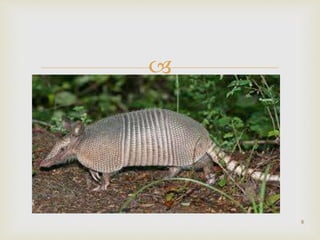
Armadillos increase the risk of leprosy.
7
Determinants of leprosy

8

Reservoir of infection:
Men the active cases of leprosy are the chief resources .
9
Cont’s

Portal of exit:
 Nose
 Upper respiratory tract
 Skin
As bacilli leave the body as indicated
 Skin= ulcer or breach of skin
 Nose= secretions and ulcer of nose
 Throat=coughing ,sneezing and speaking .
10
cont’s

 Infectivity:
Highly infectious but low of pathogenicity.
 Attack rate:
It is 6.8 per 1000among contact
0.8 per 1000 without contact.
11
Cont’s

1. Contact transmission: direct or indirect contact
between an infectious and healthy but susceptible
person’s.
2. Droplet infection: air born disease
3. Other routes: lapra bacilli have been found in
human milk.
Insect vector
Tattooing needles
12
Mode of transmission

It is not exactly known .
Commonly between 2 to 5 years or more.
13
Incubation period

14
Classification of leprosy
1. Lepromatous
2. Non-lepromatous
• Tuberculiod
• Maculo-anaesthetic
• Polyneuritics
3. Borderline leprosy
4. Intermediate type

15
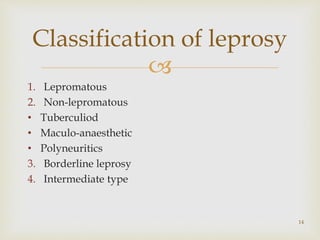
Borderline leprosy
 Four or more lesion which my b flat raised,
hypopigmented or erythematous ,sensory
impairments or loss.

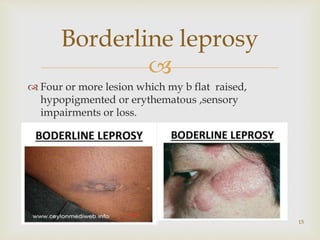
 Diffuse infiltration or numerous flat or raised poorly
defined shiny, smooth , symmetrically distributed
lesions.
16
Lepromatous type

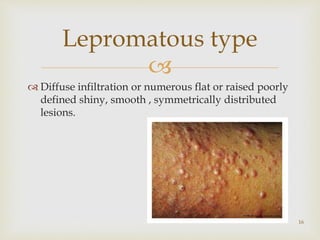
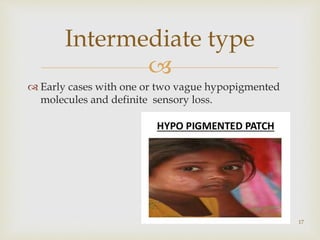
 Early cases with one or two vague hypopigmented
molecules and definite sensory loss.
17
Intermediate type

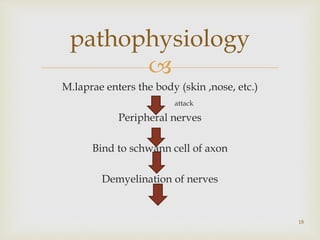
M.laprae enters the body (skin ,nose, etc.)
attack
Peripheral nerves
Bind to schwann cell of axon
Demyelination of nerves
18
pathophysiology

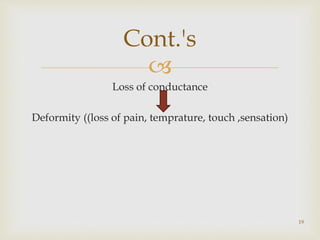
Loss of conductance
Deformity ((loss of pain, temprature, touch ,sensation)
19
Cont.'s

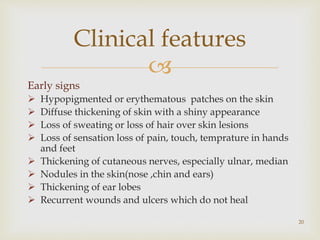
Early signs
 Hypopigmented or erythematous patches on the skin
 Diffuse thickening of skin with a shiny appearance
 Loss of sweating or loss of hair over skin lesions
 Loss of sensation loss of pain, touch, temprature in hands
and feet
 Thickening of cutaneous nerves, especially ulnar, median
 Nodules in the skin(nose ,chin and ears)
 Thickening of ear lobes
 Recurrent wounds and ulcers which do not heal
20
Clinical features

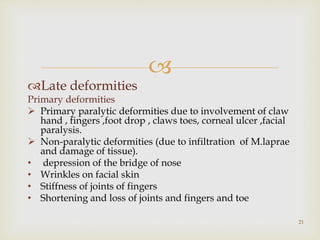
Late deformities
Primary deformities
 Primary paralytic deformities due to involvement of claw
hand , fingers ,foot drop , claws toes, corneal ulcer ,facial
paralysis.
 Non-paralytic deformities (due to infiltration of M.laprae
and damage of tissue).
• depression of the bridge of nose
• Wrinkles on facial skin
• Stiffness of joints of fingers
• Shortening and loss of joints and fingers and toe
21

Secondary deformities
Due to carelessness in protecting anesthetics hands and
feet.
22

Clinical examinations
 Presence of pigmented patches on the skin
 Thickening nerves
 Appearance of patch
 Testing of sensation
 Lepra reaction
 Identification of complications
23
Diagnosis

Bacteriological examination
 Skin silt smears(scrape method material from skin is
obtained from active lesions)
 Skin biopsy
 Nerve biopsy
 Lepromin test(for detecting CMI)
24

1. Immunologically mediated
2. Inflammatory episodes
3. Eye lagopathalmos discharge from eyes conjunctivitis
corneal ulcers
4. Nose mucopurulent foul smelling discharge nose
bleeding
5. Nerve neuritis cause sever pain tingling and numbness
6. Tropical ulcer on the feet
7. Fever
8. Testis (orchitis resulting in swelling and pain)
25
Complication's

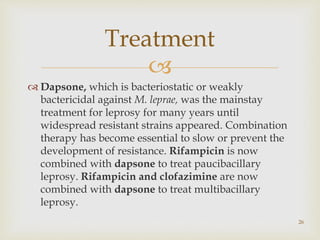
 Dapsone, which is bacteriostatic or weakly
bactericidal against M. leprae, was the mainstay
treatment for leprosy for many years until
widespread resistant strains appeared. Combination
therapy has become essential to slow or prevent the
development of resistance. Rifampicin is now
combined with dapsone to treat paucibacillary
leprosy. Rifampicin and clofazimine are now
combined with dapsone to treat multibacillary
leprosy.
26
Treatment

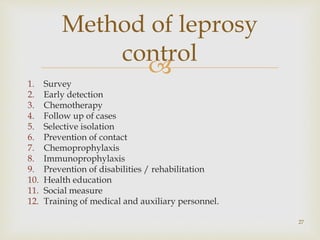
1. Survey
2. Early detection
3. Chemotherapy
4. Follow up of cases
5. Selective isolation
6. Prevention of contact
7. Chemoprophylaxis
8. Immunoprophylaxis
9. Prevention of disabilities / rehabilitation
10. Health education
11. Social measure
12. Training of medical and auxiliary personnel.
27
Method of leprosy
control

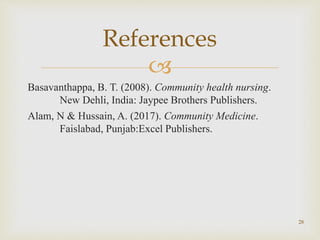
Basavanthappa, B. T. (2008). Community health nursing.
New Dehli, India: Jaypee Brothers Publishers.
Alam, N & Hussain, A. (2017). Community Medicine.
Faislabad, Punjab:Excel Publishers.
28
References

Laprosy

  • 1.
    Ms. Chanda Jabeen PhD(Scholar) Epidemiology & Public Health 1
  • 2.
     OBJECTIVES At the endof this presentation students will be able to:-  Define the Leprosy  Discuss the Epidemiology and its etiology  Describe its signs & symptoms.  Explore Preventive measures and Control of Leprosy  Explain its complications.
  • 3.
      Leprosy isan infectious disease caused by mycobacterium leprae and clinically characterised by hypopigmented patches partial or total loss of sensation presence of thickened nerves and presence of acid-fast bacilli in skin smears.  It is a chronic inflammatory disease and displays a wide clinical spectrum related to host’s ability to develop specific cell mediated immunity . 3 introduction
  • 4.
    Distribution 1. By time: Climatemore common in warm and humid climate. 2. By place: • Poor environmental surroundings • Low stander of living • Poverty • Substandard house • Overcrowding • Lack of education • Unhygenic personal habit • Use of common clothing and linen 4 Epidemiological feature
  • 5.
     3. By person: • Age: Person of any age suffers on exposure . A survey shows 70% of cases above 25 years of age and 80% of cases above 20 years of age .a highly prevalence of disease among children indicates that the disease is active and spreading. • Sex: more commonly seen in Men’s then in women’s in proportion of 2:1 . 5 cont’s
  • 6.
     • Race: All humansraces are susceptible. • Susceptibility: Genetic susceptibility(only small percentage infected with disease due to genetic factor) Married partners (not more then 5%) Twin study (identical twin shows more similarity) Migration (migration increased the spread of disease) 6 Cont’s
  • 7.
     A.Primary determinants: Mycobacterium leprae,an acid-fast bacilli resembling TB occur in clumps or bundles. B. Secondary deretminants: Armadillos increase the risk of leprosy. 7 Determinants of leprosy
  • 8.
  • 9.
     Reservoir of infection: Menthe active cases of leprosy are the chief resources . 9 Cont’s
  • 10.
     Portal of exit: Nose  Upper respiratory tract  Skin As bacilli leave the body as indicated  Skin= ulcer or breach of skin  Nose= secretions and ulcer of nose  Throat=coughing ,sneezing and speaking . 10 cont’s
  • 11.
      Infectivity: Highly infectiousbut low of pathogenicity.  Attack rate: It is 6.8 per 1000among contact 0.8 per 1000 without contact. 11 Cont’s
  • 12.
     1. Contact transmission:direct or indirect contact between an infectious and healthy but susceptible person’s. 2. Droplet infection: air born disease 3. Other routes: lapra bacilli have been found in human milk. Insect vector Tattooing needles 12 Mode of transmission
  • 13.
     It is notexactly known . Commonly between 2 to 5 years or more. 13 Incubation period
  • 14.
     14 Classification of leprosy 1.Lepromatous 2. Non-lepromatous • Tuberculiod • Maculo-anaesthetic • Polyneuritics 3. Borderline leprosy 4. Intermediate type
  • 15.
     15 Borderline leprosy  Fouror more lesion which my b flat raised, hypopigmented or erythematous ,sensory impairments or loss.
  • 16.
      Diffuse infiltrationor numerous flat or raised poorly defined shiny, smooth , symmetrically distributed lesions. 16 Lepromatous type
  • 17.
      Early caseswith one or two vague hypopigmented molecules and definite sensory loss. 17 Intermediate type
  • 18.
     M.laprae enters thebody (skin ,nose, etc.) attack Peripheral nerves Bind to schwann cell of axon Demyelination of nerves 18 pathophysiology
  • 19.
     Loss of conductance Deformity((loss of pain, temprature, touch ,sensation) 19 Cont.'s
  • 20.
     Early signs  Hypopigmentedor erythematous patches on the skin  Diffuse thickening of skin with a shiny appearance  Loss of sweating or loss of hair over skin lesions  Loss of sensation loss of pain, touch, temprature in hands and feet  Thickening of cutaneous nerves, especially ulnar, median  Nodules in the skin(nose ,chin and ears)  Thickening of ear lobes  Recurrent wounds and ulcers which do not heal 20 Clinical features
  • 21.
     Late deformities Primary deformities Primary paralytic deformities due to involvement of claw hand , fingers ,foot drop , claws toes, corneal ulcer ,facial paralysis.  Non-paralytic deformities (due to infiltration of M.laprae and damage of tissue). • depression of the bridge of nose • Wrinkles on facial skin • Stiffness of joints of fingers • Shortening and loss of joints and fingers and toe 21
  • 22.
     Secondary deformities Due tocarelessness in protecting anesthetics hands and feet. 22
  • 23.
     Clinical examinations  Presenceof pigmented patches on the skin  Thickening nerves  Appearance of patch  Testing of sensation  Lepra reaction  Identification of complications 23 Diagnosis
  • 24.
     Bacteriological examination  Skinsilt smears(scrape method material from skin is obtained from active lesions)  Skin biopsy  Nerve biopsy  Lepromin test(for detecting CMI) 24
  • 25.
     1. Immunologically mediated 2.Inflammatory episodes 3. Eye lagopathalmos discharge from eyes conjunctivitis corneal ulcers 4. Nose mucopurulent foul smelling discharge nose bleeding 5. Nerve neuritis cause sever pain tingling and numbness 6. Tropical ulcer on the feet 7. Fever 8. Testis (orchitis resulting in swelling and pain) 25 Complication's
  • 26.
      Dapsone, whichis bacteriostatic or weakly bactericidal against M. leprae, was the mainstay treatment for leprosy for many years until widespread resistant strains appeared. Combination therapy has become essential to slow or prevent the development of resistance. Rifampicin is now combined with dapsone to treat paucibacillary leprosy. Rifampicin and clofazimine are now combined with dapsone to treat multibacillary leprosy. 26 Treatment
  • 27.
     1. Survey 2. Earlydetection 3. Chemotherapy 4. Follow up of cases 5. Selective isolation 6. Prevention of contact 7. Chemoprophylaxis 8. Immunoprophylaxis 9. Prevention of disabilities / rehabilitation 10. Health education 11. Social measure 12. Training of medical and auxiliary personnel. 27 Method of leprosy control
  • 28.
     Basavanthappa, B. T.(2008). Community health nursing. New Dehli, India: Jaypee Brothers Publishers. Alam, N & Hussain, A. (2017). Community Medicine. Faislabad, Punjab:Excel Publishers. 28 References