Communicable diseases
Leprosy
By:
Marwa Gaafar
Objectives:
• Causative agent.
• Background.
• Epidemiology
• Clinical features & complications.
• Diagnosis.
• Reservoir, incubation period & transmission.
• Treatment .
• Control .
• Elimination.
What is leprosy?
 A infectiuos bacterial disease of the skin,
peripheral nerves and mucosa of the upper
airway.
 Chronic, granulomatous.
 Only few from who exposed to infection
develop the disease.
Causative agent:
 Mycobacterium leprae
 Acid fast, rod shaped bacillus
 Stain with Ziehl Neelsen carbol fuchsin.
 cannot be grown in bacteriological media
or cell cultures.
 Present intra and extracellularly, forming
characteristic clumps called Globi.
Background:
 Leprosy has afflicted humanity, left behind a
terrifying image in history and human
memory of mutilation, rejection and exclusion
from society.
 Lots of people have suffered its chronic
course of incurable disfigurement and
physical disability.
Background- discovery
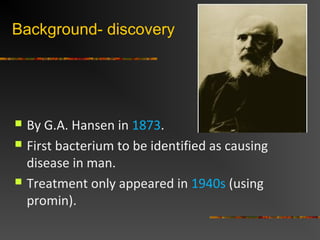
 By G.A. Hansen in 1873.
 First bacterium to be identified as causing
disease in man.
 Treatment only appeared in 1940s (using
promin).
Background:
 Many countries in Asia, Africa and Latin
America with a significant number of cases.
 About 1 – 2 million people disabled due to
past and present leprosy who need to be
cared for by the community.
Epidemiology:
 Age:
 All ages, from early infancy to very old age.
 Youngest age reported is 1 and a half months.
 Sex:
 Both.
 Males more than females, 2:1 (equal in Africa)
Epidemiology:
 Prevalence pool:
 Constant flux resulting from inflow and
outflow.
 Inflow: new cases, relapse, immigration.
 Outflow: cure, inactivation, death, emigration.
 Global prevalence rate is less than one case
per 10,000 persons.
 Elimination achieved in 2000.
Epidemiology - distribution
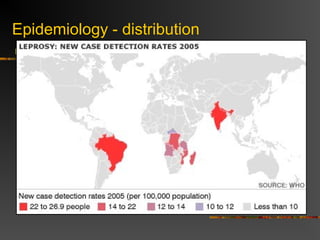
 Approximately 83% of the leprosy cases live in
6 countries: Nepal, Madagascar, Indonesia,
and especially, India and Brazil.
Clinical features:
1. Skin :
Variable lesions: Macules, papules, nodules.
Single / multiple.
Hypopigmented, sometimes reddish.
Sensory loss typically (anaesthesia/hypothesia).
Clinical features:
2. Nerves :
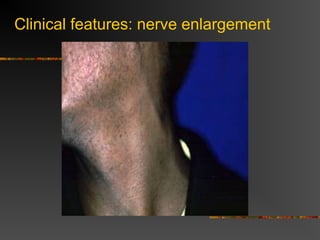
Thickened.
Loss of sensation.
Muscle weakness.
Mechanism of Nerve Damage
Scollard, DM et al. 2006. “The continuing challenges of leprosy.”
Clinical microbiology reviews 19, no. 2: 338-81.
1.Entry Through
Blood Vessels
2. Inflammatory
Response
3. Demyelination
Clinical features:hypopegmented patch
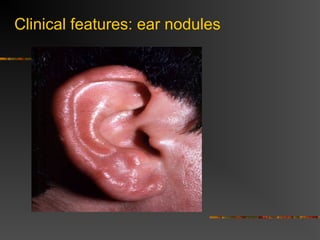
Clinical features: ear nodules
Clinical features: nerve enlargement
Clinical features: neurological defecit
International Federation of Anti-Leprosy Associations (ILEP)
http://www.ilep.org.uk/en/
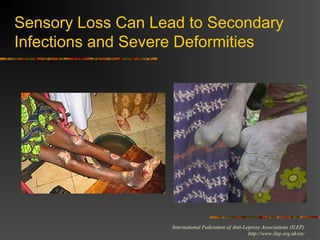
Sensory Loss Can Lead to Secondary
Infections and Severe Deformities
Diagnosis:
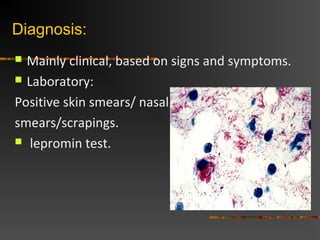
 Mainly clinical, based on signs and symptoms.
 Laboratory:
Positive skin smears/ nasal
smears/scrapings.
 lepromin test.
Lepromin test:
 Used to determine type of leprosy.
 Injection of a standardized extract of the
inactivated bacilli intradermally in the
forearm.
 Positive reaction: 10 mm or more induration
after 48 hrs/ or 5 mm or more nodule after 21
days.
 Negative In lepromatous leprosy because of
humoral immunity not cell mediated.
What is not leprosy !!
 Skin patches which
 have normal feeling
 are present from birth
 cause itching
 are white, black, dark red or silver coloured
 show scaling
 appear and disappear periodically
 spread quickly
What is not leprosy (cont.)
 Signs of damage to hands/feet/face without
loss of sensation
 due to other reasons like injury, accidents,
burns, birth defects
 due to other diseases like arthritis
 due to other conditions causing paralysis
Case definition (WHO operational definition)
 Is a person having one or more of the
following, who has yet to complete a full
course of treatment:
 Hypopigmented or reddish skin lesion(s) with
definite loss of sensation
 Involvement of the peripheral nerves (definite
thickening with loss of sensation)
 Skin smear positive for acid-fast bacilli.
Classification:
 Based on:
 Skin smear results, or number of skin lesions.
1. Paucibacillary leprosy
2. (PB) Multibacillary leprosy (MB
3. Borderline leprosy- between the two.
 Differ in treatment regimen.
 Tuberculoid leprosy
 less than 5 patches of skin lesions.
 Skin tests with lepromin elicit a strong
positive response
 Lesions bacteriologically negative.
 strong cell-mediated responses.
 peripheral nerves damaged by host’s
immune response.
Classification of leprosy
 Lepromatous leprosy:
 Numerous poorly defined lesions.
 Symmetrical distribution.
 Positive smear test.
Classification of leprosy
 Borderline leprosy:
 Four or more lesions .
 Well or ill defined.
 Bacteriologic positivity is variable.
 If not treated, progresses to lepromatous
type.
 If severe, treated with corticosteroids.
Classification of leprosy
 Immunologically mediated episodes of
inflammation.
 Can affect peripheral nerves causing
deformities.
 Diagnosed clinically.
 Not due to treatment.
Leprosy reactions
 Type 1 (reversal reaction)
 Delayed hypersensitivity reaction.
 In both pauci/multibacillary.
 Recurrent.
 Inflammation in skin lesions and nerves
(nuritis).
 Lesions: edema , ulcer.
Leprosy reactions
 Type 2 (erythema nodosum leprosum)
 Humoral response.
 Only in multibacillary.
 Red , painful subcutaneous nodules
 In face, arms, legs bilaterally symmetrical.
 Neuritis also occurs.
 Serious, diffficult to manage.
Leprosy reactions
Transmission- route
 Exactly unknown.
 Contact with cases. Which contact?! (intimate,
repeated, skin to skin…. Household contact
easily identifed)….related to dose of infection.
 Respiratory route, possibility is increasing.
 Biting Insects, questionable.
 Organisms exit thro skin & nasal mucosa.
 Entry: skin (broken-tattooing needle),
respiratory tract (propable)
Transmission - reservoir
 Human being, only known.
 Similar organisms detected in wild armadillo.
 History of handling armidellos reported.
Transmission - survival
 M.leprae from nasal secretions up to 36 hrs.
 Also reported in nasal secretions up to 9 days.
 So contaminate clothing and other fomites.
 Infectivity only 1 day after starting treatment.
Incubation period
 From 9 months to 20 years.
 Average 4 years for tuberculoid leprosy and
twice that for lepromatous leprosy.
Treatment
 In 1941, promin introduced,but painful injections.
 In 1950s, Dapsone pills, but resistance developed.
 In 1981, WHO recommends multi drug treatment
(MDT): Dapsone, Rifampicine, Clofazimine
 Patients under treatment should be monitored
for drug side-effects, leprosy reactions and for
development of trophic ulcers
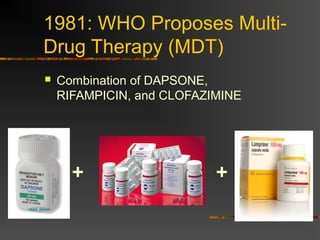
1981: WHO Proposes Multi-
Drug Therapy (MDT)
 Combination of DAPSONE,
RIFAMPICIN, and CLOFAZIMINE
+ +
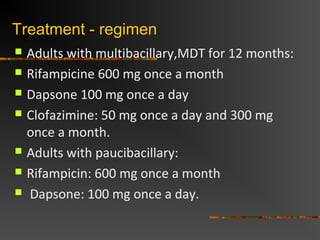
Treatment - regimen
 Adults with multibacillary,MDT for 12 months:
 Rifampicine 600 mg once a month
 Dapsone 100 mg once a day
 Clofazimine: 50 mg once a day and 300 mg
once a month.
 Adults with paucibacillary:
 Rifampicin: 600 mg once a month
 Dapsone: 100 mg once a day.
Steps to start MDT
 Classify as PB or MB leprosy
 Inform patient about the disease .
 Explain the MDT blister pack - show drugs to be
taken once a month and every day
 Explain possible side effects (e.g. darkening of
skin) and possible complications and when they
must return to the health centre
 .Give enough MDT blister packs to last until the
next visit.
 Fill out the patient treatment card
Treatment – drug presentation
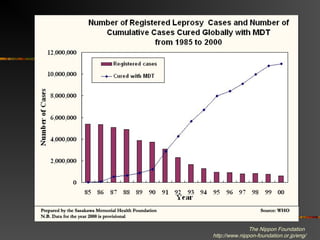
1995: WHO Distributes MDT Drugs
for Free to Worldwide Patients
The Nippon Foundation
http://www.nippon-foundation.or.jp/eng/
Some patients may develop
complications
 Leprosy reactions
 Side-effects
 Disabilities
Leprosy reactions
 1 or 2 patients in 10 may develop reactions
 Reactions are not a side effect of MDT.
They are the body’s response to leprosy
 More commonly seen in MB cases
 Signs and symptoms include
 Skin: patch/s becomes reddish and/or swollen;
sometimes painful reddish nodules appear
 Nerves: pain in the nerve and/or joint;
loss of sensation and weakness of muscles
(commonly of hands, feet and around eyes)
 General: fever, malaise, swelling of hands/feet
Managing reactions
 Early diagnosis and prompt treatment of
reactions
 Every patient should be informed about the
signs and symptoms of reactions
 Inform them to go as soon as possible to
the health centre
 Reassure patients that:
 reactions can be treated
 they are not a side-effect to MDT
 does not mean that MDT is not working
Managing reactions
 Rest is very important:
 Help to get leave from work or school for a
few days (e.g. medical certificate)
 Control of pain and fever
 Aspirin or paracetamol
 Continue MDT regularly
Managing reactions
 Reactions which only involve the skin:
 rest and pain-killers are usually sufficient.
 If there is no improvement within few days or
worsening, then specific treatment is needed
 Reactions which involves the nerves
 start treatment with a course of
corticosteroids (e.g. prednisolone) as soon as
possible
 will control all signs/symptoms of reaction
MDT side-effects
 Red coloured urine
 Darkening of skin
 Severe itching of skin
 This is due to rifampicin. Lasts
only for few hours Reassure the
patient that this is harmless
 This is due to clofazimine.
Reassure the patient that this will
disappear after treatment is
completed
 This is due to allergy to one of the
drugs (commonly to dapsone).
Stop all medicines and refer to
hospital
Treatment of disability
 Why disability occur??
 Late diagnosis and late treatment with MDT
 Advanced disease (MB leprosy)
 Leprosy reactions which involve nerves
 Lack of information on how to protect
insensitive parts
Treatment of disability
 The best way to prevent disabilities is: early
diagnosis and prompt treatment with MDT
 Inform patients (specially MB) about common
signs/symptoms of reactions.
 Ask them to come to the centre
 Start treatment for reaction, Inform them
how to protect insensitive hands/ feet /eyes
 Involve family members in helping patients
Care of feet
 Cracks and fissures
 Blisters
 Simple ulcer
 Soak in water
 Apply cooking
oil/Vaseline
 Use footwear
 Do not open blister
 Apply clean bandage
 Clean with soap & water
 Rest and clean bandage
Care of feet
 Infected ulcer
 Wounds/injury
 Weakness/paralysis
 Clean with soap & water
 Rest & apply antiseptic dressing
 Soak in water
 Apply cooking oil/Vaseline
 Clean and apply clean bandage
 Protect when working/cooking
 Oil massage
 Exercises
 Refer
Care of eyes
 Redness and pain
 Injury to cornea
 Difficulty in closing eye
 Aspirin or paracetamol
 Atropine and steroid
ointment
 Cover with eye pad
 Apply antibiotic ointment
 Refer
 Tear substitute eye drops
 Exercises
 Dark glasses to protect
 Refer
Treatment – post completion
 Congratulate the patient
 Thank family/friends for their support
 Reassure that MDT completely cures leprosy
 Any residual lesions will fade away slowly
 Show them how to protect anaesthetic areas
and/or disabilities
 Encourage to come back in case of any problem
 Tell that they are welcome to bring other
members of family or friends for consultation
Treatment – before & after
Control
1. Preventive measures.
2. Control of cases, contacts and immediate
environment.
3. Disaster implications.
Control – preventive measures
 Early dtection and treatment of cases.
 Health education and counselling must stress
on the availability of effective therapy, the
absence of infectivity of patients under
treatment and prevention of physical and
social disabilities.
Control – preventive measures
 BCG vaccination for tuberculoid leprosy; this
as part of T.B. control , not be undertaken
specifically to prevent leprosy, it provides
variable levels of protection.
 Currently, no single vaccine that confers
complete immunity in all individuals.
Control of patient, contacts and the
immediate environment:
1. Report to local health authority.
2. Isolation: is of questionable value and can lead
to stigmatization. No restrictions in
employment or attendance at school are
indicated.
3. Quarantine: Not applicable.
4. Immunization of contacts: Not recommended
5. Investigation of contacts and source of
infection.
6. Specific treatment: MRT
Control : disaster implications
 Any interruption of treatment schedules is
serious.
 During wars, diagnosis and treatment of
leprosy patients has often been neglected.
Elimination
 Leprosy meets the demanding criteria for
elimination:
- Practical and simple diagnostic tools: can be
diagnosed on clinical signs alone;
- Availability of an effective intervention to
interrupt its transmission: multidrug therapy
- A single significant reservoir of infection:
humans.
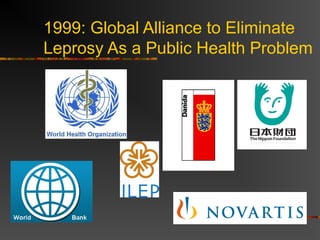
1999: Global Alliance to Eliminate
Leprosy As a Public Health Problem
Elimination strategy
 Providing MDT to all communities
 Breaking the chain of transmission by intensive
case detection and prompt treatment
 Improving quality of patient care, including
disability prevention and management
 Ensuring regularity and completion of treatment
 Encouraging and ensuring community
participation
 Providing rehabilitation to the needy patients
 Organising health education to patients , their
families and community
Obstacles to Eliminating Leprosy in
Endemic Countries
.
STIGMA
Overcoming Stigma
 Mass Media
 Integrated Primary Health Services
 Education & Training
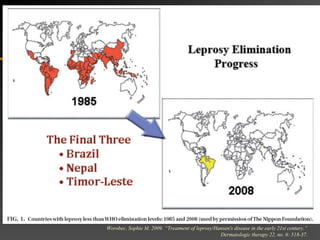
Worobec, Sophie M. 2009. “Treatment of leprosy/Hansen's disease in the early 21st century.”
Dermatologic therapy 22, no. 6: 518-37.
 Sudan achieved the elimination level,
nevertheless incidence of new cases is
rising, reporting between 300-900 cases
per yr.
 Some districts has not achieved
elimination, also in egypt and yemen.
 South sudan is the only in eastern
mediterranean region that reports more
than 1000 new cases per yr.
Thank you

Leprosy

  • 1.
  • 2.
    Objectives: • Causative agent. •Background. • Epidemiology • Clinical features & complications. • Diagnosis. • Reservoir, incubation period & transmission. • Treatment . • Control . • Elimination.
  • 3.
    What is leprosy? A infectiuos bacterial disease of the skin, peripheral nerves and mucosa of the upper airway.  Chronic, granulomatous.  Only few from who exposed to infection develop the disease.
  • 4.
    Causative agent:  Mycobacteriumleprae  Acid fast, rod shaped bacillus  Stain with Ziehl Neelsen carbol fuchsin.  cannot be grown in bacteriological media or cell cultures.  Present intra and extracellularly, forming characteristic clumps called Globi.
  • 5.
    Background:  Leprosy hasafflicted humanity, left behind a terrifying image in history and human memory of mutilation, rejection and exclusion from society.  Lots of people have suffered its chronic course of incurable disfigurement and physical disability.
  • 6.
    Background- discovery  ByG.A. Hansen in 1873.  First bacterium to be identified as causing disease in man.  Treatment only appeared in 1940s (using promin).
  • 7.
    Background:  Many countriesin Asia, Africa and Latin America with a significant number of cases.  About 1 – 2 million people disabled due to past and present leprosy who need to be cared for by the community.
  • 8.
    Epidemiology:  Age:  Allages, from early infancy to very old age.  Youngest age reported is 1 and a half months.  Sex:  Both.  Males more than females, 2:1 (equal in Africa)
  • 9.
    Epidemiology:  Prevalence pool: Constant flux resulting from inflow and outflow.  Inflow: new cases, relapse, immigration.  Outflow: cure, inactivation, death, emigration.  Global prevalence rate is less than one case per 10,000 persons.  Elimination achieved in 2000.
  • 10.
    Epidemiology - distribution Approximately 83% of the leprosy cases live in 6 countries: Nepal, Madagascar, Indonesia, and especially, India and Brazil.
  • 11.
    Clinical features: 1. Skin: Variable lesions: Macules, papules, nodules. Single / multiple. Hypopigmented, sometimes reddish. Sensory loss typically (anaesthesia/hypothesia).
  • 12.
    Clinical features: 2. Nerves: Thickened. Loss of sensation. Muscle weakness.
  • 13.
    Mechanism of NerveDamage Scollard, DM et al. 2006. “The continuing challenges of leprosy.” Clinical microbiology reviews 19, no. 2: 338-81. 1.Entry Through Blood Vessels 2. Inflammatory Response 3. Demyelination
  • 14.
  • 15.
  • 16.
  • 17.
  • 18.
    International Federation ofAnti-Leprosy Associations (ILEP) http://www.ilep.org.uk/en/ Sensory Loss Can Lead to Secondary Infections and Severe Deformities
  • 19.
    Diagnosis:  Mainly clinical,based on signs and symptoms.  Laboratory: Positive skin smears/ nasal smears/scrapings.  lepromin test.
  • 20.
    Lepromin test:  Usedto determine type of leprosy.  Injection of a standardized extract of the inactivated bacilli intradermally in the forearm.  Positive reaction: 10 mm or more induration after 48 hrs/ or 5 mm or more nodule after 21 days.  Negative In lepromatous leprosy because of humoral immunity not cell mediated.
  • 21.
    What is notleprosy !!  Skin patches which  have normal feeling  are present from birth  cause itching  are white, black, dark red or silver coloured  show scaling  appear and disappear periodically  spread quickly
  • 22.
    What is notleprosy (cont.)  Signs of damage to hands/feet/face without loss of sensation  due to other reasons like injury, accidents, burns, birth defects  due to other diseases like arthritis  due to other conditions causing paralysis
  • 23.
    Case definition (WHOoperational definition)  Is a person having one or more of the following, who has yet to complete a full course of treatment:  Hypopigmented or reddish skin lesion(s) with definite loss of sensation  Involvement of the peripheral nerves (definite thickening with loss of sensation)  Skin smear positive for acid-fast bacilli.
  • 24.
    Classification:  Based on: Skin smear results, or number of skin lesions. 1. Paucibacillary leprosy 2. (PB) Multibacillary leprosy (MB 3. Borderline leprosy- between the two.  Differ in treatment regimen.
  • 25.
     Tuberculoid leprosy less than 5 patches of skin lesions.  Skin tests with lepromin elicit a strong positive response  Lesions bacteriologically negative.  strong cell-mediated responses.  peripheral nerves damaged by host’s immune response. Classification of leprosy
  • 26.
     Lepromatous leprosy: Numerous poorly defined lesions.  Symmetrical distribution.  Positive smear test. Classification of leprosy
  • 27.
     Borderline leprosy: Four or more lesions .  Well or ill defined.  Bacteriologic positivity is variable.  If not treated, progresses to lepromatous type.  If severe, treated with corticosteroids. Classification of leprosy
  • 28.
     Immunologically mediatedepisodes of inflammation.  Can affect peripheral nerves causing deformities.  Diagnosed clinically.  Not due to treatment. Leprosy reactions
  • 29.
     Type 1(reversal reaction)  Delayed hypersensitivity reaction.  In both pauci/multibacillary.  Recurrent.  Inflammation in skin lesions and nerves (nuritis).  Lesions: edema , ulcer. Leprosy reactions
  • 30.
     Type 2(erythema nodosum leprosum)  Humoral response.  Only in multibacillary.  Red , painful subcutaneous nodules  In face, arms, legs bilaterally symmetrical.  Neuritis also occurs.  Serious, diffficult to manage. Leprosy reactions
  • 31.
    Transmission- route  Exactlyunknown.  Contact with cases. Which contact?! (intimate, repeated, skin to skin…. Household contact easily identifed)….related to dose of infection.  Respiratory route, possibility is increasing.  Biting Insects, questionable.  Organisms exit thro skin & nasal mucosa.  Entry: skin (broken-tattooing needle), respiratory tract (propable)
  • 32.
    Transmission - reservoir Human being, only known.  Similar organisms detected in wild armadillo.  History of handling armidellos reported.
  • 33.
    Transmission - survival M.leprae from nasal secretions up to 36 hrs.  Also reported in nasal secretions up to 9 days.  So contaminate clothing and other fomites.  Infectivity only 1 day after starting treatment.
  • 34.
    Incubation period  From9 months to 20 years.  Average 4 years for tuberculoid leprosy and twice that for lepromatous leprosy.
  • 35.
    Treatment  In 1941,promin introduced,but painful injections.  In 1950s, Dapsone pills, but resistance developed.  In 1981, WHO recommends multi drug treatment (MDT): Dapsone, Rifampicine, Clofazimine  Patients under treatment should be monitored for drug side-effects, leprosy reactions and for development of trophic ulcers
  • 36.
    1981: WHO ProposesMulti- Drug Therapy (MDT)  Combination of DAPSONE, RIFAMPICIN, and CLOFAZIMINE + +
  • 37.
    Treatment - regimen Adults with multibacillary,MDT for 12 months:  Rifampicine 600 mg once a month  Dapsone 100 mg once a day  Clofazimine: 50 mg once a day and 300 mg once a month.  Adults with paucibacillary:  Rifampicin: 600 mg once a month  Dapsone: 100 mg once a day.
  • 38.
    Steps to startMDT  Classify as PB or MB leprosy  Inform patient about the disease .  Explain the MDT blister pack - show drugs to be taken once a month and every day  Explain possible side effects (e.g. darkening of skin) and possible complications and when they must return to the health centre  .Give enough MDT blister packs to last until the next visit.  Fill out the patient treatment card
  • 39.
    Treatment – drugpresentation
  • 40.
    1995: WHO DistributesMDT Drugs for Free to Worldwide Patients
  • 41.
  • 42.
    Some patients maydevelop complications  Leprosy reactions  Side-effects  Disabilities
  • 43.
    Leprosy reactions  1or 2 patients in 10 may develop reactions  Reactions are not a side effect of MDT. They are the body’s response to leprosy  More commonly seen in MB cases  Signs and symptoms include  Skin: patch/s becomes reddish and/or swollen; sometimes painful reddish nodules appear  Nerves: pain in the nerve and/or joint; loss of sensation and weakness of muscles (commonly of hands, feet and around eyes)  General: fever, malaise, swelling of hands/feet
  • 44.
    Managing reactions  Earlydiagnosis and prompt treatment of reactions  Every patient should be informed about the signs and symptoms of reactions  Inform them to go as soon as possible to the health centre  Reassure patients that:  reactions can be treated  they are not a side-effect to MDT  does not mean that MDT is not working
  • 45.
    Managing reactions  Restis very important:  Help to get leave from work or school for a few days (e.g. medical certificate)  Control of pain and fever  Aspirin or paracetamol  Continue MDT regularly
  • 46.
    Managing reactions  Reactionswhich only involve the skin:  rest and pain-killers are usually sufficient.  If there is no improvement within few days or worsening, then specific treatment is needed  Reactions which involves the nerves  start treatment with a course of corticosteroids (e.g. prednisolone) as soon as possible  will control all signs/symptoms of reaction
  • 47.
    MDT side-effects  Redcoloured urine  Darkening of skin  Severe itching of skin  This is due to rifampicin. Lasts only for few hours Reassure the patient that this is harmless  This is due to clofazimine. Reassure the patient that this will disappear after treatment is completed  This is due to allergy to one of the drugs (commonly to dapsone). Stop all medicines and refer to hospital
  • 48.
    Treatment of disability Why disability occur??  Late diagnosis and late treatment with MDT  Advanced disease (MB leprosy)  Leprosy reactions which involve nerves  Lack of information on how to protect insensitive parts
  • 49.
    Treatment of disability The best way to prevent disabilities is: early diagnosis and prompt treatment with MDT  Inform patients (specially MB) about common signs/symptoms of reactions.  Ask them to come to the centre  Start treatment for reaction, Inform them how to protect insensitive hands/ feet /eyes  Involve family members in helping patients
  • 50.
    Care of feet Cracks and fissures  Blisters  Simple ulcer  Soak in water  Apply cooking oil/Vaseline  Use footwear  Do not open blister  Apply clean bandage  Clean with soap & water  Rest and clean bandage
  • 51.
    Care of feet Infected ulcer  Wounds/injury  Weakness/paralysis  Clean with soap & water  Rest & apply antiseptic dressing  Soak in water  Apply cooking oil/Vaseline  Clean and apply clean bandage  Protect when working/cooking  Oil massage  Exercises  Refer
  • 52.
    Care of eyes Redness and pain  Injury to cornea  Difficulty in closing eye  Aspirin or paracetamol  Atropine and steroid ointment  Cover with eye pad  Apply antibiotic ointment  Refer  Tear substitute eye drops  Exercises  Dark glasses to protect  Refer
  • 53.
    Treatment – postcompletion  Congratulate the patient  Thank family/friends for their support  Reassure that MDT completely cures leprosy  Any residual lesions will fade away slowly  Show them how to protect anaesthetic areas and/or disabilities  Encourage to come back in case of any problem  Tell that they are welcome to bring other members of family or friends for consultation
  • 54.
  • 55.
    Control 1. Preventive measures. 2.Control of cases, contacts and immediate environment. 3. Disaster implications.
  • 56.
    Control – preventivemeasures  Early dtection and treatment of cases.  Health education and counselling must stress on the availability of effective therapy, the absence of infectivity of patients under treatment and prevention of physical and social disabilities.
  • 57.
    Control – preventivemeasures  BCG vaccination for tuberculoid leprosy; this as part of T.B. control , not be undertaken specifically to prevent leprosy, it provides variable levels of protection.  Currently, no single vaccine that confers complete immunity in all individuals.
  • 58.
    Control of patient,contacts and the immediate environment: 1. Report to local health authority. 2. Isolation: is of questionable value and can lead to stigmatization. No restrictions in employment or attendance at school are indicated. 3. Quarantine: Not applicable. 4. Immunization of contacts: Not recommended 5. Investigation of contacts and source of infection. 6. Specific treatment: MRT
  • 59.
    Control : disasterimplications  Any interruption of treatment schedules is serious.  During wars, diagnosis and treatment of leprosy patients has often been neglected.
  • 60.
    Elimination  Leprosy meetsthe demanding criteria for elimination: - Practical and simple diagnostic tools: can be diagnosed on clinical signs alone; - Availability of an effective intervention to interrupt its transmission: multidrug therapy - A single significant reservoir of infection: humans.
  • 61.
    1999: Global Allianceto Eliminate Leprosy As a Public Health Problem
  • 62.
    Elimination strategy  ProvidingMDT to all communities  Breaking the chain of transmission by intensive case detection and prompt treatment  Improving quality of patient care, including disability prevention and management  Ensuring regularity and completion of treatment  Encouraging and ensuring community participation  Providing rehabilitation to the needy patients  Organising health education to patients , their families and community
  • 63.
    Obstacles to EliminatingLeprosy in Endemic Countries . STIGMA
  • 64.
    Overcoming Stigma  MassMedia  Integrated Primary Health Services  Education & Training
  • 65.
    Worobec, Sophie M.2009. “Treatment of leprosy/Hansen's disease in the early 21st century.” Dermatologic therapy 22, no. 6: 518-37.
  • 66.
     Sudan achievedthe elimination level, nevertheless incidence of new cases is rising, reporting between 300-900 cases per yr.  Some districts has not achieved elimination, also in egypt and yemen.  South sudan is the only in eastern mediterranean region that reports more than 1000 new cases per yr.
  • 67.