This document provides an overview of ethnography as a qualitative research method. It defines ethnography as the description and interpretation of cultural behavior through field work and written text. Ethnographic research aims to understand a culture from an emic or etic perspective by observing cultural behaviors, artifacts, and speech in natural contexts over time. The key characteristics of ethnographic research are that it is contextual, unobtrusive, longitudinal, collaborative, interpretative, and organic. Successful ethnographies employ methods like interviews, observation, and document analysis to develop a rich narrative description of a culture. The outcome is a holistic understanding of cultural norms, behaviors, and practices that can provide insights for health research.
Unit 6 (a):
ETHNOGRAPHY
Ms.Chanda Jabeen
Lecturer
RN, RM, BSN
M.Phil. Epidemiology & Public Health
PhD (Scholar) Epidemiology & Public Health 1
2.
LEARNING OBJECTIVES
At thecompletion of this lecture learners will be able to:
• Definition of Ethnography.
• Describe the Philosophical Perspective Of
Ethnographic Research.
• Explain the characteristic of ethnographic research.
• Define ethno nursing.
• Explain the methodology of Ethnography.
2
3.
ETHNOGRAPHY
Ethnography is atype of qualitative inquiry that
involves the description and interpretation of
cultural behavior. Ethnographies are a blend of a
process and a product, field work, and a written
text.
Ethnography came from the Greek ethnos =
folk/people and graphein = writing. It identifies
its roots in sociology and anthropology.
3
4.
Ethnographic research isin some cases concerned
with broadly defined cultures (e.g., a Samoan
village culture), in what is sometimes referred to
as a macroethnography.
However, ethnographies sometimes focus on
more narrowly defined cultures
in a microethnography.
Ethnographic researchers sometimes refer to
“emic” and “etic” perspectives.
4
5.
An emic perspectiverefers to the
way the members of the culture envision their
world—it is the insiders’ view. The emic is the
local language, concepts, or means of expression
that are used by the members of the group under
study to name and characterize their experiences.
The etic perspective, by contrast, is the outsiders’
interpretation of the experiences of that culture; it
is the language used by those doing the research
to refer to the same phenomena.
5
6.
Ethnographers strive toreveal what has been
referred to as tacit knowledge, information
about the culture that is so deeply embedded in
cultural experiences that members do not talk
about it or may not even be consciously aware of
it.
6
7.
The Philosophical PerspectiveOf
Ethnographic Research
The philosophical perspective of ethnographic research is based in
anthropology and recognizes that culture is material and
nonmaterial.
Material culture consists of all created or constructed
aspects of culture, such as buildings used for cultural events,
symbols of the culture, family traditions, networks of social
relations, and the beliefs reflected in social and political
institutions.
Nonmaterial culture consist of Symbolic meaning, social
customs, and beliefs may be apparent in a different culture only
over time, but are essential elements of cultures.
7
8.
CHARACTERISTICOFETHNOGRAPHIC
RESEARCH
CONTEXTUAL
The researchis carried out in the context in which the
subjects normally live and work
UNOBTRUSIVE
The research avoids manipulating the phenomena
under investigation.
LONGITUDINAL
The research is relatively long.
8
9.
COLLABORATIVE
The researchinvolves the participation of stakeholders
other than the researcher.
INTERPRETATIVE
The researcher carries out interpretative analyses of the
data.
ORGANIC
There is interaction between questions/ hypotheses and
data collection/ interpretation.
9
10.
Ethnonursing Research
Ethnonursing research“focuses mainly on
observing and documenting interactions with
people [and] how these daily life conditions and
patterns are influencing human care, health, and
nursing care practices”.
10
11.
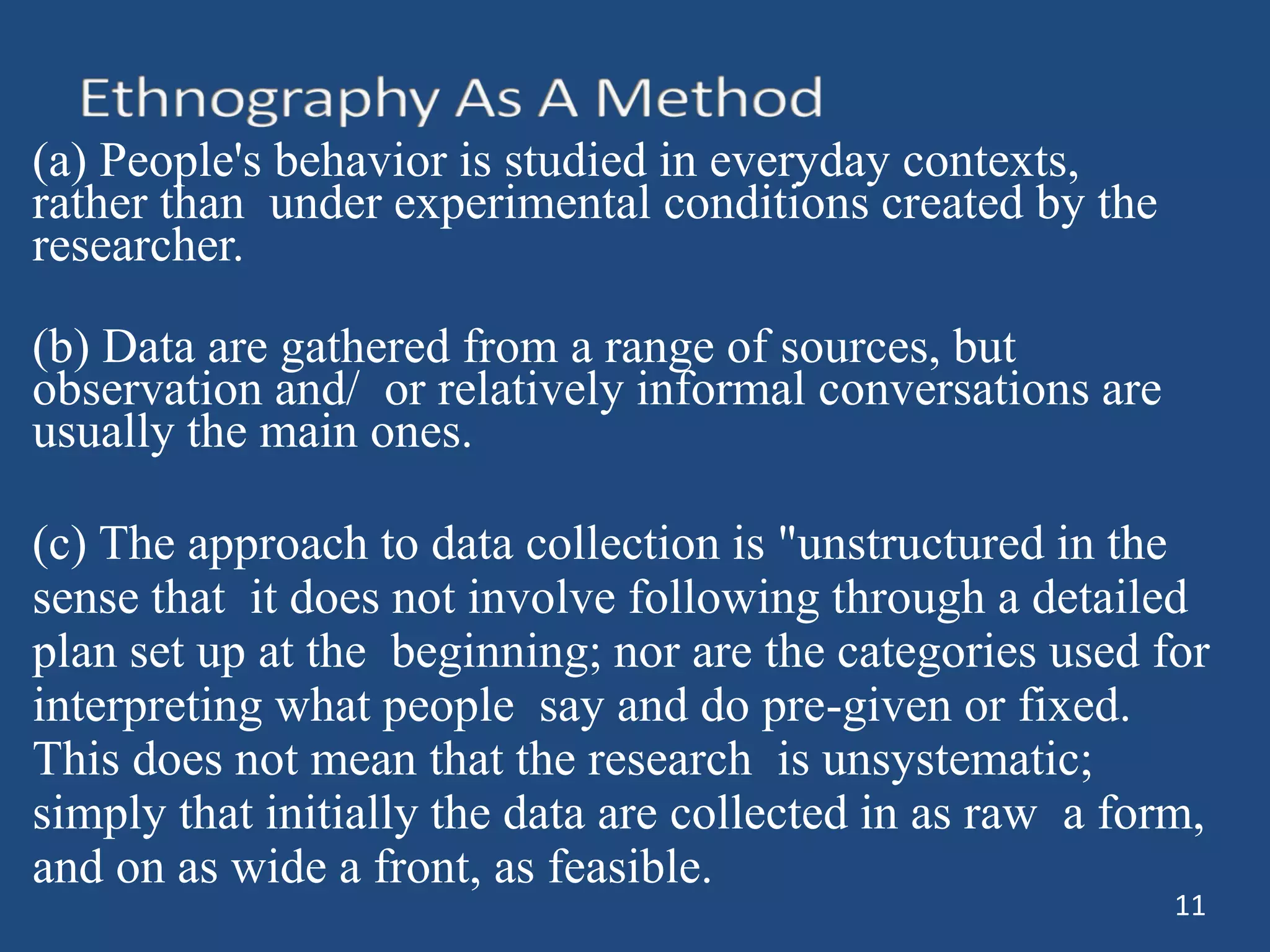
(a) People's behavioris studied in everyday contexts,
rather than under experimental conditions created by the
researcher.
(b) Data are gathered from a range of sources, but
observation and/ or relatively informal conversations are
usually the main ones.
(c) The approach to data collection is "unstructured in the
sense that it does not involve following through a detailed
plan set up at the beginning; nor are the categories used for
interpreting what people say and do pre-given or fixed.
This does not mean that the research is unsystematic;
simply that initially the data are collected in as raw a form,
and on as wide a front, as feasible.
11
12.
(d) The focusis usually a single setting or group, of
relatively small scale. In life history research the
focus may even be a single individual.
(e) The analysis of the data involves interpretation of
the meanings and functions of human actions and
mainly takes the form of verbal descriptions and
explanations, with quantification and statistical
analysis playing a subordinate role at most.
12
13.
Three broad typesof information are usually
sought by ethnographers:
1. Cultural behavior (what members of the
culture do),
2. Cultural artifacts (what members of the culture
make and use), and
3. Cultural speech (what people say).
13
14.
1. NATURALISM
This isthe view that the aim of social research
is to capture the character of naturally
occurring human behavior, and that this can
only be achieved by first-hand contact with it,
not by inferences from what people do in
artificial settings like experiments or from
what they say in interviews about what they
do elsewhere.
14
15.
2. UNDERSTANDING
From thispoint of view, if we are to be able to
explain human actions effectively we must
gain an understanding of the cultural
perspectives on which they are based.
That this is necessary is obvious when we are
studying a society that is alien to us, since we
shall find much of what we see and hear
puzzling.
15
16.
3.. DISCOVERY
Another featureof ethnographic thinking is a
conception of the research process asinductive or
discovery-based; rather than asbeing limited to
the testing of explicit hypotheses.
16
17.
The design ofan ethnographic research is deceptively
simple. It appears to require only one “act naturally.”
Then again, looking beyond, conducting an ethnographic
research is a process of discovery. It is something that
cannot be programmed. It is not a matter of following
methodological rules but a practical activity requiring the
exercise of one’s judgment.
17
18.
Typical ethnographic researchemploysthree kinds of data
collection: interviews, observation, and documents. This
in turn produces three kinds of data: quotations,
descriptions, and excerpts of documents, resulting inone
product: narrativedescription.
watching what happens
listening to what issaid
askingquestions through informal and formalinterviews
collecting documents andartifacts
18
19.
Thedata collected include,in addition to the rich
descriptive accounts, photographs, maps,figures, tables,
texts, audio and video records, and transcriptions. The
most common types of method usedin data collection
are interviews [both formal and informal], documents
[also both formal and informal/ official], and through
observation.
19
20.
In conducting anethnographic research, there are also
certain ethical concerns that are being raised everynow
and then. Over-all, they canbe summarizedas:
informed consent
privacy
harm
exploitation
20
21.
Ethnography outcome
1. Theethnographer prepares a written report
based on the analysis of the culture. The
product of ethnographic research usually is a
rich and holistic description of the culture
under study.
2. Ethnographers also make interpretations of the
culture, describing normative behavioral and
social patterns.
21
22.
Ethnography outcome
3. Amonghealth care researchers, ethnography
provides access to the health beliefs and health
practices of a culture or subculture.
4. Ethnographic inquiry can thus help to facilitate
understanding of behaviors affecting health and
illness.
22
23.
For example, agroup of nurse researchers conducted an
ethnographic study of family presence when their loved
ones were being weaned from mechanical ventilation
(Happ et al., 2007). They collected data by watching the
family members of 30 patients during weaning and
described their “active engagement in the observation
and interpretation” of the patient’s status as surveillance
(p. 51).
The researchers recommended that the typography of
family member behaviors they developed “could enhance
the dialogue about family-centered care
and guide future research on family needs and presence
in the ICU”
23





![Ethnonursing Research
Ethnonursing research “focuses mainly on
observing and documenting interactions with
people [and] how these daily life conditions and
patterns are influencing human care, health, and
nursing care practices”.
10](https://image.slidesharecdn.com/1-201204164250/75/ethnography-Research-10-2048.jpg)


![Thedata collected include, in addition to the rich
descriptive accounts, photographs, maps,figures, tables,
texts, audio and video records, and transcriptions. The
most common types of method usedin data collection
are interviews [both formal and informal], documents
[also both formal and informal/ official], and through
observation.
19](https://image.slidesharecdn.com/1-201204164250/75/ethnography-Research-19-2048.jpg)