UNIT 4 ( d) ACTION
RESEARCH & OUTCOME
RESEARCH
Ms. Chanda Jabeen
Lecturer
RN, RM, BSN
M.Phil. Epidemiology & Public Health
PhD (Scholar) Epidemiology & Public Health
1
OBJECTIVES
Define action research.
Explain Purposes of Conducting Action Research.
Describe Participatory Action Research.
Discuss aim of Participatory Action Research.
Describe data gathering
Explain difference between action research &
formal research
Describe steps of action research
Discuss outcome research
2
Action Research
Action research – which is also known as
Participatory Action Research (PAR),
community-based study, co-operative enquiry,
action science and action learning – is an
approach commonly used for improving
conditions and practices in a range healthcare
environments. OR Action research is a form of
applied research that tries to empower people
through a process that constructs and uses
knowledge.
3
It involves healthcare practitioners conducting
systematic enquiries in order to help them
improve their own practices, which in turn can
enhance their working environment and the
working environments of those who are part of
it.
4
Purposes of Conducting Action
Research
• Action research is a method used for
improving practice. It involves action,
evaluation, and critical reflection and – based
on the evidence gathered – changes in practice
are then implemented.
• Action research is participative and
collaborative; it is undertaken by individuals
with a common purpose.
5
Purposes of Conducting Action
Research
• It is situation-based and context specific.
• It develops reflection based on interpretations
made by the participants.
• Knowledge is created through action and at
the point of application.
• In action research findings will emerge as
action develops, but these are not conclusive or
absolute.
6
Participatory Action Research
Participatory action research
(PAR), one of several types of action research
that originated in the 1940s with social
psychologist Kurt Lewin, is based on a
recognition that the production of knowledge can
be political and can be used to exert power.
7
Researchers in this approach typically work with
groups or communities that are vulnerable to the
control or oppression of a dominant group or
culture.
8
Participatory action research is, as the name
implies, participatory. There is collaboration
between researchers and study participants in the
definition of the problem, the selection of an
approach and research methods, the analysis of
the data, and the use to which findings are put.
9
AIM of PAR
The aim of PAR is to produce not only
knowledge, but action and consciousness-raising
as well.
Researchers specifically seek to empower people
through the process of constructing and using
knowledge.
10
The PAR tradition has as its starting
point a concern for the powerlessness of the
group under study. Thus, a key objective is to
produce an impetus that is directly used to make
improvements through education and
sociopolitical action.
11
DATA-GATHERING
The “data-gathering” strategies used are not only
the traditional methods of interview and
observation (including both qualitative and
quantitative approaches), but may include
storytelling, sociodrama, drawing and painting,
plays and skits, and other activities designed to
encourage people to find creative ways to
explore their lives, tell their stories, and
recognize their own strengths.
12
What is involved in action research?
• Research is about generating knowledge.
Action research creates knowledge based on
enquiries conducted within specific and often
practical contexts. As articulated earlier, the
purpose of action research is to learn through
action that then leads on to personal or
professional development.
13
14
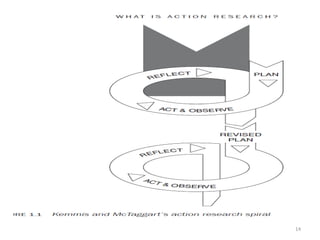
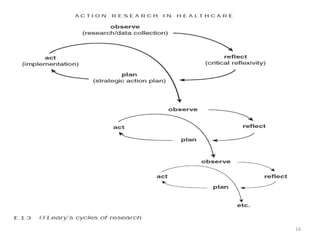
The authors state that action research involves a
spiral of self-reflective cycles of:
• Planning a change.
• Acting and observing the process and
consequences of the change.
• Reflecting on these processes and consequences
and then replanning.
• Acting and observing.
• Reflecting.
15
16
What is Not Action Research?
 Action research is not usually comes to mind when
we hear the word “research.”
 Action research is not a library project where we
learn more about a topic that interests us.
 It is not problem-solving in the sense of trying to
find out what is wrong, but rather a quest for
knowledge about how to improve.
17
What is Not Action Research?
 Action research is not about doing research on or
about people, or finding all available information on
a topic looking for the correct answers. It involves
people working to improve their skills, techniques,
and strategies.
 Action research is not about learning why we do
certain things, but rather how we can do things
better. It is about how we can change our instruction
to impact students.
18
Similarities and Differences
between
Action Research and
Formal Quantitative and
Qualitative Research
19
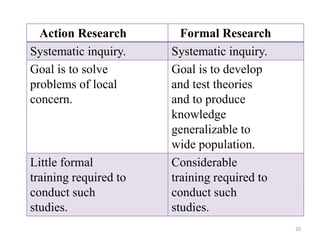
Action Research Formal Research
Systematic inquiry. Systematic inquiry.
Goal is to solve Goal is to develop
problems of local and test theories
concern. and to produce
knowledge
generalizable to
wide population.
Little formal Considerable
training required to training required to
conduct such conduct such
studies. studies.
20
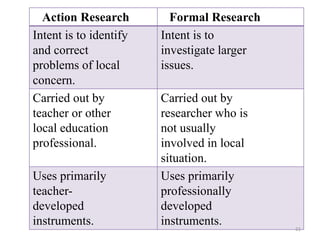
Action Research Formal Research
Intent is to identify Intent is to
and correct investigate larger
problems of local
concern.
issues.
Carried out by Carried out by
teacher or other researcher who is
local education not usually
professional. involved in local
situation.
Uses primarily Uses primarily
teacher- professionally
developed developed
instruments. instruments. 21
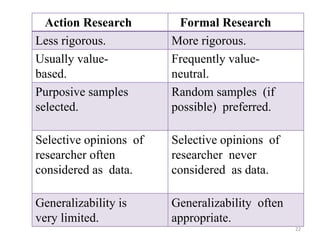
Action Research Formal Research
Less rigorous. More rigorous.
Usually value-
based.
Frequently value-
neutral.
Purposive samples
selected.
Random samples (if
possible) preferred.
Selective opinions of
researcher often
considered as data.
Selective opinions of
researcher never
considered as data.
Generalizability is
very limited.
Generalizability often
appropriate.
22
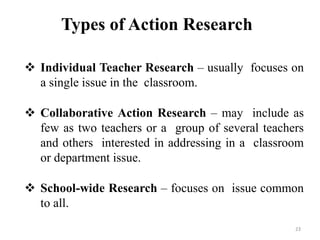
Types of Action Research
 Individual Teacher Research – usually focuses on
a single issue in the classroom.
 Collaborative Action Research – may include as
few as two teachers or a group of several teachers
and others interested in addressing in a classroom
or department issue.
 School-wide Research – focuses on issue common
to all.
23
Types of Action Research
 District-wide Research – far more complex and
utilizes more resources, but the rewards can be
great. Issues can be organizational, community-
based, performance-based or processes for
decision making.
24
Steps in Action Research
Within all thedefinitions of action research,
there are four basic themes:
1. Empowerment of participants
2. collaboration through participants
3. Acquisition of knowledge, and
4. social change.
25
Steps in Action Research
These routines are loosely guided by movement
through five phases of inquiry:
1. Identification of problem area
2. Collection and organization of data
3. Interpretation of data
4. Action based on data
5. Reflection
26
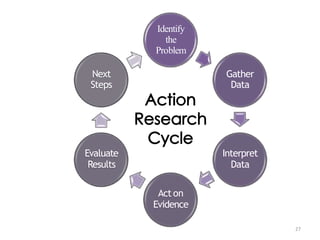
Identify
the
Problem
Gather
Data
Interpret
Data
Act on
Evidence
Evaluate
Results
Next
Steps
27
Identify a Problem Area
Teachers often have several questions they wish
to investigate, however, it is important to limit the
question to one that is meaningful and doable in
the confines of their daily work. Careful
planning at this first stage will limit false starts
and frustrations.
28
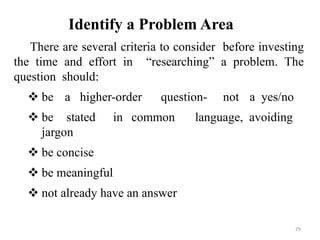
Identify a Problem Area
There are several criteria to consider before investing
the time and effort in “researching” a problem. The
question should:
 be a higher-order question- not a yes/no
 be stated in common language, avoiding
jargon
 be concise
 be meaningful
 not already have an answer
29
Gather Data
The collection of data is an important step in
deciding what action needs to be taken. Multiple
sources of data are used to better understand the scope
of happenings in the classroom orschool.
30
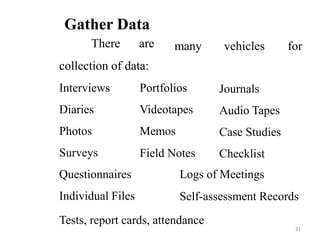
Gather Data
manyThere are
collection of data:
Interviews
Diaries
Photos
Surveys
Portfolios
Videotapes
Memos
Field Notes
vehicles for
Journals
Audio Tapes
Case Studies
Checklist
Questionnaires
Individual Files
Logs of Meetings
Self-assessment Records
Tests, report cards, attendance
31
Interpret Data
Analyze and identify major themes.
Depending upon the question, teachers may wish
to use classroom data, individual data or
subgroup data. Some of the data are quantifiable
and can be analyzed without the use of statistics
or technical assistance.
32
Act on Evidence
Using the information from the data
collection and review of current literature, design a
plan of action that will allow you to make a change
and to study that change. It is important that only
one variable be altered.
33
Evaluate Results
Assess
intervention
the effects of the to
determine if
improvement has occurred. Is there is
improvement, do the data clearly provide the
supporting evidence? If no, what changes can
be made to the actions to elicit better reults?
34
Next Steps
As a result of the action research project,
identify additional questions raised by the data
and plan for additional improvements, revisions
and next steps.
35
OUTCOME RESEARCH
• A research planned to assess or record the end
result of health care services to develop
evidence based practice or improve health care
services. It is used in nursing to develop
evidence based practice.
36

4. action research

  • 1.
    UNIT 4 (d) ACTION RESEARCH & OUTCOME RESEARCH Ms. Chanda Jabeen Lecturer RN, RM, BSN M.Phil. Epidemiology & Public Health PhD (Scholar) Epidemiology & Public Health 1
  • 2.
    OBJECTIVES Define action research. ExplainPurposes of Conducting Action Research. Describe Participatory Action Research. Discuss aim of Participatory Action Research. Describe data gathering Explain difference between action research & formal research Describe steps of action research Discuss outcome research 2
  • 3.
    Action Research Action research– which is also known as Participatory Action Research (PAR), community-based study, co-operative enquiry, action science and action learning – is an approach commonly used for improving conditions and practices in a range healthcare environments. OR Action research is a form of applied research that tries to empower people through a process that constructs and uses knowledge. 3
  • 4.
    It involves healthcarepractitioners conducting systematic enquiries in order to help them improve their own practices, which in turn can enhance their working environment and the working environments of those who are part of it. 4
  • 5.
    Purposes of ConductingAction Research • Action research is a method used for improving practice. It involves action, evaluation, and critical reflection and – based on the evidence gathered – changes in practice are then implemented. • Action research is participative and collaborative; it is undertaken by individuals with a common purpose. 5
  • 6.
    Purposes of ConductingAction Research • It is situation-based and context specific. • It develops reflection based on interpretations made by the participants. • Knowledge is created through action and at the point of application. • In action research findings will emerge as action develops, but these are not conclusive or absolute. 6
  • 7.
    Participatory Action Research Participatoryaction research (PAR), one of several types of action research that originated in the 1940s with social psychologist Kurt Lewin, is based on a recognition that the production of knowledge can be political and can be used to exert power. 7
  • 8.
    Researchers in thisapproach typically work with groups or communities that are vulnerable to the control or oppression of a dominant group or culture. 8
  • 9.
    Participatory action researchis, as the name implies, participatory. There is collaboration between researchers and study participants in the definition of the problem, the selection of an approach and research methods, the analysis of the data, and the use to which findings are put. 9
  • 10.
    AIM of PAR Theaim of PAR is to produce not only knowledge, but action and consciousness-raising as well. Researchers specifically seek to empower people through the process of constructing and using knowledge. 10
  • 11.
    The PAR traditionhas as its starting point a concern for the powerlessness of the group under study. Thus, a key objective is to produce an impetus that is directly used to make improvements through education and sociopolitical action. 11
  • 12.
    DATA-GATHERING The “data-gathering” strategiesused are not only the traditional methods of interview and observation (including both qualitative and quantitative approaches), but may include storytelling, sociodrama, drawing and painting, plays and skits, and other activities designed to encourage people to find creative ways to explore their lives, tell their stories, and recognize their own strengths. 12
  • 13.
    What is involvedin action research? • Research is about generating knowledge. Action research creates knowledge based on enquiries conducted within specific and often practical contexts. As articulated earlier, the purpose of action research is to learn through action that then leads on to personal or professional development. 13
  • 14.
  • 15.
    The authors statethat action research involves a spiral of self-reflective cycles of: • Planning a change. • Acting and observing the process and consequences of the change. • Reflecting on these processes and consequences and then replanning. • Acting and observing. • Reflecting. 15
  • 16.
  • 17.
    What is NotAction Research?  Action research is not usually comes to mind when we hear the word “research.”  Action research is not a library project where we learn more about a topic that interests us.  It is not problem-solving in the sense of trying to find out what is wrong, but rather a quest for knowledge about how to improve. 17
  • 18.
    What is NotAction Research?  Action research is not about doing research on or about people, or finding all available information on a topic looking for the correct answers. It involves people working to improve their skills, techniques, and strategies.  Action research is not about learning why we do certain things, but rather how we can do things better. It is about how we can change our instruction to impact students. 18
  • 19.
    Similarities and Differences between ActionResearch and Formal Quantitative and Qualitative Research 19
  • 20.
    Action Research FormalResearch Systematic inquiry. Systematic inquiry. Goal is to solve Goal is to develop problems of local and test theories concern. and to produce knowledge generalizable to wide population. Little formal Considerable training required to training required to conduct such conduct such studies. studies. 20
  • 21.
    Action Research FormalResearch Intent is to identify Intent is to and correct investigate larger problems of local concern. issues. Carried out by Carried out by teacher or other researcher who is local education not usually professional. involved in local situation. Uses primarily Uses primarily teacher- professionally developed developed instruments. instruments. 21
  • 22.
    Action Research FormalResearch Less rigorous. More rigorous. Usually value- based. Frequently value- neutral. Purposive samples selected. Random samples (if possible) preferred. Selective opinions of researcher often considered as data. Selective opinions of researcher never considered as data. Generalizability is very limited. Generalizability often appropriate. 22
  • 23.
    Types of ActionResearch  Individual Teacher Research – usually focuses on a single issue in the classroom.  Collaborative Action Research – may include as few as two teachers or a group of several teachers and others interested in addressing in a classroom or department issue.  School-wide Research – focuses on issue common to all. 23
  • 24.
    Types of ActionResearch  District-wide Research – far more complex and utilizes more resources, but the rewards can be great. Issues can be organizational, community- based, performance-based or processes for decision making. 24
  • 25.
    Steps in ActionResearch Within all thedefinitions of action research, there are four basic themes: 1. Empowerment of participants 2. collaboration through participants 3. Acquisition of knowledge, and 4. social change. 25
  • 26.
    Steps in ActionResearch These routines are loosely guided by movement through five phases of inquiry: 1. Identification of problem area 2. Collection and organization of data 3. Interpretation of data 4. Action based on data 5. Reflection 26
  • 27.
  • 28.
    Identify a ProblemArea Teachers often have several questions they wish to investigate, however, it is important to limit the question to one that is meaningful and doable in the confines of their daily work. Careful planning at this first stage will limit false starts and frustrations. 28
  • 29.
    Identify a ProblemArea There are several criteria to consider before investing the time and effort in “researching” a problem. The question should:  be a higher-order question- not a yes/no  be stated in common language, avoiding jargon  be concise  be meaningful  not already have an answer 29
  • 30.
    Gather Data The collectionof data is an important step in deciding what action needs to be taken. Multiple sources of data are used to better understand the scope of happenings in the classroom orschool. 30
  • 31.
    Gather Data manyThere are collectionof data: Interviews Diaries Photos Surveys Portfolios Videotapes Memos Field Notes vehicles for Journals Audio Tapes Case Studies Checklist Questionnaires Individual Files Logs of Meetings Self-assessment Records Tests, report cards, attendance 31
  • 32.
    Interpret Data Analyze andidentify major themes. Depending upon the question, teachers may wish to use classroom data, individual data or subgroup data. Some of the data are quantifiable and can be analyzed without the use of statistics or technical assistance. 32
  • 33.
    Act on Evidence Usingthe information from the data collection and review of current literature, design a plan of action that will allow you to make a change and to study that change. It is important that only one variable be altered. 33
  • 34.
    Evaluate Results Assess intervention the effectsof the to determine if improvement has occurred. Is there is improvement, do the data clearly provide the supporting evidence? If no, what changes can be made to the actions to elicit better reults? 34
  • 35.
    Next Steps As aresult of the action research project, identify additional questions raised by the data and plan for additional improvements, revisions and next steps. 35
  • 36.
    OUTCOME RESEARCH • Aresearch planned to assess or record the end result of health care services to develop evidence based practice or improve health care services. It is used in nursing to develop evidence based practice. 36