UNIT 4 ( C) : EPIDEMIOLOGICAL
RESEARCH DESIGNS
Ms. Chanda Jabeen
Lecturer
RN, RM, BSN
M.Phil. Epidemiology & Public Health
PhD (Scholar) Epidemiology & Public Health
1
LEARNING OBJECTIVES
At the end of this session, the students will be able
to:
 Understand different Epidemiological Research
Designs.
• Cross Sectional
• Case-Control
• Cohort
2
WHY CONDUCT STUDIES?
• Todescribe burden of disease or prevalence of
risk factors, health behaviors, or other
characteristics of a population that influences
risk of disease
• Todetermine causes or risk factors for illness
• Todetermine relative effectiveness of
interventions
3
4
DESCRIPTIVE OR ANALYTIC
STUDIES
Descriptive studies
• Generate hypotheses
• Answer what, who, where, and
when
Analytic studies
• Test hypotheses
• Answer why and how
5
CROSS-SECTIONALSTUDIES
Cross-sectional studies include surveys
People are studied at a “point” in time, without
follow-up.
Can combine a cross-sectional study with follow-up
to create a cohort study.
Can conduct repeated cross-sectional studies to
measure change in a population.
6
EXAMPLE
According to the 2002 National Survey of Family
Growth, 35%, or about 7.4 million, of births to
U.S. women during the five years
7
MEASURE PREVALENCE AT “POINT” IN
TIME
“Snapshot” of a population, a “still life”
Can measure attitudes, beliefs, behaviors, personal or
family history, genetic factors, existing or past health
conditions, or anything else that does not require
follow-up to assess.
The source of most of what we know about the
population
8
DESIGN OF CROSS-SECTIONAL
STUDIES
Defined Population
Exposure +
Outcome +
Exposure +
Outcome -
Exposure -
Outcome +
Exposure -
Outcome -
Gather data on exposure
and disease
9
TYPES OF CROSS-SECTIONAL
STUDY
Descriptive
A cross-sectional study may be purely
descriptive and used to assess the frequency and
distribution of a particular disease in a defined
population.
For example a random sample of schools across
London may be used to assess the burden or
prevalence of asthma among 12-14 year olds.
10
ANALYTICAL
Analytical cross-sectional studies may also be
used to investigate the association between a
putative risk factor and a health outcome.
However this type of study is limited in its
ability to draw valid conclusions about any
association or possible causality because the
presence of risk factors and outcomes are
measured simultaneously.
11
It may therefore be difficult to work out
whether the disease or the exposure came first,
so causation should always be confirmed by
more rigorous studies.
The collection of information about risk factors
is also retrospective, running the risk of recall
bias.
12
ADVANTAGES OF CROSS
SECTIONAL STUDIES
Provides estimate of the disease burden
(prevalence)
Relatively short duration
Easy and quick
Less costly
Starting point for cohort study for screening
existing diseases
Provide wealth of data for further research
13
DISADVANTAGES
Does not provide estimate of disease occurrence
(incidence)
No direct estimate of risk possible
Rare diseases, short duration, high case fatality not
detected
Natural history of disease information minimal
Prone for biases from selective survival
Not possible to establish temporality Therefore, it is
a weak design for proving causality
14
COHORT STUDIES
In a cohort study, subjects with an exposure to a
causal factor are identified and the incidence of a
disease over time is compared with that of controls
(persons who do not have the exposure).
In a longitudinal study, subjects are followed over
time with continuous or repeated monitoring of risk
factors or health outcomes, or both.
15
ADVANTAGES
Can get best assessment of exposure and can deal with
changes in exposure
May be only design if exposure needs to be measured
directly
Only way to get prospective information for rapidly
fatal diseases
Good for establishing temporal sequence and natural
history of disease
Can examine multiple outcomes linked to exposure -
often find other effects than
16
Can estimate overall and specific disease rates,
usually incidence
Researcher selects, measures & records data
Lower potential for bias than a case-control study -
no recall and selection bias
Results are considered more conclusive than results
from case-control studies
The longer a cohort study continues, the stronger it
can become
17
DISADVANTAGES
Costly and time consuming
Larger sample size than case-control
Data collection is usually very expensive
Long time commitment for follow-up
They are not good for diseases with a long latency
18
COHORT STUDY DESIGN
19
Study
Population
Exposure is
self-selected
Disease
Exposed
No Disease
Disease
Unexposed
No Disease
Follow
over time
TYPES OF COHORT
STUDIES
Prospective cohort studies
• Group participants according to past or
current exposure and follow-up into the
future to determine if outcome occurs
Retrospective cohort studies
• At the time that the study is conducted,
potential exposure and outcomes have
already occurred in the past
20
PROSPECTIVE COHORT STUDIES
21
Disease
Exposed
No Disease
Study
Population
Disease
Unexposed
No Disease
Startof
study
(Present)
(Future)
RETROSPECTIVE COHORT
STUDIES
Study
Population
Disease
Exposed
No Disease
Disease
Unexposed
No Disease
Start of
study
(Present)
(Past)
22
In statistics and epidemiology, relative
risk or risk ratio (RR) is the ratio of
the probability of an event occurring (for
example, developing a disease, being injured)
in an exposed group to the probability of the
event occurring in a comparison, non-exposed
group.
23
EXAMPLE
Risk
Disease status
Present Absent
Smoker a b
Non-smoker c d
Consider an example where the probability of developing
lung cancer among smokers was 20% and among non-
smokers 1%. This situation is expressed in the 2 × 2 table
to the right.
24
Here, a = 20, b = 80, c = 1, and d = 99. Then the
relative risk of cancer associated with smoking
would be
RR= a/a+b
c/c+d
Smokers would be twenty times as likely as non-
smokers to develop lung cancer.
25
INTERPRETATION:
RR > 1 Increased risk of outcome
RR = 1 No risk of outcome/No association
RR < 1 Reduced risk of outcome/Protective
Factor
26
CASE-CONTROL STUDIES
Case-Control Studies identify existing disease/s
and look back in previous years to identify
previous exposures to causal factors.
Cases are those who have a disease.
Controls are those without a disease.
Analyses examine if exposure levels are different
between the groups.
27
CASE-CONTROL STUDY
DESIGN
Source
Population
Cases
(Diseased)
Exposed
Unexposed
Exposed
Unexposed
Identify
cases
and
select
controls
Assess
exposure
history
Controls
(No Disease)
28
ADVANTAGES
Best design for rare diseases
Can be accomplished quickly since events of
interest have already occurred
Can study several potential exposures at the same
time
Lends itself well to hospital-based studies and
outbreaks
29
DISADVANTAGES
Hard to decide when disease was actually acquired
Control group can be difficult to find
Can’t calculate incidence, population relative risk or
attributable risk
HIGH potential for bias
Usually not generalizability
30
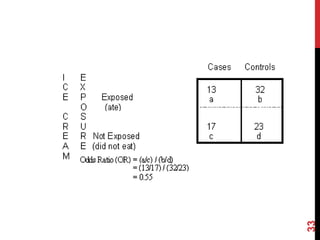
An odds ratio (OR) is a measure of association
between an exposure and an outcome.
The OR represents the odds that an outcome will
occur given a particular exposure, compared to the
odds of the outcome occurring in the absence of
that exposure.
31
CALCULATION
the odds of the disease in exposed over the odds
of the non-exposed
OR = odds of disease in exposed / odds of disease
in the non-exposed
= (a/c) / (b/d)
32
33
INTERPRETATION:
OR > 1 Increased frequency of exposure among
cases
OR = 1 No change in frequency of exposure
OR < 1 Decreased frequency of exposure
34
Exposure Outcome
Cohort
Case-control
Cross-sectional
35
DIFFERENCE BETWEEN RETROSPECTIVE COHORT
STUDY & CASE-CONTROL STUDY
Case-control studies starts from outcomes to
exposure while in a retrospective cohort study one
already knows the if there was exposure and tries
identify association to outcome in a retrospective
way.
36
ECOLOGICALSTUDY
An ecological study is an observational study
defined by the level at which data are analyzed,
namely at the population or group level, rather
than individual level.
Ecological studies are often used to measure
prevalence and incidence of disease, particularly
when disease is rare.
They are inexpensive and easy to carry out, using
routinely collected data, but they are prone to bias
and confounding
37
WHY CARRY OUTAN
ECOLOGICALSTUDY?
An ecological study design is used when;
The purpose of the study is to monitor population
health so that public health strategies may be
developed and directed;
The purpose of the study is to make large-scale
comparisons, e.g, comparisons between countries;
38
The purpose of the study is to study the
relationship between population-level exposure to
risk factors and disease.
Ecological fallacy, also
called ecological inference fallacy, in epidemiology,
failure in reasoning that arises when an inference is
made about an individual based on aggregate data for
a group.
39
The Strengthening of Reporting
of Observational Studies in
Epidemiology Statement
(STROBE)
40
STROBE provides a checklist of important
steps for conducting these types of studies, as
well as acting as best-practice reporting
guidelines.
von Elm E, Altman DG, Egger M, Pocock SJ, Gøtzsche PC, Vandenbroucke JP; STROBE
Initiative. The Strengthening the Reporting of Observational Studies in Epidemiology
(STROBE) statement: guidelines for reporting observational studies. Lancet 2007
Oct;370(9596):1453-14577. PMID: 18064739.
41
REFERENCE
Grove, S. K., Gray, R.J.,& Burns, N.(2015).Understanding
Nursing research building an evidence- based
practice(6thed.).St. Louis: Elsevier Health Sciences.
42

3. epidem research designs

  • 1.
    UNIT 4 (C) : EPIDEMIOLOGICAL RESEARCH DESIGNS Ms. Chanda Jabeen Lecturer RN, RM, BSN M.Phil. Epidemiology & Public Health PhD (Scholar) Epidemiology & Public Health 1
  • 2.
    LEARNING OBJECTIVES At theend of this session, the students will be able to:  Understand different Epidemiological Research Designs. • Cross Sectional • Case-Control • Cohort 2
  • 3.
    WHY CONDUCT STUDIES? •Todescribe burden of disease or prevalence of risk factors, health behaviors, or other characteristics of a population that influences risk of disease • Todetermine causes or risk factors for illness • Todetermine relative effectiveness of interventions 3
  • 4.
  • 5.
    DESCRIPTIVE OR ANALYTIC STUDIES Descriptivestudies • Generate hypotheses • Answer what, who, where, and when Analytic studies • Test hypotheses • Answer why and how 5
  • 6.
    CROSS-SECTIONALSTUDIES Cross-sectional studies includesurveys People are studied at a “point” in time, without follow-up. Can combine a cross-sectional study with follow-up to create a cohort study. Can conduct repeated cross-sectional studies to measure change in a population. 6
  • 7.
    EXAMPLE According to the2002 National Survey of Family Growth, 35%, or about 7.4 million, of births to U.S. women during the five years 7
  • 8.
    MEASURE PREVALENCE AT“POINT” IN TIME “Snapshot” of a population, a “still life” Can measure attitudes, beliefs, behaviors, personal or family history, genetic factors, existing or past health conditions, or anything else that does not require follow-up to assess. The source of most of what we know about the population 8
  • 9.
    DESIGN OF CROSS-SECTIONAL STUDIES DefinedPopulation Exposure + Outcome + Exposure + Outcome - Exposure - Outcome + Exposure - Outcome - Gather data on exposure and disease 9
  • 10.
    TYPES OF CROSS-SECTIONAL STUDY Descriptive Across-sectional study may be purely descriptive and used to assess the frequency and distribution of a particular disease in a defined population. For example a random sample of schools across London may be used to assess the burden or prevalence of asthma among 12-14 year olds. 10
  • 11.
    ANALYTICAL Analytical cross-sectional studiesmay also be used to investigate the association between a putative risk factor and a health outcome. However this type of study is limited in its ability to draw valid conclusions about any association or possible causality because the presence of risk factors and outcomes are measured simultaneously. 11
  • 12.
    It may thereforebe difficult to work out whether the disease or the exposure came first, so causation should always be confirmed by more rigorous studies. The collection of information about risk factors is also retrospective, running the risk of recall bias. 12
  • 13.
    ADVANTAGES OF CROSS SECTIONALSTUDIES Provides estimate of the disease burden (prevalence) Relatively short duration Easy and quick Less costly Starting point for cohort study for screening existing diseases Provide wealth of data for further research 13
  • 14.
    DISADVANTAGES Does not provideestimate of disease occurrence (incidence) No direct estimate of risk possible Rare diseases, short duration, high case fatality not detected Natural history of disease information minimal Prone for biases from selective survival Not possible to establish temporality Therefore, it is a weak design for proving causality 14
  • 15.
    COHORT STUDIES In acohort study, subjects with an exposure to a causal factor are identified and the incidence of a disease over time is compared with that of controls (persons who do not have the exposure). In a longitudinal study, subjects are followed over time with continuous or repeated monitoring of risk factors or health outcomes, or both. 15
  • 16.
    ADVANTAGES Can get bestassessment of exposure and can deal with changes in exposure May be only design if exposure needs to be measured directly Only way to get prospective information for rapidly fatal diseases Good for establishing temporal sequence and natural history of disease Can examine multiple outcomes linked to exposure - often find other effects than 16
  • 17.
    Can estimate overalland specific disease rates, usually incidence Researcher selects, measures & records data Lower potential for bias than a case-control study - no recall and selection bias Results are considered more conclusive than results from case-control studies The longer a cohort study continues, the stronger it can become 17
  • 18.
    DISADVANTAGES Costly and timeconsuming Larger sample size than case-control Data collection is usually very expensive Long time commitment for follow-up They are not good for diseases with a long latency 18
  • 19.
    COHORT STUDY DESIGN 19 Study Population Exposureis self-selected Disease Exposed No Disease Disease Unexposed No Disease Follow over time
  • 20.
    TYPES OF COHORT STUDIES Prospectivecohort studies • Group participants according to past or current exposure and follow-up into the future to determine if outcome occurs Retrospective cohort studies • At the time that the study is conducted, potential exposure and outcomes have already occurred in the past 20
  • 21.
    PROSPECTIVE COHORT STUDIES 21 Disease Exposed NoDisease Study Population Disease Unexposed No Disease Startof study (Present) (Future)
  • 22.
  • 23.
    In statistics andepidemiology, relative risk or risk ratio (RR) is the ratio of the probability of an event occurring (for example, developing a disease, being injured) in an exposed group to the probability of the event occurring in a comparison, non-exposed group. 23
  • 24.
    EXAMPLE Risk Disease status Present Absent Smokera b Non-smoker c d Consider an example where the probability of developing lung cancer among smokers was 20% and among non- smokers 1%. This situation is expressed in the 2 × 2 table to the right. 24
  • 25.
    Here, a =20, b = 80, c = 1, and d = 99. Then the relative risk of cancer associated with smoking would be RR= a/a+b c/c+d Smokers would be twenty times as likely as non- smokers to develop lung cancer. 25
  • 26.
    INTERPRETATION: RR > 1Increased risk of outcome RR = 1 No risk of outcome/No association RR < 1 Reduced risk of outcome/Protective Factor 26
  • 27.
    CASE-CONTROL STUDIES Case-Control Studiesidentify existing disease/s and look back in previous years to identify previous exposures to causal factors. Cases are those who have a disease. Controls are those without a disease. Analyses examine if exposure levels are different between the groups. 27
  • 28.
  • 29.
    ADVANTAGES Best design forrare diseases Can be accomplished quickly since events of interest have already occurred Can study several potential exposures at the same time Lends itself well to hospital-based studies and outbreaks 29
  • 30.
    DISADVANTAGES Hard to decidewhen disease was actually acquired Control group can be difficult to find Can’t calculate incidence, population relative risk or attributable risk HIGH potential for bias Usually not generalizability 30
  • 31.
    An odds ratio(OR) is a measure of association between an exposure and an outcome. The OR represents the odds that an outcome will occur given a particular exposure, compared to the odds of the outcome occurring in the absence of that exposure. 31
  • 32.
    CALCULATION the odds ofthe disease in exposed over the odds of the non-exposed OR = odds of disease in exposed / odds of disease in the non-exposed = (a/c) / (b/d) 32
  • 33.
  • 34.
    INTERPRETATION: OR > 1Increased frequency of exposure among cases OR = 1 No change in frequency of exposure OR < 1 Decreased frequency of exposure 34
  • 35.
  • 36.
    DIFFERENCE BETWEEN RETROSPECTIVECOHORT STUDY & CASE-CONTROL STUDY Case-control studies starts from outcomes to exposure while in a retrospective cohort study one already knows the if there was exposure and tries identify association to outcome in a retrospective way. 36
  • 37.
    ECOLOGICALSTUDY An ecological studyis an observational study defined by the level at which data are analyzed, namely at the population or group level, rather than individual level. Ecological studies are often used to measure prevalence and incidence of disease, particularly when disease is rare. They are inexpensive and easy to carry out, using routinely collected data, but they are prone to bias and confounding 37
  • 38.
    WHY CARRY OUTAN ECOLOGICALSTUDY? Anecological study design is used when; The purpose of the study is to monitor population health so that public health strategies may be developed and directed; The purpose of the study is to make large-scale comparisons, e.g, comparisons between countries; 38
  • 39.
    The purpose ofthe study is to study the relationship between population-level exposure to risk factors and disease. Ecological fallacy, also called ecological inference fallacy, in epidemiology, failure in reasoning that arises when an inference is made about an individual based on aggregate data for a group. 39
  • 40.
    The Strengthening ofReporting of Observational Studies in Epidemiology Statement (STROBE) 40
  • 41.
    STROBE provides achecklist of important steps for conducting these types of studies, as well as acting as best-practice reporting guidelines. von Elm E, Altman DG, Egger M, Pocock SJ, Gøtzsche PC, Vandenbroucke JP; STROBE Initiative. The Strengthening the Reporting of Observational Studies in Epidemiology (STROBE) statement: guidelines for reporting observational studies. Lancet 2007 Oct;370(9596):1453-14577. PMID: 18064739. 41
  • 42.
    REFERENCE Grove, S. K.,Gray, R.J.,& Burns, N.(2015).Understanding Nursing research building an evidence- based practice(6thed.).St. Louis: Elsevier Health Sciences. 42