By
Dr. G Chirag Krishna Yadav
Moderator
Dr. C Ananda Reddy
“A surgeon can do more for the community by
operating on hernia cases and seeing that his
recurrence rate is low, than he can, by operating on
cases of malignant disease”
Sir Cecil Wakely, 1948
President
Royal College of Surgeons
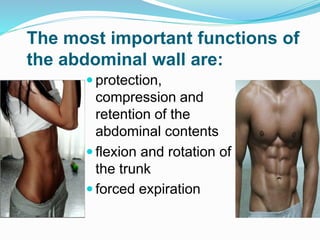
The most important functions of
the abdominal wall are:
 protection,
compression and
retention of the
abdominal contents
 flexion and rotation of
the trunk
 forced expiration
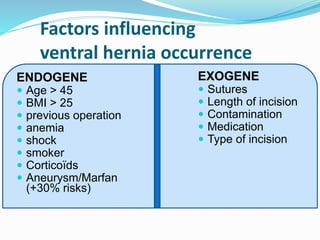
Factors influencing
ventral hernia occurrence
ENDOGENE
 Age > 45
 BMI > 25
 previous operation
 anemia
 shock
 smoker
 Corticoïds
 Aneurysm/Marfan
(+30% risks)
EXOGENE
 Sutures
 Length of incision
 Contamination
 Medication
 Type of incision
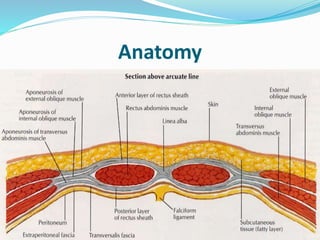
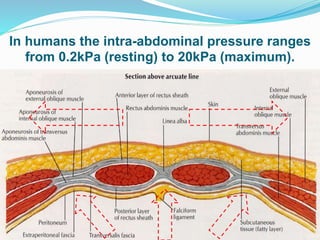
Anatomy
In humans the intra-abdominal pressure ranges
from 0.2kPa (resting) to 20kPa (maximum).
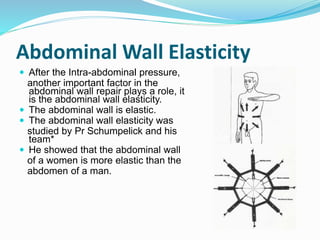
Abdominal Wall Elasticity
 After the Intra-abdominal pressure,
another important factor in the
abdominal wall repair plays a role, it
is the abdominal wall elasticity.
 The abdominal wall is elastic.
 The abdominal wall elasticity was
studied by Pr Schumpelick and his
team*
 He showed that the abdominal wall
of a women is more elastic than the
abdomen of a man.
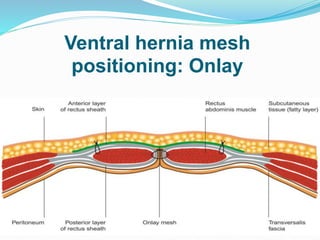
Ventral hernia mesh
positioning: Onlay
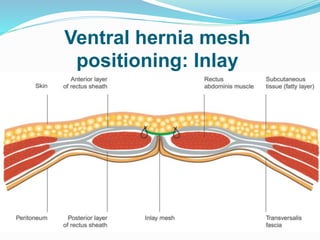
Ventral hernia mesh
positioning: Inlay
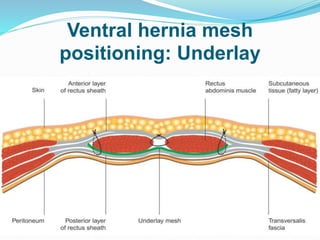
Ventral hernia mesh
positioning: Underlay
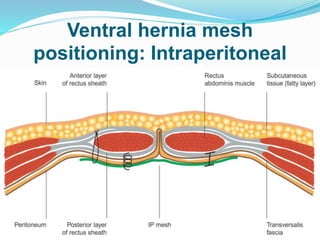
Ventral hernia mesh
positioning: Intraperitoneal
PROPERTIES OF IDEAL MESH
 Possess good handling characteristics in the OR
 Invoke a favourable host response
 Be strong enough to prevent recurrence
 Place no restrictions on post implantation function
 Perform well in the presence of infection
 Resist shrinkage or degradation over time
 Make no restrictions on future access
 Block transmission of infectious disease
 Be inexpensive
 Be easy to manufacture
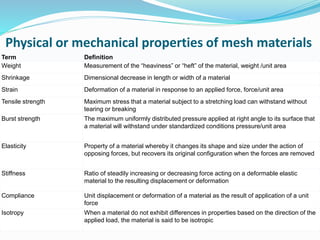
Physical or mechanical properties of mesh materials
Term Definitiona
Weight Measurement of the “heaviness” or
“heft” of the material, weight /unit area
Shrinkage Dimensional decrease in length or width
of a material
Strain Deformation of a material in response to
an applied force, force/unit area
Tensile strength Maximum stress that a material subject
to a stretching load can withstand
without tearing or breaking
Burst strength The maximum uniformly distributed
pressure applied at right angle to its
surface that a material will withstand
under standardized conditions
pressure/unit area
Elasticity Property of a material whereby it
changes its shape and size under the
action of opposing forces, but recovers
its original configuration when the forces
are removed
Stiffness Ratio of steadily increasing or
decreasing force acting on a deformable
elastic material to the resulting
displacement or deformation
Compliance Unit displacement or deformation of a
material as the result of application of a
unit force
Isotropy When a material do not exhibit
differences in properties based on the
direction of the applied load, the
material is said to be isotropic
Term Definition
Weight Measurement of the “heaviness” or “heft” of the material, weight /unit area
Shrinkage Dimensional decrease in length or width of a material
Strain Deformation of a material in response to an applied force, force/unit area
Tensile strength Maximum stress that a material subject to a stretching load can withstand without
tearing or breaking
Burst strength The maximum uniformly distributed pressure applied at right angle to its surface that
a material will withstand under standardized conditions pressure/unit area
Elasticity Property of a material whereby it changes its shape and size under the action of
opposing forces, but recovers its original configuration when the forces are removed
Stiffness Ratio of steadily increasing or decreasing force acting on a deformable elastic
material to the resulting displacement or deformation
Compliance Unit displacement or deformation of a material as the result of application of a unit
force
Isotropy When a material do not exhibit differences in properties based on the direction of the
applied load, the material is said to be isotropic
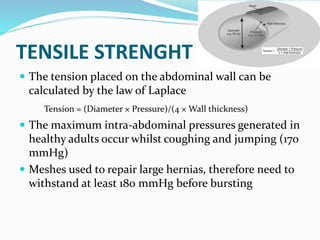
TENSILE STRENGHT
 The tension placed on the abdominal wall can be
calculated by the law of Laplace
Tension = (Diameter × Pressure)/(4 × Wall thickness)
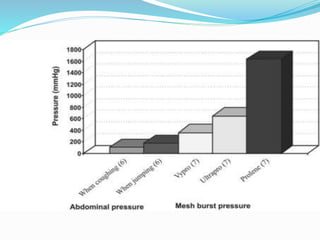
 The maximum intra-abdominal pressures generated in
healthy adults occur whilst coughing and jumping (170
mmHg)
 Meshes used to repair large hernias, therefore need to
withstand at least 180 mmHg before bursting
PORE SIZE
 Porosity is the main determinant of tissue reaction
 Pores must be more than 75 μm in order to allow
infiltration by macrophages, fibroblasts, blood vessels
and collagen
 Meshes with larger pores allow increased soft tissue in-
growth and are more flexible because of the avoidance
of granuloma bridging
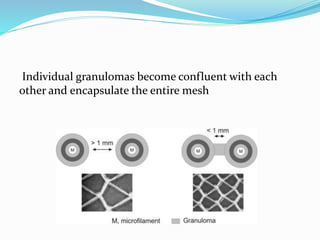
 Granulomas normally form around individual mesh
fibres as part of the foreign body reaction
 This leads to a stiff scar plate and reduced flexibility. It
occurs in meshes with small pores of less than 800 μm.
Individual granulomas become confluent with each
other and encapsulate the entire mesh
WEIGHT
 The weight of the mesh depends on both the weight of the polymer and
the amount of material used (pore size)
 Heavy-weight meshes use thick polymers, have small pore sizes and
high tensile strength. These meshes typically weigh 100 g/m2. The
strength is derived from a large mass of material, which activates a
profound tissue reaction and dense scarring.
 Light-weight meshes are composed of thinner filaments and have
larger pores (> 1 mm). Their weight is typically 33 g/m2.
 They initiate a less pronounced foreign body reaction and are more
elastic. Despite a reduced tensile strength, they can still withstand
pressures above the maximum abdominal pressure of 170 mmHg
 A new generation of even lighter meshes include the
titanium/propylene composite meshes. These have been shown to be
associated with a more rapid recovery in a recent, randomised
controlled trial
REACTIVITY/BIOCOMPATIBILITY
 Modern biomaterials are physically and chemically inert.
 They are generally stable, non-immunogenic and non-toxic.
 Despite this, they are not biologically inert. A foreign body
reaction is triggered by their presence.
 This involves inflammation, fibrosis, calcification, thrombosis
and formation of granulomas
 Meshes also appear to alter collagen composition. During normal
scar healing, the initial, immature, type III collagen is rapidly
replaced by stronger, type I collagen. This process is delayed in
the presence of a foreign body such as a mesh. The result is a
much lower ratio of type I/III collagen, leading to reduced
mechanical stability. This effect occurs regardless of the type of
mesh used
ELASTICITY
 The natural elasticity of abdominal wall at 32 N/cm is
about 38%.
 Light-weight meshes have an elasticity of about 20–
35% elasticity at 16 N/cm.
 Heavy-weight meshes have only half this elasticity (4–
16% at 16 N/cm) and can restrict abdominal
distension.
CONSTITUTION
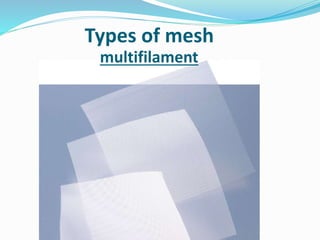
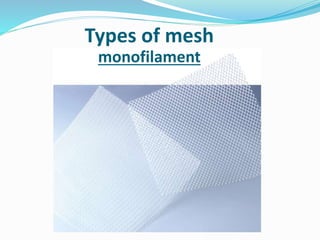
 Mesh fibres can be monofilament, multifilament
(braided), or patches (for example, ePTFE).
 Multifilament fibres have a higher risk of infection.
* Expanded polymer, polytetrafluoroethylene
SHRINKAGE
 Shrinkage occurs due to contraction of the scar tissue
formed around the mesh.
 Scar tissue shrinks to about 60% of the former surface
area of the wound.
 The smaller pores of heavy-weight meshes lead to
more shrinkage due to the formation of a scar plate.
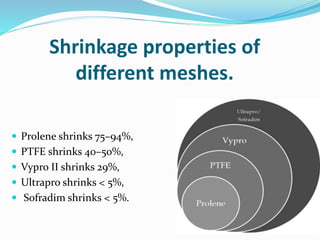
Shrinkage properties of
different meshes.
 Prolene shrinks 75–94%,
 PTFE shrinks 40–50%,
 Vypro II shrinks 29%,
 Ultrapro shrinks < 5%,
 Sofradim shrinks < 5%.
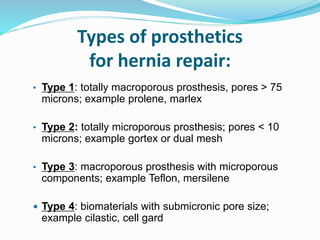
Types of prosthetics
for hernia repair:
• Type 1: totally macroporous prosthesis, pores > 75
microns; example prolene, marlex
• Type 2: totally microporous prosthesis; pores < 10
microns; example gortex or dual mesh
• Type 3: macroporous prosthesis with microporous
components; example Teflon, mersilene
 Type 4: biomaterials with submicronic pore size;
example cilastic, cell gard
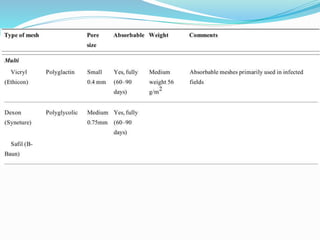
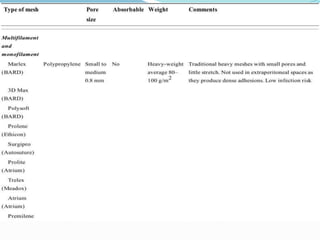
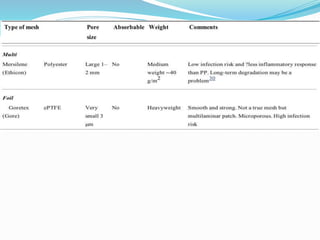
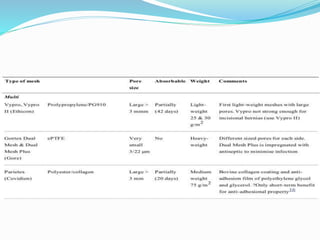
multifilament
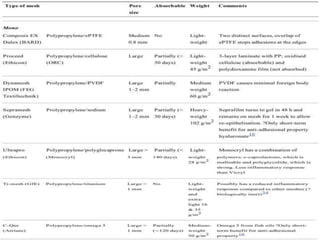
Types of mesh
monofilament
Types of mesh
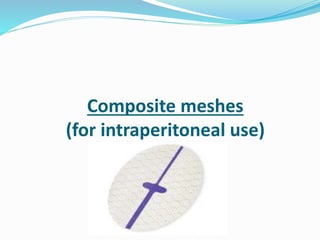
Composite meshes
(for intraperitoneal use)
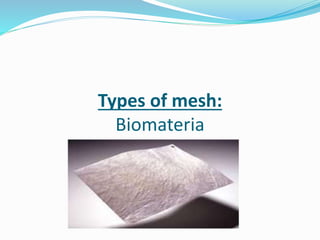
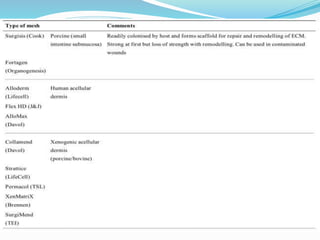
Types of mesh:
Biomateria
Complications of meshes
 Most complications are merely a reflection of the
properties already described.
 Thus, when choosing a mesh, the surgeon must decide
which properties are the most important for the
specific situation.
 For example, materials such as ePTFE have a good
profile for adhesion risk but a high risk of infection.
 Incontrast, Polypropylene meshes are durable and
have a low infection risk but they have little flexibility
and a high adhesion risk.
INFECTION RISK
INFECTION RISK
 Mesh infection is feared because it is difficult to eradicate without removing
the mesh and can become clinically apparent many years after implantation.
 Mesh infection remains about 0.1–3%, although this is obviously higher in the
infected fields, for example, in parastomal hernia repair.
 Although widely practiced, there is no evidence that routine prophylaxis with
antibiotics confers any protection against infection.
 In contrast there is some evidence that the infection risk can be lowered by
impregnating meshes with antiseptics.
 The risk of infection is mainly determined by the type of filament used and
pore size.
 Microporous meshes (for example, ePTFE) are at higher risk of infection
because macrophages and neutrophils are unable to enter small pores (< 10
μm). This allows bacteria (< 1 μm) to survive unchallenged within the pores. A
similar problem applies to multifilament meshes.
 The meshes at lowest risk of infection are, therefore, those made with
monofilament and containing pores greater than 75 μm. Eradication of
infection in such meshes can be achieved without their removal.
ADHESION RISK
ADHESION RISK
 The popularisation of laparoscopic intraperitoneal mesh placement
has led to increasing concern regarding mesh-related adhesions.
 Adhesions result from the fibrin exudates that follow any kind of
trauma. These exudates form temporary adhesions until the
fibrinolytic system absorbs the fibrin.
 Absorption is delayed in the presence ischaemia, inflammation or
foreign bodies (for example, meshes). In these situations, they mature
into tissue adhesions.
 All meshes produce adhesions when placed adjacent to bowel, but their
extent is determined by pore size, filament structure and surface area.
 Heavy-weight meshes induce an intense fibrotic reaction which
ensures strong adherence to the abdominal wall but also causes dense
adhesions.
 In contrast, microporous ePTFE does not allow tissue in-growth. It has
a very low risk of adhesion formation, but is unable to adhere strongly
to the abdominal wall.
ADHESION RISK
 These two extremes illustrate the difficulty of producing a mesh
which will adhere well to the abdominal wall but not to the
bowel.
 Composite meshes aim to do this by providing an additional

surface which can be safely placed in contact with bowel whilst
peritoneal mesothelial cells grow over the mesh.
 It takes up to 7 days to regenerate peritoneum; however, once
formed, it should prevent adhesion formation to the mesh.
 Until recently, the standard composite mesh was a PP/ePTFE
mix, but there are now a large variety of substances available,
including PVDF, cellulose and omega-3 fatty acids.
 Unfortunately, there is evidence to suggest that most of these
only prevent adhesion formation in the short term and the effect
is diminished after 30 days. In some types, it is also possible for
the layers to separate and become adherent to bowel.
RECURRENCE
RECURRENCE
 The use of meshes is thought to reduce dramatically the
incidence of hernia recurrence. Quoted rates vary greatly
between studies, but most describe a reduction in the rate of
recurrence by at least half when using a mesh (for example, for
incisional hernias this is reduced from 17–67% to 1–32%).
 In nearly all cases, recurrent herniation occurs at the edges of
meshes. This is commonly due to inadequate fixation, or
underestimation of shrinkage of the mesh, at the original
operation.
 There is little evidence that recurrence is related to the type of
mesh used,although it has been proposed that light-weight
meshes have a higher risk due to their increased flexibility and
movement.
 Other known risk factors include postoperative infection,
seroma and haematoma.
RECURRENCE
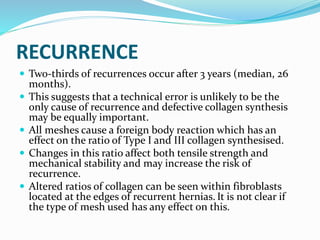
 Two-thirds of recurrences occur after 3 years (median, 26
months).
 This suggests that a technical error is unlikely to be the
only cause of recurrence and defective collagen synthesis
may be equally important.
 All meshes cause a foreign body reaction which has an
effect on the ratio of Type I and III collagen synthesised.
 Changes in this ratio affect both tensile strength and
mechanical stability and may increase the risk of
recurrence.
 Altered ratios of collagen can be seen within fibroblasts
located at the edges of recurrent hernias. It is not clear if
the type of mesh used has any effect on this.
PAIN
PAIN
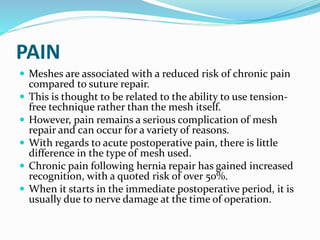
 Meshes are associated with a reduced risk of chronic pain
compared to suture repair.
 This is thought to be related to the ability to use tension-
free technique rather than the mesh itself.
 However, pain remains a serious complication of mesh
repair and can occur for a variety of reasons.
 With regards to acute postoperative pain, there is little
difference in the type of mesh used.
 Chronic pain following hernia repair has gained increased
recognition, with a quoted risk of over 50%.
 When it starts in the immediate postoperative period, it is
usually due to nerve damage at the time of operation.
PAIN
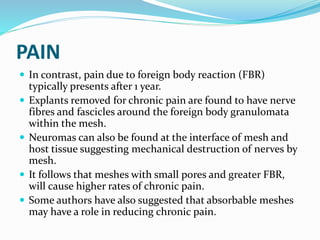
 In contrast, pain due to foreign body reaction (FBR)
typically presents after 1 year.
 Explants removed for chronic pain are found to have nerve
fibres and fascicles around the foreign body granulomata
within the mesh.
 Neuromas can also be found at the interface of mesh and
host tissue suggesting mechanical destruction of nerves by
mesh.
 It follows that meshes with small pores and greater FBR,
will cause higher rates of chronic pain.
 Some authors have also suggested that absorbable meshes
may have a role in reducing chronic pain.
MESH DEGRADATION
MESH DEGRADATION
 Degradation of meshes is rare and mainly seen in
polyester meshes.
 Degradation may be due to hydrolysis, resulting in
brittleness and loss of mechanical strength.
 Calcification can also occur but has only been
documented in meshes with small pores.
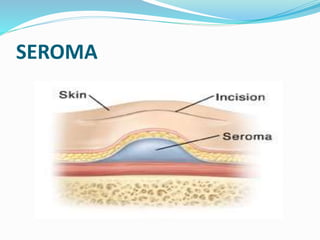
SEROMA
SEROMA
 Seromas develop with any mesh type but those with
larger pores may be less likely to do so
Which mesh should surgeons use?
 When choosing a mesh, the surgeon must consider the context
in which it is to be used.
 In most situations, one should look for a light-weight mesh, with
large pores and minimal surface area. Ideally, it should consist of
a monofilament. A polypropylene or polyester mesh is, therefore,
usually suitable (for example, Paritiene Light, Optilene,
Mersilene).
 These meshes will be more comfortable and have a lower risk of
infection. If the mesh is to be placed inside the peritoneal cavity,
an attempt should be made to minimise adhesions by choosing a
hybrid mesh with an absorbable surface.
 Despite manufacturers' claims, the differences between the
various types of these are unproven and it is currently difficult to
recommend a single material.
Which mesh should surgeons use?
 In infected wounds, an absorbable mesh is preferred, for
example, polyglactin (Vicryl) or polyglycolic (Dexon).
 Biomaterials may also be useful in this situation if the
additional cost can be justified.
 Finally, the surgeon should not forget that the way the
mesh is placed is as important as the type of mesh used.
 If a mesh is too small or fixed under tension, there will be
complications whatever its material.
 Despite the new implants available, surgical skill still has a
role in preventing hernia recurrence!
THANK YOU
“If we could artificially produce tissues of
the density and toughness of fascia, the
secret of the radical cure of hernia would
be discovered”.
Theodore Billroth, 1857

Types of mesh &amp; complications

  • 1.
    By Dr. G ChiragKrishna Yadav Moderator Dr. C Ananda Reddy
  • 2.
    “A surgeon cando more for the community by operating on hernia cases and seeing that his recurrence rate is low, than he can, by operating on cases of malignant disease” Sir Cecil Wakely, 1948 President Royal College of Surgeons
  • 3.
    The most importantfunctions of the abdominal wall are:  protection, compression and retention of the abdominal contents  flexion and rotation of the trunk  forced expiration
  • 4.
    Factors influencing ventral herniaoccurrence ENDOGENE  Age > 45  BMI > 25  previous operation  anemia  shock  smoker  Corticoïds  Aneurysm/Marfan (+30% risks) EXOGENE  Sutures  Length of incision  Contamination  Medication  Type of incision
  • 5.
  • 6.
    In humans theintra-abdominal pressure ranges from 0.2kPa (resting) to 20kPa (maximum).
  • 7.
    Abdominal Wall Elasticity After the Intra-abdominal pressure, another important factor in the abdominal wall repair plays a role, it is the abdominal wall elasticity.  The abdominal wall is elastic.  The abdominal wall elasticity was studied by Pr Schumpelick and his team*  He showed that the abdominal wall of a women is more elastic than the abdomen of a man.
  • 8.
  • 9.
  • 10.
  • 11.
  • 12.
  • 13.
    PROPERTIES OF IDEALMESH  Possess good handling characteristics in the OR  Invoke a favourable host response  Be strong enough to prevent recurrence  Place no restrictions on post implantation function  Perform well in the presence of infection  Resist shrinkage or degradation over time  Make no restrictions on future access  Block transmission of infectious disease  Be inexpensive  Be easy to manufacture
  • 14.
    Physical or mechanicalproperties of mesh materials Term Definitiona Weight Measurement of the “heaviness” or “heft” of the material, weight /unit area Shrinkage Dimensional decrease in length or width of a material Strain Deformation of a material in response to an applied force, force/unit area Tensile strength Maximum stress that a material subject to a stretching load can withstand without tearing or breaking Burst strength The maximum uniformly distributed pressure applied at right angle to its surface that a material will withstand under standardized conditions pressure/unit area Elasticity Property of a material whereby it changes its shape and size under the action of opposing forces, but recovers its original configuration when the forces are removed Stiffness Ratio of steadily increasing or decreasing force acting on a deformable elastic material to the resulting displacement or deformation Compliance Unit displacement or deformation of a material as the result of application of a unit force Isotropy When a material do not exhibit differences in properties based on the direction of the applied load, the material is said to be isotropic Term Definition Weight Measurement of the “heaviness” or “heft” of the material, weight /unit area Shrinkage Dimensional decrease in length or width of a material Strain Deformation of a material in response to an applied force, force/unit area Tensile strength Maximum stress that a material subject to a stretching load can withstand without tearing or breaking Burst strength The maximum uniformly distributed pressure applied at right angle to its surface that a material will withstand under standardized conditions pressure/unit area Elasticity Property of a material whereby it changes its shape and size under the action of opposing forces, but recovers its original configuration when the forces are removed Stiffness Ratio of steadily increasing or decreasing force acting on a deformable elastic material to the resulting displacement or deformation Compliance Unit displacement or deformation of a material as the result of application of a unit force Isotropy When a material do not exhibit differences in properties based on the direction of the applied load, the material is said to be isotropic
  • 15.
    TENSILE STRENGHT  Thetension placed on the abdominal wall can be calculated by the law of Laplace Tension = (Diameter × Pressure)/(4 × Wall thickness)  The maximum intra-abdominal pressures generated in healthy adults occur whilst coughing and jumping (170 mmHg)  Meshes used to repair large hernias, therefore need to withstand at least 180 mmHg before bursting
  • 17.
    PORE SIZE  Porosityis the main determinant of tissue reaction  Pores must be more than 75 μm in order to allow infiltration by macrophages, fibroblasts, blood vessels and collagen  Meshes with larger pores allow increased soft tissue in- growth and are more flexible because of the avoidance of granuloma bridging  Granulomas normally form around individual mesh fibres as part of the foreign body reaction  This leads to a stiff scar plate and reduced flexibility. It occurs in meshes with small pores of less than 800 μm.
  • 18.
    Individual granulomas becomeconfluent with each other and encapsulate the entire mesh
  • 19.
    WEIGHT  The weightof the mesh depends on both the weight of the polymer and the amount of material used (pore size)  Heavy-weight meshes use thick polymers, have small pore sizes and high tensile strength. These meshes typically weigh 100 g/m2. The strength is derived from a large mass of material, which activates a profound tissue reaction and dense scarring.  Light-weight meshes are composed of thinner filaments and have larger pores (> 1 mm). Their weight is typically 33 g/m2.  They initiate a less pronounced foreign body reaction and are more elastic. Despite a reduced tensile strength, they can still withstand pressures above the maximum abdominal pressure of 170 mmHg  A new generation of even lighter meshes include the titanium/propylene composite meshes. These have been shown to be associated with a more rapid recovery in a recent, randomised controlled trial
  • 20.
    REACTIVITY/BIOCOMPATIBILITY  Modern biomaterialsare physically and chemically inert.  They are generally stable, non-immunogenic and non-toxic.  Despite this, they are not biologically inert. A foreign body reaction is triggered by their presence.  This involves inflammation, fibrosis, calcification, thrombosis and formation of granulomas  Meshes also appear to alter collagen composition. During normal scar healing, the initial, immature, type III collagen is rapidly replaced by stronger, type I collagen. This process is delayed in the presence of a foreign body such as a mesh. The result is a much lower ratio of type I/III collagen, leading to reduced mechanical stability. This effect occurs regardless of the type of mesh used
  • 21.
    ELASTICITY  The naturalelasticity of abdominal wall at 32 N/cm is about 38%.  Light-weight meshes have an elasticity of about 20– 35% elasticity at 16 N/cm.  Heavy-weight meshes have only half this elasticity (4– 16% at 16 N/cm) and can restrict abdominal distension.
  • 22.
    CONSTITUTION  Mesh fibrescan be monofilament, multifilament (braided), or patches (for example, ePTFE).  Multifilament fibres have a higher risk of infection. * Expanded polymer, polytetrafluoroethylene
  • 23.
    SHRINKAGE  Shrinkage occursdue to contraction of the scar tissue formed around the mesh.  Scar tissue shrinks to about 60% of the former surface area of the wound.  The smaller pores of heavy-weight meshes lead to more shrinkage due to the formation of a scar plate.
  • 24.
    Shrinkage properties of differentmeshes.  Prolene shrinks 75–94%,  PTFE shrinks 40–50%,  Vypro II shrinks 29%,  Ultrapro shrinks < 5%,  Sofradim shrinks < 5%.
  • 25.
    Types of prosthetics forhernia repair: • Type 1: totally macroporous prosthesis, pores > 75 microns; example prolene, marlex • Type 2: totally microporous prosthesis; pores < 10 microns; example gortex or dual mesh • Type 3: macroporous prosthesis with microporous components; example Teflon, mersilene  Type 4: biomaterials with submicronic pore size; example cilastic, cell gard
  • 26.
  • 27.
  • 31.
  • 34.
  • 36.
    Complications of meshes Most complications are merely a reflection of the properties already described.  Thus, when choosing a mesh, the surgeon must decide which properties are the most important for the specific situation.  For example, materials such as ePTFE have a good profile for adhesion risk but a high risk of infection.  Incontrast, Polypropylene meshes are durable and have a low infection risk but they have little flexibility and a high adhesion risk.
  • 37.
  • 38.
    INFECTION RISK  Meshinfection is feared because it is difficult to eradicate without removing the mesh and can become clinically apparent many years after implantation.  Mesh infection remains about 0.1–3%, although this is obviously higher in the infected fields, for example, in parastomal hernia repair.  Although widely practiced, there is no evidence that routine prophylaxis with antibiotics confers any protection against infection.  In contrast there is some evidence that the infection risk can be lowered by impregnating meshes with antiseptics.  The risk of infection is mainly determined by the type of filament used and pore size.  Microporous meshes (for example, ePTFE) are at higher risk of infection because macrophages and neutrophils are unable to enter small pores (< 10 μm). This allows bacteria (< 1 μm) to survive unchallenged within the pores. A similar problem applies to multifilament meshes.  The meshes at lowest risk of infection are, therefore, those made with monofilament and containing pores greater than 75 μm. Eradication of infection in such meshes can be achieved without their removal.
  • 39.
  • 40.
    ADHESION RISK  Thepopularisation of laparoscopic intraperitoneal mesh placement has led to increasing concern regarding mesh-related adhesions.  Adhesions result from the fibrin exudates that follow any kind of trauma. These exudates form temporary adhesions until the fibrinolytic system absorbs the fibrin.  Absorption is delayed in the presence ischaemia, inflammation or foreign bodies (for example, meshes). In these situations, they mature into tissue adhesions.  All meshes produce adhesions when placed adjacent to bowel, but their extent is determined by pore size, filament structure and surface area.  Heavy-weight meshes induce an intense fibrotic reaction which ensures strong adherence to the abdominal wall but also causes dense adhesions.  In contrast, microporous ePTFE does not allow tissue in-growth. It has a very low risk of adhesion formation, but is unable to adhere strongly to the abdominal wall.
  • 41.
    ADHESION RISK  Thesetwo extremes illustrate the difficulty of producing a mesh which will adhere well to the abdominal wall but not to the bowel.  Composite meshes aim to do this by providing an additional surface which can be safely placed in contact with bowel whilst peritoneal mesothelial cells grow over the mesh.  It takes up to 7 days to regenerate peritoneum; however, once formed, it should prevent adhesion formation to the mesh.  Until recently, the standard composite mesh was a PP/ePTFE mix, but there are now a large variety of substances available, including PVDF, cellulose and omega-3 fatty acids.  Unfortunately, there is evidence to suggest that most of these only prevent adhesion formation in the short term and the effect is diminished after 30 days. In some types, it is also possible for the layers to separate and become adherent to bowel.
  • 42.
  • 43.
    RECURRENCE  The useof meshes is thought to reduce dramatically the incidence of hernia recurrence. Quoted rates vary greatly between studies, but most describe a reduction in the rate of recurrence by at least half when using a mesh (for example, for incisional hernias this is reduced from 17–67% to 1–32%).  In nearly all cases, recurrent herniation occurs at the edges of meshes. This is commonly due to inadequate fixation, or underestimation of shrinkage of the mesh, at the original operation.  There is little evidence that recurrence is related to the type of mesh used,although it has been proposed that light-weight meshes have a higher risk due to their increased flexibility and movement.  Other known risk factors include postoperative infection, seroma and haematoma.
  • 44.
    RECURRENCE  Two-thirds ofrecurrences occur after 3 years (median, 26 months).  This suggests that a technical error is unlikely to be the only cause of recurrence and defective collagen synthesis may be equally important.  All meshes cause a foreign body reaction which has an effect on the ratio of Type I and III collagen synthesised.  Changes in this ratio affect both tensile strength and mechanical stability and may increase the risk of recurrence.  Altered ratios of collagen can be seen within fibroblasts located at the edges of recurrent hernias. It is not clear if the type of mesh used has any effect on this.
  • 45.
  • 46.
    PAIN  Meshes areassociated with a reduced risk of chronic pain compared to suture repair.  This is thought to be related to the ability to use tension- free technique rather than the mesh itself.  However, pain remains a serious complication of mesh repair and can occur for a variety of reasons.  With regards to acute postoperative pain, there is little difference in the type of mesh used.  Chronic pain following hernia repair has gained increased recognition, with a quoted risk of over 50%.  When it starts in the immediate postoperative period, it is usually due to nerve damage at the time of operation.
  • 47.
    PAIN  In contrast,pain due to foreign body reaction (FBR) typically presents after 1 year.  Explants removed for chronic pain are found to have nerve fibres and fascicles around the foreign body granulomata within the mesh.  Neuromas can also be found at the interface of mesh and host tissue suggesting mechanical destruction of nerves by mesh.  It follows that meshes with small pores and greater FBR, will cause higher rates of chronic pain.  Some authors have also suggested that absorbable meshes may have a role in reducing chronic pain.
  • 48.
  • 49.
    MESH DEGRADATION  Degradationof meshes is rare and mainly seen in polyester meshes.  Degradation may be due to hydrolysis, resulting in brittleness and loss of mechanical strength.  Calcification can also occur but has only been documented in meshes with small pores.
  • 50.
  • 51.
    SEROMA  Seromas developwith any mesh type but those with larger pores may be less likely to do so
  • 52.
    Which mesh shouldsurgeons use?
  • 53.
    Which mesh shouldsurgeons use?  When choosing a mesh, the surgeon must consider the context in which it is to be used.  In most situations, one should look for a light-weight mesh, with large pores and minimal surface area. Ideally, it should consist of a monofilament. A polypropylene or polyester mesh is, therefore, usually suitable (for example, Paritiene Light, Optilene, Mersilene).  These meshes will be more comfortable and have a lower risk of infection. If the mesh is to be placed inside the peritoneal cavity, an attempt should be made to minimise adhesions by choosing a hybrid mesh with an absorbable surface.  Despite manufacturers' claims, the differences between the various types of these are unproven and it is currently difficult to recommend a single material.
  • 54.
    Which mesh shouldsurgeons use?  In infected wounds, an absorbable mesh is preferred, for example, polyglactin (Vicryl) or polyglycolic (Dexon).  Biomaterials may also be useful in this situation if the additional cost can be justified.  Finally, the surgeon should not forget that the way the mesh is placed is as important as the type of mesh used.  If a mesh is too small or fixed under tension, there will be complications whatever its material.  Despite the new implants available, surgical skill still has a role in preventing hernia recurrence!
  • 55.
    THANK YOU “If wecould artificially produce tissues of the density and toughness of fascia, the secret of the radical cure of hernia would be discovered”. Theodore Billroth, 1857