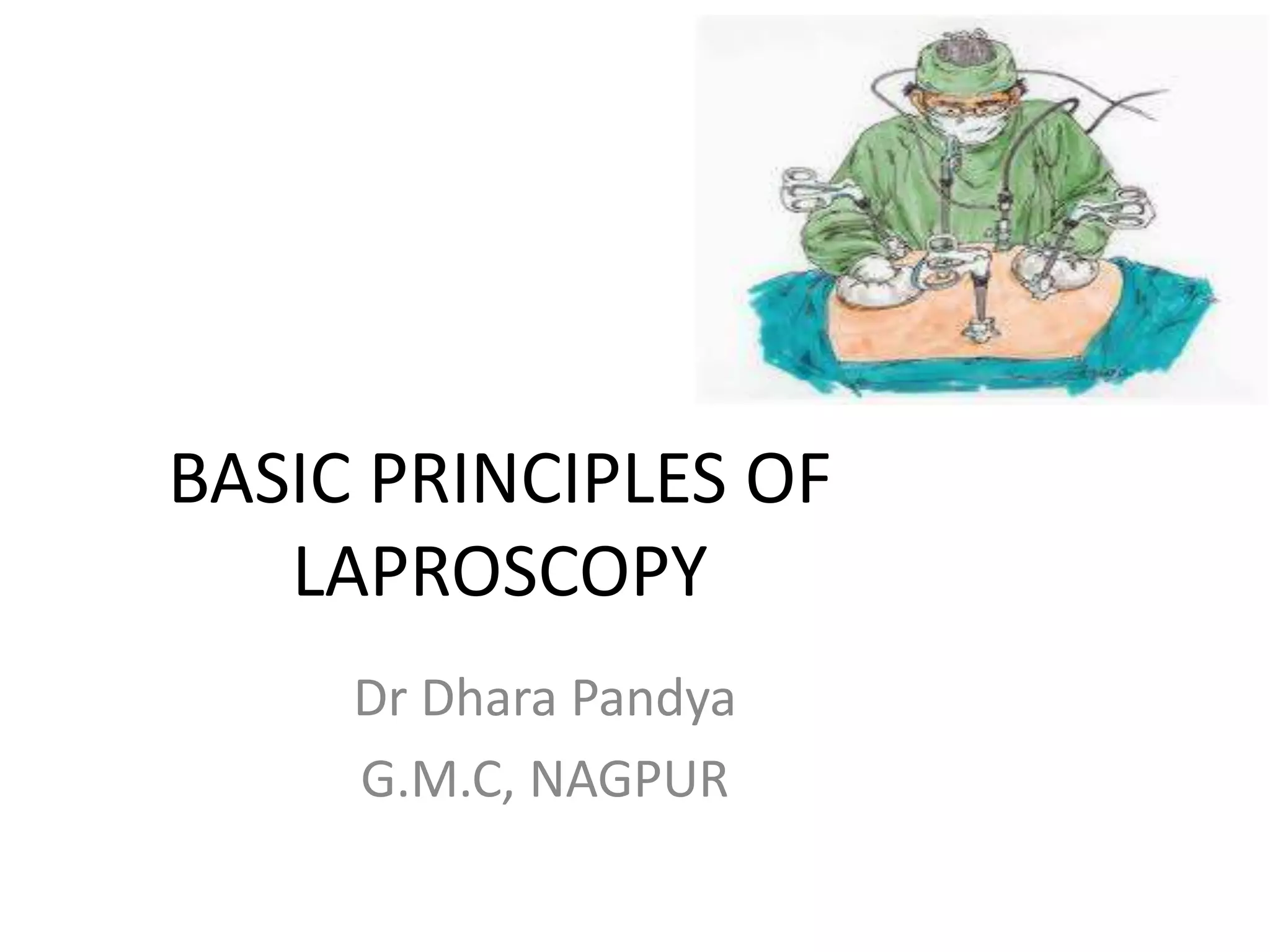
BASIC PRINCIPLES OF
LAPROSCOPY
Dr Dhara Pandya
G.M.C, NAGPUR
Principle Differences between
Laparoscopic and Open Surgery
FOR THE PATIENT
 Post operative pain related to size of incision- smaller
incisions =less pain.
 Less Handling of intestines results in little or no
disturbance of normal function.
 Avoidance of the trauma of abdominal wall injury by
the incision allows rapid return to normal activity
 No incision allows early return to more strenuous
activities: driving, lifting, sport etc.
Principle Differences between
laparoscopic and open surgery
For the Surgeon
 Magnified view often better than obtained via
an incision allows precise dissection.
 Altered (but not absent) tactile response
 Two dimensional (flat screen) view.
 Usually (but not always) longer operating time
 Need to develop entirely different operating
technique
 Adaptation of principles of open surgery to
laparoscopic surgery.
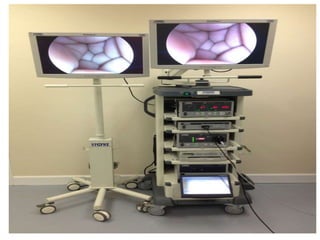
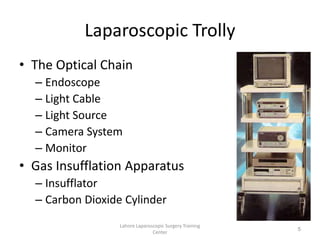
Laparoscopic Trolly
Lahore Laparoscopic Surgery Training
Center
5
• The Optical Chain
– Endoscope
– Light Cable
– Light Source
– Camera System
– Monitor
• Gas Insufflation Apparatus
– Insufflator
– Carbon Dioxide Cylinder
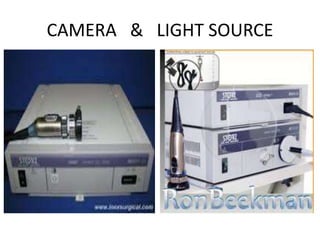
CAMERA & LIGHT SOURCE
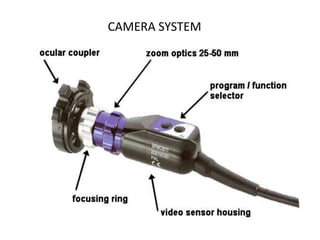
CAMERA SYSTEM
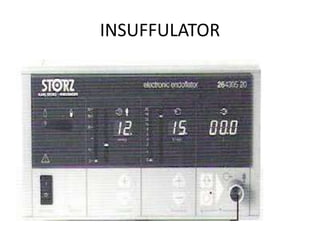
INSUFFULATOR
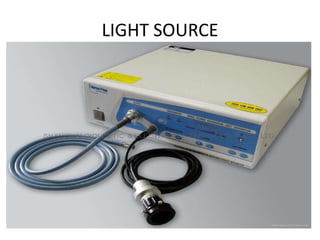
LIGHT SOURCE
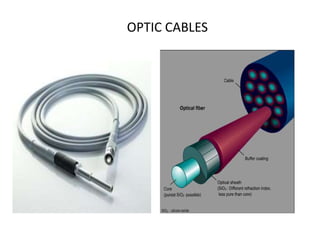
OPTIC CABLES
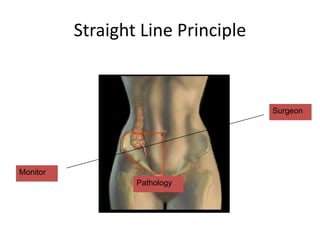
Straight Line Principle
Surgeon
Pathology
Monitor
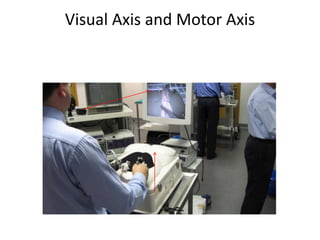
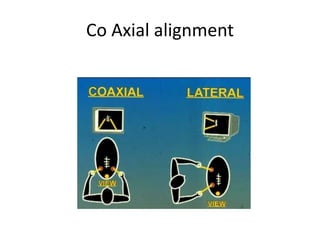
Visual Axis and Motor Axis
Co Axial alignment
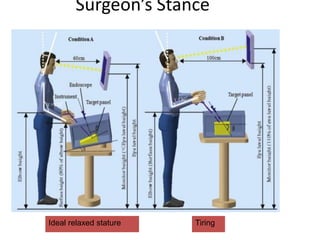
Surgeon’s Stance
Ideal relaxed stature Tiring
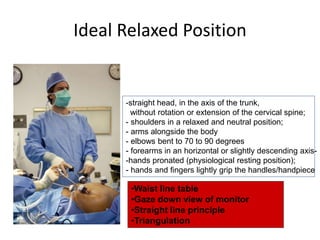
Ideal Relaxed Position
-straight head, in the axis of the trunk,
without rotation or extension of the cervical spine;
- shoulders in a relaxed and neutral position;
- arms alongside the body
- elbows bent to 70 to 90 degrees
- forearms in an horizontal or slightly descending axis-
-hands pronated (physiological resting position);
- hands and fingers lightly grip the handles/handpiece
•Waist line table
•Gaze down view of monitor
•Straight line principle
•Triangulation
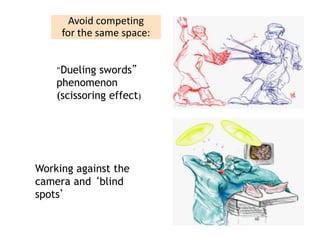
Working against the
camera and ‘blind
spots’
“Dueling swords”
phenomenon
(scissoring effect)
Avoid competing
for the same space:
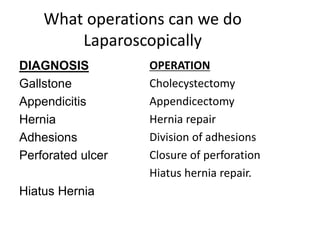
What operations can we do
Laparoscopically
DIAGNOSIS
Gallstone
Appendicitis
Hernia
Adhesions
Perforated ulcer
Hiatus Hernia
OPERATION
Cholecystectomy
Appendicectomy
Hernia repair
Division of adhesions
Closure of perforation
Hiatus hernia repair.
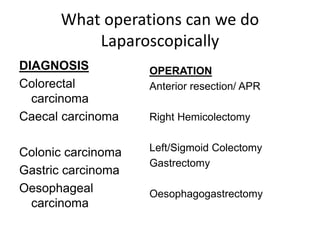
What operations can we do
Laparoscopically
DIAGNOSIS
Colorectal
carcinoma
Caecal carcinoma
Colonic carcinoma
Gastric carcinoma
Oesophageal
carcinoma
OPERATION
Anterior resection/ APR
Right Hemicolectomy
Left/Sigmoid Colectomy
Gastrectomy
Oesophagogastrectomy
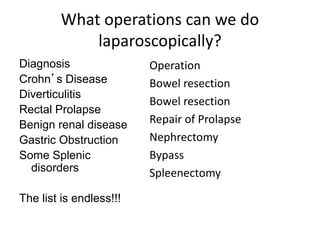
What operations can we do
laparoscopically?
Diagnosis
Crohn’s Disease
Diverticulitis
Rectal Prolapse
Benign renal disease
Gastric Obstruction
Some Splenic
disorders
The list is endless!!!
Operation
Bowel resection
Bowel resection
Repair of Prolapse
Nephrectomy
Bypass
Spleenectomy
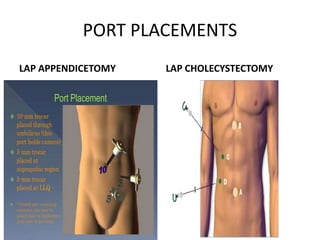
PORT PLACEMENTS
LAP APPENDICETOMY LAP CHOLECYSTECTOMY
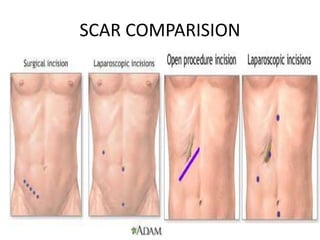
SCAR COMPARISION
Laparoscopic Instruments
• Operative instruments
• Energy sources
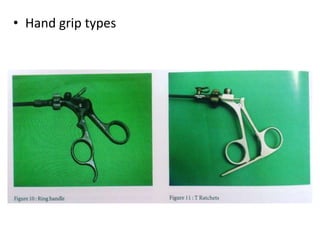
• Hand grip types
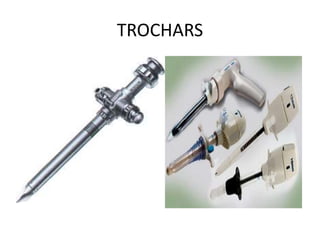
TROCHARS
Operative instruments
• Dissectors
• Scissors
• Retractors
• Forceps
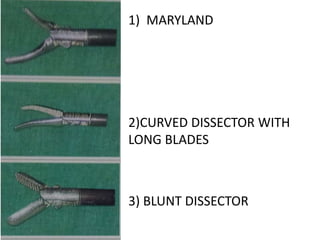
DISSECTORS
1) MARYLAND
2)CURVED DISSECTOR WITH
LONG BLADES
3) BLUNT DISSECTOR
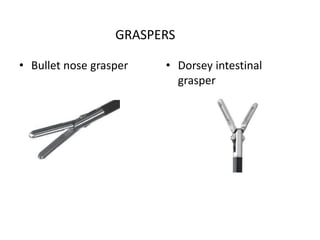
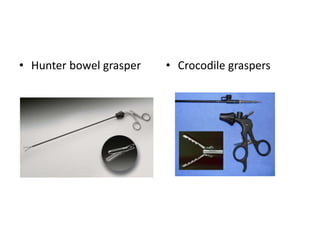
• Bullet nose grasper • Dorsey intestinal
grasper
GRASPERS
• Hunter bowel grasper • Crocodile graspers
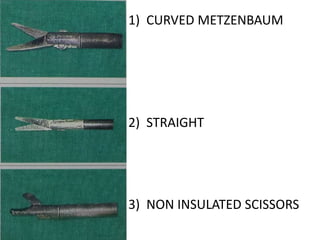
SCISSORS
1) CURVED METZENBAUM
2) STRAIGHT
3) NON INSULATED SCISSORS
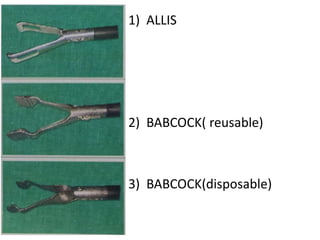
BOWEL CLAMPS
1) ALLIS
2) BABCOCK( reusable)
3) BABCOCK(disposable)
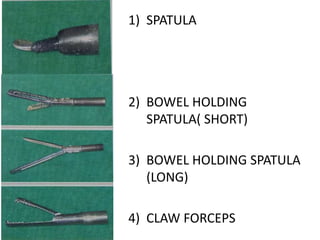
SPATULA
1) SPATULA
2) BOWEL HOLDING
SPATULA( SHORT)
3) BOWEL HOLDING SPATULA
(LONG)
4) CLAW FORCEPS
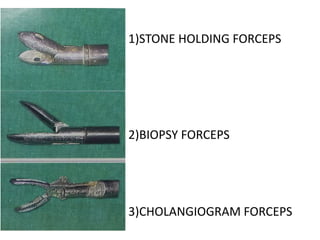
FORCEPS
1)STONE HOLDING FORCEPS
2)BIOPSY FORCEPS
3)CHOLANGIOGRAM FORCEPS
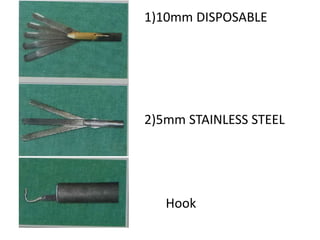
RETRACTORS
1)10mm DISPOSABLE
2)5mm STAINLESS STEEL
Hook
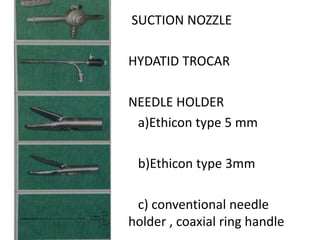
SUCTION NOZZLE
HYDATID TROCAR
NEEDLE HOLDER
a)Ethicon type 5 mm
b)Ethicon type 3mm
c) conventional needle
holder , coaxial ring handle
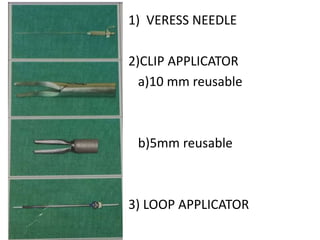
1) VERESS NEEDLE
2)CLIP APPLICATOR
a)10 mm reusable
b)5mm reusable
3) LOOP APPLICATOR
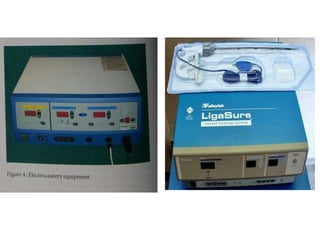
Energy sources
• Electro surgery
• Ligasure
• Argon beam coagulation
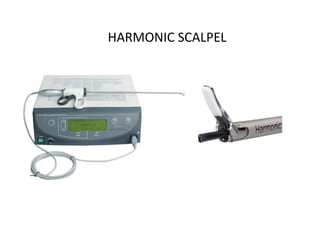
• Ultrasonic dissection
• Cavitational ultrasonic surgical aspirator
(CUSA)
HARMONIC SCALPEL
COMPLICATIONS OF
LAPAROSCOPIC SURGERIES
1. Anaesthetics Complications
2. Complications due to pneumoperitonium
3. Surgical complications
4. Diathermy related injuries
5. Patients factors related complications
6. Post operative complications
CONTRAINDICATIONS
Absolute :
• Generalized peritonitis
• Intestinal obstruction
• Clotting abnormalities
• Liver cirrhosis
• Failure to tolerate general anesthesia
• Uncontrolled shock
Relative :
• Multiple abdominal adhesions
• Organomegaly
• Abdominal aortic aneurysm
Emerging Technologies
• Robotics
• SILS
• NOTES
• Trocarless laparoscopy
• ENDOBARRIER
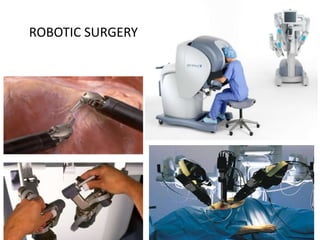
ROBOTIC SURGERY
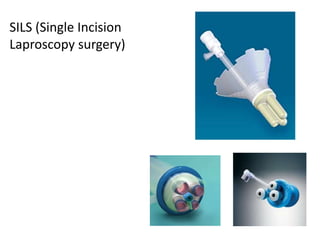
SILS (Single Incision
Laproscopy surgery)
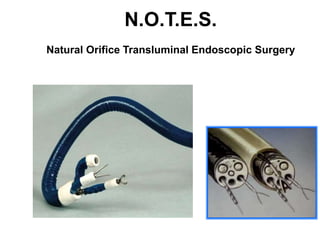
N.O.T.E.S.
Natural Orifice Transluminal Endoscopic Surgery
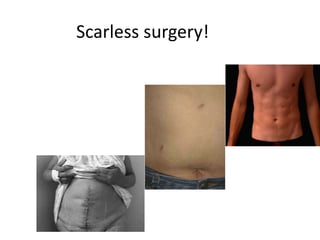
Scarless surgery!
THANK YOU!!!

BASICS PRINCIPLES OF LAPROSCOPY