The Surgery for Rectal Cancer Nick Rieger Associate Professor University of Adelaide South Australia
Surgical considerations “What is a surgeon thinking” The patient The tumour Preoperative chemoradiotherapy The Operation (TME) Postoperative dysfunction Postoperative chemoradiotherapy
The Patient Age Sex Male vs Female Build (BMI) Co-morbidities Cognition Ability to manage a Stoma
The Tumour Height from anal verge Circumferential relationships Size Tumour depth (T stage) Distant metastasis Rectal examination Imaging    CT, MRI, ENUS
Rectal Anatomy 15   cm High Anterior Resection Low Anterior Resection Ultralow Anterior Resection Abdominoperineal Resection
Endorectal Ultrasound
MRI
Rectal cancer Cooperative trials Local recurrence rates 25-35% NIH consensus adjuvant chemotherapy and radiotherapy for T3 and N1 rectal adenocarcinoma Wide surgeon variability for Local Recurrence and Survival.
Pre-operative Chemoradiotherapy Before After
Pre-operative Chemoradiotherapy T3 / T4 Tumours Down stage tumour Long course (5-6 weeks) Short course (1 week) Reduced local recurrence Improved survival
Total Mesorectal Excision An operation for Rectal Cancer Low rate of Local Recurrence after “curative” resection. The term initially introduced by Bill Heald (UK) in 1982 Many surgeons had practised this concept of surgery prior to the introduction of the term “TME”
Bill Heald Archives of Surgery 1998 405 curative resections / No radiotherapy Local Recurrence 3% at 5 years Local Recurrence 4% at 10 years Disease free survival 80% at 5 years Disease free survival 78% at 10 years
Local Recurrence What is Important? Circumferential margins Distal margin Removal mesorectal envelope containing all the lymph nodes Cytocidal rectal washout Radiotherapy - pre and post operative YOUR SURGEON
TME   Rectal cancer spreads to lymph nodes in the mesorectum This may be in nodes below the inferior margin of the cancer Particularly relevant in cancers of the middle and lower thirds of the rectum
TME
TME
TME Leak Rate Karanjia, Heald et al BJS 1994 219 LAR with TME Major leak (abscess or peritonitis) 11% Minor leak (contrast enema) 6.4%
TME Nerve preservation (sexual and bladder function) Low anastomosis - Reduced APR Low anastomosis - Colonic pouch Higher anastomotic leak rate Higher rate covering stoma ? Negates the need for routine use of radiotherapy
Modified TME Distal spread of adenocarcinoma either in the rectal wall or mesorectum greater than 2-3 cm is rare. When it occurs it is with advanced tumours and associated with a poor prognosis. The need to remove the mesorectum more than 5 cm below the tumour is not proven and unnecessary and will increase the rate of anastomotic leakage (devascularised rectal stump)
Modified TME 5 cm 5 cm
Rectal Ultrasound
The Technique Pre-operative Consent Bowel preparation Stomal therapy and siting for stoma DVT prophylaxis Antibiotics Urinary catheter
The Technique Set-up Extended Lloyd-Davies position Good assistance Long midline incision Wide retraction Small bowel packed out of the way Full laparotomy (liver etc)
Operative Position
The Technique Colonic Mobilisation Transverse, Splenic flexure and Descending colon mobilised High ligation inferior mesenteric artery on the aorta High ligation inferior mesenteric vein at the lower border of the pancreas Preservation of ureter, gonadal vessels, and hypogastric nerves
Mobilisation Sigmoid Colon “Ureter”
Splenic Flexure Mobilised
High Ligation Inferior  Mesenteric Artery
Ligation Inferior Mesenteric Vein and Exposure of the Spleen
Full Bowel Mobilisation
The Technique Posterior Rectal Dissection Develop the plane at the pelvic brim anterior to the hypogastric nerves and posterior to the superior rectal artery.  Enter the areolar space between the mesorectal fascia and the sacral fascia. Do not  “cone in”  on the mesorectum Sharp dissection or diathermy Avoid blunt dissection St Marks retractor
St Mark’s Retractor
The Technique Posterior Rectal Dissection
The Technique Anterior Rectal Dissection Divide the anterior peritoneum of rectovesical or rectouterine pouch above and anterior to its apex Develop the plane between the seminal vesical or vagina anterior to Denonvilliers fascia Continue dissection to pelvic floor
The Technique Anterior Rectal Dissection
The Technique Transection of Rectum Mesorectum at least 5 cm below tumour (modified TME) or at pelvic floor. Cross clamp or staple below tumour Rectal cytocidal washout 30 mm stapler at least 2 cm below the tumour Haemostasis
Transverse Staple Line Rectal Stump
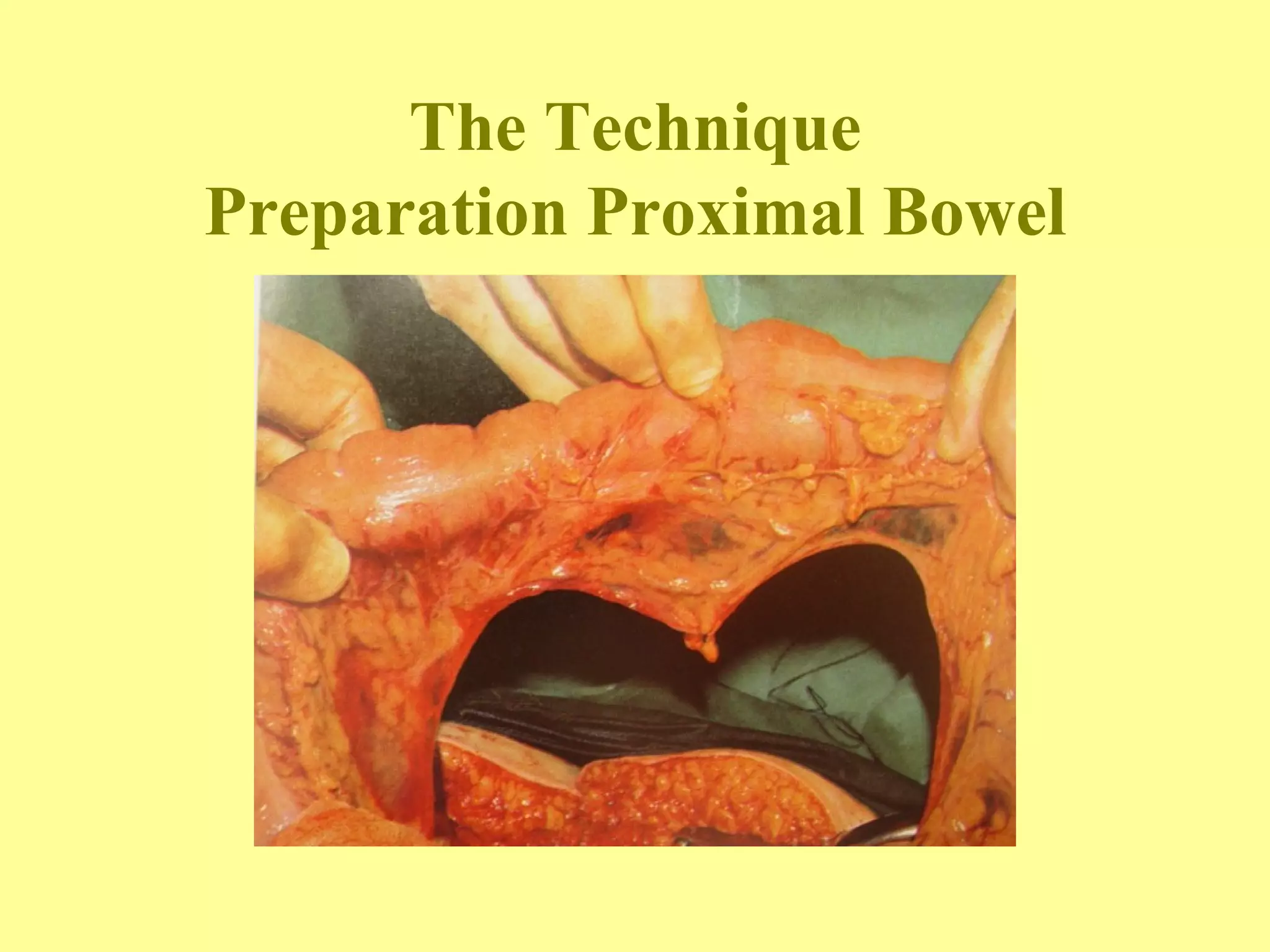
The Technique Preparation Proximal Bowel Ligation mesocolon vessels preserving the marginal artery Avoid using the sigmoid colon  Use the descending colon Fashion colonic pouch if ULAR Insert purse-string suture and head of circular staple gun
The Technique Preparation Proximal Bowel
Transected Bowel
Staple Gun Head
The Technique Anastomosis Ensure colon not twisted Ensure vagina excluded Double staple anastomosis Check donuts and Air test Haemostasis Drain pelvis Loop ileostomy
Mid-rectal Anastomosis Inserting the Staple Gun
Midrectal Anastomosis
Resected Specimen Low anterior resection Abdominoperineal resection
Summary TME associated with low rate of local recurrence Requires meticulous technique and a surgeon familiar with operating in the pelvis Modified TME acceptable for high and mid rectal tumours.
TEMPORARY STOMA (Ileostomy) Dependant on: Height of anastomosis Ease and technical success of operation Well being of the patient (co-morbidities) Surgical conservatism Radiation PERMANENT STOMA (Colostomy) Dependant on: Height of tumour from anal canal Likelihood of continence
Laparoscopy
Postoperative Adjuvant Therapy Multi-disciplinary meeting Chemotherapy  Radiotherapy Age and well-being of the patient Tumour factors
Postoperative Bowel Function Rectum acts as a reservoir Removal leads to replacement with a colonic conduit (neorectum)  “ Anterior resection syndrome” Frequent loose stool, stool clustering, urgency, occasional incontinence Colonic “J” Pouch
Conclusions Results of surgery operator dependent “ Good” surgery must account for the nuances of the patient and the tumour Multidisciplinary approach

The Surgery for Rectal Cancer

  • 1.
    The Surgery forRectal Cancer Nick Rieger Associate Professor University of Adelaide South Australia
  • 2.
    Surgical considerations “Whatis a surgeon thinking” The patient The tumour Preoperative chemoradiotherapy The Operation (TME) Postoperative dysfunction Postoperative chemoradiotherapy
  • 3.
    The Patient AgeSex Male vs Female Build (BMI) Co-morbidities Cognition Ability to manage a Stoma
  • 4.
    The Tumour Heightfrom anal verge Circumferential relationships Size Tumour depth (T stage) Distant metastasis Rectal examination Imaging CT, MRI, ENUS
  • 5.
    Rectal Anatomy 15 cm High Anterior Resection Low Anterior Resection Ultralow Anterior Resection Abdominoperineal Resection
  • 6.
  • 7.
  • 8.
    Rectal cancer Cooperativetrials Local recurrence rates 25-35% NIH consensus adjuvant chemotherapy and radiotherapy for T3 and N1 rectal adenocarcinoma Wide surgeon variability for Local Recurrence and Survival.
  • 9.
  • 10.
    Pre-operative Chemoradiotherapy T3/ T4 Tumours Down stage tumour Long course (5-6 weeks) Short course (1 week) Reduced local recurrence Improved survival
  • 11.
    Total Mesorectal ExcisionAn operation for Rectal Cancer Low rate of Local Recurrence after “curative” resection. The term initially introduced by Bill Heald (UK) in 1982 Many surgeons had practised this concept of surgery prior to the introduction of the term “TME”
  • 12.
    Bill Heald Archivesof Surgery 1998 405 curative resections / No radiotherapy Local Recurrence 3% at 5 years Local Recurrence 4% at 10 years Disease free survival 80% at 5 years Disease free survival 78% at 10 years
  • 13.
    Local Recurrence Whatis Important? Circumferential margins Distal margin Removal mesorectal envelope containing all the lymph nodes Cytocidal rectal washout Radiotherapy - pre and post operative YOUR SURGEON
  • 14.
    TME Rectal cancer spreads to lymph nodes in the mesorectum This may be in nodes below the inferior margin of the cancer Particularly relevant in cancers of the middle and lower thirds of the rectum
  • 15.
  • 16.
  • 17.
    TME Leak RateKaranjia, Heald et al BJS 1994 219 LAR with TME Major leak (abscess or peritonitis) 11% Minor leak (contrast enema) 6.4%
  • 18.
    TME Nerve preservation(sexual and bladder function) Low anastomosis - Reduced APR Low anastomosis - Colonic pouch Higher anastomotic leak rate Higher rate covering stoma ? Negates the need for routine use of radiotherapy
  • 19.
    Modified TME Distalspread of adenocarcinoma either in the rectal wall or mesorectum greater than 2-3 cm is rare. When it occurs it is with advanced tumours and associated with a poor prognosis. The need to remove the mesorectum more than 5 cm below the tumour is not proven and unnecessary and will increase the rate of anastomotic leakage (devascularised rectal stump)
  • 20.
  • 21.
  • 22.
    The Technique Pre-operativeConsent Bowel preparation Stomal therapy and siting for stoma DVT prophylaxis Antibiotics Urinary catheter
  • 23.
    The Technique Set-upExtended Lloyd-Davies position Good assistance Long midline incision Wide retraction Small bowel packed out of the way Full laparotomy (liver etc)
  • 24.
  • 25.
    The Technique ColonicMobilisation Transverse, Splenic flexure and Descending colon mobilised High ligation inferior mesenteric artery on the aorta High ligation inferior mesenteric vein at the lower border of the pancreas Preservation of ureter, gonadal vessels, and hypogastric nerves
  • 26.
  • 27.
  • 28.
    High Ligation Inferior Mesenteric Artery
  • 29.
    Ligation Inferior MesentericVein and Exposure of the Spleen
  • 30.
  • 31.
    The Technique PosteriorRectal Dissection Develop the plane at the pelvic brim anterior to the hypogastric nerves and posterior to the superior rectal artery. Enter the areolar space between the mesorectal fascia and the sacral fascia. Do not “cone in” on the mesorectum Sharp dissection or diathermy Avoid blunt dissection St Marks retractor
  • 32.
  • 33.
    The Technique PosteriorRectal Dissection
  • 34.
    The Technique PosteriorRectal Dissection
  • 35.
    The Technique AnteriorRectal Dissection Divide the anterior peritoneum of rectovesical or rectouterine pouch above and anterior to its apex Develop the plane between the seminal vesical or vagina anterior to Denonvilliers fascia Continue dissection to pelvic floor
  • 36.
    The Technique AnteriorRectal Dissection
  • 37.
    The Technique Transectionof Rectum Mesorectum at least 5 cm below tumour (modified TME) or at pelvic floor. Cross clamp or staple below tumour Rectal cytocidal washout 30 mm stapler at least 2 cm below the tumour Haemostasis
  • 38.
  • 39.
    The Technique PreparationProximal Bowel Ligation mesocolon vessels preserving the marginal artery Avoid using the sigmoid colon Use the descending colon Fashion colonic pouch if ULAR Insert purse-string suture and head of circular staple gun
  • 40.
  • 41.
  • 42.
  • 43.
  • 44.
  • 45.
    The Technique AnastomosisEnsure colon not twisted Ensure vagina excluded Double staple anastomosis Check donuts and Air test Haemostasis Drain pelvis Loop ileostomy
  • 46.
  • 47.
  • 48.
    Resected Specimen Lowanterior resection Abdominoperineal resection
  • 49.
    Summary TME associatedwith low rate of local recurrence Requires meticulous technique and a surgeon familiar with operating in the pelvis Modified TME acceptable for high and mid rectal tumours.
  • 50.
    TEMPORARY STOMA (Ileostomy)Dependant on: Height of anastomosis Ease and technical success of operation Well being of the patient (co-morbidities) Surgical conservatism Radiation PERMANENT STOMA (Colostomy) Dependant on: Height of tumour from anal canal Likelihood of continence
  • 51.
  • 52.
    Postoperative Adjuvant TherapyMulti-disciplinary meeting Chemotherapy Radiotherapy Age and well-being of the patient Tumour factors
  • 53.
    Postoperative Bowel FunctionRectum acts as a reservoir Removal leads to replacement with a colonic conduit (neorectum) “ Anterior resection syndrome” Frequent loose stool, stool clustering, urgency, occasional incontinence Colonic “J” Pouch
  • 54.
    Conclusions Results ofsurgery operator dependent “ Good” surgery must account for the nuances of the patient and the tumour Multidisciplinary approach