Prepared by : Dr. Albino Amum Awin
Student of Master Degree of General
Surgery
Alexandria University, Surgical
Oncology Unit,
2017
INTRODUCTION :
 Laparoscopic colonic surgery has
been performed for a number of
years and is widely accepted in
the medical community as an
alternative for procedures involving
benign disease.
 For malignant disease, recent
studies have shown equal or better
oncologic results, favoring the
laparoscopic approach, especially
1. Standard laparoscopic
surgery
2. Laparoscopic assisted
surgery
3. Hand assisted
Laparoscopic surgery
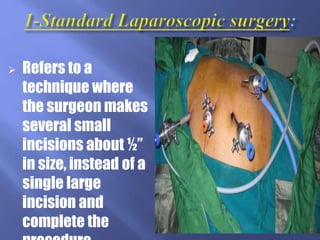
 Refers to a
technique where
the surgeon makes
several small
incisions about ½”
in size, instead of a
single large
incision and
complete the
 Is used to describe a procedure that is
performed largely laparoscopically and then
completed through a small abdominal incision.
 Many “laparoscopic” procedures are actually
laparoscopic-assisted because some part of the
operation may be performed through the
specimen-removal incision.
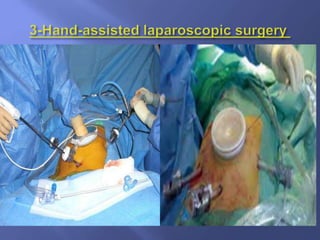
 Refers to another variation of laparoscopic surgery in which
a device is placed in a small (2-3 inch) incision that allows the
surgeon to pass a hand into the abdomen to assist in
performing the operation. The surgeon still uses the
laparoscope to view the operation on monitors and uses the
same instruments, staplers and energy devices as in
traditional laparoscopic surgery. The specimen is removed
through the device used by the surgeon to place a hand in
the abdomen.
 The main advantage of this procedure is that the ability to
use the surgeon’s hand may be very helpful in performing
the operation.
 The disadvantage is that the incision required might be
slightly larger than would otherwise be necessary. Studies
have shown hand-assisted techniques to provide the same
recovery benefits as purely laparoscopic procedures.
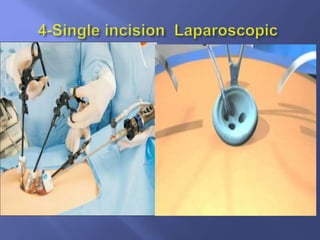
 Is another minimally invasive option. With this
technique, both the laparoscopic camera and the
operating instruments are passed through a single,
small incision (about 2 inches in length) that can also be
used to remove the specimen.
 The primary advantage of this technique is less visible
scarring since no additional small trocar incisions are
necessary.
 The disadvantage is that most surgeons find this
technique more difficult than traditional laparoscopic
surgery because the instruments are placed so closely
together
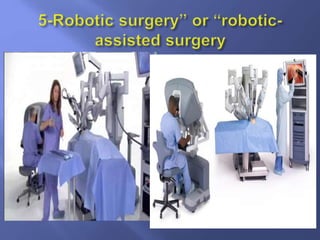
 Is a newer variation on minimally invasive colon and rectal
surgery.
 The technique is very similar to standard laparoscopic surgery
in that instruments are passed into the abdomen through
trocars.
 Rather than manipulate the instruments manually, the surgeon
sits at a console, or special computer desk, and manipulates
small controllers while observing the inside of the abdomen with
a 3-D monitor.
 A sophisticated computer system translates the movements of
the surgeon’s hands to the robot, which then moves the surgical
instruments.
 Robotic surgery is gaining popularity primarily for
rectal operations because the robotic instruments
are well suited to operating in the pelvis where
laparoscopic surgery is more difficult..
 Potential advantages:include better visibility and
greater ability to perform minimally invasive
procedures on the rectum.
 Disadvantages: include the high cost of the robot,
1. Hemicolectomy ( right and left
).
2. Anterior (sigmoid) and low
anterior (sigmoid and rectum)
resections
3. Abdominal-perineal resection
(laparoscopic-assisted)
4. Primary anastomosis
(laparoscopic-assisted and totally
intraperitoneal)
5. Creation of colostomy and
 The most obvious is diagnosis of colonic
cancer
 The same principle is applied to
resection of polyp not amendable for
colonoscopic removal. Similar principle
may also apply in event of syndromes
such as (HNPCC)and ( FAP ),
 patient with ulcerative colitis with either
high or low -grade dysplasia should be
The main relative contra indication to
laparoscopic colonic resections are :
1-Intestinal obstruction
2-Tumor bulky size
3-Tumor invasive into adjacent organs.
4-Pregnancy
5-The obesity and previous surgery
increase risk of conversion to open
surgery, but is not a contraindication to
1.Limited abdominal wall trauma
2.Reduced postoperative pain
3.Possible more rapid return of bowel function
4.Possible reduced length of hospital stay
5.Possible hastened postoperative recovery
6.Similar staging opportunities compared with open
procedures
7.Short-term outcomes similar to traditional procedures
8.Possible protection of immune function
9.Decreased postoperative Ileus
10.Fewer pulmonary complications;
11.Improved cosmoses
1. Tumor spillage secondary to
manipulation
2. Disbursement of cells secondary to
carbon dioxide pneumoperitoneum
3. Mechanical disruption of peritoneum
4. Entrapment of tumor cells secondary to
 Full intra-abdominal assessment
 Identification and confirmation of
visceral metastases
 Full mesenteric and nodal dissection
 Adequate margins of resection
(longitudinal and radial)
1. Reduced ability to explore peritoneum
2. Reduced ability to palpate and localize
colonic lesion
3. Mechanical manipulation of tumor leading to
cellular disbursement
4. Increased operating room time and cost
5. Possibility of port-site tumor seeding
6. Possible detrimental effects of conversion to
I- Tumor localization:
When approaching colon resection
laparoscopically, every effort should be made to
localize the tumor preoperatively. Small lesions
should be marked endoscopically with
permanent tattoos before surgery to maximize
the surgeon’s ability to identify the lesion.
Surgeons should be prepared to use
colonoscopy intraoperatively if lesion localization
is uncertain.
II-Diagnostic evaluation for metastases:
III-Preparation for operation:
The preoperative mechanical bowel
preparation be used to facilitate manipulation
of the bowel during the laparoscopic
approach and to facilitate intraoperative
colonoscopy when needed
IV-Surgical Technique :
The laparoscopic resection must follow
standard oncologic principles: proximal ligation
of the primary arterial supply to the segment
harboring the cancer, appropriate proximal and
distal margins, and adequate
lymphadenectomy.
V-Contiguous Organ Attachment:
For locally advanced adherent colon and
VI- Obstructing Colon Cancer (Right-sided):
The patients with an obstructing right or transverse colon
cancer is recommended to undergo a right or extended right
colectomy. The open approach is required if the laparoscopic
approach will not result in an oncologically sound resection.
VII-Obstructing Colon Cancer (Left-sided):
For patients with an obstructing left-sided colon cancer, the
procedure must be individualized according to clinical factors.
Colonic stenting may increase the likelihood of completing a
one-stage procedure and may decrease the likelihood of an end
colostomy.
VIII-Prevention of Wound Complications:
The use of a wound protector at the extraction site and the
irrigation of port sites and extraction site incisions may reduce
abdominal wall cancer recurrences.
IX-Training and Experience:
Before surgeons apply the laparoscopic approach
for the resection of curable colon and rectal
cancer, they must have adequate knowledge,
training, and experience in laparoscopic
techniques and oncologic principles.

Laparoscopy and colonic cancer

  • 1.
    Prepared by :Dr. Albino Amum Awin Student of Master Degree of General Surgery Alexandria University, Surgical Oncology Unit, 2017
  • 2.
    INTRODUCTION :  Laparoscopiccolonic surgery has been performed for a number of years and is widely accepted in the medical community as an alternative for procedures involving benign disease.  For malignant disease, recent studies have shown equal or better oncologic results, favoring the laparoscopic approach, especially
  • 3.
    1. Standard laparoscopic surgery 2.Laparoscopic assisted surgery 3. Hand assisted Laparoscopic surgery
  • 4.
     Refers toa technique where the surgeon makes several small incisions about ½” in size, instead of a single large incision and complete the
  • 5.
     Is usedto describe a procedure that is performed largely laparoscopically and then completed through a small abdominal incision.  Many “laparoscopic” procedures are actually laparoscopic-assisted because some part of the operation may be performed through the specimen-removal incision.
  • 6.
     Refers toanother variation of laparoscopic surgery in which a device is placed in a small (2-3 inch) incision that allows the surgeon to pass a hand into the abdomen to assist in performing the operation. The surgeon still uses the laparoscope to view the operation on monitors and uses the same instruments, staplers and energy devices as in traditional laparoscopic surgery. The specimen is removed through the device used by the surgeon to place a hand in the abdomen.  The main advantage of this procedure is that the ability to use the surgeon’s hand may be very helpful in performing the operation.  The disadvantage is that the incision required might be slightly larger than would otherwise be necessary. Studies have shown hand-assisted techniques to provide the same recovery benefits as purely laparoscopic procedures.
  • 8.
     Is anotherminimally invasive option. With this technique, both the laparoscopic camera and the operating instruments are passed through a single, small incision (about 2 inches in length) that can also be used to remove the specimen.  The primary advantage of this technique is less visible scarring since no additional small trocar incisions are necessary.  The disadvantage is that most surgeons find this technique more difficult than traditional laparoscopic surgery because the instruments are placed so closely together
  • 10.
     Is anewer variation on minimally invasive colon and rectal surgery.  The technique is very similar to standard laparoscopic surgery in that instruments are passed into the abdomen through trocars.  Rather than manipulate the instruments manually, the surgeon sits at a console, or special computer desk, and manipulates small controllers while observing the inside of the abdomen with a 3-D monitor.  A sophisticated computer system translates the movements of the surgeon’s hands to the robot, which then moves the surgical instruments.
  • 11.
     Robotic surgeryis gaining popularity primarily for rectal operations because the robotic instruments are well suited to operating in the pelvis where laparoscopic surgery is more difficult..  Potential advantages:include better visibility and greater ability to perform minimally invasive procedures on the rectum.  Disadvantages: include the high cost of the robot,
  • 13.
    1. Hemicolectomy (right and left ). 2. Anterior (sigmoid) and low anterior (sigmoid and rectum) resections 3. Abdominal-perineal resection (laparoscopic-assisted) 4. Primary anastomosis (laparoscopic-assisted and totally intraperitoneal) 5. Creation of colostomy and
  • 14.
     The mostobvious is diagnosis of colonic cancer  The same principle is applied to resection of polyp not amendable for colonoscopic removal. Similar principle may also apply in event of syndromes such as (HNPCC)and ( FAP ),  patient with ulcerative colitis with either high or low -grade dysplasia should be
  • 15.
    The main relativecontra indication to laparoscopic colonic resections are : 1-Intestinal obstruction 2-Tumor bulky size 3-Tumor invasive into adjacent organs. 4-Pregnancy 5-The obesity and previous surgery increase risk of conversion to open surgery, but is not a contraindication to
  • 16.
    1.Limited abdominal walltrauma 2.Reduced postoperative pain 3.Possible more rapid return of bowel function 4.Possible reduced length of hospital stay 5.Possible hastened postoperative recovery 6.Similar staging opportunities compared with open procedures 7.Short-term outcomes similar to traditional procedures 8.Possible protection of immune function 9.Decreased postoperative Ileus 10.Fewer pulmonary complications; 11.Improved cosmoses
  • 17.
    1. Tumor spillagesecondary to manipulation 2. Disbursement of cells secondary to carbon dioxide pneumoperitoneum 3. Mechanical disruption of peritoneum 4. Entrapment of tumor cells secondary to
  • 18.
     Full intra-abdominalassessment  Identification and confirmation of visceral metastases  Full mesenteric and nodal dissection  Adequate margins of resection (longitudinal and radial)
  • 19.
    1. Reduced abilityto explore peritoneum 2. Reduced ability to palpate and localize colonic lesion 3. Mechanical manipulation of tumor leading to cellular disbursement 4. Increased operating room time and cost 5. Possibility of port-site tumor seeding 6. Possible detrimental effects of conversion to
  • 20.
    I- Tumor localization: Whenapproaching colon resection laparoscopically, every effort should be made to localize the tumor preoperatively. Small lesions should be marked endoscopically with permanent tattoos before surgery to maximize the surgeon’s ability to identify the lesion. Surgeons should be prepared to use colonoscopy intraoperatively if lesion localization is uncertain. II-Diagnostic evaluation for metastases:
  • 21.
    III-Preparation for operation: Thepreoperative mechanical bowel preparation be used to facilitate manipulation of the bowel during the laparoscopic approach and to facilitate intraoperative colonoscopy when needed IV-Surgical Technique : The laparoscopic resection must follow standard oncologic principles: proximal ligation of the primary arterial supply to the segment harboring the cancer, appropriate proximal and distal margins, and adequate lymphadenectomy. V-Contiguous Organ Attachment: For locally advanced adherent colon and
  • 22.
    VI- Obstructing ColonCancer (Right-sided): The patients with an obstructing right or transverse colon cancer is recommended to undergo a right or extended right colectomy. The open approach is required if the laparoscopic approach will not result in an oncologically sound resection. VII-Obstructing Colon Cancer (Left-sided): For patients with an obstructing left-sided colon cancer, the procedure must be individualized according to clinical factors. Colonic stenting may increase the likelihood of completing a one-stage procedure and may decrease the likelihood of an end colostomy. VIII-Prevention of Wound Complications: The use of a wound protector at the extraction site and the irrigation of port sites and extraction site incisions may reduce abdominal wall cancer recurrences.
  • 23.
    IX-Training and Experience: Beforesurgeons apply the laparoscopic approach for the resection of curable colon and rectal cancer, they must have adequate knowledge, training, and experience in laparoscopic techniques and oncologic principles.